



Abstract
This article is the second part of a study devoted to the sociology of tomb robberies at the end of the 20th Dynasty and focuses on the organization of the thieves into bands. These structures were relatively stable. Leadership was inconstant and associated with unequal loot sharing and conflict. Households, including enslaved people, played an important role in band organization particularly among tomb robbers, while hierarchy and patronage with corruption and blackmailing characterized temple thefts. Another social pattern relying on equality, solidarity, and merit existed among tomb robbers of an equal social status and probably corresponds to what ancient Egyptians called wnḏw. How these patterns of sociability are representative of the society of the time is discussed.

Introduction
This article is the second of a series on the social aspects of tomb and temple robberies recorded at the end of the 20th Dynasty in the so-called Tomb Robberies papyri. A first analysis 1 showed that with the exception of workmen from Deir el-Medina, tomb robbers were of a lower social status than temple robbers, consisting mostly of craftsmen originating from the east bank, whereas temple robbers were mostly priests and staff members of the temple they robbed. Another dichotomy appeared as thefts were investigated before or during the Renaissance. Before the Renaissance, robbers were mostly specialists exercising professional skills for what they looted, whereas post-Renaissance, people without suitable professions frequently committed the thefts. Finally, those who robbed the institution they pertained to, although transgressing taboo, generally respected its most sacred parts, whereas robbers foreign to them did not. Here we analyse the social organization of the bands of thieves with the eventual discussion of whether this may tell us something of the society of the time.
Material and Methods
The material and methods used in this study have been extensively described in the first article of this series. To recapitulate briefly: a database was used containing 298 individuals involved in tomb robberies, 92 in temple thefts, and three in both. The ancient Egyptian terminology calls all of these people ỉṯȝyw. However, we also distinguished between robbers proper and accomplices, fences, blackmailers, suspects, and witnesses. Women represent 9.3% of this population. Statistics used the Chi-2 test and the Fisher exact test for comparison of categorical variables and the ANOVA test for quantitative ones. A p value of < 0.05 indicated significance; marginal significance was p ≥ 0.05 and < 0.10. Social network analysis 2 was used to graphically represent inter-individual relationships and provide quantitative indices for the identification of important players in the network including the Eigenvector centrality, which measures influence in a network for being connected to other well-connected actors, and betweenness centrality, which identifies actors bridging players. Here the two values gave similar results. The bands of thieves are detailed in the Appendix. Finally, we used the traditional chronology for the end of the 20th Dynasty for reasons explained in part I.
Terminology Designating Bands of Robbers and Their Hierarchy
The most interesting term is  , wnḏw. In P. Amherst-Leopold II,
3
a thief states that: ỉw rḫ.tw ʿšȝ.t n rmṯ.w n pȝ tȝ ỉṯȝy ỉm.w m mt.t ỉw.w m wnḏw sp-sn, ‘it is known that a multitude of people of the land robbed among them [the tombs] likewise being as wnḏw’, with sp-sn stressing on the word.
4
In P. BM EA10052, in a lacuna context, a robber declares: ‘whether the… me alone or a wnḏw’,
5
rhetorically opposing robbing collectively and alone. Although the thieves’ declarations are probably not verbatim (see part I), the context suggests that wnḏw was actually used by the robbers and not put in their mouth by the investigators. The use of wnḏw corroborates evidence showing that robbers formed bands, probably because tomb plundering needed a combination of specialized skills and robbing temples attended by many people was impossible for a single man. The same thief of P. Amherst-Leopold II adds that he went about robbing with his accomplices for several years,
6
showing that wnḏw were relatively long-lasting structures, although subgroups might form within a band and dissolve according to opportunities.
, wnḏw. In P. Amherst-Leopold II,
3
a thief states that: ỉw rḫ.tw ʿšȝ.t n rmṯ.w n pȝ tȝ ỉṯȝy ỉm.w m mt.t ỉw.w m wnḏw sp-sn, ‘it is known that a multitude of people of the land robbed among them [the tombs] likewise being as wnḏw’, with sp-sn stressing on the word.
4
In P. BM EA10052, in a lacuna context, a robber declares: ‘whether the… me alone or a wnḏw’,
5
rhetorically opposing robbing collectively and alone. Although the thieves’ declarations are probably not verbatim (see part I), the context suggests that wnḏw was actually used by the robbers and not put in their mouth by the investigators. The use of wnḏw corroborates evidence showing that robbers formed bands, probably because tomb plundering needed a combination of specialized skills and robbing temples attended by many people was impossible for a single man. The same thief of P. Amherst-Leopold II adds that he went about robbing with his accomplices for several years,
6
showing that wnḏw were relatively long-lasting structures, although subgroups might form within a band and dissolve according to opportunities.
Wnḏw probably carries more than the neutral meaning of ‘herd/group of people’ etymologically derived from wnḏw ‘cattle’. 7 This rare word mostly appears in religious, official, and wisdom texts to designate a collectivity of humans but with differences concerning the fundamental purpose of this collectivity according to the context. In chapter 1 of the Book of the Dead, the deceased declares n.wỉ wnḏw.k Wsỉr, ‘I belong to your wnḏw, Osiris’, and the same with Horus 8 to indicate that he is among the gods’ followers. The Abydos stela of Neferhotep I distinguishes wnḏw and mr.wt among the personnel adoring Osiris in his temple, 9 and Seti I states that the gold transporters of his Abydean sanctuary are m msw n ḥw.t.ỉ ỉm wnḏw n r-pr.ỉ ‘among the children of my temple, within the wnḏw of my sanctuary’. 10 Thus, wnḏw includes temple staff members who are not priests but, more importantly, distinguishes them from dependent people liable to a corvée (mr.wt). 11
The use of wnḏw is not limited to an Osirian context. In a letter from the 21st Dynasty, wnḏw designates a group of people exercising the same occupation. 12 In a professional context, the scribe of P. Anastasi I describes himself as tp ỉry.w.f ḥȝt ỉm wnḏw.f, ‘first of his comrades, foremost of his wnḏw’, to which a variant interestingly adds m-ẖn mhw.t.f, ‘in his family/tribe’. 13 Thus wnḏw may designate a group of professional peers, with a sense of belonging to a tribe or a family. The same connotation melding familial links and the notion of a collectivity of worthy people a good man wishes to belong to is exemplified by another passage of the same text, in which, to demonstrate his probity, the scribe declares he will be buried at Abydos in his father’s tomb and adds: ḳrs.tw.ỉ m wnḏw m ḏw tȝ ḏsr.t (‘I shall be buried among wnḏw in the sacred mountain’). 14 Wnḏw as designating a community of dead among whom a person of good standing might expect to be buried similarly appears in the Decree of Nesikhons, in which Amon-Ra decides ỉw.ỉ dỉ.t šsp st nȝ nty <m> wnḏw nb m ẖr.t-nṯr m šsp nfr (‘I will make that all those who are <in/as> any wnḏw will receive her in the Necropolis in good reception’). 15 Finally, the importance of wnḏw as a structure particularly worthy of respect is demonstrated by its second position in the list of negative confessions of Chapter 125 of the Book of the Dead in which the deceased declares n smȝr.ỉ wnḏw (‘I have not penalized wnḏw’). To conclude, the best translation of wnḏw is probably ‘community’, to designate a human collectivity sharing socially meaningful motives and values.
In other instances, the Tomb Robberies papyri use the factual collective tȝ rmṯ or tȝ rmṯ n ỉṯȝy.w (group of men or group of robbers) to designate the bands, 16 while both investigators 17 and thieves 18 refer to partners with the usual ỉry (comrade, colleague, or companion) and use ỉry n. ṯtṯt (opponent) when conflict arises. 19 In any case, none of the words designating bands of robbers have a specific criminal connotation.
Hierarchy among thieves is seldom mentioned. On one occasion the investigators indicate that a robber and his brother were the leaders, saying they ḥn r-ḥat, ‘went at [their] head’. 20 As we have seen, a similar expression is used in P. Anastasi I to indicate that the scribe is ḥȝt ỉmy wnḏw.f, ‘the foremost of his wnḏw’. 21 The situation in P. BM EA10052 6.20–23 22 can be interpreted in two different ways. A robber tells how he went to the Valley of the Queens with his accomplices and adds: ỉw Pȝ-wr-ỉḫtf r-ḥȝt=n, ‘while Pawerikhtef was at our head’. Here, r-ḥȝt may simply describe a factual situation: Pawerikhtef, a tomb workman, 23 who knew where the tomb lay, guided the robbers and logically probably walked at their head. But as, in this band, the man who showed the way to the tomb received a double share, 24 r-ḥȝt might also indicate at the same time Pawerikhtef’s precedence over his accomplices. 25 In contrast, when in P. BM EA10053, Vs 7.12 a troop commander and blackmailer is said to be the superior (ḥry) of robbers, it probably means that he was their hierarchical superior in the temple organization according to the usual meaning of the word, rather than the band leader. Thus, what ancient terminology suggests is that thieves formed communities sharing different social commonalities and values, among which hierarchy was not the crucial point, even if leaders or distinguished people might emerge among peers.
The Bands
The analysis was conducted with 279 individuals who could be ascribed to one of the eight bands of ỉṯȝy.w involved in tomb and temple robberies 26 for which we have enough information (see table 1 and the Appendix). These people had 518 identified inter-individual links. A ‘link’ corresponds to a direct relationship between two ỉṯȝy.w identifiable in the texts, whatever its nature. Evidently, detailed declarations as in P. BM EA10052 provide more information than concise ones as in P. Amherst-Leopold II, P. BM EA10053, P. BM EA10054, and P. Mayer A and this should be taken into account when analysing the results.
Band characteristics. Date: date of investigation. Band organization is according to the texts. Band leader designated or not. Hierarchy: influence of hierarchy of the structure embedding the band. Empty boxes: no information. None: not mentioned. R: Ramesses. Ren: Renaissance. Y: year. RP: robbers proper. A: accomplices. F: fences. %: % of links. * Result limited to a subgroup.
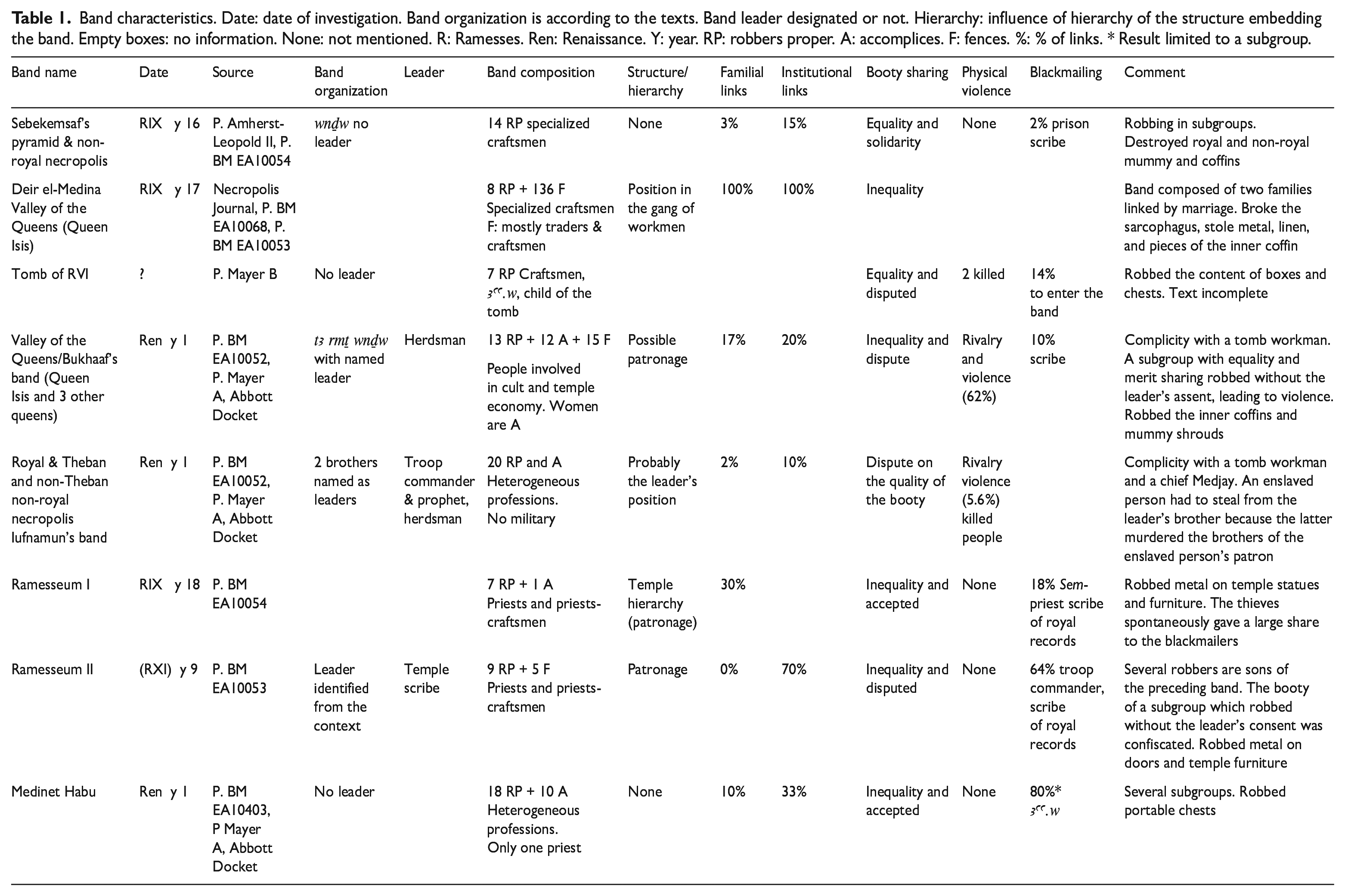
Two categories of consistently recorded links could be analysed with confidence: familial relationship and booty sharing. An analysis of the affiliated institutions is less compelling since these are not always mentioned. The following categories of sharing were considered: egalitarian and accepted (shares are equal and the thieves agree), unequal and accepted (shares are unequal with the agreement of all), conflictual (the amount of share or its quality is contested or a share is confiscated by others, sometimes violently), and shares obtained by extortion or blackmailing. The results are summarized in table 1.
Among the eight identified bands, the pattern of organization was far from unique and appears independent of whether thieves robbed temples or tombs, or were investigated before or during the Renaissance. Only three bands had an identified leader. 27 Of the two wnḏw mentioned in the corpus, only one had a leader in keeping with what was seen previously. However, two of the eight bands stand apart. The first one, which robbed Sebekemsaf’s pyramid, consisted of craftsmen gathered for their complementary skills who manoeuvred in smaller formations according to the circumstances. Due to the importance of professionalism in the formation of this band, familial links played a secondary role. Pertaining to the same institution was not a major factor, although a core subgroup of the band came from the temple of Amun. This band probably had other points of sociability to facilitate member meeting and contact. 28 An important characteristic is booty sharing, which was totally equitable. Moreover, solidarity was a strong bond: when a partner was deprived of his share, his colleagues compensated his loss. 29 This explains the longevity of the band, which stayed together for several years. 30 An equal division of booty apparently occurred with the thieves who robbed Ramesses VI’s tomb, 31 although one member used menace to enter the band. 32 This band which, as far as we know, had no leader was similarly composed of low-status people.
The band of Deir el-Medina also shows specific features. It is the only one totally composed of family members originating from a single institution. The particular organization of the tomb is the probable reason. The men in charge of the construction of the royal sepulchres where probably among the rare group of people who may have had access to the royal wadis. They lived in a settlement specifically assigned to them and their family and they followed a strong tradition of intra-familial transmission of the function. 33 Thus, in a community where everybody could know what his neighbour was doing, family offered the best warranty for discretion and security. Another interesting feature is that loot sharing probably took into account the traditional precedence of fathers over sons, but also hierarchical position in the tomb workforce (see Appendix).
Unequal loot sharing was the most frequent situation, whether there was an identified leader or not. The reasons vary. It was a case of merit with the man who showed the way to the tomb receiving a double share with the agreement of his comrades (Bukhaaf’s band). 34 In two other bands, although without a designated leader, it was because thieves who considered themselves prominent players requested a larger share (Ramesseum I 35 and Medinet Habu 36 ).
How and why band leaders appeared is unclear. It did not depend on whether a tomb or a temple was robbed. In two cases the prominent positions of scribe and troop commander probably explain leadership 37 but the third one was a simple herdsman. 38 Possibly, his skill in networking with people of higher status gave him precedence (see Appendix). Being the leader of a band was not straightforward: in all known examples, the leader’s authority was contested. In two cases he was compelled to sanction his subordinates for robbing without referring to him, thereby impeding his control of the loot (Ramesseum II 39 and Bukhaaf’s band 40 ). The result was a division between those who supported the leader and the others. In the last case a plot was hatched against the leader’s brother, probably in retaliation for the leader’s violent behaviour (Iufnamun’s band). 41 In the three cases, booty sharing was contested, leading sometimes to violence, which is not mentioned in bands without leaders.
Other than for the band from Deir el-Medina, familial links were decisive for band formation, probably because kinship offered trust, confidentiality, and security. Familial ties are more frequent among robbers and accomplices than among the other ỉṯȝy.w (62/321, 19% versus 11/197, 6%: p <0.01%). The most frequent relationship is that between fathers and sons (41% of cases), followed by siblings (27%), and spouses (20%). The authorities were fully aware of this, since they regularly questioned children or wives to get information. 42 Women are involved in 30% of familial links. They played a crucial role in specific stages, in particular by concealing in the house their husband’s share and the stones or pieces of wood used for the sharing and kept in case of litigation, as evidence of what fell to each accomplice. 43 They might also interfere with the sharing when they felt deprived of their right, opening the way to violence in the band (Bukhaaf’s band 44 ). In contrast, belonging to the same institution does not distinguish robbers and accomplices from other ỉṯȝy.w, indicating that this was probably not a factor in band cohesion (40/314, 13% versus 24/204, 12%, non-significant).
Another important group of players is the blackmailers. Numbering thirteen men, they affected six out of eight bands and sometimes impacted inter-individual relationships. A variety of situations occurred. The most frequent (7/13 blackmailers and 3/8 bands) happened when the crooks saw or heard that a theft was ongoing, which allowed them to extort a part of the booty, supposedly in exchange for their silence (see Appendix). In other cases, the situation lay at the border of corruption and blackmailing. It is sometimes difficult to decide which prevailed without precise context, such as when an arrested thief purchased his freedom by abandoning his share to the prison scribe. 45 More interesting is the situation of the Ramesseum bands. Thieves were repeatedly compelled to transfer a substantial part of the booty to temple authorities, including a sem-priest, a troop commander, and a scribe of the divine records, who clearly threatened to report them to the high priest of Amun. 46 Blackmailing was in all cases a position of power exerted over robbers by individuals external to the band. 47 It resulted from the impossibility of keeping robberies secret, particularly in temples, and implied that a low proportion of people (6% of ỉṯȝy.w) aware of what was occurring took advantage of their position.
Two occupations were significantly overrepresented among blackmailers, 48 namely scribes (3/13, 23%, compared to the fact that scribes made up only 4% of the bands, 7/162, 4%: p<0.05) and foreigners (4/13, 31% versus 14/162, 9%: p<0.05), and there was a marginally significant overrepresentation of subaltern administrators (3/13, 23% versus 11/162, 18% p=0.07). 49 The presence of scribes is certainly explained by their powerful position, which gave them easy access to the highest authorities, their most efficacious weapon for blackmailing. The same probably explains administrators. In contrast, foreigners (ȝʿʿ.w) are unexpected. 50 They appear under Ramesses XI with the arrival at Thebes of the King’s Son of Kush Panehsy and probably formed his Nubian troops. Some were settled on fields at the south of Thebes. 51 In the dossier, we find them as cultivators, soldiers, bakers, 52 and even a prophet of a temple of Sobek, 53 but more frequently without specification. As occupation troops, perhaps they took advantage of their power to racketeer the thieves. 54
Discussion
Here we will focus on points not yet discussed. The first issue concerns the use of ‘band’ and not ‘gang’ to designate groups of robbers. In our modern terminology, gangs are well-structured collectivities following regularized rules, with differentiated roles among members and placing primary importance on group survival. 55 Clearly, ancient Egyptian robbers were less structured, prompt to denounce colleagues, and their leaders faced difficulties in affirming their authority, showing that regularized rules were seldom accepted, hence the use of the term ‘band’.
Another point of discussion is the criminal nature of the activities undertaken by the groups concerned here. Post-internment interventions were commonplace in ancient Egyptian tombs, resulting in a fragmentation and a rearrangement of the initial burials to accommodate newcomers, whether they were descendants of the initial owner or of a different origin. 56 Accidental tomb collision was another common cause of these rearrangements. Despite the frequent reappropriation of a part of the initial grave goods, including coffins, 57 these rearrangements did not exclude respect toward the dead, 58 though they were a source of conflict between claimants to ownership of the tomb and thereby to the right to rearrange the burial. 59 In the known cases, the court which arbitrated the conflicts did not sanction the rearrangement itself, but the right to do it, 60 showing that this behaviour was not considered intrinsically deviant.
The activities concerned here are of a different nature. The context of the Great Tomb Robberies is clearly that of such serious and reprehensible acts that they needed to be investigated by the highest authorities and exposed the culprits to a death sentence. The Abbott papyrus uses the verb thi to qualify what the accused did against royal and non-royal tombs, 61 a term which basically signifies ‘going against’ someone or something with the connotation of wrongdoing, so that its primary meaning is to transgress or violate. 62 The investigated people were well aware of the transgressive nature of their acts and that they were exposing themselves to the risk of a death sentence. 63 Thus, their behaviour was not the result of a more or less conscious shift from a tolerated and even recognized behaviour toward tombs, but a conscious transgression of a social taboo. 64
This brings us to the question of what bands tell us about Ramesside society as a whole. One could argue that the disarray of the times marked by an economic crisis would have deeply altered social structures by pushing people to transgressive behaviours, such that the bands of thieves cannot be considered representative of the ‘normal’ society. To address the issue, several counterarguments can be put forth. First, an important part of the western Theban population (perhaps 15 to 20%, and possibly more) 65 was implicated in the robberies, so that it is unlikely that all of the thieves easily abandoned the principles of their society to join bands governed by a completely different set of rules. Second, the absence of a universal definition of modern gangs because of their different sociocultural background indirectly demonstrates the weight of the society in which gangs develop. 66 In addition, a modern gang feature is their ability to evolve with changes affecting their society, confirming that gangs wholly reflect this society. 67 Things were probably similar in ancient Egypt.
Households and patronage are currently viewed as the main axes structuring ancient Egyptian society. At the ‘horizontal’ level, 68 households collect people forming the headman’s nuclear family, his kinship, enslaved people, and dependants. 69 Hence, a household is an economic unit contributing to the wealth of all and hierarchically structured by the function of its members. It may be crossed by dissensions, since land and house were frequently collectively inherited between siblings. 70 Patronage is the ‘vertical’ axis, as any household depends, for its survival, on a man of higher status, or supports the household of a poorer one. 71 Asymmetrical reciprocity is the principle of patronage. 72 The patron protects his dependants in exchange for loyalty. In this way patronage crosses society from top to bottom and adds a stratum of power inextricably interwoven with that of the state, whose highest servants were themselves patrons. 73 However, patronage may deviate from the ideal when the patron behaves abusively to keep his dependant under control. This is what Eyre calls corruption. 74
That bands followed at least one of the two axes is demonstrated by a number of examples, particularly in the case of households. The prominent role of familial links, including siblings and spouses over two and sometime three generations, 75 has already been stressed. Household is also present in the participation of enslaved people (sometimes bought with the booty) in supporting or witnessing the crimes of their patron. The detailed declarations of Bukhaaf’s band amply show how the house was a sheltering place for preparing thefts, 76 receiving accomplices or fences, 77 and sharing and concealing the booty. 78 Households were the place to find support when conflicts arose among partners. 79 They were also the place where familial dissent broke out, such as, for example, with the father, probably the head of the household, who expelled his son-in-law because he disagreed with the theft. 80
Patronage is less apparent because there is no specific word to designate the patron. However, we may suspect its presence with the priests who robbed the Ramesseum, who were compelled to transfer a part of the booty to the scribe of royal records, the sem-priest, and the troop commander of that temple, their administrative superiors whose role, tarnished by corruption, is clearly a diversion of that of patron. With tomb robbers, patronage is particularly difficult to identify because bands collected people from different backgrounds without hierarchical links. However, a probable case is the overseer of fields of the House of Amun, Akhmin, who was likely the patron of the herdsman Bukhaaf of that House. Bukhaaf and one of his partners bought a jar of wine with honey before going to his dwelling, the kind of behaviour we expect from a dependant eager to obtain his patron’s goodwill, 81 here with the intention to purchase land. 82 Once more, the context is that of hierarchy among people from the same institution.
When Akhmin was interrogated by the court, he was only requested to give the money back. 83 Similarly, the Ramesseum patrons were apparently not summoned before the court. The scribe of royal records and the sem-priest stayed in place several years to reappear in later documents. 84 Patrons, if these men should be seen as such, were not considered by the authorities as being directly implicated. Whether this was a conscious decision to spare them owing to their status or because, from the ancient Egyptian point of view, they did not commit a crime is open to discussion.
What robbers also tell us is that inter-individual relationships frequently escaped the frame of household and patronage. This is best exemplified by fences and especially those of the band of Deir el-Medina, who show the extent of the relationship robbers could develop far beyond their family, patron, colleagues, or institution. Unfortunately, how fences and robbers came into contact remains mostly unknown to us. 85
Finally, there is another and unexpected mode of sociability that bands illustrate, that of equality, solidarity, and recognition of merit. This mode develops outside the protection of households since the persons concerned with it seldom have familial links. Interestingly, the known cases never concerned temple robberies, where patronage and hierarchy predominated. It is the appanage of people of the same social rank, mostly craftsmen, sometimes of the same institution. Although this sociability is not without conflict, out of the five bands on which we have information, it appears with two of them and with a subgroup of a third one. This shows that it is not rare. It goes hand in hand with the absence of a leader and, interestingly, is qualified in one case as wnḏw, which probably designates a community of peers sharing the same social values. Whether this sociability was informal and developed according to circumstances or was a regular and structured mode of collective relationship is unknown. It would be worth analysing the documentation to find traces of that sociability of peers.
In conclusion, the corpus of the Great Tomb Robberies sheds light on a part of the ancient Egyptian society which otherwise left few traces. The context in which these people evolved is certainly particular, but any socio-economic crisis inevitably tells us something about the society in which it occurs.
Footnotes
Appendix
Here, we will summarize the data concerning the eight identified bands, including social network analysis.
Acknowledgements
The author expresses his grateful thanks to the reviewers of the JEA for improving this article by their remarks and suggestions.
Funding
The author did not receive funding for this project.
3.
P. Amherst-Leopold II, 3.6–7.
4.
Capart, et al. 1936: 181.
5.
6.
Three or four years in 1.15–16.
7.
Wb I: 326 gives: ‘Leute, Angehörige jemds, Bewohner eines Ortes’; Faulkner 1962: 63: ‘associates’;  , I: 103–104: ‘entities, colleagues, compeers, companions, gangs, human herd’.
8.
Faulkner and Andrews 1972. Lines 8 and 10 in the papyrus of Ani: : 20.
9.
10.
Kanais Inscription C, line 8 (KRI I: 68.10).
11.
On mrw.t: Moreno García 1998; Bakir 1952: 22–29; Janssen 1975: 171–173; Helck 1975; : 112.
12.
14.
P. Anastasi I, 8.6.
15.
16.
P. BM EA10052, 2.1 and 7.3 used by investigators and robbers.
17.
P. BM EA10052, 5.6; P. BM EA10053, Vs 3.6.
18.
P. BM EA10053, Vs 2.11 and 14; P. BM EA10054, Vs 1.9.
19.
P. BM EA10052, 5.9.
20.
P. BM EA10052, 7.11.
21.
P. Anastasi I, 1.3.
22.
Lines 6.22–23 have been restituted in Collier, et al. 2010: 244.
24.
P. BM EA10052, 3.7.
25.
Pawerikhtef requested only a small share to avoid drawing the attention of his colleagues, tomb workmen (6.19), which suggests that he was expected to receive a higher reward. The robber who related the theft insisted on the fact that Pawerikhtef was at their head by saying the phrase twice, as if by stressing Pawerikhtef’s position he hoped to reduce his responsibility, thereby demonstrating Pawerikhtef’s prominence.
26.
The difference to the total number of 298 ỉṯȝy.w corresponds to people who could not be ascribed to a band.
28.
The Island of Amenmope where thieves of different origin met may be one: P. Leopold II-Amherst, 4.6; P. BM EA10054, Rt 1.6; P. BM EA10052, 10.4. I thank the reviewer of the JEA for their suggestion.
29.
P. Amherst-Leopold II, 3.1–4 for Sebekemsaf’s pyramid. P. BM EA10054, Rt 3.6 for non-royal tombs.
30.
P. Amherst-Leopold II, 1.15–16.
31.
P. Mayer B, 12–13.
32.
P. Mayer B, 4–5.
33.
Among others: Valbelle 1995: 1–20.
34.
P. BM EA10052, 3.7. In another case, to remain unnoticed, the man who showed the way to the tomb requested a lower part than the one his comrades intended to give him (6.17–19).
35.
P. BM EA10054, Rt 3.9.
36.
P. BM EA10403, 1.21–27.
37.
Band of the Ramesseum II and Iufnamun’s band.
38.
39.
P. BM EA10053, Vs 3.16.
40.
Bukhaaf’s (P. BM EA10052, 1.8–13) and Shedsukhon’s (3.9–17) depositions probably refer to the same events.
41.
P. BM EA10052, 12.1–6. The leader was probably dead when the plot was hatched, explaining why his brother was targeted.
43.
P. BM EA10052, 3.8 and 6.4.
44.
A woman was stabbed and a robber’s father was threatened with death (P. BM EA10052, 3.14–17 and 6.10).
45.
P. Amherst-Leopold II, 3.4.
46.
P. BM EA10053, Vs 3.12–14.
47.
Sometimes, the nature of the blackmailers’ power over the thieves is not specified. However, they were clearly seen as a menace and the thieves abandoned to them a part of their loot (P BM 10403, 1.27–30).
48.
Calculated after exclusion of fences.
50.
On ʿʿȝ.w: Goedicke 1966; Haring 2005; .
52.
P. Mayer A, 1.12, 5.20, and 13C.12; P. Mayer A, 11.19 and 13B.7 and P. BM EA10052, 8.25; and P. Mayer A, 9.2, respectively.
53.
The foreigner Panehsi was Prophet of Sobek of Piankh: Abbott Dockets, A16, B16; P. BM EA10052, 11.4; P. Mayer A, 1.12; 5. 20 and 13C.12.
54.
P. BM 10403, 1.27–30.
56.
Cooney 2011 and .
60.
See, for example, the dispute over the ownership of the tombs of Amenmose and Khaemnun (O. BM EA5624, O. Florence 2621, and P. Berlin P 10496), probably triggered by the expulsion of one of the coffins present in the tomb by one of the plaintiffs. The final conclusion of the court was that all of the parties would swear an oath to not unduly enter the tomb. No sanction was taken regarding the coffin disturbance. Blackman 1925: 176–181; Cooney 2011: 14; and .
61.
P. Abbott, 3.2, 3.16, and 3.18.
63.
64.
: 649–652) distinguishes two different categories of intra-cultural tomb fragmentation: grave robbing proper and secondary deposition. Robberies include thefts committed during the funerals by those who performed the final stage of the burial and thefts occurring after the burial, sometimes performed by organized bands, as is the case here.
69.
Among the abundant literature, see: Müller 2015; Kóthay 2001; .
71.
See particularly: Bardoňová and Nováková 2017; Compagno 2014; Moreno García 2013; Eyre 2011; .
72.
Compagno 2014: 5; : 704.
76.
P. BM EA10052, 3.2–25.
77.
P. BM EA10052, 2.6.
78.
P. BM EA10052, 3.8, 4.21, and 6.6.
79.
P. BM EA10052, 3.14 and 6.10.
80.
P. BM EA10052, 13.17.
81.
P. BM EA10052, 1.19, 2a. 4–6.
82.
P. BM EA10052, 2.19; P. Mayer A, 10.2–8.
83.
P. Mayer A, 10.8. He does not appear in the lists of the culprits of the Abbott Docket and P. Mayer A.
85.
Except for the band of Deir el-Medina, whose fences partly originated from the village.
86.
Davies 1999: 111–113, 171–174, and chart 8; Davies 2017/18; Bierbrier 1975: 54; Demarée and Valbelle 2011: 12; .
87.
Rt 1.1–7.2.
88.
Rt 1.1–8.14.
90.
Černý 1973: 146–147; .
91.
P. Turin 2106/07 (KRI VI: 868) contains the very fragmentary confession of Nakhtmin son of Pentawer.
92.
93.
For linen, the difference depends on the fact that none are listed for Hori, which may be an oversight.
94.
Davies 1999: 242–243. Guardians are listed with workmen in salary distributions and occupied an esteemed position (Valbelle 1985: 100; : 160).
96.
There were fourteen weavers and three sandal-makers.
97.
They may be Theban representatives of Middle Egyptian patrons. Römer 1992: 268–271; Vernus 1993: 73; Allam 1998, : 118.
98.
P. Abbott; P. Amherst-Leopold II; and P. BM EA10054, Vs.
99.
P. Amherst-Leopold II, 3.16–19 and 4.1–4.
100.
P. BM EA10054 Vs 1.4–9.
101.
Namely the ‘Great Places’. P. BM EA10052, 14.10–18. On these men: Thijs 1998 and Gasse 2001. On the fact that their presence in documents more than 25 years apart cannot be used to support Thijs’s hypothesis of a ‘short chronology’, see : 38–44.
102.
P. BM EA10054, Vs 5–6 contains the names of eight further robbers or suspects.
103.
See below.
104.
The thieves are listed in P. Ahmerst-Leopold II, 3.7–16; P. BM EA10054 Vs 1.4–8 and Rt 3.1–4. The boatman Ahutynefer of the Mayor of No appears in P. Ahmerst-Leopold II, 2.4 and 3.15, and the fisherman Panakhtemope in P. BM EA10054, Rt 2.2–3 and 3.5.
105.
P. BM EA10054, Rt 3.5.
106.
P. BM EA10053, Rt 7.15 and P. BM EA10052 14.15.
107.
The coppersmith Pakyhat of the tomb is a receiver of the band of Deir el-Medina: Turin Necropolis Journal of year 17, Vs A.9 and P. BM EA10053, Rt 7.15.
108.
P. Amherst-Leopold II, I.15; P. BM EA10054, Vs I.6 and even longer as this man used to rob in the early years of Ramesses IX (P. Amherst-Leopold II, 1.14).
109.
P. Amherst-Leopold II, 2.5–3.5 for the detailed description of the plundering of Sebekemsaf’s pyramid.
110.
P. BM EA10054, Vs 1.8–9; Rt 1.4–9; Rt 2.8–16.
111.
P. Amherst-Leopold II, 3.7.
112.
P. BM EA10054, Rt 2.13 where three out of seven thieves formed an expedition.
113.
The coppersmiths Pakhyat, Paweresh, and Pentahutnakht were sons of Kadekhtef (P. BM EA10054, Vs 5.7–9). They form only 7.5% of all the links.
114.
P. Amherst-Leopold II, 3.1–4 for Sebekemsaf’s pyramid. P. BM EA10054, Rt 3.6 for non-royal tombs.
115.
P. Amherst-Leopold II, 3.4.
116.
This text was dated by Aldred 1979 to around year 9 of Ramesses IX but it more probably dates to the reign of Ramesses XI (: 25–26).
117.
The coppersmith Pentahutnakht appears in year 16 of Ramesses IX (P. BM EA10054, Rt 3.2 and Vs 5.7) and possibly in the house list of year 12 (of Ramesses XI): P. BM EA10068, Vs 5.10.
118.
P. Mayer B, 3–5.
119.
A robber confessed that a foreigner showed them the tomb and goes on ‘we asked him where is the child of the Tomb who was with you?’ (P. Mayer B, 7–9) as if he was surprised that the child of the tomb was not their guide. On the technical term ms-ḫr designating people originating from Deir el-Medina, see : 117–120.
120.
P. Mayer B, 10–15.
121.
P. Mayer B, 12–14.
123.
P. BM EA10052, 1.16. The queen appears with another name, probably of foreign origin, which is rendered as Habrezet by Peet 1930: 143 and Habadjilat by : 540.
124.
P. Mayer A, 3.23–25. Their identification is difficult.
125.
P. BM EA10052, 6.22–23: Collier, et al. 2010: 243–244.
126.
P. BM EA10052, 1.18 and 5.13; swḥ.t designates the innermost mummy cover (Cooney 2007: 22–24). With a queen, it probably refers to the set of precious metal, sometimes inlaid with precious stones, sewn on the shroud rather than to a mummy board (: n. 89).
127.
P. BM EA10052, 6.22–23. Collier, et al. 2010: 244.
128.
Other commodities include metal vessels (P. BM EA10052, 5.10 and 7.7), linen (7.4), seals of semi-precious stone (6.5, 12, and 13), and a gold object (5.10).
129.
P. BM EA10052, 2.1–14.
130.
Unnamed in P. BM EA10052, 2.27 but probably the goldsmith Ramose accused of melting precious metals in 15.4.
131.
This man is possibly Bukhaaf’s patron. See above.
132.
P. BM EA10052, 12.22–23.
133.
The thieves frequently met in their houses where their enslaved people and spouses were present. P. BM EA10052, 3.2; 3.25; 4.21; 7.4; 13.15–21.
134.
P. BM EA10052, 3.8; 6.6; 13.19–21.
135.
P. BM EA10052, 4.15 and 31; 14.5 and 9; 16.6. P. Mayer A, 4.18. Degay was bought by Bukhaaf with a part of the booty (P. BM EA10052, 2.23).
136.
Seven out of eight for whom the information is available: Amenkha, trumpeter, probably arrested unduly for a matter of homonymy and found innocent (P. BM EA10052, 4.6 and 14); Amenpaytjau, enslaved person, denounced in P. BM EA10052, 4.28–29, interrogated in P. Mayer A, 4.12 and freed in P. Mayer A, 13. B9; Hori/Kadjadja, coppersmith, denounced in P. BM EA10052, 4.31, interrogated and found innocent in 16.1; Pennestawy, butcher, denounced in P. BM EA10052, 4.3, interrogated in P. Mayer A, 3.18 and freed in 13. B10; Paynedjem, attendant (šmsw), interrogated twice and freed (P. BM EA10052 14.1 and 18); Ahutynefer, brandsman, interrogated and freed in P. Mayer A, 4.15–18; Ahutynefer, soldier and foreigner, denounced in P. BM EA10052, 4.27, interrogated and found innocent in 15.21–23; only Khonsumose, sailor, denounced by an accomplice of Bukhaaf, is interrogated in P. BM EA10052 11.20 and P. Mayer A, 8.20, and sent to the king for final decision (P. Mayer A, 12.19).
137.
P. BM EA10052, 2.1 and 7.3.
138.
The robbers’ confessions show frequent discrepancies concerning who participated in the robbery, the number of shares and which tomb was actually targeted, opening the way to different interpretations. This may conceal several thefts or be explained by the fact that the investigations occurred many years after the robberies, so that the robbers’ memories were in part blurred. The scenario presented here is one among several possibilities.
139.
140.
In P. BM EA10052, he is regularly referred to as the son of the singer of the offering table Hori (e.g. 1.12). His title of scorpion charmer appears in P. Mayer A, 3.24.
141.
P. BM EA10052, 6.17–23 (Collier, et al. 2010: 244).
142.
The same individuals appear in the depositions of three members of the group (P. BM EA10052, 3.1–8; 3.22–28; and 6.17–23). Beside Amenkha son of Hori and Pawerikhtef, the trumpeter Parpatjaemope, the foreigner Userhatnakht, the incense roasters Nesamun, also called Tjaybay, and Shedsukhons completed the band. Amenkha, Usirhatnakht, and Pawerikhtef, who were not interrogated despite their role and who do not appear in the lists of ỉṯȝy.w of the Abbott Dockets and P. Mayer A, may have been dead in year 1 of the Renaissance (: 23–25).
143.
P. BM EA10052, 3.7. In fact, Amenkha was informed of the tomb location by Pawerikhtef (6.19). There was probably at least two robberies: the first with Amenkha guided by Pawerikhtef (6.17–23) and the second led by Amenkha and his accomplices but apparently without the participation of Pawerikhtef (3.1–9).
144.
Perpatjaemope/Perpatja. His father Pawero may be Bukhaaf’s receiver (P. Mayer A, 3.7 or P. BM EA10052, 2.10–3.11). Djuthyhotep son of Perpatja, chief porter of the Amun temple, is probably his son. Denounced as a tomb robber (P. BM EA10052, 5.15 and 12.26), Djuthyhotep robbed at Karnak (P. Rochester MAG 51.346.1, A.2–3).
145.
P. BM EA10052, 3.26. In part lacunar. The tomb is a m-ʿḥʿ.
146.
P. BM EA10052, 3.25–28. In 5.7, one of the five thieves confessed robbing a m-ʿḥʿ, which might be different from the one where the booty was hidden, since he was with an accomplice not pertaining to the group of five.
147.
P. BM EA10052, 3.25. Since Amenkha was the brother of Nesmut (see n. 149), Perpatjaemope was visiting the house of his father-in-law.
148.
The incense roasters Shedsukhons and Nesamun called Tjaybay. Perpatjaemope was similarly an employee of the House of Amun.
149.
P. BM EA10052, 6.1–9.
150.
P. BM EA10052, 6.3–6. Her name is lost. She is the wife of one of the five thieves and sister of an Amenkha who can only be Amenkha son of Hori. The booty was shared using five wood marks and the woman under question kept her husband’s share. This is reminiscent of Shedsukhons’s declaration in 3.8–9 in which Nesmut, wife of Perpatjaemope, kept five stones as a mark of the weight of each share. This identification explains the otherwise strange behavior of Nesmut, who denounced the group of five to Bukhaaf (see below). This conclusion contradicts : 163, who suggested she was the wife of an Ankhenkhonsu, but this man was not a member of the group.
151.
P. BM EA10052, 6.1–6. The passage is open to discussion. She joined the group of four robbers asking for herself a part of the loot (‘what shall I eat with you?’, which recalls the fact that ‘bread’ was a slang word to designate the booty: see : 141. Although reviled by the others, her husband accepted the division of the booty into five parts (he asked for five pieces of wood, perhaps to help with the calculation) but in the end the booty was divided into only four parts so that she was excluded from the sharing.
152.
P. BM EA10052, 13.22 and 3.9.
153.
Amenkha son of Muthemhab. He is a ms-ḥm (young enslaved person or born from an enslaved person?) in P. BM EA10052, 2.8. Mutemhab was a singer of the House of Mut (combination of P. BM EA10052, 4.25 and P. Mayer A, 5.13–14) and wife of the goldsmith Ramose, Bukhaaf’s accomplice (P. BM EA10052, 15.4) who was married with four spouses (P. BM EA10052, 15.7). That Ramose was Amenkha’s father is uncertain.
154.
P. BM EA10052, 1.8–10 and 3.10 where her name appears.
155.
P. BM EA10052, 13.22–26. P. BM EA10052, 13.22–26. ‘Mutemwia, wife of Nesamun’ declares that ‘this man’ robbed her father. As Nesamun is the only man mentioned in the deposition beside her father, Nesamun is probably the robber.
156.
Bukhaaf’s deposition (1.8–13) and that of Shedsukhons (3.9–17), one of the five robbers, refers to the same events although they are not identical.
157.
P. BM EA10052, 3.16.
158.
P. BM EA10052, 7.11.
159.
161.
The storekeeper of the temple of Montu of Armant declares ‘Iufnamun was prophet of Montu (…) and I was in the house of Iufnamun’ (P. BM EA10052, 7.12) and ‘I was at Armant when I heard that Iufnamun…’ (12.22–23).
162.
P. BM EA10052, 7.12: wn ʿIwf.n.ʿImn ḥm-nṯr Mntw ỉw pȝ smd.t Pr-Mntw m-dỉ.f. ‘Iufnamun was prophet of Montu while the smd.t people of the House of Montu were in his hand’. Peet 1930: 150 and : 547 translate pȝ smd.t into Pasemdet, seen as a title of Montu or a human member of his temple respectively. Although smd.t is frequently a plural, it is also used as a singular (ex. O. Ashmoleam Museum 293, 3 and O. Černý 13, Rt. 3) to designate the auxiliary personnel of an institution. However, it is a feminine noun. In the context of Iufnamun’s attributions, that pȝ smd.t was an error for tȝ smd.t seems more plausible than the other solutions.
163.
The storemen Iufenmontu (P. BM EA10052, 7.9 and P. Mayer A, 8.21–23; I9.3, 9.10, 12.7) and Djuthyemheb (P. BM EA10052, 12 and P. Mayer A, 9.1 and 12.18).
164.
P. BM EA10052, 12. 2–5. The Wall of the Mighty (ỉnb pȝ pḥty) and the Town of the Stela at the North of Nemty (dmỉ pȝ wḏ mhyt n Nmty). These localities were at the north of Qâw el-Kebir in the tenth nome (Demarée 2014: 138–139), contrary to my initial hypothesis (: 27).
165.
Several other people were denounced but we have no information regarding their role in the thefts.
166.
See n. 163.
167.
Pakhor (P. BM EA10052, 13.1). Accused of having ferried the robbers, he denied it and said he sent his apprentice Nesamun, who confirmed this (13.7–8). In P. Mayer A, 12.20, Pakhor was transferred to the king for final decision, showing that he was considered as Iufnamun’s accomplice (Abbots Docket, B5 where he is said to be ỉrm (with) Iufnamun). Nesamun also appears in P. BM EA10052, 8.15 and 9.7, and in P. Mayer A, 8.23–25.
168.
Sekhahatyamun, enslaved person and ʿʿȝ (P. BM EA10052, 8.2; Abbott Dockets, A9 and B10; P. Mayer A, 9.15 and 12.24); Kerbaal, Syrian (P. BM EA10052, 8.15 and 12.1; P. Mayer A, 9.9 and 12.21).
169.
Adjar, cultivator of the temple of Montu (P. BM EA10052, 8.13; Abbott Dockets B13).
170.
Montusankh, god-father of Montu (P. BM EA10052, 12.11 and 22; P. Mayer A, 9.10).
171.
Panehsy the Younger (P. BM EA10052, 8.13 and 12.20; P. Mayer A, 9.3). The ʿʿȝ and baker Penwadjyt (P. Mayer A, 9.2) was denounced, but his role is uncertain.
172.
P. BM EA10052, 8.14.
173.
P. BM EA10068, Vs 7.7.
174.
He denounced the thefts (P. Mayer A, 1.3) but was involved in a suspect affair of copper exchange (2.20). He is probably one of the two chiefs of Medjay listed in 13. A 13 among ‘the deposition uttered by the thieves of the portable chests’. See below.
175.
P. BM EA10052, 7.13, 8.6–10, 12.20. In 8.10, he is strangely and possibly erroneously called ‘this son of Panefer’. No workman Panefer son of Panefer is attested in Davies 1999. On Panefer and his dating, see : 22.
176.
177.
P. BM EA10052, 8.14–15.
178.
P. BM EA10052, 8.2 and 16.
179.
P. BM EA10052, 12.2–11.
180.
P. BM EA10054, Rt 3.7–17.
182.
He is unnamed but he may be the wab-priest Penwenheb interrogated in the first lines (3.7). His declaration probably stopped in line 10 to resume in line 11 with ‘…and the goldsmith said’.
183.
Rt 3.12.
184.
Rt 3.17.
185.
P. BM EA10068, Vs 7.21. Other references: P. BM EA10054 Rt 3.8 and 14.
186.
The wab-priest or god’s father Paysen is explicitly Hapiwer’s son in P. BM EA10054, Rt 3.8. The wab-priest Suthekhmose is probably the wab-priest Sutekhmose son of Hapiwer who held a house near the Ramesseum (P. BM EA10068, Vs 3.20). Another son may be the herdsman Nefer/Irynefer son of Hapiwer (P. Mayer A, I2.14–6.2).
187.
Rt.3.15.
188.
The sem Khaemope who heads the Ramesseum house list in year 12 (of Ramesses IX) (P. BM EA10068 Vs, 2.15) was certainly sem of that temple. He was thus still in place almost fifteen years later. He also appears in P. Pennsylvania Museum 49.11, 2.8 dated to year 2 of the Renaissance. On this man and the possibility that he was temporarily replaced by the troop commander Pameniu, see : 30.
189.
P. PM EA 10054, Rt 3.15–16. He also appears in P. BM EA10053, Vs 3.13, 14, 15, and 22, and Vs 5.6. A scribe of the treasury Sutekhmose appears in P. BM EA10068, Vs 3.1 and P. BM EA10383, 1.6. He is probably a different man.
190.
P. BM EA10054, Vs 9–19 and 13–16.
191.
The date is lost on page 1 and appears on page 2.
192.
P. BM EA10053, Vs 2.7. On what they looted, see Antoine 2023a: 138. On the fact that despite the mention of Medinet Habu, only the Ramesseum is concerned here, see : 32–33.
193.
P. BM EA10053, Vs 3.16.
194.
P. BM EA10053, Vs 1.9–10.
196.
The text says: ‘He wrote down every theft which he had committed in every inspection of his’. Sedy did not commit all the thefts but, as the leader, he was probably seen by the investigators as assuming all the crimes. Another possibility is that here ‘he’ means ‘someone’. I thank the reviewer of JEA for this suggestion.
197.
P. BM EA10053, Vs 2.16–17.
198.
P. BM EA10053, Vs 3.13–14. He threatened to denounce robbers to the high priest of Amun. His presence supports the hypothesis that the Ramesseum was concerned here.
199.
Pȝy.n ḥry. P. BM EA10053, Vs 3.12–13. He may have temporarily assumed the function of the sem Khaemope, who is conspicuously absent in this text but reappears in year 12 (see n. 188).
200.
P. BM EA10053, Vs 3.13.
201.
P. BM EA10053, Vs 4. 9. The attendants of an overseer of cattle seemingly obtained gold by extortion but the passage is obscure (Vs 2.15).
202.
203.
The scribe Telnefer (P. BM EA10053, Vs 4.7–4.9) and the army scribe Aaner of the House of Amun (Vs 4.20). The latter probably appears in the house list of Medinet Habu in P. BM EA10068, Vs 3.22.
204.
Vs 4.19 (unnamed).
205.
P. BM EA10053, Vs 4.16–17.
206.
P. BM EA10053, Vs 4.21–22: the same scribe Aaner. The request for wood for making a coffin (Vs 4.15–16) also looks like an order.
207.
The god’s father Pakhore appears in P. BM EA10054, Rt 3.8, 14, and 15.
208.
Hori son of Pakhore is named in P. BM EA10053, Vs 3.10 and 17, and with his two brothers Paysen and Nesamun in the house list of P. BM EA10068 Vs 2.17–19.
209.
Paysen is wab-priest and carpenter in P. BM EA10053 Vs 3.8 and 18, 4.5, 4.11–12, and 21. He is probably the wab-priest son of Pakhore named in the house list of year 12 in P. BM EA10068, Vs 2.17. In this case he should be distinguished from the wab-priest or god’s father Paysen son of Hapiwer named in P. BM EA10054, Rt 3.8 and 16.
210.
Nesamun appears as wab-priest or carpenter in P. BM EA10053 Vs 3.9–10, 3.18, 4.12. He is probably the wab-priest son of Pakhore named with his two brothers in P. BM EA10068, Vs 2.17–19.
211.
The god’s father Sedy appears in P. BM EA10054, Rt 3.8 and 15.
213.
P. BM EA10403, 1.7 states that the same robbers were involved in all the portable chest robberies. Two of them appear in both documents: the wab-priest of Medinet Habu Tatashery son of Hori (P. BM EA10403, 1.18, 3.25; P. Mayer A, 1.11, 2.6. He is also a householder in P. BM EA10068, 4.16); and the temple scribe of Medinet Habu Pabaki (P. BM EA10403, 1.17, 23; P. Mayer A, 1.11, 2.6, 10; Abbott Dockets, A.14). Six other men named in P. BM EA10403 appear in the lists of P. Mayer A: the porter/chief doorkeeper Panefer (P. BM EA10403, 1.11; P. Mayer A, 13.A15; P. BM EA10068 Vs 1.22–3.11); the incense roaster Wenamun (P. BM EA10403, 1.15–16; P. Mayer A, 13.A18; P. BM EA10068, Vs 4.5); the scribe Djuthymose (P. BM EA10403, 1.16 and 2.2; P. Mayer A, 11.3 and 13.A9); the scribe Hori (P. BM EA10403 1.16 and 2.2; P. Mayer A, 13.A11; and possibly P. BM EA10068, Vs 6.9); the carpenter Pentahutnakht (P. BM EA10403, 1.6 and 1.9; P. Mayer A, 13.A16); and the god’s father Amenkha (P. BM EA10403, 3.20; P. Mayer A 13.A21; probably P. PM 49.11, 2.7).
214.
The chests of Ramesses II and Ramessesnakht were pr n stȝ (P. Mayer A, 1.1 and P. BM EA10403, Rt 1.6). That of Seti I was as a gs-pr (P. Mayer A, Rt 1.2). P. Mayer A deals with the royal chests and P. BM EA10403 with that of Ramessesnakht.
215.
P. Mayer A. 1.3. Concerning portable chests, he also appears in 1.13, 2.20, and probably 13.A13. See also nn. 171–173.
217.
See n. 213.
218.
The carpenter Pentahutnakht (n. 213); the coppersmith Paysen (P. BM EA10403, I.17 and 2.1); the weavers Taty/Tutuy (P. BM EA10403, 1.11, 13, and 14) and another one with name lost (P. BM EA10403 1.14); the incense roaster Wenamun (n. 213); the chief gardener Ptahemheb (P. BM EA10403, 1.16; P. BM EA10068, Vs 1.13 and 3.10) and the boat keeper Pataenamun (P. BM EA10403, 1.15).
219.
Panehsy son of Tjaty, former prophet of Sobek of Piankh and sȝrr (P. Mayer A, 1.12, 5.20, 13.C12; Abbott Dockets A16, B16; P. BM EA10052, 11.4); Nesmontu, cultivator of the house of Montu lord of Armant (P. Mayer A, 1.12, and 21, and 11.4); Pakamn, herdsman, with variants (P. Mayer A, 1.8, 16, 17, 11.11; Abbott Dockets, A17).
221.
The scribes Djuthymose (see n. 213) and Hori son of Seny (P. BM EA10403, 1.16 and 2.2; P. Mayer A 13.A1; holder of a house in P. BM EA10068, Vs 6.9). The last is Pabak, scribe of Medinet Habu (P. BM EA10403, 1.17 and 23; P. Mayer A, 1.11; 2.6 and 10; Abbott Dockets A.14) and son of Nesamun, deputy of that temple (P. BM EA10403, 1.17–18; P. PM 49.11, 1.5 and 19; holder of a house in P. BM EA10068, Vs 6.22).
222.
Panefer (see n. 213).
223.
Pentahutnakht, attested since year 14 of Ramesses IX, is mentioned in the Late Ramesside Letters around year 4–6 of the Renaissance as the army scribe of Medinet Habu (: 121–122). He probably succeeded the compromised Kashuty. He appears in a witness’s statement as ‘scribe’, but his role is possibly not criminal (P. BM EA10403, 3.19).
224.
P. Mayer A, I.13, P. BM EA10403, 1.19, and P. Mayer A, 2.14.
225.
P. BM EA10403, 1.22–27.
226.
P. BM EA10403, 1.27–30.
227.
P. BM EA10068, Vs I4.16.
228.
This Hori probably occurs as a fence in P. BM EA10053, Vs 4.15, and as the holder of a house in P. BM EA10068, Vs 4.21. He is also named in P. PM 49.11, 1.9.
231.
A King Nebmaatre is mentioned in P. PM 49.11, 1.7, Ramesses VI more likely than Amenhotep III.
232.
P. BM EA10383, 1.2.
233.
P. BM EA10383, I.9.
234.
From the Ramesseum and transported to Medinet Habu. P. PM 49.11, 2.3.
235.
P. PM 49.11, 2.4. Without title.
236.
P. PM 49.11, 2.8–9. A mast (ḫt) of possibly this boat provoked a conflict between the mayor and a certain Thuithui of the royal entourage, arbitrated in favour of the latter by the king in P. BM EA10383, 3.
237.
The sem-priest appropriated the vase stand: ỉw.f ỉr hȝw.f (P. BM EA10383, 1.11), a phrase usually used for abusive appropriation. The same phrase occurs in P. PM 49.11, 2.9, concerning Panehsy.
238.
Ordered by Ramesses XI and possibly Panehsy (see above).
239.
See n. 221.
240.
See nn. 186–187.
241.
Two different men are named Paysen in this text: P. PB EA 10383, 2.4; P. PM 49.11, 2.6 and P. BM EA10383, 1.5; P. PM 49.11, I2.7–8. Nesa[mun]: PM 49.11, 1.8. Hori: P. PM 49.11, 1.9. Amenkha: P. PM 49.11, 1.7, and 2.6.