Abstract
The fear of the evil eye is common throughout the world and found in many cultures. Interestingly, there are only a few examples known from ancient Egypt, even if sources such as the Temple Library of Edfu state that there existed rituals against the evil eye. The following article presents papyrus BM EA10563, which contains a new spell against the evil eye, before all known attestations are presented in chronological order and discussed.

A New Attestation Against the Evil Eye (pBM EA 10563)
The manuscript was registered under the number 1925,0430.1 in 1925. 1 The circumstances of how it came to the British Museum are unknown. 2 The papyrus measures approximately 42.0 by 5.2 cm. The upper and the lower part of the manuscript are broken off. The edges and the beginning are of a darker colour than the rest of the papyrus. The right half shows an inscription with six lines in black ink. The first and the sixth lines are badly preserved and more or less illegible. Additionally, the ink is partially rubbed off and fibres are missing.
The other part of the papyrus (left side) shows, from right to left: a hieracocephalous crocodile 3 deity facing right and seated on a shrine which contains a human head. The headdress is not entirely preserved but was most likely a sun disk with a uraeus. It is followed by an ithyphallic god (facing right) with an atef-crown on his head. His body seems to be wrapped in a long cloth, which gives him a mummy-like appearance. His left arm is raised and holds a flail behind his head. This male deity is probably to be identified with Min. 4 Remains of ink are visible under his feet. He was probably standing on a pedestal. Behind this male deity are a beetle (L1) and a cobra (I12; facing right). On the far left, there is another falcon-headed crocodile deity visible, looking in the same direction. It is crowned with the pschent, which has the uraeus attached at its front, and is seated on a shrine, as well. The shrine contains a heart. The left edge of the manuscript shows remains of ink in a certain pattern. Therefore, it seems likely that there was originally another depiction behind the second hieracocephalous crocodile that was later somehow lost (see figs 1–2). The depiction cannot be connected to the amulet’s text without difficulties because the figures do not have any inscriptions and the text apparently does not refer to them – e.g. the god Min. Horus imi-Shenut, who is mentioned in line 4 (see below), often appears as a falcon-headed crocodile deity and he is known to sit on a shrine, which can contain a head. 5 Therefore, it could be that the first falcon-headed crocodile deity is supposed to be Horus imi-Shenut. The second falcon-headed crocodile deity cannot be identified. 6 As the first crocodile deity (= Horus imi-Shenut?) and Min are depicted together, one may assume that the amulet could come from Middle Egypt, the ninth Upper Egyptian nome, in which both Min and Horus imi-Shenut were worshipped. 7
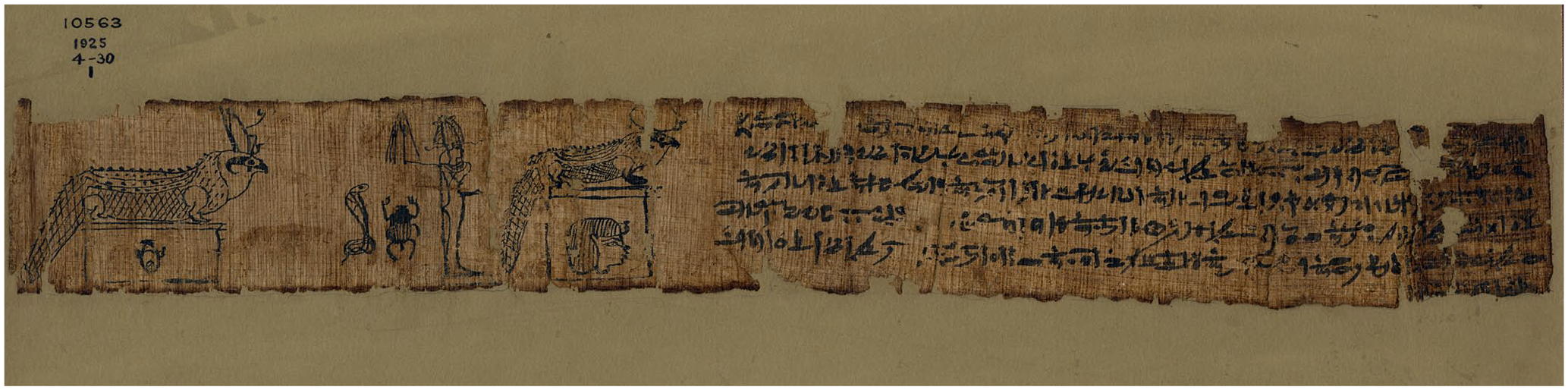
pBM EA10563 (photo: © The British Museum, courtesy of the Trustees of the British Museum).
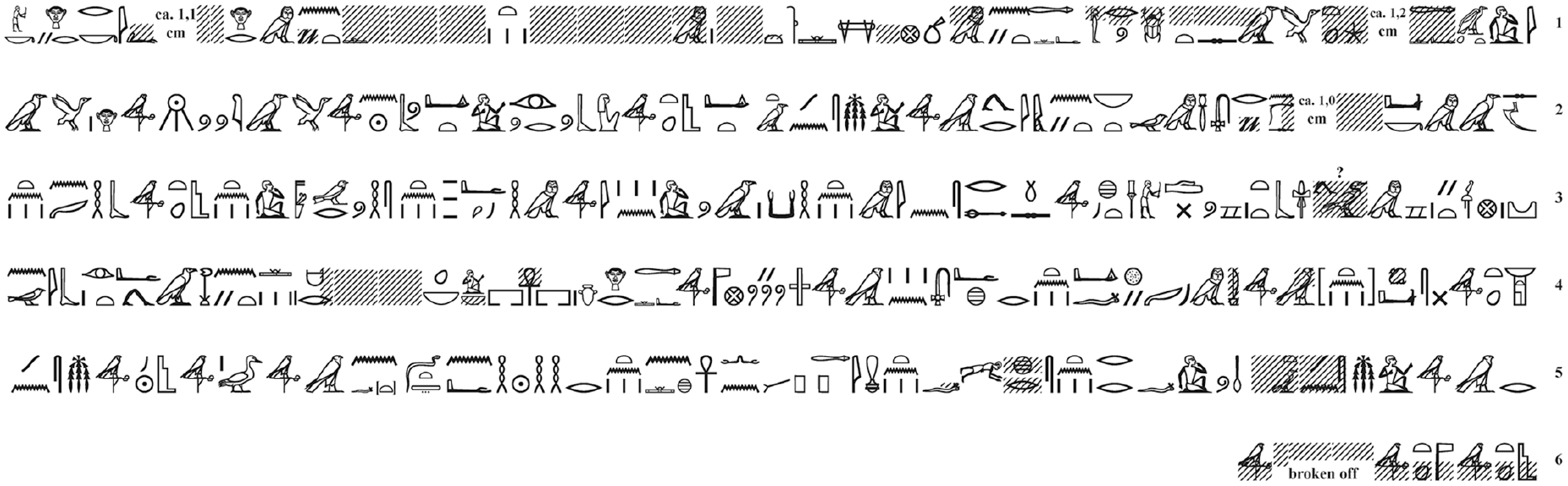
Hieroglyphs of pBM EA10563 (image: S. Beck, created with Jsesh and Adobe Illustrator).
The papyrus paleographically dates to the Late Period; more precisely, from the middle to the end of the seventh century BC. 8 The manuscript belonged to Hor, 9 son of Ta-dit-Isis, 10 and contains a spell against the evil eye (l. 4). Lines 3–5 more or less duplicate the texts of the wooden amulets Berlin 23308 11 and BM EA20775, 12 which both also date to the Late Period (see fig. 3). 13
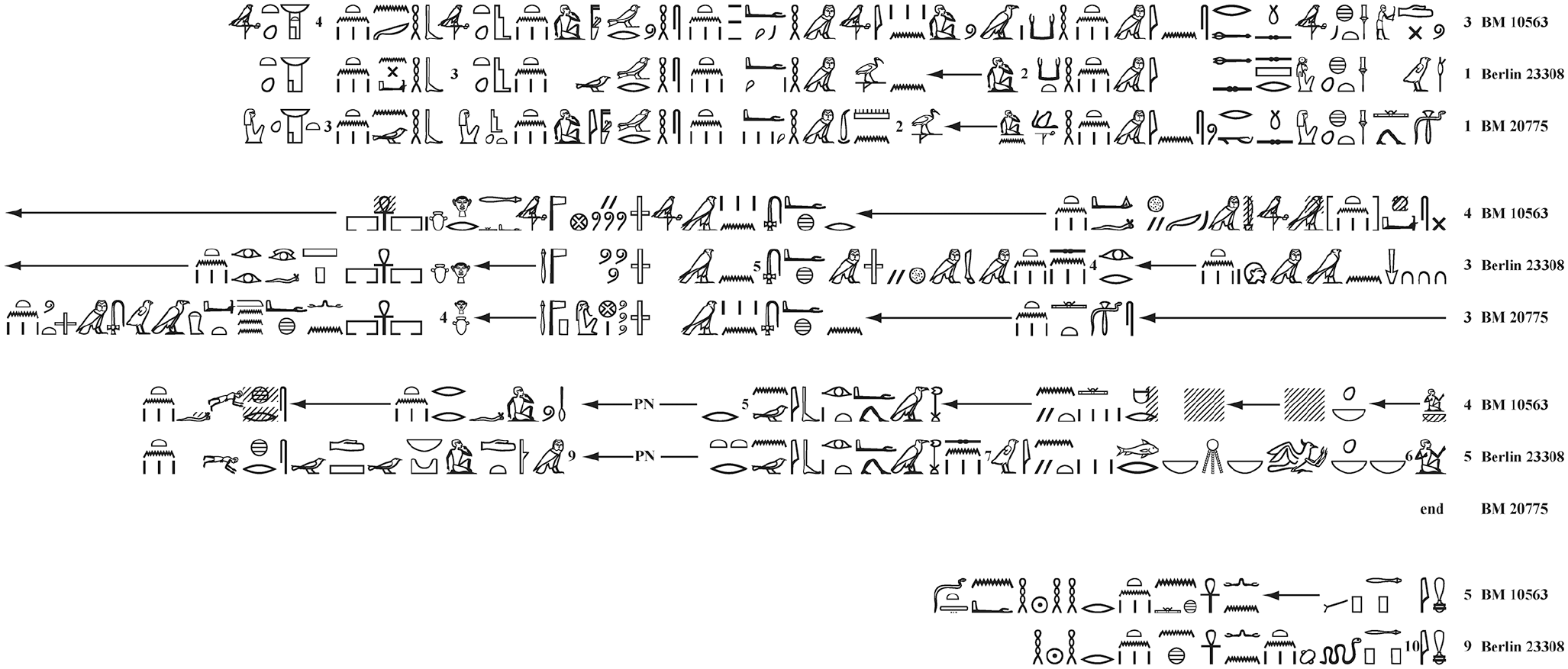
Synopsis of the texts of pBM EA10563, Berlin 23306, and BM EA20775 (image: S. Beck created with Jsesh and Adobe Illustrator).
Transliteration
1 j mw.t ʿȝ(.t) […] pȝ [… ḫp]r.w ʿȝ n.ty m […] rnp.t? […] m […].wt […] n.ty m ḥr […]a jr=k ḥry=kb
2 z:mȝ(m)=k […]c [n]zr mr nb.t n.ty jy r Ḥr(.w) ms.n tȝ-ḏj.t-ȝs.td bw jr(w)=j ḏj.t wbn pȝ šw(w) ḥr pȝ
3 ḏw jmn.ty m [ʿḳ?] jȝb.tye wd Sḫm.t šzr=s n-jm=tnf ḥkȝ.w n(.w) J m ḥʿ.w=tng s:ḥwr tn ȝs.t bḥn tn
4 Nb.t-ḥw.th ḥsb [tn] Ḥr(.w) <m> nm zp-sn ḏj=f tn r ʿḫ.w n Ḥr(.w) jm.y-Šn.wti nṯr-ʿȝ ḥr-jb pr-ʿnḫj r(m)T [nb] pʿ.t nb(.t) [rḫ.yt nb.t ḥnmm.t nb.t ḥmw.t-r’].wk n.ty ḫȝʿ jr.t bjn(.t)l
5 r Ḥr(.w) ms.n […]m ḫrw=f r-r=tn s:ḫr=f tn mj ʿȝpp nn ʿnḫ=tn r nḥḥ ḥnʿ ḏ.tn n[t]f Ḥr(.w)o zȝ Wsjr ms.n
6 ȝs.t nṯr.t […]p
Translation
R:1O great mother/Mut? the great […] great [be]ing? which […] You shall instil dread! R:2You shall slay […] burn every illness/pain, which comes against Hor whom Ta-dit-Isis has borne! I will not let the sun rise above the R:3western hill while [descending?] easterly. Sekhmet shall shoot her arrow at you (pl.). The magic of Thoth is in your limbs. Isis shall vilify you. Nephthys shall R:4punish you (and) Horus shall slaughter [you] <with> the knife twice. He shall give you to the braziers of Horus imi-Shenut, the great god, who is in the middle of the ‘house of life’. [Every] man, every pat, [every rekhit, every sun folk, etc.], who give the evil eye R:5against Hor, whom [… has] borne: His voice is against you! He shall fell you like Apophis. You will not live forever and ever more. H[e] is Horus son of Osiris, whom R:6Isis has borne, the goddess […].
Commentary
The word jȝb.ty, which is written at the end of the phrase, indicates that a word which describes the sunset stood there. Typical lemmata for sunset are ʿḳ 23 , ḥtp 24 , snk 25 , and skj. 26 The preposition m before the hole in the papyrus suggests the construction ḥr + infinitive. The sign’s remains on the edges of the gap are most likely to amend to [ʿḳ], which needs the preposition m for the pseudoverbal construction using jȝb.ty as attribute.
The phrase ḏw jmn.tj is slightly odd. One would expect ȝḫ.t jm.tjt. 27 A new topic starts in the next sentence.
 wḏ Sḫm.t šzr=s n-jm=tn ‘Sekhmet shall shoot her arrow at you’ and Berlin 23308 writes (columns from right to left)
  wd Sḫm.t šzr=z jm=tn ‘Sekhmet shall shoot her arrow at you.’ Notwithstanding Schott’s reading, here the initial sign is not read as
  but as
  . A short sloping stroke on the upper right side indicates this reading. Unfortunately, this cannot be verified because the object is a loss of war and no other photographs exist.
30
The topic of Sekhmet shooting arrows at enemies is well attested.
31
. A short sloping stroke on the upper right side indicates this reading. Unfortunately, this cannot be verified because the object is a loss of war and no other photographs exist.
30
The topic of Sekhmet shooting arrows at enemies is well attested.
31
Interestingly, the pronoun is changed again to the second person plural (=ṯn), which implies a new kind of threat has appeared. However, the threat is not named before the fourth line.
Berlin 23307, columns 1–2, writes  ḥkȝ(.t) n(.j) Ḏḥw.tj m ḥʿ=tn ‘The magic of Thoth is in your body’ and BM EA20775, lines 1–2, states:
  ḥkȝ n(.j) Ḏḥw.tj mn(.w) m ḥʿ.w=tn ‘The magic of Thoth is remaining in your limbs’, extending the sentence with a stative.
 s:ḥwr tn ȝs.t bḥn tn Nb.t-ḥw.t and Berlin 23308, columns 2–3
  s:ḥwr tn ȝs.t bḥn tn Nb.t-ḥw.t.

 mʿbȝ n(.j) Ḥr(.w) m tp=tn jr=zn tn m wḥm zp-sn jm(.j) ʿḫ n(.j) Ḥr(.w) jm.j-Šn.wt nṯr-ʿȝ ḥr(.j)-jb pr-ʿnḫ ‘The spear of Horus is in your head. They shall put (lit. make) you again (and) again
34
within the brazier of Horus imi-Shenut, the great god, who is in the middle of the “house of life”’, whereas BM EA20775, lines 3–4 shortens this and the next sentence to
mʿbȝ n(.j) Ḥr(.w) m tp=tn jr=zn tn m wḥm zp-sn jm(.j) ʿḫ n(.j) Ḥr(.w) jm.j-Šn.wt nṯr-ʿȝ ḥr(.j)-jb pr-ʿnḫ ‘The spear of Horus is in your head. They shall put (lit. make) you again (and) again
34
within the brazier of Horus imi-Shenut, the great god, who is in the middle of the “house of life”’, whereas BM EA20775, lines 3–4 shortens this and the next sentence to 
 s:wḏ.t(w)=tn n ʿḫ.w n(.w) Ḥr(.w) jm(.j)-Šn.wt p(ȝ) nṯr-ʿȝ ḥr(.j)-jb pr-ʿnḫ nn ʿḫm.t(w) tȝ.w m-jm?.wt(j)=tn ‘You will be handed over to the braziers of Horus imi-Shenut, the great god, who is in the middle of the “house of life”. The blaze will not be extinguished amongst you!’ The translation as conjunctive is unlikely due to the writing of the tw-passive voice; that is why a future is used instead. Afterwards, the amulet proceeds differently. In pBM EA10252 R:I20, the same phrase appears.
35
s:wḏ.t(w)=tn n ʿḫ.w n(.w) Ḥr(.w) jm(.j)-Šn.wt p(ȝ) nṯr-ʿȝ ḥr(.j)-jb pr-ʿnḫ nn ʿḫm.t(w) tȝ.w m-jm?.wt(j)=tn ‘You will be handed over to the braziers of Horus imi-Shenut, the great god, who is in the middle of the “house of life”. The blaze will not be extinguished amongst you!’ The translation as conjunctive is unlikely due to the writing of the tw-passive voice; that is why a future is used instead. Afterwards, the amulet proceeds differently. In pBM EA10252 R:I20, the same phrase appears.
35
 šp=f jr.tj=tn r(m)ṯ nb pʿ(.t) nb(.t) rḫ.y(t) nb(.t) ḥmḥm(.t) nb(.t) Hmw.t-r’.w (…) ‘He shall blind both your eyes, (o) every man, pat, rekhit, sun folk, etc. (…).’ A similar group of people seems to be named here, too, but the previous sentence (‘He shall blind both your eyes’) is missing. The similar group of people is also mentioned on the writing board BM EA5646, R:7 and frequently in pAMS 23b (old: pLeiden I 347) R:III9, 14, V8, VI1, VII2, 7, VIII4, IX2, X12, XII2.
36
šp=f jr.tj=tn r(m)ṯ nb pʿ(.t) nb(.t) rḫ.y(t) nb(.t) ḥmḥm(.t) nb(.t) Hmw.t-r’.w (…) ‘He shall blind both your eyes, (o) every man, pat, rekhit, sun folk, etc. (…).’ A similar group of people seems to be named here, too, but the previous sentence (‘He shall blind both your eyes’) is missing. The similar group of people is also mentioned on the writing board BM EA5646, R:7 and frequently in pAMS 23b (old: pLeiden I 347) R:III9, 14, V8, VI1, VII2, 7, VIII4, IX2, X12, XII2.
36
For the writing of ḥmw.t-r’.w
37
with  (K2), compare pCGT 54050 V:II5,7, IV2, 5, 6, 9, V3
 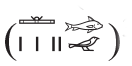 38
and pBM EA 10188 R:XXVI12
38
and pBM EA 10188 R:XXVI12 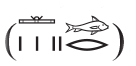 .
39
.
39
 (…) n.ty jw=zn ḫȝʿ jr.t bjn.t r (…) ‘(…) who will give the evil eye against (…)’. The phrase ḫȝʿ jr.t bjn.t r literally means ‘throw the evil eye against’. For the evil eye, see below.
40
(…) n.ty jw=zn ḫȝʿ jr.t bjn.t r (…) ‘(…) who will give the evil eye against (…)’. The phrase ḫȝʿ jr.t bjn.t r literally means ‘throw the evil eye against’. For the evil eye, see below.
40
 s:ḫr=tn mj ʿȝpp mw(t)=tn nn ʿnḫ=tn r nḥḥ ‘You shall fall like Apophis. You shall die! You will not live forever!’ The sign Aa2 can be read as mwt ‘to die’.
41
In comparison, Horus is apparently still defending Hor, who Ta-dit-Isis has borne in BM EA10563.
s:ḫr=tn mj ʿȝpp mw(t)=tn nn ʿnḫ=tn r nḥḥ ‘You shall fall like Apophis. You shall die! You will not live forever!’ The sign Aa2 can be read as mwt ‘to die’.
41
In comparison, Horus is apparently still defending Hor, who Ta-dit-Isis has borne in BM EA10563.
The Evil Eye in Ancient Egypt
The evil eye is very common through the world and is found in many cultures. 43 Interestingly, there are only a few sources known from ancient Egypt. The following outline will focus on the attestations in magical-medical texts with some additional sources. 44 The oldest attestations date to the Third Intermediate Period: the bronze vessel Boston MFA 24.900 (no. 1) 45 and the fragmentary stela Louvre E 20904 (no. 2). 46 Both mention the evil eye twice. 47 Two amulets date to the Late Period: papyrus BM EA10669 (no. 3) 48 and the above-described papyrus BM EA10563 (no. 4). The former names the evil eye in a long list of potential evil. 49 The wooden amulet Berlin P. 23308 (no. 5) 50 and papyrus Brooklyn 47.218.138 (no. 6) 51 both date from the Late Period to the Ptolemaic Period. The wooden amulet 52 has already been mentioned as a parallel text to papyrus BM EA10563. The Brooklyn papyrus names the evil eye in a long list of protective rituals. 53 There are four sources coming from the Ptolemaic Period: Hor’s chapel at Dendera (no. 7), 54 papyrus Mil. Vogl. Inventory Hieratic 1 (no. 8), 55 papyrus Strasbourg BNU 124 (no. 9), 56 and the Temple Library of the temple of Edfu (no. 10). 57 The first three of these name the evil eye in protective spells, whereas the latter states the existence of an entire manual of these utterances. The youngest sources date around the turn of the era (no. 11: Papyrus HieraTeb SCA 2276) 58 and the second or third century AD (no. 12: papyrus London-Leiden). 59 Both papyri – the latter in Demotic – also contain a spell against the evil eye.
The evil eye was a known phenomenon in ancient Egypt and several statements can be made about it. The oldest attestation dates to the Third Intermediate Period (25th Dynasty, no. 1) and the youngest to the second or third century AD (no. 12). Interestingly, there are no attestations before the Third Intermediate Period, which may either mean it was not so common before that time or, more likely, it could be by chance that we lack earlier sources.
From the temple of Edfu (no. 10), it becomes clear that there must have been a manual or manuals for repelling the evil eye from the temple. This is confirmed by attestation no. 7 (Hor’s chapel in Dendera), which also claims that the evil eye is repelled from that chapel. 60 The statement in pBrooklyn 47.218.138 (no. 6), which mentions a ritual of repelling the evil eye, goes in a similar direction. The incantations usually seem to be prophylactic (nos 3–5, 7–8, 11) rather than curative (nos 9, 12). Sometimes, it is difficult to tell due to the fragmentary state of preservation (nos 1–2). Only attestation no. 3 gives a hint from whom this peril may come: according to that amulet, foreigners give the evil eye.
There is specific vocabulary commonly used with the evil eye. However, one should keep in mind that only a few sources are currently known. The usual Egyptian expression for ‘to give the evil eye’ is ḫȝʿ jr.t bjn.t r …, ‘to throw the evil eye against …’, as in attestations nos 1, 4, 5, and 8. 61 The usual lemma for fending off the evil eye is ḫsf jr.t bjn.t ḥr … ‘to repel the evil eye from …’, which is used in attestations nos 2, 6–7, and 10. However, the vocabulary seems to be more open, because the following phrases are each used once to refer to driving off this evil: nḥm XY m-ʿ jr.t bjn.t ‘may XY rescue from the evil eye’(no. 3), rwj/nj(ȝ)? jr.t bjn.t ‘expel/drive away the evil eye (no. 9), and ʿḥʿ jr.t bjn.t ‘halt, (you) evil eye’ (no. 11). In the London-Leiden magical papyrus, the patient is under the evil eye (ẖr jr.t bjn.t; no. 12), which is a common expression in magical-medical texts for when somebody is suffering from an ailment. 62 Furthermore, the topic of Sekhmet shooting arrows against the evil eye also seems to be common (nos 4–5, 8). Sekhmet is named in attestation no. 2, too.
The new attestation, pBM EA 10563 (no. 4), is the first manuscript that partially duplicates another spell against the evil eye: wooden amulet Berlin 23308 (no. 5).
Footnotes
Acknowledgements
I would like to thank Ann-Katrin Gill for reading the manuscript and her useful suggestions on it, Ivan Guermeur for sharing his transliteration of Papyrus HieraTeb SCA 2776, Jana Helmbold-Doyé, Ägyptisches Museum und Papyrussammlung, Berlin, for the information on Berlin 23308, and last but not least, Mohammad Refaat for translating the abstract into Arabic.
Funding
The author did not receive any funding for the project.
2.
The acquisition register (vol. 10, p. 165) only states ‘Found amongst an old collection unnumbered.’ The entry was made by Stephen R. K. Glanville on 22.06.1925.
3.
For falcon-headed crocodile deities, see among others Kees 1929: 107–112; Žabkar 1975: 143–153; Bresciani 1986: 87–94. See also  : 17.
: 17.
4.
6.
8.
The sign inventory is limited by the shortness of the amulet: 81 signs were analysed, of which 24 cannot be taken into consideration either because they always look the same (8: G17, N35, O29 O34, Y1, Z1, Z4, Z9), are broken off (4: F20, M18, Z3A, Aa2), or are not attested in that specific form in Verhoeven 2001 or (12: A1, B1, D40, G37, N5, O49, Q7, T19, V31, Z2, Aa1, Ab300). 57 signs can be assigned to a specific time; 34 signs date to the seventh century BC (A24, D2, D4, D28, D35a, D36, D54, D58, F34, F51, G36, G39, H8, I9, M12, M17, N26, P8, Q1, R8, R14, R15, T11, T30, T34, V6, V12, V28, V30, X1, Z5, Z6, Z7, Z11), eight to the seventh to sixth century BC (H6, D21, D46, G41, I10, N8, Q3, U23), six from the Late Period to the Graeco-Roman Period (G5, N23, O9, S29, S34, W19), and three to the Graeco-Roman Period (U1, F31, O1). Furthermore, there are a few attestations earlier than the Late Period: one dating to the Third Intermediate Period (S42), three from the Third Intermediate Period to the Late Period (A2, F47, D37), and two from the Third Intermediate Period to the Graeco-Roman Period. The peak is clearly in the Late Period, with a special focus on the end of the seventh century BC.
13.
See Vittmann 1984: 166; Quirke 1993: 39 (no. 73); Fischer-Elfert 2014: 37. See also <> (332–30 BC; accessed 13.12.2022).
14.
For mw.t ʿȝ.t, see LGG III: 253.
15.
Wb III: 146–147.9.
16.
Wb II: 355.4–11.
21.
Wb I: 292.9–10; III: 191.15; IV: 431.4–5; V: 542.2–3.
22.
See Lange 1927: 57–59 <> (accessed 13.12.2022).
23.
Wb I: 230.8.
24.
Wb III: 191.11–19.
25.
Wb IV: 175.7, only Old Kingdom.
26.
Wb IV: 311–312.1–3.
27.
See Wb I: 17.12–13.
30.
Information provided by J. Helmbold-Doyé, Ägyptisches Museum und Papyrussammlung, Berlin, personal communication, 29.10.19. See also Vittmann 1984: 166 n. 9. For this phrase, compare also : 137.
31.
See Hoenes 1976: 67–87, especially 67, 70–71; : 249–270, especially 253, 256, 264–270.
32.
See Wb I: 25.6; LGG VII: 639–644 with further literature.
34.
For m-wḥm, m wḥm-zp see Wb III: 436.5. The second phrase is clearly written zp-sn; therefore, the translation ‘again (and) again’ was chosen.
37.
Wb III: 85.2.
38.
Roccati 2001: 30, 32, 33.
40.
Spiegelberg 1924: 149–154; Fischer-Elfert 2014: 31–49 with further literature; Pries 2020a: 43–55; Pries 2020b: 61–66; Goyon 2012: 89–90, 92, pl. 13. See also : 7–10, with a slightly different approach.
41.
See Wb II: 165; Kurth 2009: 229 (99). Compare also : 108.
43.
For the evil eye in general, see among others Dundes 1992 and Elliott 2015. Compare also the literature given by Fischer-Elfert 2014: 31–33; Pries 2020a: 51–52. See also .
44.
A first overview was given by H.-W. Fischer-Elfert in his article ‘Ein Spruch gegen den Bösen Blick in Meroe’ in 2014 (Fischer-Elfert 2014). Compare also the outline by Pries 2020a: 51–54, who discusses the attestations known thus far. The evil eye is additionally named in the Demotic papyri pKrall, II9 (Hoffmann 1996: 145–146, pl. II) and XVII18 (Hoffmann 1996: 325, pl. XVII), in pWien D 6165+6165A, II38 (Hoffmann 1995: 49–50, pl. 2), and in pTait 1, l. 14 (Tait 1977: 2–3, 8, pl. 1). See also Spiegelberg 1895: 93–94. For attestations in Coptic, see Kropp 1931, II: 215 (Berlin 3829, Berlin 8331) and : 39.
45.
Fischer-Elfert 2014: 41–46. As the spell was incised on the edge of a vessel, it could be that the bowl was used to prepare a remedy against the evil eye – even if the vessel was part of the owner’s funerary equipment (Fischer-Elfert 2014: 49). From other incantations in Egypt and beyond, it is known that the evil eye can be treated with specific liquids; see Dundes 1992: 257–312, especially 266–298; compare Pries 2020a: 47–48 and on divine bodily fluids for creation and destruction.
46.
Cauville 1989: 53, pl. VII, <> (accessed 13.12.2022).
47.
Boston MFA 24.900: […] pȝ r’ bjn <n.j> z nb z.t nb.t tȝ nb ḫȝs.t n.ty jy.t r ḫȝa jr.t bjn.t r Mks-kdy-ḳ ms.n Dpks? jw=tn r ḫȝʿ jr.t bjn.t r=z n.ty-jw […] ‘[…] the bad rumour <of> every man, every woman (from) every plain (and) every downs, who come to give (lit. throw) the evil eye against Mks-kdy-ḳ, whom Dpsk? has born, while you are coming to give the evil eye, those who are […]’; Louvre E 20904, line 3: Sḫm.t ḫsf=z jr.t bjn(.t) ḥr […] ‘Sekhmet, she shall repel the evil eye […]’, line 5: [… mn] sṯȝ jr.t bjn(.t) […] ‘[… without?] pulling out the evil eye […]’; compare : 34 with n. 10.
48.
Mahlich and Theis 2023. See also <> (accessed 16.12.22).
49.
Papyrus BM EA10669, V:x+IX1–3: nḥm=k sw (…) [m]-ʿ jr.t nb(.t) bjn(.t) n(.t) ḫ(ȝ)rw.(j)w n(.t) K(ȝ)S.w n(.t) km.[tjw …] ‘You shall rescue her (…) [fr]om every evil eye of Syrians, Kushites/Nubians, (and) Egypt[ians …]’; the lemma km.t ‘Egypt’ can be used as a synonym for ‘Egyptian’ as well; see Wb V: 127.18–20. See : 211 (fig. 4), 216.
52.
Berlin P. 23308, column 5–6: šp=f jr.tj=tn rmṯ nb pʿ(.t) nb(.t) rḫ.y(t) nb(.t) ḥmḥm(.t) nb(.t) ḥmw.t-r’.w n.ty ḫȝʿ jr.t bjn(.t) r Pȝ-ḏj-Jmn-nb-ns.wt-tȝ.wj ms.n Mḥ.wt-n-wsh.t (…) ‘He shall blind both your eyes, (o) every man, pat, rekhit, sun folk, etc. who give (lit.: throw) the evil eye against Pȝ-ḏj-Jmn-nb-ns.wt-tȝ.wj, whom Mḥ.wt-n-wsh.t has born (…)’; see also the synopsis.
53.
54.
: 52, pl. VI; entrance pillar (northern part), column 1: r’ n(.j) ḫsf jr(.t) bjn(.t): jnk ȝs.t wr(.t) mw.t-nṯr mr.jj(t) n(.t) nṯr nb (…) ‘spell of repelling the evil eye: I am Isis, the great one, the god’s mother, the loved one of every god (…).’, and column 2: (…) jy=j m p.t pr(r)=j m ȝḫ.t r ḫsf jr(.t) bjn(.t) r pr pn (…) ‘(…) That I come to the sky (and) go forth to the horizon, was to repel the evil eye from this temple (…)’.
55.
56.
: 61–66, pl. 13; fragment A, R:x+3–4: […] jn-jw ȝs.t mw.t-nṯr jn-jw tȝ jr.t bjn.t [… tȝ jr.t bj]n(.t) n[t.y] m ʿ.wt nb(.wt) n(.w) Ḥr(.w) zȝ ȝs.t n.ty m ʿ.wt nb(.wt) n(.w) [pr-ʿȝ …] ‘Is it Isis, the god’s mother? Is it the evil eye? [… the ev]il [eye], wh[ich] is in every limb of Horus, son of Isis; which is in every limb of [the pharaoh …]’, and fragment B, R:x+1–2: [… rwj/nj](ȝ) tȝ jr.t [bjn.t … ] tȝ jr.t b[jn.t …] ‘[… expel/drive away] the [evil] eye […] the e[vil] eye […]’; compare Pries 2020b: 65–66.
57.
E III, 351:9: r’.w n.w ḫsf jr(.t) bjn.t ‘spells of repelling the evil eye’ (Ptolemy VIII Euergetes II), <http://www.tempeltexte.uni-tuebingen.de/portal/#/text-detail/5970> (accessed 18.12.2022). Compare also Schott 1990: 273 (1240). These spells are repeated on the enclosure wall (Ptolemy IX Soter II): E VI, 263:5, <http://www.tempeltexte.uni-tuebingen.de/portal/#/text-detail/13683> (accessed 18.12.2022), and E VI, 300:6–7, <> (accessed 18.12.2022).
58.
Papyrus HieraTeb SCA 2776, x+II7: ʿḥʿ zp-sn tȝ jr.t bjn.t s:ḥwr tn pȝ nṯr ʿȝ (…) ‘Halt, halt, (you) evil eye! The great god shall vilify you (…)’, x+II11–III1: ʿḥ[ʿ zp-sn tȝ jr.t bjn(.t) bḥn tn pȝ fdw?-ḥr.w jpn […] s:ḥwr tn Jmn-Rʿ(w) (…) ‘Hal[t], halt, (you) evil eye! These four? faces shall punish you! Amun-Re shall vilify you (…)!’; see Guermeur 2008: 115–116; Guermeur 2018/19: 7–8. Compare also : 37–39. My gratitude goes to Ivan Guermeur, who kindly shared his transliteration of the Hieratic papyrus with the author. He is currently preparing an edition of the text.
59.
Papyrus London Leiden, V:XX1: r ḏj.t lk jr.t bjn(.t) n rmṯ (…) ‘(spell/remedy) to heal (lit. let extract) the evil eye from a human (…)’, V:XX6–7: r wʿ ḫm n(.j) nḥḥ mtw=k ḏj.t ḥmȝ ḫljn r-r=f mtw=k ths pȝ rmṯ n.tj ẖr jr.t bjn(.t) n-jm=f mtw=k sẖ nȝj an r wʿ ḏmʿ n mȝj{.t} mtw=k jr=f n mḏȝ r ẖe.ṱ=f ‘(to be spoken) upon a bit of oil and you shall give salt (and) cress to it, (and) you shall anoint the patient (lit.: human), who is under the evil eye, with it, (and) you shall write this again on a new papyrus, (and) you shall make it to an amulet for his body.’ See G. Vittmann <https://aaew.bbaw.de/tla/servlet/GetCtxt?u=guest&f=0&l=0&tc=12&db=1&ws=28558&mv=2> (accessed 18.12.2022); see also , I: 192–193, II: pl. Verso XVII–XX.
60.
It is not entirely clear whether the spell refers only to Hor’s chapel or the entire temple of Dendera, because pr pn ‘this temple’ is rather unspecific. See attestation no. 7.
Author Biography
References