




Abstract
Sixteen ceramic figurines were discovered during excavations in 2015 at the site of Tell Nabasha by a team from the University of Liverpool. The figurines were found in several contexts dating from the Late to the early Ptolemaic Period. This article presents the assemblage and discusses the function of these figurines within the sacred landscape of Tell Nabasha linking them to the worship of primarily two local deities: Wadjet, Mistress of Imet, and Harpocrates. The figurines were most likely produced on the site and donated as votive offerings to the local temple, particularly during festivals conducted at the site.

Introduction
The archaeological site of Tell Nabasha is located on the western edge of the town of el-Hosayneya in the Sharqia Governate of the Nile Delta. 1 The site itself was first described by Jean-Jacques Rifaud 2 in 1830, before being excavated more systematically by William Matthew Flinders Petrie from February to May 1886. 3 Petrie’s excavations unearthed a large temple complex, which included a temple most likely dedicated to Wadjet, Mistress of Imet, and a smaller temple and shrine built during the reign of Amasis II and dedicated to the god Min. The third god worshipped at the site, who completed the triad along with Wadjet and Min, at least during the Ptolemaic Period (and potentially earlier), was a version of the Young Horus as convincingly demonstrated by Vincent Razanajao. 4
The site was excavated extensively in periods from 1906 to 2015 by the Egyptian Antiquities Organisation and the Ministry of State Antiquities, in particular from the 1960s to the 1980s. 5 In the autumn of 2015, a mission run by the University of Liverpool conducted exploratory excavations as well as a topographical survey on the remaining tell towards the eastern edge of the site in an area where Petrie had found largely excavated Late Period and Ptolemaic settlement remains. 6
The 2015 Liverpool mission unearthed mudbrick structures lying close to the surface of the tell as well as a wide range of ceramics (numbering approximately 650 diagnostic sherds) and more than 300 small finds. Among this assemblage, which included sculptural pieces of limestone, fragments of faience and stone vessels, ceramic counters, and metal artefacts such as nails, a bronze ring, and tools, were sixteen ceramic figurines secured from four individual contexts (C005, C015, C017, and C020).
The majority of ceramic figurines came from C005, which also constitutes one of the most problematic contexts from the site. It is the fill of a large intrusive cut, most likely made in recent years by looters, which cuts across several diachronic strata and was refilled with a jumble of materials, ceramics, and small finds. Because of its intrusive nature the finds from C005 are of a relatively wide chronological range, with some finds dating to the early Late Period and some ceramics, such as a Greek lopas cooking pot, having parallels as late as the first century BCE, at odds with the majority of small finds and ceramics from other sealed contexts at the site, which tend to be earlier, dating to the fourth and third centuries BCE.
Diachronic Considerations of C015, C017, and C020 (fig. 1)
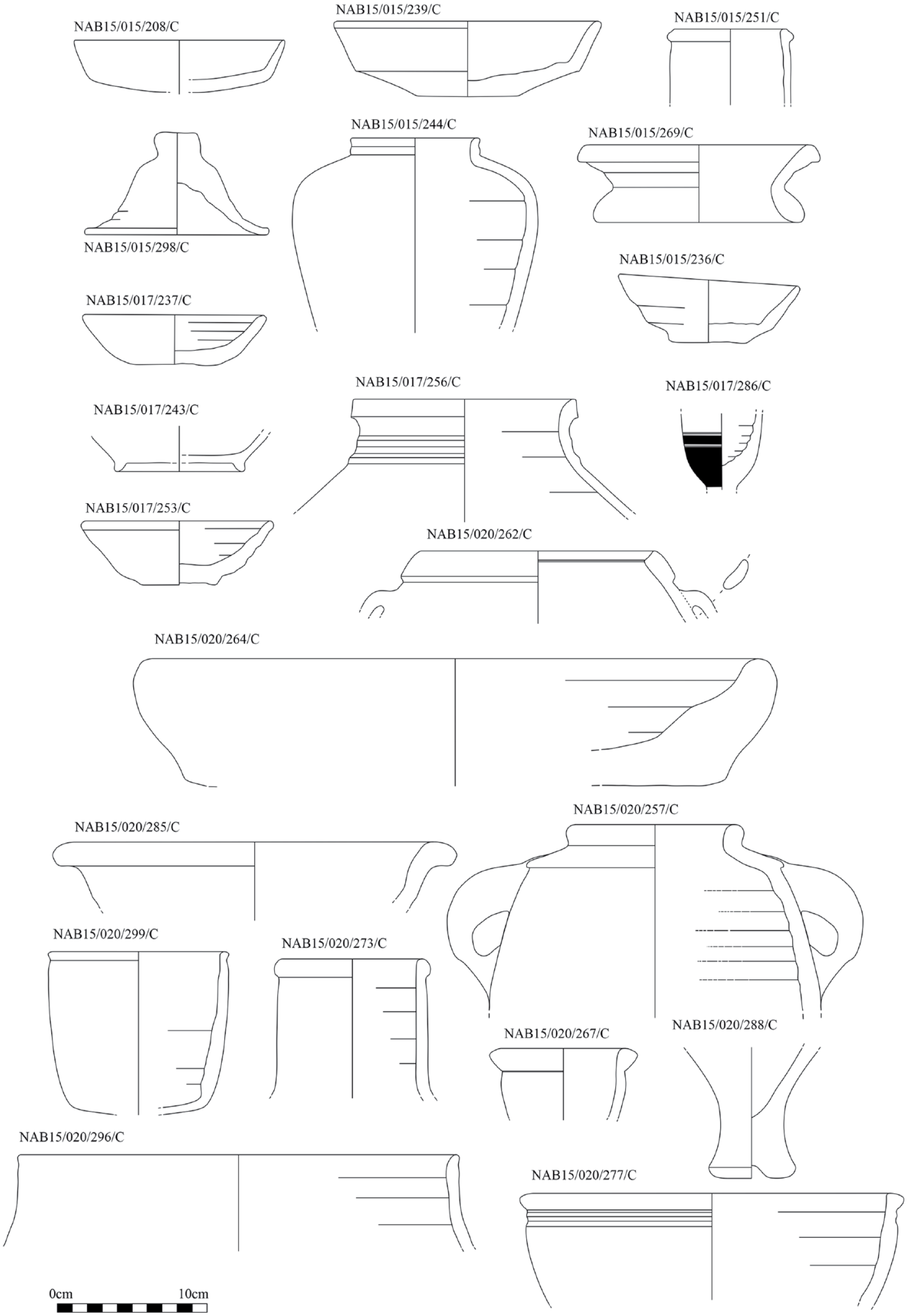
Diagnostic ceramics from Trench 1 at Tell Nabasha (drawing: N. Nielsen).
Even though much of the assemblage of coroplastic figurines presented in this article can be typologically dated broadly on the basis of comparanda from other sites in Egypt, some of the individual pieces are too poorly preserved to identify useful parallels. In these cases, and to allow a narrowed dating, a discussion of the diachronic profile of the contexts in which they were found using ceramic material is useful. While most of the figurines were found in the disturbed context C005 as discussed above, five figurines and figurine fragments were located in more secure deposits, namely C015, C017, and C020 (figs 2–3). The precise dating of these contexts can be ascertained with some degree of certainty by using the ceramic evidence recovered from them in the form of diagnostic sherd material.
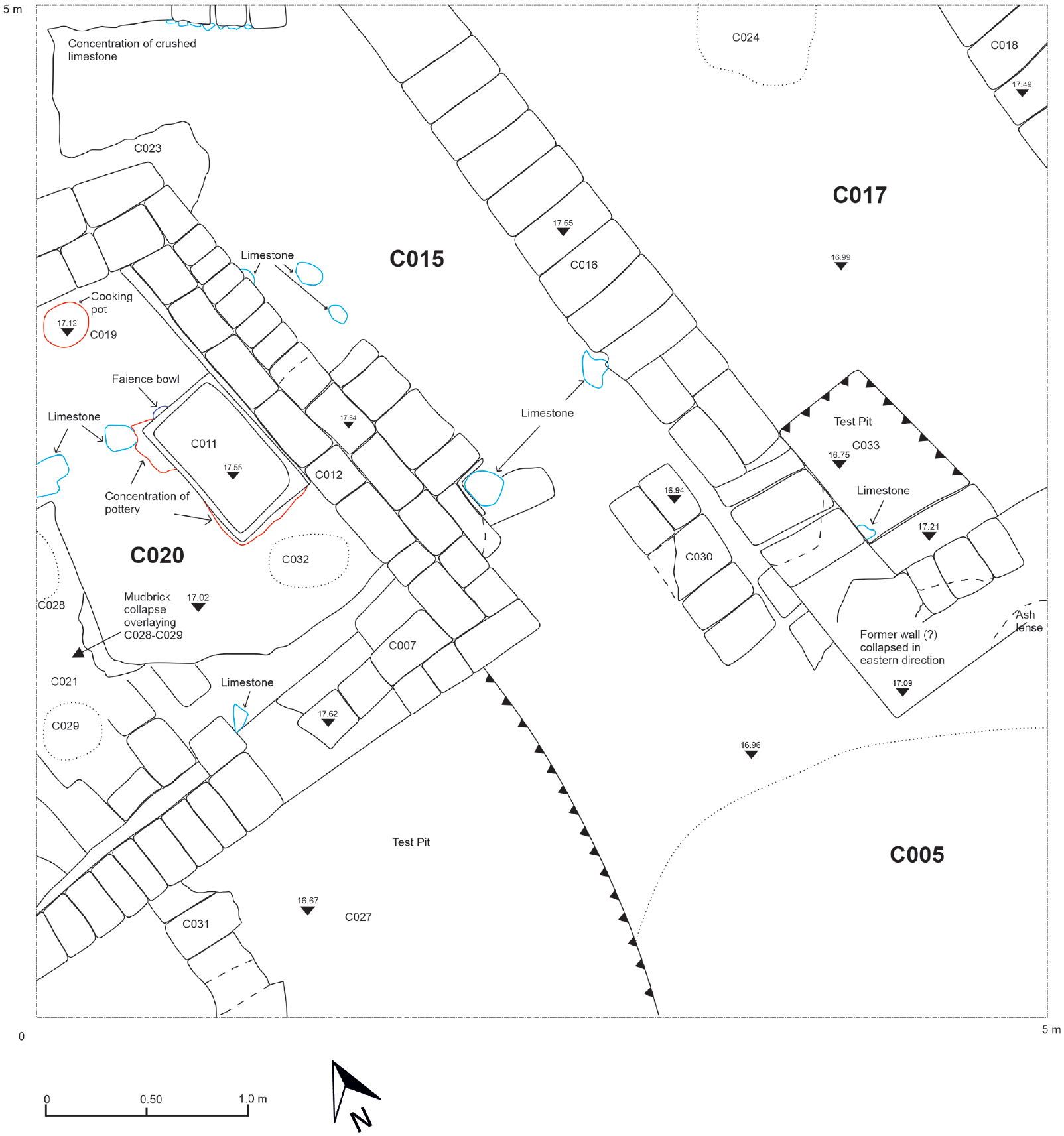
Top plan of Trench 1 highlighting C005, C015, C017, and C020 (plan: M. Mamedow and N. Nielsen).
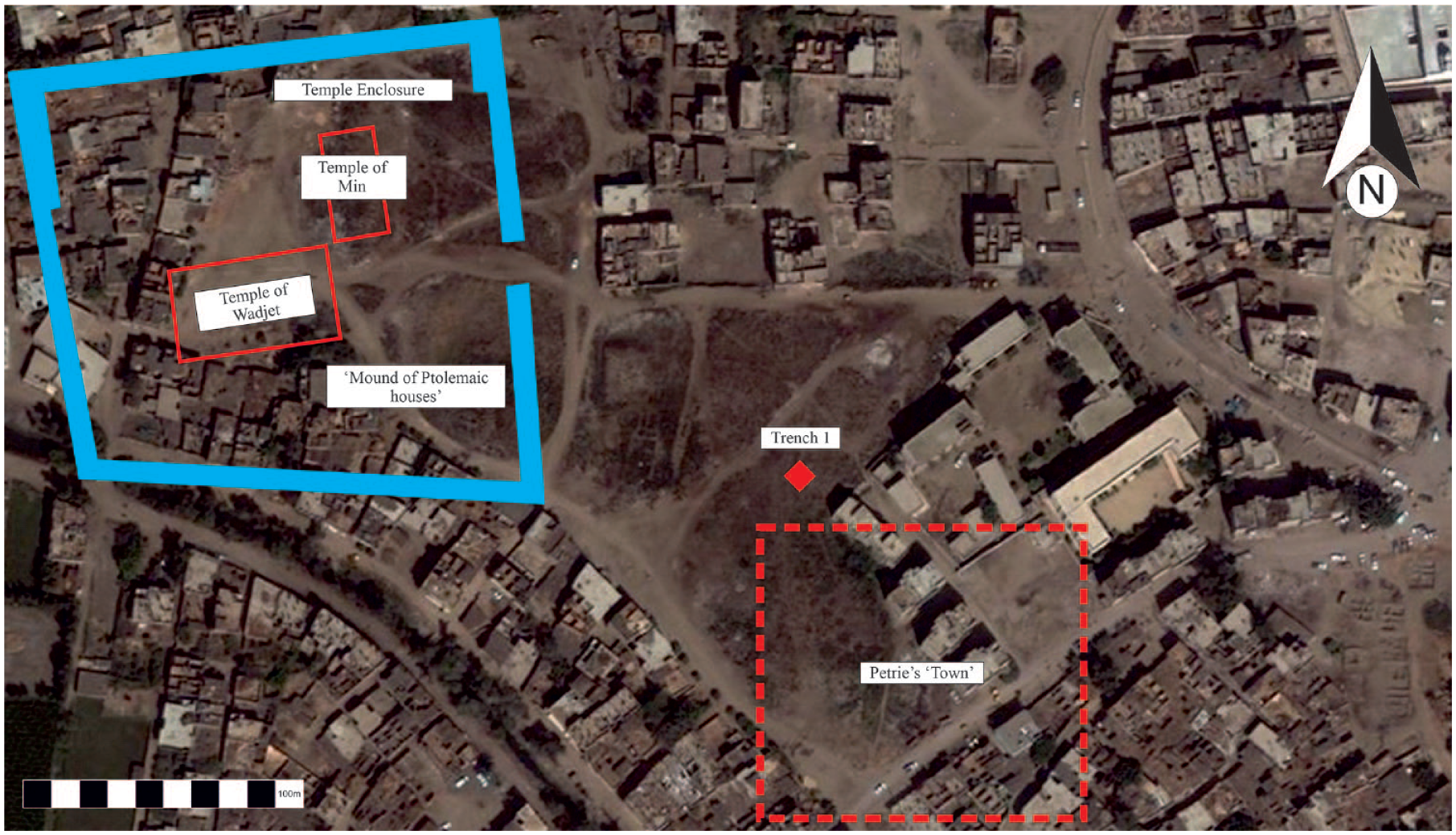
Satellite image of the site of Tell Nabasha overlaid with the structures and areas identified by Petrie in 1886 as well as Trench 1 (image: N. Nielsen).
C015
This context is comprised of a surface of hard-packed silty soil mostly underlying the collapse of wall C012 and C016. The context may have functioned as the floor level during the occupation of the structure, an interpretation supported by a piece of limestone with a circular indentation embedded into C015, where it adjoins C012, most likely functioning as a pivot stone for a door. The ceramic corpus from C015 consists of a relatively small amount of well-preserved whole vessels and diagnostics. Two carinated dishes with direct rims and flat bases (
In addition to the whole vessels/profiles from C015, the excavation also recovered two other shapes more difficult to date accurately: a ring stand (
C017
C017 comprised a surface of hard-packed soil underlying the collapse of walls C016 and C018 running perpendicular north–south through the eastern section of Trench 1. Unsurprisingly, given that this context most likely constituted the actual floor level of the structure during its main occupation phase, there were relatively few small finds and ceramic materials associated with it. However, while small in terms of quantity, the material found nonetheless provides some useful diachronic indications, which helps to provide an approximate date for the main occupation phase of the structure as a whole.
Among the most unusual ceramic material from within this context are two diagnostic sherds: a body sherd (
Nevertheless, the lekythos from Trench 1 provides a useful terminus ante quem for C017. Viewed in conjunction with the two fully preserved dishes/lids (
C020
C020 is the most mixed and potentially chronologically problematic of the contexts containing coroplastic figurines (aside from the fill C005). It consists of a lens of loose, sandy soil mixed with debris from a collapsed mudbrick wall (C007) and may in parts include ceramic material and small finds from the foundation cuts of C007. A reflection of this somewhat problematic nature of the context is the relatively wide date range of the pottery found associated with it.
Among the oldest is the relatively well-preserved upper portion of a Levantine ‘torpedo’ jar (
The 2015 Season Ceramic Figurines (figs 4–5)
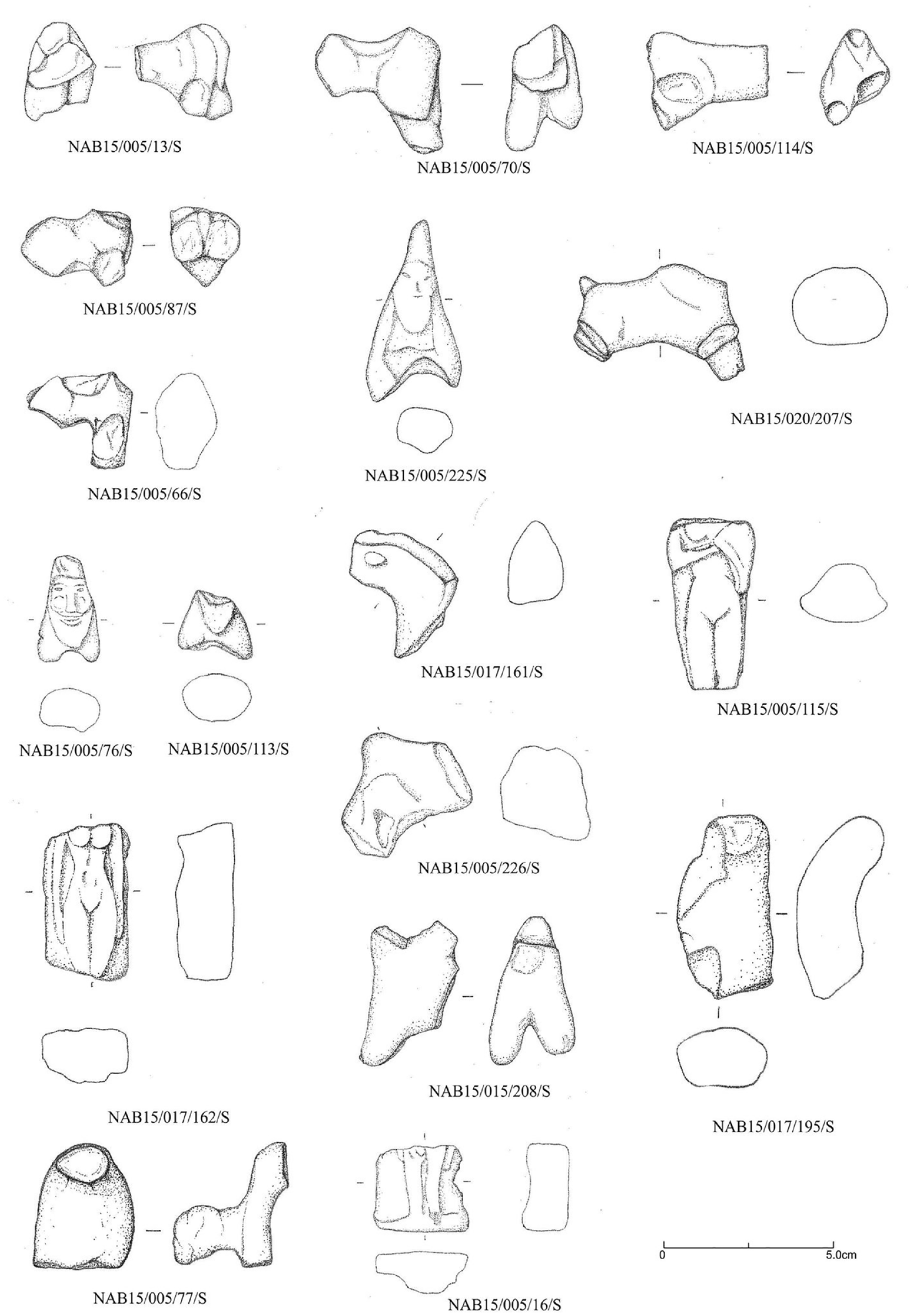
Corpus of ceramic figurines from Tell Nabasha (drawings: N. Nielsen and V. Gasperini).
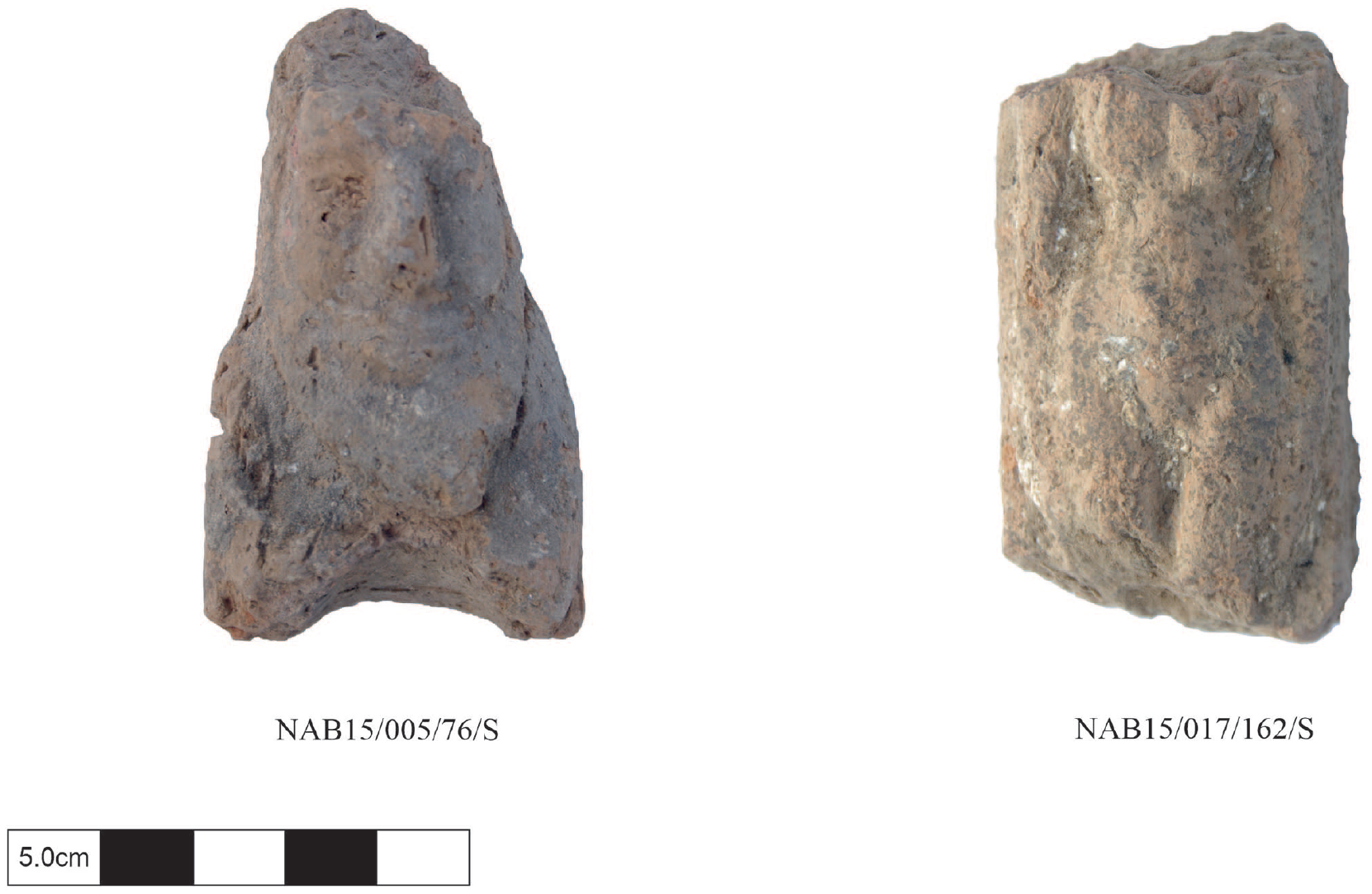
NAB15/005/76/S and NAB15/017/162/S, a Persian rider and a female plaque figurine from Trench 1 (photos: V. Gasperini).
The 2015 season figurines are broadly divided into four categories: Persian rider figures, female plaque figurines, canine figurines, and a miscellaneous category for figurines too damaged to identify in any detail (table 1). Of these, the most common by far are the Persian rider, which make up a total 43.8% of the corpus. The Persian rider figurines are exclusively associated with C005 and can be further subdivided into the four surviving horse figurines and the three surviving rider figurines.
A list of coroplastic figurines found at Tell Nabasha in 2015.
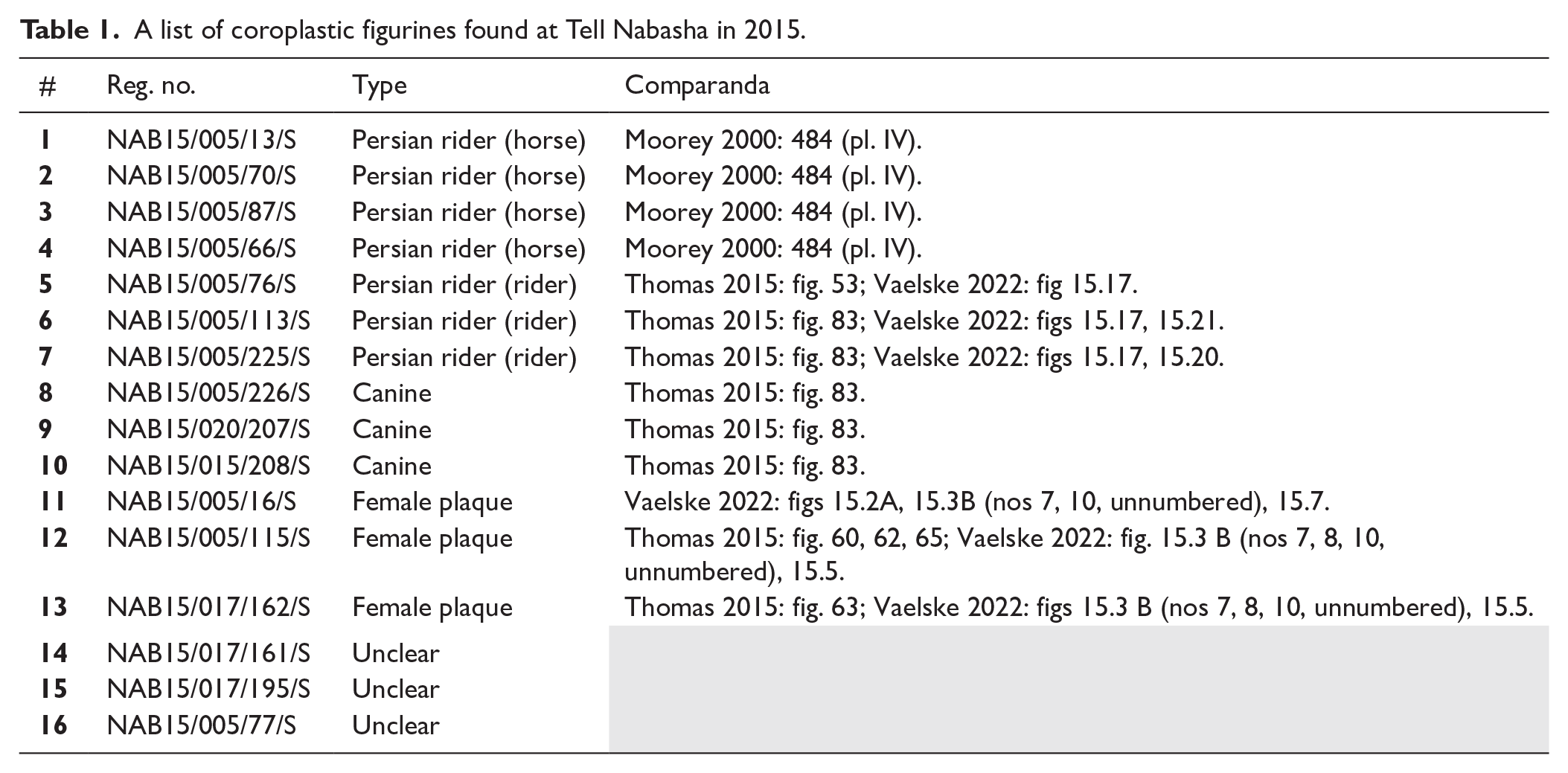
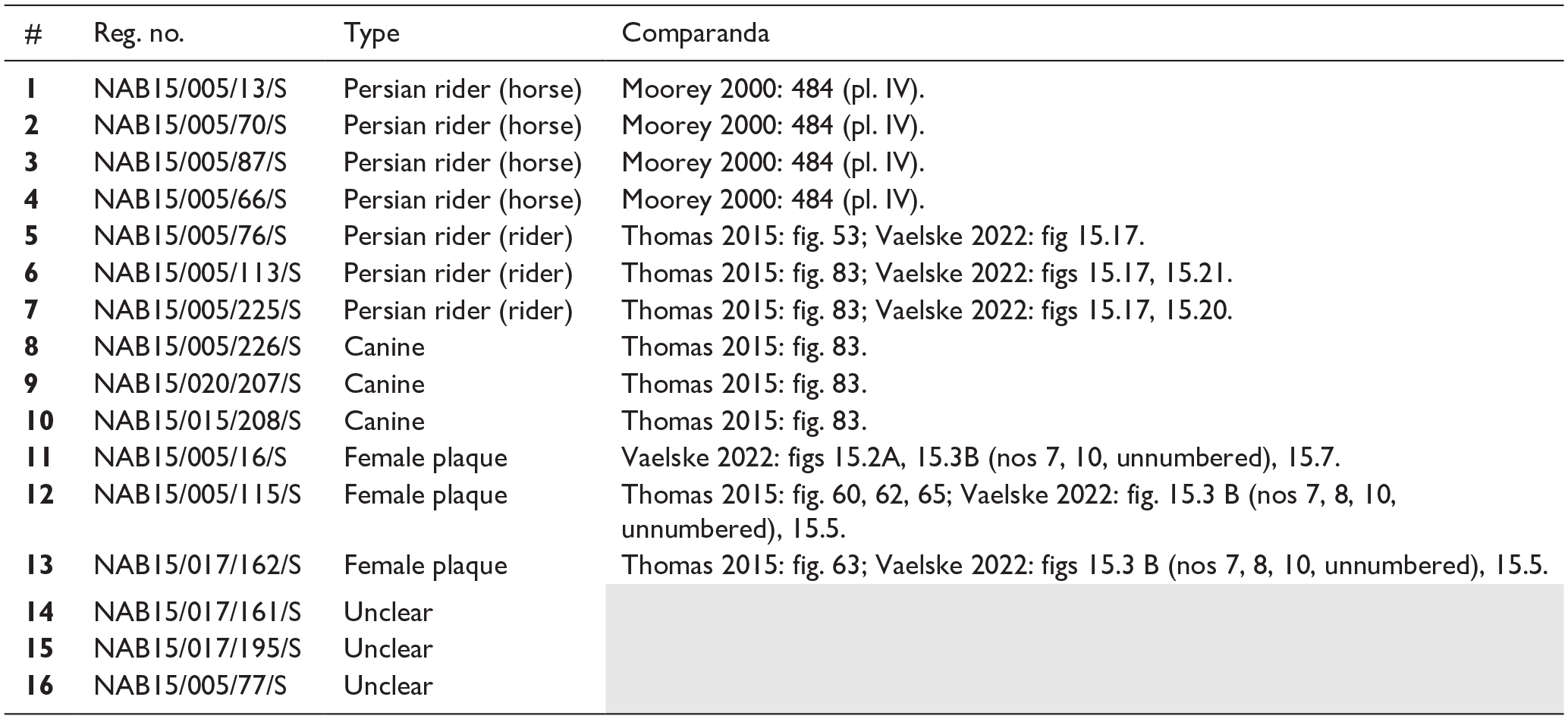
Of the horse figurines,
Aside from the Persian riders and their horses, other animal figurines are also associated with contexts C005, C015, C017, and C020. These figurines broadly show a similar state of preservation to the Persian rider horses; in
In addition, two other animal figurines –
The three female plaque figurines at Nabasha are of the ‘plain background’ type, rather than the typical variations found that incorporate a shrine in the background or pose the figure holding a tambor. Of the three,
In terms of material, the figurines are all made from similar greyish-brown silt, comparable to the rougher tableware pottery found on the site. This suggests local manufacture, although further chemical analysis (using, for instance, portable X-ray fluorescence) would be needed to verify this theory.
Identifying Function
The two most common types of figurines found at Tell Nabasha are respectively the so-called Persian riders and the female plaque figurines, making up a significant majority of the small corpus of coroplastic figurines. The Persian riders are not a uniquely Egyptian artefact, but rather are found across the Near East 32 and wider eastern Mediterranean, for instance on Cyprus. 33 They are identified by the distinctive Persian cavalry headgear (kyrbasia) and beards worn by the riders, usually made from a combination of a mould-made rider and a hand-made mount. 34 Within the geographical context of the eastern Nile Delta the large number of Persian riders found at Tell Basta (ancient Bubastis) may suggest that a production centre for this kind of figurine was originally found at the site. 35
Their function is problematic to identify. Both within and outside Egypt the figurines are commonly found in domestic contexts, often in tertiary depositions as part of foundation fills or foundation walls, 36 although this does not preclude their potential function as votive offerings as argued by Moorey. 37 The latter location may suggest that the figurines fulfilled a spiritual purpose, or that they were viewed as proxies of one or more specific deities. Outside Egypt, this may be a rider god. 38
In the case of Egypt, it is tempting to associate the Persian riders with the slightly later religious tradition, prevalent during the Ptolemaic Period, of portraying Horus as a Macedonian cavalry soldier, 39 complete with relevant armour and weaponry. As discussed by Thomas, 40 the Persian riders found at Naukratis also share a distinctive pinched head shape with figures depicting Harpocrates, one of the iterations of the Young Horus, perhaps further suggesting a link between the Persian riders and depictions of the god Horus.
While the Persian riders were not an Egyptian innovation, but most likely spread to Egypt from the Near East, it is possible that the Egyptians imbued these figurines with meaning pertinent to their own religious pantheon. The discovery of depictions of Harpocrates (both figurative and sculptural) at Tell Nabasha from fourth to third century BCE contexts contemporary to the Persian riders, along with the role played by Horus at the site as the third member of the local triad, at least from the Ptolemaic Period onwards, 41 may suggest that the figurines were produced as votive offerings intended for deposition in a possible Horus temple or chapel, possibly located within the sacred enclosure that also contained the temples dedicated to Wadjet, Mistress of Imet, and Min.
It is possible that the Persian rider figurines found at Tell Nabasha were produced on the site and used in local religious ceremonies, and additionally bartered to visitors. In addition, they may have been used as votive objects within houses and, when they eventually broke, subsequently deposited in foundation fills and/or discarded with other rubbish. The production of figurines at the site is evidenced by the half-finished limestone ithyphallic figurine (
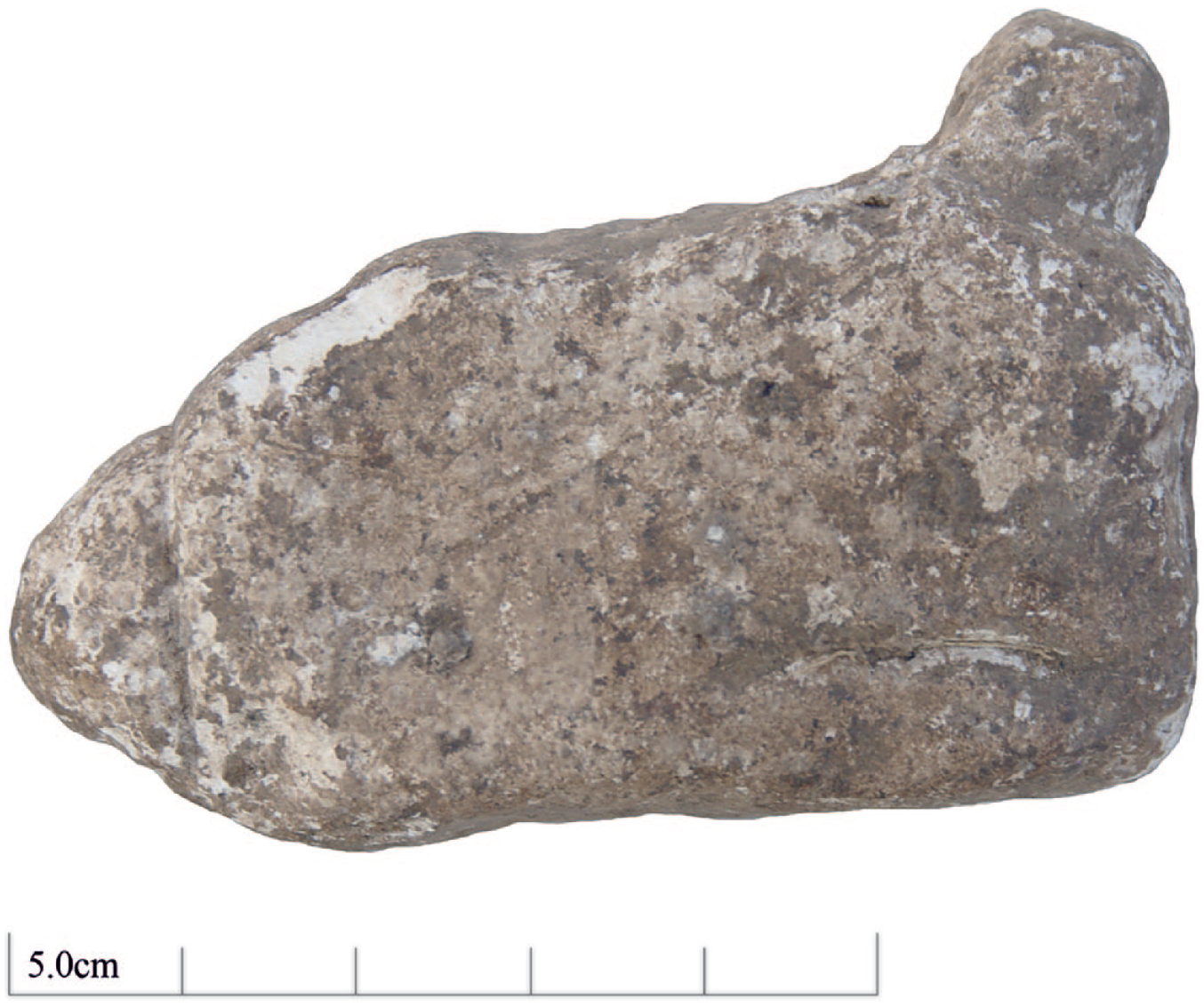
Partially worked limestone ithyphallic figurine (photo: V. Gasperini).
The three female plaque figurines may have served a somewhat related function. 43 Figurines of this type are often labelled as ‘fecundity’ figurines and are associated with fertility rites and fertility aspects of specific deities, notably Hathor. 44 Their precise function within a cultic environment is less clear, although they may have fulfilled multiple purposes related to both fertility and the curing of disease. 45 It is important to note that none of the female plaque figurines from Tell Nabasha come from a primary cultic context. Rather they are found mixed with broken pottery and other small finds in tertiary depositions, suggesting that they have been retrieved after their main function had been played out, similarly to the figurines found at the Mut Temple in Luxor. 46 Another possibility is that their location within Trench 1 is due not to the final stages of the object’s life, but rather the first, that they are present due to the production of ceramic figurines in the area. Despite the presence of pottery kilns nearby, however, there is little hard archaeological evidence – in the form of moulds, for instance – to evidence this hypothesis which therefore must represent the less likely possibility.
The link between fertility and the female plaque figurines at Tell Nabasha may also be strengthened by considering the Stela of Gemenefhorbak 47 dated to the Ptolemaic Period, which contains a clear reference to a religious festival conducted in the Temple of Wadjet at Tell Nabasha that involved individuals who faced problems conceiving children directing their prayers directly to the goddess herself. 48 The female plaque figurines may have been manufactured at the site in conjunction with this and similar festivals, and sold or bartered to visitors. After the figurines were used in the festival, they may have been deliberately broken as suggested by Waraksa and then simply deposited as refuse in the settlement portion of the site, outside the boundaries of the sacred enclosure of Wadjet. Another type of coroplastic figurine which has also been identified at the site is the so-called dotted blue-glazed female figurines. 49
The assemblage of ceramic figurines from Tell Nabasha is relatively small, although concentrated given the size of the test trench from which the artefacts came (25 m2). In the absence of moulds located in the area, it is not clear whether these figurines were manufactured at the site itself, although given the partly finished ithyphallic limestone figurines recovered from Trench 1, it is certainly a possibility. The function of the figurines and their likely association with two major deities worshipped at the site during the Late Dynastic Period, Wadjet and Harpocrates, also suggest that at least some local manufacture was conducted for the purposes of providing the figurines both to inhabitants of the settlement and to visitors taking part in the rituals, including specific festivals, at the site.
Further investigation of these figurines is naturally warranted, as is further exploration of the site itself. The condition of the archaeological area at Tell Nabasha is precarious, with multiple threats militating against the preservation of the remaining tell area. However, portions of the sacred enclosure still remain, as demonstrated by remote sensing surveys conducted in 2016 and 2017 and, in addition, several areas of potential industrial manufacture, including kiln installations, also remain largely unexplored on the extreme eastern edge of the archaeological area. Future exploration of these two sectors, the sacred zone and the industrial one, may produce further evidence providing links and information about the production, use, and disposal of the Late Dynastic ceramic figurines which are so prominent in the small finds assemblages not just from Tell Nabasha, but from multiple contemporary settlement and cult sites in Lower Egypt.
Footnotes
Funding
The 2015 excavation season of the Tell Nabasha Survey Project was generously funded by the Gerald Averay Wainwright Foundation.
1.
Petrie 1893: 64; Razanajao 2014: 48–63. The site is also known as Tell Fara’un and Tell Bedawi, as well as Tel Nebeshe; see for instance Petrie 1888: 46. Rifaud 1830 referred to the site as Taquièh Pharaoun. See  : 487.
3.
Petrie 1888; .
6.
Nielsen, et al. 2016: 65–74.
9.
Hudson 2014: .69.
15.
Saqqara: Aston and Aston 2010: pl. 3.46–52 and from a fourth century BCE Achaemenid context: : no. 2253. The shape is generally common, utilitarian, and appears relatively unchanged from the Ramesside Period through to the Ptolemaic Period.
16.
See also Aston and Aston 2010: pl. 3.45; Aston 1999: nos 2230 and 2464; and : pl. 39.3–4.
21.
Chauvet and Marchand 1998: fig. 17; and : nos 2596–2597.
32.
For Persian figurines from Syria and Israel, see for instance Lund 2003: 256 and Stern 2007: 322–324, as well as : 365–366.
35.
Vaelske 2012: 12–13 and : 72.
36.
See for instance Vaelske 2022: 384–385 and : 80.
43.
During his excavations at the site, Petrie also identified a number of female figurines, most likely in the area of occupation that had spread into the south-eastern portion of the temple enclosure, though the information provided for these particular objects is not entirely clear; see : 26–27 and pl. VII.10, .12, .20, and .23.
47.
See Drioton 1943 and more recently : 219–244.
49.
See for instance Bulté 1991: docs 116 and 123; see also Bakr, et al. 2014: nos 55–56. For further discussion of possible links between the cult of Wadjet at Imet and fertility figurines, see : 382–383.