




Abstract
The Archives of the Allard Pierson Museum in Amsterdam contain a stack of letters from W. M. Flinders Petrie to the German Egyptologist von Bissing, dating from between 1899 to 1911. Among other subjects, the letters refer to Petrie’s conflict with the French excavator Amélineau, his rival for the concession at Abydos, asking von Bissing to keep an eye on him. Furthermore, Petrie gives short reports about his work in Abydos, Heracleopolis, the Fayum and Memphis, sometimes with otherwise unpublished details. Personal details, complaints on the bureaucracy of the Service des Antiquités are other important subjects occurring in the letters.

Keywords
In the archives of the former Museum Scheurleer in The Hague, now in the Allard Pierson Museum in Amsterdam, a number of letters from W. M. Flinders Petrie 1 to F. W. Freiherr von Bissing are deposited, dating from between 1899 and 1911. They were apparently left there by von Bissing as he was stationed in The Hague in the 1920s, among more items from his personal archive. Belonging to very rich German nobility, he had assembled a huge collection before the First World War. This collection had been moved to the Museum Scheurleer, awaiting a final arrangement to transfer the ownership to this Museum. However, this was never completely accomplished due to the economic crisis of 1929. Most of the collection was widely dispersed afterwards. 2
It is not clear whether this archive of 23 letters is complete, as those from von Bissing to Petrie are missing. Nevertheless, what is left produces some interesting insights in the personal and institutional relations between both gentlemen in the pre-First World War period, after which British–German relations were understandably strained. Von Bissing resided at that time in Cairo, where he worked on the Catalogue Général and his own excavations at Abusir. He was also a member of the Service des Antiquités commission, which decided on the granting of excavation licences.
The earliest letter in the collection (figs 1–2) is one of the most interesting:
Arabah, Baliana.
15 Dec 1899
My dear Sir,
I write to ask if you / will do me the favour of / informing me of Amélineau’s
3
/ movements if he comes to / Cairo. Any news of his / intentions will be most / useful to me, as we may / have to be prepared for / his appearance here. / From what M. Maspero / says it is not clear exactly / what status Amélineau / possesses at present. In any // case it will be a great / kindness to me if you / would let me know if he / comes to Cairo, + if he / intends to claim the rights / which I was told he had / formally abandoned./ I would ask Quibell
4
to help / me in this, but his absence / from Cairo inspecting will / prevent his knowing what / is done. / Pardon my thus troubling / you, + believe me, / Yours very truly, / W.M. Flinders Petrie.
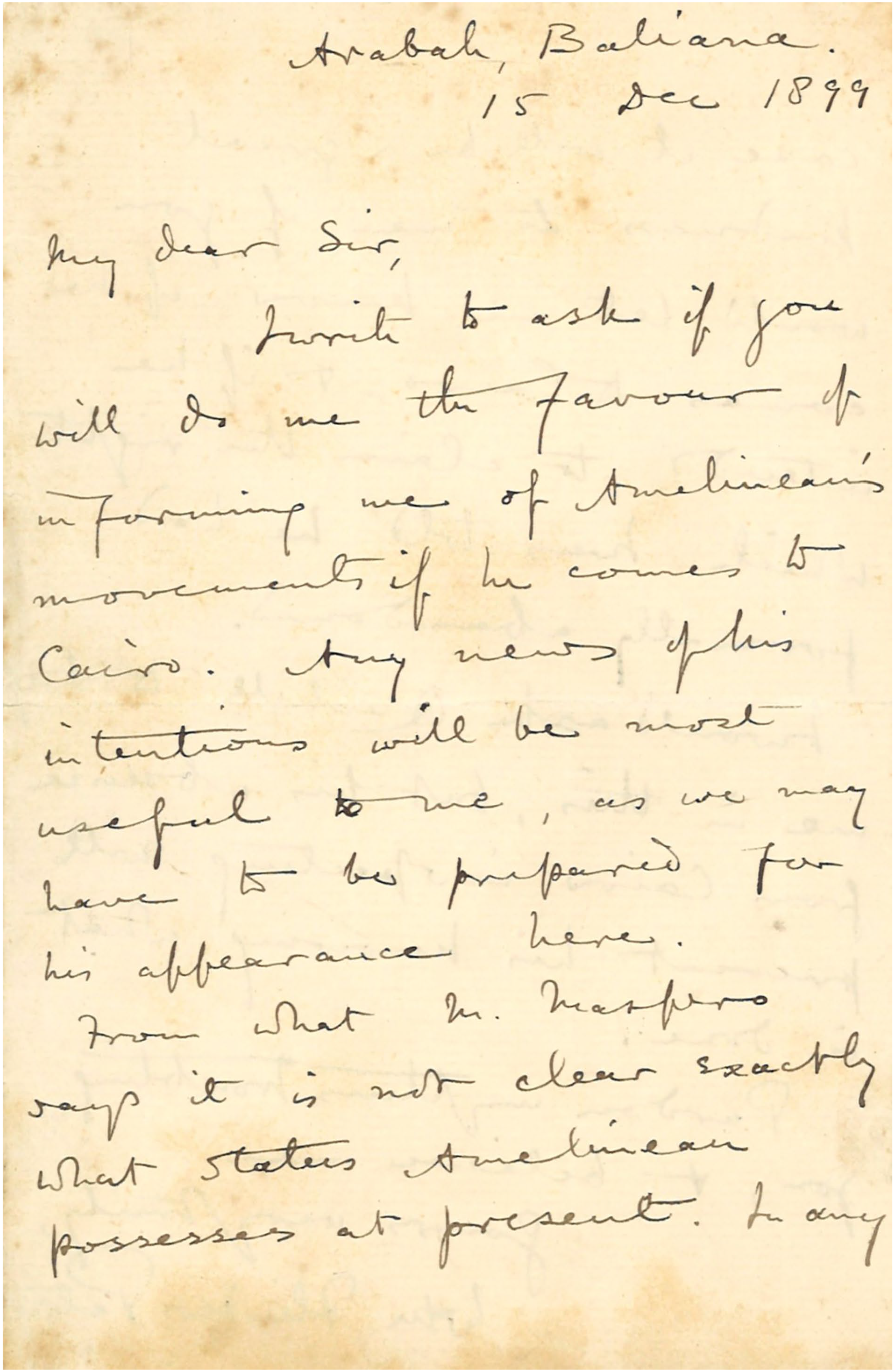
Letter of 15 December 1899 from Petrie to von Bissing, recto (Allard Pierson Museum Archives).
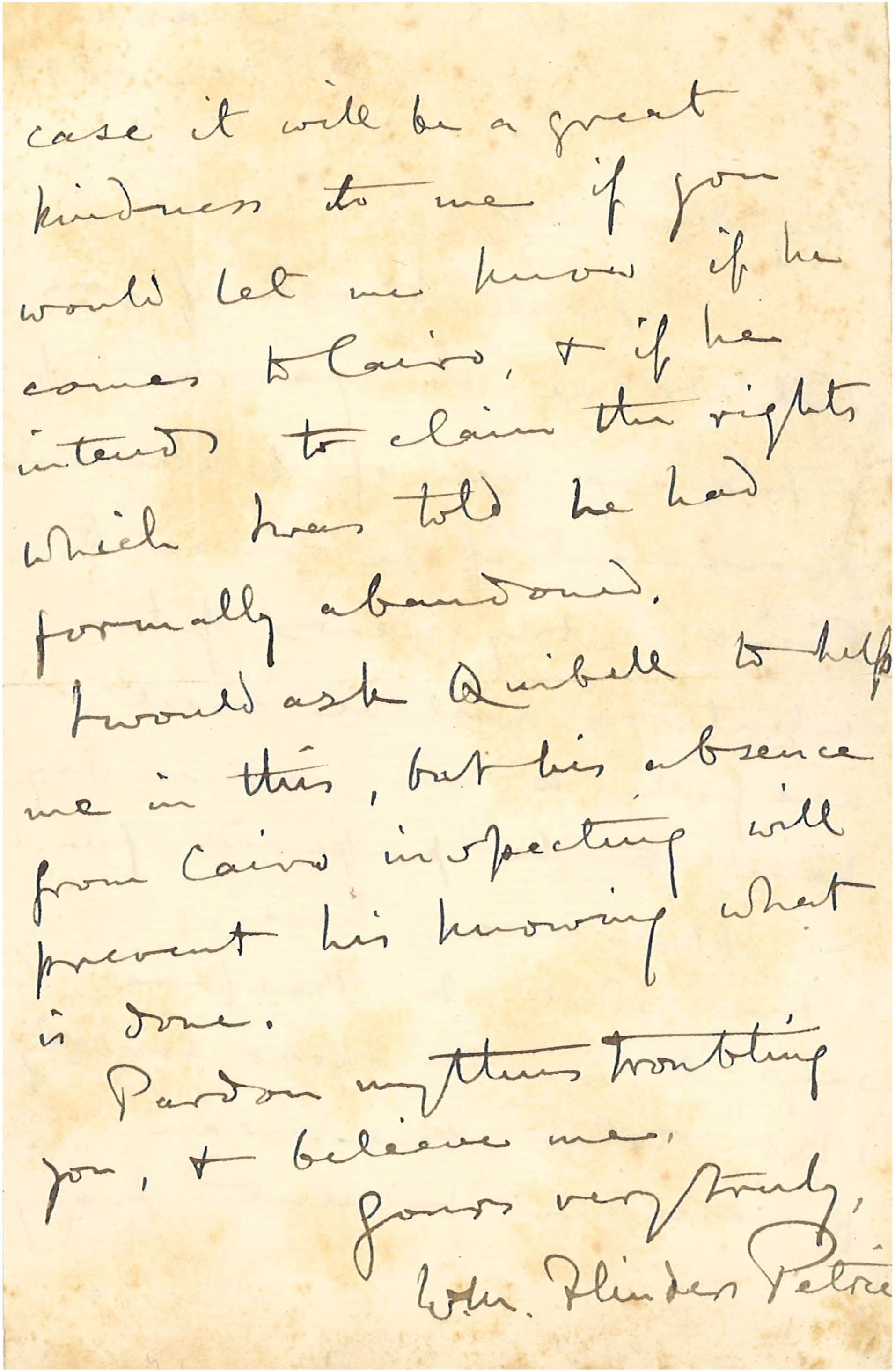
Letter of 15 December 1899 from Petrie to von Bissing, verso (Allard Pierson Museum Archives).
The reply by von Bissing is missing, but quotations from Petrie’s answer, dated 24 January 1900, are revealing:
. . . Many thanks for your / kind reply about Amélineau. / His new book seems to exceed / his old one in follies … We have good historical results / from the remains which Amélineau / had not the knowledge to destroy or / to utilize. But he has broken / every jar in the place, as he / said he would …
Petrie had secured his work permit at Abydos in a somewhat underhanded way. 5 Much of the correspondence is taken up with discussions of the bureaucratic and administrative procedures of the Service des Antiquités (such as Petrie’s failed efforts to obtain a permission to work in Saqqara 6 ) and the Egypt Exploration Fund and short reports about finds and circumstances in Abydos, the Fayum, Heracleopolis and Memphis. When compared in detail with existing publications, this can produce additional information on the work at these sites. For example, see the sketch with an indication of previous work done at the main temple of Heracleopolis by Naville (of which Naville himself does not provide a plan in his publication) and Petrie’s additional findings (fig. 3). 7 Additional biographical details on the individuals involved (such as personal sympathies and antipathies) are also supplied in the letters.
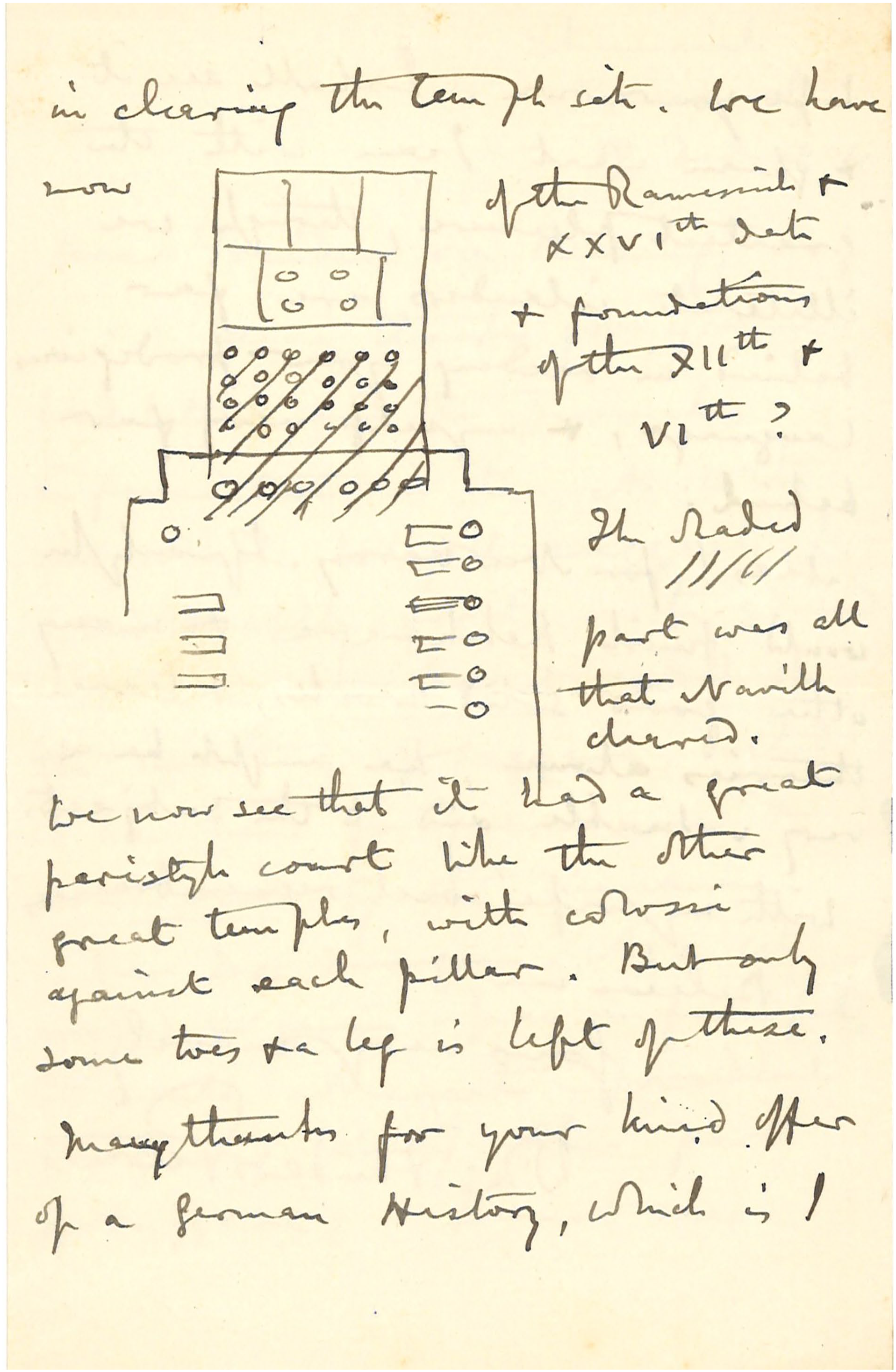
Page 3 of a letter dated 17 February 1904 from Petrie to von Bissing (Allard Pierson Museum Archives).
Many letters also contain proposals about exchanges of publications and requests for photographs, and suggested selections of objects for von Bissing in exchange for his contributions to the Egyptian Research Account/British School of Archaeology in Egypt excavations. A letter dated 5 August 1909 mentions the following: ‘We wish to know if you would care to have the pieces of Sankhkara’s shrine with names + graffiti, + pottery of offerings. The whole would be about 1 metre square’.
This should refer to the fragments from the temple of Sankhkare Mentuhotep III at Thot Hill, excavated by Petrie in 1909. 8 Apparently von Bissing accepted the offer, because he donated what must have been the same group of objects in 1934 to the Rijksmuseum van Oudheden in Leiden. 9
Petrie invited von Bissing frequently to come to London and stay with him, but it is uncertain whether von Bissing ever visited him there (although he did meet him in Egypt).
Footnotes
Funding
The author did not receive funding for this project.
1.
M. L. Bierbrier, Who was Who in Egyptology (4th rev. edn; London, 2012), 17 (Amélineau), 60 (von Bissing), 359 (Maspero), 428 (Petrie), 450 (Quibell). More details on von Bissing in P. Raulwing and Th. L. Gertzen, ‘Friedrich Wilhelm Freiherr von Bissing im Blickpunkt ägyptologischer und zeithistorischer Forschungen: die Jahre 1914 bis 1926’, JEgH 5 (2012), 34–119.
2.
Chr. Loeben, ‘Die ägyptische Sammlung von Friedrich Wilhelm Freiherr von Bissing, die “Musea Scheurleer”, das “Museum Carnegielaan 12” in Den Haag und der Ankauf der Bissingschen Sammlung durch die Stadt Hannover’, in Ch. Loeben (ed.), Die Ägypten-Sammlung des Museum August Kestner und ihre (Kriegs-)Verluste (Rahden, 2011), 101–10.
3.
French scholar, conducting heavily criticised excavations in the royal tombs at Abydos before Petrie (M. Étienne, ‘Émile Amélineau (1850–1915): Le savant incompris’, Archéo-Nil 17 (2007), 27–38, especially 33). Criticism is not only made repeatedly and in detail by Petrie himself (Royal Tombs of the Earliest Dynasties II (EES EM 21; London, 1901), 2), but also by his contemporaries G. Maspero (Études de mythologie et d’archéologie égyptiennes VI (Paris, 1893–1916), 153–82) and J. de Morgan (Ch. Lorre, ‘Jacques de Morgan (1857–1924) et son rôle dans la découverte de la préhistoire égyptienne’, Archéo-Nil 17 (2007), 39–56, especially 47), who worked in Abydos, as well. Both were successively Directors General of the Service des Antiquités.
4.
Former pupil of Petrie, at that time working for the Service des Antiquités.
5.
M. S. Drower, Flinders Petrie: A Life in Archaeology (London, 1985), 249–73.
6.
Drower, Petrie, 272–3.
7.
See E. Naville, Ahnas el Medineh (EES EM 11; London, 1894), 1–14; and W. M. F. Petrie, Ehnasya (EES EM 26; London, 1905), pl. I.
8.
W. M. F. Petrie, Qurneh (BSAE 16; London, 1909).
9.
G. Vörös, ‘The Ancient Nest of Horus above Thebes: Preliminary Study of the fragments deriving from the Thoth Hill Temple’, OMRO 77 (1997), 23–9.
Author biography
Willem van Haarlem studied Egyptology at the University of Amsterdam. In 1989 he became Curator of the Egyptian Department of the Allard Pierson Museum in Amsterdam. From 1991 to 2014 he was director of the excavations at Tell Ibrahim Awad in Egypt. In 2014, he received his PhD from the University of Leiden.