




Abstract
This article examines critical ethnographic and archival elements of Paradise Camp, Yuki Kihara's highly celebrated Aotearoa New Zealand national pavilion at the Venice Biennial in 2022. Through its scenography that in Kihara's words is “fa’afabulous,” consisting of archival collages drawn from museum collections and staged photography made after Gauguin's paintings in collaboration with queer Sāmoan communities, we argue that Kihara's heavily annotated version of a so-called paradise assembled within Paradise Camp offers a ‘potential museum’ that reconnects the missing links between colonial registrations of the past with today's queer Sāmoan lives. This queer Indigenous reconfiguration of a fabulous paradise, which refuses imperial understandings of Pacific people and geographies, seems central to Paradise Camp's queer ‘camp’ effects, much like an eye roll that dethrones authority. Therefore, we propose that such an artist-fabulated museum lays claims to an Oceanic sovereignty, and broadly fosters a shared world for Fa’afafine and queer Pasifika peoples.
Paradise Camp is the title of Yuki Kihara's highly celebrated national pavilion of Aotearoa New Zealand at the 59th Venice Biennale in 2022. Curated by Australian Natalie King OAM along with Sāmoan/Pākehā assistant curator Ioana Gordon-Smith, it is largely conceptualized by the representing artist Kihara (born in Upolu, Sāmoa in 1975), an interdisciplinary artist with Sāmoan and Japanese heritage. Kihara is Fa’afafine, which refers to being assigned “male by birth, embraced in traditional Sāmoan life by living feminine and non-binary lives,” one of cultural genders, which has a masculine counterpart termed Fa’atama (McMullin, 2022: 159, note 2). 1 As the very first artist to represent Aotearoa at this major art world showcase with the intersectional identities of Pasifika 2 , Asian, and queer, it is striking that Kihara composes a hybrid scenography of ‘paradise.’ The Venice iteration of Paradise Camp interweaves colonial archives, historical photos, media reports, a video performance, staged photographs of Fa’afafine and Fa’atama communities, as well as a floor to ceiling wallpaper image of the ocean taken from the shoreline hit by the 2009 tsunami. During its exhibition she programmed three online and two multiple day Talanoa forums titled “Swimming Against the Tide,” which brought in the Pasifika tradition of open-hearted discussion amongst people differently positioned in relation to variables of identity. 3 Kihara's work explicitly addresses the shared basis of conflict and difference, but to what effect on the visitor? And for whom, what kind of shared worlds are being created in her Venice exhibition? Beyond being an illustration of Sāmoan history from an indigenous Pasifika perspective, her non-dualist approach to difference should be understood as central to her practice as a Sāmoan artist whose role is to mediate conflict, creating beauty from harmony in aesthetic as well as social contexts.
In reviewing earlier works by Kihara, US-based anthropologist in the field of World Art Studies, Pamela C. Rosi suggests that these potentially conflicting personal identities at the intersection between Asian and Pasifika, male and female, heterosexual and homosexual “are a stimulating source for keeping [Kihara's] vibrant art true to her own vā-space – the space-in-between” (Rosi, 2007: 73). Kihara herself speaks of her Vārchive that is brought into Paradise Camp: a compound word for vā (space) and archive. It refers to the socio-cultural space she inhabits that is filled in with historical pasts, community memory, and learned knowledge from skills and tradition that she draws on in her creative process. In explaining this term, she references Sāmoan poet Albert Wendt (1999) who articulated Vā as an in-between space that connects diverse social relations and categories of things. 4 According to Tongan philosopher ‘Ōkusitino Māhina's theory of pan-Pacific history, from a Moana 5 perspective, all art is the modus operandi for transfigurations of Tā-Vā (time-space) that is expressed through transformations of form and content in physical mediums and social praxis (2010: 86–87, 89). In short, Tā-Vā is the abutting experiences of walking forward into the past while walking backward into the yet-to-take-place future, a movement in time-space that constantly mediates an ever-changing present. 6 The Pacific Islander anthropology scholars Ka’ili et al. (2017), in their role as guest editors of the Pacific Studies Journal, elaborate how the notion of Tā-Vā (time-space) in the Moana forms a theory of four-dimensional reality in which Tā-Vā are “inseparable ontological entities, […] the common medium in which all things are” (4). They criticize how often Vā (space) is usually considered in isolation from Tā (time) in scholarly writings on Moana, despite being of equal importance in Oceania people's theories of reality and lived realities (12–13). 7 Likewise, we see that our analysis of Paradise Camp should also “underscore the abiding importance of ancestral guidance across time” in a way that does justice to its ontological and epistemological world view (Ka’ili et al., 2017: 13). By way of collage techniques, Kihara's Paradise Camp merges historical images and contemporary media, exercising a refusal of the predominant Western linear arrangement of past in the back, present in the middle, and future in the front. The yawning present opens to draw in indigenous fa’afafine's relations with their community, Pacific histories, and the Oceanic world, propelling a future that reworks the conflictual colonial, racial, and sexual boundaries.
While we are not indigenous to Moana, our article proceeds so as to recall Kihara's hybrid use of collage as an artistic means of research, that is, we do not present her work chronologically or by following a thematic order. As scholars of visual culture and art history, and not of anthropology, we will focus foremost on the material sources provided by exhibition itself rather than the wider socio-cultural context or specific experiences of those living in Moana. We have employed art historical methods of observing the exhibition first-hand, interviewing the artist, consulting scholarly literature, and performing visual analysis. From these we layer our analysis with a consideration of the intervention the work as a whole is making in the art world and local social worlds. While we are located in the Netherlands, it is worthwhile to explain that we are writing together across positional differences that are highlighted by Paradise Camp: one of us is racialized as white and the other as Asian, one from the Southern US state of Kentucky and the other from Taiwan, one relating to being a non-binary trans person and the other a cisgender gay man, and both of us finding belonging in transnational queer communities.
Alongside indigenous Moana thinkers of art and ontology, we include in our theoretical framework the concept of ‘potential history’ from the cultural theorist Ariella Aïsha Azoulay (2019). She develops this notion to counter the imperial ideology extended through museums and archives that tend to prioritize particular objects, knowledge, and colonial relations in the name of scientific objectivity and historical progression while studiously ignoring actual indigenous and undocumented people. Rather than privileging the institutional narrative and accumulation of Indigenous artifacts that have preconditioned Western disciplines such as art history and anthropology, with her notion of the potentiality of an anti-imperial history, Azoulay seeks to redraw shared relations between time, space, and body destroyed by imperialism and continuously governed by Western institutions. With its strong emphasis on unlearning the colonial divide, with foregrounding fa’afafine knowledge and ways of knowing, we see in a Paradise Camp a potential fa’afafine museum.
In what follows, this article will first retrospectively connect the archival assemblage in Paradise Camp with Kihara's earlier collage practices, such as in the series Coconuts that Grew from Concrete (2017), 8 that juxtaposes art-historical and ethnographic images in order to expose their shared imperial gaze, what Azoulay has termed the photographic “shutter” that captures and divides an object from its people (2019: 1–8). Here, we suggest Kihara's persistent collage practice creates an interconnected Vā-space that dissolves the colonial imagination of the European self and Pacific others. Then, we shift to analyzing how the artist's drag as Gauguin humorously collapses the binary temporalities of then and now, a production of “temporal drag” to borrow American queer theorist Elizabeth Freeman's theoretical concept for non-linear temporal encounters (Freeman, 2010: 62–65). Temporal collapses and interpenetrations can also be found in her long-term photographic practice of re-staging ethnographic photography with posed performances of gendered ‘ethnicity,’ such as in the series In the Manner of a Woman (2004–2005). We conclude by reflecting on how through critical visitorship and artistic interventions, the potential fa’afafine museum effectively rearranges museal scripts and fixed roles for colonizer/exotic racial “other” by insisting on the complexity of urban and contemporary Indigenous experience. We situate the Paradise Camp TV program of “First Impressions” within the artist's long-standing projects of assembling Talanoa. In this talk show styled Talanoa, a multifarious positionality of being, extending from the Vā-space and Fa’afafine perspective on the world is taken up by Sāmoan Fa’afafine and Fa’atama community members whose lived experiences of gender and sexuality are the lens to work through colonialism, art history, and the present climate crisis.
In these ways, the article responds to this volume's question: What does it mean to think about histories of gender and sexuality through the local cultures and temporalities to which ethnographic objects rightfully belong? Looking through the fabulous cohabitation of ‘camping out’ together in Paradise Camp, Kihara's archival, collage, and photographic practices put pressure on the binary categories that divide artistic from ethnographic visual/material culture. Her works dissolve these distinctions through their creative insistence upon the significance of queer Sāmoan voices found within Gauguin's legacy and transnational ethnographic collections. How, then, does gender function as an expression of spatial configuration within this exhibition context? Can we view gender as a spatial assemblage that takes place between and among the archive, memory, and embodied expression of Indigenous culture? Hence, we argue that Paradise Camp constitutes a potential museum for queer Sāmoans, in that it tethers a meaningful interpretation of its assemblage of a variety of objects to a willingness to see, to be, to cohabitate within the Fa’afafine Vārchive fabulously.
Being in Paradise Camp
Occupying half of a very central exhibit room in the Arsenale, the Paradise Camp pavilion is composed of three parts: the Vārchive, Paradise Camp photographs, and a single-channel video. The first part consists of an assemblage of various printed images such as archival photos of colonial encounters between Sāmoans and Westerners during the nineteenth and twentieth centuries, news clippings about the Pacific islands’ climate disasters and COVID-19 crisis, colonial photography and painted images of Sāmoan land and people mostly depicted by western colonizers and artists such as Thomas Andrew and Paul Gauguin, as well as reproductions of the artist's passports showing the shift of the gender maker across ‘M’, ‘X’, ‘F.’ The second part dazzles the viewer with a series of highly saturated color photos mounted on two walls covered in a panoramic view of a sandy coastline looking to sparkling blue waters. In the distance, one can see the island the German colonizers made into a quarantine island for those infected by (dying of) the diseases they brought. In these images, a group of Fa'afafine (in the manner of a woman) and Fa'atama (in the manner of a man) communities are posed by the artist in a remaking and ‘upcycling’ of Gauguin's paintings, repurposing Gauguin's compositions “from the currencies of canonical art history,” to redirect the viewer's attention “to the concerns of contemporary Pacific Islanders,” expressly those who are Fa’afafine (Childs, 2022: 113). The third part consists of a vertical column with poster-like photographs and a single-channel video depicting Kihara's drag persona as Gauguin, her cosmetically enhanced drag performance as the late-nineteenth-century Frenchman, whom she interacts with as Yuki Kihara the fa’afafine artist showing in the 59th Venice Biennale.
We suggest that Kihara's upcycling of Gauguin's compositions and her multifaceted archival scrapbooking, displayed on the walls of the Arsenale in a manner that transforms it into her artist studio, serves to create a uniquely Sāmoan musée imaginaire. Through the artist's counter-archival methodology of bringing to the foreground the lives and embodied experiences of Fa’afafine, Kihara reshapes the colonial cultural archive of Sāmoa and Polynesia more broadly. This mode of de-routinizing habitual western understandings of ownership and the gaze seems central to Paradise Camp's queer ‘camp’ effects, much like a campy eye roll that dethrones authority, getting habits unstuck in the process. 9 Notably, it was one of the most visited pavilions and perhaps its popularity owes to the approachability of the work presented and the very apparent fun taken in creating them. 10 Both authors felt a sense of respite in the “camp,” a feeling of being amongst community in which queer folks were in charge and not just represented. In the curator's words, Paradise Camp presents a “multifarious position of being” (King, 2022: 27), what Kihara calls a Vārchive that brings into the time-space of the installation the pressing presence of Fa’afafine and Fa'atama embodiment and their imaginary (King, 2022: 27). Kihara remarks in her mock dialogue with Gauguin that Paradise Camp is “Fa’afafine-fabulous.” We take this claim seriously in order to see what such fabulous cohabitation may mean for potentializing a Fa’afafine museum. The fabulosity of Kihara's artist-imagined museum is what we think effectively casts a critical eye and a queer Sāmoan vision toward the ethnographic collection established by colonizers.
Paradise Camp has received a significant amount of media attention and many raving art reviews, and the critical writing on it also includes an elaborate exhibition catalog that analyzes Kihara's artistic projects in recent years. What has been insufficiently discussed is how Paradise Camp echoes Kihara's long-term artistic engagement, since the early 2000s, with complicating the binary of art and artifact. She both refigures ethnographic images, objects, and performances as contemporary art and, working in the opposite direction, insists that canonical artistic works are, in fact, a visual archive of Fa’afafine presence in history. That said, our goal in analyzing Paradise Camp as a site for a potential Fa’afafine museum is not to produce a chronology of her artistic development that seems to lead seamlessly to Paradise Camp as the apotheosis. 11 (We heed Azoulay, who warns that linear history is often employed to highlight an imperialist sense of inevitable progression rather than a history punctuated by ongoing Indigenous resistance). Our contribution to this volume's attempt to think about objects in collections from varying standpoints, especially regarding the question of gender, is to show how Kihara offers fabulations and speculations to achieve a potential Fa’afafine museum that thoroughly challenges the “active working memory” of both the Western art canon and ethnographic collections (Assmann, 2008: 97–99). In this vein of reconstituting the working memory of and about Sāmoa as a place and a living culture, we aim to draw out Kihara's artistic moves between historical archives, artifacts, and images to demonstrate a potential history that repurposes colonialist representations of Sāmoan people and honors their connection with the world in the wake of longstanding ecological crises and a pandemic present.
A potential Fa’afafine museum
Many of the archival photos and drawings in Paradise Camp come from various museum and library collections of (settler) colonial countries, including Australia, Belgium, France, Germany, New Zealand, and the United States. Far from a neutral repository of historical memories, Kihara recognizes the biased representation and knowledge production within these archives that are primarily framed by the colonizers’ gaze, thus revealing their worldview rather than voices of the colonized/collected others. Paradise Camp thus takes up a position we understand as a ‘critical visitor’ to these museum collections. 12 Throughout her artistic career, Kihara has continuously researched objects, stories, and trajectories of Sāmoan, other Pasifika peoples, and Oceanic collections in and across various museums. The importance of this critical visitorship for her creative practice is concretized by how Kihara regularly films moments of Indigenous people encountering their cultural heritage in museum depots, a staged scene of encountering objects that works to challenge colonial claims to ownership and knowledge production.
Kihara also takes these so-called artifacts of the past, as they are treated in ethnographic practices of collecting, documenting, and experiencing Indigenous culture, directly into contemporary art spaces. In 2011, she examined the collection in the Weltkulturen Museum in Frankfurt and found objects left by Sāmoans who performed at the human zoo in nineteenth-century Hamburg. This research resulted in Culture for Sale (2011), a performance project that invited contemporary Sāmoan dancers to re-enact the human zoo scene by performing their skills within the museum's aestheticized gallery space. Kihara instructed the performers dressed in traditional ways to hold themselves entirely still, just like they were an exhibit while waiting for the museum visitor to put coins in a bowl placed in front of them; only then did the performers start to dance for a length of time according to how much money was paid. This on-site gallery performance negotiates the complex colonial relationship between the Sāmoan performer and the visitor in which the uneven economic exchange, circuited through racial difference, becomes emphasized and admittedly even reaffirmed (Treagus and Seys, 2017). 13 Prior to the Venice exhibition opening, Kihara was also a research fellow at the National Museum of World Cultures in the Netherlands, resulting in her latest project, Going Native (2019/2022). This exhibition displays ethnographic artifacts such as a drum, bark paintings, and wood carvings from the Oceania collection as artistic objects to be aesthetically appreciated for their beauty (which they originally were). These exhibits are located next to screens of three videos of interviews with Dutch people who cultivate cultural knowledge and enact Indigenous culture: the Māori waka (canoe), hula (dance form), and Aborginal Yolŋu yidaki (didgeridoo music).
Both projects arise as a creative response to the problem of appropriation, namely, who has the right to perform and to view (in)tangible culture in the ethnographic or art museum. We want to suggest that Kihara's primary critical visitorship to museum collections becomes a secondary scene for others to enter: to follow her in and to take up and disarray the roles scripted by the ethnographic/art museum of the presumptive colonial visitor, colonial owner, and excluded Indigenous Other. By switching around the typical bodies who engage in these scripts and enact particular roles, Kihara shakes off the ethnographic and art museum's largely static image of Pacific cultures relegated to the past, as constructed by colonial encounters. We see in her oeuvre a strategic deployment of archival images, ethnographic artifacts, and colonial scripts in ways that seek to redraw the fixed relationships between them and break with reified positions of value judgement and of temporal orderings. In many ways, Paradise Camp demonstrates how Kihara creates movement between different objects, images, and relations; her artistic moves are also epistemological as they effectively reshape knowledge of cultural and social categories.
We situate Kihara's artistic move between images and artifacts within the broader decolonial and indigenous movement in the twenty-first century art and ethnographic museums. The division between art and artifact, despite being reflected and contested in both the discipline of art history and anthropology since last century, remains largely in place as a “moot” paradigm suggested by Canadian art historian Ruth B. Phillips (2022: 52–53). The consequences of this division, as Mexican decolonial theorist Rolando Vázquez Melken points out in his interview with Rosa Wevers, are profound: The museum is not made for publics that are located at the other side of the colonial difference. Museums, and here the ethnographic museum is a clear example, are representing the other at the other side of the colonial difference, classifying them, speaking about them, but not serving them and considering them as spectators: they are the ones that are seen, not the ones that are privileged to see (Melken in Wevers, 2019: 2).
The three-part scenography of Kihara's heavily annotated version of ‘paradise’ – a paradise reclaimed from Gauguin, redressing the sexual-racist violence of depicting Polynesian women as ‘dusky maidens,’ as well as condemning a polluting tourism industry, the nuclear testing in the mid-twentieth century, and today's climate change that are decimating the islands – altogether assembled within Paradise Camp offers a ‘potential museum’ that reconnects the missing links between colonial registrations of the past with the Vārchive of Fa’afafine Sāmoan lives. 15 Here, our use of the term ‘potential museum’ echoes Azoulay's (2019) notion of ‘potential history’ that recognizes how photography, archives, and the museum are part of the imperial mode of knowledge-making and colonialist destruction that divides the people from their objects, time, and world. Thus, through a reparative process that she calls “unlearning” of these institutionalized ways of thinking and professional practices, she proposes that we learn to think with these people and objects as cohabiting in a potentially shared world, a world that has not been conquered and displaced by the imperial power.
A potential history is a crucial thought experiment that forces one to contend with the one-sidedness of historical narratives. However, we can see in Paradise Camp the material actualization of a potential museum in that it spatializes and temporalizes the conflict as shared through the Fa’afafine vā-space. The imperial order is not utterly jettisoned, but it is decentered and scrambled into meaning created in light of tā-vā. This transformative process finds expression in the creation of “entangled objects” through techniques such as upcycling, collage, annotation, and scenography assembly, echoing Nicholas Thomas's exploration of material evidence that showcases indigenous appropriation of European objects to challenge the dominant Western imperial narrative (Thomas, 1991).
Azoulay's calling for rebuilding a shared world is, in some ways, nothing new, as it closely resonates with Indigenous and anti-imperial thinking. According to the scholar of Pacific Studies Epeli Hau‘ofa, European colonialism profoundly shapes the Pacific Islanders’ self-images by dividing time between dark barbarism and the bright progress brought by Christianity (2008: 28). Cartographically, international laws and western-dominant worldviews see islands as small and isolated from the continent. However, Hau‘ofa argues that Oceanic culture, capaciously kept in mythology, oral histories, and local traditions, reflects the world beyond their land surface that remains closely connected with the ocean surrounding their islands. Rather than seeing themselves as living on isolated islands, thousands of years of cultural connectedness through extensive trading networks, a widely shared lingua franca, navigation techniques, and cross-island kinship have proved otherwise (Hau‘ofa, 2008: 30–39). Accordingly, Hau‘ofa claims that Pacific islands are not tiny, remote islands but represent a very vast and cohabitant world, a “sea of islands,” based on the Oceanic worldview (31).
Seeing Kihara's Paradise Camp as a potential museum then, as we wish to propose, refuses the imperial modes of the divide, conquer, and collect that continues to fragment the Oceanic world and its own self-understanding. Instead, it potentializes a reparative museum that repairs the Oceanic time, space, and people that have been divided/damaged by the oppressive temporal order of imperial power that comes through colonial institutions such as archives and museums, which impose European modernity, “not as a world-historical period, but specifically to speak of the Western project of civilization,” clarifies Vázquez (Vázquez in Wevers, 2019: 7). In many ways, Paradise Camp offers a potential history of Sāmoan people's worlding-making, but one also entangled with colonial contacts, through its archival assemblage and visual re-enactment. By doing so, Kihara's artistic vision compels the visitor to critically rethink the binary categories between European and Oceanic, male and female, art and ethnography, those binaries that have been historically and culturally constructed by the imperial museum.
Collaging the Vārchive collection
Entering Paradise Camp, the visitor is guided to the right, a corner wall called the Vārchive that begins the installation with a colorful, dizzying constellation of printed archival photos, photographs of fish species and news clippings glued to a map of the Pacific islands, portraits of recently deceased ancestors hung high to signify their importance, nineteenth-century photographs of Sāmoan suspected to be Fa’afafine, and broadly historical paintings and drawings of Pasifika peoples who are possibly Māhū (meaning a gender ‘in the middle’ in Native Hawaiian and Tahitian cultures) or Indigenous queers. The artist collected these contemporary and archival images to create a sense of Vā, a connected cultural space in the Sāmoan tradition. Discussing her artistic research process, Kihara references Sāmoan poet Albert Wendt's definition of Vā: Vā is the space between, the betweenness, not empty space, not space that separates but space that relates, that holds separate entities and things together in the Unity-that-is-All, the space that is context, giving meaning to things. The meanings change as the relationships/the contexts change. (Wendt, 1999: 402)
Through connecting seemingly unrelated stories and moments – fish that change sex, destruction from a tsunami, a community member who died by alleged suicide – the artist threads a Vā, a connective space that gives meaning to the relationship between Fa’afafine, the histories created about them and by them, and their living environment. 16
Rather than the state-owned archive building that gathers status and power from being a temple or crypt with relics, such as Achille Mbembe describes (2002: 19), Kihara's counter-archive is enclosed by the Sāmoan barkcloth siapo, a pattern of seeds that float and give new life, a pattern made by the late Sylvia Hanipale, her own teacher in this art form. Rather than the internment of documents in the state archive that tends to suppress the presence of queer Sāmoans, to refuse them as authors of their own lives, Kihara's authorial signature writ large on her artistic archive makes the Fa’afafine experience very present, lively, in harmony with the environment. These archival materials, like a photograph of Kihara standing in Apia, the capital city of Sāmoa, amid an extreme flood in 2020 and Kihara's three passports with different gender registrations, are visual lessons that help the viewer to read the nuance from these different archival spaces, to read the sprouting Vārchive between the lines. The Vārchive, as presented here, is a part of Kihara's own research process that collects and assembles materials in a collage-like fashion in order to identify the intersecting lines of imperial ordering and the weave of Indigenous life. Such assemblages that mix and match materials bring new meaning to the fore, and it include examples from her earlier notebooks that are also published in the exhibition catalog and presented in her early collage series we discuss below.
During her training in textiles, fashion, and design, Kihara embarked on an exploration of the historical visual representation of Pasifika people, a journey initiated by an assignment requiring her to investigate regalia in various world cultures. Her research took a pivotal turn when she stumbled upon a book filled with early twentieth-century postcards and photographs (Wolf, 2010: 27). This discovery prompted Kihara to reevaluate the pervasive imagery of the Pacific within the framework of European visual traditions and ethnographic depictions. In recognizing the omnipresent “imperial shutter,” in Azoulay's term, pervasive throughout the visual archive, Kihara became acutely aware of its role in separating people from their cultural heritage. Her artistic approach involved skillfully superimposing ethnographic photographs, which illuminated the recurring theme of imperial dominance manifest in the divisions within archival images. This creative gesture served to construct a collective anti-colonial vision, one we propose as the foundation of what we term a Vārchive of resistance.
The utilization of collage to emphasize the recurrence of colonial narratives across various forms of media represents a resilient Sāmoan counter-archive. These themes were further developed within Kihara's solo exhibition, “Coconuts that Grew From Concrete,” held at Artspace, Auckland, in 2017. Here, ‘coconuts’ carry a dual meaning. Firstly, it has been derogatorily used to describe the Pacific diaspora residing in urban areas of New Zealand, Australia, or Western countries. Secondly, from a Sāmoan perspective, coconuts symbolize prized fruits capable of drifting across the ocean and taking root in new lands, thus providing sustenance to emerging communities (Kihara, 2017: online n/p). Within this exhibition, Kihara showcased a digital collage series Noa Noa (After Gauguin) (2017, Figure 1), that converges both the colonial and diasporic worldviews. Noa Noa (fragrance) was the name that Gauguin gave to his notebooks containing materials like postcards, drawings, and ideas noted down over a decade during two trips to New Zealand and then staying on Tahiti and the Marquesan Island of Hiva Oa, French Polynesia. In Kihara's version, she researched to collect and then collage forty-six images that merge nineteenth-century ethnographic photography of Pacific people, mostly female nudes, often used as carte de visite, with European oil paintings of women posed in the exact same manner made by male artists such as Titian, Boucher, and Gauguin.
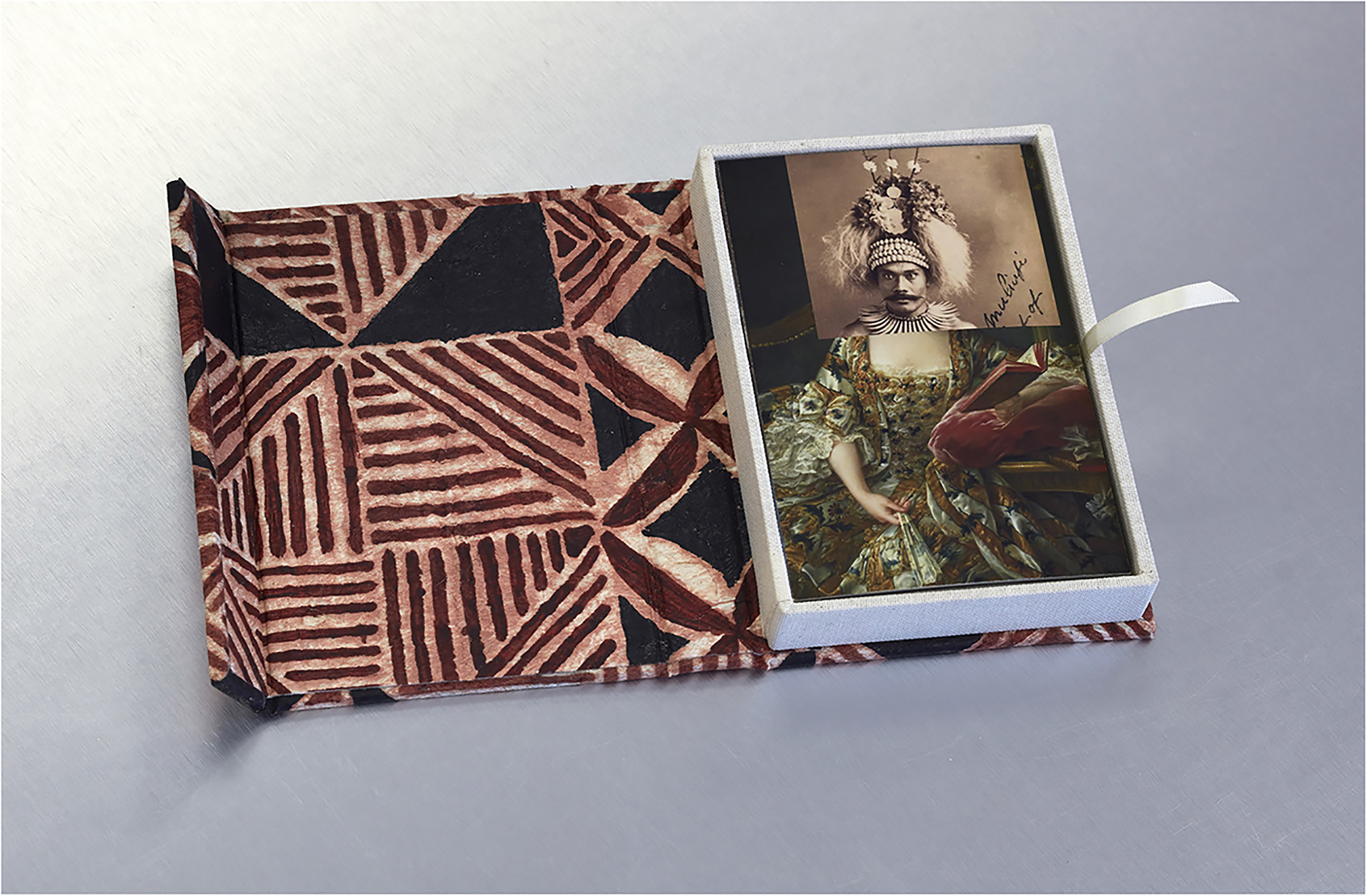
Yuki Kihara, Noa Noa (After Gauguin), 2017, handmade paperboard box covered in siapo cloth containing 46 postcards with digital collage. Courtesy of Yuki Kihara and Milford Galleries, Aotearoa New Zealand.
“Coconuts that Grew From Concrete” has been realized as an art gallery exhibition, a digital postcard catalog, and a hand-made paperboard box decorated in siapo cloth. These versions allowed Noa Noa (After Gauguin) to travel between physical and digital spaces and reach mixed audiences who would recognize the colonial, canonical, and Indigenous content. By doing so, the artist does not only revisit the nineteenth-century imperial visual culture to demonstrate the force of this long-standing and pervasive gaze on patternings of gender, race, and landscape but also enacts a meaningful and lively Pasifika Vārchive from this visual economy of arranged bodies, many of which are reclaimed as material evidence of Sāmoan history and agency.
Referring to Gauguin's legacy of traveling in search of an idyllic Eden only to represent it framed from within his own cultural gaze, Noa Noa (After Gauguin) (2017) creates a series of double visions that compellingly reflect on the odd sameness created by colonial discourses of difference. It thus challenges the visual hierarchy between European portraiture as a dignifying genre of paintings and ethnographic photos of Sāmoan as a racializing/sexualizing genre by appropriating possible poses and costumes from one another to demonstrate the mirroring effects across these images. In the first set, Kihara crops around ten images of European portraiture of historical royal figures and slots them into the same poses arranged in nineteenth-century ethnographic photography of Pacific Islanders, mainly shown as nudes. By doing so, the dignified form of European portraiture gains the erotic charge expressed in stereotyping representations of Pacific people, or perhaps these images gain a respectable veneer. While the former visual form expresses the individuality of European royalty and the latter captures generic Sāmoan and other Pacific Islanders, their convergence troubles the visual hierarchy of the ‘subject’ in the Western art world system.
In a second set of Noa Noa (After Gauguin), Kihara merges around 11 images of female nudes in court paintings (Titian, Velázquez, and Goya), classical mythology (Botticelli), and orientalism (Ingres) together with postcards of Sāmoan beauties (those ‘dusky maidens’). Specifically, the almost perfect superimposition of European and Sāmoan women's bodies (most of which are nude) reveals the shared schema of the colonial gaze with the male gaze in the European visual tradition. In the third set, Kihara further troubles the boundary of race, gender, and geography in this collage series. She pastes heads of European royalty into ethnographic photography, but also transplants three Sāmoan males’ heads wearing ceremonial chiefly headdresses with European court lady's dresses that make for fabulous gender and ethnicity transgressions. With the last few images of landscape collages, the artist merges three pastoral and landscape paintings (after Boucher, Lorrain, and Delacroix) together with postcards of Pacific paradise. The viewer is reminded of the shared visual schema employed by nineteenth-century white male artists, whether they render opulence, erotic, or valued land. In other words, the almost symmetrical convergence of the two images conflates the pictures of Europe and Oceania, producing a weirdly baggy and vast imaginary geography constructed by European colonizers and artists. By relating two respective spaces together, Kihara practices collage not only as a modern artistic technique but also as a Sāmoan philosophy of Vā that connects time and space together rather than separates them.
As we have seen, the artist mobilizes collage to disrupt the imperial camera that has captured the Pacific people through the “shutter,” in Azoulay's term. This artistic practice of reconfiguring the European-imagined geography by bringing time and space together from a different embodied and located perspective is further developed in the Vārchive at Kihara's Paradise Camp. Among the assembled panels, one of the very first lessons the artist teaches the viewer is how to unlearn the imperialist imagery that tends to replicate the colonizer's view of the Pacific islands. For instance, in Headlines, the second panel superimposes recent news headlines of the Pacific when COVID-19 broke out around the world over a sixteenth-century map made by European cartographer Abraham Ortelius. Kihara covers the map with sensational headlines while leaving exposed the expedition ship fleets, which are disproportionately larger than the Pacific islands. The outsized fleets drawn on the map reveal the colonial mentality of Europeans that understood the Pacific islands as an arena to express their domination. Such ships seen in conjunction with the headlines illustrate how the mass media renders Pacific islands as isolated, remote, and small. By doing so, the artistic collage of historical and media archives reveals the hidden colonial connection to how the Pacific is viewed today (Figure 2).
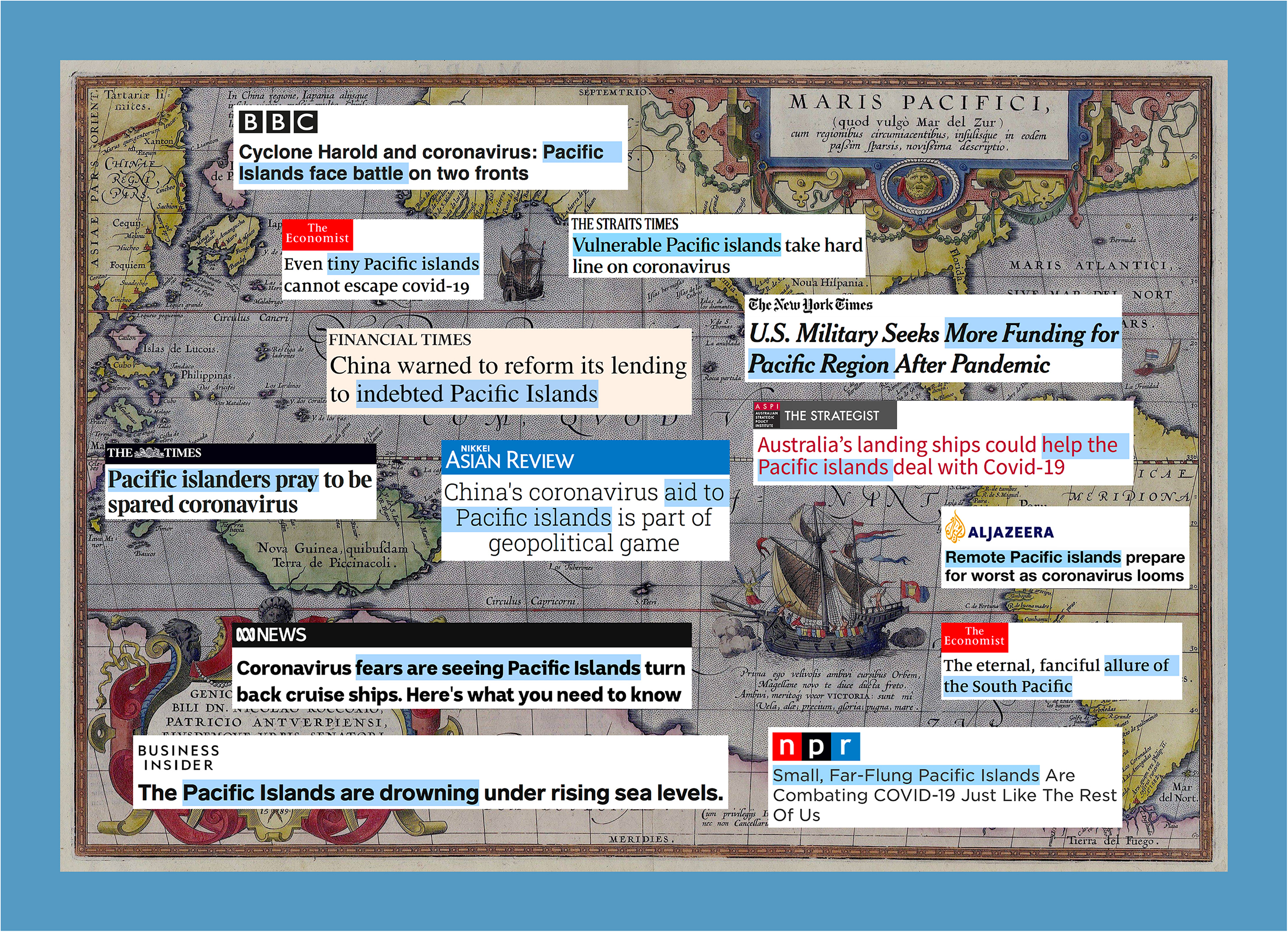
Yuki Kihara, “Headlines,” from the Vārchive as part of the Paradise Camp (2020/2022) series. Courtesy of Yuki Kihara and Milford Galleries, Aotearoa New Zealand.
Central to this Vārchive is the olive-green panel (Figure 3) that draws the historical relation between Gauguin and Sāmoa. Although this French artist never visited Sāmoa himself, Kihara suspects that he had drawn artistic inspiration from photographs of Sāmoan people he viewed during his trip to the Auckland Art Gallery Toi o Tāmaki and the Auckland Museum Tāmaki Paenga Hira in 1895. Thus, the panel presents Kihara's visual argument that Gauguin's sources for his famous Tahitian paintings are often lifted (and outright copied) from postcard photography of Sāmoan Fa’afafine, Fa’atama, men and women. In the first row, Kihara shows the New Zealand photographer Thomas Andrew's photograph of a Sāmoan man with a pe’a tattoo on his back (c. 1890). Then, the artist shows Gauguin's Three Tahitians (1899), in which the middle man with his back facing the viewer resembles the exact pose, size, and stature of the man in Andrew's photo. Kihara's collage of both images line up the man's bodily outline to demonstrate the extreme visual resemblance as if the painting was made from tracing the photograph. In the second row, the artist replicates this collage method with Gauguin's Sacred Waters (1893), in which the former is matched precisely with a photograph of a waterfall and an Indigenous person next to it taken in Sāmoa.
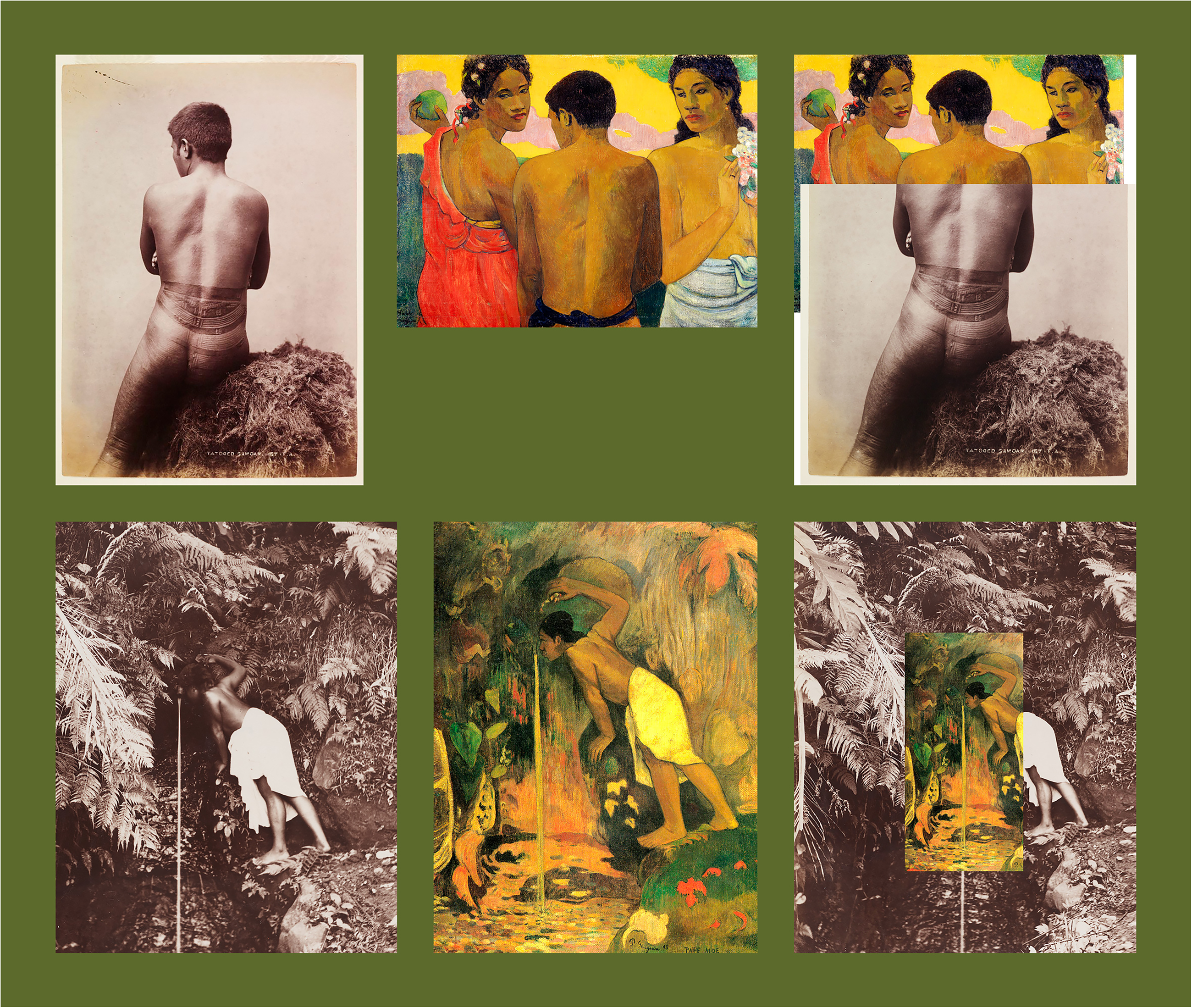
Yuki Kihara, “Gauguin and Sāmoa,” from the Vārchive as part of the Paradise Camp (2020/2022) series. Courtesy of Yuki Kihara and Milford Galleries, Aotearoa New Zealand.
In the form of a collaged visual essay, Kihara exposes how Gauguin has manipulated photographs of Indigenous people to rip them from their original bodies and context, with no disregard for whether they are Sāmaons or other islanders: he passes them all off as Tahitians. 17 This artistic analysis unveils the pervasive impact of Gauguin's colonial fantasy. Furthermore, Pacific Studies researcher Vehia Wheeler and artist Mareikura Whakataka-Brightwell (2021) have critiqued recent museums for engaging with Gauguin's colonial legacy in collaboration with Indigenous Pacific artists, notably without representation from French-speaking Tahitians. This institutional neglect is duly acknowledged. However, Kihara's essayist collage demonstrates that Gauguin's colonial fantasy extends beyond Tahiti (Eshrāghi, 2022: 74).
In his Three Tahitians, Gauguin removed the Sāmoan man's pe’a tattoo extending from the middle to the knees and replaced it with a thin blue cloth. However, from the Pacific perspective, this tattoo is more than decoration but part of clothing, culture, identity and lifestyle (Mallon and Galliot, 2018; Wendt, 1999). As Wendt (1999) has argued: “Being clothed (lavalava) had little to do with clothes or laei. In pre-Papalagi [foreign/European people] times, to wear nothing above the navel was not considered ‘nakedness.’ To ‘clothe’ one's arse and genitals was enough” (400). Māhina (2010) further expands on the importance of black ink in Oceanic tattoo arts, noting that it symbolizes a “time marker of body as space” (187). In this way, Gauguin's styling with a fantastical cloth over a naked back implicates the colonial gaze. It removes the tell-tale detail that this man was, in fact, a Sāmoan person (not a generic islander or Tahitian type). Through collaging these two images at the juncture of a horizontal line, Kihara restores the Sāmoan tattoo; as a result of this reparative act, Kihara's artistic collage creates a space of Vā that enables the viewer to detect and reject the colonial displacement of Indigenous time, space, and bodies.
To restore the ancestral roots of Fa’afafine within the archives, Kihara summons a visual constellation that evidences a queer Pacific world. Notably, the pink panel (Figure 4) next to Gauguin's archive displays photos and paintings of ‘potential’ queer existence made mainly by European artists. Despite the artist acknowledging that not all images could directly point to Fa’afafine, their potential queer expressions suggest a cohabitated Oceanic world that conjures Indigenous interconnectedness instead of colonial division. Here, Kihara visualizes the potential genealogy of queer Oceania through her constellation of Vā. On the top left are two photos of a supposed Sāmoan man taken by Englishman John Davis during 1873–77, which, despite the catalog card written in 1935 at the Cambridge Museum of Archaeology and Anthropology recognizing no queer identity (“Man from Tutuila, hair bound ‘Vignetted style’”), the American Sāmoan poet Dan Taulapapa McMullin and Kihara (2018) speculates that their outdated long hairstyle could be a sign of being Fa’afafine. Next to the photos is a sketch made by the American painter John La Farge who visited Tahiti and Sāmoa before Gauguin. His sketched painting Chiefs and Chiefesses Passing on Their Way to a Great Conference. Evening. Samoa. (1891) seems to show one of the ‘Chiefesses’ to have no significant breasts (McMullin and Kihara, 2018: 7).
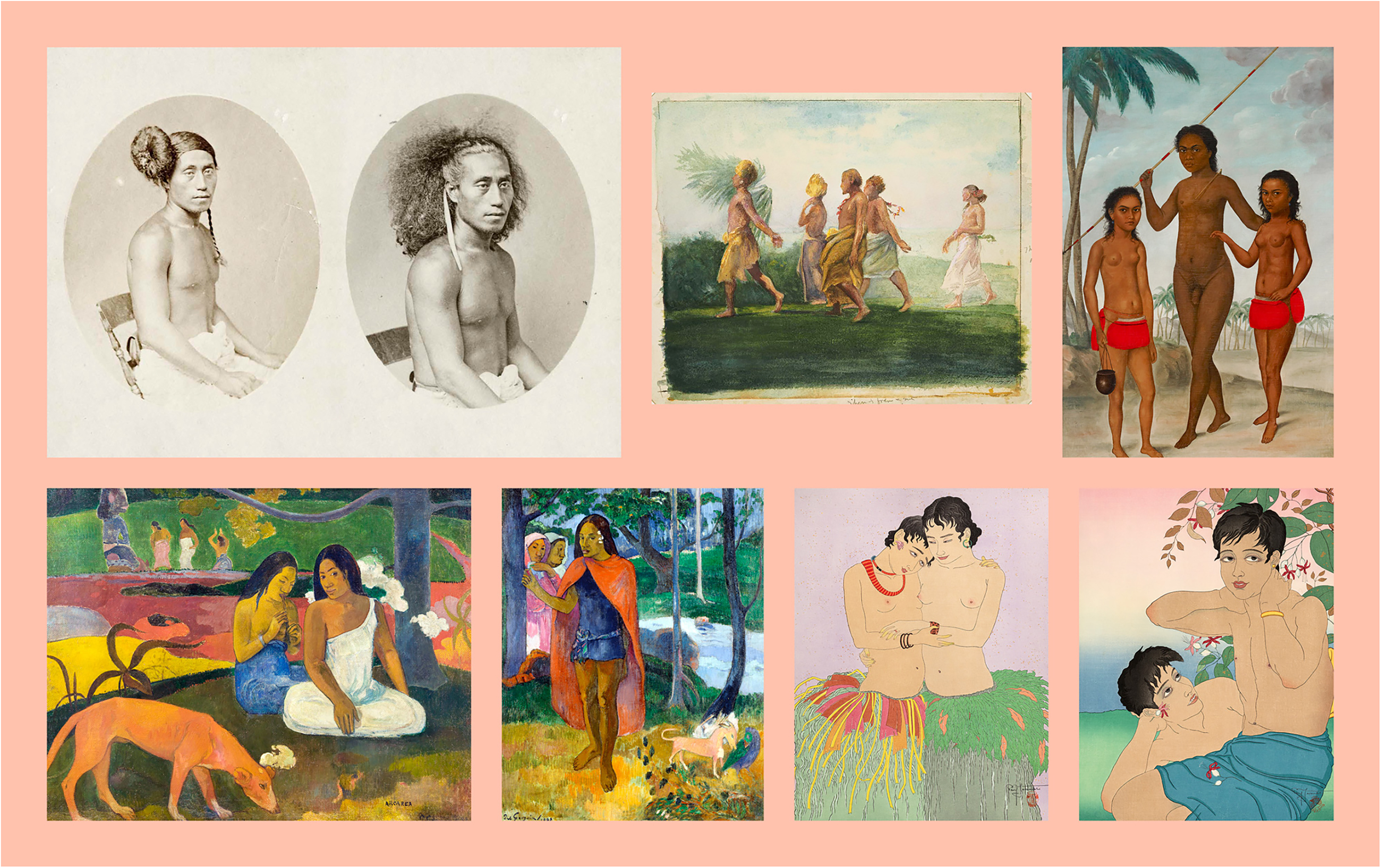
Yuki Kihara, “Pasifika Theirstories,” from the Vārchive as part of the Paradise Camp (2020/2022) series. Courtesy of Yuki Kihara and Milford Galleries, Aotearoa New Zealand.
For McMullin, the linguistic history of Fa’afafine demonstrates what he refers to as the “archival silence” of Sāmoan queer existence (2022: 40). The British missionary George Pratt (1817–1894) censored the word Fa’afafine in his first edition of the Sāmoan dictionary (McMullin, 2022: 40). During New Zealand's colonial rule, the employment of the Crimes Ordinance of 1961 criminalized any sexual contact between males and impersonations of females or cross-dressing, which targeted Fa’afafine (Farran and Su’a, 2005). Against these acts of archival erasure and colonial discrimination, the image constellation produced in these panels aims to counter the linguistic and the seeming absence of any visual record. The selection of paintings ranges from Gauguin's Arearea (1892), in which two gender-ambiguous figures sit peacefully against a fanciful background of people worshiping a lifesize statue invented by the French painter, to his Le Sorcier d'Hiva Oa (1902), in which the Māori scholar and non-binary lesbian activist Ngahuia Te Awekotuku (1992) suspects the Sorcerer figure to be a queer Tahitian; from the Chinese artist Spoilum (Guan Zuolin)'s Portrait of three Micronesians - Kokiuaki and His Sisters (1791), to the Japan-based French artist Paul Jacoulet's woodblock prints depicting handsome, groomed young men from Yap and the Saipan Islands in Micronesia in the North Pacific in intimate positions. Despite the works also presenting artistic idealizations and exoticizations of gender diversity in the Pacific world, Kihara reclaims these images in order to present a potential archive that has been silenced or misrecognized by western colonizers.
Nevertheless, in what ways are the archival collage “Pasifika Theirstories” (Figure 4)? Rather than treating these images as hard historical evidence, Kihara seems to call them forth as imaginary companions that might inspire us to rethink our worldview, thereby unlearning the imperial shutter that divides objects from their people. For Azoulay, unlearning imperialism requires historians and museum professionals to rethink their professionalized practices that refuse collective, cohabitating imaginations. Azoulay explains that: Unlearning means not engaging with those relegated to the “past” as “primary sources” but rather as potential companions. I sought out companions with whom entering (or not entering) the archive or the museum could be imagined and experienced as a form of cocitizenship, a partnership against imperial citizenship that dooms different people who share a world to not coincide in it ontologically or politically. (2019: 16)
With her speculative arrangement of people joined through “cocitizenship,” namely those people who have been emptied into generic figures and made over into objects, Kihara's archival constellation reimagines a potential history for queer Sāmoans in which gender diversity is not considered a postcolonial right but an Indigenous practice already co-existent in the Pacific world long before the colonial encounter. Thus, these images are not “primary sources” to be studied and disciplined but “potential companions” for the livable world of Fa’afafine then as of now. The Sāmoan-Persian-Cantonese art curator Léuli Eshrāghi, who is also Fa’afafine, has called Kihara's Vārchive “kin constellations” that are “cherished in this fale fono (meeting house), which doubles as a fale mata’aga (house of culture)” (2022: 78). Through amassing historical photographs and paintings together with the ancestor portraits of Fa’afafine, Kihara convenes an Indigenous queer kinship within the exhibition space.
Unlearning Gauguin's then and now: Fabulous temporal drag
A pillar of Paradise Camp is Kihara's own performance as a late nineteenth century version of “Gauguin in Polynesia” and her mock dialogue with him as Yuki Kihara “the artist representing Aotearoa New Zealand at the Venice Biennale” in a series of three short scenes (Figure 5). Playing both parts in splitscreen, Kihara converses with Gauguin against the backdrop of a white sandy beach complete with palm trees. As seen in the screen shot from the first scene (Figure 5), Gauguin has a drawing pad and is actively looking at and drawing Kihara as if she was one of his models. She talks to him, interrupting his rendering (which we never see). The gist of their exchange is that she tells him in no uncertain terms that she is onto him as an appropriation artist, but rather than just call him out, she in turn re-appropriates his artworks by improving them within her own ‘upcycling’ artistic project. This creative move to hold a live dialogue with Gauguin causes a collapse of the binary then and now, of his time and our time. It sparks with the electricity of a virtual encounter arranged for Gauguin to meet with Kihara–he should be so lucky as to speak with a Fa’afafine Sāmoan artist–and extends a reparative gesture back to his dated output. The enfolding of then and now seeks to undo Gauguin's artistic signature of primitive pastiche, that rips and tears the image of Pasifika peoples from their specific time and place–to set them on the other side of colonial difference. By placing Indigenous peoples into the realms of the transcendental, the before, and outside of industrialization, Gauguin commits what the German anthropologist Johannes Fabian has termed the “denial of coevalness,” which is a disavowal of sharing time-space, of being contemporaries, that goes hand-in-hand with colonial difference thinking (1983: xi). 18 His paintings refuse the coevalness of the Pasifika peoples, enforcing a colonial division by depicting them as backwards but in a supposedly admiring way: through using the primitivism style that tries to extract their nature inspired spirituality as a salve for urban industrialization, while studiously ignoring the context of their meeting under a colonial regime. Kihara's staging of the coeval encounter within the scope of the Vārchive exposes how colonial ordering still connects them, and with cheeky repartee she also insists on their ongoing connectedness in Paradise Camp but on her decolonial terms.
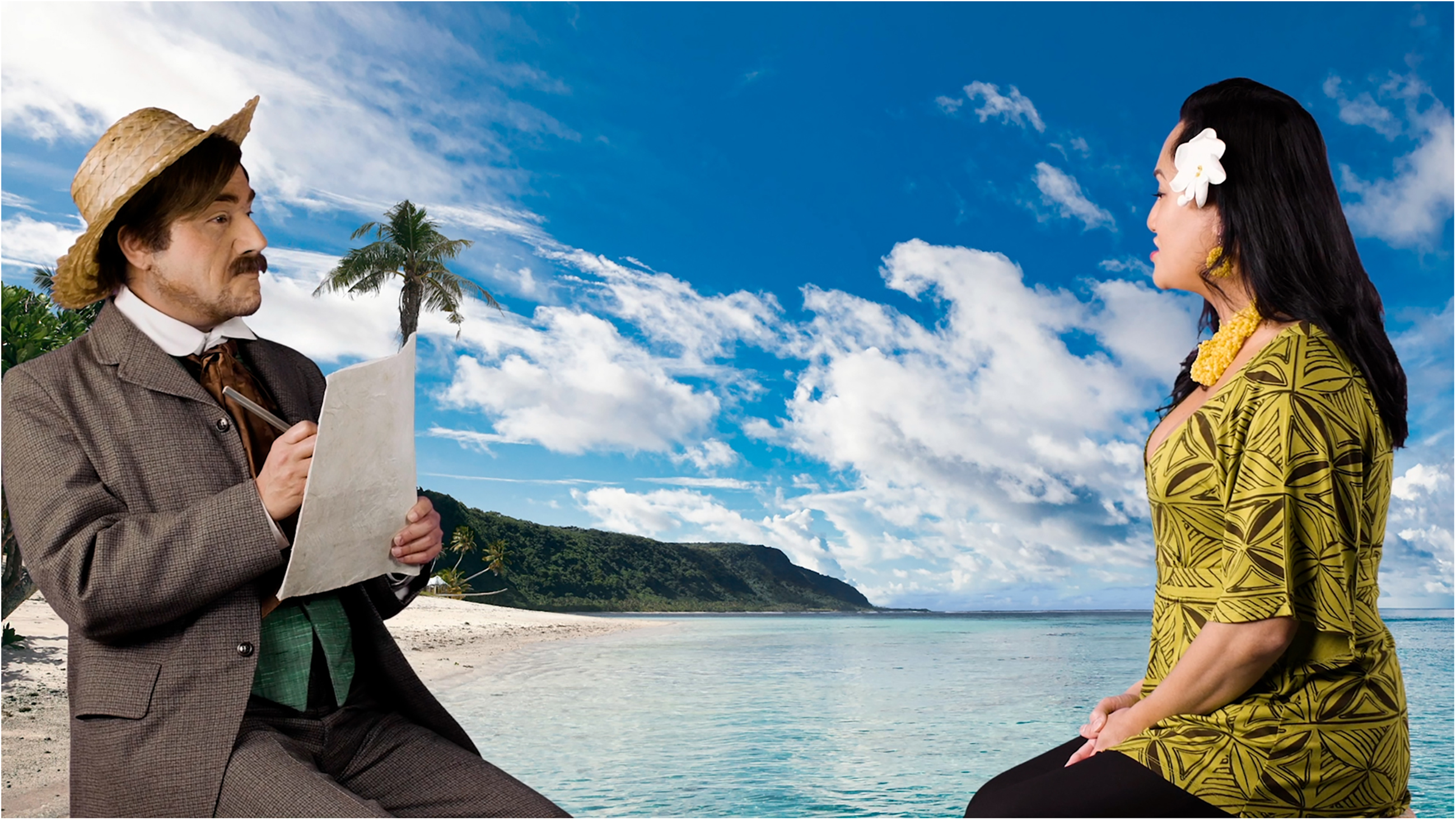
Yuki Kihara, video still from “Talanoa Between Yuki Kihara and Paul Gauguin” (2022) in the Paradise Camp (2020/2022) series. Courtesy of Yuki Kihara and Milford Galleries, Aotearoa New Zealand.
This section of Paradise Camp puts forward the proposition that the temporal impossibility of their ‘meeting’ like this, and of any resonant coincidence between Gauguin and his Pasifika figures, is what must be unlearned. Further, we argue that Kihara approaches the suturing of this split in time and along colonial difference through the technique of what we read as an artistic practice of ‘embodied collage,’ which engages acts of re-staging history to force into the present a disavowed past. As Kihara writes, she has “used [her] body as a medium in order to masquerade as a variety of characters and to pay homage to unnamed Sāmoans” featured in colonial photography and as fictitious native figures in Gauguin's paintings (2020a: 172). Her various performances for the camera showcase a temporal jumbling that drags forward outdated iconography and gender norms, a practice that Freeman has termed ‘temporal drag.’ To better understand Kihara's fabulated mode of reworking colonial and dated iconography within the potential Fa’afafine museum of Paradise Camp, we will first look at how she ‘encountered’ Gauguin in the west, then at her use of gender and ethnic masquerade in her five- image series Fa’afafine: In the Manner of a Woman (2005). What is striking is how Kihara relies on photographic and cinematic editing to undo being placed on the side of the colonial difference; it is as if she holds open the shutter to make us see the enduring, connecting time-space of the Vā.
In her 2020 essay “First Impressions: Paul Gauguin,” the artist recalls her first in-person encounter with the actual paintings of Gauguin in 2008 when she presented her solo exhibition Living Photographs in the Modern and Contemporary Art Department at the Metropolitan Museum of Art in Mannahatta (Manhattan), New York. She writes: “I remember thinking how strange it was to be in front of his paintings, as if time and space had collapsed. Here we were as artists from two different parts of the world having a dialogue in two different moments in history” (our emphasis, 2020a: 169). She remarks on how she had never taken much notice of his paintings even though they were a part of the everyday visual commodity culture of Moana, being “featured in tourism paraphernalia like coffee mugs, postcards, T-shirts, posters, and cruise ship advertisements outside of Sāmoa” (Kihara, 2020a: 169). In an interview with the authors, she recounted this as a “historical meeting” of a Pasifika artist at the most important art institution in the West, at their shrine in the Oceanic art wing, and her first impression was, “What was all the fuss about? I can do a better version.” 19 What has fueled her passion to do a better version of artistically representing Oceanic people was not only that she was unimpressed by his exoticizing and fictionalized version of her peoples, but that she noticed how in these busy NYC galleries where Gauguin paintings hung there were hardly any Tagata Māo’i Indigenous people in sight. “For centuries,” she explains, “Papālagi [foreigner] and other non-Indigenous artists, anthropologists, and museum curators have represented–and exoticized–Tagata Māo’i [indigenous] to non-Indigenous audiences” (2020a: 169). The potential museum of Paradise Camp that foregrounds an Indigenous audience and perspective can be seen as a crowning achievement of this goal she set to do better.
The collapse of time and space Kihara describes could be a sensory registration of the colonial afterlife of Gauguin's works, and the feeling could also be the expansive, contextual time and space of Tā and Vā that relates to her embodied knowledge as Fa’afafine. In front of the Gauguin paintings hanging in the Met, such as Ia Orana Maria (Hail Mary) (1891) and Two Tahitian Women (1899) (in Figure 6), she picks up on some telling details: she thinks the models look suspiciously androgynous, rendered with care to show the young maiden are beautiful with thick limbs, strong jaws, and small breasts. When she reads an essay that offers a revisionist account of Gauguin's paintings by Māori scholar Ngahuia Te Awekotuku, her first feelings of recognizing aspects of herself blossoms into a larger agenda to recover in Gauguin visual evidence of Fa’afafine and Māhu. The essay was delivered as a talk “He tangi mo Ha’apuani (A lament for Ha’apuani): Gauguin's models - a Māori perspective” presented in 1992 at the Gauguin Symposium held by the Auckland Art Gallery Toi o Tāmaki. 20 Looking at Gauguin's Noa Noa journals and seeing his explicit personal and sexual fascination with Māhū in Tahitian culture, Te Awekotuku discusses how Gauguin seems to have painted his models to appear especially androgynous: a reflection and confession of his own desires, but possibly also created with the assistance of Māhū models. 21 Supported in her own interpretation, Kihara returns to Gauguin again and again throughout her artistic career to reweave this connection between the colonial inflicted gaze and (queer) Pasifika Indigenous bodies. 22
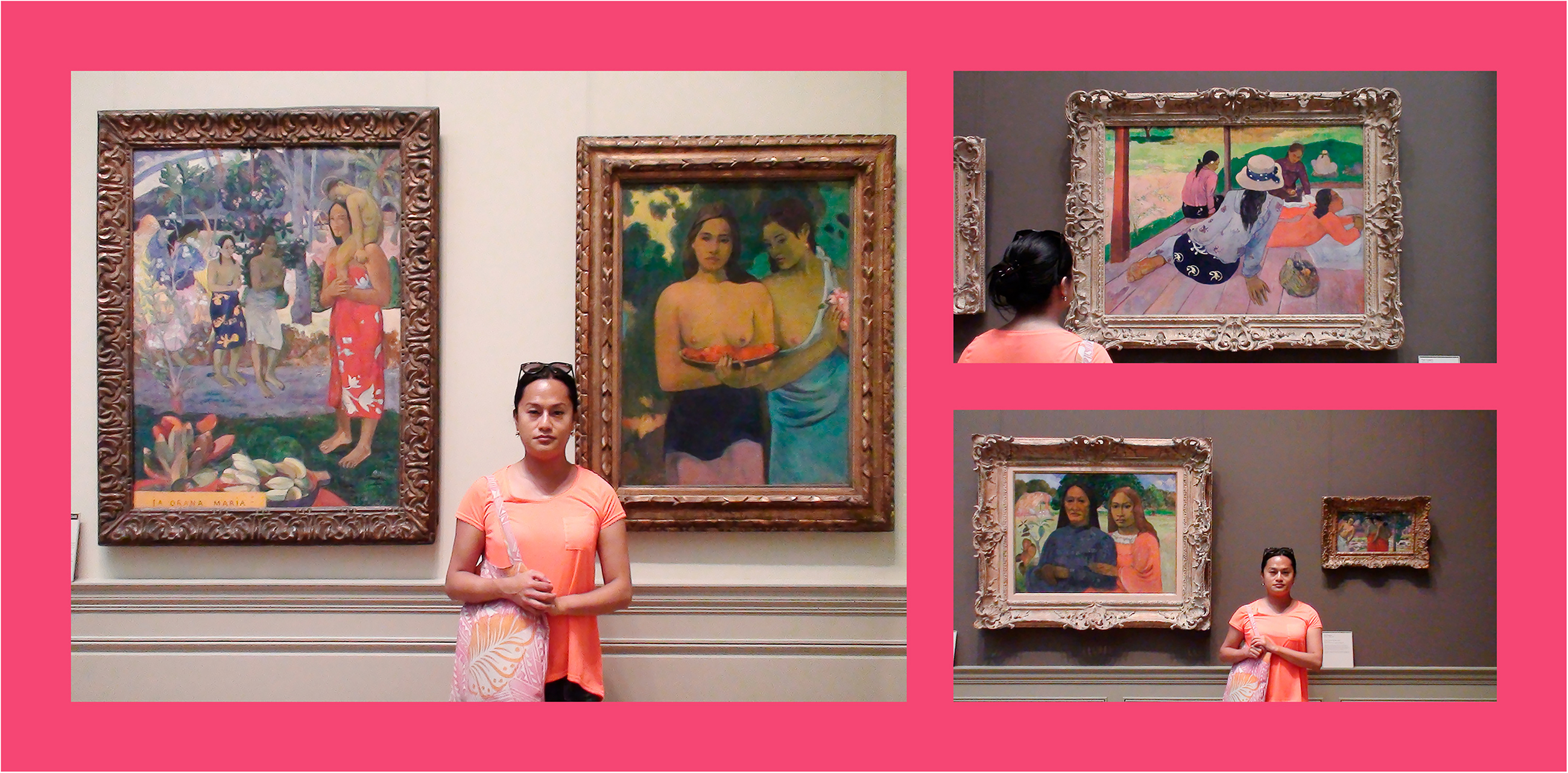
“Yuki Kihara at The Metropolitan Museum of Art in 2008” from the Vārchive as part of the Paradise Camp (2020/2022) series. Courtesy of Yuki Kihara and Milford Galleries, Aotearoa New Zealand.
The mock dialogue's first scene opens with Gauguin exclaiming out loud when seeing Kihara, “Oh là là, beautiful dusky maiden, magnifique!” To which she answers with a roll of her eyes, dismissing his come-one as not only unwanted, but an expression of sexual-racial violence. She then addresses him with a Sāmoan greeting and introduces herself as “Yuki Kihara, I’m an interdisciplinary artist […]” placing herself on the same level, also an artist, which is reinforced by the framing of them facing each other with equal space in the shot and at the same height. She also has another big eye roll and small shake of a head in response to when he introduces himself as having lived “in paradise with the savages of Tahiti.” At this moment she alone fills the frame, making her reaction the only possible point of identification. She says she is “familiar with your work,” but then can’t help but notice that he tries to pass off some of his paintings as of Tahitian people and scenes when in fact they seem to be Sāmoan, starting with Sacred Waters (1893). Her line of argumentation is utterly convincing, and he admits to the evidence of his signature in the Auckland Art Gallery guest book and picking up postcards of Sāmoan scenes. The ethnographic impulse in his paintings and prints, given Tahitian titles and often claiming to be of Tahitian Women, Faces, Bathers, Landscape, is given credibility through his having been in the country and being able to empirically observe it. He therefore makes a claim to visual evidence that Kihara's own research uncovers has a dubious status. She ends the scene with the rhetorical question that his work seems to be clearly copied from postcards of photographs that were taken in Sāmoa, “that is interesting, is it not?” Then, before he can answer, while he stammers, she says a farewell to him in Sāmoan, then, “Paul, great to catch up but I have to go. I’m representing Aotearoa New Zealand at the 59th Venice Biennale with my own exhibition, Paradise Camp.” He is left open-mouthed, a sputtering, dejected punter.
The deadpan dressing down continues in scene two when she says to him, “Cry me a river Paul, you built up this image of paradise and dressed up like a noble savage. You even turned your studio in Paris into a Polynesian styled brothel.” As she speaks, he starts to crouch behind his drawing pad, to shrink away into the corner of the frame. She continues, “All this to help sell your paintings. What if I do this in reverse so you can look at yourself and your work through my eyes?” The split screen dialogue then fades to a sped-up time-lapse of the make-up artists working on Yuki's face to cosmetically transform her into Paul, including adding elaborate hair and facial contouring molds. It ends with a framed shot of the two Paul's on the right and the left, which dissolves into the one of the lefts showing Gauguin's own Self-portrait with a Hat (1893–4). Who is the real Paul Gauguin? We are left with the feeling he himself also committed to a form of ethnic drag, of playing dress up as the noble savage to try to travel back in time. 23 As his French mother had Peruvian heritage, he had earlier sought to claim a special relation to the Incas, which then later was expanded into a kinship to some more generalized ‘savage,’ and to partaking of the supposed pureness of Tahitian and later Marquesan ways of life that are at a distance from civilization. When we look at him in reverse, through the eyes of Yuki, we see the construction of his colonial superiority within the project of his elaborate self-representation as an artist. Moreover, we see how he used those peoples, his contemporaries, as props, to the production of his status as a new kind of artist, a noble savage himself.
In the third scene, Paul asks her to explain what upcycling means. Yuki says, “I’ve done the courtesy of upcycling the myths in your paintings into something more meaningful and fa’afafabulous.” To which he puzzles, “Whaaat? Fa’afafabulous?” Ignoring his ignorance, and refusing to explain any further, she simply tosses her head and says, “You’re welcome.” The material of Gauguin's appropriative practice over a hundred years ago is treated by Kihara as the opportunity to take something old and make it into “something fresh, current, and exciting.” She treats Gauguin's output then as an archival drawer that might yet yield something else, to serve another purpose than the one for which it was collected/created. The Paradise Camp TV mock dialogue cuts up and re-pieces Gauguin himself through Kihara's technique of embodied collage. Through her Gauguin drag performance she refuses to see the man, the artist, or the output in isolation from the context in which he worked, or safely tucked into a colonial past. On this point Kihara has said that “Working with archives often feels like I’m using time as a sculptural material to talk about what's happening now and what would happen in the future” (Kihara quoted in King, 2022: 27). Instead, she sets things in motion, to see that with time and in changing times the Gauguin colonial archive offers new meaning and can become current and active in shaping the present. The archive is never simply apparent nor complete. Even when seemingly safely ensconced in the past, historical archives make time into a material, and therefore become available to practices of temporal drag that effect “retrogression, relay, and the pull of the past on the present” (Freeman, 2010: 8).
Just how open, or pliable, the historical archive is a question asked by African-American cultural historian Saidiya Hartman, who has dedicated her career to researching minoritized and enslaved people's lives in archives that yield little insight other than certainty of capture and violence. This crisis of evidence raises the issue for her of whether, “Is it possible to exceed or negotiate the constitutive limits of the archive?” (2008: 11). Out of necessity, her writing images a speculative mode that employs the subjunctive grammatical mood of anticipation, doubt, desires and possibilities “to tell an impossible story” and “to amplify the impossibility of its telling” (2008:11). The narration she gives to events in the past, shifting from different points of view to cast doubt and desires on an event, to destabilize and puncture it what is (un)known, enacts a “critical fabulation” method: it strains against the limits of the archive by re-sequencing the basic elements of story, the ‘fabula’ being “a series of logically and chronically related events that are caused and experienced by actors” (Bal in Hartman, 2008: 11). She calls it a “playing with and rearranging,” and “re-presenting” to jeopardize the status of the event, all terms that speak to the artistry of crafting history in the present (Hartman, 2008: 11). Similar to Hartman's narrative technique, we can see a method of critical fabulation at work in Kihara's visual and audio-visual Fa’afafabulous creation of Paradise Camp, in her mock encounter with Gauguin, and her speculative reclaiming of his androgynous figures for her kin.
The method of critical fabulation also shares the etymological Latin root of fabula (story, tale) with the adjective of being fabulous, synonymous with being legendary, mythical, and incredible. The humor, costuming, and self-consciously highly staged scenarios that Kihara creates are forms of what she has termed an In-drag-enous practice, melding drag's elaborate camp theatricality with Indigenous Sāmoan traditional community theater called faleaitu (house of the spirits). Notably, anthropologist Jeannette Marie Mageo has observed a significant shift in the role of the Spirit House in Sāmoa over the twentieth century, with increasing gender segregation that excludes female performers. Paradoxically, the faleaitu has evolved into a platform where male and fa’afafine performers can challenge binary gender norms (Mageo, 1998: 202–205). This contextual backdrop within the faleaitu tradition serves as a crucial motivation for Kihara's exploration of gender and ethnicity through her drag persona as Gauguin. This creative expression transcends the examination of gender and ethnicity alone; it provides a critical lens through which she scrutinizes figures like Gauguin, colonialist legacies, and canonical art histories.
A compelling example of this exploration is her series of five photographs collectively titled Fa’afafine: In the Manner of a Woman (2005). In this series, Kihara employs drag to transform herself into various roles from turn-of-the-nineteenth century Sāmoan society, including men, women, and Fa’afafine. Her purpose is to reveal the deeply ingrained gender codes present in early studio photography, which aimed to capture Pasifika ethnicity and differentiate it from European norms of whiteness. These images lay bare the cultural scripts and visual codes crucial for interpreting ethnographic photography. Within this collection, she disguises herself to depict both a Sāmoan man and woman within a portrait of a married couple. Additionally, she assumes the persona of “My Sāmoan Girl” and presents a thought-provoking triptych of “Fa’afafine,” where she is depicted wearing a grass skirt, with her penis tucked between her legs, and with her genitalia visible. 24
Each theatrical mise-en-scene nearly exactly recalls early studio photography in its stylization of the exotic portraits complete with ethnographic objects as props created, then as now, for the Global North marketplace. However, this insatiable hunger is forced to cope with the campiness of the image that challenges its truthiness. As a production of her In-drag-enous camp practice, they seem to be one thing, dated portraits of different actual people, but they are not, they are all Kihara and a contemporary version of self-portraits. We see that the series aims to be uncovered as deceptive to the viewer, the modern wainscotting of the studio is a give-away to a careful or trained eye. As such, visual tutoring by the photographs leads to the collapse of then and now, and to the spoiling of imperial distinctions between categories of artistic/ethnographic, man/woman, owner/owned. Particularly the viewer of the triptych is guided in their reading, either left to right or right to left, to understand that when the woman's penis is revealed, “the penis completes her,” in the sense that is supposed to be there (Kihara, 2020b). Perhaps drawing on her longtime work creating editorial photographs for magazines, Kihara's weighty selection of props, the costuming, poses and its elaborate staging in a studio, produces what King has called faithless re-enactments (2022: 26). For us, the thrilling element of Kihara's temporal dragging of studio ethnographic photography as well as Gaugin's paintings and prints is how she humbles the white colonial male gaze. She dethrones ‘him’ from being the artist who controls how Pacific peoples are seen. By privileging her community's vision, she crowns Paradise Camp as fa’afafine-fabulous creative output.
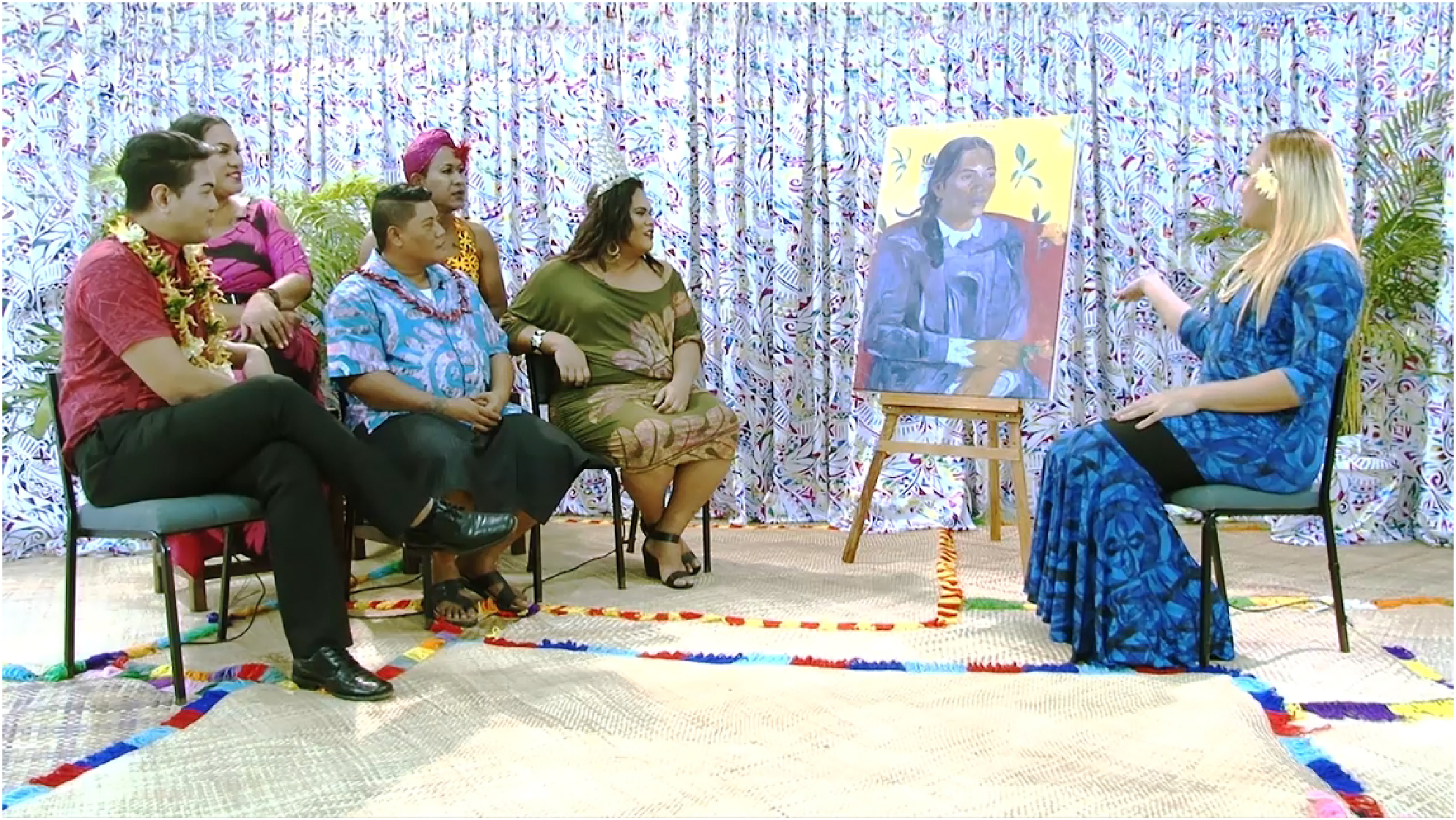
Yuki Kihara, video still from First Impressions: Paul Gauguin (2018). Commissioned by Fine Arts Museum of San Francisco and Ny Carlsberg Glyptotek. Courtesy of Yuki Kihara and Milford Galleries, Aotearoa New Zealand.
Conclusion: Potentializing Fa’afafine's paradise
In the course of preparing this article, Kihara shared with us the following quote from African American writer with Caribbean heritage Audre Lorde (Steinbock and Yu, 2023): Black and Third World people are expected to educate white people as to our humanity. Women are expected to educate men. Lesbians and gay men are expected to educate the heterosexual world. The oppressors maintain their position and evade their responsibility for their own actions. There is a constant drain of energy which might be better used in redefining ourselves and devising realistic scenarios for altering the present and constructing the future. (Lorde, 1984/2007: 107–108)
Echoing Lorde's reflection, we think that Paradise Camp refuses to be a classroom for the straight white male spectator. The embodied collage of Vārchive and transtemporal Fa’afafine photography as well as video installations that rework the ethnographic gaze and imperial shutter do not intend to be a didactic pedagogy despite their seemingly illustrative format at first glance. Rather, these scenographic installations conserve the fabulous vistas among queer Sāmoan communities and reconfigure a potential museum for them.
Such potential Fa’afafine museum is most evident in the three episodes of First Impressions: Paul Gauguin (2018) included in the video installation Paradise Camp TV (2022) (in Figure 7), mounted in front of the photography series, which offers the visitor a lucid picture of the Fa’afafine worldview mixed with the camp humor, creative fabulation, and empowerment of queer Sāmoan communities. The First Impression: Paul Gauguin video directed by Kihara invites six members from the Fa’afafine, Fa’atama, and transgender community to freely comment on Gauguin's works in the form of a buoyant TV talk show. Although this work was commissioned by the Fine Arts Museums of San Francisco and Ny Carlsberg Glyptotek in Copenhagen, Kihara utilizes this opportunity to bring in her Fa’afafine community as critical visitors who critique Gauguin's work, a critical role monopolized by Western art historians and museum institutions. Unattached to the museal script of Gauguin as a white master painter of the Pacific paradise, these Fa’afafine commenters unreservedly draw on their embodied knowledge to approach this French artist's work. The campy, low culture format of a TV talk show enables these Fa’afafine participants to offer polyvocal perspectives without needing to hew to a singular dominant interpretation. Commenting on Gauguin's When Will You Marry? (1892), they read beyond the heteronormative perspective by speculating about the two girls’ relationship as friends, siblings, lovers, rivals in love, or a “Fa’afafine couple”. When it comes to Gauguin's Two Tahitian Women (1899), they inventively give it the new title, “Two Tahitian Transwomen,” based on their embodied knowledge and Fa’afafabulous speculation. By doing so, these critical comments made by non-experts of Western art history unseat the authoritative interpretation sustained by art museums and the discipline of Euro-centric art historiography, which often perpetuates a binary gender lens and thereby silences the queer Oceanic world.
The extensive Fa’afafine commentary on Gauguin echoes the overall artistic strategy in Kihara's Paradise Camp towards the western canon. As this pavilion attests, to rethink the history of gender and sexuality through the Fa’afafine worldview requires us to unlearn the practices of existent museum institutions with their imperial mode of ethnographic collection, classification, and display. It requires us to rethink the colonial conception of paradise, its mapping of Oceania, its racialization of Pasifika people, its criminalization of queers. With the large-scale Vārchive collage set against the iconic image of paradise wallpaper, the installation conjures up colonial histories, ongoing sexual and racial discrimination, and Islanders’ lives. These can no longer be seen as isolated incidents but as a vast interconnected “sea of islands.” It requires us to postpone the opening and closing of the imperial shutter that captures the Pasifika people and displaces them from their culture, histories, and visual wealth. Through her transtemporal photography and mock video of Gauguin, Pasifika people are put back in Vā-Tā time-space and thereby in conversation with contemporary issues of religion, same-sex marriage, legal recognition, social activism, and ecological crisis. Finally, Paradise Camp is a potential museum for us simply because the existent ethnographic museums still have much to unlearn what imperial experts have known or thought they knew and truly converse and listen to queer Pasifika voices. More than a participatory museum that tends to center on doing better as an institution to welcome and make room for the “others,” Paradise Camp potentialized multiple positions that Fa’afafine and queer Indigenous people could take up within a shared, cohabitant world in which hegemonic notions of binary genders and cultures are dissolved. Such a potential museum exists in the speculative realm, resonating with queer performance studies scholar José Esteban Muñoz proclaims that “queerness is not yet here” (2009: 1); it is on the horizon, to paraphrase Muñoz. Paradise Camp is a paradise for Fa’afafine, seen just ahead on the queer Oceanic horizon. A place not yet here, but we meet in Paradise Camp to convene, to train, to learn how to fight for it. 25
Footnotes
Declaration of conflicting interests
The authors declared no potential conflicts of interest with respect to the research, authorship, and/or publication of this article.
Funding
The authors received no financial support for the research, authorship, and/or publication of this article.

Notes
Author biographies
Liang-Kai Yu is a doctoral candidate in the Department of Literature and Art at the Faculty of Arts and Social Sciences, Maastricht University. Grounded in queer of color and black feminist theories, his research delves into contemporary LGBT+ and artistic interventions within Dutch and international art museums. In 2020, he co-curated the exhibition titled “不適者生存? Survival of the Exceptional” at Tainan Art Museum. From 2021 to 2022, he served as an embedded researcher for the “Queering the Collection” project at the Van Abbemuseum.
Eliza Steinbock is an associate professor of Gender and Diversity Studies at the Department of Literature and Art, Faculty of Arts and Social Sciences, Maastricht University. They are the director of the Centre for Gender and Diversity, Project Leader of the national consortium “The Critical Visitor: Intersectional Approaches for Rethinking and Retooling Accessibility and Inclusivity in Heritage Spaces” (NWO 2020–2025), and a Principle Investigator in the European partner project “Perverse Collections: Building Europe's Queer and Trans Archives” (JPI - Cultural Heritage 2023–2025). Eliza also works as a consultant, advisor, and guest curator for artists as well as arts and heritage organizations. https://www.elizasteinbock.com/