




Abstract
This short communication is a discussion of a series of watercolours of Flinders Petrie’s excavations at Meidum made by Henry Eliot Howard, a visitor to the site in 1891. These watercolours add a new visual record to the archive of nineteenth century excavations, in particular showcasing how Petrie lived and worked whilst on site.

Introduction
Flinders Petrie’s tolerance of frugal living conditions while excavating is well documented. Whilst surveying the Giza pyramids between 1880 and 1882, he lived in a series of three small tombs which had been connected by the English engineer Waynman Dixon, who had investigated the pyramids in 1872. 1 That accommodation gave rise to an evocative image of the young archaeologist (fig. 1).
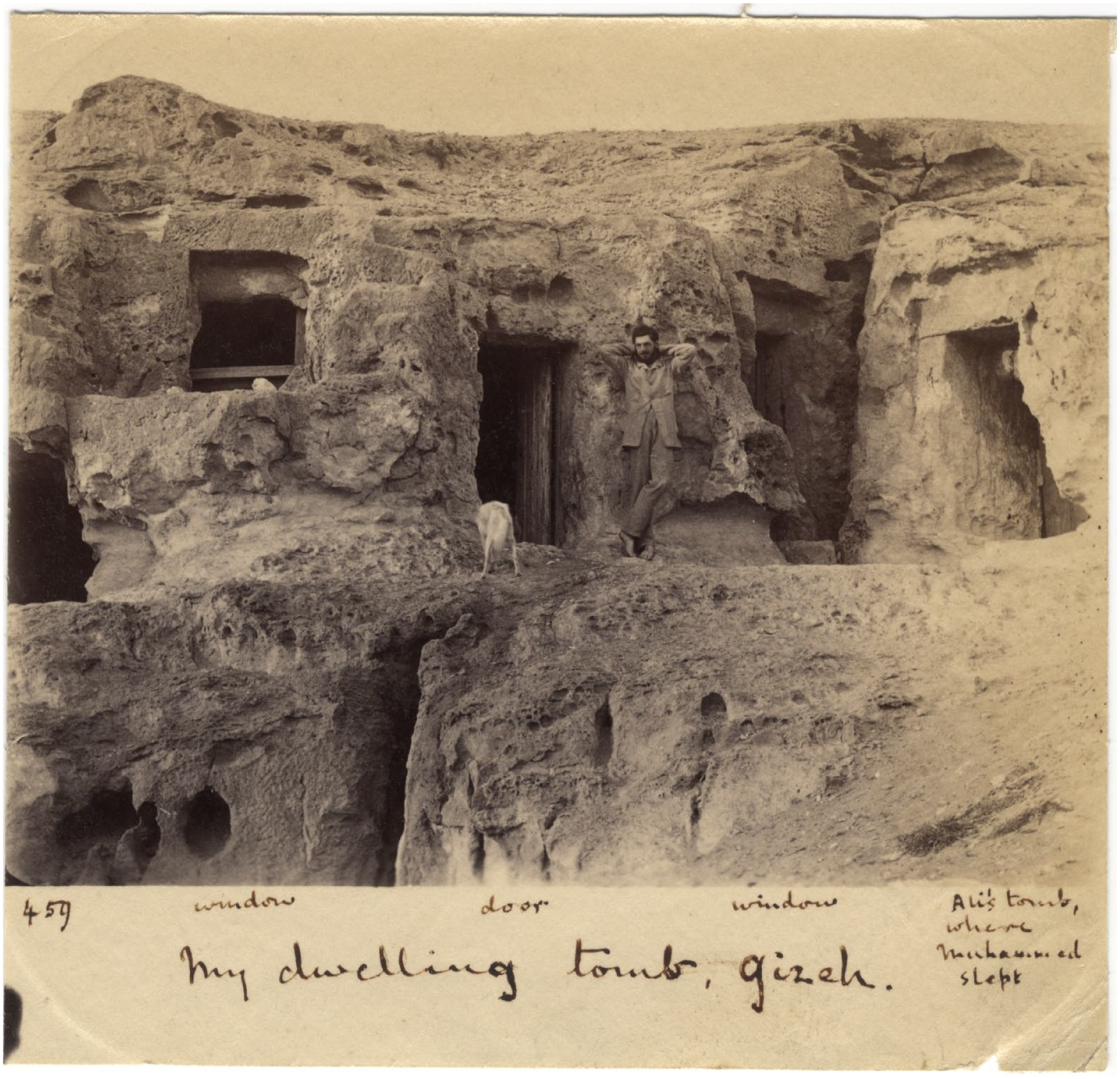
‘My dwelling tomb, Gizeh’. Griffith Institute Petrie MSS 5.5.23c (© Griffith Institute, University of Oxford).
It is worth repeating Petrie’s account of the experience in full:
I had three rooms, which had belonged to separate tombs originally; the thin walls of rock which the economical Egyptian left between his cuttings, had been broken away, and so I had a doorway in the middle into my living-room, a window on one side for my bedroom, and another window opposite for a store-room. I resided here for a great part of two years; and often when in draughty houses, or chilly tents, I have wished myself back in my tomb. No place is so equable in heat and cold, as a room cut out in solid rock; it seems as good as a fire is in cold weather, and deliciously cool in the heat… I lived then, as I have since in Egypt, independent of servants. The facilities of preserved provisions, and the convenience of petroleum stoves, enable one to do without the annoyance of having someone about meddling with everything. I had one of the most intelligent men of the place, Ali Gabri, to help me with the work, and his nephew and slave used to sleep in the next tomb [on the right in a sketch accompanying the text] as my guards at night.
2
The Egyptian that Petrie mentions, Ali Gabri, worked alongside him across multiple field seasons. 3 Petrie’s notebook for 1880/81 describes how he met Ali for the first time, and the high commendation he came with; it was in fact Ali who suggested that Petrie occupy the same tomb as had Waynman Dixon. 4 Note that figure 1 also points out, on the far right, ‘Ali’s tomb where Muhammed [Ali Gabri’s nephew] slept’.
In later memoirs, Petrie still fondly remembered the tomb as ‘comfortable’, compared to the heat in the pyramid itself – something which he admitted often caused him to strip naked for work.
5
That said, Petrie’s writings from the time itself present perhaps a more nuanced picture of life in a tomb. His notebook entry for Sunday 27 February 1881 reads: Did not get any sleep till 11 or 12, & then broken by: 1st Trap down, big rat, killed, & reset. 2nd mouse about trap for long, thought bait must be eaten, got up to see. 3rd Fleas. 4th mouse let trap down without going in, got up, re-set it. 5th mouse in, got up, killed him, reset trap. 6th Fleas. 7th Dog set up a protracted conversational barking (just by my door) with sundry neighbours in adjacent villages; went out & pelted him off. 8th woke in heavy perspiration, had to change singlet shirt, & take off sheet.
6
In subsequent excavations Petrie swapped the tomb for a tent and then dig house, although he remained frugal. In 1891, however, Petrie returned to the tomb. Whilst working at Meidum, he spent four months dwelling in the cemetery there. Outside the tomb chapel of the vizier Nefermaat and his wife Itet (mastaba no. 16), Petrie pitched a tent which he used for working and cooking, but he chose to sleep inside the tomb chapel itself as he considered it ‘quieter, and warmer’. 7
Petrie’s notebooks often recount visits he received from fellow Egyptologists, dignitaries, and acquaintances. One such visit was made by a Henry Eliot Howard, who visited Egypt in 1891 and as part of his itinerary travelled to Meidum whilst Petrie was on site. Petrie individually named certain visitors, but Howard is not amongst those, nor was he mentioned in the notebook for this field season more generally. It is therefore assumed that the two did not know each other personally; rather, Howard visited as part of a larger group, as Meidum was at the time a popular stop on the private tourist’s itinerary. 8 Howard made several watercolour sketches of his trip, which are now in the Victoria and Albert Museum (V&A acc. nos SD.512 and SD.513). 9 These include several sketches illustrating Petrie’s living conditions, and the accompanying annotations contain information that suggests it was imparted by Petrie himself, possibly whilst conducting a tour of the site.
Watercolour Drawings by Henry Eliot Howard
Henry Eliot Howard travelled to Egypt in February 1891 aboard the R.M.S. Orotava, a mail ship transferred to the Orient Line in 1890. From June 1890 it was deployed on the Australian service via the Suez Canal, and Howard joined the ship on its second journey on this route, disembarking at Egypt.
Howard’s drawings of the journey are a mixture of individual watercolours, and smaller sketches arranged six to a sheet, originally from a bound volume. They were previously in the possession of Rodney Searight, the well-known collector of paintings and drawings of the Middle East, who purchased them at a Christie’s auction in 1969. 10 Searight in turn presented his entire collection to the V&A in 1985. The first page of Howard’s Egypt volume documents stages of the ship’s passage: Mt Elias in Greece, boarding at Port Said, and a series of cartouches with mock-hieroglyphs based on activities on board (fig. 2). The hieroglyphs are rather wry, depicting activities annotated as ‘potato race’, ‘chess tournament’, ‘cockfighting’, ‘egg and spoon race’, ‘sparring’, and ‘tug-of-war’, with ‘one of our cockroaches’ prominently at the top of both cartouches. A further drawing, of a sea-monster, is annotated simply ‘This we have not yet seen’.
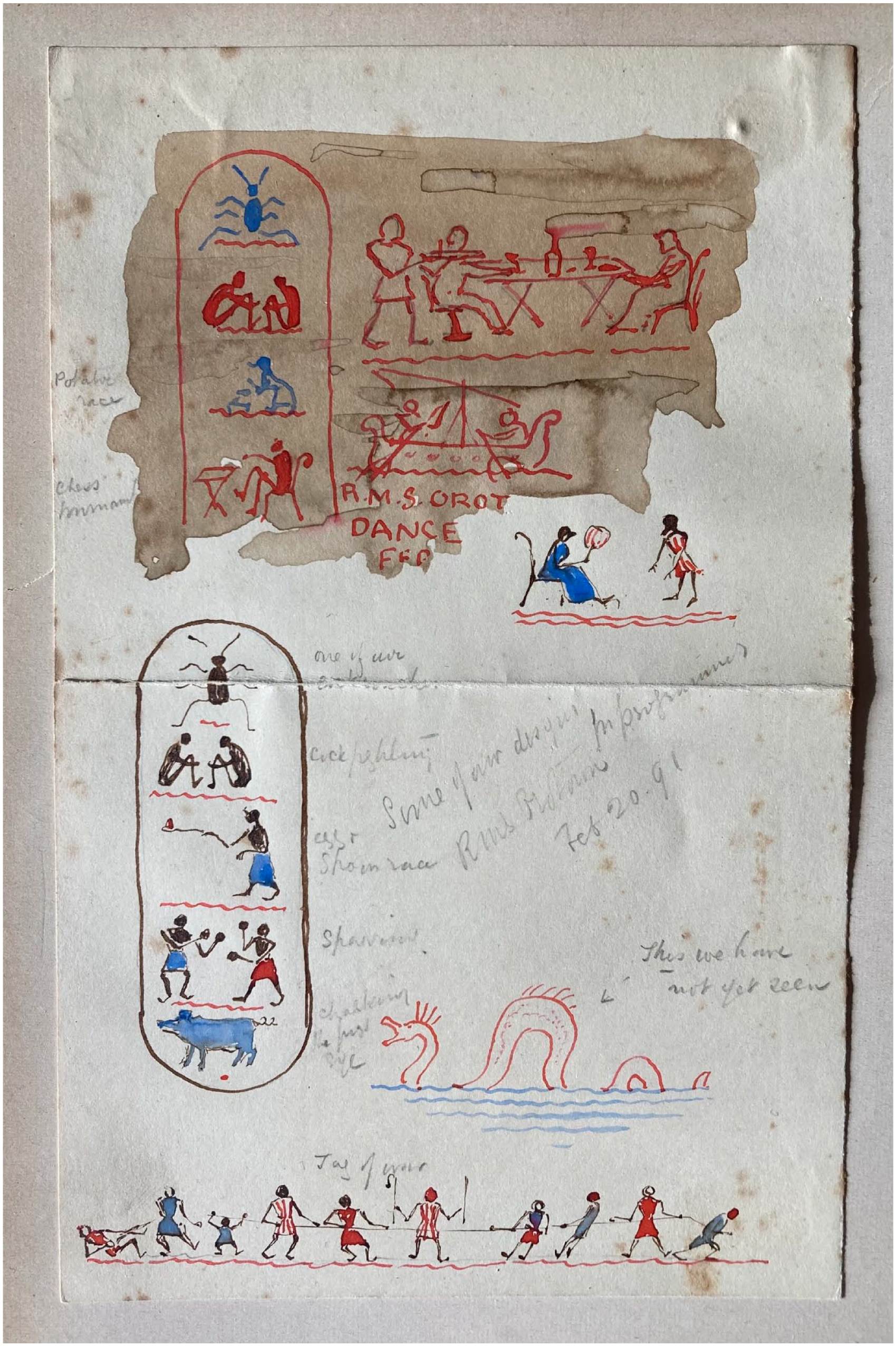
‘Some of our designs for performances, RMS Orotava, Feb 20.91’. Drawing from H. E. Howard’s album of watercolours, V&A SD.512.1 (© Victoria and Albert Museum).
The second page of Howard’s volume contains six further sketches (fig. 3). The first three were made at Meidum and the rest are studies of various objects, a minbar and a mastaba bench in Cairo. An annotation on the reverse of this sheet indicates that it contained further drawings, now lost, of the Red Sea and Arabian peninsula. It is unclear if these represent subsequent stages of Howard’s same voyage.
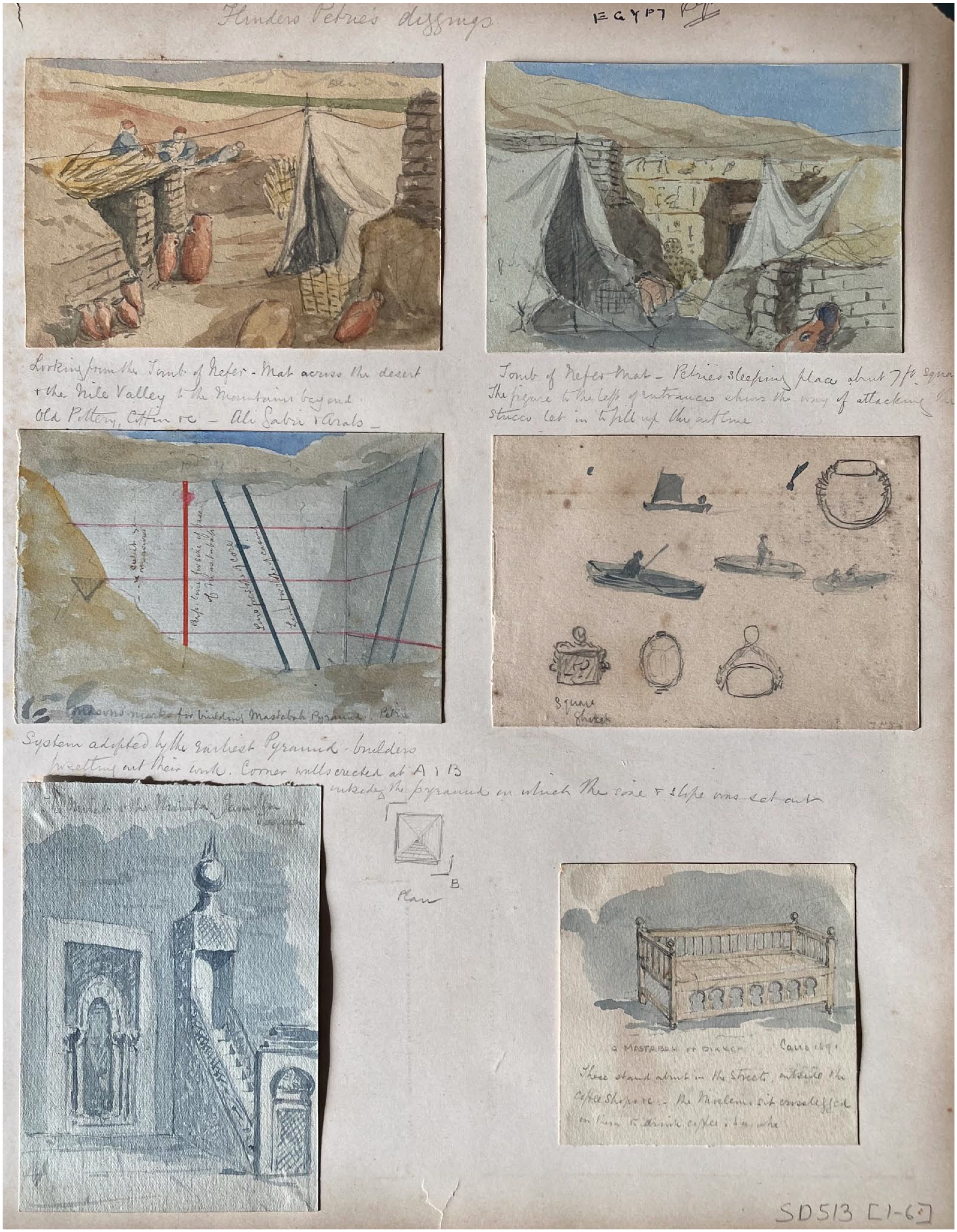
‘Flinders Petrie’s diggings’. Drawings from H. E. Howard’s album of watercolours, V&A SD.513.1–6 (© Victoria and Albert Museum).
It is the three Meidum drawings that are of interest here. The first is captioned ‘Looking from the Tomb of Nefer-Mat across the desert, the Nile Valley and the Mountains beyond. Old Pottery, Coffin etc – Ali Gabri and Arabs’ (fig. 4). This image, with its straw-roofed huts, depicts the living quarters of the Egyptian workforce employed by Petrie. It clearly illustrates what Petrie described in the site report as ‘huts of the bricks of Nefermat, which had been thrown out by the hundred in past excavations there; these, roofed with durra straw, served them for dwellings all the winter, although they found it a cold harbour without any doors, on frosty nights’. 11
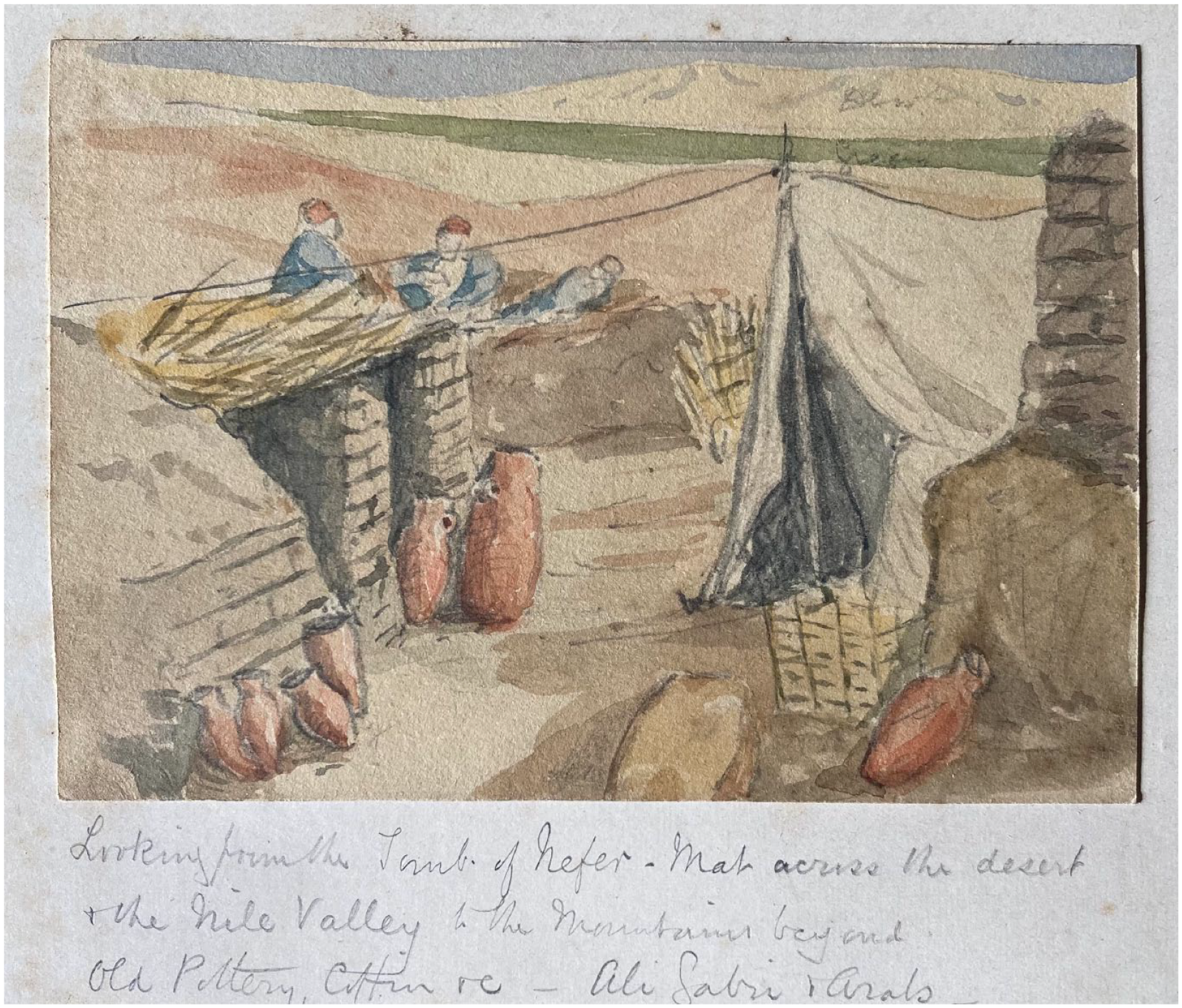
‘Looking from the Tomb of Nefer-Mat across the desert, the Nile Valley and the Mountains beyond.
The second picture, capturing Petrie’s field digs, is captioned ‘Tomb of Nefer-mat – Petrie’s sleeping place about 7ft square. The figure to the left of the entrance shows the way of attacking the stucco let in to fill up the outline’ (fig. 5). This watercolour shows the left half of the outer façade of Nefermaat’s tomb chapel leading to the false door, where Petrie slept. 12 Outside of it is the tent Petrie used for working and cooking, and another tent occupied by some of the workforce who did not reside in the makeshift huts.
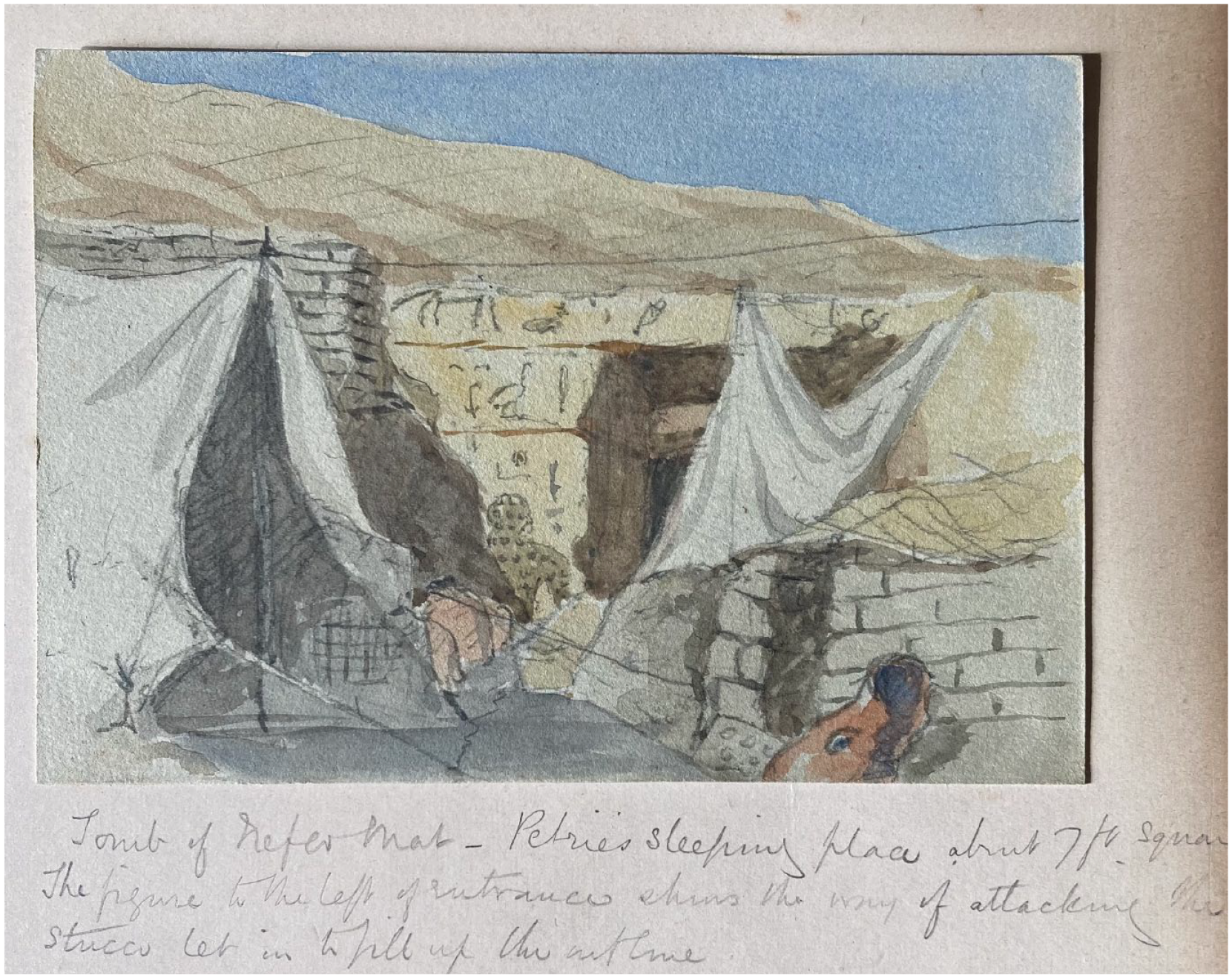
‘Tomb of Nefer-mat – Petrie’s sleeping place about 7ft square. The figure to the left of the entrance shows the way of attacking the stucco let in to fill up the outline’. V&A SD.513.2 (© Victoria and Albert Museum).
The image caption, and the figure of Nefermaat in the picture, illustrate the unusual way in which his tomb was decorated. The shapes were cut deeply into the stone, and coloured pastes applied to fill them in. Undercut edges, as well as a roughly prepared surface with drilled holes, helped anchor the paste in place. 13 In the tomb, Nefermaat boasted of having created what he described as sš n sỉn=f, ‘unspoilable (lit. un-rubbable) writing’, through this process. 14 By Petrie’s time, the decoration was almost entirely destroyed through a combination of salt degradation and deliberate defacing following its increased exposure after 1871, when Mariette first rediscovered the tomb. 15 However, the bottom half of the scene shown in this watercolour, which remained covered by rubble and debris until Petrie’s time, was better preserved.
Howard’s view of Nefermaat’s façade can be compared directly to a contemporary photograph taken by Petrie (fig. 6). His watercolour shows both the outline shape of the figure, and the rough preparation of its surface for receiving paste, and also indicates the placing of several of Nefermaat’s titles on both the south jamb and the architrave. Visible on the jamb are ỉry-pʿ.t (‘nobleman’) above the figure and ẖtm.ty-bỉty (‘seal bearer of the King of Lower Egypt’) beside it. On the architrave, portions of the titles ḥm-nṯr bȝstt (‘priest of Bastet’) and ḥm-nṯr šsmtt (‘priest of Shesmetet’) can be read on the middle line, and on the top line the signs for ṯȝ.ty (‘vizier’) and jackal sȝb (‘chief justice’) from the title compound tȝy.ty sȝb ṯȝ.ty commonly held by viziers. 16
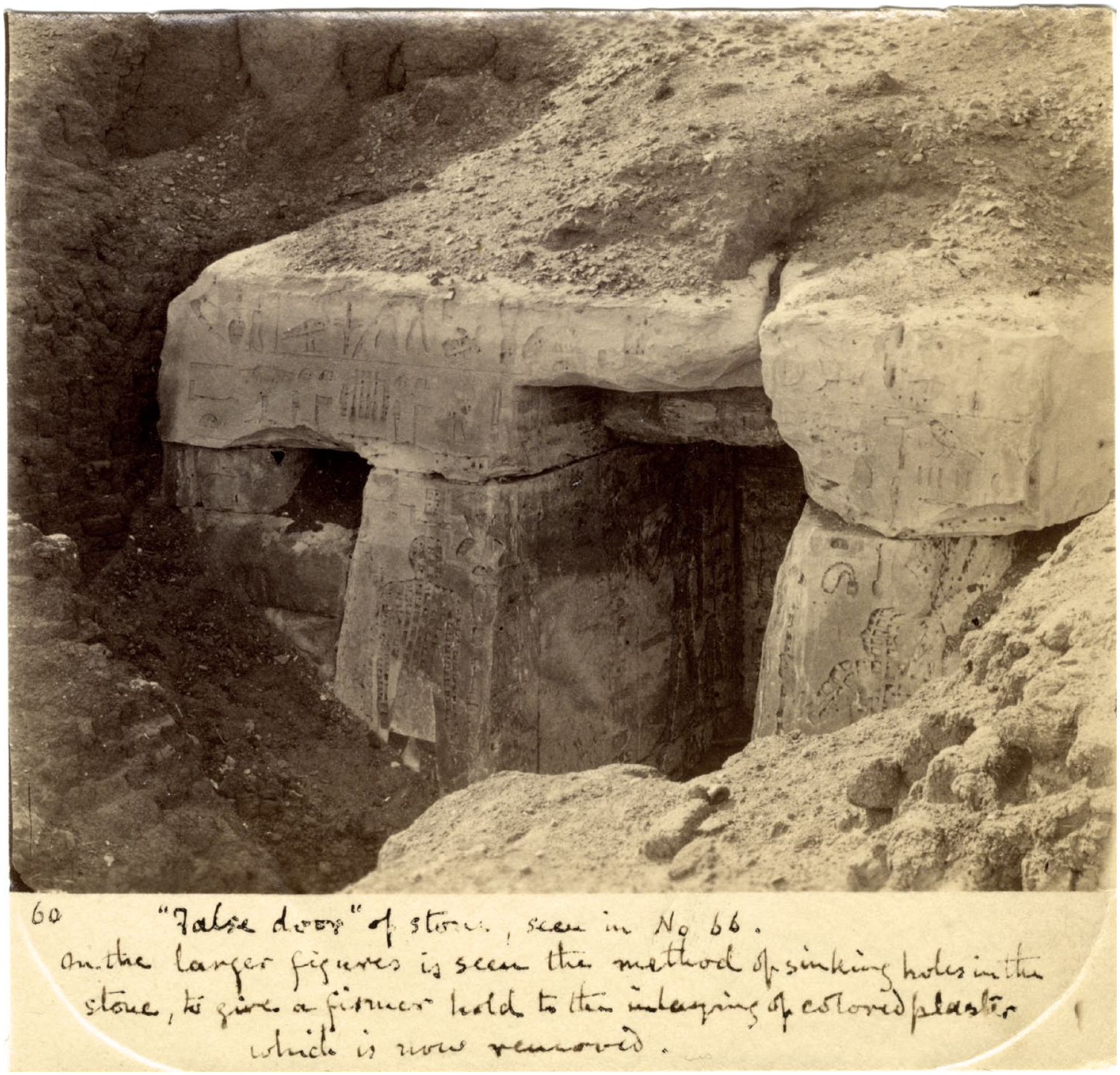
‘“False door” of stone’. Griffith Institute Petrie MSS 5.5.06d (© Griffith Institute, University of Oxford).
Howard’s third watercolour is annotated ‘System adopted by the earliest Pyramid builders for setting out their work. Corner walls erected at A + B outside the pyramid in which the size and slope was set out’ (fig. 7). This drawing shows the system of external L-shaped walls, with red and black painted lines, that were set up as an initial guide to aid construction before a mastaba was built. This ingenious step is described and illustrated both in Petrie’s journal and his final publication of the site. 17 Before building the mastaba itself, L-shaped walls were erected just beyond its extent, one at each corner. The intended positions of the mastaba corners were indicated by two vertical red lines on each L-shaped wall. Then, based on the intersection of these vertical lines with the ground level, the slope of the mastaba was indicated by two parallel diagonal black lines. Petrie initially assumed one was to help align the angle of the inner bricks and the other for the final outer casing, an interpretation followed in Howard’s drawing (the two black lines are annotated ‘line for slope of core’ and ‘line for slope of casing’ respectively), but by the time he published the site, Petrie questioned this conclusion. Finally, horizontal lines a cubit apart ran down each wall, indicating depth. It is unsurprising that Howard made a point of illustrating this engineering, as it was clearly a popular feature of Petrie’s guided tours of Meidum. In his field notebook Petrie observed that ‘visitors have been much interested in the setting <out> of the mastaba by diagrams on the corner walls. It seems to ‘fetch’ everybody who sees it, the idea is so neat and well carried out’. 18
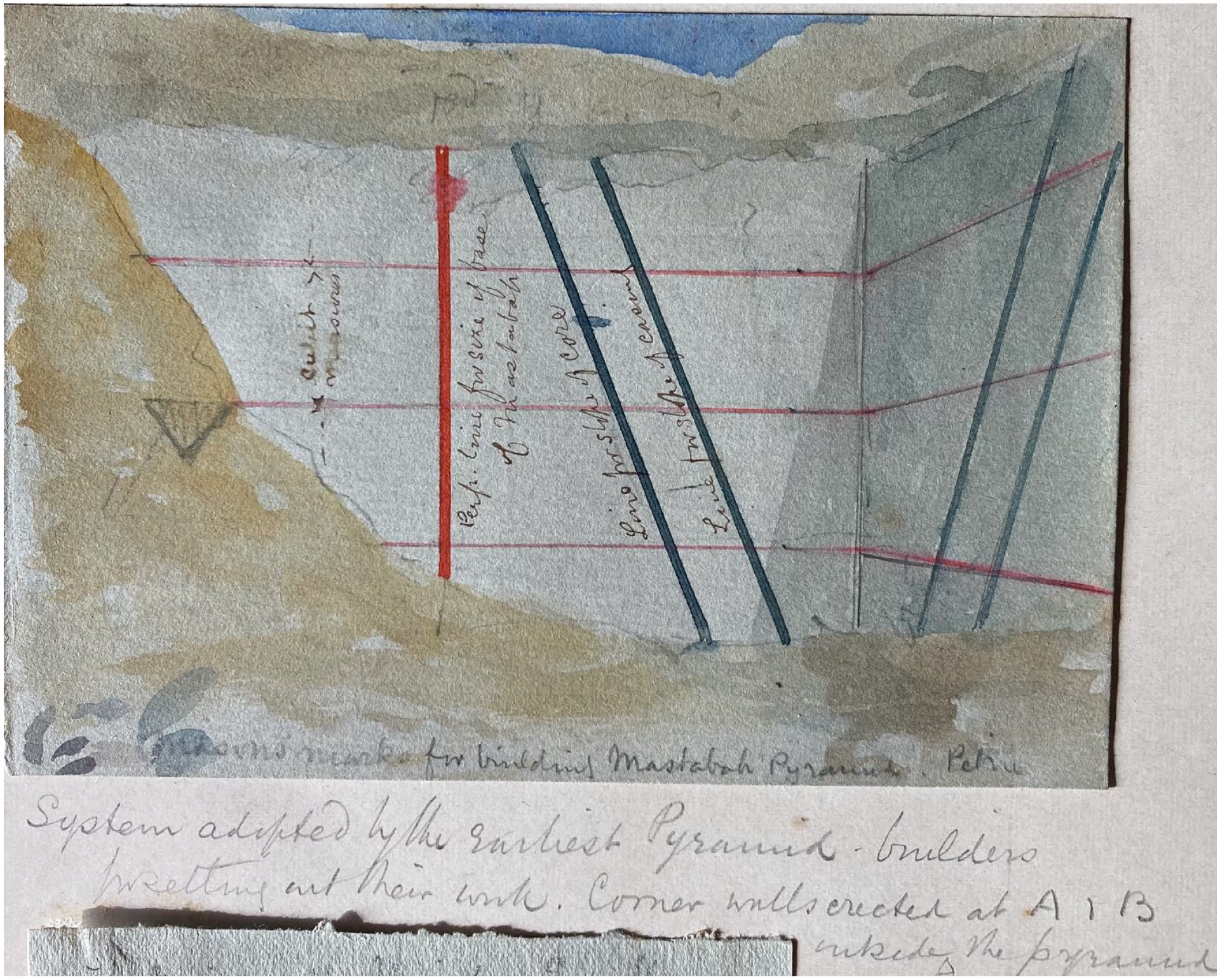
‘System adopted by the earliest Pyramid builders for setting out their work. Corner walls erected at A + B outside the pyramid in which the size and slope was set out’. V&A SD.513.3 (© Victoria and Albert Museum).
This point neatly highlights the phenomenon of which Eliot provides only one example, namely private tour groups to Egypt visiting sites where active fieldwork was ongoing. By the late nineteenth century, the ‘tourist boom’ to Egypt was in full swing, helped in no small part by companies such as Thomas Cook, and the development of package holidays. In 1869, Cook’s first group visited Cairo; by the winter season of 1889/90, 11,000 Thomas Cook tourists visited Egypt, and in 1893, a thousand in a single week. 19 It was inevitable that tourist groups and fieldwork would overlap, as both tended to cluster in the winter months, when Egypt’s climate was milder. As mentioned earlier, Meidum was a particularly popular stop on the private tour itinerary, given its accessible location. The pyramid and mastabas were routinely included in Murray’s and Baedeker’s guides, which recommended that the site could be visited as a day trip from Cairo. The route included a train ride to el-Riqqa, from where Meidum could be reached on donkey back, the total round trip from el-Riqqa taking around 6 hours. 20 Indeed, Eliot’s visit was far from a rare occurrence, as Petrie reports in passing that there were clearly many such visits by members of the public, and that he interacted with and escorted such groups personally; he writes ‘I shall not forget the strange astonishment that it was to me when a visitor asked “Who protected my things?” and “If I could trust my People?”. 21 The chance to meet Petrie personally must have also, of course, acted as an additional draw, as he was well known to the general public by this point.
Rather than just curios, tourist’s sketches and diaries are also important Egyptological resources, and can offer important and otherwise unpreserved accounts of field activity. For example, in 1891, on one of her multiple trips to Egypt, Marianne Brocklehurst drew in her diary several watercolour sketches of the clearing of the Bab-el Gasus or Second Cache as it was ongoing at Deir el-Bahari. 22 Save for sketches made by Émile Bayard for the French newspaper L’Illustration, there are few other surviving visual depictions of this moment, which was one of the most important archaeological discoveries of the nineteenth century. In a similar vein, Eliot’s drawings of both Petrie’s set-up outside the mastaba of Nefermaat, and the workforce’s quarters, visually document the reality of nineteenth century fieldwork, something described in Petrie’s accounts but otherwise unillustrated.
In conclusion, Howard’s watercolours add another source of information on late nineteenth century excavation practices in Egypt, and specifically another important visual record to the archive of Petrie’s fieldwork. Moreover, they highlight the intersection between private tourist groups and active field seasons, where one of the appeals of visiting ancient sites was not just the remains themselves, but the opportunity to witness excavation in action, and possibly be amongst the first to see new discoveries as they were made.
Footnotes
Acknowledgements
The author would like to thank Ruth Hibbard for providing access to the watercolours discussed in this article, and the anonymous reviewers of the paper for their comments and suggestions.
Funding
The author received no financial support for the research, authorship, and/or publication of this article.
9
Howard returned to Egypt in 1896, making further watercolour studies of boats on the Nile at Luxor and Girgis (V&A acc. nos SD.509–SD.511).
10
Auction 02 February 1969, Lot 24. The lot contained 105 drawings made by Howard.
12
Illustrated in Petrie 1892b: pls XVI–XVII;  : 58–59, figs 71–72, 74, 181–182, pl. 3. The façade is today in the Egyptian Museum in Cairo, JE 43809.
13
Petrie 1892b: 24–25; : 165–168.
15
For a summary of the damage done to the tomb across this period see : 13. Henry Villiers Stuart MP visited Meidum in 1878/79, between Maspero and Petrie, and illustrated the façade as it was then, showing how much damage had occurred even just in that first decade since rediscovery; see Stuart 1879: pl. LVI.F, reproduced in Harpur 2001: Appendix 1, fig. 176.
17
Petrie MSS 1.10 1890/91: 69–70 (entry for 8–14 February); : 12–13, pl. 8.
19
Hunter 2004: 42; : 20.
20
Murray 1900: 644d; : 467–469.