




Abstract
Creative writing programs offer prisoners a means of self-expression and rehabilitation, fostering self-reflection and emotional expression by encouraging introspection, channelling emotions, building resilience, and fostering creativity and identity. Despite numerous publications on these programs, there is a lack of summaries detailing the types of programs, providers, target audiences, and rigorous evaluation of the benefits. This scoping review examines 56 sources (peer-reviewed, and non-peer reviewed including dissertations, book chapters, and reports) on creative writing initiatives in prisons, focusing on their characteristics and efficacy. Most studies were conducted in the U.S., Australia, and the U.K., with programs mainly run by universities or charitable organizations. Nearly half of the studies did not provide demographic information about participants, and few included evaluations. Evaluations relied on self-reports, observations, and analysis of written works, with minimal use of surveys or interviews. The study highlights the need for more rigorous research to assess the effectiveness of creative writing programs, which have the potential to improve prisoners’ wellbeing during and after imprisonment. Thorough research could demonstrate effectiveness, identify best practices, understand impact, improve programs and inform policy.
Introduction
Creative writing programs have a long-standing presence in prisons, serving multiple purposes such as educational enhancement, skill development, emotional expression, and facilitating re-entry into society (Littman & Sliva, 2020). These programs are instrumental in boosting inmates’ self-confidence, improving learning retention, and providing a means for emotional expression (Hanley & Marchetti, 2020).
Creative writing in prison is not a new phenomenon: the tradition of writing goes back centuries, demonstrating how deeply it is rooted as a way for prisoners to make sense of their lives and experiences behind bars. Many notable authors have written some of their works while incarcerated, including Fanny Hill by Cleland (1748), Civil Disobedience by Thoreau (1849), The Enormous Room by Cummings (1922), De Profundis by Oscar Wilde (1897) and (Woodsmall, 2015).
The growth of programs that support and encourage creative writing in prison is related to established carceral policies that see education as central to rehabilitation (Eggleston & Gehring, 2000). The importance of educational programs in prisons has been well established. In Discipline and Punish (1975), Foucault provides an overview of change in thinking about punishment in eighteenth and nineteenth centuries as moving towards the idea of rehabilitation through work and education (Beasley, 2015; Foucault, 1975). Many governments and correctional systems have implemented policies that value education as a prominent component for rehabilitation and numerous studies have shown that prison education can reduce recidivism, improve post-release employment and nurture personal growth.
Educational Programming in Prison
Creative writing programs in modern prisons build on this rich tradition and serve as a vital component of broader educational initiatives. These programs not only provide an outlet for self-expression but also foster critical thinking, essential skills, and personal growth (e.g., Beasley, 2015). As a subset of educational initiatives, creative writing programs offer prisoners a unique opportunity to engage in self-reflection, emotional expression, and personal development, while also mitigating some of the well-documented harms associated with incarceration (e.g., Gussak, 2009; Johnson, 2008; Schwan, 2011). Additionally, these programs can act as a bridge to broader educational opportunities, fostering a culture of learning and rehabilitation within the prison environment.
Some recent studies, such as the RAND Corporations 2013 meta-analysis of prison education programs, suggest that education not only improves recidivism and employment outcomes for incarcerated people, but is also a cost-effective measure for such improvements (Davis et al., 2013). The movement from punishment to rehabilitation through work and education was formalised by the United Nations mandate in 1957 stating that inmate education is a basic human right fostering rehabilitation and re-entry into society (Farrell et al., 2001). In Australia, various State Governments have legislation recognising the right to inmate education.
These insights collectively underscore the diverse advantages of educational programs in prisons, particularly creative writing initiatives. By offering inmates avenues for personal development and skill acquisition, these programs not only aid in rehabilitation but also advance broader societal objectives, such as lowering recidivism rates and facilitating successful reintegration into society.
Creative Writing and Arts-Based Interventions
Creative writing programs in prison often sit between what might be called “educational” and “arts-based” initiatives and offer benefits of both types of programs including skill development and structured learning (educational programs) and artistic expression and therapeutic benefits (arts-based programs). It is important to distinguish between creative writing as a tool within a larger suite of tools (for instance, journal-keeping in criminogenic behaviour courses), and creative writing as a methodology and educational approach. There is also a valuable distinction between creative writing as a purely therapeutic tool—what is often vaguely construed as ‘art therapy’—and creative writing courses that propose manifold benefits of writing beyond personal therapy. Ezell and Levy (2003) have identified two types of “arts-based” programs in prisons that reinforce such a distinction: those conducted by professional therapists who provide “art therapy” for treatment purposes, and those facilitated by artists and writers who, while not trained as therapists, understand the value of art in enriching individuals’ lives.
It is also important to foreground the “creative” in “creative writing,” distinguishing between forms of writing instruction that privilege literacy or writing competency from programs that aim to develop “creative writing skills” and produce writing outputs that are recognisably “creative.” According to Appleman (2013), creative writing of this kind is a useful way to enhance creative potential, to foster a love of language and to offer a way of self-expression (Appleman, 2013). Creative writing prison programs also have the potential to foster cultural engagement and identity, such as the “The Dreaming Inside” program in New South Wales, Australia, which is specifically for Aboriginal and Torres Strait Islander prisoners (Marchetti & Nicholson, 2020).
Marchetti and Nicholson (2020) point out, that simple initiatives such as creative writing programs can be used to radically alter the learning experiences for people who likely struggled in school and might have lost interest in learning (Marchetti & Nicholson, 2020). Creative writing in prison can contribute to rehabilitation of inmates, support the development of positive self-concept, and be beneficial to the individual, beneficial to institutional management and beneficial to society (Littman & Sliva, 2020).
Arts-based programs, including creative writing, can also help improve an inmate’s mood and decrease depression, through receiving praise or through being able to express themselves (Littman & Sliva, 2020). Creative writing can improve self-esteem and confidence which is particularly useful for those who have experienced disadvantage and loss of power throughout their lives and while incarcerated (Brewster, 2014; Cheliotis & Jordanoska, 2016). Writing workshops—along with other prison educational initiatives—also provide vital access for incarcerated people to social, vocational and culturally relevant contacts and networks to allow them to build relationships of trust (Solbakken & Wynn, 2022). Participation in arts-based programs, like creative writing programs, can lead to less disruptive behaviour in prison and changes in self-perception which can lead to challenging prior offending behaviour (Cheliotis & Jordanoska, 2016).
Challenges Faced by Creative Writing Programs
Prison programs that privilege arts such as creative writing have struggled to achieve positive and ongoing recognition (Atherton et al., 2022), even though participation in creative expression through the arts can assist in the rehabilitation and re-education of inmates (Littman & Sliva, 2020). Limited funding for arts programs mirrors non-custodial environments, but in the case of prison education, these programs are also perceived as less essential than other rehabilitation initiatives. The common misconception that art programs—like other non-behavioural interventions—are a “luxury” for prisoners makes it difficult to secure public and institutional support (Mastandrea et al., 2019).
An additional challenge is that much of the research on arts-based programs, including creative writing programs, is primarily descriptive and uses anecdotal or subjective reports (Rosenbaum, 2019). The reliance on descriptive research offers a significant limitation as it not only limits generalizability to broader populations, but reports based on personal experiences and perceptions can introduce bias and might not accurately represent the experiences of all participants. It also affects the credibility, policy adoption, and funding of these programs. Descriptive research tends to lack rigorous, systematic analysis required to establish causality. Consequently, policymakers and funding bodies may view the evidence as less reliable, which can impede the adoption of arts-based programs in correctional settings and limit allocation of resources to support these initiatives. Robust, empirical data demonstrating the effectiveness of these programs are needed to advocate for their inclusion in rehabilitation strategies and secure sustained funding.
Some programs have used a more systematic and objective way of measuring impact of arts-based programs and found that, for example, participation of juvenile prisoners resulted in a reduction of rule breaking (Development Services Group Inc., 2016). Other research has shown that enjoyment and achievement in prison art programs can stimulate prisoners to pursue further education inside prison as well as upon release (Littman & Sliva, 2020). The need for education in prison is validated by research demonstrating education in prison reduces recidivism (e.g., Nur & Nguyen, 2023; Roxell, 2024; Stickle & Schuster, 2023). A recent meta-analysis of 78 articles showed that prison education programs increase post-release employment and wages. The authors reported that each form of education in prison has large and positive returns, primarily due to the high costs of incarceration and high benefits of crime avoidance (Stickle & Schuster, 2023).
Prisons though, operate with a continuous tension as they are required to punish but at the same time have to reform and provide social order (Gul, 2018). On the one hand, the punitive side of incarceration often prioritises security and control, which can limit the educational opportunities and strict regulations. On the other hand, the reformative quality recognises the importance of education in reducing recidivism and can assist in reintegration in society. This tension was highlighted by the Victorian Court of Appeal in 2005, which asserted that prisons should fulfill the goals of retribution, deterrence, and rehabilitation (Kellam, 2006). The continuous balance between punishment and reform can shape prison policies where educational programs can be both valued and constrained.
Purpose for This Scoping Review
Globally, the prison population has increased significantly in the past decades. The U.S. has around 15% of the world’s 11.2 million prisoners with 531 people per 100,000 incarcerated (Institute for Crime and Justice Policy, 2024), while the rate is 202 per 100,000 for Australia (ABS, 2024). El Salvador has the highest rate of 1086 per 100,000 people (Institute for Crime and Justice Policy, 2024). Rehabilitative programs are needed to support the growing international community of incarcerated people. Article 10.3 of the International Covenant on Civil and Political Rights (ICCPR) (GA Resolution 2200AA (XXI) states that the essential aim of the penitentiary system includes reformation and social rehabilitation of prisoners rather than focus on punishment and education and vocational training and work should be offered (United Nations, 1966).
There is a wide variety of educational programs in the prison system in Western countries, however, there is little information which summarises what kind of programs are being offered, in particular who offers the programs, who are the participants, what is being offered, in which Western countries, and what are the potential benefits of the program. Educational programs include but are not limited to adult basic education which focuses on improving literacy and numeracy skills; secondary education which provides opportunities to earn a high school diploma; vocational training offering job-specific skills and certifications such as culinary arts and carpentry; life skills programs; and creative arts programs (Davis et al., 2013). In this scoping review, we examine the landscape of creative writing programs in prisons across the world. The focus is on creative writing which we understand as distinct from basic literacy courses and separate from therapeutic programs that treat writing as a tool for understanding behaviour. Instead, creative writing programs encourage a higher level of self-exploration and analysis that goes beyond the boundaries of literacy training and therapy, follow specific creative writing methodologies and pedagogies, and produces creative artefacts (Beasley, 2015). Our focus on creative writing was based in part on our own team’s experience running and evaluating creative writing programs in New South Wales (Australia) prisons, but also on the particular challenge that these programs offer in terms of methodological clarity and meaningful measures of evaluation and review. The aim of this study is to provide an overview of published research about creative writing programs in prisons across the world and examine what programs exist, who offers them, and who their target population is.
Methodology
Scoping reviews have become a popular methodology adopted across disciplines including health sciences, social sciences, and business and management, due to the ability to broach relatively broad and under-researched topics (Daudt et al., 2013; Munn et al., 2018). Despite this popularity, there remains a lack of consistency in the method through which scoping reviews are undertaken (Munn et al., 2018; Tricco et al., 2016). Similarly, there remains no agreed upon definition nor a standardized framework upon which scoping reviews are categorized (Arksey & O’Malley, 2005; Daudt et al., 2013). In fact, the name itself is inconsistent, varying from anywhere from “scoping studies” to “scoping exercise,” and “scoping literature review” (Levac et al., 2010). The goal of this scoping review is to identify knowledge gaps in the literature on creative writing programs in prison. The overarching research question is: What do we know about creative writing programs in prison across the globe? The sub questions are:
What are the characteristics of creative writing programs in prison?
Who develops and offers the programs?
Who is the target audience in prison?
What are the outcomes of the creative writing programs in prison?
Databases and Key Word Search
For this scoping review, we initially identified 12 databases after consultation with the librarian. Of these, four (HathiTrust, Clarivate Analytics, Ingenta Connect, GALE and Informit) were eliminated as they returned a lack of results or overwhelmingly irrelevant results during the pilot search. Thus, a total of eight databases were searched : EBSCO, Proquest, Scopus, Web of Science, OVID (APA), JSTOR, Project Muse, and Google Scholar.
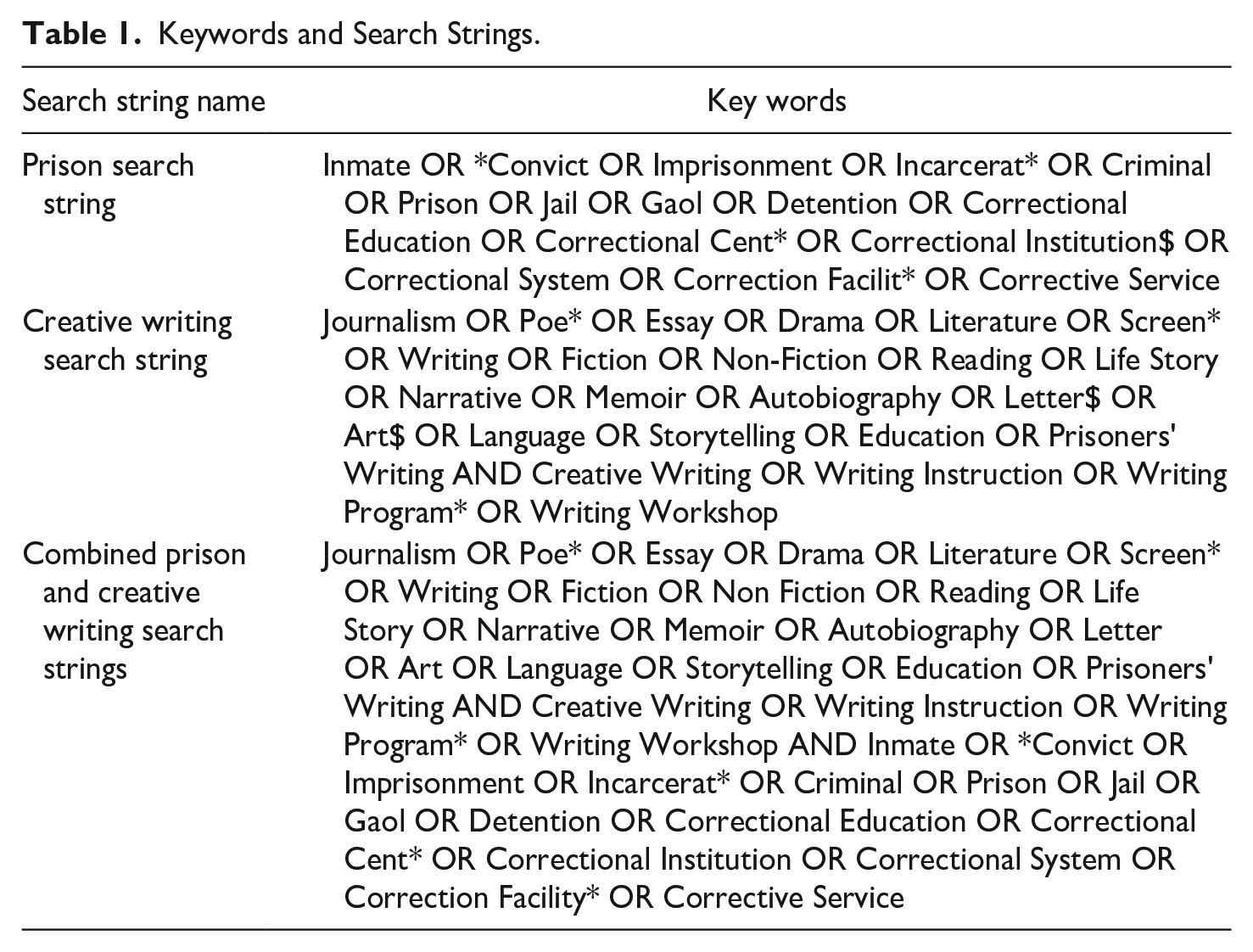
We first identified key words focusing on “prison” and “writing.” We identified the key words by reviewing previous literature, consulting with the librarian, and testing the results. We then created a search string listing possible terms and variants (i.e., due to geographical spelling differences) that would capture the desired data related to the research questions. Overall, 52 key words were identified, classified into either “writing” (n = 32) or “prison” (n = 20) sub-categories. Two search strings were then constructed from the truncations and wildcards of these terms (see Table 1), aptly nicknamed the “prison search string” and the “creative writing search string.” These two categories were adopted to ensure that any source that mentions a term from “writing” also mentions a “prison” term, eliminating all potential data that was only relevant to one of these key topics. The search strings are shown in Table 1.
Keywords and Search Strings.
Inclusion and Exclusion Criteria
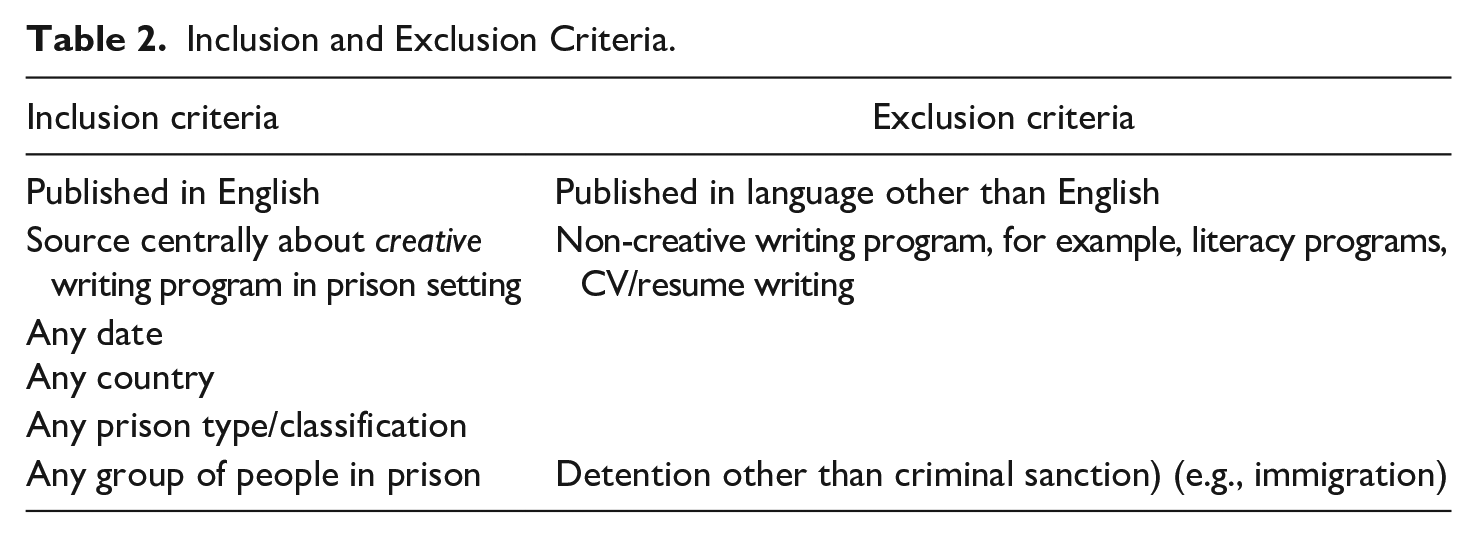
Table 2 shows the inclusion and exclusion criteria for studies to be included in the scoping review. The focus of the study had to be on creative writing in prison and we excluded literacy programs focusing on improving literacy skills such as writing a resume. Equally, we omitted studies that may have implemented “creative writing tools”—such as reflective writing or journal keeping—but were centrally non interested in generating creative writing outputs. For example, a criminogenic behavioural program that included reflective writing exercises as one strategy did not meet the criteria, “centrally about creative writing.”
Inclusion and Exclusion Criteria.
For each database, we ran the search string, checked whether journal articles were peer reviewed and generated a total of 143,698 sources. Two of the databases—JSTOR and Google Scholar—did not permit adequately complex search strings, and so we had to run multiple, shortened versions of our primary string to remove irrelevant results, and reduce the number of returned search results. Finally, we removed duplicates and ended up with 981 results (see Table 3).
Total Search Results.
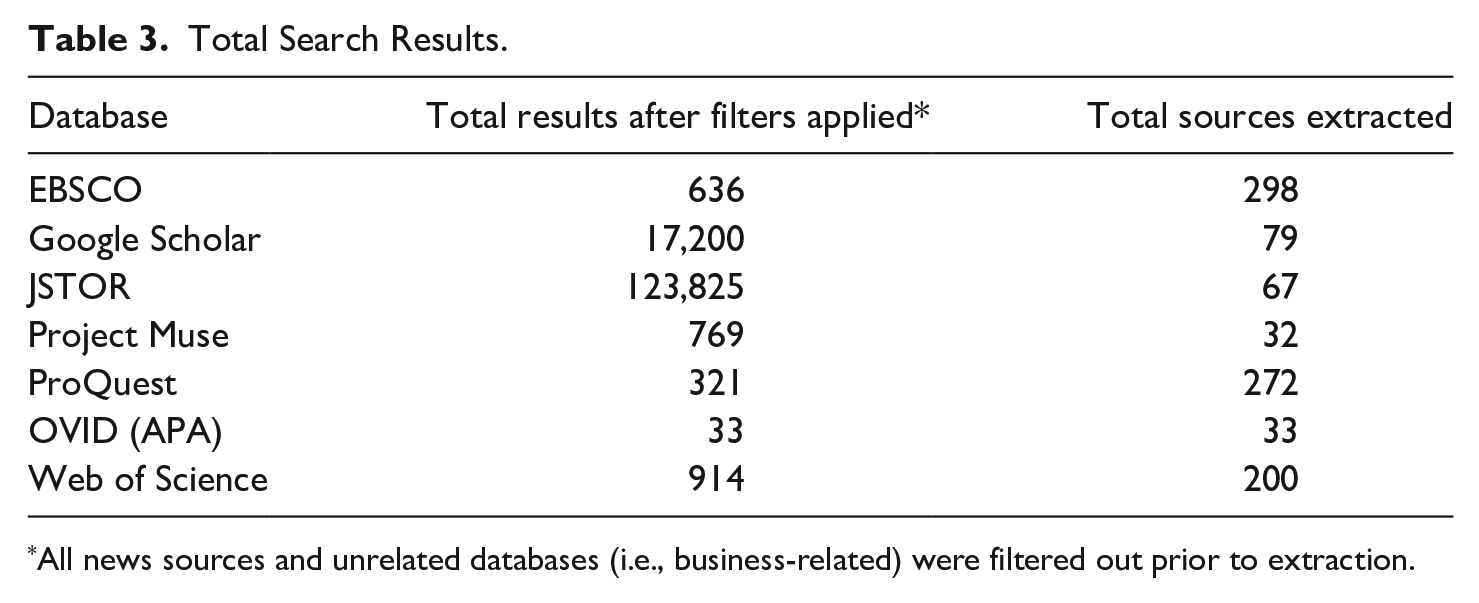
All news sources and unrelated databases (i.e., business-related) were filtered out prior to extraction.
Collecting, Summarizing, and Reporting Data
We extracted the first 200 peer-reviewed and first 100 non-peer reviewed sources from each database (extraction completed in 2022) and exported into EndNote to capture the most relevant sources and eliminate the irrelevant ones from the large number of search results. Due to the large number of sources for a scoping review, we opted to review the first 200 peer-reviewed journals, anticipating that they would contain more rigorous research. As the number of irrelevant sources increased significantly after approximately 100 for non-peer-reviewed and around 200 for peer-reviewed sources, we ultimately decided to cease reviewing sources beyond this initial large sample. Although it is stated that all articles in one of our databases, Web of Science, are peer reviewed, Clarivate Analytics (2018) does not keep a log of the journals’ peer status so this may not be accurate for some cases. There is also no option for determining the validity of the “peer-reviewed” classification in the Web of Science results, as you cannot filter out so-called non-peer reviewed sources. While we acknowledge this limitation, we proceeded with the assumption that the majority of the journals listed as peer-reviewed would adhere to standard peer review practices and we recognize this as a potential area for improvement in future review. All duplicates were removed, and the authors reviewed the title and abstract of each source and used the inclusion and exclusion criteria to either include or exclude a source.
Two reviewers independently reviewed each source to ensure diverse perspectives and reduce bias. We held regular meetings to discuss and evaluate the sources together, ensuring consistency in our assessments. Additionally, we used a stepwise approach (three exclusion rounds) to systematically narrow down the number of eligible sources, focusing on relevance and quality at each stage. Where the first exclusion round resulted in a total of 185 sources, the second 100 sources and the third 56 sources. We created a data extraction guide (see Appendix A) which included information on author, title, date, abstract but also demographics of people in prison, as well as program information including type, duration, mode, writing products, aims and evaluation. Deductive categories were created based on the literature (such as program characteristics), while inductive categories were based on the information generated from the analysis of the data (such as program outputs). This article only examines the data extracted using the data extraction guide.
Results
The works were published between 1992 and 2020 with 2020 being the most represented year (n = 6), followed by 2017 and 2018 (n = 5 for each). There were 37 journal articles, four book chapters and three dissertations with a total of nine different types of publications (1 anthology, 1 conference paper, 1 magazine, 2 reflective narratives, 1 report and 1 thesis). The total number was 56, spanning four continents, with North America contributing the most sources (n = 49) and Australia the second most (n = 5) (see Figure 1).
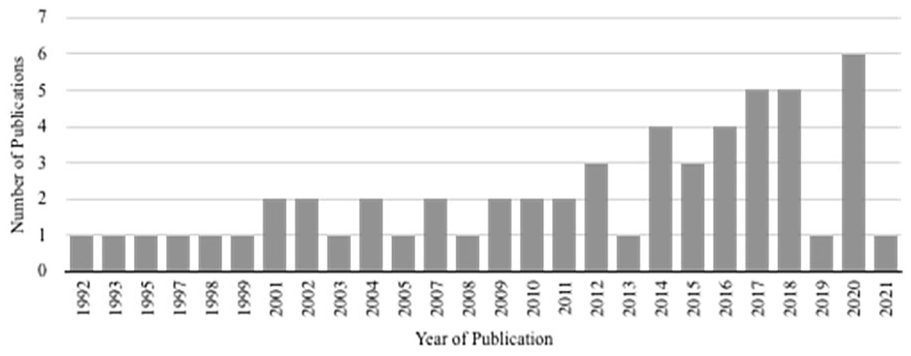
Source by publication year.
The literature had a strong American focus, with the majority of published works (n = 45 or 76.27%) originating from the U.S. In the included studies, Washington State and California were the most represented states (n = 4) and a total of 18 separate states were represented throughout the literature, where 22% were specified. The remaining studies originated in Australia (n = 5 or 8.4%), the U.K (n = 4 or 6.8%), with Mexico, Belgium and Argentina represented with a single work (each 1.7%). Among the Australian programs, a majority (60% or three studies) involved the participation of Aboriginal Indigenous and Torres Strait Islander people.
Program Demographics
When looking at who offers the creative writing programs in prison, the majority of the programs were externally based (25 vs. 6) and primarily originating from universities (n = 10) and charitable organisations (n = 7). In nearly half of the included works, the demographics of the participants (e.g., prisoners) were not specified regarding gender and age. Twenty-one studies provided specific ages for the participants (n = 21), while the majority of the programs referred to age more generally, using terms like “youth” or “adolescents” (n = 43). The eldest participant was 60 or older and the youngest 11, with the age range 20 to 30 years most represented. Where gender was specified, there was a fairly even representation of male and female participants (n = 15 vs. 12) and 11 studies included mixed gender. Many of the programs focused on youth (n = 17) but the majority focused on adults (n = 30). Group sizes were small with the maximum being 20 participants per group (n = 14) and the most common size being between 11 and 20 participants (n = 9), followed by 0 to 10 (n = 5).
Sixteen of the works did include additional details about the participants, such as the participants’ histories and backgrounds to varying degrees. When participant demographics were included, they tended to focus on general age, for example, youth (n = 17) vs adult (n = 30) or mixed (n = 7), followed by specific age (i.e., xx years old) (n = 16) and educational background (n = 7). Other demographic information included were criminal history/status (n = 6), race/ethnicity (n = 5), sexual orientation (n = 3), mental health (n = 3), and familial status (n = 2). Criminal history referred to convictions of participants which were usually labelled as “drug-related offences,” or “high risk offending” etc. Mental health was always discussed in relation to substance-related disorders, that is, addiction. Only one work discussed mental health in relation to psychiatric disorders in addition to substance-related disorders.
Program Output
When specified, the most common outcome from the creative writing programs was labelled as “creative writing as output” (n = 22) followed by poems (n = 14). Other outputs included letters (n = 4), non-fiction writing products (n = 3) and anthologies (n = 4). Additional writing outputs included journals (n = 2), playwrighting (n = 1), songwriting (n = 1), screenplay (n = 1), autobiography (n = 1), CD recording (n = 1), and prose (n = 1). There was a small but not insignificant representation of visual art products among a few of the discussed programs (n = 6) where various visual art mediums were used. Where specified outside of “visual arts,” drawing and photography (both n = 1) were also products of these programs. Non-fiction writing products included a program where the “students” wrote a handbook for future “residents” on what to expect for their stay at the (prison) facility. Another program included products which changed each term, but students chose a research topic of their choice.
Many programs listed multiple products, for example, letters and poetry, rather than having a single output. Where the focus was only one product, poetry was the specified product. Most of the prisons where the programs were offered were of mixed gender (n = 19) or male only (n = 18) with the remainder (n = 9) being female-only prisons. Many works did not specify the type of prison or provide the facility name where data was collected (n = 12). In terms of security status of the facilities where the programs were held, many had multiple levels of security (n = 13), with the remainder being minimum (n = 12) or medium (n = 10) security. However, this does not necessarily reflect the security level of the participants in the programs as this was often not specified.
Evaluation
Most programs did not have a formal evaluation. There were 30 programs (53%) that had no evaluation or did not mention an evaluation of the program. Many of the sources were rather vague or did not specify whether there had been an evaluation of the program and if yes, what was evaluated. Some programs had a combination of evaluations, but evaluations fell roughly into three categories: (a) observation or self-report (b) analysis of the written products (c) interviews or surveys. One program looked at recidivism rates after completion of the program. There were six programs in the first category, four in the second category, and five in the third category. Another five programs mentioned an evaluation but did not specify what type of evaluation was conducted.
Discussion
Creative writing has been present in prisons for over a century and has a variety of aims: from educational and skill development to self-expression and re-entry into society (Littman & Sliva, 2020). These programs can assist in promoting prisoners’ self-confidence, learning retention and expression of emotions (Hanley & Marchetti, 2020). Despite the long history of creative writing programs in prison, beginning at least as far back as Boethius’s 523 AD “Consolation of Philosophy” (Woodsmall, 2015), there is little empirical research evaluating creative writing programs in prisons. As far as we know, there has not been a scoping review laying out “the landscape” of creative writing programs in prison. In this study, we examined the characteristics of creative writing programs across the Western world, including who develops and offers the program, the target audience and the potential outcomes. We developed inclusion and exclusion criteria based on the research questions and twelve databases were searched. We found over 143,000 sources which mentioned creative writing in prison. After removing duplicates, we ended up with 981 results which consisted of a combination of peer-reviewed articles and grey literature. We extracted the first 200 peer-reviewed articles and the first 100 non-peer reviewed sources. After applying the inclusion criteria (see Table 1), the final sample included 56 sources (See Appendix B for a list of sources).
The results showed that the majority of the sources were peer-reviewed journal articles (37%) and originated from the U.S. (76%) with Australia making up 5% of the studies. Most of the programs were externally based and originated from universities and charitable organisations. Demographics were often omitted from the studies or studies mentioned they focused on “youth” or “adults,” without specifying who was included in these groups.
Creative writing output was the most common product of the programs, with some mentioning visual arts or non-fiction and letter writing as the outcomes. Most programs included mixed gender, however, where mentioned, there was an almost even number of programs for males and females (15 vs. 12). This is remarkable, as the number of men in prison is far higher than the number of women in prison. In Australia, for example, 93% of prisoners are male, compared to 50% of the general population (ABS, 2024).This seems to suggest that either programs tend to target women or programs for women are more likely to be reported on. There may be a publication bias where studies on women’s creative writing programs are more frequently published, possibly due to the unique and compelling narratives of women’s experiences in prison, which attract more academic and public interest. Women in prison often have different rehabilitation needs compared to men, as they are more likely to have experienced trauma, abuse, and mental health issues prior to incarceration. Creative writing programs can effectively address these issues by providing a therapeutic outlet for self-expression and emotional healing (Whitecross, 2025). Additionally, the smaller female prison population might allow for more targeted and specialized programs. With fewer participants, it can be easier to implement and manage creative writing programs that specifically address women’s needs.
Although creative writing is known to be beneficial for prisoners, the fact that 30 out of the 56 sources did not include an evaluation, makes it difficult to formally assess the program benefits. The few programs which did have an evaluation, relied on self-report or observations, analysis of written projects, surveys and interviews, while almost none had a rigorous design allowing for assessing their effectiveness in terms of prisoner wellbeing and rehabilitation. It should be noted that these 56 sources were substantially more rigorous than many omitted search results, and even still, most of these peer-reviewed, academic outputs were inadequate in satisfying what many prison bureaucracies expect from formal programs: for instance, evaluation of impact, demonstration of effectiveness, capacity for scalability, and so on. While we suspect that many creative writing programs have different metrics for success—for example, improved institutional culture, positive reporting on self-worth, opportunity for creative self-reflection—it remains true that creative writing programs would benefit from improved design and formal evaluation.
We know that there are multiple benefits for creative writing programs in prison including individual benefits such as self-reflection, self-knowledge, a sense of accomplishment, opportunities for reparation and improvement of skills (Argue et al., 2009). Often the available educational training is limited in prison and political and financial issues influence whether and what can be studied (Beasley, 2015). Creative writing programs in prison should be distinguished from literacy courses, as they involve more than just literacy training; they require self-reflection and serve as an outlet for creativity (Kendig, 1985). These programs can boost self-esteem (Palmer et al., 1994), aid in establishing relationships outside of prison (Harvey, 2010) and enhance writing skills that may be beneficial for employment (Flynn & Price, 1995).
A recent systematic review by Mansfield et al. (2024) on the effects of arts interventions for at-risk children and youth on behavioural, psychosocial, cognitive, and offending outcomes found insufficient evidence from quantitative studies to assess the effectiveness of these interventions. The review included various arts-based activities such as creative writing, theatre, and podcasting, with a particular emphasis on music. The studies they reviewed tended to have methodological weaknesses such as limited discussions on recruitment, data collection and analysis, which aligns with our findings (Mansfield et al., 2024). While “prison education,” typically encompassing high school and literacy programs, has been shown to reduce recidivism by 13% for participants compared to non-participants (see meta-analysis by Davis et al., 2013), there is no comparable data available for creative writing programs in prison.
The authors of this recent systematic review also conducted a cost-benefit analysis which showed that providing 100 inmates with an education would cost approximately US$140,000 to $174,000, and three-year reincarceration costs would be between US$0.87 million to $0.97 million less for those inmates who completed prison education compared to those who did not (Davis et al., 2013). Although none of this information is available for creative writing programs in prison, it would be helpful to have this information to rigorously and systematically assess the benefits of creative writing programs in prison. Given the need to align funding with explicit outcomes, creative writing programs would benefit from costing, evaluation, and ongoing research into their efficacy. This information could be helpful to set up, run and evaluate creative writing programs, enhance their sustainability and improve their effectiveness. The direct costs of the program, such as materials, instructor salaries, administrative expenses, and facility usage, along with indirect costs like staff training and additional security measures, can be identified and compared. Additionally, tangible benefits, including measurable outcomes like reduced recidivism rates, improved mental health, and educational achievements, can be quantified in terms of cost savings for the prison system and society. The cost savings from reduced recidivism can be calculated by estimating the average cost of incarceration per inmate and the reduction in re-incarceration rates. Improved mental health outcomes can also lead to cost savings due to a decreased need for mental health services.
This scoping review underscores notable gaps in the current literature, particularly the absence of comprehensive information on program evaluation, including details on what was evaluated and the demographics of the participants. The findings underscore the need for more rigorous research methodologies to assess the effectiveness of creative writing programs to establish best practices and improve program design. The review emphasizes the potential of creative writing programs to enhance the wellbeing of prisoners both during and after imprisonment, thereby aiding their successful reintegration into society.
While it would be challenging, future research could incorporate longitudinal studies to monitor participants over time, both during and after incarceration. This approach would help evaluate the long-term impacts of creative writing programs on recidivism rates, reintegration success, and sustained mental health improvements. Some programs in this study were developed and delivered in collaboration with local universities. Partnering with these universities, non-profit organizations, and correctional institutions for collaborative research could enhance the reach and credibility of the studies, ensuring that findings are widely disseminated to inform policy and practice.
Limitations
One of the limitations of this review is the fact that it is a scoping review, thereby not an exhaustive review of the literature on creative writing programs in prison. We decided to conduct a scoping review as there is very little information on the characteristics of creative writing programs in prison, as well as on the characteristics and the effectiveness. However, a systematic literature review might be warranted in the future to provide a more thorough review of the literature.
Another limitation of the study is the selection of sources. As we retrieved a large number of sources, it was not possible to review all of them, we decided to focus on the first 200 peer-reviewed and the first 100 non-peer reviewed sources. This approach enabled us to manage the scope of our review within the available time and resources while ensuring a diverse and representative sample of the literature. By prioritizing the first 200 peer-reviewed sources, we aimed to include high-quality, rigorous research that provided reliable and valid findings. Including the first 100 non-peer-reviewed sources, such as dissertations and book chapters, allowed us to capture a broader range of perspectives and insights that might not be present in peer-reviewed journals. Future studies might want to broaden the inclusion criteria and review a larger number of sources. This would provide a more comprehensive understanding of creative writing programs in prisons and their impact on participants. Since the review primarily included published sources, there might also be an underrepresentation of unpublished reports or internal evaluations conducted by prison programs. The retrieval and analysis was done in 2022, therefore more recent studies were not included in the analysis and this might not reflect the most current developments. Periodic updates or living reviews could assist in capturing ongoing trends.
While this study aims to provide an overview of creative writing programs in prisons across Western countries, it is important to recognize the variability in carceral systems, funding models, and attitudes toward rehabilitation. These differences can significantly influence the implementation and outcomes of these programs.
Despite these limitations, this study provides an insight into the characteristics and evaluation (or lack thereof) of creative writing programs in prisons across the Western world. The results show that studies on creative writing in prison often lack information on the characteristics, the targeted population and the evaluation of the program. More research is needed to examine the delivery of the programs, as well as evaluating their effectiveness to ensure that an increasing number of prisoners across the globe can have access to programs which can help improve their self-esteem, self-confidence and potentially their reintegration into society.
Footnotes
Appendix A
Appendix B: list of included studies
Alexander, B. (2010). Is William Martinez not our brother?: Twenty years of the prison creative arts project. The University of Michigan Press and The University of Michigan Library, Michigan, U.S. https://doi.org/10.2307/j.ctv65swd5
Appleman, D. (2013) Teaching in the dark: The promise and pedagogy of creative writing in prison. English Journal, 102(4), 24–30. https://doi.org/10.2307/23365346
Appleman, D. A. (2017). Achieving the promise of educational opportunities for the incarcerated. Paper presented at Challenging Educational Borders, 29 April, San Antonio, Texas. https://doi.org/10.302/1177934
Arthur, D. S. (2017). A symphony of possibilities: The joy of art and writing through the beat within. Teaching Artist Journal, (15)3/4, 163–168. https://doi.org/10.1080/15411796.2017.1386497
Atherton, S., Knight, V., & Carpenter van Barthold, B. (2022). Penal arts interventions and hope: Outcomes of arts-based projects in prisons and community settings. The Prison Journal, 102(2), 217–236. https://doi.org/10.1177/00328855221079282
Baird, I. C. (2001). Evolution of activists: Prison Women’s writings as change agent for their communities. Paper presented at the Annual Meeting of the Adult Education Research Conference, Lansing, Michigan, U.S., June 1-3.
Beasley, C. (2015). Teaching behind bars: Challenges and solutions for creative writing classes in prison. Text, 19(2), 1–16. https://doi.org/10.52086/001c.253841
Blinn, C. (1995). Teaching cognitive skills to effect behavioral change through a writing program. Journal of Correctional Education, 46(4), 146–154. https://doi.org/10.2307/23292745
Brewster, L. (2014). The impact of prison arts programs on inmate attitudes and behavior: A quantitative evaluation. Justice Policy Journal, 11(2), 1–28. https://doi.org/10.12691/education-7-10-3
Christianakis, M., & Mora, R. (2018). (Re)writing identities: Past, present, and future narratives of young people in juvenile detention facilities. Life Writing, 15(1), 43–58. https://doi.org/10.1080/14484528.2016.1138568
Clemente, A., Higgins, M. J., & Sughrua, W. M. (2011). ‘I don’t find any privacy around here’: Ethnographic encounters with local practices of literacy in the state prison of Oaxaca. Language and Education, 25(6), 491–513. https://doi.org/10.1080/09500782.2011.596318
Cohen, M. L., & Wilson, C. M. (2017). Inside the fences: Pedagogical practices and purposes of songwriting in an adult male US state prison. International Journal of Music Education, 35(4), 541–553. https://doi.org/10.1177/0255761416689841
Cotto, M. (2009). Creative writing in the culture of the American prison. Salmagundi, 162/163, 160–181.
Crowley, M. (2014). Chapter and verse: The role of creating writing in reducing re-offending. Prison Service Journal, 214, 10–16.
Curry, M., & Jacobi, T. (2017). “Just sitting in a cell, you and me”: Sponsoring Writing in a county jail. Community Literacy Journal, 12(1), 5–22. https://doi.org/10.25148/clj.12.1.009114
Daldorph, B. (2010). “What truly matters”: Nine years of teaching a creative writing class at Douglas County Jail, Lawrence, Kansas. J Journal: New Writings on Criminal Justice, 3(1), 33–45. https://doi.org/10.2307/j.ctv1rr6dgr.6
Dunphy, K. (1999). A creative arts performance program for incarcerated women. The Arts in Psychotherapy, 26(1), 35–43. https://doi.org/10.1016/S0197-4556(98)00051-3
Exell, Ezell, M., & Levy, M. (2003). An evaluation of an arts program for incarcerated juvenile offenders. Journal of Correctional Education, 54(3), 108–114. https://www.jstor.org/stable/41971150[1].
Farrier, A., Froggett, L., & Poursanidou, D. (2009). Offender-based restorative justice and poetry: Reparation or wishful thinking? Youth Justice, 9(1), 61–76. https://doi.org/10.1177/1473225408101432
Gavigan, K., & Albright, K. (2015). Writing from behind the fence: Incarcerated youths and a graphic novel on HIV/AIDS. Journal of Adolescent & Adult Literacy, 59(1), 41–50. https://doi.org/10.1002/jaal.425
Geidel, M. (2005). Supermaxes, stripmines, and hip-hop. Journal of Popular Music Studies, 17(1), 67–76. https://doi.org/10.1111/j.1524-2226.2005.00034.x
Geraci, P. (2001). Fathering program implementation: A teacher’s experience. Journal of Correctional Education, 52(1), 2–3.
Ginsburg, R. (Ed.). (2019). Critical perspectives on teaching in prison: Students and instructors on pedagogy behind the wall. Routledge, Taylor & Francis.
Gold, R. (2014). Pongo creative writing for at-risk youth. In B. E. Thompson & R. A. Neimeyer (Eds.), Grief and the expressive arts: Practices for creating meaning (pp. 226–232). Routledge, Taylor & Francis.
Greenbaum, C. (2018). Development and mixed methods evaluation of a trauma-informed intervention for juvenile justice-involved youth (Ph.D. thesis). New York University.
Greenbaum, C. A., & Javdani, S. (2017). Expressive writing intervention promotes resilience among juvenile justice-involved youth. Children & Youth Services Review, 73, 220–229. https://doi.org/10.1016/j.childyouth.2016.11.034
Gussak, D. E., & Ploumis- Devick, E. (2004). Creating wellness in correctional populations through the arts: An interdisciplinary model. Visual Arts Research, 30(1), 35–43. https://doi.org/10.5406/visuartsrese.30.1.0035
Hanley, N., & Marchetti, E. (2020). Dreaming Inside: An evaluation of a creative writing program for Aboriginal and Torres Strait Islander men in prison. Australian & New Zealand Journal of Criminology, 53(2), 285–302. https://doi.org/10.1177/0004865820905894
Harding, N. A. (2020). Co-constructing feminist research: Ensuring meaningful participation while researching the experiences of criminalised women. Methodological Innovations, 13(2), 1–14. https://doi.org/10.1177/2059799120925262
Hawk, K., Bohna Jr, E. A., & Stark, J. M. (1993). Anthology of inmate art. Special demonstration project. Fayette County Community Action Agency Inc.
Helfgott, JB, Gunnison, E., Sumner, J., Collins, P. A., & Rice, S. K. (2020). “If someone would have showed me”: Identifying pivotal points in pathways to crime and incarceration through prisoner self-narratives. International Journal of Offender Therapy and Comparative Criminology, 64(6–7), 609–634. https://doi.org/10.1177/0306624X19867562
Hinshaw, W. W. (2018). Writing to listen: Why I write across prison walls. Community Literacy Journal, 13(1), 55–70. https://doi.org/10.25148/CLJ.13.1.009090
Hurkmans, G., & Gillijns, E. (2012). “In & out” Autobiography as an instrument for re- planning in consequence of an imprisonment experience. Social and Behavioral Sciences, 46, 5693–5697. https://doi.org/10.1016/j.sbspro.2012.06.499
Jacobi, T. (2011). Speaking out for social justice: The problems and possibilities of US women’s prison and jail writing workshops. Critical Survey, 23(3), 40–54. https://doi.org/10.3167/cs.2011.230304
Jacobi, T., & Becker, S. L. (2012). Rewriting confinement: Feminist and queer critical literacy in SpeakOut! writing workshops. Radical Teacher, 95, 32–40. https://doi.org/10.5406/radicalteacher.95.0032
Kahler, J. (2019). National novel writing month behind bars: A road map for NaNoWriMo at FCI-Elkton. Journal of Prison Education and Reentry, 6(2), 233–241. https://doi.org/10.25771/w75a-dq92
Leto, L. (1992). Writing/communications curriculum for incarcerated adults, A 353 project final report. Schuylkill Intermediate Unit #29.
Marchetti, E., & Bargallie, D. (2020). Life as an Australian Aboriginal and Torres Strait Islander male prisoner: Poems of grief, trauma, hope, and resistance. Canadian Journal of Law & Society/Revue Canadienne Droit et Societe, 35(3), 499–519. https://doi.org/10.1017/cls.2020.25
Marchetti, E., & Nicholson, B. (2020). Using a culturally safe creative writing programme to empower and heal Aboriginal and Torres Strait Islander men in prison. The Howard Journal of Crime and Justice, 59(4), 423–441. https://doi.org/10.1111/hojo.12383
McDonough, S. K. (2002). The view up close: Creative writing in a juvenile correctional facility (Ph.D. thesis). Auburn University.
Nelson, N. J. (2007). The design and implementation of an education program for African American inmates. Journal of Correctional Education, 58(3), 262–267.
Nicholson, A. B., Krishnabhakdi-Vasilakis, F., & Higgins, C. (2016). Unpenning words: Releasing literature from within dreaming inside-voices from Junee correctional centre. Journal of the Association for the Study of Australian Literature (JASAL), 16(1), 1–8.
Padilofsky, M., & Stolbach, B. C. (2012). Dramatic healing: The evolution of a trauma- informed musical theatre program for incarcerated girls. Journal of Child & Adolescent Trauma, 5(3), 239–256. https://doi.org/10.1080/19361521.2012.697102
Pankey, T. M., Kelly, P. J., & Ramaswamy, M. (2016). Stress reduction through a brief writing intervention with women in jail. Journal of Correctional Health Care, 22(3), 240–246. https://doi.org/10.1177/1078345816654230
Parchuc, J. P. (2018). Prison writing creating literature and community organization. In J. Lockard & S. Rankins-Robertson (Eds.), Prison pedagogies (pp. 123–140). Syracuse University Press. https://doi.org/10.2307/j.ctt20p5732.9
Parkinson, D. (2007). Let me tell you a story. Adults Learning, 19(2), 18–20.
Power, L. G., & Sistare, H. (2021). Writing in jail: A community-engaged, social work course model. Journal of Social Work Education, 57(2), 316–331. https://doi.org/10.1080/10437797.2019.1671259
Pytash, K. E. (2016). Composing screenplays: Youth in detention centers as creative meaning-makers. English Journal, 105(5), 53–60. https://doi.org/10.58680/ej201628538
Rausch, J. (2015). Your true freedom. Journal of Prison Education and Reentry, 2(1), 10–12. https://doi.org/10.15845/jper.v2i1.715Rowe, DL 2004, From the inside out: Women writers behind prison walls, University of Maryland, College Park, Maryland, U.S.
Russell, M., & Lizama, M. (2016). Iconoclast artists: Creating spaces for improbable friendships. Book 2.0, 6(1–2), 71–80. https://doi.org/10.1386/btwo.6.1-2.71_1
Smith Arthur, D., & Valentine, J. (2018). In service together: University students and incarcerated youth collaborate for change. The Prison Journal, 98(4), 427–448. https://doi.org/10.1177/0032885518776377
Smitherman, T., & Thompson, J. (2002). “Writing our stories”: An anti-violence creative writing program. Journal of Correctional Education, 53(2), 77–83.
Sparks, L., Stauss, K., & Grant, K. (2017). Letters to Children project: A letter-writing group designed to help incarcerated women develop or reinforce their roles as mothers. Journal of Offender Rehabilitation, 56(5), 349–372. https://doi.org/10.1080/10509674.2017.1327920
Sparks, L. P. (2008). The creative writing process as a means for a woman inmate to cope with her incarceration, rehabilitate herself within the prison setting, and prepare for her reentry into society (Ph.D. thesis). University of Arkansas.
Stino, Z. H. (1997). Improving writing performance and self-esteem of women offenders: An exploratory study (Ph.D. thesis). Florida State University, College of Education
Stino, Z. H., & Palmer, B. C. (1998). Improving self-esteem of women offenders through process-based writing in a learning circle: An exploratory study. Journal of Correctional Education, 49(4), 142–15.
Data availability
Not applicable.
Declaration of Conflicting Interests
The author(s) declared no potential conflicts of interest with respect to the research, authorship, and/or publication of this article.
Funding
The author(s) received no financial support for the research, authorship, and/or publication of this article.
Ethical considerations
Not applicable.
Consent to participate
Not applicable.
Consent for publication
Not applicable.
