




Abstract
This scoping review analyzes research on service members and veterans (SMVs) employed as law enforcement and prison officers, providing an overview of themes in the literature and concludes with a discussion on field limitations and future research needs. Through a comprehensive search of academic databases, we identified 31 studies that examine various aspects of SMV employment in criminal justice roles. Our analysis identified eight themes across studies on law enforcement (perceptions, health, misconduct and use of force, occupational success, recruitment) and prison work (international contexts, occupational success, recruitment, and hiring). While some studies show positive effects of military experience on stress management and adaptation, others indicate increased use of force incidents and misconduct complaints. The evidence regarding occupational success is mixed, with studies showing both lower emotional exhaustion and higher turnover rates among SMV officers. Our review revealed several notable limitations and gaps in the literature, highlighting the need for additional nationally representative, longitudinal, and qualitative studies. There is also a need to examine several important dimensions, including challenges veteran officers face in civilian life, motivational aspects influencing career choices, nonveteran officers’ perspectives of SMVs, and specific military background characteristics, such as combat experience, branch of service, and length of deployment.
For millions of U.S. residents and their families, serving in the military provides both employment and financial support, significantly influencing various aspects of their lives. Currently, the United States has more than 18 million veterans, comprising nearly 7% of the adult population, with approximately 200,000 service members transitioning to civilian life annually (GAO, 2024; VA, 2023). For these individuals, the transition from military to civilian life involves the loss of an existing source of income, necessitating a search for new occupational alternatives. The criminal justice system is one field where veterans often find or seek employment, with an estimated 22% of U.S. law enforcement personnel having a military background, despite veterans constituting only about 7% of the adult population (Lewis & Pathak, 2014; U.S. Census Bureau, 2023). Furthermore, a recent report from the American Community Survey shows that a notable proportion (i.e., 9.1%) of post-9/11 veterans are employed in the protective services, including law enforcement and prison officer roles, making it the second most popular career path for veterans after management-related positions (i.e., 9.9%; Gumber & Vespa, 2020).
While the military and criminal justice system have some distinctions, they share numerous organizational characteristics that make criminal justice careers appealing to veterans. These similarities include being government-run, serving the public, allowing members to carry weapons and wear uniforms, operating hierarchically, and fostering camaraderie among members (Medeiros, 2024; Souhami, 2020). Veterans perceive that their military skills, such as weapon proficiency, equipment operation, performance under pressure, and stress management, align well with criminal justice roles, and their values like loyalty, teamwork, discipline, patriotism, and integrity, which form their military identity, are compatible with criminal justice work (Cooper et al., 2018; Hajjar, 2014; Hartley et al. 2013). The appeal is mutual, as criminal justice agencies view veterans as ideal job candidates, demonstrated by recent veteran-focused hiring practices (Logan et al., 2024). The preference of veterans mainly stems from the applicability of military-acquired skills in criminal justice settings, including firearms expertise, physical fitness, discipline, and crisis response abilities (IACP, 2009). Veterans also possess unique experiences that distinguish them from civilian candidates, such as commitment to duty, adaptability to extended work hours in challenging environments, resilience, responsibility, and following orders (Logan et al., 2024; McGarry et al., 2015; Shernock, 2016). Consequently, criminal justice agencies consider veterans well-suited for the demands of the field and capable of addressing recent staffing shortages in law enforcement and corrections (Logan et al., 2024; Montgomery, 2022).
Understanding the role of military service background in the experiences, perceptions, and occupational outcomes of veterans within the criminal justice system is critical to inform and guide ongoing research and recruitment efforts, as well as developing evidence-based practices for the employment of veterans in this field. Academic research on the experiences of veterans employed in the criminal justice system, as well as the effectiveness of their recruitment, is still in its infancy and scholars have recently begun to focus on the growing and disproportionate presence of individuals with military backgrounds in law enforcement and corrections. The aim of the current study is to conduct a scoping review of existing studies and present the current state of academic knowledge on veterans as criminal justice system actors. By synthesizing the extent, characteristics, and findings of research from multiple disciplines and identifying current gaps in the literature, this scoping review offers a comprehensive overview of different dimensions of veteran employment in law enforcement and prison officer positions, ranging from recruitment and occupational success to job-related stressors and use of force. The insights gained from this study can help guide future research and inform policy and program designs on recruitment and effectiveness of veterans in the criminal justice system.
Methodology
This review focuses on SMVs (service members and veterans) as law enforcement or prison officers in North America and United Kingdom. An extensive review of the available literature yielded a limited number of studies focusing on a broad range of subtopics, which did not permit statistical evaluation of the consistency of findings (i.e., meta-analysis). Therefore, the overall aim of the current study is to summarize the existing studies, identifying the primary themes and findings and discussing the research limitations and future directions.
Study Selection and Eligibility
The articles included in this review were identified using guidelines from PRISMA (Liberati et al., 2009) and for scoping reviews (Peters et al., 2015). As outlined in Figure 1, a systematic search of article abstracts in scholarly journals was conducted using the following databases: Applied Social Sciences Index and Abstracts, Military Database, National Criminal Justice Reference Service (NCJRS) Abstracts Database, Web of Science, Scopus, and Sociological Abstracts. The contents were restricted to peer-reviewed articles published in English after January 1, 2000, and before March 28, 2025. The start date was chosen based on preliminary searches of the articles published before 2000, which were focused on militarization of police, boots camps, and other topics outside the scope of this review. Potential studies were identified using the following key terms: military or veteran and law enforcement, police, corrections, or prison. These terms were chosen based on a preliminary review of the literature, where no studies limited to jail or probation/parole officers were found.
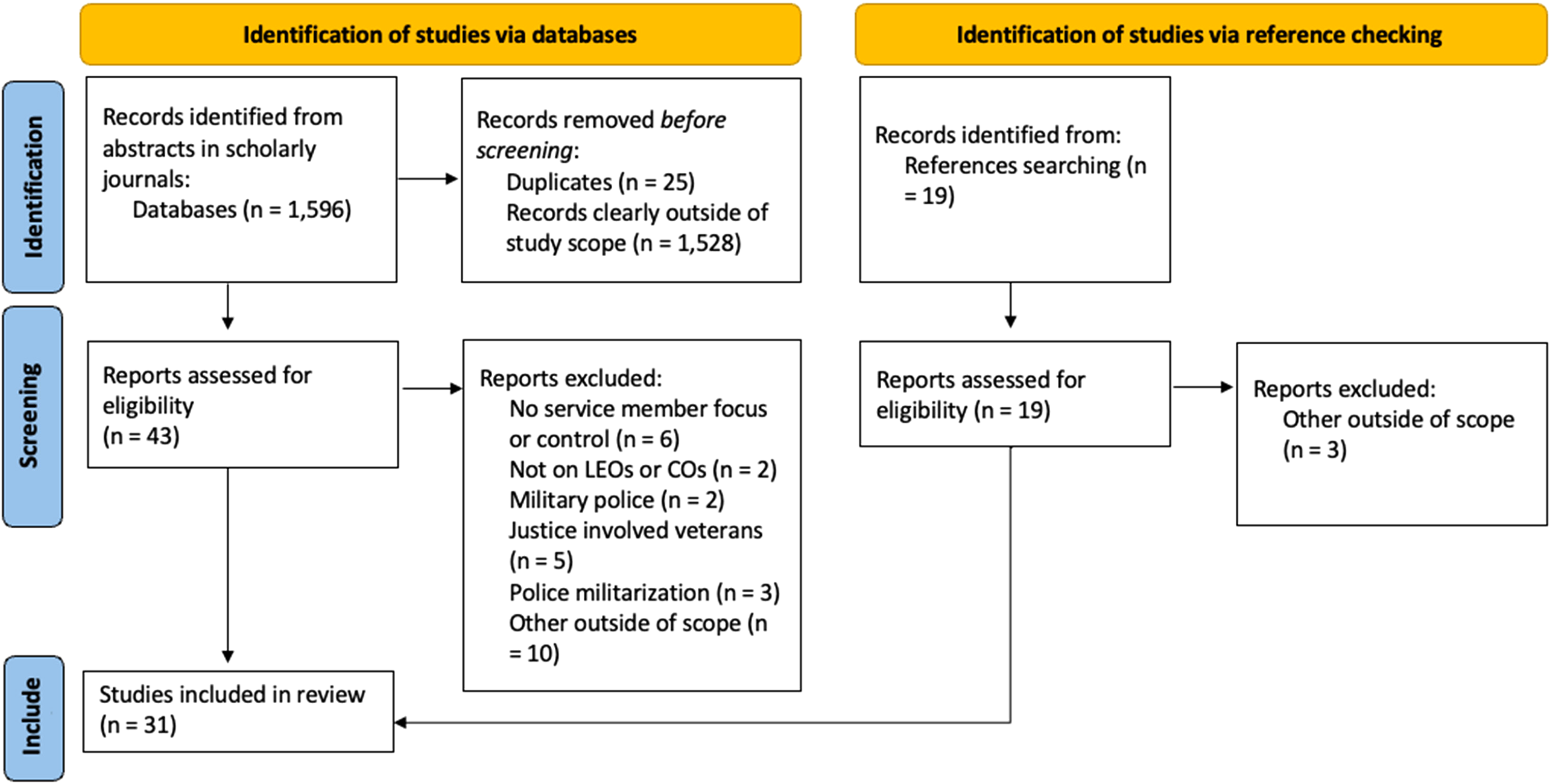
PRISMA 2020 Flow Diagram for New Reviews.
The initial search yielded 1,596 results. Article titles and/or abstracts were reviewed, and those that were duplicates or clearly on topics outside of the scope of this study, including justice involved veterans, military police officers, service members as victims, health of service members, police militarization, etc., were removed; articles were also excluded if the focus was outside North America or the United Kingdom. This screened led to a selection of 43 articles for further consideration. Of these, 15 were selected for inclusion in the scoping review. Because military service is most frequently considered as a control variable rather than a key independent variable, the references within these articles were examined to help identify studies not flagged in the abstract search. This led to the inclusion of 16 additional articles. As a result, 31 studies were selected for analysis.
Data Extraction and Synthesis
The studies selected for inclusion were reviewed and separated based on criminal justice function (law enforcement or prison work). Then, each was reviewed for key characteristics such as (1) research questions/hypotheses, (2) study design, (3) veteran percentage, (4) types of military service variables, (5) measurement of military service variables, (5) country, and (6) limitations and future research recommendations related to SMVs. The articles were independently coded by both authors according to these characteristics, and their results were compared to verify accuracy. Throughout the coding process, the authors reached a consensus, with no discrepancies occurring. Following the coding, the authors collaboratively identified and developed key themes based on the outcomes of interest from each study. In cases where studies addressed multiple outcomes, multiple themes were assigned. It is important to note that, rather than conducting an analytical comparison, this research is intended to provide a comprehensive review of the literature and identify gaps and areas for future research. Consequently, our discussion is limited to the findings of individual studies within the themes and does not evaluate the methodological rigor, potential bias, or strength of the studies.
Results
Consistent with the study objectives, we identified the key themes and summarized the results of 31 studies examining SMVs as law enforcement or prison officers. Overall, the review revealed eight unique themes across the two professions. The majority of studies included in this review employed secondary data analysis (n = 10) or survey methods (n = 18), and most utilized a dichotomous measure of military service (n = 20), while others examined additional measures such as combat experience and service branch (n = 11). In the sections below, the themes and results for the articles on SMVs as law enforcement and prison officers are discussed.
SMVs as Law Enforcement Officers
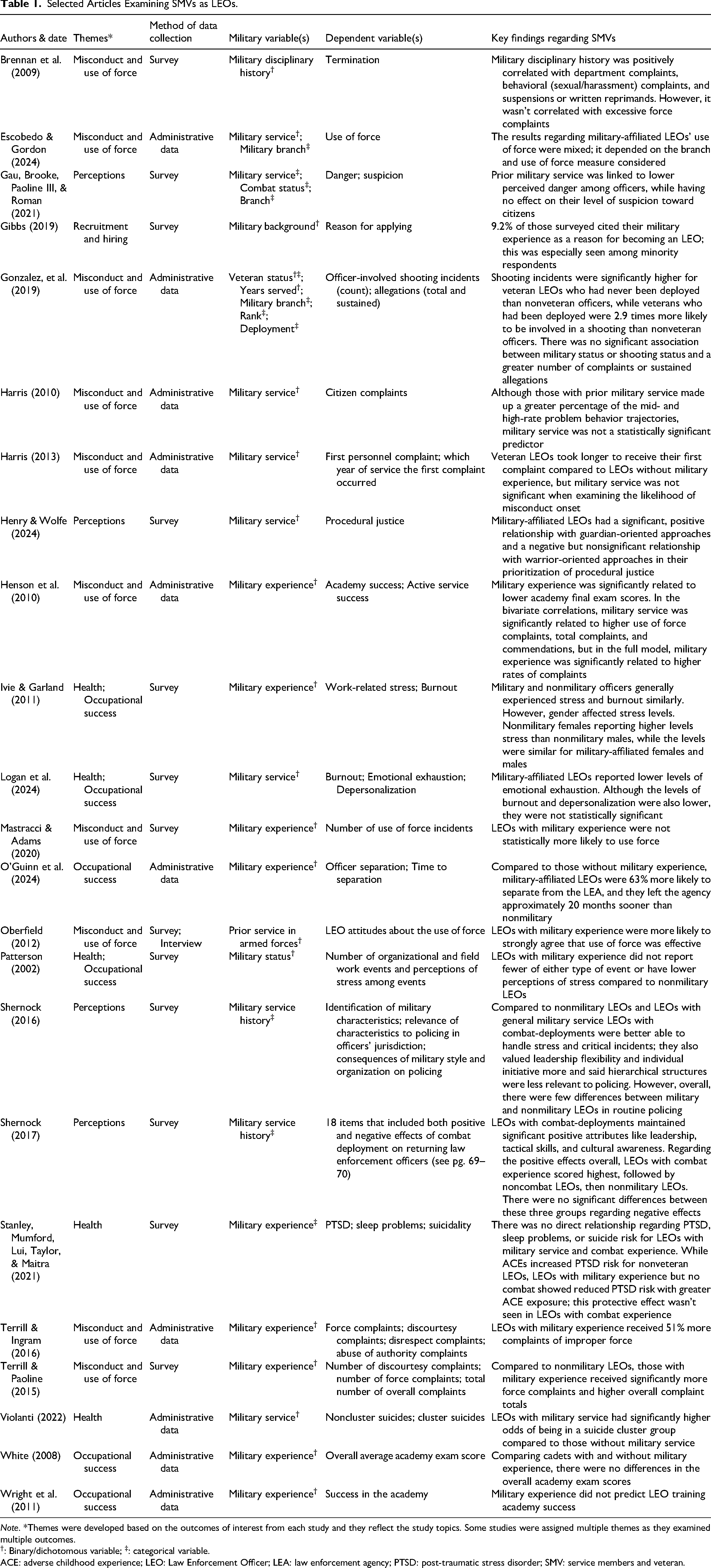
Of the 31 total articles, 23 analyzed SMVs as law enforcement officers. An analysis of these sources revealed five primary themes: (1) perceptions; (2) health; (3) misconduct and use of force; (4) occupational success; and (5) recruitment and hiring. Table 1 includes the citation, theme(s), method(s) of data collection, military variable(s), dependent variable(s), and findings for the articles. The subsequent sections discuss the findings categorized by theme.
Selected Articles Examining SMVs as LEOs.
Note. *Themes were developed based on the outcomes of interest from each study and they reflect the study topics. Some studies were assigned multiple themes as they examined multiple outcomes.
†: Binary/dichotomous variable; ‡: categorical variable.
ACE: adverse childhood experience; LEO: Law Enforcement Officer; LEA: law enforcement agency; PTSD: post-traumatic stress disorder; SMV: service members and veteran.
Perceptions
Four articles focused on the perceptions that law enforcement officers with a military history hold, including their perceptions of and attitudes toward civilians, leadership, procedural justice, and the connections between military service and policing (Gau et al., 2021; Henry & Wolfe, 2024; Shernock, 2016, 2017). All used survey methods and three used a categorical measure of military service. Overall, the findings indicate that military experience has positive or neutral impact on law enforcement officers’ attitudes. More specifically, Gau et al. (2021) found that military service reduced officers’ perceptions of danger without increasing suspicion toward citizens. Similarly, Henry and Wolfe (2024) found that procedural justice is practiced more among law enforcement with military backgrounds and an orientation to guardian style policing which emphasizes community, service, and relationship building over crime fighting. Including combat experience in their categorical military variable, Shernock (2016, 2017) found that officers who self-reported experiencing combat said they had a greater appreciation for leadership flexibility and less reliance on hierarchical structures; they also said they see positive connections between military service and policing, with enhanced stress and critical incident management, stronger leadership capabilities, better tactical skills, improved cultural awareness. Overall, these findings suggest that military experience, particularly combat experience, contributes positively to law enforcement officers’ perceptions while having no detected negative impacts on their approaches to policing or interactions with citizens.
Health
Five studies focused on the health of law enforcement officers who served in the military (Ivie & Garland, 2011; Logan et al., 2024; Patterson, 2002; Stanley et al., 2021; Violanti, 2022). Various health outcomes were examined, including stress, burnout, post-traumatic stress disorder (PTSD), emotional exhaustion, and suicidality. Most of the articles used survey methods or dichotomous measures of military service, with one (Violanti, 2022) using administrative data and another (Stanley et al., 2021) looking at service categorically to capture combat experience.
Research on various health outcomes shows mixed findings. Some have found no differences in stress perception or burnout between officers with and without military experience (Ivie & Garland, 2011; Patterson, 2002). More specifically, Stanley et al. (2021) found that there was no direct relationship between PTSD, sleep problems, or suicide risk for those with military or combat experience. Furthermore, while adverse childhood experiences (ACEs) increased the risk of PTSD for nonveteran officers, those with military experience but no combat showed reduced PTSD risk with greater ACEs exposure. In contrast, they found that military service did not have a protective effect for officers with combat experience. Considering other differences, officers with military experience reported lower rates of emotional exhaustion (Logan et al., 2024) but had significantly higher odds of being in a suicide cluster group when compared to those without military service (Violanti, 2022). Overall, the research suggests that the relationship between military service and law enforcement officer health outcomes is complex, as it may serve as both a protective and risk factor depending on combat exposure and the outcome being examined.
Misconduct and Use of Force
Ten studies examined the correlation of military service and law enforcement officer misconduct and/or use of force (Brennan et al., 2009; Escobedo & Gordon, 2024; Gonzalez et al., 2019; Harris, 2010, 2013; Henson et al., 2010; Mastracci & Adams, 2020; Oberfield, 2012; Terrill & Ingram, 2016; Terrill & Paoline, 2015). The majority of these studies used administrative data, with three using surveys (Brennan et al., 2009; Mastracci & Adams, 2020; Terrill & Paoline, 2015) and one using a survey and interview (Oberfield, 2012). Considering military measures, a dichotomous measure of military service was the most common approach, with three studies including more specific factors like branch, time served, disciplinary history, or deployment (Brennan et al., 2009; Escobedo & Gordon, 2024; Gonzalez et al., 2019).
Overall, the findings on whether SMV officers had higher levels of misconduct and/or force were mixed. SMV officers may be overrepresented in problematic behavior patterns (Harris, 2010) with higher complaints both generally and related to excessive force (Henson et al., 2010; Terrill & Ingram, 2016; Terrill & Paoline, 2015). More specifically, Terrill and Ingram (2016) found SMV officers received 51% more excessive force complaints than nonveteran officers. Some findings also suggest specific risks such as endorsing force effectiveness (Oberfield, 2012). Compared to nonveterans, Gonzalez et al. (2019) found that both nondeployed and deployed veteran officers had higher shooting incidents.
Some studies contradict these concerns though. For example, Harris (2013) found that officers with military experience took longer to receive their first complaint and that military service itself was not a statistically significant predictor of misconduct. Others have found that military experience was not correlated with other measures of misconduct like increased complaints or sustained allegations (Gonzalez et al., 2019) and use of force incidents (Mastracci and Adams, 2020). In an examination of the impact of disciplinaries while serving, Brennan et al. (2009) found that problems while serving was correlated with departmental complaints, behavioral complaints, and suspensions or reprimands but that it wasn’t correlated with excessive use of force incidents. Most recently, Escobedo and Gordon (2024) reported that relationships between military affiliation and force usage varied depending on branch of service and how force was measured (e.g., categorically, highest level, or total force used).
Occupational Success
Six studies examined the occupational success of law enforcement officers with military experience (Ivie & Garland, 2011; Logan et al., 2024; O’Guinn et al., 2024; Patterson, 2002; White, 2008; Wright et al., 2011). Regarding methodology, half used surveys, while the others used administrative data.
The studies used a variety of measures for occupational success. Regarding training and performance outcomes, research indicates that there are no significant differences between officers with and without military experience concerning academy exam scores (White, 2008) or training success (Wright et al., 2011). Additionally, research shows mixed findings regarding the relationship between military experience and specific agency outcomes. Patterson (2002) found that SMV officers did not report higher rates of stressful occupational or field events compared to those without military service. Similarly, Ivie and Garland (2011) observed comparable burnout levels between the groups; however, they found gender differences among nonmilitary officers that were not present in military-affiliated officers. Recently, Logan et al. (2024) found lower, albeit nonsignificant, rates of burnout and depersonalization. Finally, concerning retention, O'Guinn et al. (2024) found that SMV officers were 63% more likely to leave their law enforcement agency and departed approximately 20 months earlier than officers without military experience.
Recruitment and Hiring
Only one article considered the recruitment and hiring of SMVs for law enforcement roles (Gibbs, 2019). To look at the reasons why individuals applied, they used a survey with a dichotomous measure of military service. They found that 9.2% of respondents cited their military experience as a reason for becoming a law enforcement officer, and this rate was especially higher among respondents with underrepresented ethnic/racial identities.
SMVs as Prison Officers
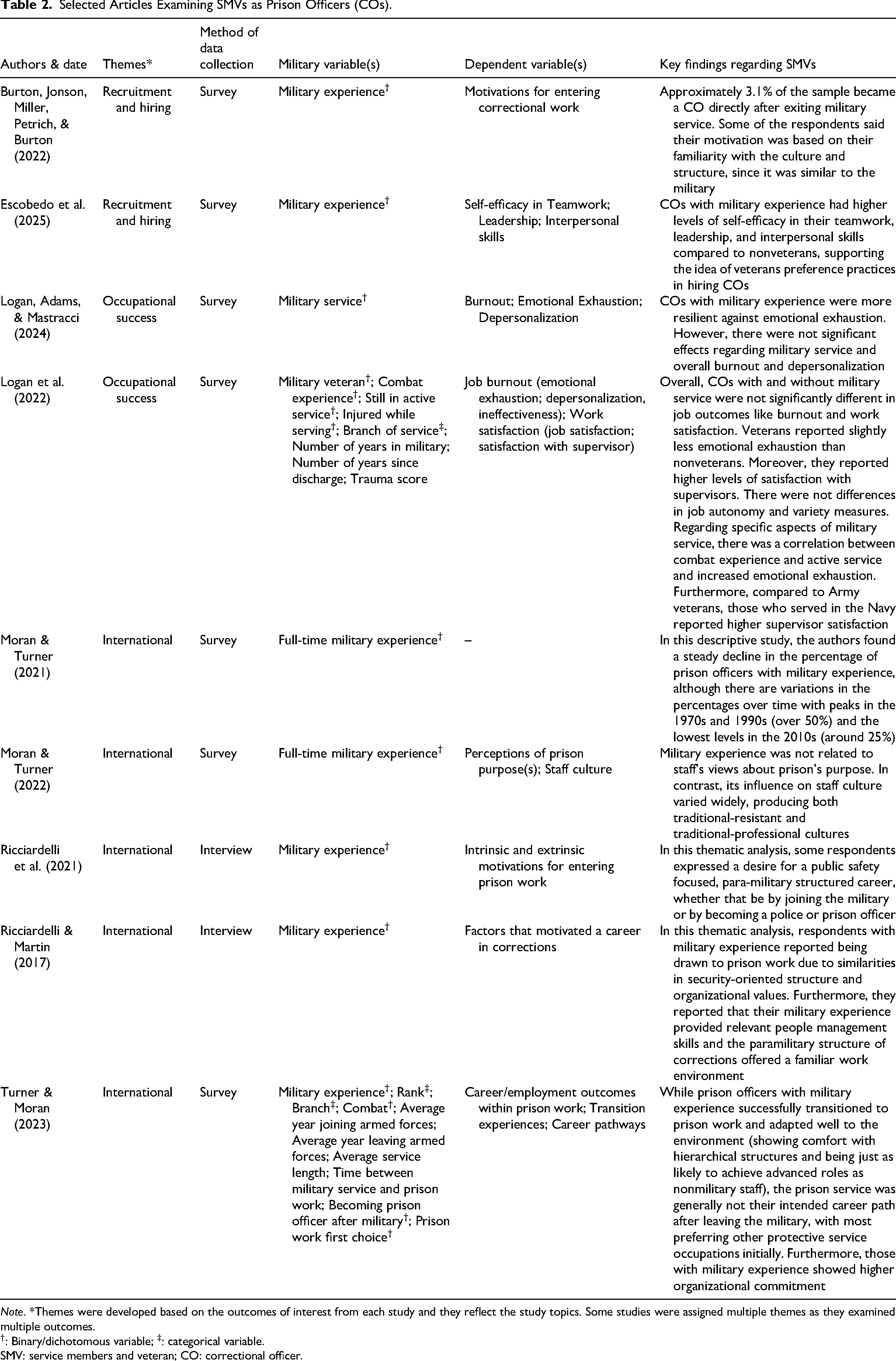
Of the 31 total articles, nine analyzed SMVs as prison officers under three primary themes: (1) international studies; (2) occupational success; and (3) recruitment and hiring. Table 2 includes the citation, theme, method of data collection, military variable(s), dependent variable(s), and findings for the articles. The following sections discuss the findings for each theme.
Selected Articles Examining SMVs as Prison Officers (COs).
Note. *Themes were developed based on the outcomes of interest from each study and they reflect the study topics. Some studies were assigned multiple themes as they examined multiple outcomes.
†: Binary/dichotomous variable; ‡: categorical variable.
SMV: service members and veteran; CO: correctional officer.
International Studies
Five articles examined prison officers with military experience outside the United States (Moran & Turner 2021, 2022; Ricciardelli et al., 2021; Ricciardelli & Martin, 2017; Turner & Moran, 2023). Three of these articles focused on the United Kingdom and used survey methods (Moran & Turner 2021, 2022; Turner & Moran, 2023), while others examined prison officers in Canada using semistructured interviews (Ricciardelli et al., 2021; Ricciardelli & Martin, 2017). The outcome variables differed greatly, focusing on prison officer perceptions, experiences, and career motivations.
In a descriptive study, Moran and Turner (2021) found that the percentage of prison officers with military experience was steadily declining in the United Kingdom. However, they note that there are variations in the percentages overtime, with peaks of over 25% in the 1970s and 1990s and the lowest levels around 25% in the 2010s (Moran & Turner, 2021). Ricciardelli et al. (2021; Ricciardelli & Martin, 2017) examined the reasons individuals choose to become prison officers in Canada and found a shared interest in working in public safety, with veteran respondents reporting job and environment similarities between prison work and their military service. Furthermore, one participant noted that 60% to 70% of prison officers had military backgrounds when they entered prison work (Ricciardelli & Martin, 2017). In an examination of officers’ perceptions of the purposes of prison in the United Kingdom, Moran and Turner (2022) found that military experience was not related to a specific viewpoint (e.g., rehabilitation, punishment, etc.). However, they did find that military experience influences staff culture, with the result varying from a traditional-resistant culture that is “cynical, petty, disrespectful and preoccupied with control” to a traditional-professional culture that is “confident, boundaried, clear, vigilant and knowledgeable” (Moran & Turner, 2022, p. 401). Finally, Turner and Moran (2023) examined prison officers’ career and employment outcomes in the United Kingdom and found that, while prison work was generally not their intended career path after leaving the military, officers with military experience successfully transitioned to prison work, adapted well to the environment, and showed higher organizational commitment. Collectively, these studies indicate that, although the proportion of veterans in corrections has decreased, military experience influences prison officer employment motivations and staff culture in the United Kingdom and Canada.
Occupational Success
Regarding occupational success, two articles examined different facets of burnout, emotional exhaustion, work satisfaction, and depersonalization using survey methods (Logan et al., 2022, 2024). One of these studies (Logan et al., 2024) utilized a dichotomous measure of military service, while the other study (Logan et al., 2022) incorporated service-specific factors into their analysis, such as combat experience, active-duty status, injuries, branch, years served, years since discharge, and the officers’ trauma scores. The two studies have mixed findings. While veteran prison officers generally reported slightly lower emotional exhaustion and higher supervisor satisfaction compared to nonveterans (Logan et al., 2022, 2024), combat experience and active service were associated with increased emotional exhaustion (Logan et al., 2022). Branch of service also appears to matter, with Navy veterans reporting higher satisfaction with their supervisor than Army veterans (Logan et al., 2022). Overall, there is a lack of research on occupational outcomes of prison officers with military experience, and the variations in the findings here support the need for additional research and measurement variation in military experience.
Recruitment and Hiring
Only two articles examined the recruitment and hiring of prison officers with military experience (Burton et al., 2022; Escobedo et al., 2025). Using a survey and dichotomous measure of military experience, Burton et al. (2022) examined prison officers’ motivations for entering prison work. They found that around 3.1% of the respondents became a prison officer immediately after exiting the military. Furthermore, some attributed their motivation to their familiarity with the prison culture and structure since it is akin to the military. Using the same data to examine the logic behind veterans preference practices, Escobedo et al. (2025) found that those with military experience had higher self-efficacy in teamwork, leadership, and interpersonal skills before beginning prison work. While future research should work to expand on these findings, the results indicate that the organizational similarities between military and prison environments may attract veterans to prison work and that prison officers with military experience may be pre-equipped to handle prison work.
Discussion
This scoping review maps and provides an overview of the existing literature on SMVs as criminal justice system actors. We identified 31 studies published across multiple disciplines between 2000 and 2024 that focus on SMVs employed in law enforcement and prison systems. Of these studies, 23 focused on SMVs in law enforcement and eight examined those in corrections, with one focused on both. While the majority of the studies were conducted in the U.S. context, five studies examined prison officers in the United Kingdom and Canada. Among all studies reviewed, only three employed qualitative interviews, while the rest used surveys or quantitative data from various sources, including police departments and correctional institutions. Our analysis revealed that research on SMVs in policing and corrections is still developing and tends to focus on several understudied areas, such as recruitment/hiring, job performance, law enforcement attitudes toward the public, officers’ perspectives on their roles, use of force, professional misconduct, and the impact of combat experience on career outcomes within the criminal justice system.
The majority of the reviewed studies (29%) investigated the impact of SMV status on job performance and outcomes (occupational success) for law enforcement and prison officers. The findings were mixed across these studies. Some indicated that police officers with military experience exhibited lower levels of emotional exhaustion and greater resilience to challenging work conditions compared to their nonveteran counterparts (Ivie & Garland, 2011; Logan et al., 2024). However, other studies found no significant distinctions between officers with and without military backgrounds regarding occupational factors such as exposure to organizational or work-related events, stress responses, and job performance (Logan et al., 2022; Patterson, 2002). Additionally, prior military service was not associated with improved performance or higher completion rates in police academies (White, 2008; Wright et al., 2011). Furthermore, research revealed that police officers with military backgrounds tended to have shorter service durations and were more prone to leaving their positions compared to officers without military experience (O'Guinn et al., 2024).
A notable proportion of studies (29%) examined the use of force and misconduct among law enforcement officers. This research generally indicated that officers with military experience held more positive views on the use of force and were more likely to discharge their weapons compared to those without military background (Gonzales et al., 2019; Oberfield, 2012). However, one study highlighted the importance of considering service in specific military branches, revealing that Army veterans had higher probabilities of employing nonfatal force than officers lacking military service (Escobedo & Gordon, 2024). Additionally, two studies found that law enforcement personnel with military backgrounds were more prone to receiving complaints about improper use of force and general citizen grievances than their nonmilitary counterparts (Terrill & Ingram 2016; Terrill & Paoline, 2015). Conversely, two other studies detected no disparities in use of force or professional misconduct between officers with and without prior military service (Harris, 2010; Mastracci & Adams, 2020).
Field Limitations and Future Research Needs
The research reviewed in this article represents a notable effort in revealing the characteristics, perspectives, and occupational outcomes of SMVs employed in the criminal justice field. Nevertheless, the current body of research has its limitations. First, there is a lack of research on other notable criminal justice system actors like jail officers, probation officers, and parole officers. As such, future studies should work to encompass actors outside of law enforcement or prison officers. Second, the majority of the studies reviewed rely on observational research designs and data collected from a convenience sample of officers from local law enforcement and prison institutions. While these samples serve important purposes in specific contexts, more nationally representative studies are needed to reveal statistical associations generalizable to the broader veteran officer population. Relatedly, while some studies utilized administrative data, the majority reviewed relied on self-report surveys which can be susceptible to various forms of bias, such as social desirability, recall, confirmation, underreporting, and overreporting. In the context of the studies of SMVs, the findings should be interpreted based on the SMVs’ own perceptions of their health, stress and burnout levels, and occupational performance, as well as their attitudes toward criminal justice careers and interactions with civilian population. Additionally, most research on veterans’ employment in the criminal justice system is based on cross-sectional data sources. To establish temporal order, track changes in key outcomes (such as job performance), and identify long-term factors associated with these patterns, longitudinal studies and designs are necessary. Finally, additional qualitative research is needed to develop a more comprehensive and nuanced understanding of SMV officers’ viewpoints, emotions, and experiences, as well as to better capture the complex relationship between military service and occupational characteristics and outcomes in the criminal justice system.
Current research limitations are also accompanied by a considerable knowledge gap in our understanding of SMVs as criminal justice system actors, warranting further investigation. Some potential research topics that have not been studied or are understudied in this area can be grouped into four main categories: (1) military service characteristics and experiences of veteran officers, (2) SMV occupational characteristics and experiences within the criminal justice field, (3) SMV experiences in civilian life, and (4) the perspectives of nonveteran officers and criminal justice agency leaders regarding SMV recruitment. Previous studies on various occupational aspects and outcomes of veteran officers typically examined military service history as a dichotomous measure (i.e., whether officers served in the military or not) and neglected to consider military background characteristics (see Tables 1 and 2). However, military service is not a uniform experience across all veterans. For example, factors such as service in different military branches, duration of service, specialization, and rank, along with experiences like deployment, combat exposure, unit interactions, and training, can substantially shape veterans’ perspectives and behaviors (see Logan et al., 2022). Therefore, it is crucial to examine the diversity in military backgrounds and experiences and assess their varying impacts on occupational characteristics and outcomes within criminal justice system actors.
In addition to military service characteristics and experiences, examining the occupational characteristics of SMVs in the criminal justice system can provide valuable insights into their career outcomes. While existing research has documented the prevalence of veteran employment in this field, our understanding of their motivations for pursuing such careers remains limited. Exploring the reasons behind SMVs’ choices to work in criminal justice is important, as it may influence their job satisfaction, commitment, and various occupational outcomes, including success, burnout, use of force, and misconduct. This underscores the need for further studies examining why veterans select law enforcement or prison work as a career path, their level of job satisfaction and commitment, and how these factors impact their performance. Additionally, it is important to analyze occupational characteristics, such as rank, years of service, and leadership roles held by veteran officers, as well as agency-specific factors like workload, cohesion, and daily stressors. Examining these elements can help account for their varying effects on job performance and outcomes in the criminal justice system.
While existing studies have primarily examined the potential connection between veteran status and job performance in the criminal justice system, it is also critical to investigate how veterans’ civilian experiences impact their roles as officers. Research has extensively documented the difficulties veterans face when transitioning to civilian life, including challenges in adapting to new social roles, insufficient support networks, family issues, loss of identity, mental health problems, and the absence of familiar routines and structure (Markowitz et al., 2023; Morin, 2011). This suggests that veteran officers may encounter unique challenges in their civilian lives that are less common among their nonveteran counterparts, potentially influencing their job performance within the criminal justice system. Thus, greater academic attention should be given to how these distinct challenges shape veterans’ experiences as criminal justice professionals. Finally, it is important to investigate the perspectives and experiences of nonveteran officers and criminal justice agency leaders regarding their veteran colleagues. Exploring how nonveteran members of the criminal justice system perceive veteran officers can provide valuable insights into targeted recruitment strategies, expectations placed on veteran officers, and whether these perceptions and expectations play a role in the career outcomes of veterans employed within the criminal justice system. This comprehensive approach, which considers both veterans’ motivations for entering the field and their occupational experiences, as well as the viewpoints of their nonveteran counterparts, can contribute to a more nuanced understanding of veterans’ roles within the criminal justice system.
Scoping Review Limitations
The information presented in this scoping review should also be evaluated in the context of some limitations. For instance, the generalizability of the findings may be constrained by the timeframe selected and the exclusion of unpublished or non-peer reviewed literature. Additionally, even though we established our search strategy based on a broader preliminary search of the literature, it is possible that our search strategy may have omitted relevant studies due to the specific keywords and phrases used.
Conclusion
This scoping review analyzed the current academic literature on service members and veterans as criminal justice system actors, providing a review of SMV employment in law enforcement and prison officer positions, outlining the state of the literature, and identifying gaps and a need for additional research. While some studies suggest positive effects of military experience on perceptions and attitudes, stress management, and organizational adaptation, others indicate potential concerns regarding the use of force, misconduct complaints, and retention. The evidence is particularly mixed regarding occupational success, with some research showing lower emotional exhaustion among veteran officers while other studies indicate earlier departure rates from law enforcement agencies. Although this area of research is still growing, it is important to emphasize the need for more dynamic measures of military service (e.g., combat experience, branch of service, length of deployment, etc.), longitudinal designs, and a focus on understudied areas such as veterans’ transition experiences, motivations for entering criminal justice careers, and the perspectives of nonveteran colleagues. Expanding SMV research in these areas will provide a more comprehensive understanding of how military service shapes SMVs’ criminal justice careers and could help inform evidence-based policies for recruitment, training, and retention of SMV law enforcement and prison officers.
