




Abstract
Existing research has demonstrated the benefits of therapist self-disclosure (TSD) in strengthening therapeutic alliance. However, little is known about its effectiveness in the forensic context. The current research sought to address this gap by interviewing six Compassion Focused (CFT) therapists who had experience of working across a range of forensic settings. Results of an Interpretative Phenomenological Analysis (IPA) indicated that all participants advocated using TSD as a powerful therapeutic tool when working with forensic clients. However, there was a tension between balancing risk with the rewards of TSD, and participants expressed how the secure forensic environment was not conducive to its use. There was a consensus that TSD was more strongly discouraged with clients who had sexual convictions. For some, this had an impact on their own disclosures. Training on the function of TSD is recommended in forensic practice to address some of the environmental barriers to its implementation.
Keywords
Therapist self-disclosure (TSD) can be defined as any verbalization or behavior provided by the therapist that communicates information about themselves to the client (Knox & Hill, 2003). It can include historical personal information about the therapist, as well as the therapist’s thoughts and feelings toward the client as they arise in therapy. It has been referred to as one of the most controversial, but poignant, therapeutic techniques (Gibson, 2012). Henretty and Levitt (2010) identified how TSD helped to build trust, equalize power dynamics, model for clients, and promote feelings of universality, which are essential factors in forming a strong therapeutic alliance. Yet, it remains a contentious area within forensic practice as there is a common assumption that practitioners should provide as little information about themselves to forensic clients as possible (Wasser et al., 2019). Whilst a large evidence base exists pertaining to the efficacy of TSD in strengthening the therapeutic alliance, its use in forensic settings remains under-researched. With increasing evidence highlighting the benefits of a strong therapeutic alliance in increasing therapeutic outcomes (Flückiger et al., 2018), there is psychological interest in exploring its effectiveness within the forensic context.
Wasser et al. (2019) explain that the discouragement of TSD in forensic settings usually stems from the corrections agenda, in which risk reduction is the paramount consideration. Therefore, the sharing of personal information by staff is cautioned, as it opens the possibility for exploitation. This presents a challenge for therapists working in the forensic setting, as risk management concerns must be weighed up against the potential therapeutic benefits. However, the belief that any personal information acquired by the client would be used to exploit, may be influenced by the negative positioning of forensic clients in society. For example, the forensic population are often labeled as being “manipulative” and “deviant” characters (Peternelj-Taylor, 2004). This may lead therapists to avoid disclosing due to an apprehension that any information shared could be used to harm them. Yet, this view contradicts the recent shift in forensic practice to accepting a more compassionate and trauma-informed understanding of harmful behavior (Taylor & Hocken, 2021a).
Over the last decade, Compassion-Focused Therapy (CFT) has gained precedence in forensic practice (Taylor & Hocken, 2021b). CFT proposes that humans have a tripartite motivational system, made up of threat, drive, and soothing systems (Gilbert, 2021). It is posited that all three systems need to be utilized adaptively, to achieve heathy functioning. Thus, the motivational state of mind needs to be at the forefront of therapy, in which clients are supported to develop a more compassionate mindset. Clients are encouraged to stimulate and direct their emotions and motives to manage their more harmful evolved capacities. The model postulates that characteristics associated with harmfulness pass through generations in the same way as characteristics for compassion. However, it is suggested that the individual’s environment can determine which characteristics are more readily available. For example, if an individual is exposed to abuse during childhood, they may develop a pervasive “readiness to react” as a method for survival (Taylor & Hocken, 2021a). This could involve an increased proclivity to fight, flight, or freeze, causing them difficulty with regulating their emotions. It is theorized that engaging in harmful behavior toward themselves or others could develop as a way of responding to perceived threats.
This theory is supported by empirical evidence demonstrating adverse childhood experiences to be a highly significant risk factor for engaging in serious violent crime (Fox et al., 2015). Understanding harmful behavior through this trauma-informed lens dispels the belief that forensic clients hold harmful pathology that the rest of the population do not. Instead, it elucidates how experiencing trauma and adversity can lead some individuals to develop an increased propensity to engage in crime as an evolved human survival strategy (Taylor & Hocken, 2021a).
Through this lens, the use of TSD should be no different with forensic and non-forensic clients. In CFT, the therapist aims to support the client to feel safe through their joint interactions. This could be facilitated by a therapist sharing experiences with the client (Gilbert, 2009) and could also be used as a powerful de-shaming tool. For example, the therapist could share with the client how they have dealt with their own experiences of shame or self-criticism in the past. This would aim to reflect to the client that no matter what crime they have committed, or how unwell they may be, other people can still relate to their experiences (Wasser et al., 2019). This would provide a sense of belonging for the client, which is the antithesis of the loneliness associated with shame. However, it is important that the therapist does not take the focus away from the client and transform it into their own therapy session, as this would be unethical (D’Aniello & Nguyen, 2017). Therefore, the disclosure must be attuned to the client’s needs and assessed by the therapist as being beneficial (Audet, 2011).
One of the few empirical studies to explore TSD in forensic settings was Doremus’s (2012) dissertation research. In this study, psychologists were asked to score their likelihood of using historical disclosures with both voluntary and court-mandated clients in different case vignettes. Results identified that psychologists were less likely to disclose with court-mandated clients overall, and even less likely to disclose with court-mandated clients who had a diagnosis of a personality disorder. Participants explained avoiding self-disclosure with forensic clients to eliminate the potential for the information to be used against them. Similarly, Vavrinak and Lunnen (2012) found psychologists working in the forensic setting were less likely to disclose their thoughts and feelings pertaining to clients’ progress during therapy. They postulated that psychologists working in forensic settings may have a “jaded opinion of their clients” (p. 387), leading them to disclose less. However, these findings provide a conjecture, as it is unclear as to whether the decision to not disclose was based on real risk-management concerns, or the negative positioning of forensic clients in society. A “position” can be defined as a collection of beliefs about an individual or group, pertaining to their mental, characterological, and moral traits (Harre & Moghaddam, 2003). It is postulated that a position determines a person’s rights, duties, and obligations. Thus, positioning someone positively or negatively can result in them being treated in a certain way, relative to another individual or group (Harre & Moghaddam, 2003).
Gredecki and Horrocks (2017) identified forensic clients to be positioned as “bad” and “untrustworthy” by prison officers (p. 303). In turn, this impacted on their approach to working with them and a tension was created in which security-focused custodial work had to be carried out alongside compassionate rehabilitative work. This same notion may exist for therapists working in the forensic setting. Consequently, forensic clients may not be afforded the opportunity to experience TSD, as their position of being untrustworthy may preclude it. However, this remains a supposition, as the beforementioned findings offer little explanatory depth. Thus, a qualitative understanding of how TSD is used in the forensic setting is required. That is, the existing literature fails to consider how a client’s offence type, mental health condition, and the forensic environment itself may influence TSD. This is important information to acquire as forensic clients are not a homogenous group, and the complexity of TSD means the issue may not be whether a therapist should disclose or not disclose, but how, when, and why they should do it (D’Annielo & Nguyen, 2017).
A gap exists in the literature exploring the use of TSD with forensic clients and the paucity of research has indicated that TSD is used less with forensic than non-forensic clients. Thus, the effectiveness of TSD in the forensic context is yet to be established. The compassionate understanding of harmful behavior that underpins CFT suggests forensic clients are positioned by CFT therapists in a way that would make TSD possible. It is therefore of psychological interest to explore what CFT therapists’ views are around using TSD, and to examine what factors exist in the forensic setting that could influence its use. This research seeks to help inform therapist training around how and when to use self-disclosure with forensic clients, and how this could encourage a more open discussion and reflection during supervision.
Method
Study Participants
One male and five females participated in the research. The sample size was guided by Smith et al. (1999), in which it is suggested that the number of participants should be small enough to gain an in-depth understanding of each individual case and the creation of themes within them. The sample was purposive and homogenous, as participants were all registered forensic psychologists who had previously received formal training in compassion-focused therapy (CFT). The researcher had no relationship established with participants before the study began. The participants were informed that the researcher was completing the study as part of the MSc in Forensic Psychology and Mental Health at the University of Manchester.
Recruitment
All participants responded to an email advertisement sent to the Compassionate Mind Forensic Special Interest group. Participants were invited to take part if they had received formal training in CFT, had experience of working with forensic clients, and were happy to discuss their professional opinions around using TSD with forensic clients. Participants’ work experience ranged across a variety of different forensic settings (e.g., prisons, secure hospitals, community settings). No participants dropped out or refused to participate during the study. Ethical approval was obtained through the Psychology and Mental Health Division Panel at the University of Manchester.
Data Collection
Semi-structured virtual interviews were conducted individually with each participant through Zoom. Interviews lasted approximately 30-40 minutes (M = 34.69) and were audio recorded, and then transcribed verbatim. All participants received a participant information sheet prior to data collection taking place. Verbal consent was obtained, and audio recorded via Zoom at the beginning of each interview. The interview topic guide consisted of questions and prompts that aimed to explore participants’ subjective opinions on the use of TSD with forensic clients. The first question was broad and open-ended, asking participants to expand on their “opinion on using therapist self-disclosure when working with forensic clients,” followed by “what are all the aspects you think would be most important to consider?.” This resulted in each participant providing a detailed narrative account, almost entirely uninfluenced by the researcher. Follow-up questions were then asked in relation to the participants’ answer to the opening questions. Subsequent prompts included questions around the therapeutic rationales for using certain disclosures, how self-disclosure fits with CFT, and how a client’s offence type, mental health condition, and the forensic setting, may influence participants hypothetical use of self-disclosure. Prompts were designed based off the existing literature into TSD, incorporating phenomenological experience with contemporary theoretical perspectives, which is a key component of phenomenological research (Smith & Osborn, 2008). All participants have remained anonymous and have been referred to by their participant number in the current study (P1-6). No repeat interviews were conducted.
Analytical Framework
Interpretative Phenomenological Analysis (IPA; Smith et al., 1999) was the methodological orientation used to analyze the interviews in the current study. IPA was chosen as its idiographic nature enabled the researcher to grasp an in-depth exploration of each participant’s unique account. The topic area of TSD is not straightforward and the complexity of how, when, and why it is used required an analytical method that used open-ended questions and explored subjective differences between participant accounts. IPA not only identified unique differences between accounts, but also themes across accounts, due to its thematic nature.
During IPA, the researcher began by familiarizing themselves with each transcript by reading it multiple times. Each transcript was analyzed individually, line by line, with anything of psychological interest noted on the left-hand margin, generating codes. Codes generated in the current study included, “other’s perception,” “tension,” and “cultural symbols.” Subsequently, codes that were similar in nature were meaningfully aggregated to create themes, which were recorded on the right-hand margin. For example, the abovementioned codes helped to form the theme of “impact of the forensic environment.”
All themes were derived from the data and were identified through the process of interpretative activity and grounded in participants’ experience of what they had said in the interview. All six verbatim transcripts were analyzed by the same method. Themes that were identified across participant accounts were then combined to create superordinate themes, with subordinate themes, that were all directly related to the use of TSD with forensic clients. The analysis continued during the writing-up phase, allowing for a rich interpretation. No software was used to manage the data. Themes have been represented by quotations from the data in the current study.
Research Team and Reflexivity
The primary investigator of this study conducted all six interviews. The researcher was female and a full-time MSc Forensic Psychology and Mental Health student at the University of Manchester. This research followed emic epistemology, in which the influence of the researcher was acknowledged. During data collection and analysis, the researcher engaged in the process of ‘bracketing out’ (Tufford & Newman, 2012). This involved a process of writing down the researcher’s own beliefs and opinions on the subject area of TSD and CFT before data analysis began. This helped the researcher to gain awareness of their own preconceptions, to reflect on interpretations, ensuring that their own personal biases and interest in the topic area did not sway participant answers, or interpretation of the data.
Analysis
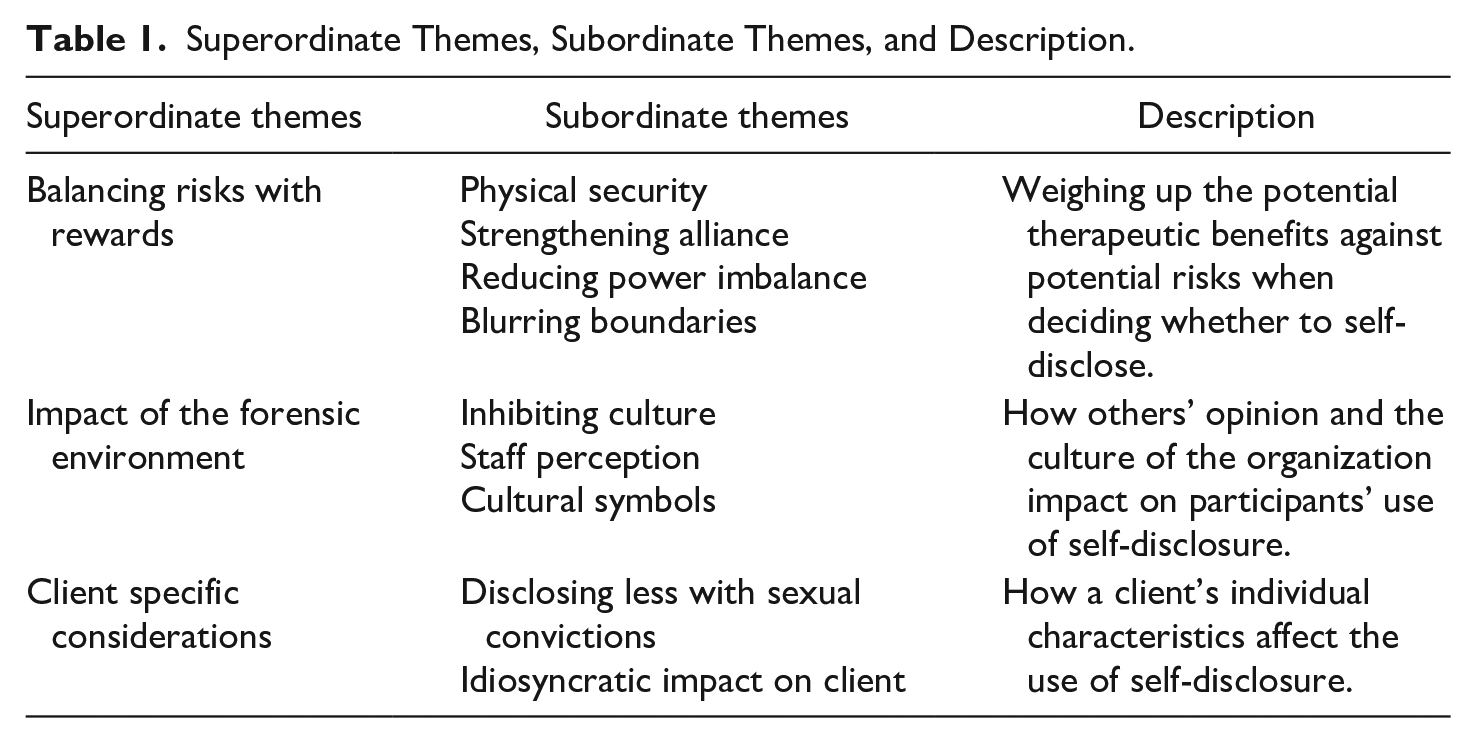
Three superordinate themes emerged across participant accounts, including, (1) balancing risks with rewards, (2) impact of the forensic environment, and (3) client specific considerations. All superordinate themes and subordinate themes derived from the data are presented in Table 1. A brief description capturing the essence of each theme is also presented. Verbatim quotes have been presented to illustrate how the data has been analyzed and interpreted.
Superordinate Themes, Subordinate Themes, and Description.
Balancing Risks With Rewards
Physical Security
There was a consensus across participant accounts that a tension existed between using self-disclosure as a therapeutic tool whilst ensuring physical safety. Participant 6 explained, “somebody’s committed a crime and therefore, to disregard somebody else’s rights and break a law, so yeah, I think security has to be one of the first things you think about.” These words reflect an acknowledgment of context, in which participants are aware they are working with clients who have been placed in forensic services for public protection. Consequently, there was a sense that self-disclosing could cause one’s own safety to become compromised, based on the assertion that the forensic clients had compromised the safety of others in the past. Participant 3 further explains: Some contexts, particularly in forensic settings, sometimes are a little bit more, make us more wary of self-disclosure, so we need to be very careful with specific details that we don’t want to disclose, to keep us safe and our loved ones safe.
These words express the importance of the risk paradigm that therapists working in the forensic setting feel they must adhere to. There is an awareness that disclosing with forensic clients could open participants up to vulnerability and harm, not only to self but also to the people close to them. This reflects the complex nature of self-disclosure in the forensic context. The notion that participants could potentially be put at risk through disclosing suggests that physical security is an ongoing consideration.
Strengthening Alliance
Nonetheless, all participants advocated for using self-disclosure as a powerful therapeutic tool within CFT. For example, Participant 6 explained: I think it does de-shame, I think it helps build rapport, and yeah just you know that we’re in this boat together and none of us are perfect, and I find self-disclosure quite a helpful way of doing that.
This extract demonstrates how self-disclosure can be used to increase connection between the therapist and client. Participants talk suggests CFT could not be carried out without any form of self-disclosure, as the model is underpinned by an understanding of common humanity. Thus, sharing personal information that reflects that therapists also experience difficulties appeared to be very important for participants.
Reducing Power Imbalance
Additionally, it was noted how self-disclosure could be used to reduce the perceived power disparity. Participant 4 commented: I think it comes back to those issues about how we’re more alike than different and I think that’s a really important point that we emphasise throughout CFT which most people in forensic services don’t see themselves as. They maybe see themselves as similar to the forensic population, but they don’t see the commonalities with other people in society and certainly not with staff.
These words suggest that self-disclosure can bridge the gap between therapist and client by demonstrating that despite the client’s offending, they are not different from humanity. This reflects an incentive for CFT therapists to use self-disclosure, to convey to the client that there nothing inherently wrong with them. It was noted how this could enable forensic clients to feel trusted, as explained by Participant 2: I think forensic clients can be quite surprised if you disclose stuff because actually, they’re so used to being seen as manipulative deviant characters that the idea that a therapist actually says well this has happened in my life, must make them think God, you must really trust me to say that, and that’s fantastic to explore the impact of what it’s like to be trusted.
These words reflect the general negative positioning of forensic clients who are often viewed by others as being “manipulative,” and the impact that this can have on how they position themselves. It is inferred that participants have positioned forensic clients in a way that makes self-disclosure possible through humanizing them, rather than viewing them as deviant. Seemingly, positioning forensic clients in this compassionate way allows them to position themselves as a CFT therapist, enabling TSD.
Blurring Boundaries
However, as it was noted that forensic clients can be surprised when staff share personal information, an increased risk of self-disclosure blurring the boundaries of the professional relationship was observed. Participant 5 commented, “one of the risks actually, is the client misinterpreting and then viewing what is happening as a boundary [violation] in terms of the therapist wanting to have a relationship with the client.” This reflects the importance of the client’s interpretation and understanding of a therapist’s motivation for self-disclosure. It was inferred that the traditional positioning of forensic clients as being “untrustworthy” could lead the client to believe that a disclosing therapist is wanting a more personal relationship. This was suggested to arise as professionals sharing personal information is not a phenomenon that forensic clients are familiar with experiencing.
Impact of the Forensic Environment
Inhibiting Culture
A ubiquitous notion existed across accounts, in which the culture of the organisation that participants were working in currently, or in the past, had a significant impact on their use of self-disclosure. There was a strong sense that self-disclosure was discouraged in forensic settings, as Participant 5 explained, “I think from a correctional staff point of view, yeah, I think there is that discouragement of don’t reveal anything about yourself.” This seemingly created a frustration for participants, as they felt that self-disclosure was an important part of therapy. Yet, they explained how their operational colleagues did not always share this view, and this usually stemmed from a security perspective. This meant not only did they have to consider the effect on themselves and the client when self-disclosing, but also the impact on wider security, as commented by Participant 4: It would come back to that point of [what] am I happy with, and that’s always your benchmark, if the head of whatever was to find out I’d disclosed I’ve got children would they be bothered or not?
These words demonstrate the tension between adhering to security principles in the forensic context whilst carrying out rehabilitative CFT work. There is a sense here that participants could be viewed through a lens of suspicion by their colleagues for disclosing, which could inhibit its use. So, although participants have explained the many benefits of self-disclosure, it is suggested that the culture of the forensic environment may not be conducive to it.
Staff Perception
There was concern that these differences in opinion could lead to splitting within the staff team. Participant 2 commented: Splitting is a potential as well if you’re working in an environment where there are some people who have very rigid views of you should never disclose anything, even your first name to a forensic client, you shouldn’t wear wedding rings if you’re working in forensic settings, that kind of stuff.
These words further reflect the controversial nature of self-disclosure with forensic clients, and that many staff working in the forensic setting hold the view that forensic clients should not be trusted with any personal information. The participants’ talk suggests that their self-disclosures could be perceived by other staff as them lacking in boundaries. This appeared to create anxiety for participants as they did not want to be positioned by their colleagues as “corrupt” (participant 4). This suggests that the wider cultural structures of the organisation can significantly affect staff behavior in the forensic context.
Interestingly, Participant 1 explained feeling more comfortable disclosing with forensic clients when working in the community: I suppose that contrast between being in the hospital in some small ward and feeling like that information can be shared, it’s easier to disclose in the community. That’s interesting because as I say that I think well why is it not more risky when you’re in the community?
Seemingly, the concern here is not about the individual client they know, but other clients and staff in the secure setting. The participant’s talk suggests the development of trust is essential before sharing information to clients, as once the trusting relationship has been built, they explain a willingness to share. However, the main concern appeared to be the extent to which participants could trust everyone else in the secure setting. Therefore, they explained that they only share information that they would feel comfortable with everyone knowing. This reflects the unique nature of working in a secure forensic environment, as the therapist and client never work in isolation, but are embedded in a wider system. Therefore, the interpersonal dynamics within the secure setting are suggested to have a profound impact on the use of therapist self-disclosure.
Cultural Symbols
Based on the participant comments there is also an absence of risk symbols in the community. Discussing the contrast between community and secure settings, Participant 5 commented: Just generally working in a prison for example, you’re much more aware of the boundaries because you’re carrying keys and you’ve got an alarm and there’s these doors to go through, so you are much more consciously aware of the symbols that suggest you know that you’re different from me, or maybe you’re unsafe to me.
These words reflect the impact that the secure forensic environment can have on how staff relate to service users. It is suggested that the cultural symbols in secure settings representing physical security, and risk, work to reinforce the notion that clients could pose a risk to staff. So, whilst a forensic client’s level of risk may be the same, or possibly increased, in the community, there appear to be fewer visual symbols reinforcing it. In turn this may result in the therapist feeling more comfortable in using TSD. Yet, in the secure setting, the participants’ talk suggests that they are more sensitive and anxious around TSD which they perceive as putting them in a challenging situation morally.
It was remarked that a cultural shift is required in forensic settings to enable self-disclosure to be used more widely and for the associated therapeutic benefits to be experienced. As Participant 2 comments: I hope there’s a move in forensic services where we’re humanising the people we’re working with, that we’re not thinking that people who end up in secure services particularly, are somehow fundamentally different, and I think once we can grasp that, we can feel safer in disclosing certain things because we’re moving beyond this idea that if this person knows anything about me then they’re going to threaten me and hurt me in some way, I mean I’ve never had that experience I have to say.
These words contain quite a strong message, namely, that there is a need for a larger-scale transformation in how forensic clients are positioned within the forensic context; especially in non-community settings. Thus, there appears to be a role for CFT therapists to work alongside the forensic environment in a consultative manner to address some of the wider systemic attitudes and beliefs that reinforce the notion that forensic clients are inherently deviant and untrustworthy (Peternelj-Taylor, 2004). It is suggested by the participants that this is necessary to support the use of TSD and to support the effective delivery of therapeutic interventions more generally. The participants’ words have reflected how purposeful they feel self-disclosure is within the therapeutic relationship. Yet, it is implied that without bringing the wider forensic community (specifically the secure forensic community) on board, it is unlikely that they can apply TSD without experiencing concern for how they are perceived within the wider cultural structures of the organisations in which they work.
Client specific Considerations
Disclosing less With Sexual Convictions
It was observed by participants that self-disclosure was not used in the same way with all forensic clients. There was a notion that practitioners tended to disclose less with clients who had sexual convictions. As Participant 5 commented, “I think people are probably more worried about working with people with sexual convictions in terms of self-disclosure, probably because they think that might be more exploited.” These words elucidate the increased trepidation surrounding self-disclosure with this client group, linked to the perception that they are more risky. Across several participant accounts, it was commented that they would be less likely to disclose information about their children with clients who had sexually offended against children. This was captured by Participant 1 who said: I’m just thinking out loud here as I talk this through, I work quite often with people who might have offended against children or have a sexual interest in children and there are definitely cases where I don’t tend to mention my children, which is interesting [pause] I don’t know, that’s an interesting one and probably one I would need to work through in supervision to think, well what is that about.
Participant 1’s talk suggests that they do not necessarily know why they hold these views, but there is a sense that they position those who offend sexually against children as being of a higher risk. This presents a contradiction in that participants have explained the purposeful nature of TSD. Yet, the words of the participants suggest that TSD is perhaps only purposeful if it is on their terms. Based on the data presented earlier, it may be the culture of working in the forensic environment that has influenced participants to believe disclosing information to certain offender groups would be dangerous. Thus, participants may justify the decision to not disclose they have children to those with convictions against children based on the premise that it is a risk-related factor. However, Participant 2 questioned why self-disclosure may be perceived differently with this client group: Your classic would be people who say I’m not going to disclose to somebody who’s committed paedophilic offences, I’m not going to tell them that I’ve got children. But why not, what does that tell you, what are you saying about that, about the way paedophilic sexual interests operate. [. . .] It’s not to say that they should necessarily disclose equally to everybody, but they need to think, what is it about my interaction with this person that’s influencing my decision?
These words portray a need for the therapist to explore and reflect on why they may feel less likely to want to disclose to those convicted of offences against children. It was noted how sharing more with certain clients over others could create “sibling rivalry” (participant 2). Therefore, it is implied that if a therapist chooses to not disclose to one client, they should not disclose to any, based on the assertion that the information could be passed on and in turn undermine other relationships.
Idiosyncratic Impact on the Client
The impact on the client of disclosing information about having children was queried in that Participant 6 stated: I remember when I was pregnant actually and somebody raised the fact of, did I feel uncomfortable with their conviction because I was pregnant, and that was about shame for them, about thinking that anything related to children they would be having unhelpful thoughts about my child. So, it’s just thinking about being sensitive I suppose, is the information you’re disclosing going to make them feel uncomfortable?
This extract reflects how the unavoidable disclosure of being pregnant could generate feelings of shame in the client, which could impact on the therapy. Therefore, it may not only be the concern for personal safety inhibiting self-disclosure with this client group, but also the impact of sharing for the client. This was further described by Participant 3 who added: One of the other things I have felt, particularly with men who have committed a sexual offence is that they sometimes don’t believe you. In the sense that if you sort of do the ad-hoc in the situation self-disclosure where you say I can see you’re upset or if that happened to me I would be upset, I think sometimes because they are so used to being judged and they judge themselves so much and the shame is so high that they sometimes find this type of self-disclosure anywhere between uncomfortable and actually they think you’re making it up.
These words demonstrate the effect that experiencing shame can have on how a client interprets therapist self-disclosure. It is implied that disclosures of thoughts and feelings could compromise the client’s wellbeing if they felt the therapist was not being genuine. However, it was observed that from a CFT perspective, there would be an incentive to explore the uncomfortable feelings with the client, to help them to understand that not everyone judges them for their past.
Discussion
This research explored the experiences and opinions of CFT therapists in relation to using TSD with forensic clients. Interviews revealed all participants had used self-disclosure at some point in time when delivering therapy, and they all considered it a powerful therapeutic tool. The participants’ talk reflected how it could reduce the accentuated power imbalance, demonstrate common humanity, and strengthen the therapeutic alliance; corroborating with existing research (Audet, 2011; Henretty & Levitt, 2010; Knox & Hill, 2003). Yet, perhaps the most important finding was the complex nature of using self-disclosure in the forensic context. Here, participants had to balance physical security and risk with the potential therapeutic rewards. The impact of working in the forensic environment had a significant influence on participants focus on physical security, and it was observed that the secure forensic setting was not necessarily conducive to TSD. This created a tension for participants, as although they had positioned forensic clients in a compassionate way that enabled self-disclosure, they did not want to be viewed as lacking in boundaries by their colleagues. There was an acknowledgement that self-disclosure was more strongly discouraged with clients who had sexual convictions. And, for some, this had an impact on their own disclosures with this client group. Thus, whilst there was a critique of the forensic environment for undermining aspects of self-disclosure within CFT, participants’ talk reflected some of the same risk-related concerns as their colleagues.
Surprisingly, the impact of the forensic environment has not been identified in previous literature exploring TSD in the forensic context. However, it may explain previous findings from quantitative research that has identified TSD to be used less with forensic than non-forensic clients (Doremus, 2012; Vavrinak & Lunnen, 2012). Findings from the current study suggest it is the cultural symbols reflective of risk, and the discouragement of sharing from the corrections agenda, that can act as a barrier to the implementation of TSD in the secure forensic setting. Although participants in the current study had positioned forensic clients in a compassionate way (and in line with CFT principles), there was a consensus that the larger cultural structures of the secure setting positioned them as untrustworthy if they made disclosures. This seemed to create a culture in which therapists were viewed as lacking in boundaries if engaging in TSD. This finding shares similarity with research by Gredecki and Horrocks (2017) that reflected the tension experienced by prison officers between carrying out a compassionate human services role, whilst not wanting to be perceived by colleagues as “being too soft” (p. 309). It reflects the deeply rooted systemic culture within the secure forensic environment, in which maintaining security and focusing on risk can predominate compassionate therapeutic work (Gannon & Ward, 2014). A dichotomy is presented for the CFT therapist in staying true to the model through facilitating connectedness, whilst adhering to the cultural principles within the secure setting that discourage sharing. Further, there is also the other confounding variable of the client’s offending risk: ignoring this would be naïve.
Gannon and Ward (2014) explain how the flexibility required to carry out effective psychologically informed treatment can be misinterpreted within the risk-focused forensic context as collusion. Thus, for self-disclosure to be used for therapeutic benefit in the forensic setting, it is suggested that non-psychologically informed staff need to be informed on how it can be used, and in what context. Additionally, it is postulated that correctional staff need to be educated on the CFT understanding of criminogenic need, to help transform the view that forensic clients are inherently deviant, to understanding the adaptive function of their harmful behavior (Taylor, 2017; Taylor & Hocken, 2021a). In the current study participants reflected the many benefits of self-disclosure in the forensic context. This included increasing connectedness and enabling forensic clients to feel trusted, as well as facilitating a reduction of shame. Thus, it is suggested that a cultural shift in how forensic clients are positioned could go some way to facilitating a more humanizing and sharing culture. This may require the forensic therapist to take a consultative position, to assess the cultural web of the organization, determining which aspects of the culture need to change (see Ireland, 2010) to facilitate TSD. However, whilst one of the considerations is that from a CFT perspective, the approach of using self-disclosure may be favored, there is a requirement to be mindful of risk and the function that it serves in maintaining public protection (Coyle, 2005). Therefore, whilst the forensic environment can be criticized for inhibiting self-disclosure, there is a need to balance the tension between the two, further reflecting the complexity to the dual role of the forensic psychologist (Gannon & Ward, 2014).
The concepts of positioning theory were evident in participant accounts when discussing the use of self-disclosure with clients who had sexual convictions. It was clear that this client group were positioned within the organization (and by the participants) as being a higher risk than clients with other offence types. This mirrors existing research (Jankhe, 2018). Notably, this position impacted on the extent to which participants were willing to share, and how the clients themselves possibly interpreted the disclosures. This reinforces the claim that beliefs about an individual, or group, can result in them being treated in a certain way, relative to another individual or group. In turn, this can have a profound effect on how clients position themselves (Harre & Moghaddam, 2003). It also elucidates that even therapists who are committed to a CFT approach, and who value the use of TSD, are not immune to the contagion of culture and attitudes. This reflects the powerful role of peer influence in organizational culture, in which the pressure to be accepted by others can take dominance over one’s own values. However, it may not necessarily be a case of values being compromised, but a reflection of the reality of risks presented by the forensic client that cannot be ignored.
The experience of shame in clients who have sexual convictions appeared to affect the participants’ interpretation of TSD. In some cases this had a negative impact on the psychological wellbeing of clients. It was inferred that harsh stigmatization could lead clients to believe that the disclosing therapist was not being genuine. Yet, from a CFT perspective, it was observed that TSD could help to reduce shame through demonstrating to the client that there was not something inherently wrong with them. This has shown to be empirically effective in rehabilitating men with developmental disabilities who have convictions for sexual offences (Taylor, 2021). However, it must be noted that although CFT is appropriate for individuals whose offending behavior is linked to their negative emotionality, it may not be as effective for individuals who do not experience guilt or shame as a result of their harmful behavior.
Particularly novel was the inconsistency presented when participants criticized the forensic environment for inhibiting self-disclosure, yet some of them carried the same risk related concerns as their colleagues. It may have been the culture within the secure forensic environment that advised it was not safe to disclose information about having children, their own perceptions, or the reality of the presenting risks. This further reflects, in part, the impact that organisational culture can have on staff values, beliefs, and attitudes (Ireland, 2010). However, it is difficult to disentangle whether it was purely the environment that impacted TSD with clients who had sexual convictions, or whether this was impacted by underpinning views that therapists held about clients.
Despite the importance of these findings, it is necessary to address several limitations. Due to the purposive sampling method used, only participants that advocated for using TSD may have volunteered to take part. However, as this study was exploring the CFT perspective of TSD, it was predicted that participants would adopt this view, based on the theoretical underpinning of the model (Taylor & Hocken, 2021a). The sample size was small and only one male participant was interviewed. However, IPA research is not meant to be generalizable as it captures the phenomenological experiences of a particular group (Smith & Osborn, 2008). Furthermore, due to ethical constraints, only professionals could be interviewed in the current study, and thus, the client perspective of TSD in the forensic context is yet to be explored. Additionally, due to the paucity of research exploring TSD in the forensic context, there was limited research to contextualize the current findings. It also remains unclear as to how reaching therapeutic goals within CFT, such as the reduction of shame and increase in the client’s ability to soothe, have a direct effect on the reduction of recidivism. That said, this research offers valuable insight into the complexity of self-disclosure in the forensic context, adding to the growing body of literature into TSD and CFT.
Implications of the current findings are that more needs to be done in forensic psychologist training around self-disclosure, to address some of the barriers to its implementation in the secure forensic environment. The identified discouragement of sharing by the corrections agenda does not fit in line with the connectedness component within CFT. Thus, for self-disclosure to be used as a therapeutic tool in the forensic context, it is suggested that there needs to be a cultural change in how forensic clients are positioned. This may involve psychoeducation for staff, to gain an understanding of criminogenic need from a CFT perspective. Additionally, modifications to security training may be required, so that the blanket no approach to disclosure is transformed into understanding how it can be purposeful, and in what context. Exploring TSD in supervision should also be more strongly encouraged in order for the therapist to assess how they position the clients they are working with. Future research should aim to investigate TSD from the forensic client’s perspective, to further understand the benefits and risks of the therapeutic tool given the absence of research exploring this. Additionally, future studies should aim to explore what triggers a therapist to self-disclose during the session; how many disclosures are required to have an effect; which type of forensic clients would benefit and which would not; and what the relationship is between reaching CFT therapeutic goals and post-release recidivism.
In summary, this study is the first to qualitatively explore the use of TSD with forensic clients through a compassion-focused therapy lens. It has elucidated the impact that the culture of the secure forensic environment can have on TSD. There is a need to balance the tension between building connections with clients, whilst working within the security-focused risk framework. It is proposed that for TSD to be used for therapeutic benefit within CFT, forensic practitioners need to address some of the wider beliefs that reinforce the assumption that forensic clients are inherently untrustworthy. Thus, there is a requirement for forensic training and supervision to encourage discussions on how the positioning of forensic clients can impact on a therapist’s willingness to share. This is against a wider agenda of considering the way in which forensic services construct the individuals they are responsible for caring for.
Footnotes
Declaration of Conflicting Interests
The author(s) declared no potential conflicts of interest with respect to the research, authorship, and/or publication of this article.
Funding
The author(s) received no financial support for the research, authorship, and/or publication of this article.
