



Abstract
Experiential learning opportunities in aerodynamics instruction often relies on large, expensive, and sometimes impersonal demonstrations, frequently relying on research-focused wind tunnels. For larger class sizes, such facilities may have several downsides, such as safety considerations, ambient noise levels, and access. A small, inexpensive wind tunnel enabled by 3D printing can allow for more personal, more tactile learning experiences, where students can safely operate the device themselves, at acceptable noise levels for ordinary classrooms. In this way, students can use the device as a problem-solving tool that supplements theory – mirroring the way such tools are used in research – in addition to a demonstration. This manuscript describes the design of a 3D printed wind tunnel, including our decision-making process for the design compromises between pedagogical goals and aerodynamic quality, and our experiences introducing this tool into a mixed undergraduate/graduate class. The wind tunnel was integrated into assignments as a date source, and a voluntary survey was performed to gauge the perceived value of the activity. The student feedback was very positive, with many commenting that the wind tunnel activities improved their understanding of the theory that was taught simultaneously and assisted in their assignment work. We are including full 3D models for printed components are included in supplementary materials, along with assembly instructions, and anticipate that this wind tunnel can be reproduced for under $50CAD in filament if basic components like fasteners are available, provided access to an appropriate 3D printer.
Introduction
It is typical in aerodynamics education, and engineering education generally, to follow a linear model of knowledge that flows from science to applied science to engineering: for example, aeronautics may be presented in a lecture as a matter of airfoil theory, and airfoil theory in turn may be presented as a matter of boundary layer theory. The history of aeronautics is much more complex. The Wright Brothers first flight at Kitty Hawk, North Carolina, occurred seven months prior to Ludwig Prandtl presenting his discovery of the boundary layer at the International Mathematical Congress in Heidelberg, in 1904, 1 while Max Munk did not publish thin airfoil theory until 1923. 2 The process used by the Wright Brothers to build their first airplane, and their gliders and kites in the years before, therefore required a philosophy of knowledge that was broader than this linear model. For instance, whereas in physics a complete theory of knowledge includes a functional description of cause and effect, in engineering contexts a simple curve-fit between two pi-groups – such as lift or drag coefficients against angle of attack – can be viewed as a self-complete theory of knowledge, despite falling well short of the standards of rigor for a theorem in mathematics or a theory in physics. If handled carefully, an historic discussion of the development of aerodynamics and aeronautics not only provides a motivation to undergraduates for the theory they will be exposed to later in the course, but can also demonstrate a more realistic relationship between engineering knowledge and scientific knowledge that they are not often exposed to. How do we capture this experience of discovery in the classroom?
There are some parallels between the achievements and developments of the Wright brothers and experiential learning. We believe that this is an excellent opportunity for students to experience discovery by having them perform similar experiments, in a similar process, and use that experience as a means to explore the limitations of theory they have been introduced to. We propose here that by designing an experiential learning process that intentionally demonstrates shortcomings with theory we can provide some of that experience of discovery within the constraints of a university classroom. Our approach does not require significant course restructuring, significant financial investment, or research grade facilities for undergraduates. Rather, we provide here our experience, including motivation, theory, and build plans, to incorporate this type of experiential learning in a mixed graduate/undergraduate aerodynamics course.
Experience as building expertise
A classical model of memory is as a network3,4: nodes of this network are made up of individual concepts, while these nodes link together by either semantic relationships, that is a clustering of nodes by similar meaning, or by episodic relationships, or a clustering of nodes by having experienced them at similar times. These sources suggest likewise that the density of this network – in both semantic and episodic links – improve recall. In that sense, learning multiple facets of a particular concept, for example, learning the derivation of airfoil theory adjacent to the historical context of that development, may help by building different types of associative links simultaneously can provide a more dense network in our memory model. In this model memory, Anderson argues that memory is triggered by these links, meaning that a more dense, more interconnected network of memory provides more rapid recall. Indeed, this model can be used to explain why an “expert” can so quickly recall large quantities of information on a particular topic with high accuracy, or integrate new information more quickly: expertise, in this model, can be viewed as the process of building a large, dense, highly-interconnected network of memory, with many episodic and semantic connections between the nodes of concepts and facts.
The value of experiential learning in engineering education has been widely explored in pedagogical circles. 5 In order for effective and deep learning to take place, a learner's experience should involve abstract conceptualization, active experimentation, concrete experiences, and reflective observation, 6 which corresponds to both semantic and episodic links in memory. As will be discussed later, the implementation of the wind tunnel in this course was designed to meet learner's needs at each stage of this theoretical experiential learning cycle.
Course background
The course targeted for development is a senior-level aerodynamics course, (herein “Aerodynamics”). While it is primarily used as a final-year technical elective for undergraduates, it is also available to Masters students and is officially listed as a graduate course. Typical enrollment ranges between 60 and 100 students per term, three terms per year, with approximately 90% being undergraduates. The course is not a prerequisite for any other course, and the only prerequisite is a single introductory course in fluid mechanics. Within the mechanical engineering program, compressible flow is covered in the senior fluid mechanics course. Therefore, Aerodynamics covers basic airfoil theory, up to panel methods, focusing on potential flow solutions, and stops short of compressible flow. The course does not have a laboratory component, and most iterations of the course have only included lectures, without any or with very limited physical demonstrations, primarily due to the availability of appropriate demonstration materials and labs, occasionally using research wind tunnels on an ad-hoc basis.
Background on facilities
Some earlier iterations of the course included tours and demonstrations in one of the research wind tunnels available to the home department. A large, two-story recirculating wind tunnel with a 1.2 × 2.4 meter test section provided impressive demonstrations, including large-scale, high quality airfoil flows and flow visualizations. However, as an active research facility, safety limitations impose significant constraints on the number of students who can attend demonstrations at any given time. As enrollment has increased, this wind tunnel is no longer regularly used for demonstrations. A smaller, 60 × 60 cm wind tunnel was also used for course demonstrations, with a dedicated space more appropriate for instruction, but its location is likewise limited by safety and fire code considerations.
To provide a meaningful experiential learning opportunity, the various constraints on the learning environment including spatial (the size of available teaching spaces with respect to student population), temporal (whether or not a course has been assigned explicit laboratory time), human resources (student-to-instructor ratio, teaching assistant support), or financial must first be addressed. Given the existing constraints of the course, it became clear that a small-scale wind tunnel could provide the flexibility and scalability needed to not only meet the demonstration value provided by the former tours, but also provide an opportunity for experiential learning to take place within the course. Due to their low cost, the potential of having multiple demonstration units (not yet implemented) would provide students with an opportunity to directly interact with experiments themselves in small groups, such that deep learning could be achieved. Dedicated lab time and smaller class sizes would also achieve these effects, but unfortunately many class structures can be restricted more by administrative demands than pedagogical ones. In other words, without dedicated lab time, and with large class sizes, the only viable alternative for physical demonstration was to bring them into the lecture theatre itself.
Value proposition / hypothesis
It is important for students to interact directly with real-world systems in the context of physical phenomena as it provides a conceptual scaffold to support the understanding and retention of theory, and may provide an understanding of why and how theory developed historically to motivate the understanding and retention of that theory.
Generally, as wind tunnels get smaller and smaller, their demonstrative value decreases. The physical quality of the flow decreases, the ability of students to observe the demonstration can become more difficult, and the differences between different demonstration cases become more subtle. However, at some point, with sufficiently small and inexpensive devices, that trend can be reversed. At very small scale, the demonstrative value of a wind tunnel can be improved by providing a more intimate, tactile experience conducted by students themselves, possibly having multiple units in a classroom. We have developed a wind tunnel that has an approximate unit cost as little as $50 CAD in filament that leverages 3D printing to minimize costs. With optional components included, and if all wastage is also included if all components must be bought new (eg, purchasing a 100 pack of inserts to use 3), the total cost may be closer to $200 including wastage. This cost estimate includes filament, but of course neglects the cost of an appropriate printer. Note that the goal of developing this apparatus is not to provide precise data for experimental measurements, but rather to provide a demonstration that could be used for experiential learning in the lecture theatre, where the concepts of aerodynamic theory could be reinforced over a set of guided (but not scripted) experiments.
Design of a wind tunnel
The design of this wind tunnel does not form part of the course content, but a description of our design choices may help the reader understand the intent and purpose of the device as a teaching tool. The simplest wind tunnel would simply be a test section attached to a fan of equal cross section. Plans for such designs are common on the internet. 7 However, such designs are inefficient, and produce both poor-quality flow in the test section and poor velocities for a given fan performance. Additional components, such as the nozzle upstream of the test section and a diffuser downstream of the test section, as shown in Figure 1, are meant to improve the performance of the wind tunnel. In the case of our small, 3D-printed wind tunnel and its corresponding low flow speeds, the effectiveness of these components is modest. However, their importance is two-fold: in addition to their functional utility, they also provide a point of discussion within the course design itself.
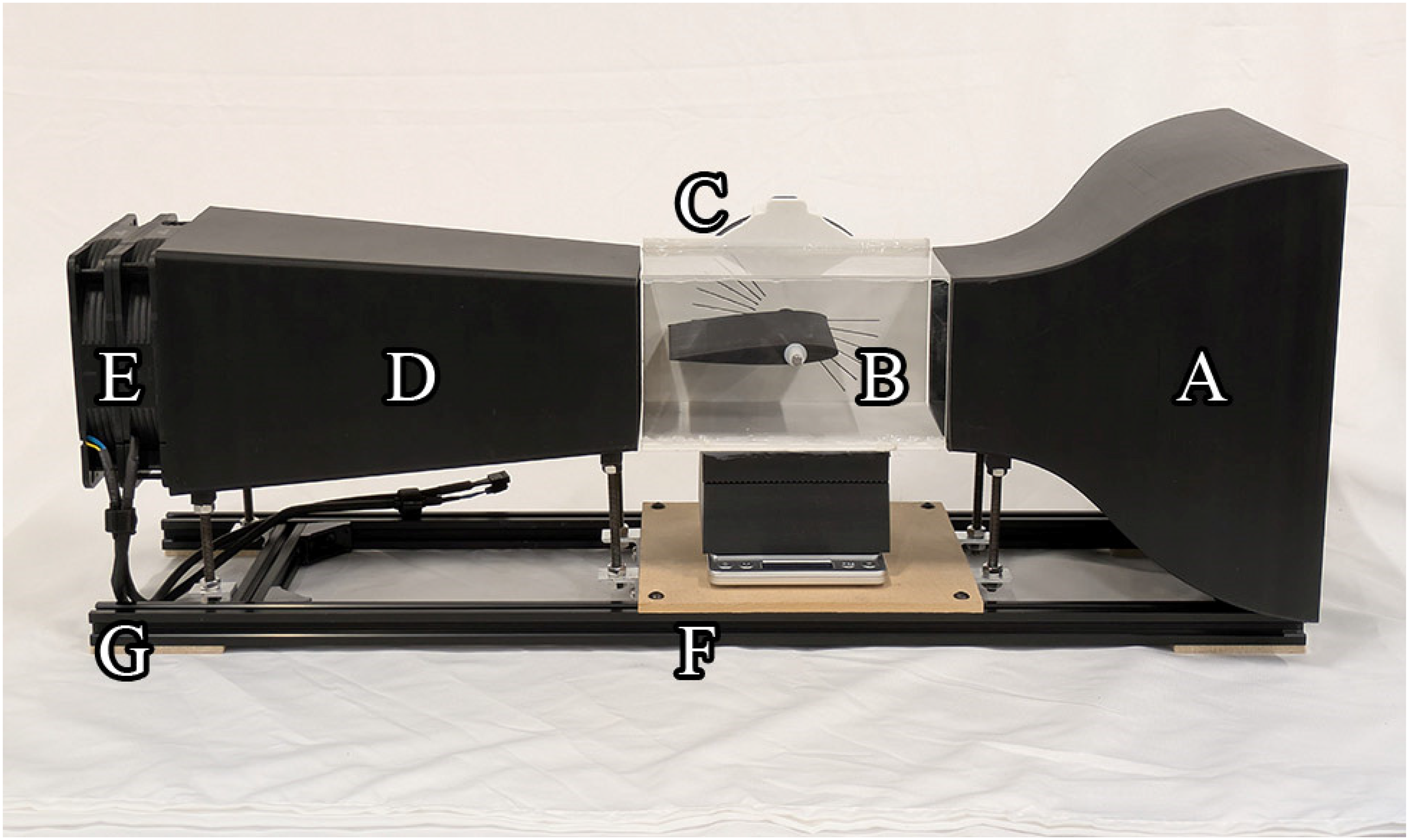
The wind tunnel setup includes a inlet nozzle (A), test-section (B), angle-of-attack adjustment (C, partially obscured), diffuser (D), driving fans (E), frame (G), and force measurement (F).
These simple components provide a practical example to review concepts such as static and dynamic pressure, boundary layer flow including the effect favorable and adverse pressure gradients, and conservation laws before being applied to aerodynamic problems. The integration of these concepts into the course design will be further elaborated on in a dedicated section below, and is mentioned here to motivate the increased complexity of this wind tunnel design over simpler choices that are available.
A more detailed description of the design, including assembly instructions and materials, can be found in the supplementary materials.
Nozzle and diffuser
The flow in the test section of a wind tunnel is, ideally, perfectly uniform and at high speed. However, commonly available drivers of flow, such as fans or some other device, are typically optimized to produce a static pressure differential. Therefore, additional components are required to make best-use of this pressure difference to create the desired effect.
The diffuser sits downstream of the test section, before the prime mover (a commercial computer fan, Noctua NH-14, in our case). Its purpose is to ensure that the static pressure of the fan is converted into dynamic pressure - flow velocity - in the test section in the most efficient way possible. Our particular diffuser also serves to adapt the square cross-section of our test-section to the round working-section of the fans. In the context of aerodynamics instruction, discussing the diffuser is an excellent opportunity to review the conservation of energy (ie, Bernoulli's equation) in its function, as well as boundary layer theory in its design. In particular, the expansion rate in our diffuser was set at 4.8 degrees, in order to prevent boundary layer separation. Boundary layer separation, of course, would dramatically reduce efficiency, and therefore flow speed. The peculiar value of this expansion rate was set by three conditions:
The expansion rate must be low enough to prevent flow separation The test section width and fan diameter were set by other practical considerations (discussed elsewhere), and The specific printer used in this project had a limited build volume, setting a limit on diffuser length
Meanwhile, upstream of the test-section, the purpose of the wind tunnel contraction section is to improve flow uniformity. At a basic conceptual level, the contraction is a nozzle that accelerates the mean flow. As other components of velocity (those perpendicular to the primary axial flow) are not subject to the same acceleration, the relative magnitude of these fluctuations should therefore be smaller at the nozzle exit than inlet. Moreover, nozzles are much less likely to suffer flow separation than diffusers, and so the contraction rate can, generally, be more aggressive than the diffuser section, although not without limit. Several sources provide guidance on the contraction ratio, the ratio between inlet and exit area, usually suggesting between 6 and 12.8,9 Likewise, contraction lengths are recommended to be between 75% and 125% of the nominal inlet diameter. Based on build-volume limitations, and fixed test-section geometry, our contraction has a contraction ratio of 6.9 with a contraction length of 80%. Short contraction lengths can suffer from flow separation, reducing efficiency, but this was seen as an acceptable compromise for the goals of this device, and the other design compromises that we have already made.
Test section
The primary limitation in wind tunnel design in low cost, DIY contexts is the ability to measure forces. In our test section design, we chose to compromise aerodynamic performance in order to enable simple measurements of forces. In particular, we have a ‘floating’ test section that is not physically connected to either the nozzle or the diffuser. The test article, usually airfoil profiles, are fixed to the test section. In this way, lift can be measured by the changing apparent weight of the test section, which can be measured externally, in our case by way of an inexpensive kitchen scale.
The angle of attack of the test article is controlled by a cycloid gear assembly, as shown in Figure 2. This mechanism allowed for precise control of the angle-of-attack of the test article. One complete rotation of the manual input corresponded to exactly a 12 degree change in the angle of attack.
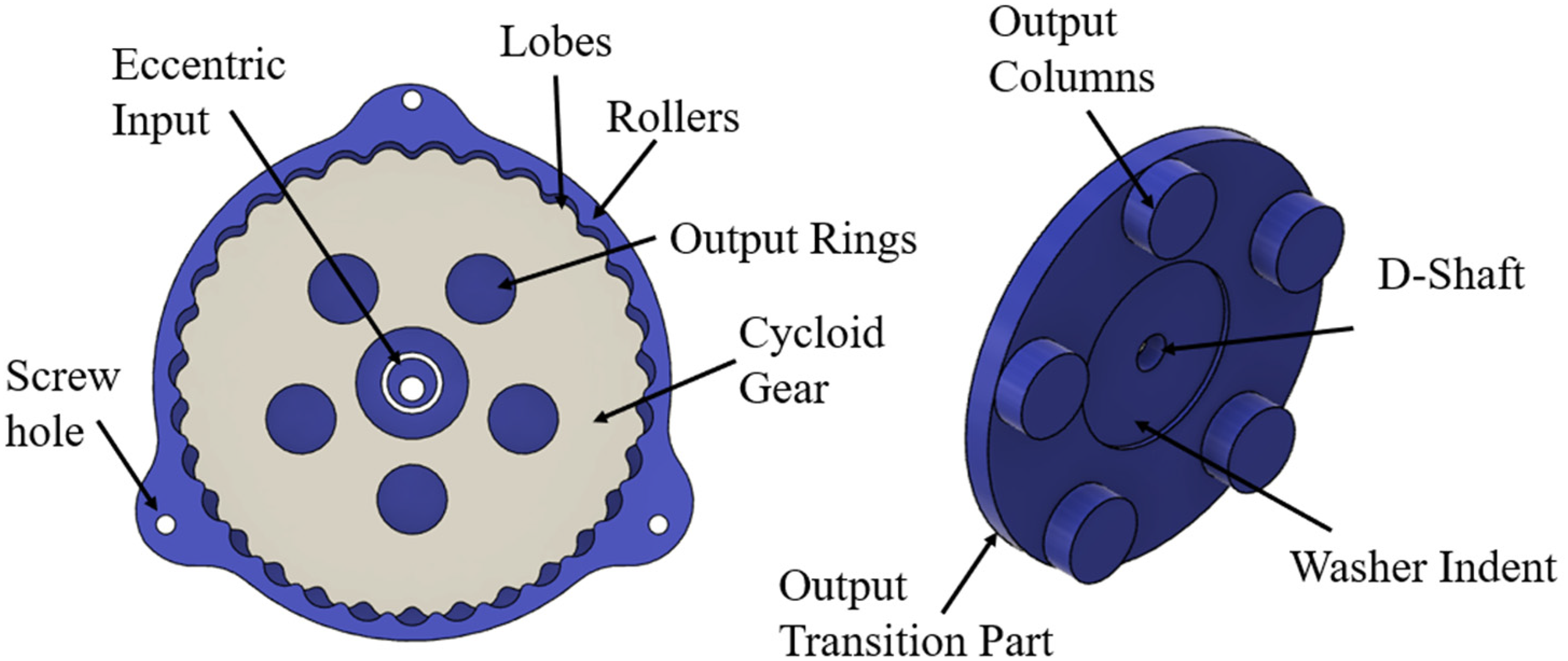
Render of cycloidal gear assembly for angle-of-attack control.
Despite the obvious aerodynamic disadvantages of this configuration, particularly the gaps between the nozzle, test section, and diffuser that may cause flow separation, we believe those are balanced by some practical and pedagogical advantages. Specifically, this configuration is much easier to construct, provides a clear view to students or other audiences, and provides an intuitive and familiar measurement. Inexpensive force balances are available from online retailers, which would permit both lift and drag estimation, but for the current iteration the use of the scale was sufficient to meet the pedagogical goals of the project.
The manufacturer's listed precision of our scale is ±0.3 g (though displayed to ±0.1 g), compared to peak measured lift forces on the order of 8 g. In our experience, variation in the physical setup is a much greater source of uncertainty (for example, placing the floating test section with identical gaps to the nozzle and diffuser each time; setting a precise zero initial angle of attack, and so on) than the scale itself. Unfortunately, these sources of uncertainty are also more difficult to quantity rigorously. To give some idea of the uncertainty, when investigating a NACA 0024 airfoil (STL file in the supplementary materials), peak lift values varied between 6.5 g and 8.5 g in our testing. Following blockage and aspect ratio corrections, this resulted in experimental lift slopes of between
Overall design summary
The design outlined above produces wind velocities of approximately 10 m/s in the test section, as measured by a commercial pitot probe anemometer. We have not tested flow uniformity or turbulence intensity, as the primary purpose of this tunnel is to estimate bulk properties like lift, which can be determined robustly even with poor flow quality. In summary, the key features of this wind tunnel design are:
Total cost of commercial off-the-shelf components between $50 and $200 CAD Prints designed with a constraint of 300 × 300 × 340 mm total build volume (consistent with the print volume of a commercial desktop printer such as the Ender-3 Max) Contraction ratio of 6.9 with a contraction length of 80% to achieve adequate flow conditions Total print time of approximately 36 h on the Ender-3 Max Simple and direct manipulation of controllable variables Use of commercial, off-the-shelf devices for force measurement (i.e., kitchen scale)
Integration of the wind tunnel into course design
The primary purpose of the aforementioned wind tunnel design was to ensure a scalable solution to real constraints in the classroom context. In this section, the integration of the wind tunnel into the course design will be discussed.
Course context
In its current form, the course makes use of wind tunnel demonstrations several times, both as a prop and visual aid as well as a demonstrative tool or activity. In the first lecture in the course, a brief history of aerodynamics is presented (which is not an evaluated learning outcome), which includes the same contradiction described in the introduction of this article: the “contradiction” of the Wright Brothers first flight occurring before the development of thin airfoil theory. With the wind tunnel present as a prop, students are often able to connect the apparent contradiction to tools like dimensional analysis that they covered in previous classes, and then accept that this forms a satisfactory theory of knowledge. That is to say, they can appreciate the power of dimensional analysis to develop empirical models, whereas most of their previous classroom experience focuses on theoretical models. Likewise, the wind tunnel is presented as a prop for review lectures, such as reviewing conservation laws (e.g., with the task of sizing the nozzle and diffuser presented as an example case).
The wind tunnel is first used as an experimental device during thin airfoil theory. In the assessment for this module, students are asked to critically consider the assumptions of the theory: we state that we assume “small” angles, “high” Reynolds numbers, and “thin” airfoils – what tools or observations can we use to quantify what it means to be “small”, “high”, or “thin”, as opposed to leaving these statements qualitative?
Prior to introducing theory, the wind tunnel is brought to lecture, and students are instructed to observe how lift varies with angle of attack. The specific values are not critical in this exercise, and the goal is simply to observe the appearance of stall. Thin airfoil theory is then introduced in lectures to describe the phenomenon we observed in demonstrations. At the end of the module, a ‘flipped lecture’ is employed to work through the assessment, where students have access to the wind tunnel as an experimental device. No specific instruction is given on its use, but the instructor is available to answer any questions.
In this activity, students observe stall, observe tuft visualizations, and produce experimental lift-slopes. Airfoils of varying thickness are available to observe their differences. Through assignment and activity, students are guided towards the idea that our assumptions of “small” angles, “high” Reynolds numbers, and “thin” airfoils all ultimately relate to an attached boundary layer. In turn, it is hoped that this activity produces an intuition for the physical justification for the assumptions that we make, rather than a strictly mathematical one. Similar experiments are also used to investigate airfoil camber.
In addition, students are offered access to the CAD files of the wind tunnel as designed. Note that we recognize here a potential future opportunity to implement design and further experimentation using this approach, but this has not been implemented.
Experiential learning framework
As discussed previously, the intent of this project was to integrate the wind tunnel as an experiential learning activity in the context of a classroom lecture. Integrating the wind tunnel into the course involved providing students with:
Opportunities to experiment with the wind tunnel Time to discuss their findings with other students and the course instructor A formative assessment designed to reflect on the associated theory and critique theoretical assumptions based on experimental results Theory and context through traditional lecture delivery
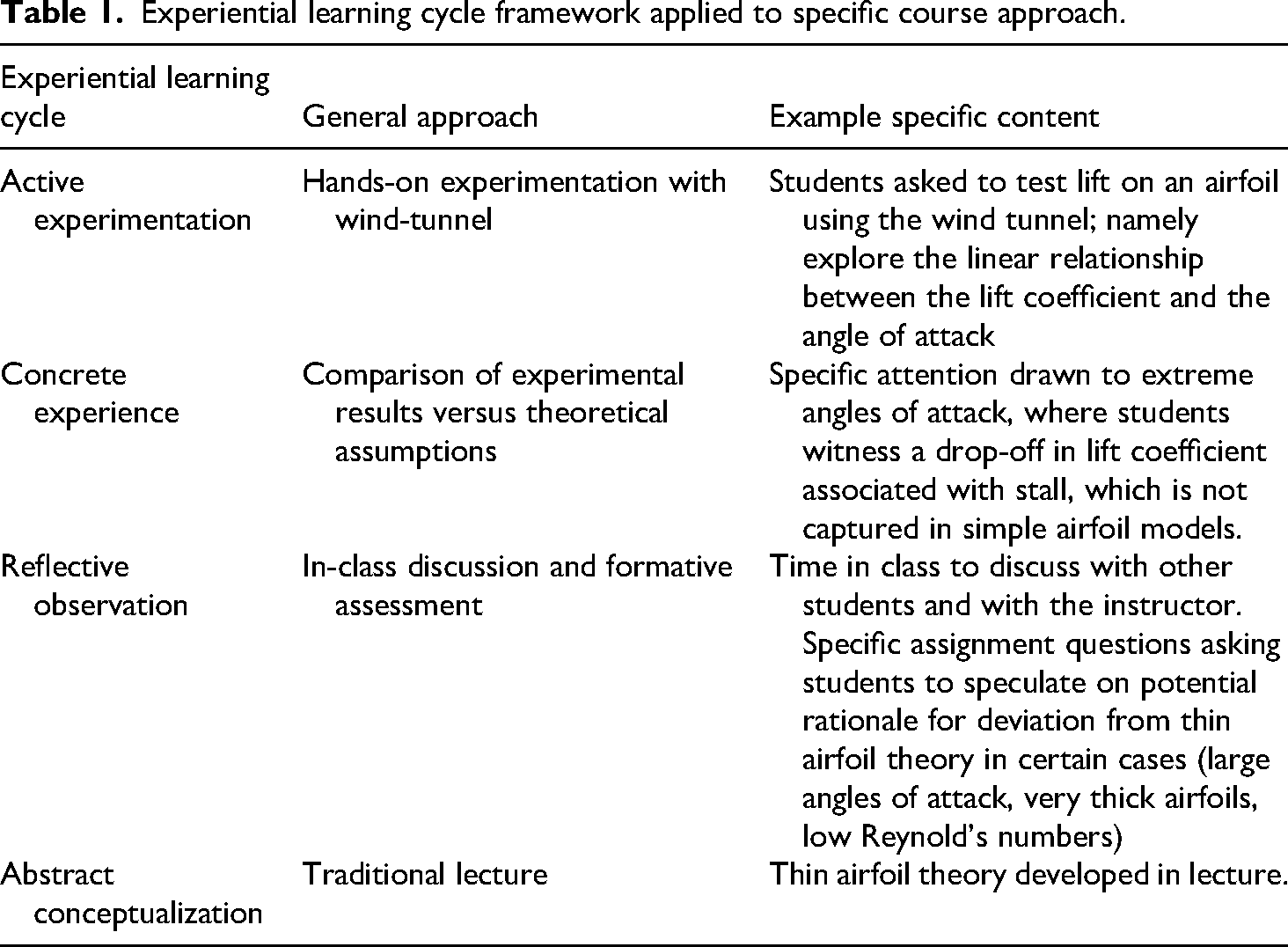
These steps are critical to ensuring that effective learning is taking place, and that the wind tunnel is not being treated as a mere demonstration. Additionally, the focus here was to experiment with what would later be presented as assumptions in the derivation of theory and not to re-derive or develop aerodynamic theory. This removes the need for high precision instrumentation, and instead focuses on the active and reflective elements of the experiential learning process. Table 1 below shows the specific activities associated with this general approach and how we believe it aligns with the experiential learning framework. 6
Experiential learning cycle framework applied to specific course approach.
Student perspectives
Student surveys were conducted during a course offering in order to evaluate the perceived value of the experimental wind tunnel.
Survey design
Survey questions were selected to explore the students’ perception of the impact on the domains of Collaboration, Discovery and Relevance, and Utility. These domains were selected based on a survey tool suggested from a study that focused on student perception of laboratories in course-based undergraduate research experiences. 10 Institutional guidelines for effective teaching were also used to help consolidate questions. 11 The first domain of Collaboration was selected to evaluate the degree to which the students were encouraged to work together in the laboratory context. Discovery and Relevance was selected to evaluate the degree to which students were able to generate and apply knowledge in the relevant field of aerodynamics and fluid mechanics. A domain of Utility was selected to evaluate the perceived usefulness of the wind tunnel in the overall context of the course offering. See Table 2 for the complete list of survey questions, coded for ease of question identification.
Complete list of survey questions.
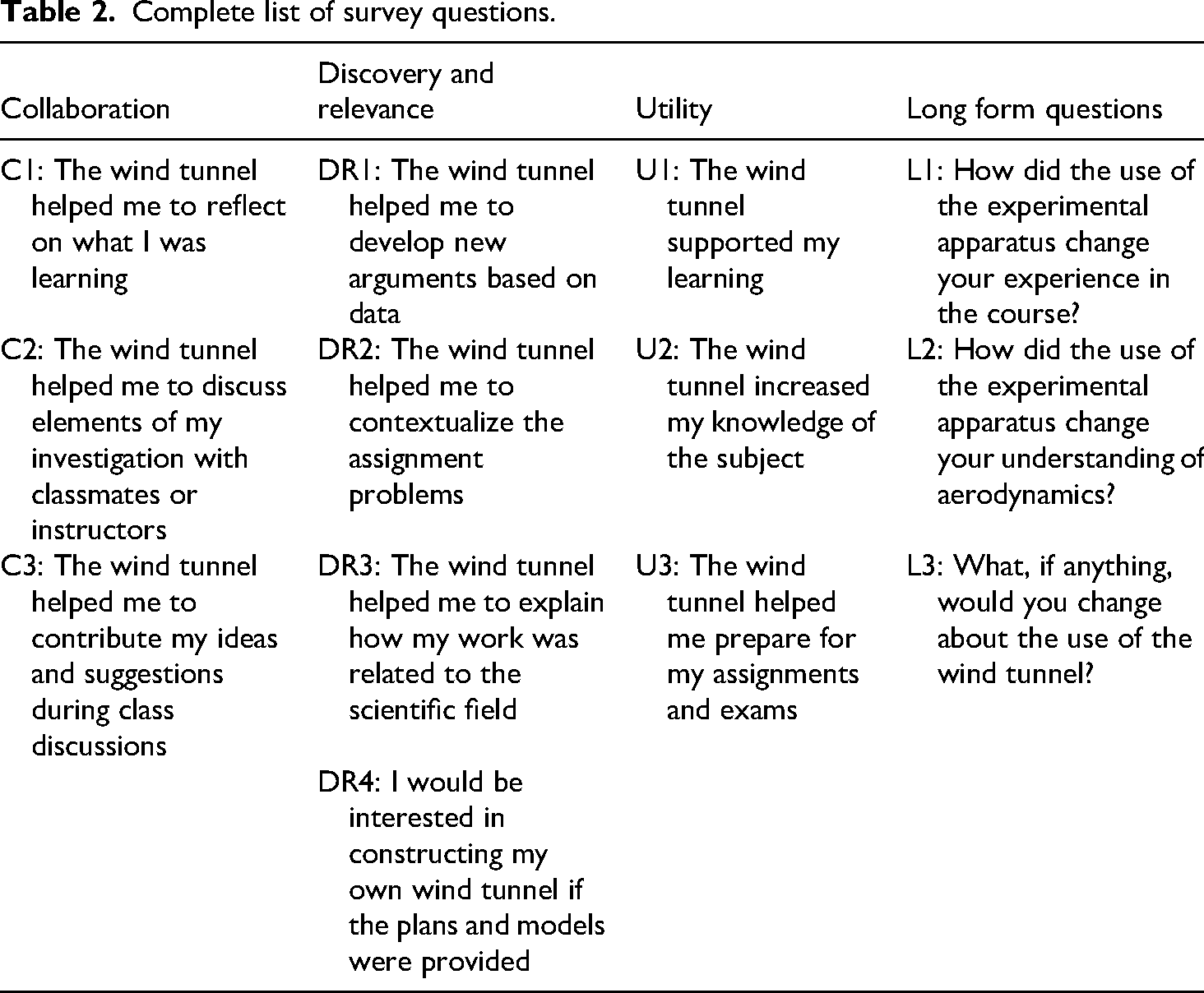
The survey was composed of a total of 13 questions. 10 questions were answered using a 5-point Likert scale, with “I don’t know” and “I prefer not to answer” as additional options. Three question prompts were for an optional long form response. The 10 Likert scale questions were mandatory for response submission, while the three long form responses were optional.
Survey results
The study design was reviewed and approved by the corresponding ethics review board at the institution. No demographic data was recorded through the survey as only anonymous data was collected. Invitations to participate were sent through the course LMS announcements by the course instructor, with an embedded URL to access the survey questions. A total of 11 participants participated from the class of 35 students.
After collection the data was organized by the three domains as shown below in Figure 3.
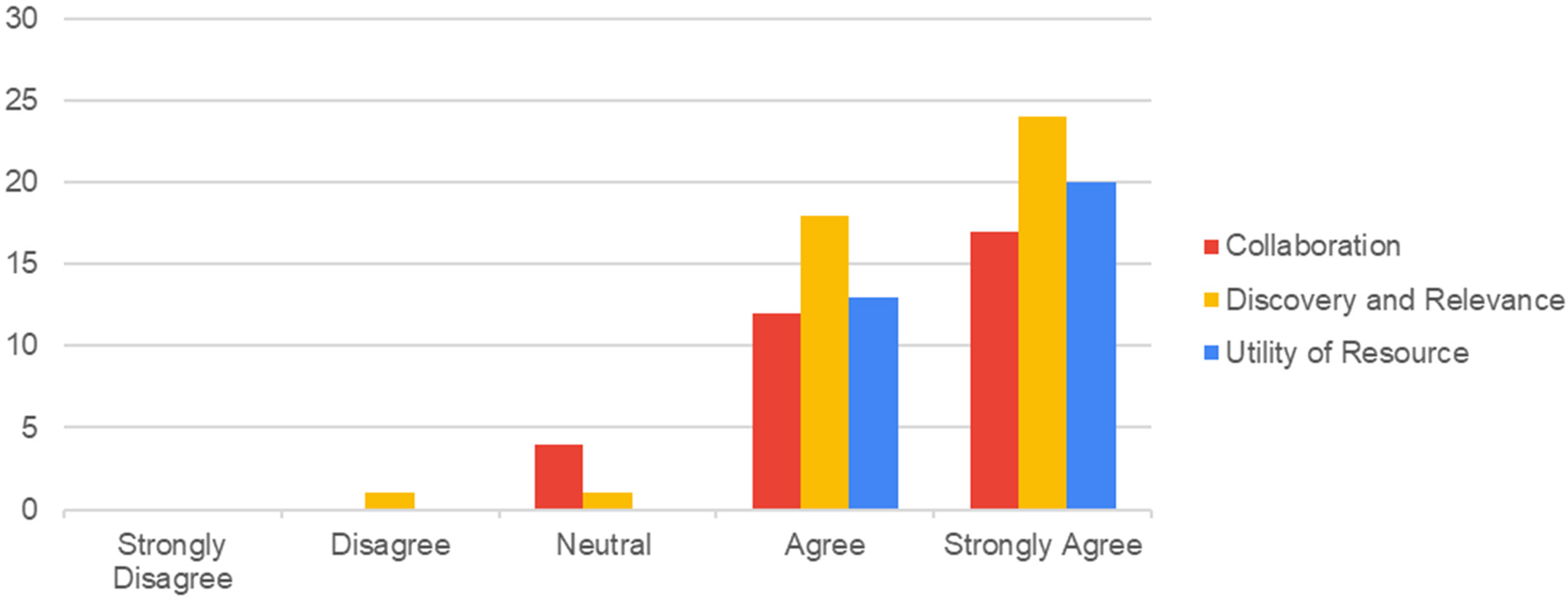
Summary of Likert-scale responses to questionnaire by domain.
The results of the survey indicate overall that the use of the wind tunnel in a classroom setting were perceived as beneficial in all three selected domains by the respondents. The only “Disagree” response was to question DR4, i.e., whether or not the student would be interested in building the wind tunnel for themselves, which also received a single “Neutral” response. The remainder of the “Neutral” responses were in the domain for Collaboration. Given the low number of respondents, further discussion of these results will forego a statistical analysis and instead focus on themes within the written responses.
Long form question responses
All but two students elected to provide long form written responses to the questions. Review of the responses yielded some themes that went outside the context of the original question, namely the overall utility, the hands-on aspect, and specific concerns related to its use.
The following selective quotes from the responses support the overall utility of the wind tunnel as important for developing theoretical understanding: “…The data proved the theory discussed in the lecture and provided a good starting point for the first assignment discussion.” “I don't know if changed my understanding as it more so solidified my understanding. And with the related assignment I was able to confirm the theory with the experimental.”
In addition, students specifically mentioned the “physical” aspect of either the hands-on interaction or actual data as benefits: “It was nice to see physical data and actually see how the wind tunnel worked. Helped for visual and hands on learners like myself.” “Practical experiments are always more engaging than videos or theoretical data, physically seeing the weight change due to the angle of attack on the airfoil, and seeing the effect of the other airfoil shapes on the coefficient of lift”
Some concerns were raised about the build quality of the wind tunnel, in contrast to the low cost, DIY option advocated for by the authors previously: “If this was to be a permanent prop I think it would be worth it to invest a little more money into making a more stable device, which could show more stable results and even have students come use it without the risk of wrecking the device.”
Others saw potential benefits outside the specific use demonstrated in class: “If the course were to change its curriculum, a design your own airfoil to fit into the wind tunnel would be a final assignment I would appreciate.” “Also please share the construction files!!!”
Summary of survey
In summary, the overall perception of the wind tunnel as designed was seen as a benefit to the course by the students. Students perceived the wind tunnel as overall beneficial towards their own discovery and development of understanding in the course. While it was generally seen as positively contributing toward discourse amongst students, there is possibly room for more explicit emphasis to encourage a sense of collaboration while engaging with the wind tunnel.
Conclusions
The design, implementation, and evaluation of a low-cost benchtop DIY wind tunnel is detailed here for the purposes of disseminating amongst engineering educators a potential solution to some of the constraints that can arise in the classroom environment. We hope that by sharing our motivations, build plans, and outcomes from this experience will encourage others to do the same and build on our efforts, with the intent of motivating and educating students to become the next generation of innovative engineers and researchers.
In our experience, the activity was well-received by students, who found it to be helpful in improving their understanding of aerodynamic theory, and we plan to utilize multiple units in future iterations to improve tangible, individual experiences among students.
Disclosures
The surveys in this work were approved by the University of Alberta ethics review committee with reference number Pro00130192.
Supplemental Material
sj-pdf-1-ijj-10.1177_03064190261419856 - Supplemental material for Experiential learning with a 3D printed wind tunnel
Supplemental material, sj-pdf-1-ijj-10.1177_03064190261419856 for Experiential learning with a 3D printed wind tunnel by Benjamin Cheung, Alvaro Arce-Borkent and Jaime G Wong in International Journal of Mechanical Engineering Education
Supplemental Material
sj-zip-2-ijj-10.1177_03064190261419856 - Supplemental material for Experiential learning with a 3D printed wind tunnel
Supplemental material, sj-zip-2-ijj-10.1177_03064190261419856 for Experiential learning with a 3D printed wind tunnel by Benjamin Cheung, Alvaro Arce-Borkent and Jaime G Wong in International Journal of Mechanical Engineering Education
Footnotes

Funding
The authors received no financial support for the research, authorship, and/or publication of this article.
Declaration of conflicting interests
The authors declared no potential conflicts of interest with respect to the research, authorship, and/or publication of this article.
Data availability statement
The datasets generated during and/or analyzed during the current study are available from the corresponding author on request.
Supplemental material
Supplemental material for this article is available online.