



Abstract
Extensions to the first and second theorems of Pappus are presented, whereby the centroid of a surface or solid of revolution can be determined using only the geometric properties of the generating plane curve or figure and the arc of revolution. The derivations are well suited to first-year-level courses in mathematics and engineering. From a didactic perspective, the resulting formulas are simple to apply, especially since the required geometric properties are typically available in standard tables of plane sections or relatively routine to derive. Furthermore, the formulas provide a general scaffold for students to attempt problems involving axisymmetric bodies while also reinforcing and embedding their knowledge of the properties of the generating plane shapes. A selection of illustrative problems is discussed that are generally regarded to be challenging for introductory mechanics courses but for which the formulas derived in this article provide straightforward solutions.
Introduction
The detailed consideration of solids and surfaces in three dimensions, including their associated properties such as volume, centroid, etc., features prominently in introductory engineering mechanics and some mathematics texts.1–4 In this context, the well-known theorems of Pappus, and the resulting formulas, are typically introduced as a convenient means to determine the volumes and areas of solids and surfaces of revolution. Interestingly, these theorems are far less prominent in typical calculus texts, even though solids and surfaces of revolution are among the most common applications of integration in calculus courses. 5
As the name suggests, the theorem is generally attributed to Pappus of Alexandria (c. 300 A.D.), 6 who is regarded as one of the last great mathematicians of the Hellenistic Age. 7 In addition, Paul Guldin (1577–1643) is often credited with an independent rediscovery of the theorem, 8 although some argue that it is most likely a case of unwitting plagiarism. 6 Either way, Guldin provides the first known attempt at a formal proof of the theorem as any proof due to Pappus has been lost. 8 The theorem has attracted much interest over the centuries 8 and inspired several generalizations, e.g., solids and surfaces generated by sweeping a plane figure along an arbitrary curve in three-dimensional space, 8 including allowances for variations in the size and shape of the plane figure 7 and similar formulations for n-dimensional space. 9
To the authors’ knowledge, all published generalizations of the theorems of Pappus appear to be focused on finding the volume or area of the generated solid or surface (or n-dimensional equivalent). There do not appear to be any attempts to extend the analysis to other properties, such as the centroid of the generated solid or surface. In the context of engineering mechanics, this means that the theorem of Pappus only simplifies the calculation of volume and area for solids and surfaces of revolution, while finding the centroid requires reversion to relatively tedious double or triple integrals. This begs the question, why study the theorems of Pappus if all they provide is the surface area or volume of an object?
This article presents extensions to the first and second theorems of Pappus whereby the centroid of a solid or surface of revolution can be determined using only the geometric properties of the generating plane figure or curve and the arc of revolution. The derivations are presented in a form suitable for introductory engineering mechanics courses and, therefore, incorporate a recapitulation of the first and second theorems of Pappus. Finally, applications of the resulting formulas are discussed in the context of a small selection of illustrative problems that are generally regarded to be challenging for introductory engineering mechanics courses.
Volume of a solid of revolution
The second theorem of Pappus can be derived as follows: Consider the infinitesimal volume of a solid of revolution depicted in Figure 1. The volume of the infinitesimal element is,


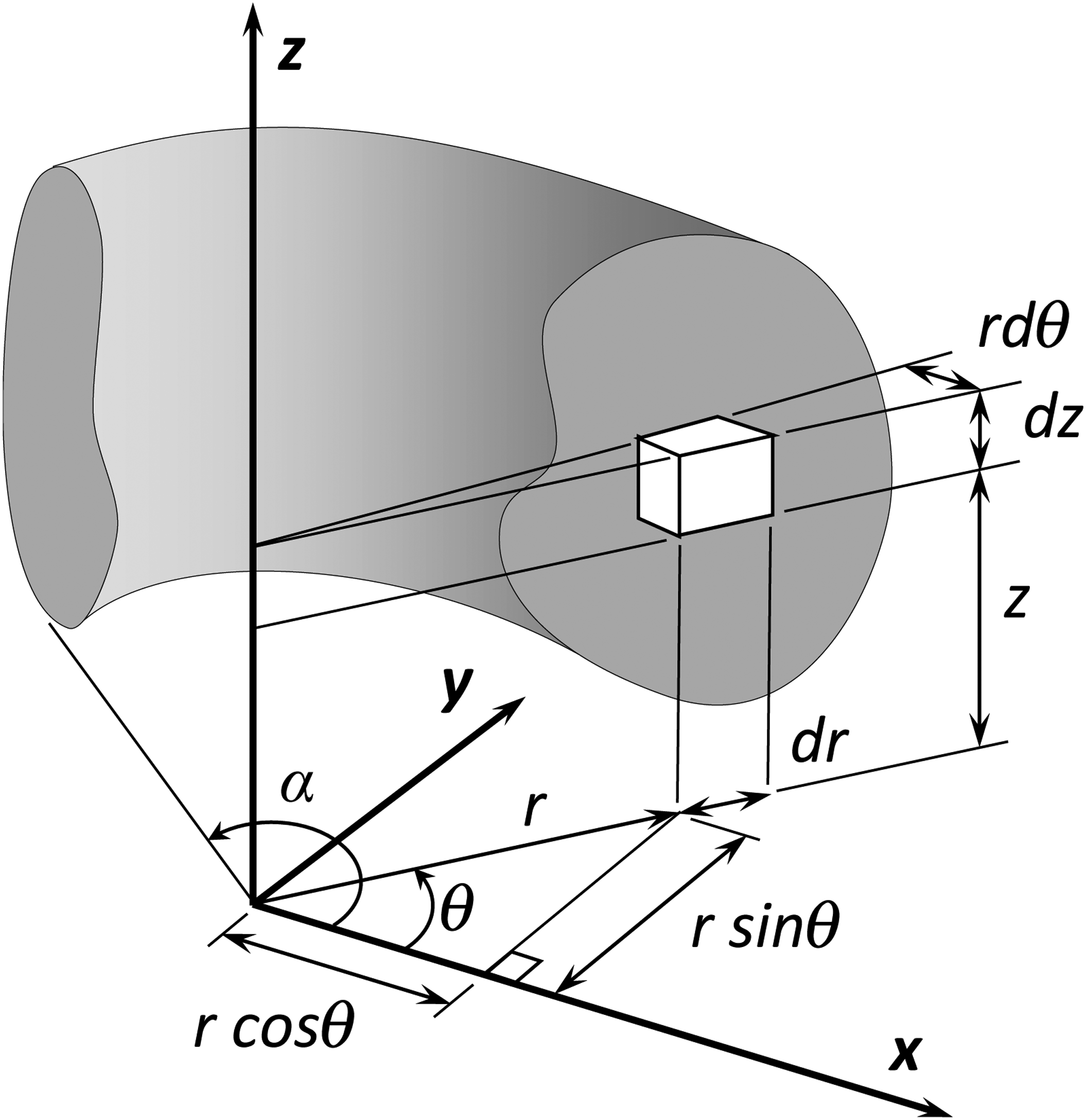
Infinitesimal volume of a solid of revolution.
Noting that the radial position r is not a function of θ, the volume can be rewritten as,

Inspection of Equation (3) reveals that the result of the first integral is simply α while the second integral is recognized as the first moment of area of the generating plane figure relative to the z-axis.1–3 Hence, Equation (3) can be rewritten as,

Equation (4) is a recapitulation of the well-known formula resulting from the second theorem of Pappus.1–9 This approach can now be extended to provide a novel formula to determine the position of the centroid of a solid of revolution.
Centroid of a solid of revolution
The position of the centroid of the solid of revolution in the x-direction is defined as,1–3




A similar result is obtained for the position of the centroid in the y-direction, where cosθ is replaced by sinθ in the integral to yield,



Hence, Equation (11) can be rewritten as,

Area of a surface of revolution
The first theorem of Pappus for the area of a surface of revolution is obtained using a similar approach as that for the volume of a solid. In this case, the infinitesimal area dA is given by,



Inspection of Equation (15) reveals that the result of the first integral is simply α while the second integral is recognized as the first moment of length of the generating plane curve relative to the z-axis.1–3 The final expression for the surface area is thus,

Equation (16) is a recapitulation of the well-known formula resulting from the first theorem of Pappus.1–9 This approach can now be extended to provide a novel formula to determine the position of the centroid of a surface of revolution.
Centroid of a surface of revolution
The position of the centroid of the surface of revolution in the x-direction is defined as,1–3




A similar result is obtained for the position of the centroid in the y-direction, where cosθ is replaced by sinθ in the integral to yield,




Illustrative examples and discussion
Centroid of a solid quarter torus
Consider the quarter torus depicted in Figure 2a, with a mean radius of R and a cross-sectional radius of a. The angular extent of the quarter torus is π/2 and the area of the cross-section is πa2, while the radial position of the centroid is R. Hence, from Equation (4), the volume of the quarter torus is,



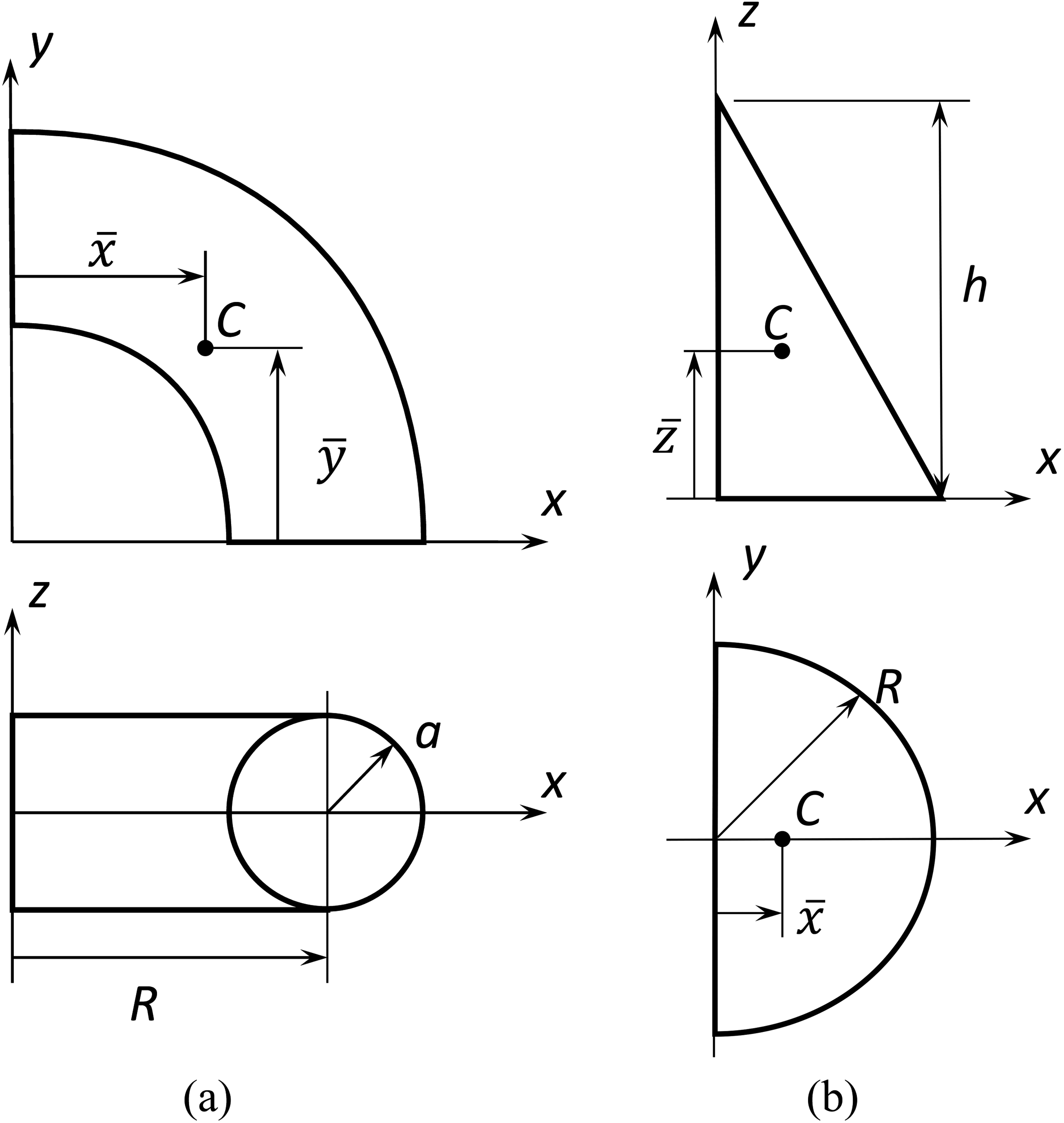
A quarter torus (a) and a half cone (b).
The results given in Equations (25) and (27) are well-known.1–3 In fact, the volume of a torus is often used as a worked example for the application of the theorems of Pappus. 1 However, examples or problems relating to the derivation of the formula for the centroid of an incomplete torus are seldom found in introductory mechanics text, presumably due to the lengthy and tedious integration required. For contrast, a summary of the triple integral approach is presented in Appendix 1. Depending on the individual student, a detailed handwritten version would likely encompass between two to four pages, which is significantly longer than solutions to typical problems found in introductory mechanics texts.
In contrast to a triple integral, the extensions to the theorems of Pappus presented here provide a derivation approach that is short and straightforward. Furthermore, the proposed approach reemphasizes the meaning and use of quantities students would have previously encountered in their coursework, e.g. the centroid of a plane figure and the parallel axis theorem, thus providing an opportunity to further embed these concepts.
Centroid of a solid half cone
Consider the solid half cone depicted in Figure 2b, with a base radius of R and a height of h. The cone can be generated as a solid of revolution where the radial cross-section is a right-angled triangle of base R and height h. The angular extent of the cone is




The results given in Equations (28), (30), and (31) are well known.1–3 In this case, their standard derivations do not require unusually lengthy or tedious integration. Nevertheless, these examples show that the theorems of Pappus and the extensions presented here provide a short and straightforward means of obtaining and/or confirming these results.
Centroid of a half-conical shell
Consider the half-conical shell forming the curved surface of the solid half-cone depicted in Figure 2b, with base radius R and height h. The shell can be generated as a surface of revolution where the plane curve is a straight line from the apex of the cone at height h to the outer radius R of the base. The angular extent of the shell is





The results given in Equations (33), (35), and (36) are well known.1–3 For this example, the quantities given in Equation (34) are not typically included in standard tables, but they are relatively routine to derive and do not require lengthy or tedious integration, as shown in Appendix 2. Furthermore, breaking these derivations down into discrete steps, as opposed to using double or triple integrals, may assist students to apprehend the logical flow. Hence, these examples again show that the extensions to the theorems of Pappus provide a short and straightforward means of obtaining and/or confirming these results.
Conclusions and recommendations
Extensions to the first and second theorems of Pappus have been presented, whereby the centroid of a surface or solid of revolution can be determined using only the geometric properties of the revolved plane curve or figure and the arc of revolution. The derivations are relatively straightforward and appropriate for presentation in first-year-level university courses in mathematics and engineering. As shown through illustrative examples, the resulting formulas are simple to apply, especially since the required geometric properties of the generating plane curves or figures are typically available in standard tables of plane sections or relatively routine to derive. These formulas provide a general scaffold for students to attempt challenging problems involving surfaces and solids of revolution in discrete steps, without requiring lengthy double or triple integrals, while re-emphasizing the properties of the generating plane shapes that students would have previously encountered in their coursework, thus providing an opportunity to further embed these concepts.
Footnotes
Declaration of conflicts of interests
The author declares that there are no potential conflicts of interest with respect to the research, authorship and/or publication of this article.
Funding
The author received no specific grant or financial support for the research, authorship, and/or publication of this article, from any funding agency in the public, commercial, or not-for-profit sectors.

Data availability statement
Data sharing is not applicable to this article as no datasets were generated or analyzed during the current study.