




Abstract
A simple experimental fin device was used to develop a laboratory procedure for undergraduate engineering students, in order to enhance their understanding of the transfer of thermal energy. This experiment exposes the student to several important concepts, namely one-dimensional, time-dependent heat transfer in extended surfaces by conduction, convection and radiation. In a few simple steps, students have the opportunity to compare the measured to the predicted temperature profiles obtained at different times using an analytical complex solution and to calculate convective and radiative heat coefficients, such as the relative predominance of convection heat transfer with respect to radiation.
Introduction
Heat transfer enhancement is an active and important field of engineering, since any increases in the effectiveness of transferred heat could result in considerable technical advantages and cost savings. The interest in such problems stems from their importance in many engineering applications such as thermal design of heat exchangers, air conditioning, convective heat loss from solar collectors, and the cooling of electronic or mechanical components. When additional metal strips, called fins, are attached to ordinary heat-transfer surfaces, they extend the surface available for heat transfer between the solid and the surrounding fluid . 1 While the finned surface increases the total transmission of heat, its influence as a surface is treated differently from simple conduction and convection problems, and its mathematical description can be complicated. It is important for engineers to understand the principles of heat transfer, and to be able to use the rate equations that govern the mechanisms of transmission of heat (i.e., conduction, convection and radiation). However, the majority of students perceive its mathematical representation as a difficult subject. Heat-fin experiments are important didactical resources to show practical applications of sophisticated mathematical techniques. The integration of the present experiment into undergraduate courses would allow students to familiarize themselves with this technique and enhance their understanding of extended surfaces.
Here we present a simple experiment that illustrates transient heat conduction in a cylindrical fin involving combined convection and radiation effects. In this experiment, the fin is assumed to be insulated at the end and the heat-flow is intended to be one dimensional. Under transient conditions, students record the time-dependent temperatures of the fin at several positions along its length and compare the measured temperature profile with the analytical solution at regular intervals of time. The convective and radiative heat transfer coefficients are also evaluated from the measured temperature profile, as well as the time needed to achieve the steady-state conditions. In addition, students could validate the dominance of convective heat transfer at low surface temperatures, and the dominance of radiation heat transfer at high surface temperatures.
Other papers describe similar experiments involving heat conduction in a fin. In some cases, experiments are conducted under steady-state conditions .2–4 In other cases, radiation or convection is neglected 5–8 or boundary conditions differ from those used in this work. As such, the equation required to carry out our experiment is not evident to find in books usually employed in undergraduate heat transfer courses.
The experiment described further on is part of a series of six different laboratories that students accomplish in the “Mechanical laboratory II” course. As a course typically taken in the sixth trimester of their curriculum, students review topics taught in the fluids/heat transfer stem of the mechanical engineering program, as well as learn new experimental techniques. It is a one credit course taught as 1.5 h of lecture and 21 h of laboratory (3.5 h for each experiment). A laboratory handout is given at the beginning of the course, well before the laboratory period, which outlines the fundamental topics and references as a review. The main objectives of this course are: i) learning to use the procedures, skills, and modern engineering tools necessary for engineering practice, including experimental approaches and techniques, data-analysis methods, and engineering measurement systems; ii) learning how to evaluate and interpret experimental data using their knowledge of physics and engineering principles; iii) learning how to present experimental results by writing a professional report at the end of each laboratory.
Methodology
Experimental apparatus and procedure
The experimental apparatus is relatively simple and inexpensive (see Fig. 1). A 10 mm diameter brass rod
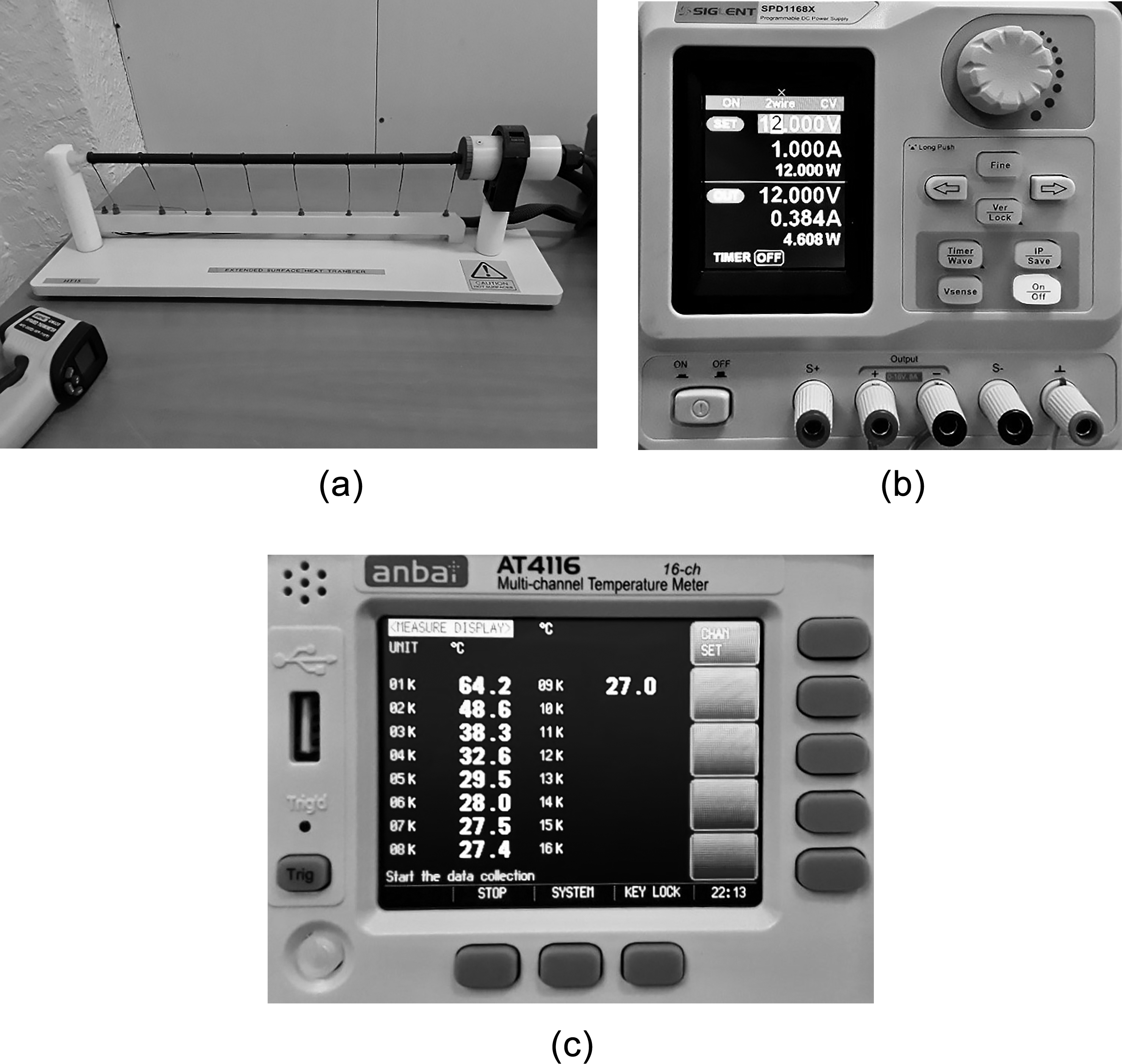
(a to c) Extended surface experimental apparatus: (a) the cylindrical brass pin fin connected to the thermocouples; (b) SPD1168X siglent programmable dc power supply connected to the heater; (c) anba AT4116 multi-channel temperature meter.
The experimental procedure is simple and straightforward to carry out. First, students turn on the voltage controller and increase the voltage to 9 V. Second, they record the axial temperature distribution (T1 to T8) and ambient air temperature Ta every 5 min until all temperatures are stable. Once readings have been completed, the voltage may be reduced to zero to allow the rod to cool. If time permits, they may carry out the experiment a second time increasing the voltage to 16 V and repeating the above readings until steady-state conditions are reached once again. The duration of the entire experiment is approximately 3 h. However, in order to verify our model, we repeated measurements for 9 V, 12 V, 14 V and 16 V, recording the axial temperature profile at different times. A comparison between experimental data and our model is presented and discussed in the Results and discussion section.
Mathematical formulation
Consider a straight cylindrical fin of constant cross-sectional area A, perimeter of the cross-section P, and length L as shown in Fig.1. The fin has a thermal conductivity k and a thermal diffusivity

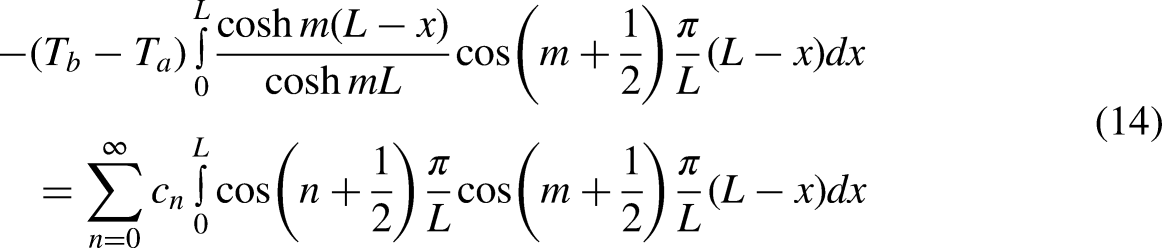
The initial and boundary conditions are














Combined convection-radiation coefficient
The heat is transferred from the rod to the external environment by a combination of radiation and convection. From a practical standpoint, the value of primary interest is the combined-mode heat transfer coefficient


The average values of convective and radiant heat transfer coefficients are calculated on the fin length by


Results and discussion
Experimental measurements of the axial temperature profile were carried out for four different voltages (9 V, 12 V, 14 V and 16 V). A higher voltage corresponds to a higher base temperature. Results are displayed in Fig. 2, where dotted lines represent the analytical solution and the points are the experimental temperatures at different t (120 s, 600 s, 1 200 s, 1 800 s, 2 700 s and 3 600 s).
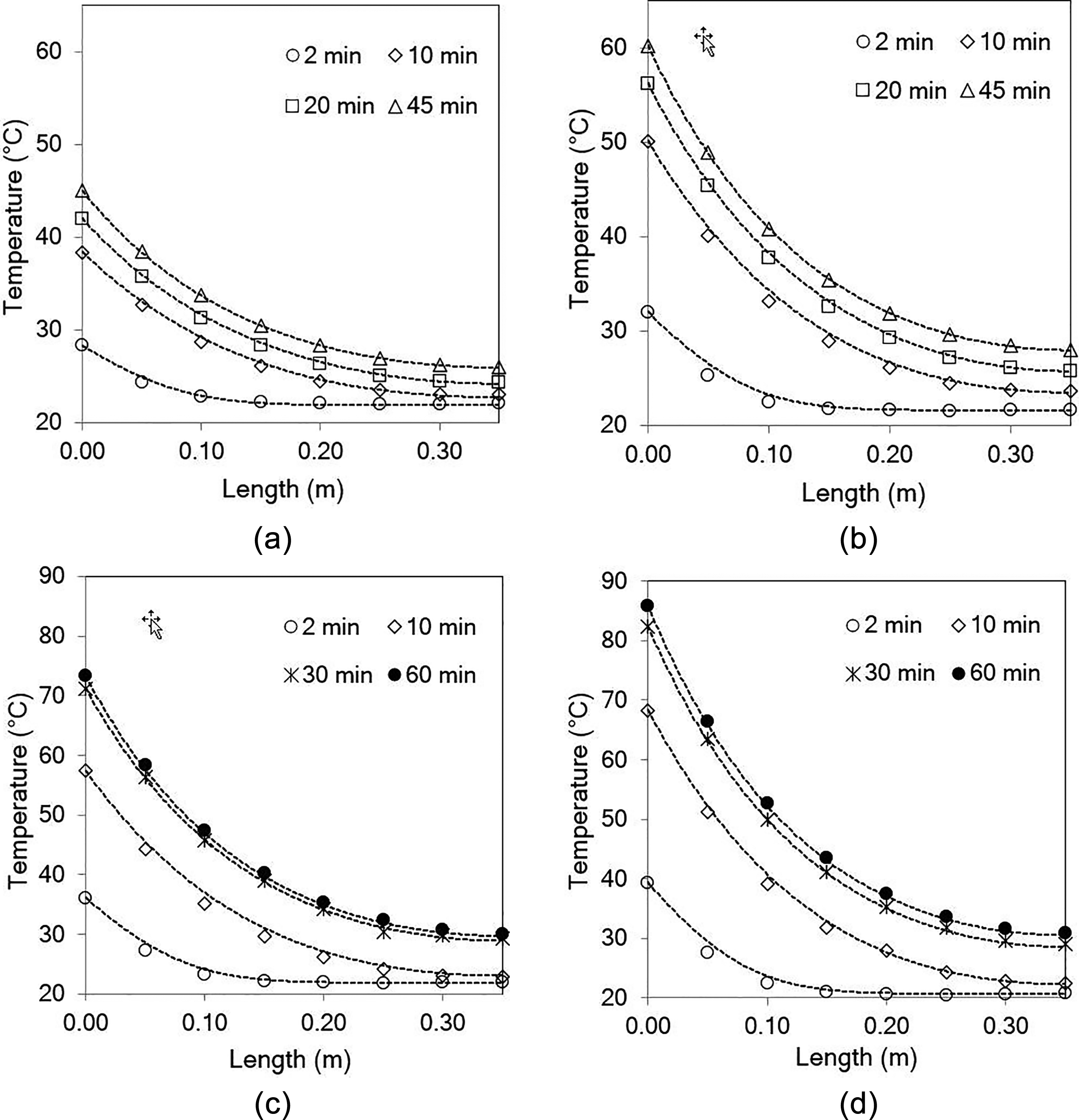
(a to d) Surface temperature: measured data (points) and analytical solutions (dotted lines) along the fin at different t and voltages: (a)
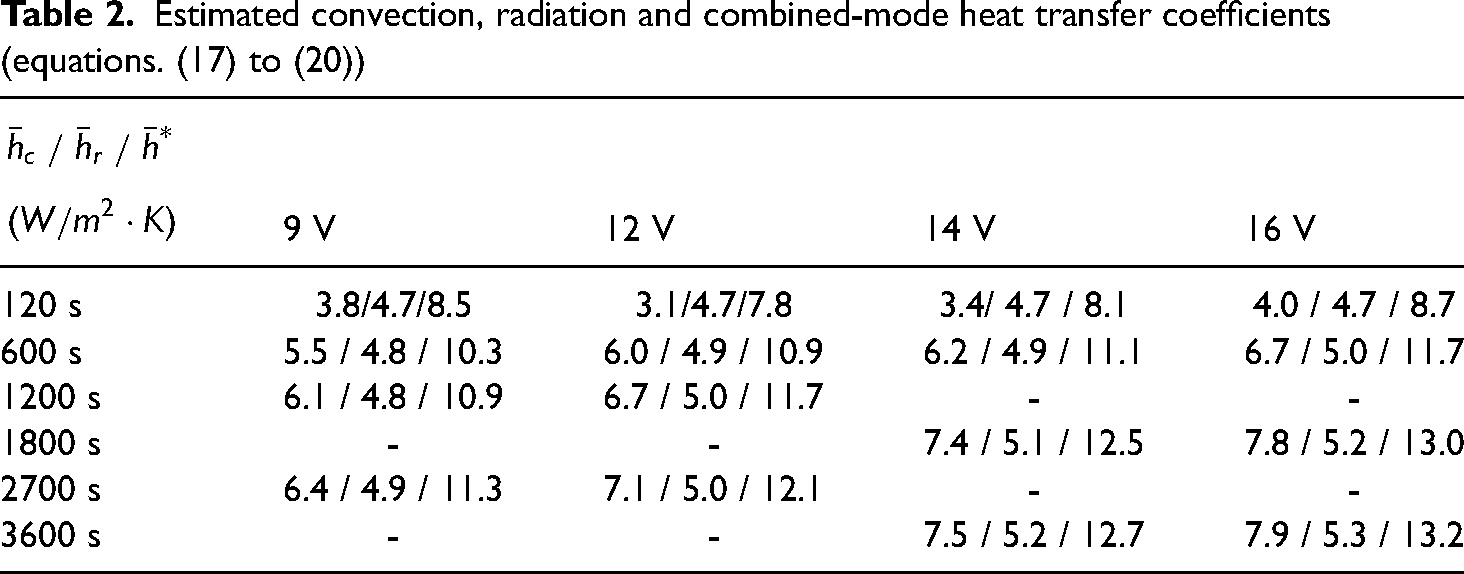
First of all, we calculated the average combined-mode heat transfer coefficients
Estimated fin parameter m.
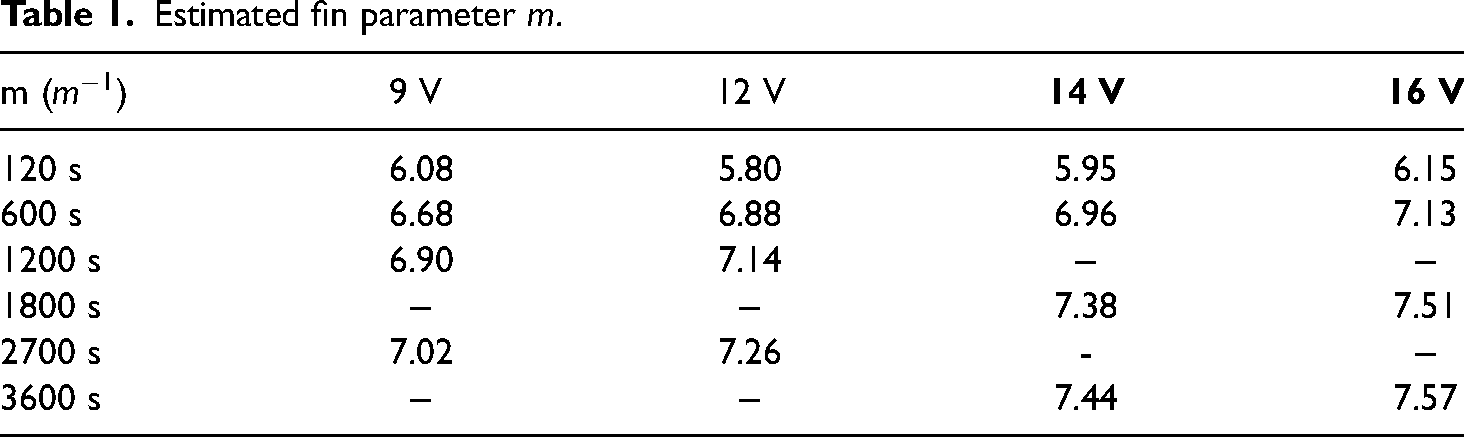
As can be seen, the model fits the experiments very well, with a coefficient of determination
The value of primary interest is the combined-mode (radiation and convection) heat flux from the fin to the surroundings, which could be easily expressed as:
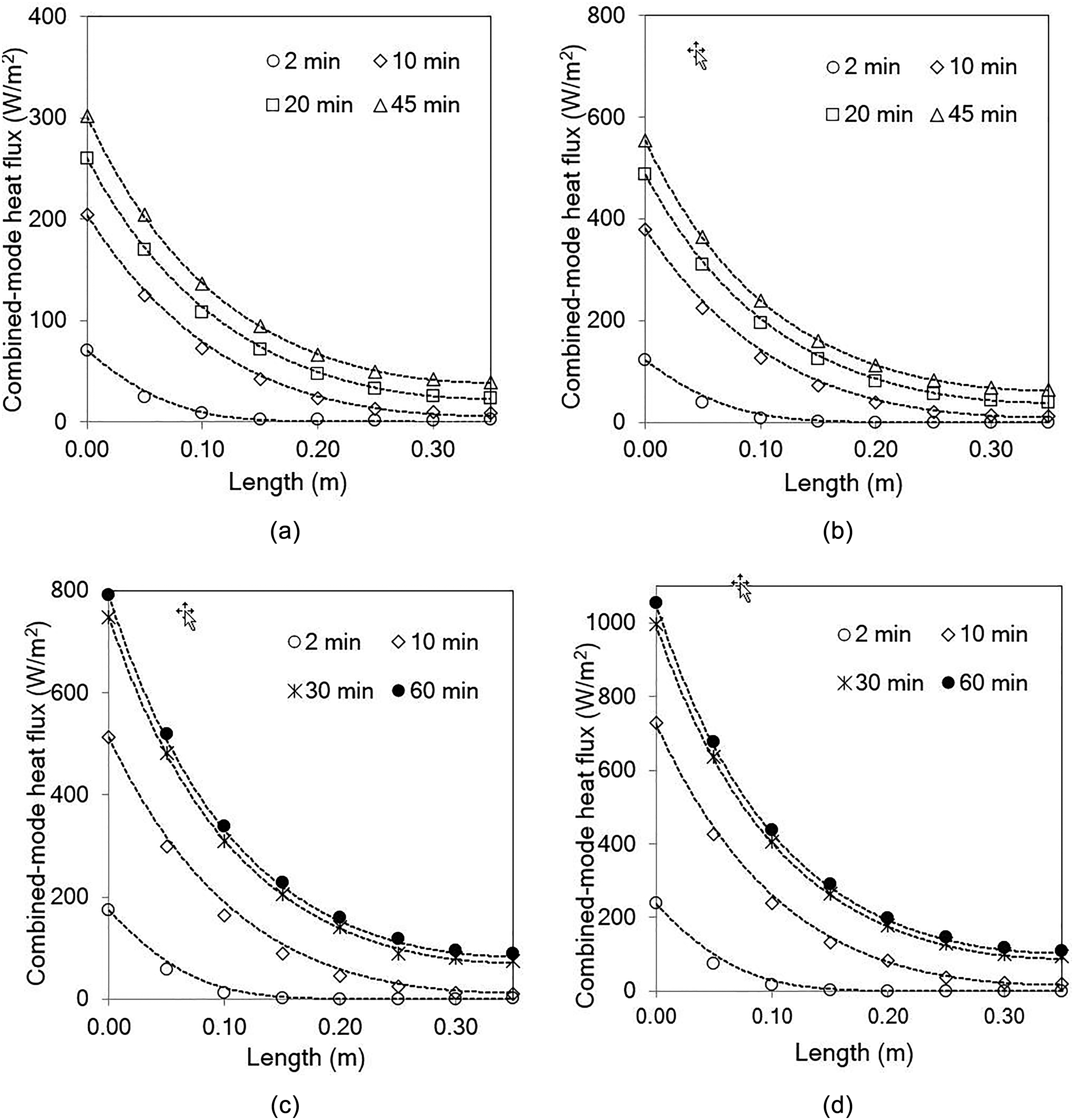
(a to d) Combined-mode heat flux: measured data (points) and analytical solutions (dotted lines) along the fin at different t and voltages: (a)
Convection, radiation and combined-mode coefficients calculated with experimental data using Equations. (17) to (20) are presented in Table 2. The convection coefficient increases rapidly with time and voltage, varying from 3.8 to 7.9
The reason for carrying out the experiment at four different voltages is to show that this analysis is repeatable and well designed. A model could also be used to investigate the influence of some parameters, such as fin conductivity, geometric fin shape or the surrounding fluid properties, in order to extend the analysis and the understanding of basic heat transfer principles of extended surfaces. Finally, this simple experiment allows the confirmation of a complex theoretical description and could motivate students to develop advanced mathematical skills.
Example of extended surfaces laboratory application in undergraduate courses
Since the lab is the main part of the course, it should be emphasized through pre- and post-lab elements (Figure 4) in order to improve student conceptual understanding of extended surfaces as well as scientific reasoning .12, 13 In the pre-lab part, students receive the lab handout which gives detailed instructions on experimental procedure. Students work in small groups (3-4 students), organizing and sharing tasks. During this time, students could review all the theoretical subjects required to perform the lab (extended surface mathematical description, transient energy balance, free convection, and radiation heat transfer coefficient correlations, etc.), ask questions on lab objectives, and prepare Excel worksheets to facilitate the data collection. Even if the procedure is the same for all students, results, analysis, and interpretation may vary from one group to another.
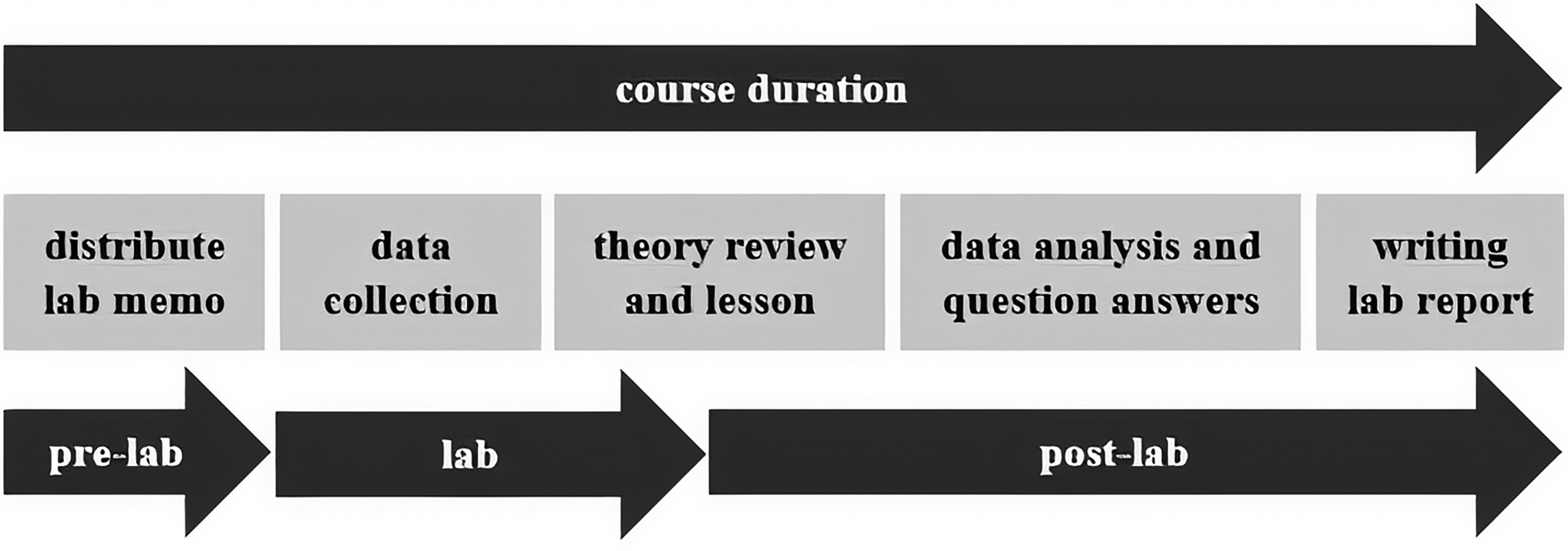
Lab structure.
Later, in the lab, students collect data together. Detailed instructions include how to turn on the electrical and the heating blocks, set the experimental voltages (9 V and then 16V, if time permits), read temperatures along the fin for different values of t using a chronometer. Moreover, students could measure fin dimensions
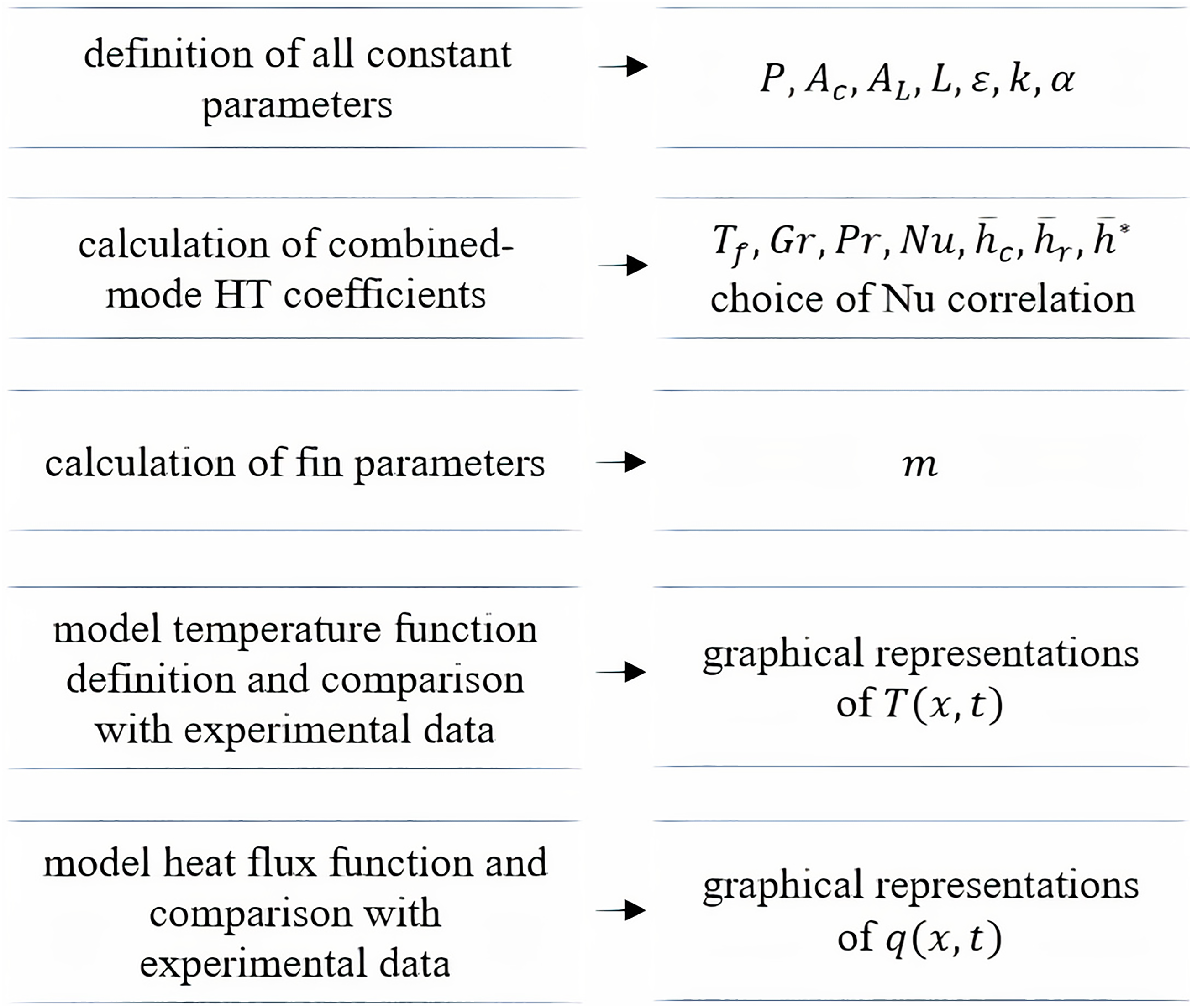
Analysis steps of experimental data.
Moreover, the combined-mode (free-convection and radiation) approach describes appropriately the heat transfer mechanism. Lastly, a comparison between different free-convection Nusselt correlations could allow the students to face the uncertainty of this calculation and make them reflect on the importance of the choice of the best correlation for their system.
Conclusion
The experimental fin device used in this paper led to the creation of an interesting experiment for undergraduate engineering students, which allowed them to develop a better understanding of transient, one-dimensional heat transfer with convection and radiation. The proposed analytical solution fits all experimental data very well and reproduces the temperature profile as well as the total heat flux with a coefficient of determination higher than 0.985. The combined-mode approach made it possible to evaluate the relative predominance of convection with respect to radiation, even if the radiation coefficient seems to be overestimated at lower values of t. The strong agreement between the measured results and the analytical solution, as well as the repeatability of the experiments demonstrates that it might be successfully used to propose to students a variety of interesting case studies over extended surfaces heat transfer. The model could also be used to investigate and compare the influence of some parameters, such as fin conductivity, geometric fin shape or the surrounding fluid properties.
Footnotes
Declaration of conflicting interests
The author(s) declared no potential conflicts of interest with respect to the research, authorship, and/or publication of this article.
Funding
The author(s) received no financial support for the research, authorship, and/or publication of this article
