




Abstract
Research on the relationship between identification factors and musical preference show contradictory results. Some studies do not find relationship between these, while others show that social identification predicts stronger music preference. The present study further delves into that controversy in the understudied context of Electronic Dance Music (EDM). Furthermore, we examine the role of two categories of emotions, namely, vitality (representing energy, joy, and power) and sublimity (representing feelings of transcendence, tranquility, or nostalgia) in the relationship between identification factors and EDM preference. To test these ideas, we conducted two studies, including a correlational survey study with a sample of 222 EDM fans in the Basque Country and a qualitative study using a focus group methodology with 25 members of the same community. Results show that stronger musical identification is associated with preference for EDM only indirectly via vitality emotions and to a lesser degree, sublimity emotions. In contrast, the more negative (and not positive) musical collective self-esteem, the stronger was the preference for EDM, and again this link was explained via mostly vitality emotions. The qualitative study corroborated the existence and acceptance of negative collective self-esteem among EDM fans, an aspect related to the strong stigma generated by the Basque society.
Keywords
Musical preference is a complex, multidimensional phenomenon shaped by diverse factors, including the features of musical genres, social and cultural dynamics, personal characteristics like age or gender, and psychological elements such as emotions, identity, self-esteem, and personality (Carpentier et al., 2003; Chamorro-Premuzik & Furnham, 2007; Schäfer, 2016; Schäfer & Sedlmeier, 2010). Within the field of social psychology, musical identity and self-esteem emerge as two critical predictors of musical preference because such tastes serve to express one’s identity as members of social groups (Frith, 1983; North & Hargreaves, 1999; Shepherd & Sigg, 2015; Tekman & Hortaçsu, 2002). While research has empirically examined the relationship between identification factors and musical preferences, both broadly (Clark & Lonsdale, 2023; Shepherd & Sigg, 2015) and within specific musical genres such as rock music (Gardikiotis & Baltzis, 2010), there remains a significant gap in the research regarding this relationship in the context of Electronic Dance Music (EDM). Thus, the aim of the present study is to analyze the relationship between musical identity and self-esteem in the preference for EDM.
In addition, emotional states have been recognized as potential predictors of musical preference (Swaminathan & Schellenberg, 2015; Xue et al., 2018). However, the specific role of emotions in the connection between identification dynamics and musical preference remains largely unexplored. To address this gap, we examined the role of two distinct categories of emotions commonly associated with experiencing EDM, namely, vitality (representing energy, joy, and power) and sublimity (representing feelings of transcendence, tranquility, or nostalgia; Talamini et al., 2022; Zentner et al., 2008). This study aims to elucidate the explanatory role of these musical emotions in the relationship between identification factors and EDM liking.
Identity, self-esteem, and musical preferences
The relationship between music and social identity is a profound matter. Music embodies symbolic elements of collective identities, allows identification with others through shared action, and fosters the emergence of collective emotions that are present in the processes of identification (Rice, 2007). A person’s sense of identity, derived from their affiliation with social groups, is crucial to their self-concept and well-being (Tajfel & Turner, 1979). According to Social Identity Theory, musical identities serve as a means of belonging and identification within specific musical subcultures. Through this identification, individuals internalize attributes of these groups, which become central components of their self-definition (Hargreaves et al., 2002; North & Hargreaves, 1999; Tekman & Hortaçsu, 2002), enhancing a sense of optimal distinctiveness from other musical subcultures (Abrams, 2009).
The relationship between social identity and musical preference remains a contested topic, as research shows contradictory results. While some studies have not established a significant relationship between social identity and musical preference (Zillmann et al., 1995), others have highlighted the cognitive, affective, and social dimensions of social identity as predictive factors of specific musical preferences, such as a preference for rock music (Gardikiotis & Baltzis, 2010). These findings suggest that certain musical tastes might be more closely intertwined with social identity processes than others (Tekman & Hortaçsu, 2002).
Some studies point to the linkage of factors related to group identification, such as ingroup favoritism, with musical preferences (Bakagiannis & Tarrant, 2006; Lonsdale, 2021; Lonsdale & North, 2009; North & Hargreaves, 1999; Tekman & Hortaçsu, 2002). Other studies indicate that the development of musical preference could be linked to a process of perceived stereotypical similarity, causing musical preferences to be defined in terms of the individual’s self-image (Lonsdale & North, 2017; North & Hargreaves, 1999). Studies suggest that this relationship is particularly relevant among young people (i.e., Clark & Lonsdale, 2023; Lonsdale & North, 2017). Taken together, studies are largely inconclusive, and further research is needed to understand better the link between musical identities and preferences.
The social valuation of a musical subculture can also influence the relationship between the preference for that style and the identification (Baker & Bor, 2008), as perceived stigma might negatively influence group identity and cause distress (Leurent & Ducasse, 2023). In the case of the present research, EDM appears to be associated with a negative stereotype often linked with drug use, violence, and low socio-cultural status, which may explain a negative relationship between musical identity and preference for EDM (Del Amo Castro, 2019; Monopoli, 2021). Thus, the most widespread stereotype of EDM connects it with the consumption of discordant and unpleasant music, to drug use as a form of escape, and to a cultural expression of protest against the social and political status quo (Wagner, 2014).
Importantly, it is necessary to consider the social context and the historical moment when analyzing the relationship between musical identification and musical preference. Continuous social interactions in specific spaces and the creation of a sense of community are necessary elements for the development of a group identity (Kavanaugh & Anderson, 2008). Accordingly, the existence of a community articulated around a musical preference can be expected to contribute to the development of a social identity linked to it.
In relation to collective self-esteem, numerous studies have associated this factor with musical preferences. Musical collective self-esteem refers to how people feel about themselves as members of a social group linked to a specific musical style (M. Rubin & Hewstone, 1998). However, research on the relationship between collective self-esteem and musical preference shows contradictory results. Several studies point to higher levels of collective (or personal) self-esteem among people who listen to rap (Dixon et al., 2009; A. M. Rubin et al., 2001), Black music (North, 2010), and upbeat and mainstream genres (Rentfrow & Gosling, 2003) compared to other musical genres. Likewise, other studies indicate lower levels of self-esteem among people with a preference forheavy metal (Swami et al., 2013) or alternative rock (North, 2010). In contrast, other studies have found no evidence of a relationship between self-esteem and musical preferences (Bodner & Bensimon, 2015; Clark & Lonsdale, 2023; Schwartz & Fouts, 2003; Zillmann et al., 1995).
The contradictory results regarding the relationship between identification factors and musical preference indicate the need for further investigation. In the case of the present research, this relationship will be analyzed in the context of EDM.
The role of emotions
Listening to music is a behavior that influences people’s emotions as it allows them to regulate psychological and physical states (e.g., Groarke & Hogan, 2016; Västfjäll et al., 2012) and contributes to emotional well-being by affective regulation and mood enhancement (Hu et al., 2021; Vigl et al., 2023). Furthermore, listening to music encourages positive moods as they promote pleasurable sensations (Lonsdale & North, 2011), generate positive emotions of inspiration (Ahmad & Rana, 2015), and emotions of self-transcendence such as love and tenderness (Haidt, 2003; Stellar et al., 2017) that orient the self to the world and promote connection with others (e.g., Yaden et al., 2017). In this research, we consider two higher-order factors of musical emotions: sublimity and vitality (Talamini et al., 2022; Zentner et al., 2008). Whereas sublimity encompasses emotions such as transcendence, tenderness, nostalgia, and peacefulness, vitality includes happiness, joyful activation, and power. Given EDM’s energetic and uplifting nature (Solberg & Dibben, 2019), often associated with faster body movements while dancing (Burger & Toiviainen, 2020), these emotional reactions are expected to be highly relevant within the context of EDM, as opposed to the dimension of unease, which comprises sadness and tension.
Several studies indicate a correlation between musical styles and emotions. Slower rhythms typically evoke sublimity-related emotions characterized by lower arousal, such as tenderness (e.g., Balteș & Miu, 2014) or sadness. Faster rhythms tend to elicit vitality-related emotions, that is, high arousal positive emotions such as happiness or feelings of energy and power, as well as occasionally high arousal negative emotions such as fear or anger (Swaminathan & Schellenberg, 2015). However, studies also suggest that individuals tend to experience both sublimity and vitality emotions when listening bothto “groovy” and “non-groovy” music (Bernardi et al., 2018).
Furthermore, studies show that musical preference is partially influenced by the emotions conveyed and evoked by different styles (Su et al., 2022; Swaminathan & Schellenberg, 2015). Generally, there is a preference for happier music styles over sadder styles (Hunter et al., 2008, 2010; Khalfa et al., 2008; Ladinig & Schellenberg, 2012; Thompson et al., 2001), although preferences may vary based on emotional states.
Musical emotions have been rarely studied in the context of EDM. As EDM involves faster rhythms, preference for this genre is expected to be associated with the experience of vitality emotions such as happiness, joy, energy, or fun. Supporting this, a study by Cook et al. (2019) found that preference for electronica/dance music was associated with emotional arousal and positive (but not negative) mood management. However, it is also proposed that EDM may be associated with other positive emotions such as tenderness or transcendence.
Context
The main exponents of EDM, house and techno, originated in Chicago and Detroit in the mid-1980s (Wiltsher, 2016). DJs of Ibiza nightclubs brought the Chicago sound to Ibiza, and the tourist boom among the British spread house to England. Cities like Leeds, Liverpool, Scheffield and, above all, Manchester, became hubs for European house music. The first half of the 1990s saw an explosion of EDM at the European level, with the multiplication of clubs and the creation of festivals such as the Love Parade in Berlin in 1991, and Sonar in Barcelona in 1994 (Kyrou et al., 2006). Thus, an underground subcultural movement linked to club culture emerged (Muggleton, 2005), with fluid and dynamic collective identities typical of neo-tribes (Maffesoli, 1996), embodying aesthetic expressions, beliefs and social behaviors divergent from the mainstream (Jaimangal-Jones et al., 2015)—a scene—where solidarity and group belonging transcended the effect of drug use (Kavanaugh & Anderson, 2008). According to Canosa and Bennett (2021), beyond artistic and cultural aspects, the collective identities linked to EDM carry a countercultural sociopolitical and ideological dimension associated with freedom, environmentalism, and social justice.
In the Basque Country (the Spanish State), Basque Radical Rock (BRR) dominated the music scene of the 1980s and 1990s, serving as a countercultural reference that intertwined aesthetic, artistic, political, and national dimensions (Del Amo Castro, 2019; Delgado & Etxezarreta, 2018). This strong identity built around the BRR meant that the collective identities around EDM were marked by major social, cultural, and national setbacks, and by stereotypes and prejudices about EDM linked to Spanishness and to a working class with a lower sociocultural status. The nationalist left and the armed pro-independence group ETA (Euskadi ta Askatasuna) further reinforced this stigma against EDM, including carrying out bombing attacks against clubs.
Despite these obstacles, a vibrant club culture developed in the Basque Country between the 1990s and the mid-2000s, with the proliferation of discotheques and small clubs with EDM. Trance, house, and techno sounds were present for about 10 years in Basque clubs like Itzela, Pagoa, Ku, Konplot, Txitxarro, Jazzberri, Was, Nice, or NON. From the 2000s onward, this club culture progressively declined, with the gradual closure of discotheques. Today, there are only a few places that regularly offer EDM sessions (e.g., Sonora, Ugaondo, Dabadaba), and events and festivals organized by companies and social agents (e.g., Dantz Festival).
Beyond the work of Del Amo Castro (2019), there is a lack of research on EDM as a sociocultural movement in the Basque context. Therefore, alongside analyzing the relationship between identification factors, emotions and musical preference for EDM, we examine key determinants of EDM in the Basque Country, focusing on the stigma and stereotypes attached to EDM, and to what extent EDM constituted a sociocultural space with a collective identity.
Present research
The current research was carried out using a twofold mixed-method approach. On one hand, a correlational survey study was conducted with a sample of EDM fans in the Basque Country (Study 1) to analyze the relationship between musical identification-related processes (namely, musical identification and musical collective self-esteem), musical affective reactions including both sublimity and vitality emotions, and EDM preference. Study 2, with a qualitative approach to EDM in the Basque Country as a sociocultural movement, was carried out using focus group methodology to examine the stigmatization of EDM and the characteristics of the collective identity associated with EDM in wasBasque society. The current research was approved by the Ethics Committee for Research with Human Beings, their Samples and their Data of the University of the Basque Country (CEISH-UPV/EHU)–Resolution code: M10_2023_023. Proper informed consent processes were carried out in both studies.
Study 1
Participants and procedure
In Study 1, 222 electronic music enthusiasts filled in a web-based questionnaire (74 women, 143 men, and five non-binary participants). The questionnaire was distributed via social media (mainly through Instagram and e-mail) by Dantz, an electronic music lab in the Basque Country, between April and July 2023, within its community. The sample included 79 individuals aged between 18 and 30, 107 aged between 31 and 45, and 36 over 46. In terms of education, three participants had no formal education, 17 had primary and 87 had secondary education, and 67 had a graduate and 48 a post-graduate degree. Most participants (142) were employed full-time, 47 held temporary positions, 28 were unemployed, four were receiving an allowance, and one was engaged in household care.
Measures
Participants completed an online questionnaire that required approximately 15 min to complete. This questionnaire was organized into several sections, each focusing on a variety of topics such as musical style preferences, identity-related processes, emotional responses to music, motivations for listening to EDM, values, and several other measures.
Musical preferences for electronic music
Participants were asked to indicate the extent to which they like electronic music and are fans of electronic music on a single 7-point item (ranging from 1 = strongly disagree to 7 = strongly agree).
Musical identification
To measure EDM identification, participants were asked to respond to five questions about their connection to electronic music on a 5-point scale (1 = strongly disagree, 5 = strongly agree), covering various facets of musical identity (adapted from Gardikiotis & Baltzis, 2010). The first two items reflected the cognitive aspect: identity centrality (adapted from Ellemers et al., 1999, “The music I listen to is an important reflection of who I am” and “Listening to music is an important part of my self-image”). The following two items addressed the affective dimension of self-identification (adapted from Mael & Ashforth, 1992, “If someone praises the music I listen to, I take it as a personal compliment” and “If someone criticizes the music I listen to, I take it as a personal insult”). The last item measured the social aspect of self-identification (adapted from Doosje et al., 1995, “I believe I am a typical member of the group of people who listen to the same music as I do”). All five items formed a reliable measure of musical identification (α = .67).
Collective self-esteem
To assess participants’ evaluation of their musical identity linked to electronic music, we examined two sub-dimensions of the Collective Self-Esteem Scale (Luhtanen & Crocker, 1992): membership self-esteem, the extent to which one considers oneself a valuable member of the electronic music community (4 items, for example, “I am a worthy representative of electronic music enthusiasts”) and private collective self-esteem, reflecting personal valuation of the social group (4 items, for example, “Overall, I am happy to belong to the electronic music community”). Participants responded to all items on a 7-point scale (1 = strongly disagree, 7 = strongly agree). Measurement model testing led us to retain four items only (see Results section for details), which successfully loaded on a single dimension and were used to create a collective self-esteem factor (α = .86). 1
Musical emotions
To assess the emotional responses elicited by EDM, we used a 9-item scale composed of the general first-order factors of the Geneva Emotional Music Scale (GEMS-9, Zentner et al., 2008). Participants rated the extent to which electronic music evoked different groups of emotions on a 5-point scale ranging from 1 = strongly disagree to 5 = strongly agree. The scale comprised nine categories of emotion, with sub-items presented simultaneously: happiness (“Happiness”), transcendence (“Transcendence, inspiration”), tenderness (“Tenderness, sensuality, love”), nostalgia (“Nostalgia, melancholia”), peacefulness (“Tranquility, calm, serenity”), power (“Strong, energetic”), joyful activation (“Joy, amusement, stimulation”), tension (“Tense, nervous, aggressive”), and sadness (“Sadness, sorrow”). In this study, we concentrated on two second-order factors identified by Talamini et al. (2022) and Zentner et al. (2008): sublimity (four items, transcendence, tenderness, nostalgia, calmness) and vitality (three items, happiness, power, and joy). These emotional reactions are considered highly relevant within the EDM context, contrasting with the dimension of unease emotions (Burger & Toiviainen, 2020; Solberg & Dibben, 2019). Hence, while the unease (two items, tension and sadness) was measured as part of the complete GEMS-9 scale, we did not have specific predictions regarding the experience of unease in response to EDM and therefore did not consider it further in this research. The sublimity and vitality dimensions showed satisfactory internal consistency (α = .75 and α = .81, respectively).
Analytical strategy
Descriptive statistics—including means and standard deviations—and correlations were derived from SPSS, utilizing the composite scores of multi-item constructs. Reliability for all scales was determined using Cronbach’s alpha (α), and the significance threshold was set at p < .05. Structural equation modeling (SEM) was conducted using Mplus version 8 to test hypotheses. This analysis addressed missing data with the full information maximum likelihood (FIML) method. Initially, a measurement model was tested, incorporating latent factors for musical identification, musical collective self-esteem, sublimity emotions, and vitality emotions. We used a cutoff point of .30 to retain factor loadings in the model. Subsequently, a mediation SEM model was constructed. This model identified musical identification and musical collective self-esteem as predictor variables, sublimity emotions and vitality emotions as mediators, and EDM preference as the dependent variable. Mediators were allowed to covary, and all constructs were treated as latent, except for EDM preference, which was measured using a single item. Model fit was evaluated using conventional criteria: comparative fit index (CFI) and Tucker–Lewis index (TLI) values of .90 or above, and a root mean square error of approximation (RMSEA) close to .06 (Hu & Bentler, 1999). Confidence intervals (CIs) for all effects, including indirect effects, were determined using bias-corrected bootstrapping with 10,000 resamples. An indirect effect was deemed significant if its CI did not include zero.
Our model was estimated with a total of 16 items. Using a sample size calculator for Structural Equation Models, we determined that a minimum sample size of 209 participants is required to detect effect sizes of .25 in a model with 16 observed variables and four latent factors. Therefore, our sample size is sufficient for testing this model (Soper, n.d.).
The analyses were not pre-registered. The data and the Mplus and SPSS codes are openly available via the OSF project website (https://osf.io/zjyed/). The complete version of the questionnaire in English and Spanish is available on the same website.
Results
The measurement model
The measurement model with five latent constructs, musical identification, two facets of musical collective self-esteem (membership and private), sublimity emotions, and vitality emotions, demonstrated a poor overall fit to the data, χ2(df) = 347.78 (160), p < .001, CFI = .86, TLI = .85, RMSEA = 0.07, 90% CI = [0.06, 0.08]). Notably, factor loadings for four items within the collective self-esteem constructs, particularly those that were negatively worded, fell below .30 and were largely statistically insignificant. The removal of these problematic items substantially improved the model’s fit: χ2(df) = 171.64 (94), p < .001, CFI = .94, TLI = .93, RMSEA = 0.06, 90% CI = [0.05, 0.08]).
Further examination revealed a high correlation (r = .73) between the two dimensions of musical collective self-esteem, suggesting considerable overlap. To address potential issues in regression models containing multiple predictors, we combined these two dimensions into a single factor. This adjustment slightly decreasedthe model fit: χ2(df) = 222.71 (98), p < .001, CFI = .91, TLI = .88, RMSEA = 0.08, 90% CI = [0.06, 0.09]), though the fit remained within acceptable thresholds. Consequently, we opted to proceed with the main analyses using this revised model.
Descriptive findings
Mean scores and standard deviations for all studied variables, along with their bivariate correlations, are presented in Table 1.
Means, Standard Deviations, and Correlations With Confidence Intervals (Study 1).
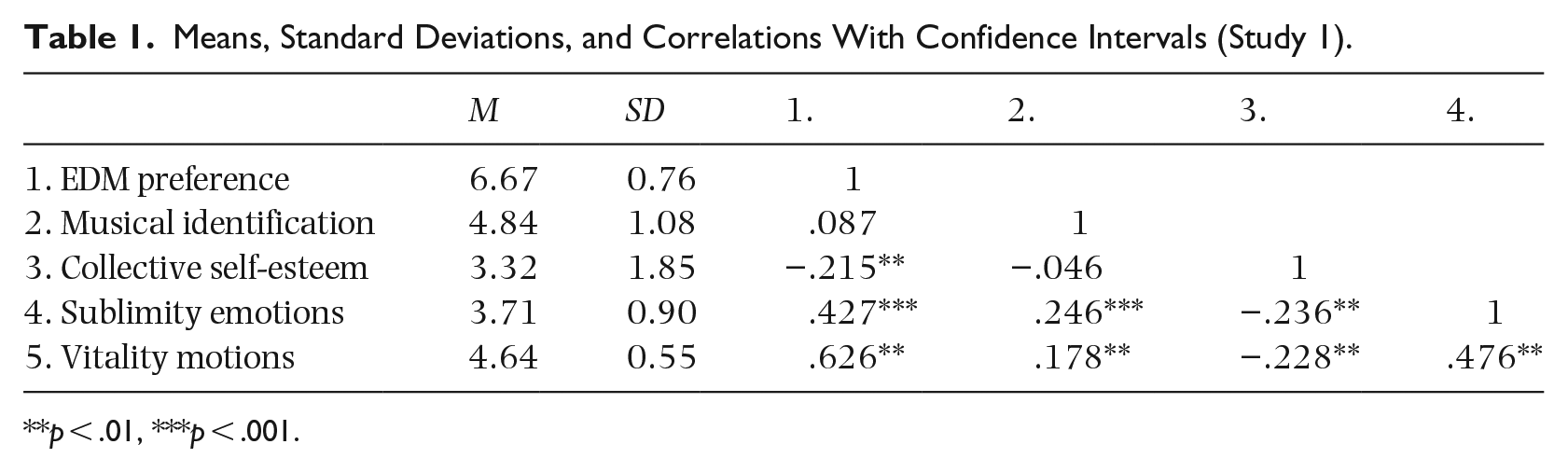
p < .01, ***p < .001.
Structural equation modeling: musical identification, musical collective self-esteem, and EDM preference via sublimity and vitality emotions
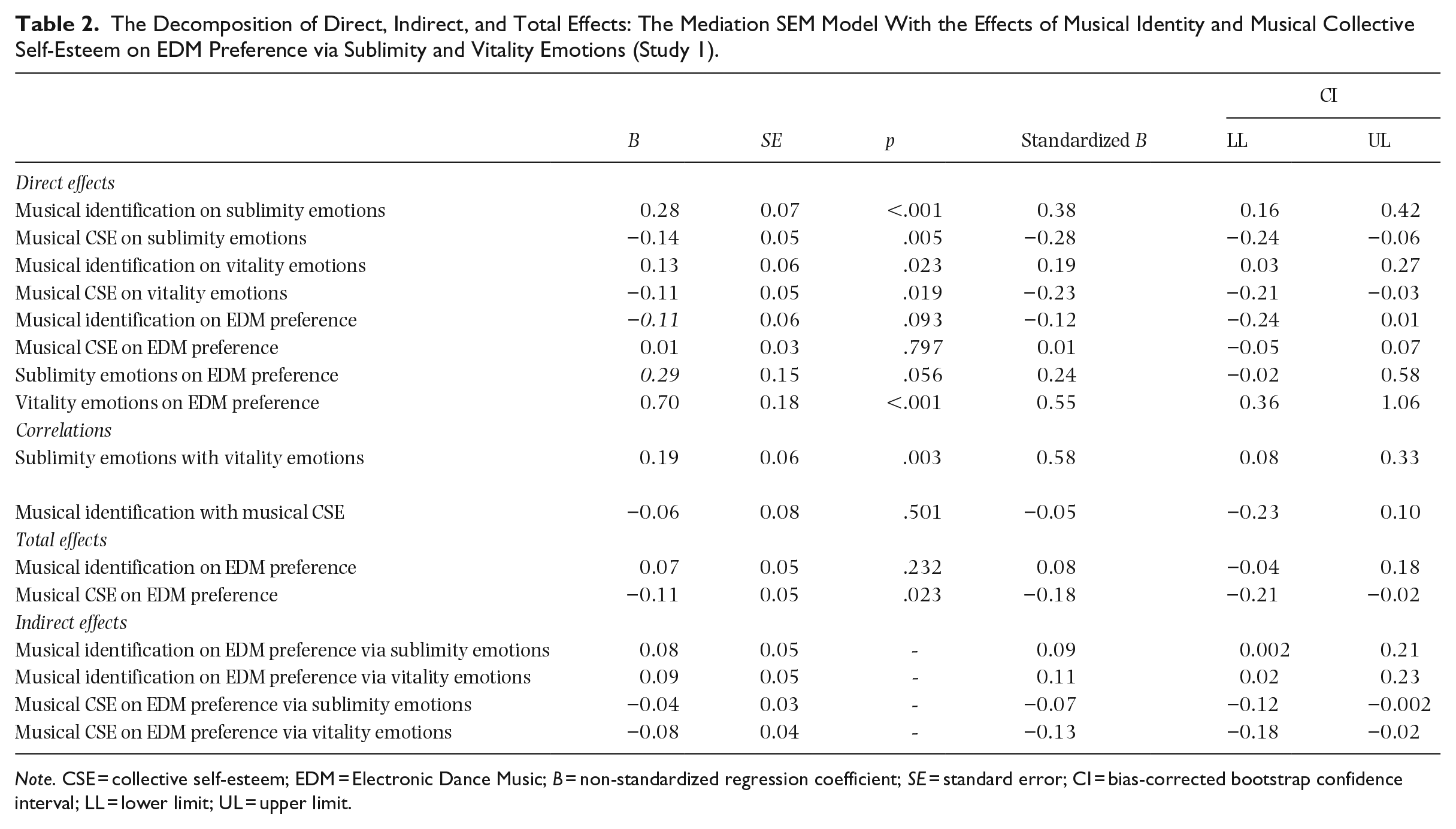
Regression results. We estimated a SEM model to test the relationship between musical identification and musical collective self-esteem, sublimity and vitality emotions, and EDM preference. Table 2 presents the decomposition of unstandardized and standardized direct and total effects. Figure 1 shows the standardized regression coefficients for the main paths. The model achieved satisfactory overall fit, χ2(df) = 247.02 (110), p < .001, CFI = .91, TLI = .88, RMSEA = .07, 90% CI = [0.06, 0.09]. Sublimity and vitality were positively correlated.
The Decomposition of Direct, Indirect, and Total Effects: The Mediation SEM Model With the Effects of Musical Identity and Musical Collective Self-Esteem on EDM Preference via Sublimity and Vitality Emotions (Study 1).
Note. CSE = collective self-esteem; EDM = Electronic Dance Music; B = non-standardized regression coefficient; SE = standard error; CI = bias-corrected bootstrap confidence interval; LL = lower limit; UL = upper limit.
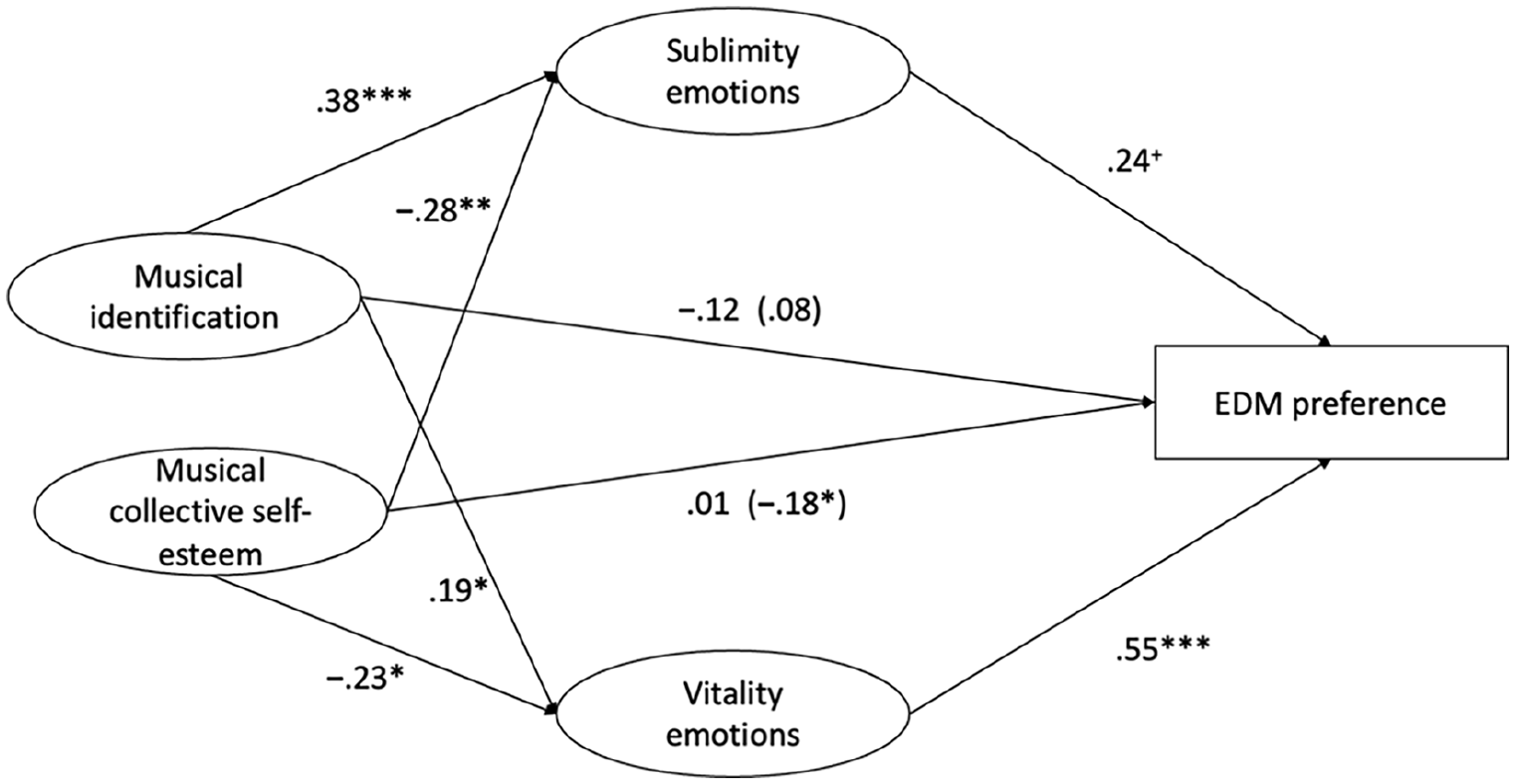
The Mediation SEM Model With the Effects of Musical Identity and Musical Collective Self-Esteem on EDM Preference via Sublimity and Vitality Emotions (Study 1).
Results showed that the total effect of musical identification on EDM preference was not statistically significant, whereas the negative relationship between musical collective self-esteem and EDM preference was significant. Direct effects of both musical identification and musical collective self-esteem on EDM preference were not statistically significant. Musical identification and collective self-esteem had significant relationships with sublimity and vitality emotions, with the former being positively associated and the latter negatively associated with both predictors. Moreover, vitality emotions was the only significant direct predictor of EDM preference, while the association between sublimity emotions and EDM preference did not achieve statistical significance (view Table 2).
Indirect effects. Table 2 shows indirect effects. Statistically significant positive indirect effects (with CIs excluding zero) were found for musical identification on EDM preference through both sublimity and vitality emotions. Musical identification was associated with stronger preference for EDM through heightened experiences of vitality and sublimity emotions. Regarding musical collective self-esteem, a significant negative indirect effect was observed through both vitality and sublimity emotions. This suggests that lower collective self-esteem is associated with a stronger preference for EDM, mediated by more intense experiences of vitality and sublimity emotions. However, in both cases, indirect effects via sublimity emotions were small and should be interpreted cautiously.
Study 2
Study 2 aimed to delve into the social identity linked to EDM and the sociocultural context in which it occurred, especially in relation to the social stigma about EDM. The Focus Group technique was used, a methodology that brings together individuals with direct experience on the topic of study to discuss and deepen the research topic from their personal experiences (Korman, 1986). Focus groups are an ideal tool for deepening the concrete meaning of quantitatively measured variables through situated interpretation (Delli Carpini, 1994).
Method
Participants and procedure
The qualitative study involved 25 people linked to EDM, aged between 22 and 48, with an average age of 34, including five DJs, five members of cultural collectives, and 15 EDM fans (11 women and 14 men). Participants were selected directly through Dantz-Electronic Music Lab, ensuring a broad representation of the EDM community. Dantz management contacted 40 potential participants from their databases, of which 25 responded affirmatively to participate.
Data collection took place through a structured dialogue meeting in five simultaneous focus groups, each consisting of five individuals. The meeting was held on August 21, 2023, in Donostia/San Sebastián, as part of the Dantz Festival. The session lasted 3 hr and 30 min and was structured in three phases. In the first phase, lasting 15 min, the session’s objective and procedure were explained. The second phase involved the simultaneous focus groups for 105 min, while the third phase consisted of a 75-min plenary session. At the plenary session, a spokesperson from each focus group presented the main ideas collected, followed by a collective dialogue. Moderators led each focus group, guiding discussions and ensuring a productive dialogue, based on the following questions: (a) the identity of EDM from its birth to the present in Basque Country and (b) Basque society’s attitude toward EDM. In addition, each group moderator collected the main ideas in a portfolio, with the objective of generating group consensus on the elements of analysis. Similarly, during the plenary session, group moderators collected the main ideas presented by the participants.
After the meeting, the research team drafted a document based on the notes collected during the focus groups and the ideas gathered during the plenary discussion. This document was returned to the participants for feedback. Only three brief contributions were received.
Analytical strategy
Data were analyzed using qualitative content analysis, based on two a priori categories: (a) stereotypes and stigmatization surrounding EDM, and (b) identity processes within EDM. Downe-Wambolt (1992) points out that the aim of this analysis is not to provide a detailed account of the positions presented by the participants, but to relate the results to the context, in this case, EDM in the Basque Country.
Through this qualitative analysis, the data were coded into thematic categories reflecting participants’ perceptions, experiences, and opinions about the psychosocial processes associated with EDM. In the domain of stereotypes and stigmatization, the emerging themes were (a) the social origins of stereotypes and stigma, (b) the political use of electronic music in the context of the Basque political conflict, (c) the characteristics of stereotypes and stigma, and (d) social hypocrisy regarding the attribution of drug use to EDM. In relation to EDM identity, the emerging themes were (a) the defining characteristics of EDM identity, (b) the construction of EDM identity through social interaction, and (c) the erosion of EDM identity with the decline of discotheques and club culture.
Results
Stereotyping and stigmatization of EDM
EDM has been subjected to strong stigmatization in the Basque Country during the period in which the club culture spread. According to testimonies, the stigmatization came both from conservative hegemonic social sectors and from the dominant counter-hegemonic sector, politically linked to the nationalist left, and culturally associated with BRR. One of the participants stated: “We come from a time where there was a high politicization of Basque society, and electronic music was especially politicized.” Testimonies indicate that the political conflict in the Basque Country influenced EDM context, as the pro-independence left accused EDM of being an obstacle to the struggle for the independence.
In addition, the obtained testimonies suggest that the stigma about EDM was built under a stereotype that associated EDM with drug use, low cultural and educational level, Spanish-speaking social and linguistic homogeneity, hedonistic individualism and depoliticization, and the manifestation of aggressive behavior. One testimonial indicated: It was projected that only Spanish was spoken, and it was a lie, in the places with more Basque-speaking people Basque was spoken; that only people without studies went there, and it was a lie, there were many students, what was said about the culture of the club was totally false.
In relation to drug use, the testimonies highlight the perceived hypocrisy of Basque society, as drug use is common in club culture, but it is also present in all recreational and festive spaces, both in the hegemonic ones and in those linked to the BRR. In this regard, one participant noted: “Basque society has always been very hypocritical about drugs. The punks, at rock concerts, in the posh discos, everywhere, there have always been drugs.”
Another interesting contribution was the collective reflection on the type of drug and the atmosphere of the clubs. It is pointed out that in the Basque Country a transformation of the atmosphere in the club culture took place with the introduction of cocaine, and the substitution of ecstasy for cocaine as the main drug of choice. These ideas are supported with participant’s statements such as the following: “It is true that drug use was a major issue. But it is also true that the decline of club culture in the Basque Country, and the beginning of the end of discotheques, is linked to the change in drug consumption, from ecstasy to cocaine.”
The Basque EDM identity
The results point to the existence of a collective identity linked to the EDM during the period when there was a notable club culture until the mid-2000s. In contrast to that stereotype and the characteristics of stigma described above, the results point to the idea that EDM was constructed as a diverse, inclusive, and vindictive social space, where fun was linked to the values of freedom and equality. One of the participants said: “The world of electronica has always been a vindicative, inclusive and sexual freedom space, a comfortable space for the LGTBI collective. It was a space of freedom, multicultural, non-discriminatory, opposed to prejudice and the stereotype of aggressive.”
Furthermore, participants emphasized that, around the discotheques, a space of continuous social interaction developed between groups of people who were weaving bonds of mutual knowledge, sociocultural affinity, and solidarity, where a “clubber” social identity was elaborated. One participant noted: “With the decline of the discotheques all the diversity dwindled, the atmosphere was cut, but we can say that the existence of a social tribe of partygoers was recognized, a group of people who identified with the club culture during the 90s and 2000s.”
However, the club culture in the Basque Country suffered a sharp decline since 2000, with the gradual closure of the most referential discotheques and the consequent disappearance of a form of collective identification linked to EDM. At present, there are only a few discotheques where EDM can be danced to every weekend or where EDM sessions are regularly scheduled. As a result, there are limited opportunities for sustained social interaction capable of fostering a social identity linked to EDM. Testimonies point out that the decline of club culture in the Basque Country parallels trends observed throughout Spain, driven by cultural shifts such as the massification of urban music, the influence of social media, and the displacement of club culture by festivals.These shifts affect all musical styles and set trends in music, consumption, and leisure. One of the participants indicated: “Currently there are no referential places for electronic music, there are no clubs, but there are not enough people who identify themselves with club culture for them to be viable. There has been a change of mentality.”
Finally, it is pointed out that club culture has limited visibility in the current Basque music scene. EDM in the Basque Country is now defined by new cultural and recreational spaces, the recovery of the “clubber” audience and the incorporation of new publics. These developments are taking place through new formats—held in daytime hours and outdoor venues—that allow attendance by younger people and families with children, thus promoting intergenerational connection and expanding participation in electronic music events beyond the party scene. The testimonies support this notion: “The change of mentality is also necessary to move towards daytime spaces, to occupy new cultural spaces, to seek diversity of audiences, to give it an intergenerational character. So, it’s good to do daytime activities, outdoors, for heterogeneous audiences.”
Discussion
Research on the relationship between identification factors (social identity and collective self-esteem) and musical preference show contradictory results. Some studies do not find a relationship between social identification and music preference (Zillmann et al., 1995) and others show that social identification predicts stronger music preference (Gardikiotis & Baltzis, 2010; Tekman & Hortaçsu, 2002). The present study delved into that controversy. Our findings pointed out that musical identification and preference for electronic dance music were not significantly associated. Yet, feeling identified with EDM community was linked with preference for this music genre indirectly via experienced emotions. To an extent, this identity was linked to positive emotional experiences when listening to EDM, especially vitality emotions and to a lesser extent sublimity emotions (the effect sizes for sublimity emotions were small). Thus, our research overall supports existing data that suggest that EDM is energetic and uplifting in nature (Burger & Toiviainen, 2020; Solberg & Dibben, 2019), thus stimulating emotions such as feeling energized and joyful.
Regarding collective self-esteem, studies associate preference toward certain musical styles with high levels of self-esteem (e.g., Clark & Lonsdale, 2023), whereas other investigations report links with low levels of self-esteem (North, 2010; Swami et al., 2013). Still others find no relationship between the two (e.g., Bodner & Bensimon, 2015; Clark & Lonsdale, 2023). In the present case, the results point to a negative correlation between collective self-esteem and EDM preference, along with a negative indirect effect through musical emotions, again, especially vitality emotions. This is a surprising finding, yet it suggests that EDM fans generally consider that their community is negatively perceived within a broader society, as the perception and internalization of negative stereotypes and stigma is a factor associated with lower collective self-esteem (Herek et al., 2009; Longares et al., 2016; Pharsadanishvili & Kitiashvili, 2023). Still, this negative collective self-view does not prevent them from experiencing positive emotions when listening to EDM and hence developing a strong preference for this genre.
Regarding Study 2, these contradictory results suggest two reflections. First, from a constructivist perspective, sustained social interaction in specific places is essential for building shared meanings and fostering a sense of community and belonging – key elements in the formation of social identity (Kavanaugh & Anderson, 2008; Luckmann, 2008; Obst & White, 2007; O’Connor et al., 2015). Our qualitative data suggest that, following the disappearance of club culture and the broader EDM cultural movement in the Basque Country, there are no longer relevant spaces in which a sense of community and belonging, and thus a social identity linked to EDM, can be developed.
Second, according to the threatened identity perspective, the degree to which culturally dominant groups devalue a stigmatized group can determine its collective self-esteem (Twenge & Crocker, 2002), such that stigmatization may lead to lower self-esteem under certain conditions (McCoy & Major, 2003). Under this premise, the social stigma surrounding EDM in the Basque Country was constructed from all dominant sociopolitical sectors, both hegemonic and counter-hegemonic (as is the case of the Basque radical rock). Moreover, the stigmatization emerged in the midst of a deep political conflict marked by strong social polarization and political violence. ETA, an armed Basque nationalist separatist organization in the Basque Country active between 1959 and 2011, carried out several attacks against discotheques, which positioned EDM at the center of the political conflict and framed it as part of the state’s strategies against the independence movement (Del Amo Castro, 2019). Thus, we consider that the context of intense stigmatization of the EDM may be a determinant factor in explaining the low levels of collective self-esteem observed among EDM fans, and consequently, the contradictory results regarding the relationship between identification factors and preference for EDM.
Limitations
While our research yields promising results, it is crucial to recognize its limitations to guide future studies. One notable constraint is the cross-sectional design of our data, which hinders our ability to infer causality. For instance, musical preferences or positive emotional encounters with EDM might bolster social identity processes. Nonetheless, our model aligns with previous conceptualizations that position social identity as a predictor of musical preference. Furthermore, our assessment of collective self-esteem could be enhanced. Through confirmatory factor analyses, we were limited to retaining only four items to establish a reliable measure of this construct. Future research should incorporate more refined measures of collective self-esteem.
Finally, while our findings offer valuable insights into the dynamics within the followers of the Dantz collective in the Basque Country, the size of the sample does not allow us to generalize the results to the Basque population as a whole and the potential limitations regarding the generalizability of our results to other cultural contexts should be acknowledged. The prevalence and significance of EDM may vary across different regions and cultural landscapes. For instance, in countries like the United Kingdom or Germany, EDM culture may hold a more prominent and entrenched position within society, influencing social identity processes to a greater extent than observed within the context of the Basque Country. Future research should aim to replicate our findings in diverse cultural settings.
Conclusion
This research examined the relationship between identification factors (identity and collective self-esteem), vitality and sublimation emotions, and affinity for EDM. Previous studies present conflicting findings: some suggest a positive relationship between musical identification and EDM preference (Gardikiotis & Baltzis, 2010), with differences across musical styles (Tekman & Hortaçsu, 2002), while others note no significant relationship (Zillmann et al., 1995). Consistent with the latter results, our results indicate no direct relationship between musical identity and EDM preference and a negative association between collective self-esteem and EDM preference, but we observed indirect effects through emotions, confirming that emotions significantly contribute to the development of musical preferences (Bernardi et al., 2018; Swaminathan & Schellenberg, 2015). Specifically, vitality emotions emerged as crucial correlates of EDM preference.
It is crucial to situate our findings within the specific context (Kavanaugh & Anderson, 2008), namely, the Basque reality. In this setting, EDM has faced a strong stigmatization, both by hegemonic and countercultural sectors (Del Amo Castro, 2019). Moreover, the vibrant club culture present during the 1990s and 2000s has disappeared, resulting in the lack of real spaces for social interaction fostering a positive group identity. These contextual elements may help elucidate the limited potency or negative role of identity dynamics in predicting preference for EDM.
Footnotes
Acknowledgements
The collaboration of Dantz-Laboratory of Electronic Music Projects and Cultural Branding, and especially of its director, Jokin Telleria, has been fundamental to carry out this research.
Data availability statement

Declaration of conflicting interests
The authors declared no potential conflicts of interest with respect to the research, authorship, and/or publication of this article.
Funding
The authors disclosed receipt of the following financial support for the research, authorship, and/or publication of this article: M.B. was funded by the Ramón y Cajal Program, Grant Number: RYC2021-032887-I financed by MCIN/AEI/10.13039/501100011033 and European Union Program NextGenerationEU/PRTR and supported by the Basque Government (Consolidated Group “Culture, Cognition, and Emotion”; Grant Number: IT1598-22).
Ethical approval and informed consent statements
The current research has been approved by the Ethics Committee for Research with Human Beings, their Samples and their Data of the University of the Basque Country (CEISH-UPV/EHU)–Resolution code: M10_2023_023. Proper informed consent processes were carried out in both studies.