




Abstract
Previous research suggests there may be links between people’s self-esteem and their musical preferences, although this evidence is inconsistent and inconclusive. The present study aimed to reexamine these links using measures of collective self-esteem, while also taking into account factors that are likely to moderate these links (i.e., age, gender, and personality). One hundred thirty-nine young adults completed an online questionnaire assessing their musical preferences, collective self-esteem, and personality. Participants’ musical preferences were found to be linked to their self-reported collective self-esteem. When controlling for the effects of age, gender, and personality, scores on the private collective self-esteem subscale were found to positively predict preference for “intense and rebellious” music (i.e., hard rock, heavy metal, punk). Scores on the importance to identity subscale, however, were found to negatively predict participants’ preference for “reflective and complex” music (e.g., blues, classical music, folk). These findings suggest that collective self-esteem might play a role in how our musical preferences develop and offer further evidence for the idea that our music preferences are somehow linked to our sense of identity.
The links between an individual’s musical preferences and their sense of identity have long been assumed in popular culture and are arguably now a part of modern folk psychology. Most notably, Simon Frith (1983) suggested that “all adolescents use music as a badge” (p. 217) as a means to express and define their self-identity and group membership. Research has found evidence to suggest that musical preferences might develop according to a process of self-to-stereotype matching (Lonsdale & North, 2017; North & Hargreaves, 1999) where music genre preferences develop according to the relative correspondence between an individual’s own self-image and the stereotypes they hold about the music fans of different music genres. When asked directly about their reasons for listening to music, it is evident that adolescents themselves regard music as a means “to create an impression with other people” (North et al., 2000). A number of studies have also found that people exhibit in-group bias toward those who share their musical preferences (e.g., Bakagiannis & Tarrant, 2006; Lonsdale, 2021; Lonsdale & North, 2009; North & Hargreaves, 1999; Tekman & Hortaçsu, 2003). Taken together, these findings support the idea that people regard their musical preference as a social badge of group membership that is likely to contribute to their sense of social identity.
Social identity theory posits that much of an individual’s self-concept is derived from their membership to particular groups (Tajfel & Turner, 1986). People seek to categorize themselves and others to better understand the social environment and their place in it. Individuals can be assigned to one of two groups: the in-group (i.e., the group that they themselves belong to) or the out-group (i.e., groups that they do not belong to); it is widely believed that intergroup prejudice and discrimination may be rooted in this simple binary distinction (e.g., Abrams & Hogg, 2010; Allport, 1954; Hamilton, 1981; Tajfel, 1969, 1978, 1982; Tajfel et al., 1971; Tajfel & Turner, 1986).
According to social identity theory, group identification is an important source of self-esteem. Indeed, individuals are expected to seek to maintain or enhance their self-image through positive evaluations of the in-group (i.e., in-group favoritism) or negative evaluations of the out group (i.e., out-group derogation). Studies have found that displays of in-group favoritism and out-group derogation can both lead to increases in self-esteem (Branscombe & Wann, 1994; Verkuyten & Hagendoorn, 2002). Similarly, there is also evidence to suggest an individual’s self-esteem may be reduced when a positive group identification is threatened, for example, through discriminating against out-groups that do not pose a threat (Branscombe & Wann, 1994) or if the in-group norm is anti-discriminatory (Iacoviello et al., 2017). This link between self-esteem, social identity, and intergroup discrimination is often referred to as the “self-esteem hypothesis.” Given the suspected links between social identity and group membership, it is perhaps reasonable to assume that self-esteem might play a role in the development of people’s musical preferences.
The relationship between music preference and self-esteem has received some, albeit limited, attention in empirical research. For example, several studies have discovered that participants who like heavy metal (Arnett, 1991, 1992; Swami et al., 2013) and “alternative rock” (North, 2010) tend to report lower self-esteem than those who do not, whereas rap music fans have been found to have significantly higher self-esteem than those who preferred other music genres (Rubin et al., 2001), and watching rap music videos has also been found to be positively associated with increased collective self-esteem among African American participants (Dixon et al., 2009). Similarly, liking for “music of black origin” (North, 2010) and upbeat and conventional genres (Rentfrow & Gosling, 2003) have been found to be positively associated with self-esteem. However, it is important to note that the links observed between participants’ self-esteem and their musical preferences are far from straightforward.
There are also a number of studies which have found no evidence of a link between self-esteem and musical preferences (e.g., Bodner & Bensimon, 2015; Schwartz & Fouts, 2003; Zillmann et al., 1995). Indeed, Shepherd and Sigg (2015) found no evidence of any association between self-esteem and music preference when studying their sample of university students as a whole. However, a different pattern emerged when men and women were analyzed separately and the self-esteem measure was divided into two subscales (i.e., self-competence and self-liking). For male students, there was a negative correlation between scores on the “self-liking” subscale and preference for “Reflective/Complex” music (e.g., blues, jazz, classical, and folk). Whereas, among female students, negative correlations were found between self-liking and preference for both Energetic/Rhythmic (e.g., dance, rap, and funk) and Upbeat/Conventional music (e.g., pop, country, and soundtracks). Likewise, Arnett (1991, 1992) found no evidence of a link between musical preferences and self-esteem among boys, whereas girls who preferred hard rock/heavy metal reported significantly lower self-esteem than girls who liked other kinds of music. On the basis of this brief review, it is clear that research findings concerning the links between self-esteem and musical preference have been inconsistent and inconclusive, and as such this topic warrants further investigation.
The present study
The research evidence concerning the possible links between music preference and self-esteem is far from conclusive. A number of studies have found clear patterns of association (e.g., Dixon et al., 2009; North, 2010; Swami et al., 2013), while some have only found associations among a particular subset of participants (e.g., Arnett, 1991, 1992; Shepherd & Sigg, 2015) and several others have found none (e.g., Bodner & Bensimon, 2015; Rentfrow & Gosling, 2003; Schwartz & Fouts, 2003; Zillmann et al., 1995). The present study aimed to reexamine the links between music preference and self-esteem in the light of these inconsistent and conflicting findings. There are arguably several different reasons as to why previous research has failed to establish a clear link with self-esteem; chief among these is the measure used to assess participants’ self-esteem.
There are two main types of self-esteem: personal and social self-esteem (Rubin & Hewstone, 1998). This distinction reflects how people feel about themselves as either an individual or as a group member. In almost all cases, studies investigating the link between musical preferences and self-esteem (e.g., Arnett, 1991; 1992; North, 2010; Rentfrow & Gosling, 2003; Shepherd & Sigg, 2015; Swami et al., 2013) used the same measure of personal self-esteem (Rosenberg, 1965); this seems to ignore the links widely thought to exist between musical preferences, group membership, and social identity. If musical preference is a badge of membership and social identity (Frith, 1983; North & Hargreaves, 1999), it would therefore be reasonable to assume that an individual’s social self-esteem may exert a greater role in determining their musical preferences than their personal self-esteem. The present study aimed to address this apparent mismatch by employing a measure of social self-esteem (Luhtanen & Crocker, 1992).
Musical preferences are unlikely to be the result of self-esteem alone, but rather a product of a complex interplay of multiple factors. For instance, it would appear that gender moderates the relationship between music preference and self-esteem (Arnett, 1991, 1992; Shepherd & Sigg, 2015). Nevertheless, the impact of gender on the relationship between musical preference and self-esteem has received little consideration in research. This is particularly surprising given the gender differences observed when researching self-esteem (Bleidorn et al., 2016; Magee & Upenieks, 2019; Maôano et al., 2004; Quatman & Watson, 2001; Shepherd & Sigg, 2015) and musical preference (Colley, 2008; North, 2010). Likewise, studies on this topic have failed to consider the influence of participants’ age, which is also surprising given that previous research has shown that musical preference (Bonneville-Roussy et al., 2013, 2017; Greasley & Lamont, 2006; Hunter et al., 2011; North, 2010) and self-esteem (Bleidorn et al., 2016; Dietz, 1996; Orth et al., 2010) are both likely to change with age. It would therefore seem essential to take both gender and age into account when studying the links between self-esteem and music preference.
A plethora of studies have also demonstrated that there is a link between peoples’ musical preferences and their personality (e.g., Dollinger, 1993; Dunn et al., 2011; Greenberg et al., 2016; Langmeyer et al., 2012; Nave et al., 2018; Rawlings & Ciancarelli, 1997; Rentfrow et al., 2011; Rentfrow & Gosling, 2003). For example, extroversion has been linked to preference for energetic and rhythmic music (e.g., dance music), while agreeable and neurotic individuals have been found more likely to prefer upbeat music (Langmeyer et al., 2012). Studies have also reported links between personality traits and self-esteem. For instance, Robins et al. (2001) found that individuals with high self-esteem tended to be more emotionally stable, more extraverted, and more conscientious than those with low esteem—a pattern which was found to be invariant across age, sex, and ethnicity. Despite these documented links, the possible impact of personality has received no acknowledgment in previous research concerned with the relationship between musical preferences and self-esteem; the present study will address this oversight.
Evidently, there is significant overlap between musical preference, self-esteem, gender, age, and personality; the present study aimed to take this into account when reexamining the links between self-esteem and musical preference. Specifically, the present study aimed to address two main questions: (1) Is it possible to predict participants’ music preference using a measure of collective self-esteem? (2) Does collective self-esteem predict participants’ music preference over and above their gender, age, and personality?
Method
Participants
One hundred thirty-nine participants (51 males, 88 females) took part in the study voluntarily and were recruited online via posts on Facebook and Instagram. Participants’ ages ranged from 18 to 25 years, with a mean age of 20.50 years (SD = 1.77).
Measures
Participants were asked to complete an online questionnaire that took 5 to 10 min to complete. The questionnaire was divided into three main sections, each concerned with a different aspect of the study:
Music preferences
Participants were presented with a list of 21 music genres and asked to rate how enjoyable they found each of them using an 11-point rating scale (0 = not enjoyable, 10 = very enjoyable). This 21-item scale was initially based on Rentfrow et al.’s (2011) 23-item Short Test Of Musical Preferences (STOMPR); however, when piloting the online questionnaire (prior to collecting data) with a small group of young adults (18–25 years old), it quickly became clear that changes were needed. For example, several musical genres were removed because several participants felt they were outdated, unfamiliar, or confusing (i.e., Bluegrass, Oldies, New age, World, Religious, Jazz, Funk, Gospel, Opera, Alternative, Reggae, and Soundtracks/Theme songs). Similarly, pilot participants were surprised to see that several music genres had not been included in this measure of music preference. For this reason, nine musical genres were added to reflect recent trends in musical preferences and popular music (i.e., K-pop, Acoustic, Indie, Pop Boybands, Pop ballads, Top 40, Electro, Techno, and House). It was also suggested that the options ‘Rap/hip-hop’ and ‘Soul/R&B’ should each be sub-divided into two distinct musical genres (i.e., Rap music, Hip-hop, Soul and R&B). Having made these revisions, we were confident that all of the genres listed in the new 21-item scale would be understood and familiar to our sample of young adults.
Personality
The Ten Item Personality Inventory (TIPI; Gosling et al., 2003) was used to assess participants “Big Five” personality traits. Participants were asked to rate the extent to which they agreed with 10 statements (e.g., “I am extraverted and enthusiastic”) using a 7-point rating scale (1 = disagree strongly, 7 = agree strongly). Overall scores for each of the five personality traits (i.e., openness to experience, conscientiousness, extraversion, agreeableness, and neuroticism) were calculated as the mean score of the two items for each respective personality trait.
Collective self-esteem
The collective self-esteem scale (Luhtanen & Crocker, 1992) was used to assess the extent to which participants’ positively evaluated their social, or collective, identity. This 16-item measure is divided into four distinct four-item subscales: (a) membership esteem (i.e., how worthy participants believe they are as members of their social groups, e.g., “I am a worthy member of the social groups I belong to”); (b) private collective self-esteem (i.e., one’s own judgment of one’s own social group, e.g., “I often regret that I belong to some of the social groups I do”); (c) public collective self-esteem (i.e., how positive others evaluate one’s social group, e.g., “Overall, my social groups are considered good by others”); and (d) importance to identity (i.e., the importance of social group membership to self-concept, e.g., “Overall, my group memberships have very little to do with how I feel about myself”).
Participants were instructed to rate the extent to which they agreed with each of the 16 statements using a 7-point rating scale (i.e., 1 = strongly disagree; 7 = strongly agree). Overall scores for each of the four subscales were calculated as the mean of the relevant four items. In the present study, three of the four subscales were found to be internally consistent (membership esteem α = .83, private collective self-esteem α = .78, and importance to identity α = .78). However, the internal consistency for the public collective self-esteem subscale was found to fall just below an acceptable threshold (α = .67).
Results
Preliminary analysis
A principal components analysis (PCA) was undertaken to better understand the structure of participants’ musical preferences. Kaiser–Meyer–Olkin measure of sampling adequacy was found to be .79, which was well above the recommended value of .60 and Bartlett’s test of sphericity was highly significant (p < .001) indicating a reliable PCA could be performed. Parallel analysis with varimax rotation and examination of the scree plot indicated that a four-factor solution explaining 65.57% of variance was the most appropriate. Factor loadings greater than 0.30 are shown in Table 1. These loadings suggest that Component 1 might be interpreted as Energetic/Rhythmic; Component 2 as Reflective/Complex; Component 3 as Upbeat/Conventional; and Component 4 as Intense/Rebellious. Preference scores for each of the four components were calculated as the mean preference rating (0–10) for each of the constituent musical genres.
Principal Component Analysis of Participants’ Musical Preferences.
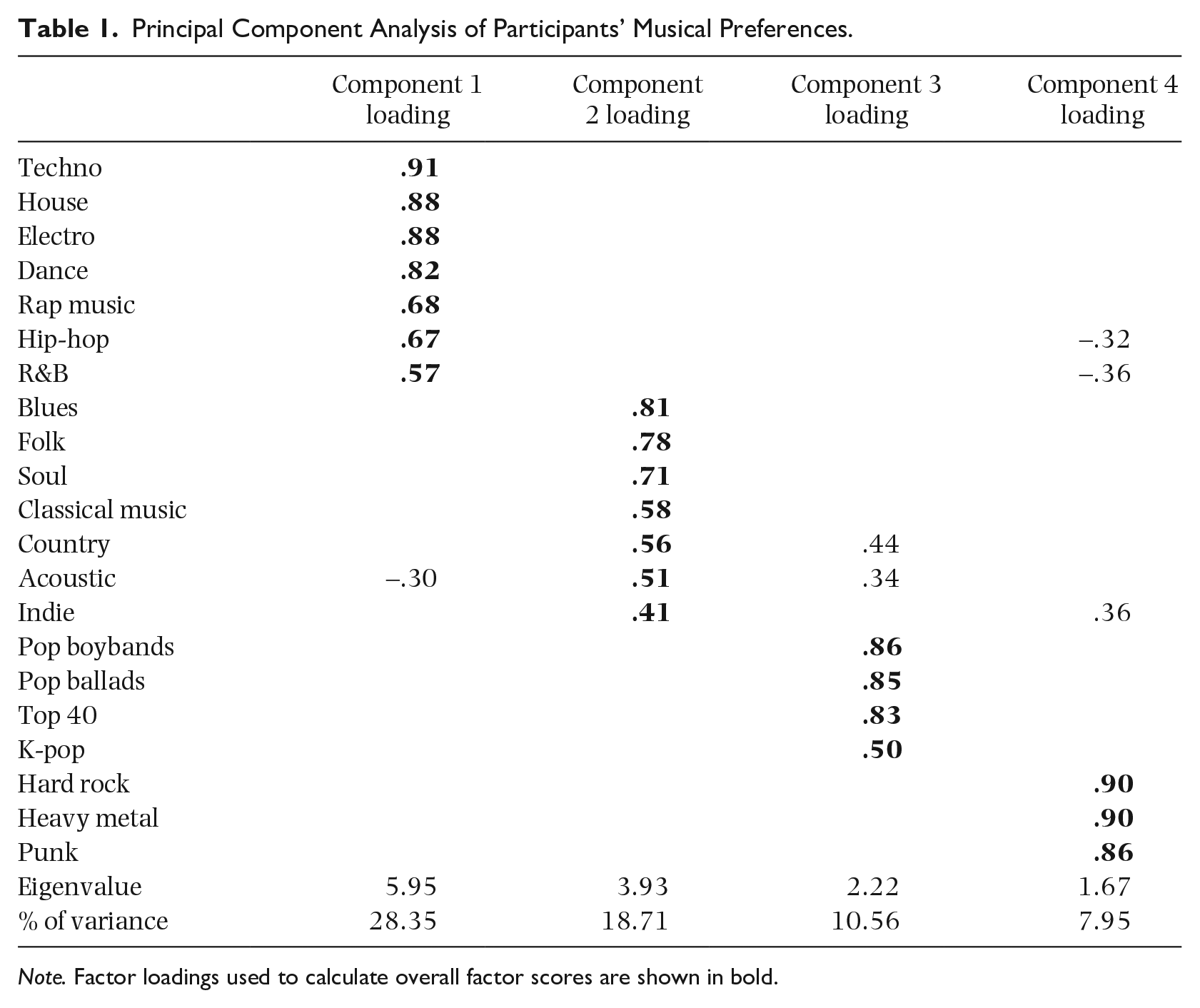
Note. Factor loadings used to calculate overall factor scores are shown in bold.
Prior to the main analysis, a multivariate analysis of variance (MANOVA) was conducted to investigate whether there were significant gender differences on any of the variables under investigation (i.e., age, musical preferences, personality, and collective self-esteem); this seemed sensible because previous research suggests that gender may moderate the relationship between music preference and self-esteem (Arnett, 1991, 1992; Shepherd & Sigg, 2015). Multivariate analysis found significant differences between the two groups, F(14, 124) = 4.12, p < .001. Subsequent univariate analysis showed that female participants (M = 5.21, SD = 1.23) were significantly more agreeable than males (M = 4.30, SD = 1.03), F (1, 137) = 19.76, p < .001, while men (M = 5.68, SD = 2.38) liked Energetic/Rhythmic music (i.e., rap, hip-hop, R&B, dance, techno, electro, house) significantly more than women (M = 4.30, SD = 2.63), F(1, 137) = 9.48, p = .003.
Main analysis
Four multiple regressions were conducted to see whether participants’ collective self-esteem could be used to predict their musical preferences. In each case, the four subscales of the collective self-esteem scale were used as predictors and the preference scores for each of the four musical components were used as the outcome variables. Table 2 shows that, with the exception of Upbeat/Conventional music, participants’ scores on the collective self-esteem scale might be used to predict their musical preferences. Scores on the membership self-esteem subscale were found to significantly predict the extent to which participants liked Energetic/Rhythmic music (β = .35, p < .001) and Intense/Rebellious music (β = −.45, p < .001). Private collective self-esteem was found to significantly predict the extent to which participants liked Intense/Rebellious music (β = .30, p = .003) and scores on the “importance to identity” subscale were found to significantly predict the extent to which participants liked Reflective/Complex music (β = −.24, p = .011). No issues with multi-collinearity were found, with variance inflation factors ranging from 1.20 to 1.56. Kolmogorov–Smirnov tests on the residuals found no significant deviations from normal distributions.
Multiple Regression Analyses of Musical Preferences (Standardized [β] Regression Coefficients).
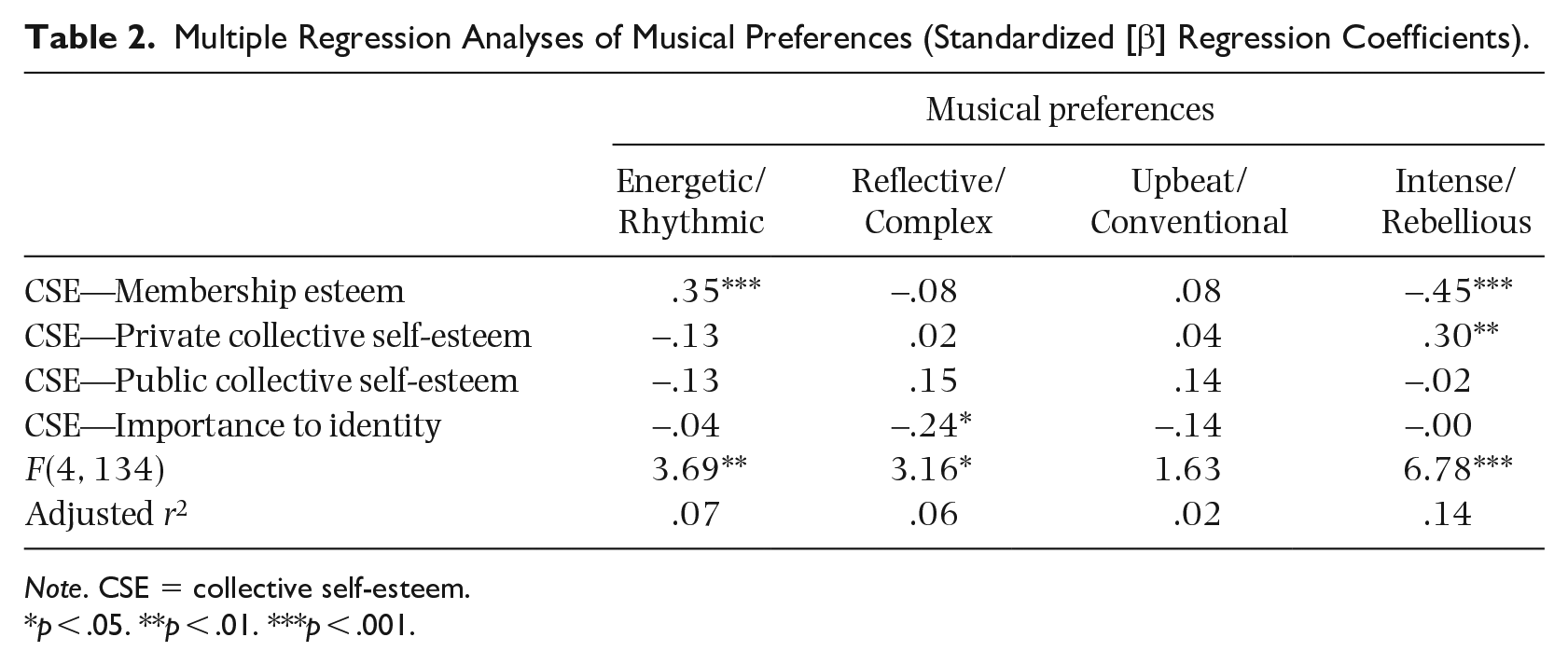
Note. CSE = collective self-esteem.
p < .05. **p < .01. ***p < .001.
Four hierarchical multiple regressions were then conducted to determine whether collective self-esteem could predict participants’ music preferences over and above their gender, age, and personality. In each case, participants’ gender, age, and personality were used as predictors in the first stage of the hierarchical regressions. Participants’ collective self-esteem scores were then added in the second stage to determine their unique contribution (if any) to the regression models. Table 3 shows that the addition of collective self-esteem significantly improved the regression models for Reflective/Complex and Intense/Rebellious music. Specifically, scores on the “importance to identity” subscale were found to significantly predict the extent to which participants liked Reflective/Complex music (β = −.19, p = .044), and private collective self-esteem was found to significantly predict the extent to which participant liked Intense/Rebellious music (β = .21, p = .019). In contrast, the addition of collective self-esteem was found to have no significant effect on the regression model for participants’ preference scores on Energetic/Rhythmic and Upbeat/Conventional music.
Hierarchical Multiple Regression Analyses (Standardized [β] Regression Coefficients).
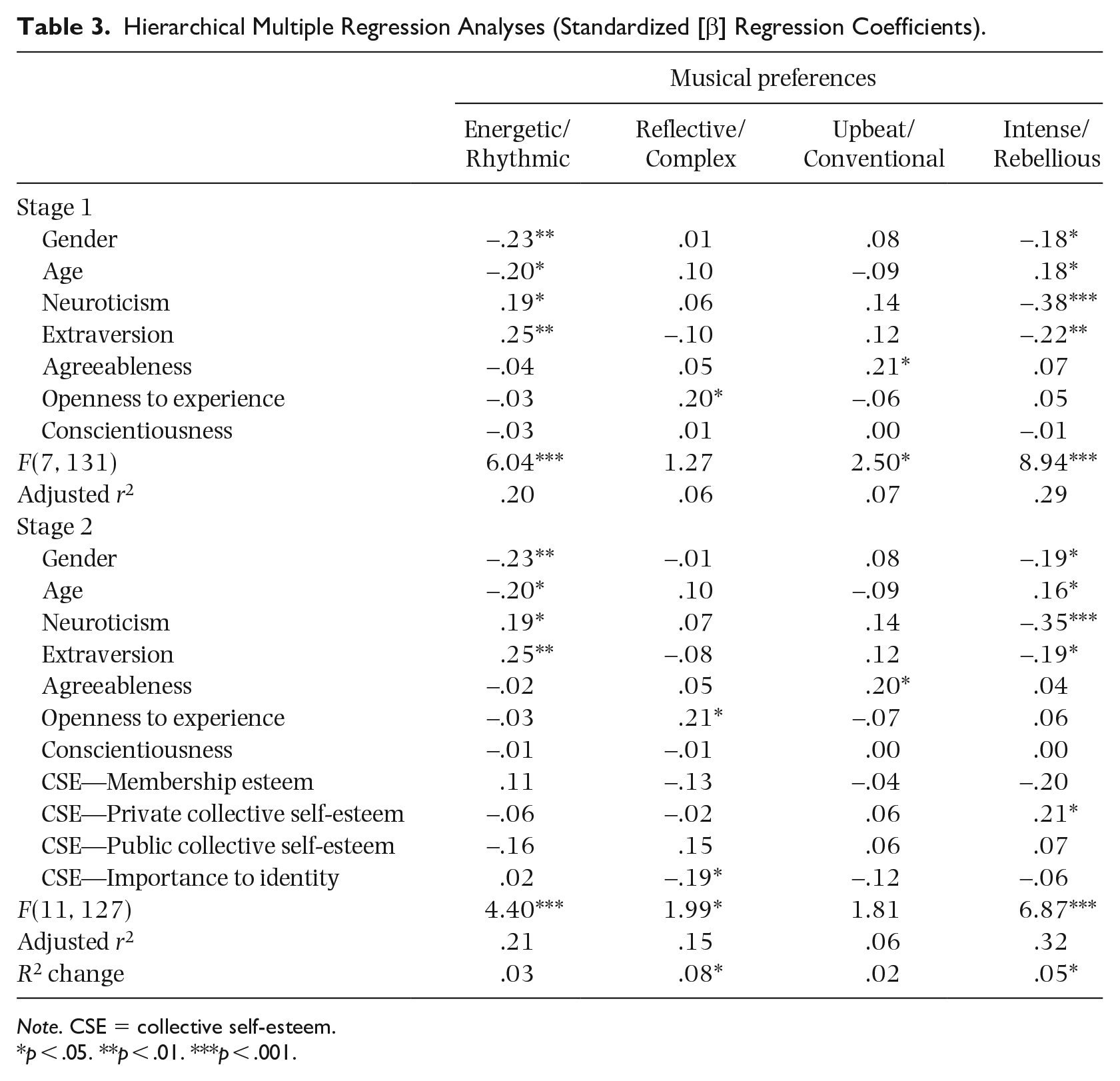
Note. CSE = collective self-esteem.
p < .05. **p < .01. ***p < .001.
Discussion
The present study aimed to reexamine the links between self-esteem and musical preference using a measure of collective self-esteem (Luhtanen & Crocker, 1992) rather than the measure of personal self-esteem used previously (Rosenberg, 1965). It was found possible to predict participants’ music preferences using a measure of collective self-esteem. Moreover, two of these significant links remained evident when the effects of gender, age, and personality had been controlled for. These results add to a growing body of evidence (e.g., Arnett, 1991, 1992; Dixon et al., 2009; North, 2010; Shepherd & Sigg, 2015; Swami et al., 2013) suggesting that young adults’ musical preferences and self-esteem are in some way linked.
In keeping with previous research (Arnett, 1991, 1992; North, 2010; Swami et al., 2013), preference for Intense/Rebellious music was found to be negatively related to participants’ self-esteem. It would therefore seem that young people with low membership self-esteem are, for whatever reason, more likely to be attracted to these oppositional musical styles (i.e., hard rock, heavy metal, and punk). One possible explanation for this might be found in Roe’s (1995) theory of media delinquency. Adolescents who like heavy metal have been found more likely to perform poorly at school (Roe, 1992), which is likely to have a significant impact on their self-esteem, leading them to reject their academic/school identity and seek an alternative or non-mainstream subcultural identity outside of school. According to Roe (1995), this new identity would then dispose these low-achieving adolescents to consume alternative, non-mainstream, and socially disvalued media (e.g., heavy metal) as a means to affirm their new non-school identity. Alternatively, it is entirely possible that being a fan of intense and rebellious music (i.e., hard rock, heavy metal, punk) might itself lead to lower self-esteem. Perhaps being a member of a social group that is often stigmatized/devalued by mainstream culture has deleterious long-term effect on the self-esteem of heavy metal/hard rock/punk music fans. In either case, these hypotheses certainly warrant further investigation.
In contrast, preference for Energetic/Rhythmic music (i.e., rap, hip-hop, R&B) was positively related to participants’ membership self-esteem. These musical styles are now arguably an integral part of contemporary culture for young people (British Phonographic Industry, 2020) and as such this finding may simply reflect the benefits of belonging to a social group that is valued and legitimatised by mainstream youth culture. However, it must be noted that both of these significant links between membership self-esteem and music preference were no longer evident when controlling for the effects of participants’ age, gender, and personality. These findings draw into question the idea that self-esteem and musical preference are somehow linked in any meaningful way and suggest that these apparent links may be better explained by the age, gender, and personality of fans of these particular music genres. However, findings relating to private collective self-esteem indicate there is still reason to suspect musical preference is linked in some way to self-esteem.
Participants’ scores on the private collective self-esteem subscale were found to positively predict preference for Intense/Rebellious music, which remained the case after controlling for the effects of age, gender, and personality. Moreover, private collective self-esteem did not significantly predict participants’ self-rated preference for the other three musical groupings (i.e., Energetic/Rhythmic, Reflective/Complex, and Upbeat/Conventional). These findings would suggest that the fans of these oppositional musical styles (i.e., hard rock, heavy metal, punk) were uniquely more inclined to judge their social groups more favorably; this is perhaps understandable given the negative reputation and public condemnation of their supposedly delinquent or deviant adolescent audiences (North & Hargreaves, 2008; ter Bogt et al., 2012). Members of publicly devalued and stigmatized groups will often employ self-protective strategies to bolster and buffer their self-esteem in the light of any prejudice and discrimination they experience (see Crocker & Major, 1989, for a review). In this context, it is possible that different music fans may base their self-esteem on different sources of information. In this case, the fans of Intense/Rebellious music might be less inclined than fans of other genres to base their self-esteem on the approval of others; future research will be needed to investigate these ideas further.
Individuals who scored higher on the importance to identity subscale of the collective self-esteem scale were also found less likely to prefer Reflective/Complex music (e.g., blues, classical music, folk), which remained the case even after taking into account the effects of age, gender, and personality. It would therefore seem that the fans of the Reflective/Complex music genres are less likely to regard their group memberships as important to their sense of identity. However, this finding may simply be a reflection of the age of those who took part in the study. Research has shown that preference for both “sophisticated” (e.g., classical and jazz) and “unpretentious” music (e.g., country music, folk, and blues) significantly increases with age, with preference peaking in middle adulthood (Bonneville-Roussy et al., 2013). It is therefore possible that these musical genres only hold social significance for these older groups, and the associations between musical preference, group membership, and social identity changes with each generation. In any case, the narrow focus on a small sample of young adults (18–25 years old) clearly limits the Generalizability of the present findings; future research might therefore consider reexamining the links between self-esteem and musical preference with a much wider age cohort of participants.
The present findings add to a body of evidence (e.g., Arnett, 1991, 1992; Dixon et al., 2009; North, 2010; Shepherd & Sigg, 2015; Swami et al., 2013) which suggests that peoples’ musical preferences and self-esteem are in some way linked and are the first to demonstrate a link between collective self-esteem and music preference. Nonetheless, it is important to recognize that the present study had several limitations that ought to be addressed by future studies. Most notably, the collective self-esteem scale (Luhtanen & Crocker, 1992) asked participants to consider all “the social groups I belong to” and as such should be regarded as a measure of global collective self-esteem. Perhaps future investigations ought to adapt this scale to assess how participants feel about fans of their favorite musical style. Future investigations should also explore the links between music preference and measures of both personal and collective self-esteem; this is likely to offer a far more nuanced understanding of these apparent associations.
Using the 10 item personality inventory (TIPI, Gosling et al., 2003) clearly has practical advantages when time is limited and personality is not the primary topic of interest. However, it must also be recognized that a brief personality measure like this one is unlikely to have the same robust psychometric properties as its longer, multi-item counterparts. It is therefore recommended that future researchers reexamine this topic using longer personality measures (e.g., Costa & McCrae, 1992; DeYoung et al., 2007; John & Srivastava, 1999; Soto & John, 2017) wherever it is possible or practical to do so. Several researchers have also quite rightly highlighted the difficulties associated with assessing participants’ musical preferences using genre categorisations like the one employed in the present investigation (e.g., Aucouturier & Pachet, 2003; Dunn et al., 2011). To address this issue, future researchers should consider using an audio-based measure of musical preference (e.g., Rentfrow et al., 2011, 2012) when exploring the links with self-esteem.
Future researchers might also bear in mind Roe’s (1995) theory of media delinquency when reexamining the link between music preference and self-esteem. For example, it would be interesting to explore how academic achievement, peer acceptance, self-esteem, and music preferences co-develop over a student’s academic career (i.e., from secondary school, college, and university). A longitudinal study would help to address the issues of causality that clearly afflict a topic like this one. If Roe (1995) is correct, then (perceived) poor academic performance might be expected to lead students to seek out alternate sources of self-esteem, which may lead them to form a subcultural identity by adopting non-mainstream musical preferences. In any case, it is recommended that future investigations studying the links between musical preference and self-esteem should also take into account students’ academic achievement, academic self-concept, and peer acceptance.
In sum, the present findings lend further support to the idea that our self-esteem and music preferences are somehow linked. The present study showed (for the first time) that a measure of collective self-esteem significantly predicted participants’ musical preferences; these links remained significant while taking into account variables known to have significant effect on musical preference and self-esteem (i.e., age, gender, and personality). It is hoped that these findings prompt future investigations to further explore the links between self-esteem and music preference and to perhaps track these associations longitudinally to determine their root causes.
Footnotes
Acknowledgements
We thank Alexander Blencowe, Imogen Horton, Ellen MacDonald, and Pui Ng who (under the supervision of Dr. Adam Lonsdale) worked together with Amber to collect the data for this study as part of their second-year undergraduate coursework assignments. We would like to thank Wakefield Morys-Carter and the two anonymous reviewers for their helpful comments on earlier versions of this article.
Funding
The author(s) received no financial support for the research, authorship, and/or publication of this article.
Ethical approval
Ethical approval for this project was given by the Psychology Research Ethics Committee at Oxford Brookes University (ref number 1819/157).
