




Abstract
To date, there has been relatively little research on the relationship between anxiety and music. Trait anxiety (TA) is known to modulate responses to threat-related stimuli, but it is unclear whether this is driven by differences or biases related to attention, vigilance avoidance, or information processing. We evaluated competing predictions based on Attentional Control Theory (ACT), Vigilance Avoidance, and the Information Processing model. We performed two affective priming tasks with auditory primes and word targets, comparing results for participants high in TA with participants low in TA. Music primes elicited congruency effects—targets were evaluated faster when preceded by a prime that shared the same valence as the target. However, TA did not influence responses. In the second task, which used affective environmental sounds, high TA was associated with slower responses to positive targets following a negative prime, consistent with the impaired processing efficiency predicted by ACT. We discuss the results in the context of theoretical models of anxiety and suggest possible stimulus properties, such as arousal and concreteness, which could explain the differences in results.
Efficient processing of threat-related stimuli is critically important for human survival (e.g., Öhman, 2013). A large body of research (see, e.g. Bar-Haim et al., 2007) considers threat processing in healthy and anxious populations (e.g., Bar-Haim et al., 2007; Goodwin et al., 2017; Meyer et al., 2019), leading to several established theoretical accounts of the affective and attentional elements of threat processing (e.g., Beck & Clark, 1988; Bentz & Schiller, 2015). In particular, much research considers attentional processes and information processing in trait anxiety (TA) (Pacheco-Unguetti et al. 2010; Soyal et al., 2017; Stamps et al., 1979). Aubé et al. (2015) suggest that music associated with fearful emotions or high levels of tension activates the same threat-processing mechanisms as fearful vocalizations. Research on strong emotional responses to music, such as chills or goosebumps, suggests fear or vigilance as a possible mechanism for these responses (Bannister, 2020; Huron, 2008). In clinical settings, music has also been shown to alleviate anxiety in certain situations (Bradt et al., 2013; Mallik & Russo, 2022), but the theoretical underpinnings of this phenomenon are not clear. More generally, there is little research on how music is processed in the context of threat perception and whether or not musical stimuli can activate anxiety-related processing biases. Here, we test whether brief exposure to positively or negatively valenced affective music and environmental sounds influences responses to an affective priming task and whether these responses are modulated by TA. Furthermore, we consider the degree to which the results are consistent with the TA models proposed by Beck and Clark (1988), Williams et al. (1988), and Eysenck et al. (2007).
Despite its apparent simplicity, affective priming (Fazio et al., 1986) is a complex phenomenon that involves affective, semantic, and attentional networks. Typically, priming studies show evidence of congruency effects: targets are classified more quickly and/or accurately when they are preceded by a prime of the same valence as the target but more slowly/less accurately when the prime and target are of opposite valences. However, some authors (e.g. Maier et al., 2003) report deviations from this pattern under conditions involving negative stimuli. According to the view taken by Hermans et al. (2003), it seems likely that TA influences the results of the priming tasks, as it is present under negative conditions but not in positive conditions. TA is known to influence responses to negative stimuli (particularly threats). In addition, the interaction of cognitive, attentional, and affective components of anxiety makes it an ideal framework for discussing affective priming in general.
Rohr and Wentura (2022) review the theoretical models of priming. Although historical models of priming rely on spreading activation, they argue that a model that relies on semantic activation in working memory provides the best account of priming. Moreover, they argue further that the presence of priming effects depends on the goal-relevance of the congruent dimension.
As noted above, TA is associated with an attentional bias in relation to negative stimuli. Several accounts of anxiety provide a theoretical basis for the influence of anxiety on reaction time (RT) in priming tasks. Here, we will focus on models of anxiety that have the potential to explain the differing patterns of results outlined earlier: Beck and Clark’s (1988; 1997) Information Processing Model of Anxiety, the Vigilance-Avoidance Hypothesis (Williams et al., 1988), and Eysenck’s et al. (2007) Attentional Control Theory (ACT). We will also test whether or not music stimuli can activate anxiety-related processing biases reported by, e.g., Maier et al. (2003) and Hermans et al. (2003). The relationship between priming and anxiety is discussed in more detail below.
Beck and Clark (1988, 1997) proposed that the initial perception of a stimulus (the orienting mode) is biased toward threat-related stimuli in anxious individuals. The second phase of processing a threat-related stimulus is the preparation mode, which involves activating the necessary schema to deal with the threat. During this stage of processing, Beck argues that all available information processing resources are deployed to process threat-related information at the expense of other tasks. The final stage of processing a threat stimulus is secondary elaboration, when the threat is appraised in terms of the individual’s coping mechanisms and the availability of safety cues. Processing becomes more conscious with less dependence on automatic processes.
Williams et al. (1988) proposed the Vigilance-Avoidance Hypothesis. As with Beck’s information processing model, Williams et al. contend that TA is characterized by an early attentional bias towards threat stimuli. However, they argue that after the initial perception of a threat stimulus, anxious individuals direct attention away from threat-related information in later stages of processing. They argue in favor of a mechanism that is only operational when competing stimuli are presented: vigilance avoidance predicts that threat stimuli are not processed more quickly than neutral stimuli when the stimuli are presented in isolation, but rather that if threat and neutral stimuli are presented simultaneously, then the threat stimulus is attended to preferentially.
More recently, ACT (Eysenck et al., 2007) predicts that anxiety, both state and trait, is associated with greater vulnerability to distractor stimuli. In essence, the bottom-up attentional system can interfere with the top-down system. In the case of a priming task, the top-down task (target classification) would be subject to disruption by bottom-up signals created by the prime, particularly when the prime is threat-related. ACT suggests that disruption is particularly evident when the working memory load is high, resulting in inhibited performance efficiency, i.e., RT in the case of an affective priming task. When the demands for working memory are low, the efficiency of cognitive task performance is independent of the level of anxiety.
Previous research on priming and anxiety suggests a consensus around congruency effects when both the prime and the target stimulus are positive: Targets are classified more quickly when preceded by a positive prime compared to when they are preceded by a negative prime. However, there is a less clear pattern of effects under congruent negative conditions (Dannlowski et al., 2006; Li et al., 2007; Maier et al., 2003). Whilst some authors found the expected congruency effect—negative targets are classified more quickly after negative primes—some (Maier et al., 2003) have found reversed priming: negative targets are classified more slowly following negative primes. Li et al. (2007) carried out a primed rating task to assess the influence of TA on affective priming. As expected, they found priming effects—that is, valence ratings of target were more positive or negative in congruent compared to incongruent conditions. The size of the priming effect was found to correlate with TA, but crucially, this correlation was found only in the negative prime condition. Li et al. also considered brain activity via electroencephalography (EEG) activity. The RT result was echoed in P1 activity, with the correlation only present in the negative prime condition. Maier et al. (2003) reported reverse priming effects in high TA participants exposed to high arousal targets. They argued that the (reverse) priming effects are a consequence of the interaction of TA and the activation level of the stimuli. They propose a dual spreading activation–inhibition mechanism: highly salient stimuli, rather than activating related concepts, actually inhibit them, resulting in reverse priming effects (see also Carr & Dagenbach, 1990). As an alternative, they point out that high TA participants may be motivated by fear of the consequences of low accuracy and respond slowly to ensure accuracy. In fact, the results are also consistent with the inhibited response efficiency to threat-related stimuli described in ACT. In contrast to this, Dannlowski et al. (2006) reported reverse priming in healthy controls, but priming effects in participants with anxiety disorder.
Experiment 1: priming with music
The present study uses a cross-modal affective priming task with two groups (high TA vs low TA). We predict that for the low TA group, we will observe standard congruency effects. Furthermore, we predict that there will be some modulation of responses to negative stimuli in the high TA group. We test whether the results of the priming task are influenced by TA as predicted by the models of anxiety outlined above. As the nature of the predicted modulation by anxiety is unclear, the research seeks to assess three competing hypotheses:
As Rohr and Wentura (2022) consider that affective priming is a consequence of semantic activation in working memory, ACT predicts that processing efficiency will be disrupted following negative primes. This suggests that participants with high TA will display significantly slower RTs when exposed to negative stimuli, that is, ACT predicts a main effect of prime valence.
The Vigilance-Avoidance hypothesis predicts response times that are sensitive to the time course of the stimuli. Mogg et al. (2004) demonstrate that at short exposures (i.e., of 500 ms), participants high in TA had an attentional bias towards negative stimuli. This suggests that, at the Stimulus Onset Asynchrony (SOA) used here (450 ms) high TA participants will have an attentional bias towards negative targets after exposure to negative primes. This aligns with the reversed priming results reported by Berner and Maier (2004). The hypothesis would be reflected in a three-way interaction between TA, prime valence, and target valence, and, in particular, shorter RTs in the negative-negative condition in the high-TA group.
Beck’s information processing account predicts that TA will influence the accuracy rate; in particular, exposure to negative primes should lead to a situation being categorized as negative at the expense of positive aspects of the situation, that is, accuracy rates in negative-positive conditions should be lower in the high TA group compared to the low TA group.
Method
Participants
In studies of this type, power is determined by both the number of participants and the number of items. Brysbaert and Stevens (2018) suggest that 1,600 readings per condition are necessary for studies of this design to be sufficiently powered to detect a small effect size, that is, d <0.2; Costa (2013) reported d = 0.14. As this required 25 participants (25 participants × 8 primes × 8 targets per congruency condition) in each of the High TA and Low TA groups, we aimed for a target sample size of 60 participants to allow for attrition.
We first prescreened 700 potential participants for anxiety with the Beck Anxiety Inventory (BAI; Beck et al., 1988). Participants were recruited through Amazon MTurk and Prolific and remunerated at a rate of $0.65 (the screening task consisting of BAI took around 3 minutes). From the screening sample, the lowest and highest 25 quantiles of anxiety—excluding the upper extreme (5%) to avoid clinical or near-clinical cases—were recruited for the actual study that contains the priming tasks. This yielded two groups, High TA and Low TA, each with a minimum of 20 participants. Participants received $3.65 for completing the priming task.
A total of 58 participants (25 male; mean age = 40 years, SD = 12.7) completed the priming task. The mean completion time was 20.4 min. Data from three participants were excluded as their accuracy rate fell below 75%, leaving 27 participants in the High TA group and 28 participants in the Low TA group.
All participants reported normal or corrected normal vision and hearing, were native English speakers, and were right handed (Hardie & Wright, 2014). Informed consent was given through an online check box and the study was approved by the Ethics Committee of the Department of Music, Durham University.
Materials and stimuli
The musical primes were taken from Armitage and Eerola (2020) and were approximately 1000 ms in duration (1000–1045 ms, M = 1015 ms, where minor variations were allowed to preserve the musical integrity of the clips and avoid cutting in the middle of the onsets). There were 16 extracts drawn from 16 different pieces of music—four each to represent positive valence-low arousal, positive valence-high arousal, negative valence-low arousal, and negative valence-high arousal. Table S1 lists the musical excerpts. The duration of 1000 ms is considered to provide the optimal trade-off of being sufficiently long to induce an affective response whilst avoiding decay in the priming effect (Bigand et al., 2005; Hermans et al., 2001).
Although the absolute loudness of the prime stimuli was determined by the participants, we calculated root mean square (RMS) values as a relative measure of loudness. The mean (SD) RMS was −23.79 dB (10.40). There was no significant difference in RMS between the positive primes (mean RMS = −25.56) and negative primes (mean RMS = −22.01),
The 16 target words (Climax, Gentle, Rabid, Saggy, Lively, Rest, Hijack, Coma, Excite, Comfy, Arrest, Dismal, Snazzy, Relax, Fatal, Morgue) were drawn from Warriner et al. (2013). The words were matched for length and arousal levels.
TA was measured using the BAI (Beck et al., 1988). BAI has demonstrated strong internal reliability (
The affective priming task was coded in Stoet (2010, 2017) to allow the collection of robust RT data online. RT data collected online through crowd-sourced samples have been shown to be of comparable quality to data collected in a laboratory (Armitage & Eerola, 2020; Kim et al., 2019).
Procedure
Participants initially completed the BAI. The selected participants were then invited to complete the priming task. Participants were initially informed that they were taking part in an experiment on the influence of music and personality on language processing. The experiment itself consisted of a practice block of 10 items followed by an experimental block of 256 items (16 primes × 16 targets). Participants received feedback during the practice block to indicate whether their responses were correct; no feedback was provided during the experimental block. Following the experiment, participants were presented with an online debrief screen.
Participants were presented 1,000 ms of auditory prime. During the auditory prime, the screen contained a fixation cross for 450 ms; after 450 ms, the target word was displayed for 2,000 ms (i.e., there was an overlap period during which the target was visible while the prime was audible), the window during which participants could respond. Participants were instructed to press ’z’ on the computer keyboard if the word has negative associations and ’m’ if the word has positive associations. The participants were instructed to respond as quickly and accurately as possible. Responses slower than 2,000 ms were classified as timeouts. Figure 1 summarises the procedure diagrammatically.
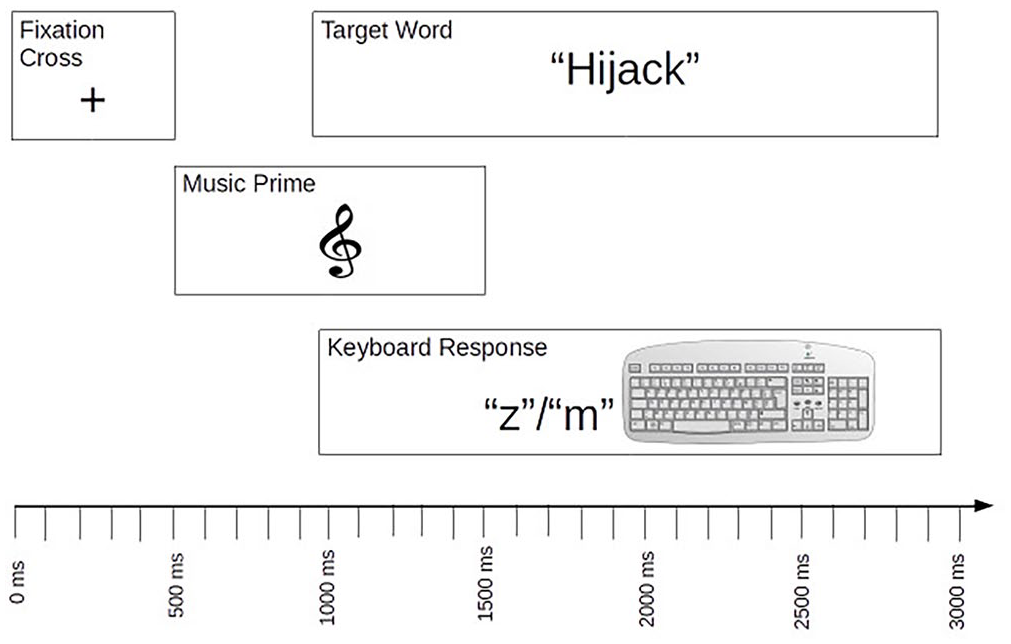
Procedure for Auditory Affective Priming.
Results
Data analysis
Outliers were removed by the participant by fitting an exponentially modified Gaussian distribution to the RTs and trimming any data in the 5% upper tails as well as RTs less than 250 ms (Hermans et al., 2001; Ratcliff, 1993). Timeouts and incorrect responses were removed prior to analysis. In total, 11% of the responses were discarded.
RTs were fitted to a generalised linear mixed model (GLMM) assuming a Gamma distribution with an identity link function (Lo & Andrews, 2015), with the fixed factors TA, prime valence and target valence, and participant as a random factor. Where planned contrasts involved multiple comparisons, the p values were subject to Bonferroni correction. All statistical tests were carried out in R (R Core Team 2023) at α = .05.
RT analysis
Mean RTs are reported in Table 1.
Mean (SD) Reaction Times (ms) & Accuracy Rates for Experiment 1.

GLMM coefficients are reported in Table 2. The GLMM yielded a significant main effect of target valence. Planned contrast revealed that positive targets were evaluated significantly faster than negative targets. We also saw an interaction of the factors Prime valence and Target valence (see Figure 2). Planned contrasts revealed that negative targets (M = 608 ms, SD = 137 ms) were evaluated marginally faster following a negative prime compared to a positive prime (M = 611 ms, SD = 131 ms),
GLMM Coefficients for Experiment 1. The Reference Level is High TA, Negative Prime, and Negative Target.

p < .001.
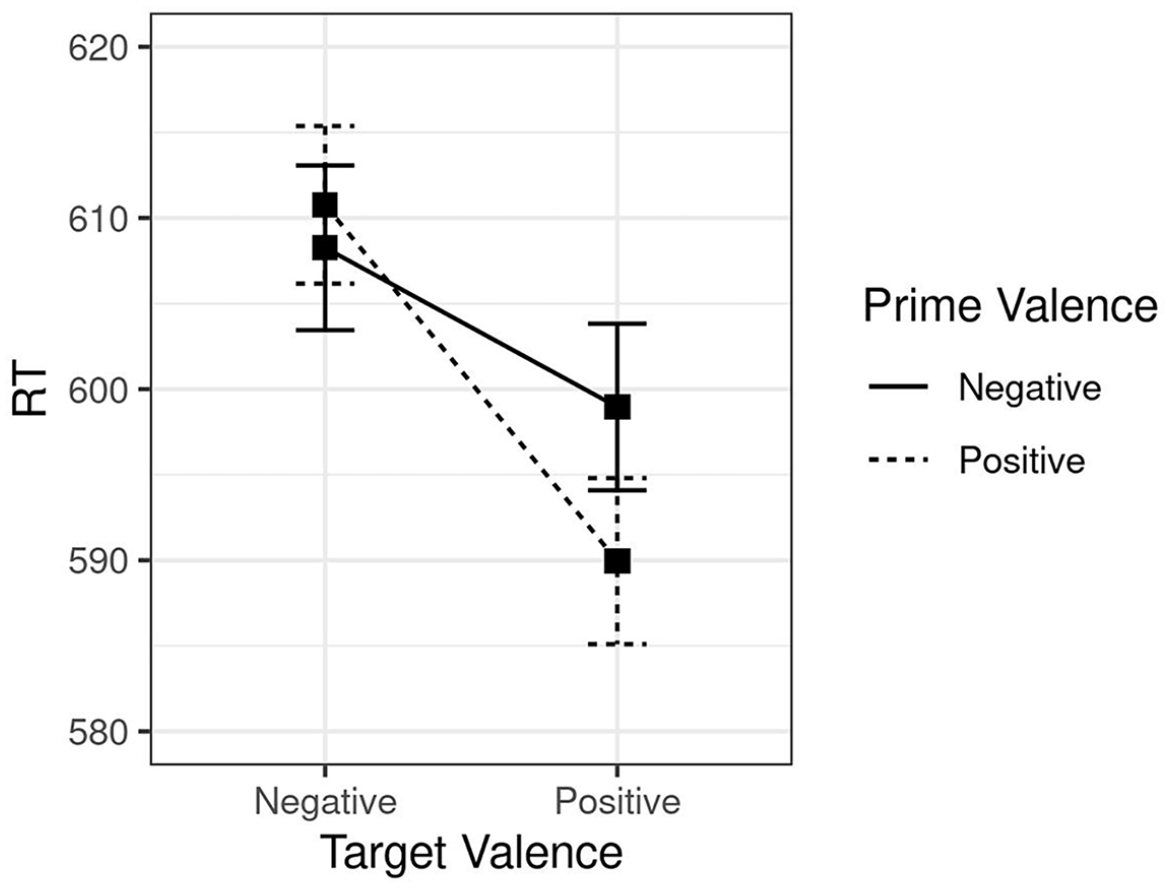
Interaction of Prime valence and Target valence.
Contrary to the hypotheses above, the main effect of TA proved nonsignificant as did all two- and three-way interactions involving TA.
Accuracy rate analysis
Accuracy rates are reported in Table 2 and were subject to a 2 (TA: High vs Low) × 2 (Prime valence) × 2 (Target valence) analysis of variance (ANOVA). All main effects and their interactions proved nonsignificant.
Discussion
As predicted, we saw a significant interaction of Prime valence and Target valence with classical ‘congruency effects’ i.e., facilitation in the positive/positive and negative/negative conditions versus inhibition in the negative/positive and positive/negative conditions, although the effect was weak in the presence of a negative prime. This is potentially due to an overall positivity effect, in which positive targets were processed faster than negative targets. The presence of congruency effects is consistent with the bulk of the music priming literature (Costa, 2013; Goerlich et al., 2011; Sollberger et al., 2003; Steinbeis & Koelsch, 2011; Tenderini et al., 2022).
We did not find evidence to support the predicted influence of TA on affective priming with music primes. Given that previous studies that have probed the link between TA and affective priming (Hermans et al., 2003; Maier et al., 2003) have found that there is an effect of TA on affective priming, it seems likely that the lack of an effect is the result of some property of the music primes. Thus, further exploration is necessary to probe the nature of any anxiety-related biases in affective priming with auditory stimuli and empirically test which of the three models of anxiety (Beck et al., 1988; Eysenck et al., 2007; Williams et al., 1988) provides the best account of any such biases.
Experiment 2: priming with environmental sounds
Experiment 1 showed a clear facilitation-interference pattern in the sense that we saw faster RTs in congruent conditions and slower RTs in incongruent conditions. However, we did not see the expected influence of TA using affective music as primes. We carried out another experiment to test the anxiety hypotheses a second time, this time using affective environmental sounds taken from the International Affective Digitised Sounds (IADS) database (Bradley & Lang, 2007). Affective environmental sounds were chosen as comparator stimuli because of their greater concreteness. Concrete (compared to abstract) threat stimuli are associated with increased physiological markers of anxiety in participants high in anxiety (Castaneda & Segerstrom, 2004). This allowed us to probe further the key question of whether the absence of an anxiety effect is something that is unique to music primes, or whether it extends to auditory primes more broadly.
Method
Participants
As in Experiment 1, the participants were recruited from Prolific and were right-handed native speakers of English with normal or corrected to normal hearing and vision. Sixty (N = 60) participants completed the priming task. Three participants did not achieve the required accuracy rate and so were removed from the data set, resulting in a sample size of 57 participants (26 female, 31 male; mean age = 41.7 SD = 11.8). There were 27 participants in the High TA group and 30 in the Low TA group.
Materials and stimuli
Target words were identical to Experiment 1. Affective environmental sounds were taken from IADS (Bradley & Lang, 2007). The stimuli were taken from the same sound clips as Scherer and Larsen (2011). The 11- to 14-s clips were reduced to roughly 1,000 ms for use in the priming experiment. The clips are listed in Table 3 alongside their standardized valence and arousal ratings.
IADS Sounds Used as Primes in Experiment 2, Adapted From Scherer and Larsen (2011).
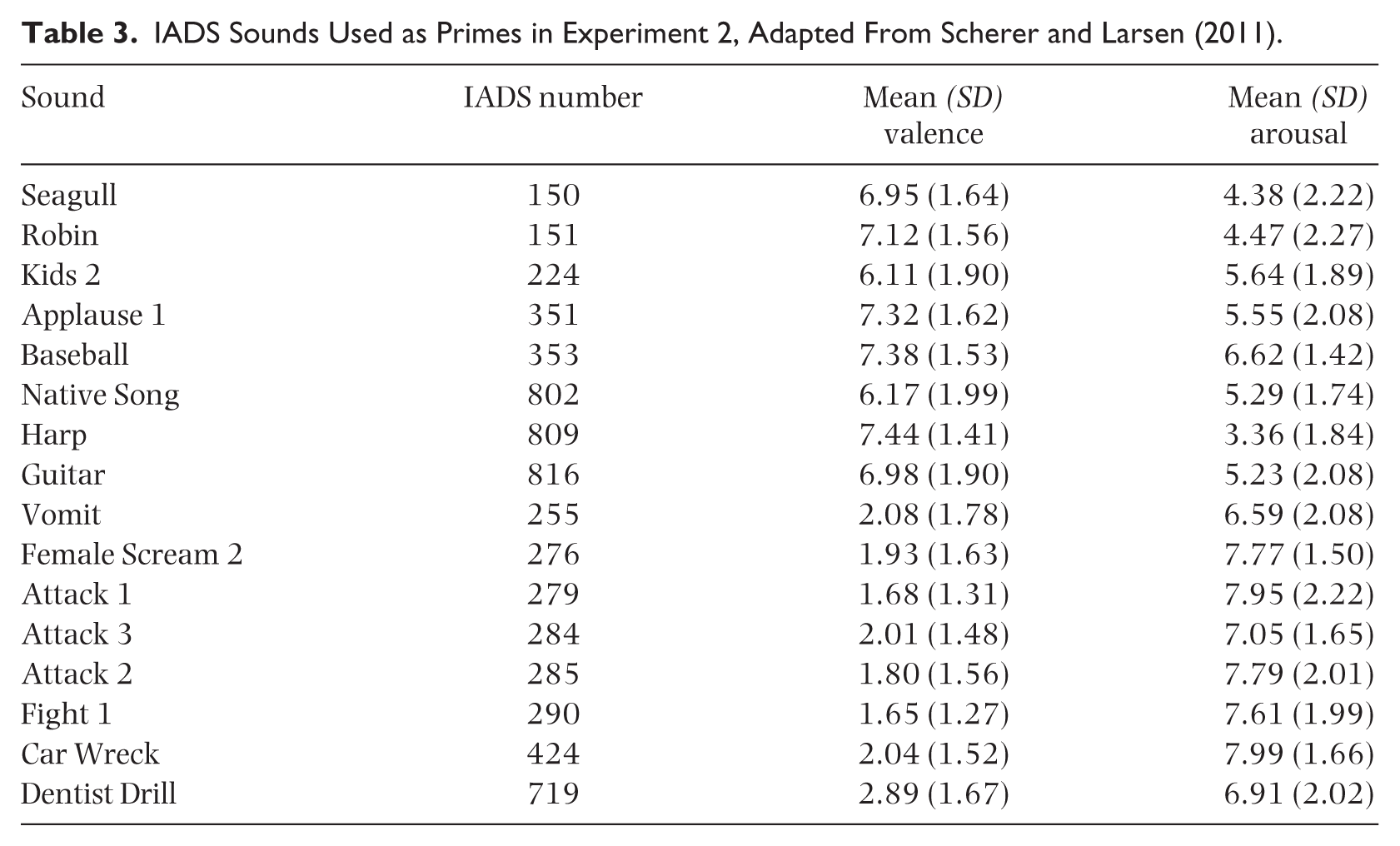
The valence ratings were subject to a between-groups t-test, which confirmed that the positive stimuli (mean valence rating = 6.93) were rated as significantly more positive than the negative stimuli (mean valence rating = 2.01),
Procedure
With the exception of substituting the IADS stimuli in place of the music stimuli, the procedure for Experiment 2 was identical to that for Experiment 1.
Results
Data pretreatment was identical to Experiment 1.
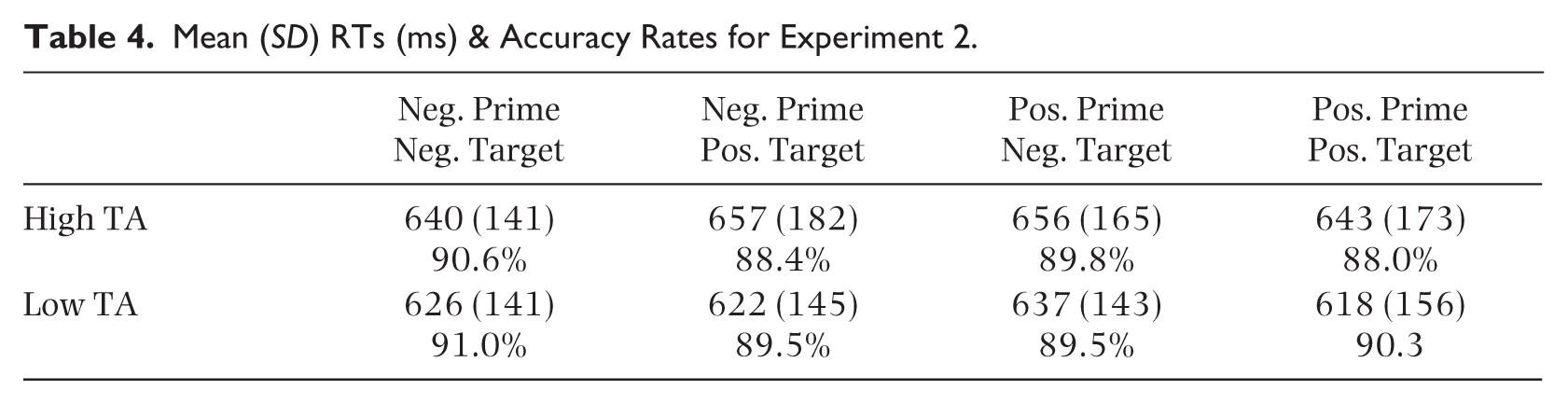
The mean RTs (SD) and the accuracy rates are presented in Table 4.
Mean (SD) RTs (ms) & Accuracy Rates for Experiment 2.
Results of the GLMM are presented in Table 5:
GLMM Parameters for Experiment 2. The Reference Level is High TA, Negative Prime, Negative Target.

p < .05, ***p < .001.
In general, there was a main effect of TA,
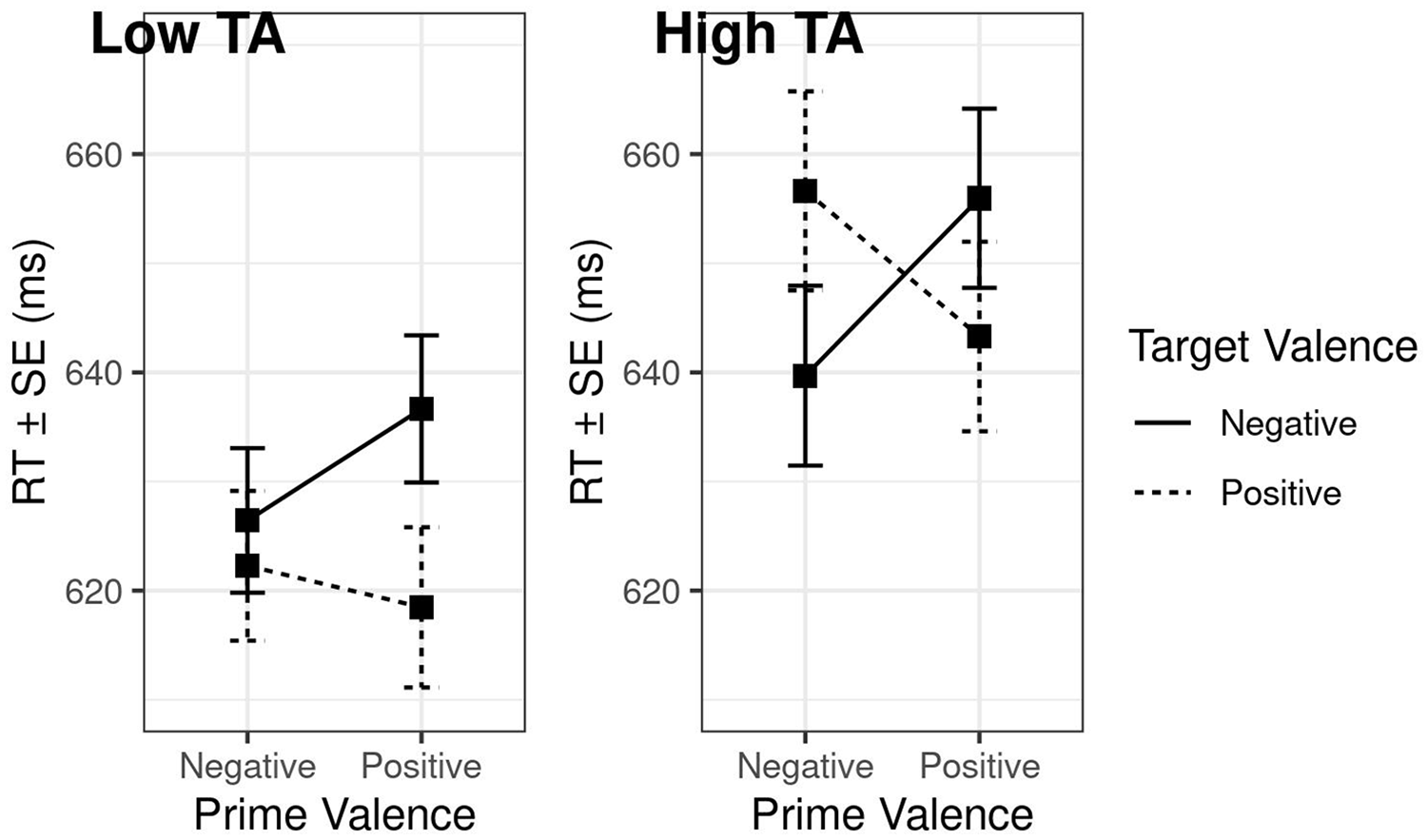
Interaction of Prime valence and Target valence for Low (3A) and High (3B) TA Groups.
Accuracy rate analysis
Mean RTs (SD) are reported in Table 2 Similar to Experiment 1, accuracy rates were subject to a 2 (TA: High vs Low) × 2 (Prime valence) × 2 ANOVA. Contrary to Hypothesis 3, all main effects and their interactions proved to be nonsignificant.
Discussion
Experiment 2 considered how TA modulates affective priming in the case of affective environmental sounds. We saw that high TA was linked to overall slower RTs. The slower RTs for the High TA group are consistent with the consensus view that high TA is associated with slower RTs on cognitive tasks than low TA (Pacheco-Unguetti et al. 2010; Soyal et al., 2017; Stamps et al., 1979). We also saw that in the High TA group, negative primes inhibited responses to positive targets, but this was not the case in the Low TA group. It is important to note that ACT predicts that task efficiency is diminished by high TA, but not task performance, whereas Beck and Clark’s (1997) anxiety information processing model predicts an erroneous classification of stimuli as negative. Therefore, the inhibited RTs in Experiment 2 seem consistent with an ACT account of anxiety. Indeed, the absence of any significant result for accuracy rate is also consistent with an ACT, rather than Beck’s and Clark’s (1997) Information Processing account of anxiety and priming, which predicts that targets will be erroneously categorized as negative.
ACT in essence suggests that bottom-up processes orient attentional resources to the negative prime stimulus. This limits the attentional resources that are deployed to the top-down word classification task, and so processing efficiency, here indexed by RT, is inhibited. Critics of ACT point to the fact that it does not account for inhibition where the response should be highly automated, as is the case with an affective priming task.
Finally, Vigilance Avoidance predicts that short (i.e., 500 ms) exposures to negative stimuli are associated with an attentional bias toward negative stimuli. The results of Experiment 2 suggest that the Vigilance Avoidance account provides the best account of anxiety-related biases in affective priming in that, at the SOA used here, attention is oriented toward negative stimuli, creating a processing advantage for negative targets.
Previous research into anxiety and priming has produced conflicting results: some authors have reported priming effects in negative conditions that are amplified by TA, whereas other authors have found that priming effects are reversed in high-anxiety groups. In general, the present study is in agreement with Dannlowski et al. (2006) who found that priming was present in anxious participants but not healthy controls, and Li et al. (2007) who found that there was a positive correlation between TA and the magnitude of the priming effect. However, the present result differs from Maier et al. (2003) and Hermans et al. (2003), who found that high TA was associated with reversed priming effects, i.e., for High TA groups, RTs in the negative prime–negative target conditions were slowest.
There are several possible reasons for the discrepancy between the results of the present study and those obtained by Maier et al. First, the experimental paradigms are slightly different in that Maier et al. used a word pronunciation task rather than an evaluative classification task. Second, the difference in prime modality may have played a role. As both the prime and the target were visually represented (as written words) in Maier et al., it may be that a degree of unimodal interference is present in a word-word priming study that is not present in a cross-modal study, for example, a negative visual prime may trigger an aversive eye movement that interferes with the participant’s ability to read the target word (see, e.g., Onnis et al., 2011, for discussion of time tracking of eye movements in response to negative stimuli in anxious individuals) or slower disengagement from the negative prime (Okon-Singer, 2018). Finally, and perhaps most crucially, Maier et al. (2003) specifically considered the activation level of the primes. In particular, they found that the reversed priming effects were a consequence of activation level, occurring with the highest levels of activation of the affective representations. It is plausible that the activation level of the word primes employed by Maier et al. is greater than that generated by the auditory primes used in Experiment 2.
General discussion
The present study has shown that TA influences RT in auditory affective priming, but that the influence is limited to environmental sounds and not affective music. While music has been used to induce state anxiety as part of other experimental paradigms, and there is a wide-ranging literature on music performance anxiety, the present study is, to our knowledge, the first to address the question of whether music can activate anxiety-related attentional biases or bring about processing inefficiency.
The different results for music and environmental sounds raise an important question: Why does TA influence responses following one kind of auditory prime but not the other? The first explanation is the activation level of the two types of stimulus. Plausibly, the activation levels induced by environmental sounds are high enough to induce anxiety-related processing inefficiency, whereas this may not be the case with music stimuli.
An alternative explanation is that the difference in how music stimuli and environmental sounds is categorical, that is, music stimuli may not carry threat-related information in the same way as the environmental sounds. While music is effective in eliciting a perceived emotion, it may not necessarily be categorized as a threat stimulus during the early stages of processing. However, this is in contrast to accounts of music-induced chills and goosebumps. For instance, Bannister (2020) and Huron (2008) contend that chills or goosebumps are linked to threat-related information conveyed by music. One possible explanation is that these explanations are often linked to long-term musical structures and expectation violations, constructs that do not feature in the music primes, which had a length of approximately 1000 ms. Similarly, the result is to some extent in conflict with the findings of Aubé et al.’s (2015) that music activates the same processing mechanisms as fearful vocalizations.
A third explanation is that the concreteness of the affective environmental sounds is responsible for the presence of the priming effects with these stimuli but not music stimuli. It seems plausible that the sounds create a more realistic sense of threat, given that they are more directly related to events (such as violence, car accidents, or drill noises) that are unpleasant than musical stimuli. Indeed, this is consistent with Castaneda and Segerstrom (2004), who found that threat stimuli high in concreteness are associated with greater vagal tension than more abstract threat stimuli.
The final explanation is semantic activation. It is plausible that semantic affective knowledge is activated differently by music and environmental sounds. For instance, it could be the case that environmental sounds are associated with the perceived threat level, given their ecological validity, while music sounds were not understood to be associated with real-life threats.
The present study uses English-speaking participants and uses Western tonal music as primes, limiting generalisability between linguistic groups or participants less familiar with Western musical idioms. Furthermore, the primes were chosen based on existing priming studies (Armitage & Eerola, 2020; Scherer & Larsen, 2011); an explanation based on activation levels could be tested more directly by manipulating the activation level of the primes.
Music is well established as a vehicle for emotion induction. However, in this instance, affective music stimuli have not tapped into anxiety-related processing biases as effectively as environmental sounds despite their widespread use in anxiety reduction interventions (Bradt et al., 2013; Mallik & Russo, 2022; Nilsson, 2008). Future studies should consider how different types of auditory stimuli create induced and recognized emotions and whether different categories of stimuli provoke affective responses that are different in activation level or whether the responses themselves are categorically different. Finally, future research should address the relative lack of research on how TA mediates music-induced emotions.
Supplemental Material
sj-pdf-1-pom-10.1177_03057356241300603 – Supplemental material for Auditory affective priming: The role of trait anxiety and stimulus type
Supplemental material, sj-pdf-1-pom-10.1177_03057356241300603 for Auditory affective priming: The role of trait anxiety and stimulus type by James Armitage and Tuomas Eerola in Psychology of Music
Supplemental Material
sj-pdf-2-pom-10.1177_03057356241300603 – Supplemental material for Auditory affective priming: The role of trait anxiety and stimulus type
Supplemental material, sj-pdf-2-pom-10.1177_03057356241300603 for Auditory affective priming: The role of trait anxiety and stimulus type by James Armitage and Tuomas Eerola in Psychology of Music
Supplemental Material
sj-tex-3-pom-10.1177_03057356241300603 – Supplemental material for Auditory affective priming: The role of trait anxiety and stimulus type
Supplemental material, sj-tex-3-pom-10.1177_03057356241300603 for Auditory affective priming: The role of trait anxiety and stimulus type by James Armitage and Tuomas Eerola in Psychology of Music
Supplemental Material
sj-tex-4-pom-10.1177_03057356241300603 – Supplemental material for Auditory affective priming: The role of trait anxiety and stimulus type
Supplemental material, sj-tex-4-pom-10.1177_03057356241300603 for Auditory affective priming: The role of trait anxiety and stimulus type by James Armitage and Tuomas Eerola in Psychology of Music
Footnotes
Funding
The author(s) received no financial support for the research, authorship, and/or publication of this article.

Supplemental material
Supplemental material for this article is available online.
References
Supplementary Material
Please find the following supplemental material available below.
For Open Access articles published under a Creative Commons License, all supplemental material carries the same license as the article it is associated with.
For non-Open Access articles published, all supplemental material carries a non-exclusive license, and permission requests for re-use of supplemental material or any part of supplemental material shall be sent directly to the copyright owner as specified in the copyright notice associated with the article.
