




Abstract
Objective:
Global-local visuospatial processing has been widely investigated in both healthy and clinical populations. Recent studies indicated that individuals with ADHD lack a global processing bias. However, the extant literature regarding global-local processing style focuses solely on the visual modality.
Methods:
ADHD (N = 21) and typically developed (TD) controls (N = 24) underwent an auditory global-local task, in which they had to decide whether the melody is ascending or descending in global or local conditions.
Results:
TD controls exhibited a classic global processing bias in the auditory task. The ADHD group exhibited no global processing bias, indicating similar processing for global and local dimensions, implying that individuals with ADHD are distracted by incongruent information in global and local conditions similarly, in both visual and auditory tasks.
Conclusion:
A lack of global processing bias in ADHD is not limited to the visuospatial modality and likely reflects a broader and more general processing style.
The global processing bias has been first demonstrated in Navon’s (1977) seminal work entitled “Forest before trees,” suggesting a tendency toward processing the global features of visuospatial stimuli before processing its local features. Since then, the global processing bias has been widely investigated and replicated mainly in visuospatial tasks, demonstrating that when a visual stimulus that is composed of global and local features is presented (e.g., a large “H” composed of small “S”s), the global dimension (e.g., the large “H”) is processed automatically (Fink et al., 1997; Kimchi & Palmer, 1982; Loftus & Harley, 2004; Macrae & Lewis, 2002; Sanocki, 1993), while the local dimension (e.g., small “S”s) is processed more slowly and is subjected to interference from the global dimension (the so-called “Navon effect”). Researchers have shown that in various psychopathologies, the global processing bias effect is weaker, nonexistent, and sometimes even reversed and a local processing bias exists (i.e., priority to the local dimension; de Fockert & Cooper, 2014; Koldewyn et al., 2013; Plaisted et al., 1999; Porter & Coltheart, 2006; Scherf et al., 2008; Shilton et al., 2019; Yovel et al., 2005). Specifically, recent studies suggested that individuals with ADHD process visual scenes without a global processing bias (Cardillo et al., 2020; Cohen & Kalanthroff, 2019), or with a local processing bias (Song & Hakoda, 2015). Researchers have even suggested that a lack of global processing bias might be an underlying mechanism of a few known phenomena in ADHD. For example, some researchers have suggested that the difficulty of individuals with ADHD in social interactions can be (at least partially) attributed to deficits in processing the “big picture” (Kalanthroff et al., 2013; Nijmeijer et al., 2009 (e.g., not using the context to identify the peer’s emotions (Singh et al., 1998; Yuill & Lyon, 2007), or focusing visual attention in irrelevant areas of the face to recognize emotions (Boakes et al., 2008; Serrano et al., 2018). Furthermore, researchers have also suggested that the lack of a global processing bias may explain the impairment in set-shifting and flexibility evident in ADHD (Lawrence et al., 2004; O’Brien et al., 2010; Toplak et al., 2008;). However, current literature on the global-local processing bias, in general, and in ADHD specifically, is limited to the visuospatial domain, raising the question of whether the lack of global processing bias in ADHD affects only visuospatial information or rather it reflects a broader and more general cognitive processing bias. The absence of evidence for the lack of global processing bias from modalities other than the visuospatial modality, weakens the claim that the lack of global processing bias in ADHD affects general processing style, might underlie the disorder’s phenotype and is clinically relevant to patients with ADHD.
The auditory modality stands out as a good candidate to investigate global-local processing outside of the visuospatial field. Auditory processing has been studied in both clinical and healthy populations in the context of music perception (Deruelle et al., 2005; Dowling, 1982; Goswami, 2011; Peretz, 1990). Music can be spatially and temporally hierarchically organized in timescales and subdivisions, allowing for the investigation of various abilities such as cognitive control, attention, inhibition, and levels of processing (Carrer, 2015; Grinspun et al., 2020; Lipe, 1995). Indeed, a few studies have previously used an auditory task to measure global-local processing (Bouvet et al., 2014; Ouimet, Foster, & Hyde, 2012; Peretz, 1990). Using this task, researchers have examined the ability to distinguish between the hierarchical organization of auditory stimuli. As in the visual global-local task, the auditory task is designed so that each stimulus is composed of both a global and a local dimension and that these dimensions can be congruent or incongruent. Thus, when participants are required to attend to one dimension and ignore the other, we can examine how they process the sensory information.
Although only a handful of studies have tested global-local processing in the auditory modality, results from healthy adults show that an auditory global advantage (global processing bias) exists in detecting changes in the melodic contour (Fujioka et al., 2004; Ouimet, Foster, & Hyde, 2012) when allocating attention to changes in melody within long time spans (and not between every pair of notes) (Justus & List, 2005; List et al., 2007; Sanders & Poeppel, 2007). One such task is the “melodic global-local task” (Justus & List, 2005; see Figure 1). In this task, participants are asked to listen to a nine notes melody in each trial. These notes are grouped to form three triplets of notes. Each triplet could appear as ascending (from the lowest note to the highest) or as descending (from the highest note to the lowest). The “melody” itself could also appear as ascending (the three triplets are ordered from the lowest pitch to the highest) or as descending (the three triplets are ordered from the highest pitch to the lowest). Participants are asked to focus on either the local dimension (are the notes within the triplets ascending or descending) or on the global dimension (is the overall “melody” ascending or descending), as the two dimensions can be congruent (e.g., both ascending) or incongruent (e.g., within each triplet the notes are descending but each triplet is higher than the prior triplet). Similar to the visuospatial task, it has been shown that performance is improved in the global task and that the global dimension creates more interference when participants are instructed to attend to the local dimension than vice versa. As mentioned above, this task was mainly used with healthy adults (Bouvet et al., 2011; Fujioka et al., 2004; Ouimet, Foster, & Hyde, 2012). However, evidence from patients with autism suggests that just as in the visuospatial task, global processing bias does not exist for these individuals in the auditory task (Bouvet et al., 2014; Ouimet, Foster, Tryfon, et al., 2012). This provides initial evidence that the absence of global processing bias in clinical populations might not be limited to the visuospatial domain.
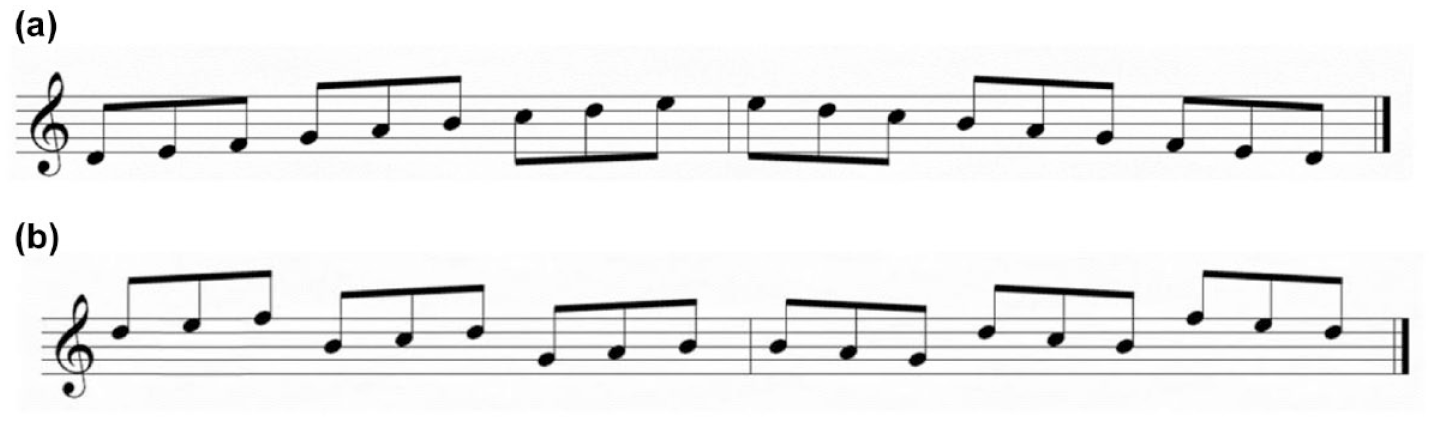
The melodic global-local task: (a) an example of two congruent trials. In the left panel, both the global melody and the local triplets are ascending whilst in the right panel, both are descending. (b) An example of two incongruent trials. In the left panel, the global melody is descending whilst the local triplets are ascending. In the right panel, the global melody is ascending whilst the local triplets are descending.
The current study has two goals. First, we wish to add to the very limited literature on global-local processing outside the visuospatial domain by replicating the global processing bias in typically developed (TD) adults using an auditory task. Second, we wish to investigate global-local processing outside the visuospatial domain in adult participants with ADHD, for the first time. By that, we wish to determine whether the lack of global processing bias in ADHD is limited to the visuospatial domain or whether it indicates a broader more general processing mechanism. Therefore, individuals with ADHD and TD adults completed the auditory global-local task (Ouimet, Foster, & Hyde, 2012), in which they were asked to identify whether a “melody” (global level) or inner triplet groups (local level) was going “up” or “down.” We hypothesized that while the TD group will exhibit a global processing bias (larger interference by the incongruent global dimension when attending to the local dimension) the ADHD group will not.
Method
Participants
Twenty-four participants with ADHD and 26 typically developed (TD) participants took part in this study for partial course credit or a small monetary payment (~15 USD). All participants had normal auditory abilities, normal or corrected-to-normal vision had no history of any psychiatric disorder (other than ADHD for the ADHD group), were naïve as to the purposes of the experiment, and reported having no formal musical education or training (defined as 3 years or more of musical education/training). All participants in both groups were undergraduate university students. Participants in the ADHD group had a formal diagnosis of ADHD conducted by the Institute for the Diagnosis of Learning Disabilities and Attention Deficits (ELAH) at the Israel National Institute for Testing and Evaluations (NITE; established by the associated heads of the universities in Israel) and were recognized as having ADHD by their academic institution. The diagnosis included 2 questionnaires and 20 computerized tests that assessed cognitive functions, language (reading and writing), arithmetic thinking, attention, memory, perception, and general processing speed. The diagnosis was conducted in three meetings: Two meetings of approximately 2 hr each, for the questionnaires and tasks, and 1 meeting for the in-person interview. Importantly, the above-mentioned ADHD diagnostic procedure is completely compatible with DSM–5 criteria. Importantly, to be diagnosed with ADHD, a previous indication of ADHD, prior to the age of 12 years, was obligatory. ADHD participants declared that they did not use any psychiatric drugs other than methylphenidate-based drugs (Ritalin or Concerta) and that they refrained from taking their ADHD-related medication on the day of the experiment. TD participants reported having no history of ADHD and having no suspicions of having undiagnosed ADHD. Five participants (three ADHD and two TD controls) either failed to complete the study procedures or exhibited poor performance on the task 1 and were, therefore, excluded from analyses. Of the 21 valid participants in the ADHD group, 13 were female and 8 were men, with mean age = 24.29 (SD = 3.13). The TD control group consisted of 24 participants, 16 females and 8 men, mean age = 22.79 (SD = 2.02).
A power analysis using G*Power 3.1 (Faul et al., 2007) indicated that the current sample allowed for examination of the three-way interaction (Congruency × Attention Condition × Group) at a power >95% to test small to medium effects size with a Type I error (α < .05).
Stimuli and Procedure
The stimuli were created using Sibelius software (version 6; Avid technology). Each “melody” consisted of nine tones on an a-tonal scale, to avoid familiarity bias resulting from exposure to western music. The nine tones were grouped to form three triplets of notes. Each triplet could appear as ascending (from the lowest note to the highest) or as descending (from the highest note to the lowest). The “melody” itself could also appear as ascending (the three triplets are ordered from the lowest pitch to the highest) or as descending (the three triplets are ordered from the highest pitch to the lowest). Within each “melody,” all three triplets were always in the same direction (ascending or descending; Figure 1). These patterns were manipulated to create two conditions: a congruent condition, in which the melody and the triplets were both ascending or descending (Figure 1a), and an incongruent condition, in which the melody was ascending, and the triplets were descending, or vice versa (Figure 1b). In the local block, participants were asked to focus on the local level of the auditory stimuli by indicating whether the notes within the triplets are ascending or descending. In the global block, participants were asked to focus on the global level (i.e., changed throughout the melody) by indicating whether the pattern of the triplets was ascending or descending. After each vocal stimulus, participants were asked to make an accurate decision as quickly as possible, using the keyboard, with no time limit. Prior to the beginning of the task, participants completed a practice block with feedback for accuracy, which was identical to the experimental block and was not further analyzed. Study procedures were administered via Gorilla Experiment Builder (www.gorilla.sc; Anwyl-Irvine et al., 2019).
Results
To assess the performance in the melodic global-local task, we calculated the accuracy rate (correct-response ratio) for each individual in each auditory attention condition (global vs. local) and each congruency condition (congruent vs. incongruent). A three-way mixed model analysis of variance (ANOVA) was carried out on accuracy rates, with auditory attention condition and congruency as within-subject factors, and group (ADHD vs. typically developed [TD] controls) as a between-subject factor (Figure 2). Age and gender were included as covariates in all analyses (to account for the minor yet existing differences between the groups). The results revealed higher accuracy rates for the global compared to the local auditory attention condition (F[1,41] = 4.213, p = .047, = 0.093), but no main effects for congruency (F[1,41] = 1.526, p = .224, = 0.036), nor group (F[1,41] = 1.844, p = .182, = 0.043). Most importantly, the three-way interaction was significant, (F[1,41] = 4.932, p = .032, = 0.107).
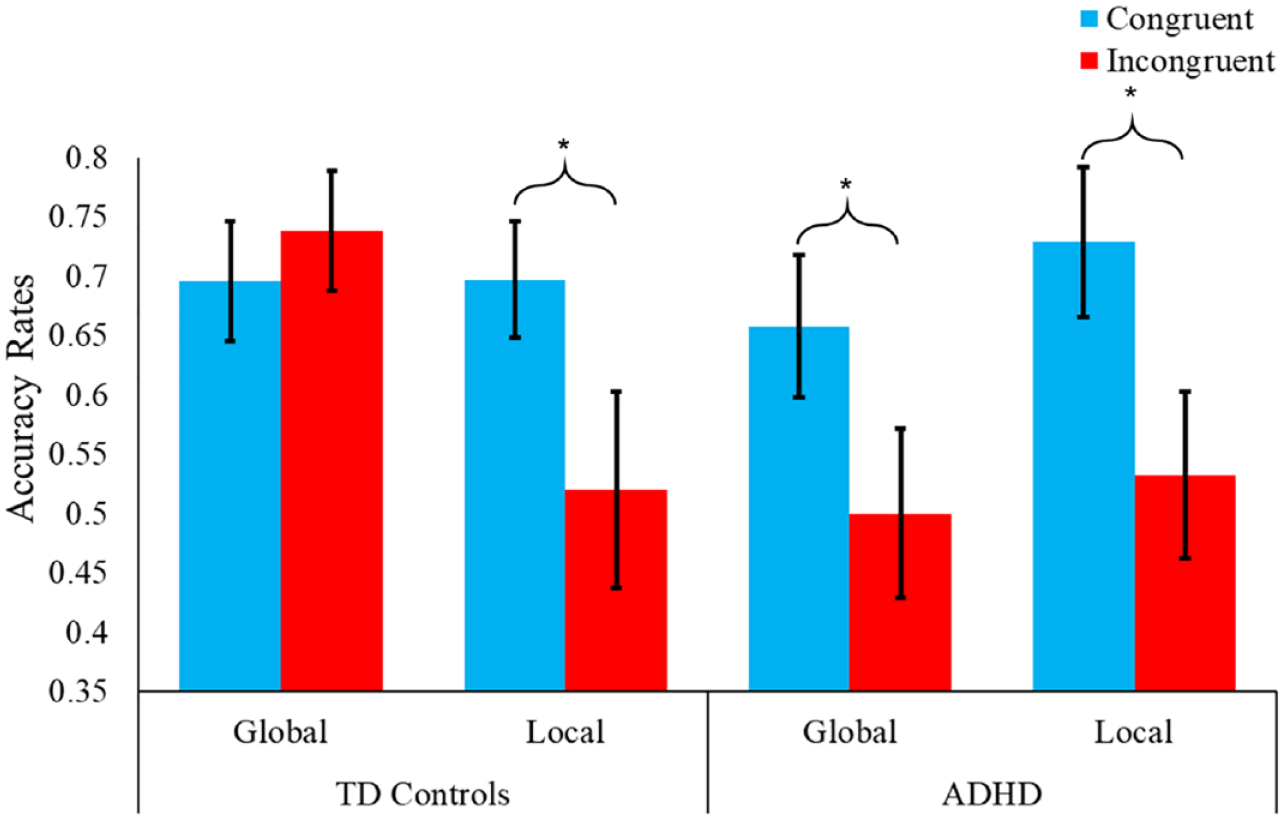
Mean accuracy rates (correct response ratio) for the melodic global-local task as a function of congruency and global/local conditions for the typically developed (TD) control group and the ADHD group. Error bars represent one standard error from the mean based on Cousineau’s (2005) method for within-subject designs.
To further investigate this three-way interaction according to our a-priori hypotheses, 2 two-way ANOVAs were carried out on accuracy rates data for each group separately, with attention condition and congruency as within-subject factors. For the TD control group, a significant simple main effect was observed for the auditory attention condition (F[1, 23] = 8.860, p = .007, = 0.278), indicating higher accuracy rates for the global compared to the local conditions. The simple main effect for the congruency condition was not significant (F[1,23] = 4.136, p = .054, = 0.152). The two-way simple interaction was significant (F[1,23] = 10.651, p = .003, = 0.317), indicating a classic global processing bias (i.e., Navon effect), such that accuracy rates were lower for the incongruent condition compared to the congruent condition, but only for the local condition (t[23] = 2.915, p = .008, d = 0.772) and not for the global condition (t[23] = 1.550, p = .135, d = 0.190; see Figure 2). For the ADHD group, the simple main effect for the congruency condition was significant (F[1,20] = 22.582, p < .001, = 0.530), indicating higher accuracy rates for the congruent compared to the incongruent condition. There was no significant simple main effect for the auditory attention condition (F[1,20] = 1.682, p = .209, = 0.078), and no significant two-way interaction (F[1,20] = 0.515, p = .481, = 0.025), indicating lower accuracy rates for the incongruent compared to congruent condition, in both the global (t[20] = 3.778, p = .001, d = 0.606) and local conditions (t[20] = 3.937, p = .001, d = 0.951; Figure 2), with no significant differences between them.
Discussion
The current study had two goals: (a) to demonstrate the existence of a global processing bias in the auditory modality and (b) to investigate global-local processing in ADHD participants using an auditory task. In typically developed (TD) participants, the results indicated a classic “Navon-like” global processing bias effect: the global dimension of the auditory stimulus was processed more accurately and with less interference from the local dimension, whilst the local dimension was processed less accurately and with more interference from the global dimension. Consistent with our predictions, and with previous global-local studies using visuospatial tasks (Cardillo et al., 2020; Cohen & Kalanthroff, 2019; Gargaro et al., 2018; Kalanthroff et al., 2013; Song & Hakoda, 2015), we did not find an indication for a global processing bias in adults with ADHD. While TD controls displayed a large congruency effect in the local condition and no congruency effect in the global condition, individuals with ADHD exhibited a large congruency effect in both the global and local conditions, with no difference between them. In other words, individuals with ADHD did not exhibit a tendency to prioritize the global compared to the local dimension of the auditory stimulus and thus were distracted by incongruent information, regardless of whether global or local information was presented.
The results of the current study contribute to our understating of auditory processing in ADHD. First, individuals with ADHD are extremely influenced by complex auditory environments (Laffere et al., 2021) and experience significant difficulties in speech-in-noise perception (Michalek et al., 2014), and in processing auditory stimuli with temporal variation (e.g., in a classroom; Cassuto et al., 2013; Schafer et al., 2013). The current study results can shed new light on this well-known phenomenon. In general, temporal patterns can be processed on both local and global levels (Geiser et al., 2014). The auditory stimuli might be processed less accurately in individuals who have no auditory global precedence, mostly in complex auditory environments with multiple tonal streaming. In turn, this might lead individuals with ADHD to “miss” parts (sometimes relevant) of the auditory scene and to focus on the local (sometimes irrelevant) aspect of the auditory scene. Thus, the lack of global bias in auditory processing in ADHD may be one cause for the difficulty to focus and process auditory information when that information is presented in a noisy environment, a common issue for individuals with ADHD.
The current study’s results can explain another implication of ADHD auditory processing, associated with core ADHD daily symptoms, namely that children and adults with ADHD exhibit difficulties in tracking, estimating, and producing the beat of rhythmic sounds (Carrer, 2015; Lense et al., 2021; Puyjarinet et al., 2017). Reduced global auditory bias might account for these difficulties, at least to some extent, as the global auditory bias influences attention allocation throughout grouping and long intervals. Moreover, a few recent investigations have suggested that deficits in temporal information processing (e.g., tapping reproduction task) may be linked to time perception (Slater & Tate, 2018; Tiffin-Richards et al., 2004), an ability that has been shown to be deficient in ADHD (Smith et al., 2002; Toplak & Tannock, 2005). Specifically, in a seminal series of studies, it has been shown that individuals with ADHD tend to overestimate time, such that time is subjectively perceived as longer for these individuals (e.g., Carrer, 2015; Zheng et al., 2022). In fact, exaggerated time estimation has even been suggested as an alternative explanation for the known “delayed aversion” effect in ADHD (Noreika et al., 2013; Toplak et al., 2006). Therefore, it is possible that the lack of auditory global bias found in ADHD may be one cause for the difficulty in estimating rhythmic timing, and thus, in time estimation in general.
The current study results demonstrate, for the first time, that a lack of global processing bias in individuals with ADHD exists beyond the visuospatial modality. The mechanism behind this broader, multi-dimensional bias can be inferred from previous studies. Accumulating evidence have shown that ADHD is characterized by low levels of alertness (e.g., Epstein et al., 1998; Nigg, 2006; L. Tucha et al., 2009). This notion of abnormal alertness levels in ADHD is also supported by both the disorder’s formal definition (American Psychiatric Association, 2013) and by the tools used to diagnose it, such as the Continuous Performance Test (CCPT; Conners et al., 2003) and the Test of Variables of Attention (T.O.V.A.; Greenberg et al., 1996), both highly contingent upon alertness levels. In fact, even the common neuropharmacological medications for ADHD (e.g., Methylphenidate) are stimulants, which increase alertness levels (Reid & Borkowski, 1984; O. Tucha et al., 2006). The effect of alertness on global-local processing has been demonstrated. In a series of studies, it has been shown that alertness enhances global processing, in both healthy controls (Tanzer et al., 2016; Weinbach & Henik, 2011) and individuals with ADHD (Kalanthroff et al., 2013). Therefore, it is possible that lower levels of alertness, characterizing ADHD, might result in reduced global processing in a general and multi-dimensional manner. This speculation regarding a potential mechanism which affects the general global-local information process in ADHD is a direction for future studies.
A few limitations of the current study should be considered. First, the experiment took place during the COVID-19 global pandemic. Although, performance (and dropout rates) was similar to previous experiments, it is important to mention that we could not deliver the instruction and ensure performance on the practice block in-person. Second, in order to ensure our results are exclusively driven by the existence of ADHD, we made a significant effort to ensure our participants have no comorbid disorder. However, it is important to mention that in ADHD, comorbid diagnoses are the rule rather than the exception. Thus, future replications of the current study results with a more heterogeneous sample are warranted.
In conclusion, the present investigation provides new insights into the underlying mechanism of information processing in ADHD. Our findings show: (a) that global-local processing can be investigated in the auditory domain and (b) that individuals with ADHD’s lack of global processing bias is not limited to the visuospatial modality and is likely to reflect a broader and more general multi-dimensional processing bias. Lack of global processing bias in the auditory domain might underlie the difficulty of individuals with ADHD to process complex auditory environments and perhaps even to track, estimate, and produce the beat of rhythmic sounds. That lack of global processing bias exists outside of the visuospatial domain indicates that this abnormal processing style may play an important role in ADHD phenotype.
Footnotes
Declaration of Conflicting Interests
The author(s) declared no potential conflicts of interest with respect to the research, authorship, and/or publication of this article.
Funding
The author(s) received no financial support for the research, authorship, and/or publication of this article.
