




Abstract
The aim of the present case study was to obtain an in-depth understanding of the long-term motivation in four world-class musicians and two Olympic athletes. One part of the sample (Case 1) included three world famous musicians and one Olympic champion who all currently enjoy busy successful careers. These individuals are referred to as High Performing Stayers (HPS). The other part of the sample (Case 2) included one highly gifted musician and one Olympic athlete who both decided to put an end to their highly successful careers. These individuals are referred to as High Performing Quitters (HPQ). The performers’ perceptions of underlying driving forces and motivational impediments on their journey toward excellence were investigated through the lens of Self-Determination Theory. Semi-structured interviews revealed conspicuous and contrasting motivational patterns throughout the development of the six performers. All the four HPS were largely driven by autonomous forms of motivation such a self-initiative, passion, curiosity and a desire for endless discovery and aspiration. In contrast, despite reaching the highest international level, the two HPQ turned out to be driven by controlled coercive forms of motivation throughout their journey toward excellence. Educational implications are discussed in relation to the main findings.
Keywords
Individuals who achieve the highest international level in fields such as music and sports have invested thousands of hours in deliberate practice and training (e.g., Ericsson, 2013; Ericsson et al., 1993). However, few performers make it all the way to the top. Reaching the highest international standard requires tremendous willpower and an ability to cope with impediments and adversity (Hatfield, 2016; Hatfield et al., 2016; Nielsen, 2004). The effort made, the dedication shown, and the achievements obtained by world-class performers may be considered extreme from a motivational perspective (Deci & Ryan, 2000; Ericsson, 2006). Consequently, quality of motivation is particularly salient in high achieving individuals and thus interesting to investigate from a psychological point of view (Evans et al., 2012; Hatfield, 2016). Nevertheless, elite performers have unique underlying motives in their strive for excellence that can be determined by a variety of internal and external factors (Lemyre et al., 2008). The present study refers to and compares high achieving individuals’ quality of motivation based on the two following cases:
Case 1 comprises four elite performers who enjoy ongoing successful careers. These individuals are referred to as High Performing Stayers (HPS). HPS are individuals who continue to strive for knowledge and new ways of developing excellence despite ups and downs.
Case 2 comprises two elite performers who reached the highest international level. Despite their success, they decided to quit their careers as world-class performers. Accordingly, these performers are referred to as High Performing Quitters (HPQ). Notably, HPQ did not quit their careers due to secondary causes (e.g., injury, fatigue, burn out, or a lack of job opportunities), but to a lack of motivation to strive professionally.
The present study aims to better understand how different motivational climates may have influenced six world-class performers’ quality of motivation throughout the various stages of their professional development. Hence, the present study aims to obtain a biographical understanding of adaptive and maladaptive impulses that influenced the performers’ long-term motivation and lack thereof.
Theoretical framework
The term motivation originates from the Latin verb movere, which in English means to move, or move forward. Schunk et al. (2013, p. 5) define motivation as “the process whereby goal-directed activities are instigated and sustained.” Motivation is affected by both environmental, cognitive and behavioral factors (Schunk & DiBenedetto, 2020; Schunk et al., 2013). While motivation has been viewed as a quantitative phenomenon by some scholars (e.g., Skinner, 1974), others conceptualize motivation as both a quantitative and qualitative phenomenon (e.g., Bandura & Schunk, 1981; Deci & Ryan, 2000; Elliot & Dweck, 2005). These scholars postulate that individuals who invest time, effort, and willpower in an activity are mostly driven by cognitive, environmental, and organismic motives (Ryan & Deci, 2020).
The present study is embedded theoretically in Self-Determination Theory (SDT), which is a broadly developed meta-theory of human motivation (Deci & Ryan, 1985, 2000; Ryan & Deci, 2020). SDT is divided into six mini-theories (for review see Ryan & Deci, 2017). From an organismic dialectical perspective, SDT claims that human beings are upward, explorative, and creative by nature (Ryan & Deci, 2000). Human functioning and wellbeing are dependent on environmental, social and cultural nutriments and support. SDT claims that human functioning and wellbeing are determined by the degree to which three basic psychological needs (i.e., autonomy, relatedness and competence) are supported or thwarted. In order to function optimally on a psychological level, all the three psychological needs ought to be supported (Deci & Ryan, 2000). Consequently, basic psychological need thwarting is associated with depression, burnout, alienation, drug abuse, and other psychopathologies (Deci & Ryan, 2000; La Guardia et al., 2001; Lemyre, 2005; Olafsen et al., 2017). Furthermore, SDT views human motivation as a continuous phenomenon reaching from amotivation to intrinsic motivation within various degrees of controlled and autonomous motivational regulations (Figure 1; Ryan & Deci, 2020). An extensive meta-analysis (narticles = 486; nparticipants = 205,000) tested the reliability of SDT as a continuum-like structure of motivation, statistically supported the notion that human motivation is largely based on distinct degrees of motivational regulation on a continuum that explains the various categories of human motivation (Howard et al., 2017).
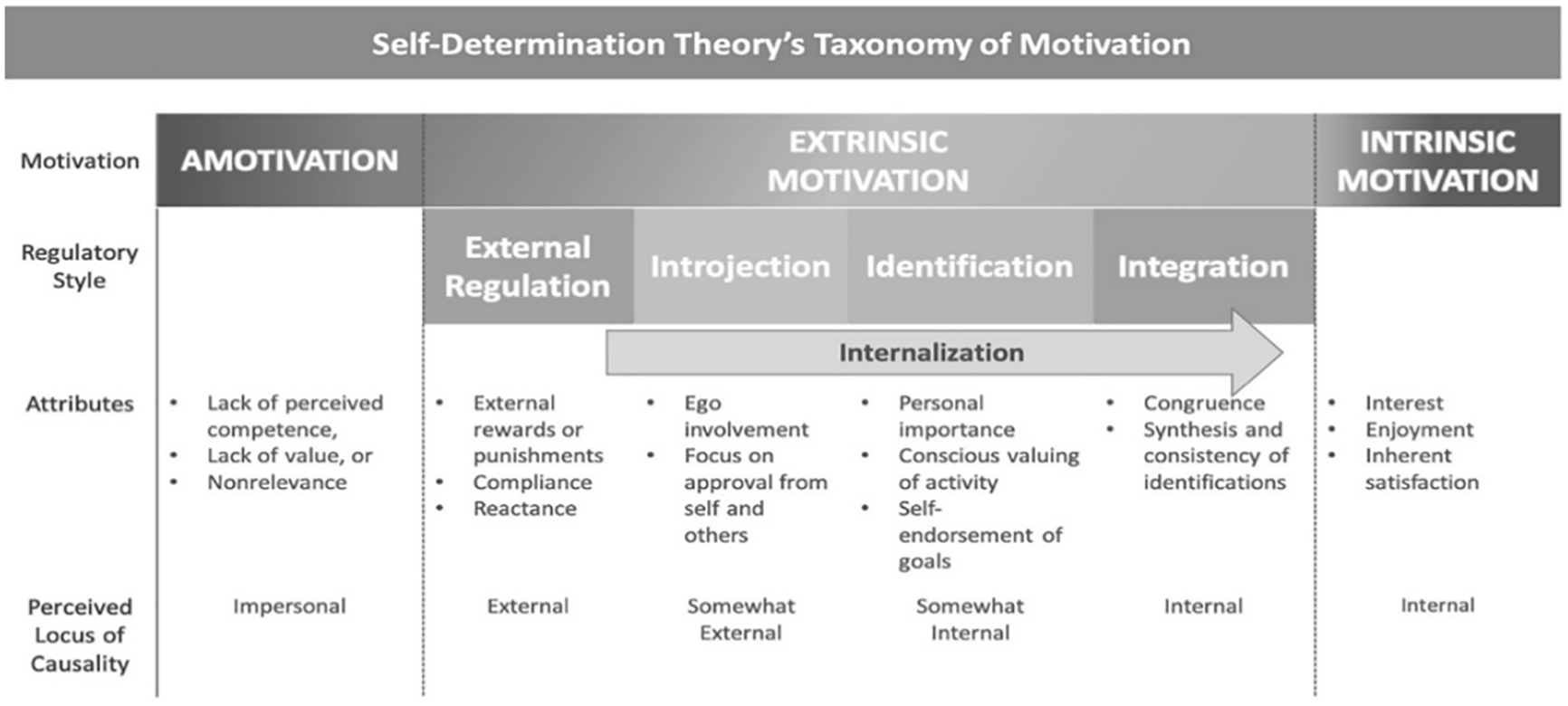
A Taxonomy of Motivation (Ryan & Deci, 2020).
Individuals are prone to both controlled and autonomous forms of extrinsic motivation based on both environmental regulations and personal perceptions (for review see Ryan & Deci, 2020). While controlled motivation inhibits personal endorsement of an activity, autonomously motivated individuals embrace the activity as personally fulfilling (Ryan & Deci, 2020). Autonomous motivation is associated with personal well-being, creativity, conceptual learning and vitality (Jang et al., 2010; Reeve et al., 2008; Richard & Frederick, 1997). While autonomously motivated individuals set intrinsic goals related to personal growth, collaboration, close relationships, and task-mastery, individuals who aspire within controlled environments are likely to set extrinsic goals, for example, outperforming others, winning, avoiding mistakes (Black & Deci, 2000; Deci et al., 1999; Evans & Bonneville-Roussy, 2015; Nielsen, 2008).
Motivation in aspiring and professional musicians
A relatively early study investigating the development of motivation among professional musicians (i.e., interview took place between 1976 and 1980), revealed that general environmental and social support from a competent other with whom one could have an elevated musical dialogue predicted the likelihood of pursuing a musical career (Manturzewska, 2016). A lack of such environmental support was found to be destructive to the gifted musicians’ careers (Manturzewska, 2016). Furthermore, a longitudinal study found that children who expressed a desire to become musicians early on and who sustained a stable regular amount of instrumental practice, continued with music 10 years after the first assessment (Evans & McPherson, 2015). Another study among aspiring musicians (n = 3,325) found that positive changes in motivation (i.e., enjoyment of performing, value of playing an instrument, self-belief in musical ability) were central predictors of expertise development (Hallam et al., 2016). A study among performing music students revealed a positive correlation between the students’ use of task goals (i.e., mastery of task at hand) and the use of metacognitive practice strategies (i.e., self-observation, concentration, self-evaluation). Negative correlations were revealed between ability avoidance orientation (i.e., focus on avoiding mistakes) and the use of cognitive and metacognitive strategies (Nielsen, 2008). Two more recent studies among music students found that support of basic psychological needs and engagement-coping strategies predicted greater commitment to quality practice, career-intentions, higher grades, and a high tolerance level when facing challenging tasks (Bonneville-Roussy et al., 2017; Evans & Bonneville-Roussy, 2016). A study based on a review of over 100 articles, books, and book chapters found that enjoyment and the feeling of empowerment in music activities are vital factors for overcoming challenges as aspiring musicians (Woody, 2021).
One of the most salient components of SDT is autonomy-support (for review see Reeve & Jang, 2006). Recent research in music education partly confirms the psychological role autonomy-support plays in enhancing music students’ quality of motivation (Valenzuela et al., 2017). Furthermore, intrinsic motivation, well-being and work ethic are strengthened when teachers and parents provide autonomy-support in aspiring musicians (Bonneville-Roussy et al., 2020; Comeau et al., 2015; Sichivitsa, 2016). Two recent studies revealed that autonomous motivation, relatedness (i.e., peer relationships), and self-oriented perfectionism (i.e., strive for self-improvement and a high standard) in aspiring musicians predicted a strong sense of vitality (i.e., self-esteem, personal agency, positive moods), and career commitment (Miksza et al., 2019a, 2019b). Furthermore, autonomy-support turned out to be as important for professional musicians as it is for aspiring young musicians. Orchestra musicians who were autonomously motivated were less prone to problem drinking compared with colleagues who were high in controlled motivation. The latter were more likely to give up their careers altogether (Parker et al., 2019).
Motivation in aspiring elite athletes
Autonomy-support is repeatedly found to be an important antecedent of vitality and well-being (Balaguer et al., 2012). In contrast, need-thwarting is related to ill-being and burnout among aspiring elite athletes (e.g., Balaguer et al., 2012; Lemyre et al., 2006). A recent study on gifted musicians, athletes and dancers in talent development programs, found that performers were involved in both controlled and autonomous forms of motivation. Factors such as social comparison and high contextual expectations triggered controlled motivation in the aspiring performers (Haraldsen, Nordin-Bates, et al., 2020). Furthermore, a qualitative study found similar patterns among female athletes who turned out to be predominantly autonomously motivated during childhood. However, as the athletes grew older, their motivation shifted toward external and introjected regulation based on maladaptive environmental and personal pressure (Jordalen et al., 2019). A study comparing biographical characteristics in elite and super-elite athletes found that super-elite athletes seemed to have an elevated sense of control through mastery in high-pressure environments (Guellich et al., 2019). Social and organizational support together with a conducive sport environment encouraged world-class Caribbean track and field runners to successfully progress with sports and remain engaged at the junior level (Thomas et al., 2019). In contrast, a longitudinal survey of athletes and performing arts students found that performers who experienced frustration of basic psychological needs were more likely to experience maladaptive growth in terms of perceived anxiety and inferior performance levels (Haraldsen, Solstad, et al., 2020). Another study found that coaches who were high in psychological need-satisfaction turned out to be more likely to provide autonomy-support. This indicates a transferring effect between coaches’ need satisfaction, their ability to provide autonomy-support, and perceived need-satisfaction among athletes (Solstad et al., 2015). Similarly, perception of controlled motivation among elite skiers predicted controlled behavior among coaches’ and athletes’ ill-being at the end of the season (Stenling et al., 2017). Hence, these studies indicate that motivational characteristics (i.e., controlled vs autonomous) of significant others influence the extent to which performers perceive their surroundings as controlling or autonomous (Solstad et al., 2015; Stenling et al., 2017).
Research questions
Despite a large body of research on motivation in sports, and more recently in music, few studies have investigated the quality of motivation based on: (a) qualitative methods, (b) targeting both music and sports (Haraldsen, Nordin-Bates, et al., 2020), and (c) in-depth studies on performers on the highest international level (Orlick & Partington, 1988; Talbot-Honeck & Orlick, 1998). Studies investigating and comparing determinants of motivation and/or lack thereof among elite musicians and athletes (i.e., HPS and HPQ) at the highest international level is to date nonexistent. With this in mind, the present study aims to address the following main research question and four associated sub-questions:
1. What are important determinants of world-class musicians’ and Olympic champions’ (i.e., HPS and HPQ) long-term motivation or lack thereof?
(a) What role do autonomous and controlled forms of motivation play in HPS’ and HPQ’ professional development? (b) Do basic psychological need-satisfaction and need-thwarting during childhood affect the quality of motivation later in the careers of HPS and HPQ? (c) What role do different motivational regulations play in the execution of practice and performance among HPS and HPQ? (d) What are important motivational regulations contributing to maintaining or quitting professional careers among HPS and HPQ?
Methods
Methodological approach
Robert Stake defines a case study as “the study of the particularity and complexity of a single case, coming to understand its activity within important circumstances” (Stake, 1995, p. 11). This echoes the present study’s objective to understanding HPS and HPQ as separate cases by investigating underlying qualitative aspects of motivation in each of these two categories of elite performers. The perceptions and experience of the aspiring musicians and athletes who were either HPS or HPQ paved the way for a second aim: to compare the two cases (HPS and HPQ) to form a quintain (i.e., differences and similarities in qualitative motivation across the cases). Investigating both collective and specific aspects of the cases were imperative to catch the complexity of the quintain (for review, see Stake, 2006). The purpose in the present study is to go beyond the two cases to form an instrumental understanding of the cross-product of HPS and HPQ (for review, see Stake, 2006).
Participants
To illuminate the aim of the present study, information-rich participants (i.e., exceptional musicians and athletes) were purposefully selected based on deviant case sampling and matched comparisons strategies (Patton, 2015). The participants were considered deviant (i.e., the highest international standard) due to a large discrepancy in level of performance when compared with professional musicians and athletes in general. The matched comparison strategy enables the comparison of “cases that differ significantly on some dimensions of interest to understand what factors explain the difference” (Patton, 2015, p. 267). The two cases in the present study were HPS and HPQ. Participants had to meet the following inclusion criteria:
HPS: World-class musicians/Olympic champions who currently enjoy active careers.
HPQ: World-class musicians/Olympic champions who chose to quit successful careers.
Based on the above inclusion criteria and a thorough search for participants, fifteen performers were contacted through their management and/or by e-mail. However, only 6 of the 15 performers were able to participate. The six performers ultimately recruited were four world-class musicians (three HPS and one HPQ) and two Olympic champions (one HPS and one HPQ: Table 1).
Overview of the Participants’ Age, Sex, Profession, and Nationality.
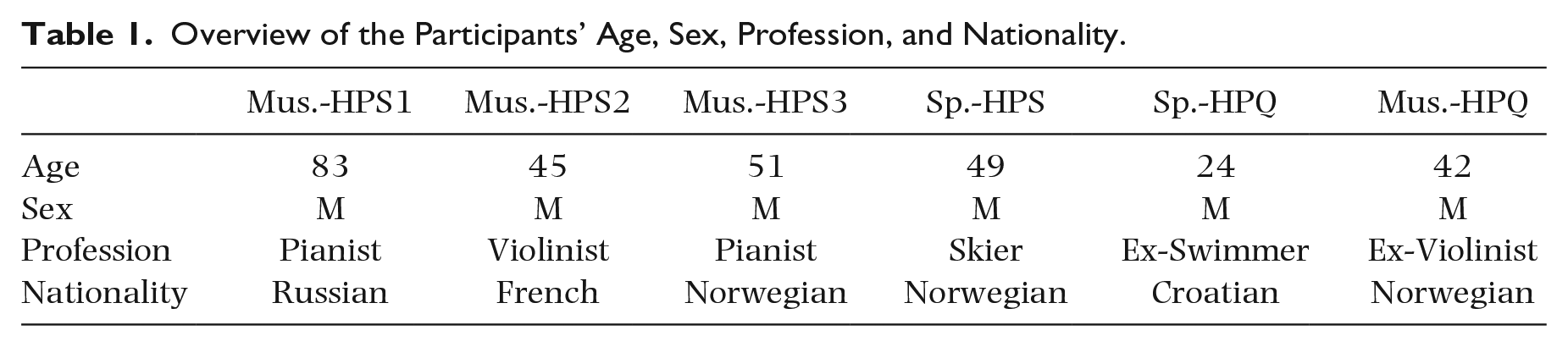
The average age of the participants was 49 years (spanning from 24 to 83 years of age). Three of the HPS musicians (referred to as Mus.-HPS 1, 2, and 3), are regarded as celebrated figures on the international classical music scene. The HPS in sports (Sp.-HPS) is regarded as a leading figure within cross-country skiing. The HPQ in music (Mus.-HPQ) was regarded as a highly distinguished chamber musician and soloist. The HPQ athlete (Sp.-HPQ) used to be one of the most promising figures internationally within swimming. However, the inclusion criteria for HPQ limited the number of suitable participants due to the rarity of such performers (e.g., one of the potential recruits, a female world-class HPQ in music, refused to participate because she found it both challenging and touchy to share her reasons for giving up her career).
Qualitative interviews
Semi-structured interviews were applied to investigate motivational development from a biographical standpoint (Kvale et al., 2015; Shopes, 2011). Oral history interviewing was selected for generating biographical firsthand knowledge about important events that had an impact on the participants’ development as performers (Shopes, 2011). Combining an oral history approach with semi-structured interviewing in the present study makes sense because semi-structured interviews target specific events in a flexible non-chronological manner, while oral history interviewing “ is an inquiry in depth [. . .] a planned and scheduled, serious and searching exchange, one that seeks detailed, expansive and reflective accounts of the past” (Kvale et al., 2015; Shopes, 2011, p. 452). Accordingly, the questions targeted the participants’ early experiences of music or sport. They were asked how they were introduced to various activities, how they perceived their practice/training, and people involved in their early development, what role these people had, and what role the performers played in their own development. Additional questions concerning perceptions of joy, goal orientation, pressure, and central driving forces during youth and adulthood were posted to get an overview of the quality of long-term motivation. In line with Kvale et al. (2015), all questions were posted in a non-leading manner, for example, “How were you introduced to music/sports?,” “Can you remember how the instrument was introduced to you?,” “Could you describe how you experienced this activity?,” “What made you feel this—was it always like this?,” “Who were important influences around you, what were their roles?.” The questions were asked in a non-chronological order based on the topics that the participants spontaneously brought up (Kvale et al., 2015), enabling a semi-structured natural conversation-like interview process.
Data collection
The data collection was conducted and carried out by the author of the present article who is an experienced senior researcher with extensive knowledge with qualitative inquiries. All the interviews were completed within a 9-month period depending on the participants’ availability. The individual interviews lasted between 48 and 93 min and were audio-recorded on an iPad. Four of the interviews were carried out through video-conversations, one was carried out in the home of one of the participants, and one at a concert house a few hours before a rehearsal. The interviews were carried out both in English (i.e., the Russian pianist and the French violinist) and in Norwegian. The interviews that were carried out in Norwegian were translated into English by the author of this article.
Data analysis
The present study takes on a post-positivistic philosophical approach (i.e., critical realism), viewing objective and value-free science as unfeasible (Bhaskar, 2015; Denzin & Lincoln, 2011). Hence, the present research axiomatically supports that social interaction and phenomena can occur both in the mind and in the objective world (Bhaskar, 2015; Miles & Huberman, 1994). Consequently, lawful and somewhat stable relationships might be captured (i.e., quantitatively or qualitatively) through valid and verifiable methods of inquiry (Bhaskar, 2015; Miles & Huberman, 1994). A partly theory-based abductive inquiry was selected due to the present study’s embedment in SDT. Moreover, scientific inquiry that refines and expands current theory abductively is in line with the present study’s epistemological position and methodology (Emmel, 2013; Patton, 2015). The present study triangulated deductive (confirmatory) and inductive (exploratory) strategies by both taking theory (i.e., SDT) and extra-theoretical components (e.g., instrumental practice strategies, self-control, grit) into account.
Thematic analysis (TA) was selected for carrying out the analysis. TA can be applied in relation to a broad spectrum of different philosophical and theoretical approaches (Braun & Clarke, 2006, 2013). In line with Braun and Clarke (2006), the following five-stage approach was applied in relation to the data analysis:
Familiarization phase: During this phase, the investigator listened through the recorded interviews several times, while taking notes that remarked some initial aspects and trends.
Initial coding: During this phase, the investigator carefully read through all the manuscripts while sorting out central features and initial mini-themes throughout the data material. Several mini-themes were identified (e.g., role of parents, significant others, exploration, personal engagement, discipline, alienation, pressure). This initial coding phase was both inductive and theory driven.
Theme-development: This phase linked the initial codes and mini-themes to more general themes that were carefully systemized in theme charts for each participant. The individual theme charts were thereafter divided into three biographical stages (i.e., childhood, adolescence and adulthood) to get a historical perspective of the various mini-themes (Shopes, 2011). This preparatory phase facilitated the cross-case analysis through which larger patterns across the cases (i.e., HPS and HPQ) were explored further (Braun & Clarke, 2013).
Reviewing the fit between the codes and the themes from the previous stage: The investigator fitted the previous codes and mini-themes of the biographical theme-charts into more general themes consisting of contrasting and coinciding factors across the data-set (e.g., self-initiative vs others-initiative, creative processes vs drilling, social interaction and support or lack thereof, varied practice vs monotonous practice, environmental and subjective control).
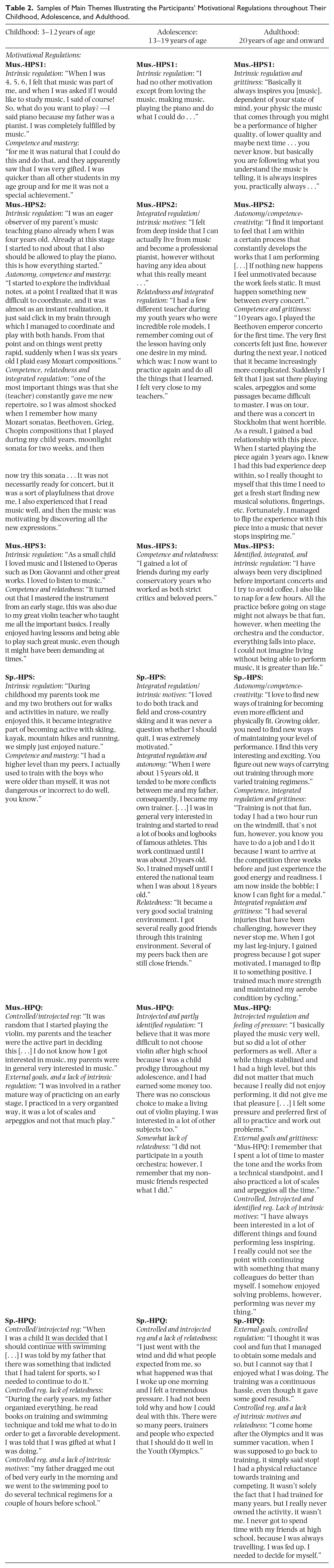
Reporting data: This was carried out by selecting vivid examples and paraphrases that captured central content and themes (Table 2). The reporting was based on the overall research questions, theory and literature. The entire analysis was organized biographically in terms of thematic characteristics concerning childhood, adolescence, and adulthood (Table 2).
Samples of Main Themes Illustrating the Participants’ Motivational Regulations throughout Their Childhood, Adolescence, and Adulthood.
Results and discussion
The purpose of the present study was to identify and elaborate important determinants of world-class musicians` and Olympic athletes` long-term motivation or lack thereof. To enable a shorter result chapter, a summary of the main themes and direct quotes based on important findings is illustrated in Table 2. For the same reasons, the discussion is linked to the result chapter.
The role of autonomous and controlled motivation during childhood
Diverse motives and regulations at the very start
The analysis revealed that the HPS and the HPQ had contrasting motives for getting involved with music or sports in the first place (Figure 1). The HPS mainly expressed intrinsic reasons for starting with music/sports: I was about eight years old and it was the first time I heard the orchestra. I remember very well that I was absolutely transfixed by the sound of the symphony orchestra, I sat next to my friend and I was amazed. (Mus.-HPS1)
The personal engagement and joy that all the HPS reported during childhood were autonomous states (e.g., Reeve et al., 2008; Ryan & Deci, 2020). The activity was embraced as meaningful and enjoyable among these performers, Mus.-HPS1: “I had no other motivation except from loving the music, making music, playing the piano.” I remember looking forward to skiing training with the other boys in the group [. . .] at times I also preferred to stay behind at the training site after the official training had ended for working on various technical aspects. (Sp.-HPS)
The two HPQ seemed to be less self-determined during their early years. They got involved with music and sports because it was suggested by parents or teachers: It was random that I started playing the violin, my parents and the teacher were the active part in deciding this [. . .] I do not know how I got interested in music, my parents were in general very interested in music. (Mus.-HPQ)
They did not report a specific desire toward music/sports, they just happened to be introduced to it (Table 2). In general, the HPQ seemed to practice and train based on controlled and introjected motivational states (Ryan & Deci, 2020). While all the HPS reported that they were free to play around with music/sports during their early years, the HPQ reported to have carried out predetermined practice schedules consisting of drilling exercises from a relatively early stage, Sp.-HPQ: “my father dragged me out of bed very early in the morning and we went to the arena to do several technical regimens for a couple of hours before school.” Thus, external control and pressure seemed to overshadow the mere joy of carrying out the activity itself (Deci et al., 1999; Woody, 2021). This was a marked contrast to the curiosity, joy and self-initiated discovery expressed by the four HPS, for example, Mus. HPS1: “I loved music and I listened to Operas such as Don Giovanni and other great works. I loved to listen to music.” The four HPS seemed to be embedded within an autonomously driven environment (Evans et al., 2012; Jang et al., 2010; Jordalen et al., 2019).
Basic psychological needs during childhood
In line with basic psychological need theory, the results revealed that all the participants felt competent in terms of early mastery of specialized tasks (Table 2). However, the responses of the HPQ pointed in the direction of loneliness and predetermined practice schedules, Mus.-HPQ: “I simply did what I was told by my teacher, which was mainly scales, arpeggios and a few pieces.” Thus, despite early mastery experiences, basic psychological needs such as autonomy and relatedness seemed to be lacking in their childhood (Ryan & Deci, 2017). For instance, the Sp.-HPQ expressed that he was told how gifted he was, and that accordingly he had to continue with swimming. Moreover, the analysis revealed that practice/training among the HPQ was based on externally defined duties and demands set by teachers and parents. This controlled motivational climate seemed to thwart the HPQ’ need for autonomy throughout their development. This need-thwarting effect may corresponds to Solstad et al. (2015), who found that coaches low in psychological need-satisfaction were more likely to provide a need-thwarting coaching style. Other studies have revealed a connection between teacher and student motivation and need-support (i.e., autonomous motivation) (e.g., Ahn et al., 2021). The present study revealed that the motivational climate among the HPQ did not seem to provide autonomy-support (Reeve et al., 2004). Nevertheless, the two HPQ evidently demonstrated highly favorable and virtuoso performance achievements. These promising results seemed to align with the fact that they simply did what they were told to do by knowledgeable significant others who provided frequent expert feedback (Ericsson & Charness, 1994).
Contrasting sources of competence, relatedness and autonomy
All the HPS clearly expressed how they perceived mastery and how this contributed to their motivation for continued practice (Table 2). As oppose to the HPQ, it seemed as if the experience of competence was accompanied by a greater sense of autonomy among the HPS. The perception of competence among the HPS was also tied to positive relatedness to peers and teachers, Mus.-HPS2: “It was very inspiring to meet others who were doing the same as myself during local music competitions.” Furthermore, the Mus.-HPQ emphasized that early mastery experiences motivated him because he rapidly gained a higher level than other children in the music school, which, in turn, motivated him to continue to practice. Rather than focusing on musical factors, the Mus.-HPQ brought up several external factors regarding technical bravura and/or being outperformed by others. In fact, the Mus.-HPQ compared his level of performance to the performance level of other violinists throughout the whole interview. This aligns with somewhat introjected forms of motivation (Ryan & Deci, 2020). In contrast, the Mus.-HPS2, who expressed that he remembered that “it was a sort of playfulness” that drove him. This playfulness and exploratory practice style seemed to be the result of his first piano teacher’s ability to provide autonomy-support. Furthermore, in contrast to the Mus.-HPQ, the Mus.-HPS2 emphasized how he built important friendships through piano competitions later during childhood. He felt that he had a special private space that he could share with a few others who had the same interest for music. Thus, it was never a question of being outperformed, or outperforming others. The focus was on discovering new music and ways of acquiring it. In fact, all the HPS spoke about their childhood in terms of discovery, playfulness, and fruitful relatedness to significant others. Accordingly, autonomy-support has been tied to aspiring musicians’ intrinsic motivation, well-being and work ethic (Bonneville-Roussy et al., 2020; Comeau et al., 2015; Sichivitsa, 2016), and to intrinsic motivation and performance among college students (Garcia & Pintrich, 1996).
Like the Sp.-HPQ and the Mus.-HPQ, the Mus.-HPS3 recognized that he underwent highly systematic practice schedules during his late childhood years, practicing 1 hr before school, in addition to a couple of hours after school. However, he also pointed out that he enjoyed being systematic and recognized how deliberateness enabled him to perform the great music he wanted to master. He underlined that his work ethic and positive drive was partly due to having a highly fruitful relationship with his first teacher, whom he admired immensely. She (i.e., his first teacher) was mentioned numerous times in positive terms throughout the interview. These experiences correspond with both identified and integrated forms of autonomous regulation (Ryan & Deci, 2020), as well as satisfaction of basic psychological needs (Ryan & Deci, 2017). Importantly, this illustrates the fact that autonomy-support may take place even within highly organized environments defined by significant others. However, the autonomy-supported agent (i.e., the Mus.-HPS3) experienced personal meaningfulness, and accordingly an internal locus of control despite being dependent on the systematic directions from the significant other (deCharms, 1977). Accordingly, Hallam et al. (2016) found that individuals who valued and enjoyed practicing and performing at a young age were more likely to become expert performers compared with those who did not. Notably, all the performers in the present study continued to aspire toward expertise based on highly contrasting qualities of motivation.
Motivational regulations during the critical years of adolescence
Intrinsic and extrinsic rationales for continuing
Evidently, all the participants aspired toward the highest international standards, albeit within different motivational frames. All the HPS reported that there was never a question giving up music or sports. The analysis revealed that all the HPS had predominantly intrinsic reasons for continuing to aspire toward a professional career, for example, Mus.- HPS2: “I felt from deep inside that I can actually live from music and become a professional pianist.” The HPS seemed to have an unwavering focus on developing as performers, Sp.- HPS: “I was in general very interested in training and started to read a lot of books and logbooks of famous athletes.” Furthermore, all the HPS had an intrinsic drive that carried them through both ups and downs: Mus.-HPS2 “It was obviously not always entertaining and fun to practice, especially not when I got injured, however, the music and the idea of transmitting it to others kept me going.” However, the two HPQ reported that they continued with music/sports because they had reached a high level, Mus.-HPQ: “I believe that it was more difficult not to choose the violin after high school because I was a child prodigy throughout my adolescence, and I had earned some money, too.” Both the HPQ avoided to discontinue because they were not willing to compromise all the hard work they had already invested. This reasoning is in line with both controlled and introjected forms of motivational regulation (e.g., Jordalen et al., 2019; Ryan & Deci, 2020). The Sp.- HPQ was repeatedly told by his father (who was also his main coach) that it would be a tragedy to compromise his talent and all the accumulated work by giving up swimming altogether. Thus, it was his predetermined duty to continue and explore how far he could reach on an international level. Conspicuously, neither of the HPQ expressed any joy regarding performing per se. However, the Mus.-HPQ reported that he enjoyed figuring out how to master virtuoso violin playing. However, he did not emphasize or mention the music itself as a source of inspiration. The Sp.-HPQ continuously did what he was told by his father. The motivational climates of both the HPQ were accordingly both controlling and introjecting (Ryan & Deci, 2020). Hence, the activities of the two HPQ seemed to be carried out based on pressure, compliance, external rewards, and approval from others (Stenling et al., 2017; Valenzuela et al., 2017).
The role of autonomy-support
The analysis revealed a conspicuous contrast between the fulfillment and the frustration of autonomy-support among the HPS and HPQ in general. The Sp.-HPQ was demanded to follow his father`s training schedules, whereas the Sp.-HPS started training himself opposing his father, who was previously his coach. Hence, the Sp.-HPS was left to decide and figure out for himself. In contrast, the Sp.-HPQ had to follow orders and did so reluctantly. Another distinction between the HPS and HPQ was the quality of perceived relatedness to significant others. Both the HPQ expressed relatedness to peers and trainers, however in terms of external competition and pressure (Table 2). However, all the HPS expressed how either teachers or peers inspired them, Mus.-HPS2: “I remember coming out of the lesson having only one desire in my mind, which was; I now want to practice again and do all the things that I learned. I felt very close to my teachers.” Three of the four HPS also expressed gratitude and fulfillment through meeting others with the same interest as themselves. This sense of social relatedness and autonomy-support seemed to have affected the HPS’ work ethic, personal agency and creativeness (Miksza et al., 2019a, 2019b). Despite these basic motivational differences between the HPQ and the HPS, the objective level of demonstrated goal achievement and performance was outstanding. However, the perceived effort and compromises needed for reaching a high international level seemed psychologically demanding for the two HPQ. During this stage of development, the four HPS experienced basic psychological need support. Furthermore, the two HPQ seemed to have satisfied their need for competence. However, their needs for relatedness and autonomy were apparently thwarted. This finding indicates that the two HPQ may have experienced some degrees of psychopathology due to need-thwarting (Deci & Ryan, 2000). In fact, the Sp.-HPQ reported being worried and stressed due to the strict regimen he had to put up with as a teenage athlete. As a reslt, he developed an aversion toward swimming. For several years he managed to suppress this aversion due to tremendous external pressure and expectations. The Mus.-HPQ expressed uncertainty due to increased competition from peers within the talent development program he attended. However, he also felt that he kept up with the best players in the program, and thus found it wise to continue to aspire (Table 2). Moreover, listening to the two HPQ speaking about their development as teenage performers indicates that they were driven by controlled and introjected regulatory styles (for review see Ryan & Deci, 2020).
Adulthood: motivation to continue or terminate outstanding careers
Autonomous or controlled motives as determinants
The participants had diverse reasons for entering professional careers. In general, the HPS tended to be triggered by a continuous search for creativeness, exploring new ways of expressing music and discovering effective solutions to technical problems (e.g., Nielsen, 2008). The HPS’ emphasis on self-engaging and creative activities is in line with research finding that autonomously driven individuals are likely to engage in creative processes and flow (Black & Deci, 2000; Valenzuela et al., 2017). Three of the HPS expressed that their practice process prior to competitions/concerts might at times be challenging and not necessarily fun. However, the true joy of competing and performing overshadowed these challenges (Table 2). This confirms Ericsson et al. (1993) definition of deliberate practice as a highly structured activity, the explicit goal of which is to improve performance. Specific tasks are invented to overcome weaknesses, and performance is carefully monitored to provide clues for ways to improve it further. We claim that deliberate practice requires effort and is not inherently enjoyable. Individuals are motivated to practice because practice improves performance. (Ericsson et al., 1993, p. 368)
Furthermore, the motives, reasons and efforts invested in preparative activities were autonomous (i.e., identified and integrated) among the HPS. The HPS also reported enthusiasm regarding practice and training, Mus.-HPS2: “I always like to discover new ways of phrasing and solving musical challenges.” During the interviews, neither of the two HPQ mentioned creative processes as part of developing as performers. Instead they reported several experiences tied to introjected and controlled regulation (Ryan & Deci, 2020): I basically played the music very well, but so did a lot of other performers. After a while, things stabilized, and I achieved a high level. This did not matter that much because I really did not enjoy performing, it did not give me that pleasure [. . .] I felt some pressure and preferred first of all to practice and work out technical problems. (Mus.-HPQ)
The mus.-HPQ did not mention purely musical aspects. However, he recalled that he was very much into finding ways of refining the technical aspects of playing his instrument. As opposed to the four HPS’ focus on joy and musical fulfillment, he tended to gravitate toward the mechanical/technical aspects of performance. The Sp.-HPQ did not seem to be involved with the processes of competing, it was simply a job that had to be done. There seemed to be little personal engagement and passion among the two HPQ (Haraldsen, Solstad, et al., 2020).
Autonomy-support turns out to be of imperative importance for harnessing constructive motivational patterns among performing artists and athletes (e.g., Haraldsen, Solstad, et al., 2020; Parker et al., 2019; Solstad et al., 2015). According to the results, the two HPQ were part of less autonomy-supportive environments throughout their development. All the HPS and HPQ were gritty, deliberate and hardworking, however the driving force behind the HPS were based on autonomous forms of motivation, while the HPQ tended to be regulated by controlled forms of motivation (Ryan & Deci, 2020). External pressure (competitiveness), the lack of social relatedness, and a lack of interest in competing and performing turned out to be central factors for quitting highly successful careers among the HPQ. For example, Mus.-HPQ: “I really could not see the point in continuing with something that many colleagues do better than myself.” Conspicuously, the two HPQ reached the highest international level by thriving within a maladaptive motivational climate. Nonetheless, it turned out as evident that this could not continue forever, Sp.-HPQ: “it simply said stop! I had a physical reluctance against training and competing. It wasn’t only the fact that I had been training for many years, but I really never owned the activity, it wasn’t me.” This statement clearly demonstrated how controlled motivational states (i.e., lack of the sense of self) in the end enforced the two HPQ to decide to put an end to their careers (for review see Reeve et al., 2008; Ricard & Pelletier, 2016; Ryan & Deci, 2020).
The conspicuous contrasts between the HPS’ and HPQ’ quality of motivation may be explained by the immense amounts of deliberate work needed for reaching the very top level of performance (Lehmann & Jørgensen, 2012). Thus, it is reasonable and logical to believe that quality of motivation is particularly prevalent in performers who invest thousands of hours in deliberate practice. Moreover, reaching the highest level through investing innumerable hours of practice in activities that do not align with a sense of self, seems to be the case with some high achieving individuals. The present study revealed that both the HPQ continued (i.e., avoided to quit) for many years due to the high level they had achieved, and simply the fact that they could make a living out of their high acheievments. Noticeably, the fact that the HPQ and HPS were able to reach the highest level based on very different underlying motives is of significant interest, as it indicates that quantitative amounts of motivation (i.e., time spent on deliberate practice regardless of motivational quality) could be sufficient to reach the highest level (e.g., Ericsson et al., 1993; Skinner, 1974). Nevertheless, quality of motivation turned out to explain more subtle aspirational differences that ultimately revealed the consequences of long-term exposure to controlled, as well as autonomous motivational climates on the performers’ professional outcomes (Deci & Ryan, 1985).
Limitations
The present study is subject to several limitations. First, the number of participants was low. This was due to the rarity of the targeted cases and difficulty in recruiting additional HPQ. Accordingly, generalization of the findings is both impossible and inappropriate (Creswell, 2009). Second, the accuracy of retrospective interviews is limited. The present study fully counted on the participants’ recollection of past episodes, which might be problematic (Kvale et al., 2015). However, several of the participants’ statements and reactions to the various questions seemed to be based on an emotional connection with the subject matter. Thus, they were seemingly genuinely involved on a personal level while being interviewed and explicit in their accounts. This strengthens the trustworthiness of the historical interviews (Shopes, 2011). On one hand, this study found that controlled motivation was tied to somewhat mechanical practice schedules focusing on technical matters. On the other hand, autonomous motivation was associated with creative exploration. These matters deserve more attention in future research by investigating the connection between motivational states, deliberate practice, creativeness, and actual exertion of performance.
Conclusion and educational implications
The present study revealed a continuum of motivational regulations from childhood throughout adolescence and adulthood. The initial desire or lack thereof to start with music/sports along with a basic driving force for practice and performance seemed to affect the performers throughout their careers (Table 2). Conspicuous differences between the HPS and HPQ were discovered in their strive for excellence. Based on the performers’ motivational biographies, it is reasonable to suggest that the quality of motivation (i.e., controlled vs autonomous states) during childhood played an important role in the development of motivational quality throughout the aspirational journey towards becomming world class performers. The present study discovered a marked distinction between the HPQ’ (i.e., whose aspirational activities were controlled, monitored and regulated by external forces) and the HPS’ (i.e., who recollected a strong desire to start playing a musical instrument based on intrinsic motives). All the participants in the present study had early experiences of mastery (i.e., competence need satisfaction). However, in contrast to the HPQ, the four HPS were truly autonomous in their decisions and in their relationships with significant others (i.e., aspirations based on internal loci of control). Although two HPQ also turned out to satisfy their need for competence through repeated mastery experiences, basic psychological needs for relatedness and autonomy were partly thwarted as they felt pressure from the environment (i.e., competition, demands and high expectations; external loci of control). Strikingly, the present study revealed that basic psychological need satisfaction and/or thwarting during the early years of aspiration seemed to stick with the performers throughout their journey toward excellence. This aligns with previous research finding that intrinsic motives during the first years of playing an instrument are crucial for quality motivation later in life (Evans & McPherson, 2015; Manturzewska, 2016). In contrast, the Sp.-HPQ, who turned out to be highly externally regulated throughout his developmental years, reported a strong aversion toward swimming. He was basically unable to enter a swimming pool several years after giving up his career. However, when he decided to take up swimming once again (i.e., on his own initiative) after retiring professionally from swimming, he reported experiencing a tremendous sense of joy for the first time. The fact that this decision was self-determined and free of controlling factors that had coerced his career in the first place is of educational importance (e.g., Jang et al., 2010, 2016; Ricard & Pelletier, 2016).
In general, significant others played a central role in the development of the performers’ motivational profiles. Thus, a lack of identifying and being integrated with the activity from an autonomous standpoint was associated with the development of long-term introjection and controlled motivational patterns (Ricard & Pelletier, 2016; Ryan & Deci, 2017; Solstad et al., 2015; Taylor et al., 2014; Thomas et al., 2019). Nevertheless, autonomy-support does not imply that young performers need to be independent in their striving. On the contrary, significant others ought to challenge young performers’ sense of curiosity through both deductive and inductive regulations (Ryan & Deci, 2017). All the participants in the present study were exposed to a traditional master-apprentice style of learning (Lave & Wenger, 1991). However, the teachers/trainers of the four HPS seemed to motivate the HPS in a way that made the HPS motivate themselves by providing autonomy-support, as well as intrinsic goals and expectations (Jang et al., 2010, 2016; Reeve et al., 2004).
This study has found that it is possible to reach the highest international level in music and sports based on both controlled and autonomous forms of motivation. On one hand, the HPS were all autonomously motivated and continued to aspire and flourish. On the other hand, the two HPQ who aspired within a controlled motivational climate from the very beginning, remained externally regulated throughout their development. As a result, both the HPQ took what they perceived as a paramount and autonomous decision, namely, to put an end to their careers. Finally, educators,’ teachers’ and coaches’ knowledge and ability to provide autonomy-support might be of imperative importance in facilitating fruitful long-term aspiration in young performers. Previous research has mainly focused on the relations between autonomy-support, intrinsic motivation, need-support, and positive outcomes (i.e., academic achievement) (e.g., Garcia & Pintrich, 1996; Taylor et al., 2014). Thus, in addition to gaining a better understanding of the prevalence of controlled motivation in elite performers, the present study’s findings indicate that a more general understanding of the psychological implications and the relations between need-frustration, controlled motivation, deliberate practice, and high performance is needed.
