



Abstract
This study examined the motivation of child and adolescent music students to learn instruments in five Austrian music schools using a person-centered approach. Drawing on self-determination theory, two autonomous and controlled forms of motivational regulation were surveyed. The results of a cluster analysis (N = 616) were used to construct four motivational profiles: one autonomously motivated type (high quality), one overall highly motivated type (high quantity), one moderately autonomously motivated type (low quality), and one type with poor quantity motivation. The clusters showed differences in the support required to meet music students’ basic psychological needs in music lessons, which are essential determinants in the development of autonomous motivation, in the individual activity preferences associated with playing an instrument, and in the tendency to stop playing an instrument. No differences were found between the instrument groups and gender. This study provides theoretical and practical implications of a person-centered approach to music-related motivation research.
Keywords
Introduction
Some children and adolescents are enthusiastic about learning a musical instrument, while others may find little joy in the experience and struggle to develop sustained intrinsic motivation. These differences can be attributed to the individual’s underlying previous socialization and the quality of music instruction or support from their social environment, such as parents or peers (Comeau et al., 2015; Evans, 2015, 2023; MacIntyre et al., 2018; McPherson, 2009; Sichivitsa, 2007). Recent motivational research, particularly that which utilizes self-determination theory (SDT; Ryan, 2023), has shown that in most cases, learners are not either intrinsically or extrinsically motivated. Rather, SDT-based research has demonstrated that intrinsic and extrinsic motivation can be confounded within the individual (Lepper et al., 1997; Vansteenkiste et al., 2009; for music education: Renwick & McPherson, 2009) and that different forms of extrinsic motivation can be conceptualized. For example, a student can play a guitar with joy, interest, and curiosity (intrinsic motivation) and, simultaneously, practice extensively because she or he wants to gain recognition from the audience at their next performance (external reward) or avoid embarrassment (avoidance motivation).
In the past two decades, numerous studies have emerged that explore various types of personal motivation and address the interaction of these motivations within an individual (Howard, 2023; Howard et al., 2016; Løvoll et al., 2020; Vansteenkiste et al., 2009). The types of personal motivation differ not only in the combination of motivation types, but also in their relevant outcomes, such as performance or well-being. However, few studies in music education have applied a profile-orientated approach, particularly in the field of instrumental music instruction. Indeed, Renwick and McPherson (2009) stated that the extent to which intrinsic and some forms of extrinsic regulatory styles of motivation may be intrapersonally confounded remains almost completely unknown in the field of music. To the best of our knowledge, these understandings have not significantly improved in the years since.
Motivational research in education and psychology, and especially in the domain of music, has primarily employed a variable-centered approach in which important information on the relationship between conditions, motivational variables, and outcomes has been presented (e.g., Kingsford-Smith & Evans, 2021; summarized in Evans, 2023). However, correlations between variables are often biased, with subpopulations demonstrating substantially different associations between variables. This raises the question of the generalizability of the findings (e.g., Moeller, 2022). As an alternative, the so-called person-centered approach considers the interplay between a person’s motives, leading to interventions aimed at influencing their entire motivational profile (Howard, 2023; Howard et al., 2016; for music education: Renwick & McPherson, 2009). To date, however, we lack knowledge about the motivation profiles in music (education) to best tailor interventions. Currently, interventions can be designed to promote one type of motivation (e.g., intrinsic) without considering the effects of the intervention on other motivational constellations (Howard et al., 2016; Ratelle et al., 2007).
In addition, the extent to which motivation profiles differ in relation to perceptions of the learning environment in music education has been completely unexplored. From a scientific and practical perspective, it is also relevant to know whether a person’s motivation differs depending on their preferences of instrumental music-related activities (Culp & Davis, 2023). Specifically, which “motivation type” likes or dislikes playing scales, or which likes theory lessons more or less, or which likes to perform on stage, for example.
The study reported in this article aimed to bridge this research gap by examining:
which profiles of motivational regulation can be found in playing and learning a musical instrument;
the extent to which the motivation profiles differ in their requirements for basic psychological need support and
whether affilliation with particular motivation profiles can be used to differentiate students in their music-related activity preferences and their intention to quit music lessons.
This study was conducted in Austrian music schools. Music schools in Austria are not integrated into the formal education system and are financed by public funds and school fees. Children, adolescents, and adults learn to play musical instruments through weekly individual and group lessons at music schools that offer major (e.g., instrumental instruction) and minor subjects (e.g., music theory or ensemble playing). A total of 205,000 individuals attended lessons in Austrian music schools in 2020/2021 (KOMU, 2024).
Self-Determination Theory
Research that investigates the conditions, processes, and outcomes of motivation in the field of music has utilized different theories, resulting in a disjointed body of research with difficulties in comparing findings. SDT provides a functional theory to examine and explain the development of human motivation (Evans, 2015), incorporateing not only cognitive and emotional aspects but also subconscious and unconscious processes that differentiate between the quality and quantity of motivation.
SDT differentiates between intrinsic and extrinsic motivation (Ryan & Deci, 2017), with intrinsic motivation considered to be self-determined, fully volitional, and accompanied by positive emotions. In contrast, extrinsic motivation is seen to appear when actions demonstrate an instrumental character. In contrast to other theories of motivation, SDT allows for qualitative differences in motivational regulation which can be categorized on a continuum from “controlled” to “self-determined” (Figure 1). Accordingly, SDT differentiates between amotivation, four extrinsic regulatory styles, and one intrinsic type of regulation (intrinsic motivation; Ryan & Deci, 2000).
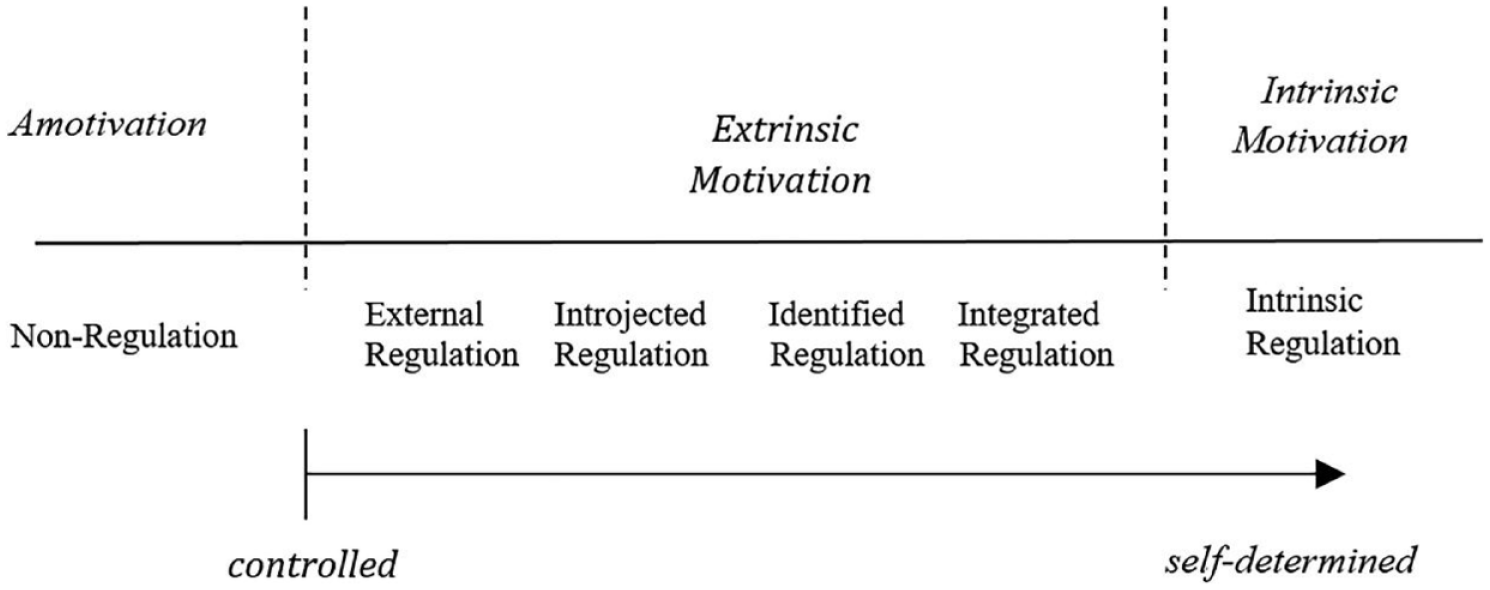
Continuum of Self-Determination (Based on Ryan and Deci [2002, p. 16]).
Amotivation
Actions defined as amotivational (e.g., lazing around) cannot be ascribed to any intention. Consequently, according to SDT, behaviors of this type are not defined as “motivated” and are located outside the continuum entirely (nonregulation).
External regulation
This motivation style corresponds with the conventional definition of extrinsic motivation. An example would be a student attending instrument lessons because their parents promised them a reward if they did.
Introjected regulation
Actions categorized at this level involve internal impulses and pressures. This motivation style can be positive or negative (Howard et al., 2021). If the form taken is negative, the failure to act may be associated with feelings of guilt. However, if the form taken is positive, an action may be undertaken to prove something to oneself or others.
Identified regulation
The idea behind this motivation style is that actions are taken because they are perceived as important and relevant to the individual. This stage is achieved when individuals can identify the values and goals of a specific action and integrate these into their broader values and goals. For example, a music student may dislike practicing scales but does so in pursuit of an objective she or he has instilled in herself or himself, such as being able to play a certain piece well.
Integrated regulation
This motivation style displays the highest degree of self-determination and can be considered the result of the integration of goals, values, and strategies of action into a coherent concept of the self (Ryan & Deci, 2017). It is difficult to measure the difference between integrated and intrinsic regulation in research due to the similarity between these two concepts and the high degree of self-determination they entail, particularly for younger people (Vallerand, 2000). Thus, no such difference is accounted for as part of this study.
Intrinsic regulation
The degree of self-determination is most clearly expressed in this motivation style. Intrinsic motivation is a prototype of self-determined motivation, and is associated with joy and curiosity.
In many studies, two scales are calculated based on regulation style: autonomous and controlled motivation (e.g., Koestner et al., 2008). Autonomous motivation combines intrinsic and identified regulation, whereas controlled motivation combines introjected and external regulation. This approach was used in this study.
SDT assumes that it is essential to satisfy three basic psychological needs—“autonomy,” “competence,” and “social relatedness”—to maintain and develop self-determined forms of motivation. Nuttin (1956) described satisfying basic needs and experiencing intrinsic motivation as the “optimal functioning” of the human psyche. In this context, intrinsic motivation and the principle of optimal functioning are synonymous. Thus, basic psychological needs should be considered as part of a holistic system of functioning that continually provides feedback on the quality of person–environment interactions (Krapp, 2005).
This can be seen through various studies on the effects of self-determined motivation on cognitive, emotional, and social outcomes (Howard et al., 2021). Support for autonomy has been demonstrated to be one of the most essential factors in the development of self-determined motivation in school contexts (Ryan, 2023). Students whose teachers support autonomy show greater intrinsic motivation and persistence, are more goal- and task-oriented and creative, and generally also accomplish more than those who are unilaterally extrinsically motivated (e.g., Gillet et al., 2012; Haerens et al., 2015; Jang et al., 2016; Leptokaridou et al., 2016; Vansteenkiste et al., 2012). Across a wide variety of settings and contexts, numerous empirical findings have confirmed the relevance of satisfying basic needs for competence and social relatedness in the development and maintenance of self-determined forms of motivation (Ryan, 2023; Ryan & Deci, 2017).
SDT and learning to play a musical instrument
An increasing number of studies have emerged on motivational conditions, processes, and outcomes in the field of music (Evans, 2015). Few studies explicitly address the motivational aspects of learning a musical instrument (e.g., Evans, 2015; Küpers et al., 2014). Studies have been conducted, based on different theories, regarding motivation toward music and music instruction as well as motivation to learn to play an instrument (Renwick & Reeve, 2012). These studies tend to draw on concepts from attribution theory (Legette, 2003; Schatt, 2011), expectancy-value theory (O’Neill & McPherson, 2002), goal orientation theory (Smith, 2005), self-efficacy (Hendricks, 2014), models of identity development (Evans & McPherson, 2015), and the theory of flow (Montanez, 2011). Overall, few studies have investigated the conditions and processes of learning motivation based on SDT in (instrumental) music, particularly in extracurricular learning settings (Oliveira et al., 2021). The following is an overview of studies conducted based on SDT in instrumental teaching and learning.
Evans, McPherson, and Davidson (2013) offer a summary of the importance of BPNS. For example, they show that those who cease to play an instrument report little to no satisfaction in the area of these basic needs (Evans, 2015) and, consequently, develop less of a sense of musical identity, intrinsic motivation, performance, flourishing, and persistence (Comeau et al., 2019; Evans, 2015; Evans & McPherson, 2015; Freer & Evans, 2019; Herrera et al., 2021; Küpers et al., 2014; Renwick & McPherson, 2002). Studies have shown that when learning an instrument, informative and learning-promoting feedback in lessons (Shaheen, 2022), belief in one’s competence (O’Neill & Sloboda, 1997), and satisfaction with the need for autonomy are particularly crucial for the development and maintenance of self-determined forms of motivation (Valenzuela et al., 2018; Wieser & Müller, 2022). In addition, Bonneville-Roussy, Vallerand, and Bouffard (2013) demonstrated that the support of autonomy is not only relevant for intrinsic motivation but is also related to passion and persistence in music education. A highly relevant aspect in supporting autonomy is the selection of pieces and exercises in the context of music instruction and/or ensembles (Wieser & Müller, 2022). Generally, this area displays a tendency toward a relative lack of autonomy—in the sense of possibilities for choice—particularly in the realm of Western classical music (Evans, 2015).
Learning to play an instrument is typically a social matter; therefore, social relatedness is an essential condition for self-determined motivation. Close contact between students and teachers satisfies the need for social relatedness. The adaptation of respective support to the abilities of the student encourages the need for competency, and increasing competency, in turn, passes on more responsibility, thus ensuring more autonomy. By contrast, other studies (Creech & Hallam, 2011; Davidson et al., 1998; Moore et al., 2003) have explored the question of what qualities of interaction between students and teachers influence motivation. In this area, it was apparent that the earliest years of instruction were the most significant for students in terms of social relatedness. One can conclude that, from the perspective of persistence and the development of motivation, social relatedness—“the security of [a] warm, friendly relationship” (Evans, 2015, p. 69)—is a significant factor for later ability to focus on developing competency in the sense of mastery.
In summary, existing SDT-based studies have primarily been conducted in formal educational institutions such as schools or universities and only a few in settings such as music schools in Austria. In addition, few studies have selected a person-centered approach to music education. Therefore, this study examines, through SDT, to what extent intrinsic and forms of extrinsic regulatory styles of motivation may be intrapersonally confounded through asking the question: Do individuals with different motivation profile differ in terms of their experiences and behaviors in instrumental music?
Person-oriented approach
In addition to descriptive statistical analyses, in this study a cluster analysis was performed to generate motivational profiles based on various regulatory styles of motivation. The decision to do this was made considering that intrinsic and forms of extrinsic motivation may have confounding effects on one another (Renwick & McPherson, 2009; Wormington et al., 2012). The advantages of a “person-orientated approach” are apparent from both a practical and a theoretical perspective. From the practical perspective, a differentiated and representative description of the various combinations of motivational patterns is necessary. Information of this type can facilitate (a) the formulation of diagnoses and (b) the adjustment of possible motivational intervention measures to suit respective groups or types (Howard et al., 2016). Through cluster analysis, it is possible to analyze the quality and quantity of motivation based on SDT regulatory styles (Vansteenkiste et al., 2009). Cluster analyses of motivational regulation have already been conducted in a wide variety of fields, such as sports (Gillet et al., 2009), education (Müller & Hanfstingl, 2018), family and parenting (Soenens et al., 2009), and work settings (Howard et al., 2016). In most of these studies, the findings were variations of a four-cluster solution, as observed in the work of Vansteenkiste et al. (2009): (a) “good quality type”: highly autonomous, regulated in a less controlled manner; (b) “high quantity type”: highly autonomous, highly controlled; (c) “poor quality type”: less autonomous, regulated in a highly controlled manner; and (d) “low quantity type”: less autonomous, less controlled. Renwick and McPherson (2009) found similar clusters behind motives for music engagement, although the “high quality type” was not observed, as individuals with internal motives also mentioned extrinsic motives. To the best of our knowledge, no profile-based study has been conducted based on motivational regulation in learning to play an instrument.
Research hypotheses
Based on previous explanations, motivation profiles were formed and related to the Basic Psychological Needs Support (BPNS) and intention to quit. In addition, data on the intention to quit and the preferred activities when learning an instrument were collected and correlated with motivation types. The following hypotheses were formed:
Hypothesis 1: It is possible to identify different profiles of motivational regulation in playing and learning musical instruments in music schools (Renwick & McPherson, 2009; Vansteenkiste et al., 2009; Wang & Biddle, 2001).
Hypothesis 2: The motivation profiles differ in their perceptions of BPNS in music lessons. Thus, students who belong to a type with high autonomous motivation will also show higher levels of BPNS (Ng et al., 2016).
Hypothesis 3: Those profiles with strong autonomous motivation are less likely to stop learning and playing instruments (Comeau et al., 2019; Evans, 2015; Vallerand et al., 1997).
Hypothesis 4: The profiles also differ in their music-related activity preferences when learning and playing an instrument (interest).
There have been initial studies on the potential differences in motivation depending on the musical instrument or genre (de Bézenac & Swindells, 2009; Schatt, 2018). Therefore, the present data were also analyzed regarding the type of instrument that the students played.
As Austrian music schools are attended by children, adolescents, and young adults, the extent to which motivational styles, BPNS, activity preferences, and the intention to quit differ with regard to age was also examined. The data were also analyzed in relation to gender differences, as studies have shown that female learners sometimes tend to be overrepresented in clusters with high autonomous motivation. However, existing research findings regarding motivation profiles and gender or age are rather inconsistent (e.g., Litalien et al., 2019).
Instruments and method
Participants and procedure
The original sample was comprised of 627 participants; however, the sample size had to be reduced because of missing data. Thus, the sample finally comprised 616 music students (32.9% male, 67.1% female) with an age range from 11 to 22 years (Mage = 14.19, SD = 2.56; 90% of the students were between 11 and 17 years old). This study was conducted at five music schools in Austria. The most common instrument groups were the wind instruments (33.9%), followed by string instruments (27.6%), and keyboard instruments (21.7%). Furthermore, 79.7% of participants had at least one family member who played an instrument.
The questionnaire was personally handed to the principals of the music schools, with the request to forward it to the music teachers, who then distributed the forms to their music students. Informed consent for the survey was provided by the school principals. Due to the non-sensitive nature of the data and the provided consent of the music school directors, no ethics committee approval was required for the study according to Austrian regulations. In Austrian schools, school principals are responsible for approvals relating to research projects conducted at their institutions, so their approval is required to conduct a study at their school(s). Participants were informed of the voluntary nature of participation, anonymity of the questionnaire, and confidentiality of their data, which would not be available to any teacher, school principal, or third party.
Measures
The questionnaire included questions on motivational regulation, BPNS, and the intention to quit. In addition, questions regarding interest in certain activities when playing and learning instruments were included. All items were rated on a 5-point Likert-type scale ranging from 1 (do not agree) to 5 (strongly agree).
To assess “motivational regulation,” a shortened version of the Self-Regulation Questionnaire–Academic (Ryan & Connell, 1989; for a German version, see Thomas & Müller, 2016), adapted for instrumental music instruction (Wieser & Müller, 2022), was applied. When selecting the items, those with the highest factor loadings on each respective dimension were used. The instrument captures intrinsic motivation (e.g., “I play and practice the music instrument because I enjoy it”; α = .68) and three forms of extrinsic motivation regulation styles: identified (e.g., “I play and practice the music instrument because it is important for me to play an instrument”; α = .58); introjected (e.g., “I play and practice the instrument because I want to make my teacher believe I am a good student”; α = .66); and external regulations (e.g., “I play and practice the music instrument because I have to do it”; α = .59). As aforementioned, intrinsic and identified regulations were summarized as autonomous motivation (α = .72) and introjected and external regulations as controlled motivation (α = .75). The reliability coefficients of the combined scales were judged to be satisfactory.
Based on studies by Vansteenkiste and colleagues (2009), we calculated an index for the quality and the quantity of motivation using the following formulas to create the motivation profiles: (a) quality of motivation = autonomous motivation − controlled motivation and (b) quantity of motivation = controlled motivation + autonomous motivation. Thus, for the description of the motivation profiles in compact form, a distinction can be made between quality and quantity of motivation.
To measure “BPNS” in instrumental music instruction within the school sector, scales from Thomas & Müller (2014, 2016) were adapted in terms of content: autonomy (e.g., “My teacher lets me choose my own music pieces”; α = .56); competence (e.g., “My teacher shows me, what I can do better”; α = .56); and social relatedness (e.g., “I feel very comfortable in class in general”; α = .78).
The “intention to quit” was recorded using one item (“I would like to stop playing the musical instrument”). To consider the content- and activity-specific characteristics of motivation as well (Krapp, 2002), several items were created to record “interest in instrumental music-related activities” (Table 3). No standardized questionnaires were available here, so we developed the instrument by ourselves. We were guided by the various areas of activity involved in learning and playing an instrument (12 single items).
The entire questionnaire was presented to 12 children and adolescents of the relevant age group in a pilot to check the comprehensibility of the items. Minor adjustments were then made to the items and the written instructions in the questionnaire.
Analysis
In addition to descriptive analyses and correlations, we performed clusters using the k-means algorithm to identify groupings of students with similar motivational profiles. In the first step, we searched the data for multivariate outliers using Mahalanobis distance and a significance level of p = .01. To cross-validate the results of the cluster analysis, we randomly divided the original sample into two subsamples of equal size and applied k-means clustering to each subsample (Breckenridge, 2000). The agreement between cluster solutions was assessed using Cohen’s kappa coefficient (Asendorpf et al., 2001). All statistical analyses were performed using IBM SPSS 28.0.
Results
Descriptive statistics
Descriptive statistics (mean values and standard deviations) are presented in Table 1.
Descriptive Statistics.
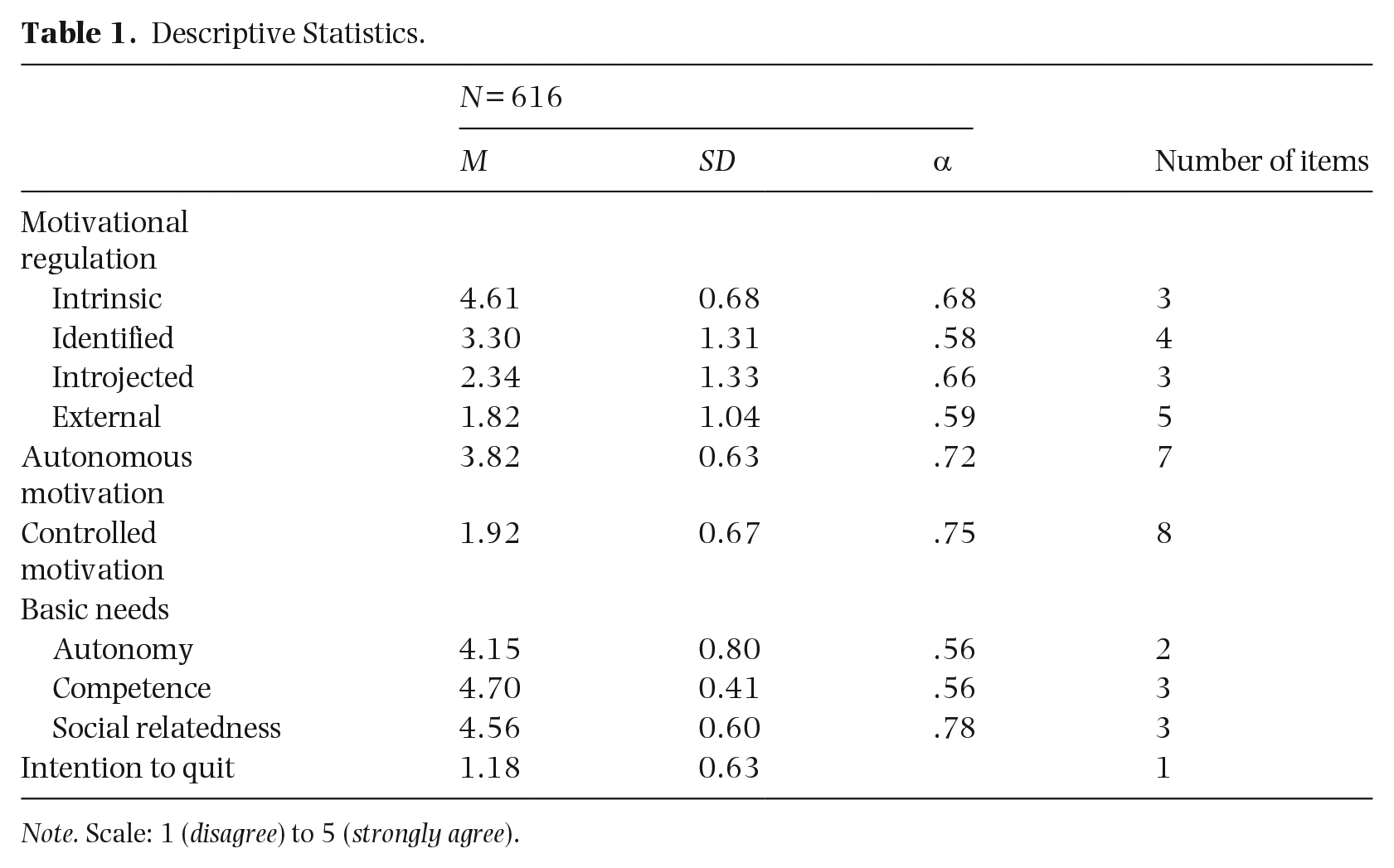
Note. Scale: 1 (disagree) to 5 (strongly agree).
Motivational regulation
The participants showed a high level of intrinsic regulation. The results for identified regulation appeared to be more heterogeneous and lower, indicating self-determined goals beyond the actions taken. When intrinsic and identified regulations were compiled into one scale, a high level of autonomous motivation became apparent. Simultaneously, music students exhibited introjected regulation at moderate levels and low scores on extrinsic regulation, reflecting a low level of controlled motivation in general. No differences in motivation were found among the different groups of instruments.
Basic Psychological Needs Support
The participants perceived high degrees of BPNS in terms of autonomy, competence, and social relatedness. Thus, music students perceived their learning environment as exceptionally positive for instrumental music instruction. Furthermore, they showed very low scores for “intention to quit.”
Interest in instrumental-related activities
The participants showed a high level of interest in playing with friends, attending lessons, and practicing new pieces. Simultaneously, music students showed lower interest, but still at a medium level, in going to theory class, practicing scales, and taking exams on the instrument (Table 3).
Correlations
Table 2 provides an overview of the correlations among the most important variables. Autonomous motivation and quality of motivation were both positively associated with BPNS (r = .157** to .321**). Controlled motivation was barely correlated with BPNS (r = −.035 to −.096*), and the quantity of motivation was only slightly associated with BPNS (r = .042–.144**). The correlations between motivational regulation styles and the intention to quit were also consistent with the theory: negative correlations were found in particular with autonomous motivation (r = −.371**) and the quality of motivation (r = −.419**). Consistent with expectations, controlled motivation was more likely to be associated with the intention to quit (r = .166**). In addition, Table 2 shows a significant positive correlation between autonomous and controlled motivation (r = .196**). From this, it can be concluded that some participants were both autonomously and controlled motivated when learning an instrument, which is an indication of different motivational profiles. Furthermore, older learners reported a higher level of autonomous motivation and rated their learning environment more positively on BPNS. Finally, the quality of motivation was more decisive in avoiding dropping out (intention to quit) than the quantity of motivation. Controlled motivation was positively associated with the intention to quit (Table 2).
Correlations between Measured Variables.
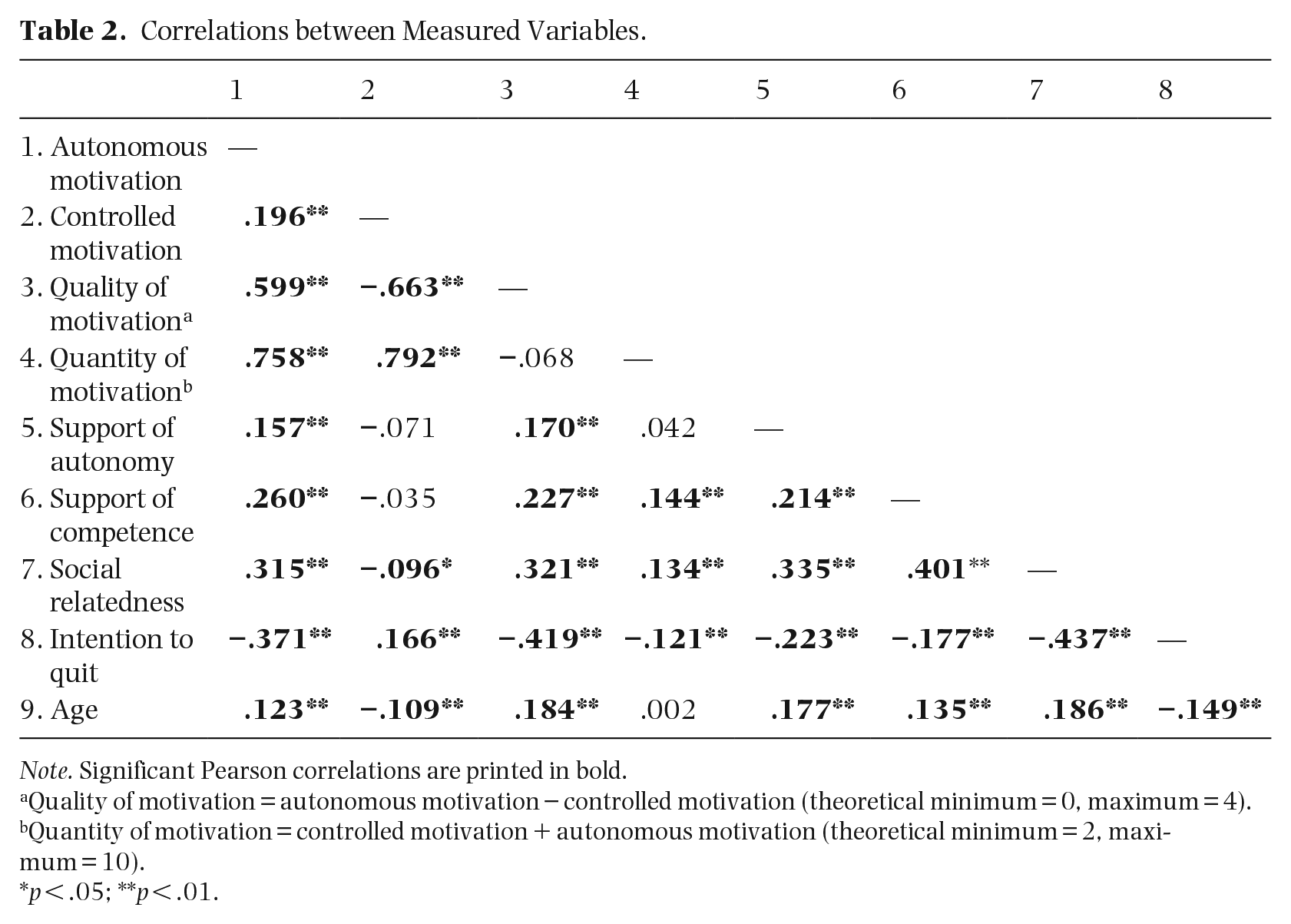
Note. Significant Pearson correlations are printed in bold.
Quality of motivation = autonomous motivation − controlled motivation (theoretical minimum = 0, maximum = 4).
Quantity of motivation = controlled motivation + autonomous motivation (theoretical minimum = 2, maximum = 10).
p < .05; **p < .01.
Motivational profiles
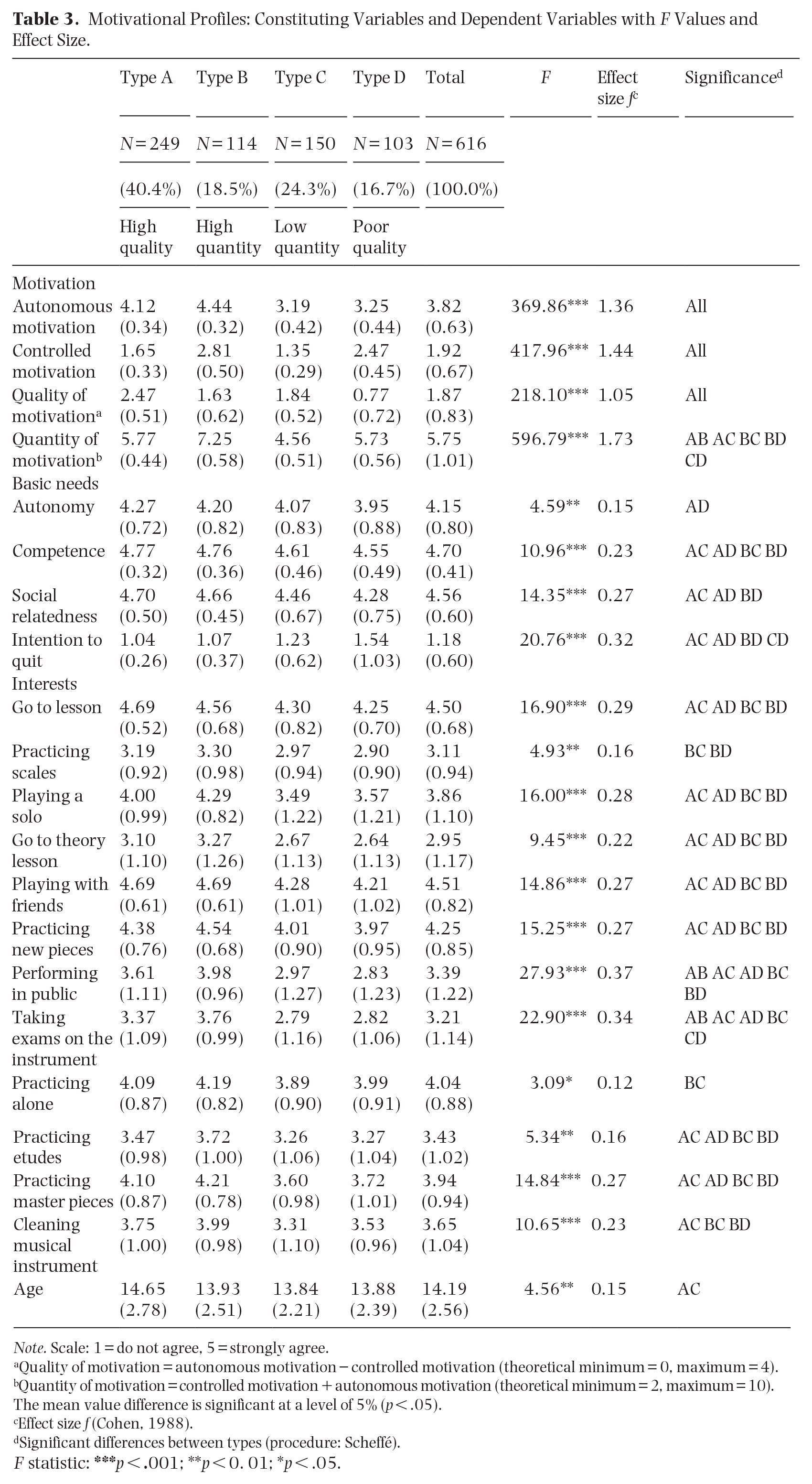
A cluster analysis of the variables of “autonomous” and “controlled” motivation produced four types. The Cohen’s kappa coefficient (group A: κ = .91; group B: κ = .87) delivered satisfactory results for the validation of the clusters depicted using the split-half method (Asendorpf et al., 2001). Figure 2 shows a summarized representation of the motivation types with z-scores, and the scale mean values are presented in Table 3.
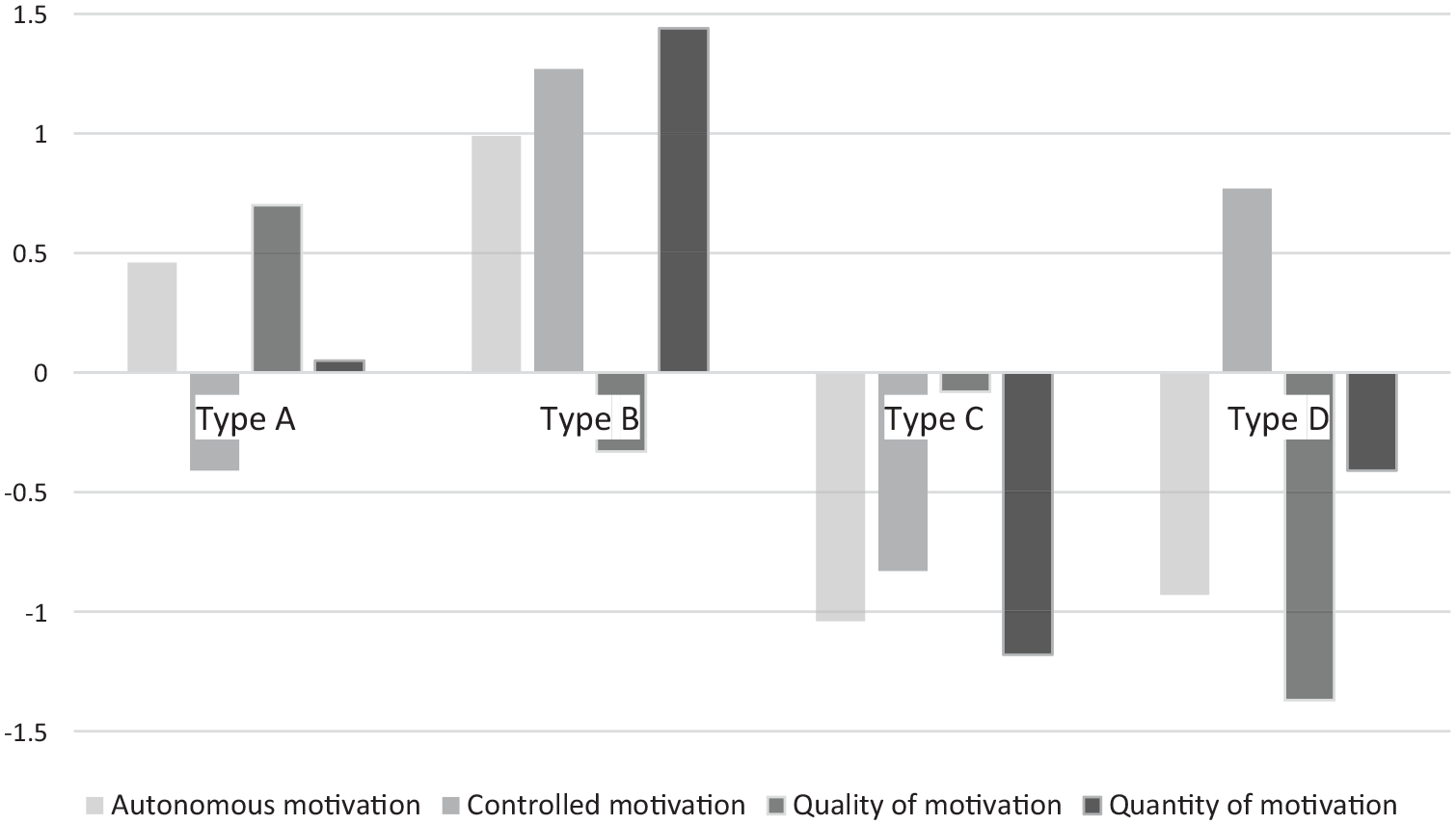
Motivational Types.
Motivational Profiles: Constituting Variables and Dependent Variables with F Values and Effect Size.
Note. Scale: 1 = do not agree, 5 = strongly agree.
Quality of motivation = autonomous motivation − controlled motivation (theoretical minimum = 0, maximum = 4).
Quantity of motivation = controlled motivation + autonomous motivation (theoretical minimum = 2, maximum = 10).The mean value difference is significant at a level of 5% (p < .05).
Effect size f (Cohen, 1988).
Significant differences between types (procedure: Scheffé).
F statistic: ***p < .001; **p < 0. 01; *p < .05.
The following types (profiles) can be distinguished:
(a) Good quality (autonomously motivated; N = 249; 40.4%): For this type, autonomous motivation was high (M = 4.12, SD = .34), whereas controlled motivation was low (M = 1.65, SD = .33). Individuals of this type produce the highest values in quality of motivation (M = 2.47, SD = .51) and play their instrument because they enjoy it and desire to achieve self-determined goals (“good quality cluster” as per Vansteenkiste et al., 2009).
(b) High quantity (autonomous and controlled; N = 114; 18.5%): This type shows the highest degree of autonomous motivation (M = 4.44, SD = .32) and reports simultaneously the highest level of controlled motivation for all clusters (M = 2.81, SD = .50). Type B can be distinguished for its high quantity of motivation (M = 7.25, SD = .58) and has been described as a “high quantity cluster” by Vansteenkiste et al. (2009).
(c) Low quantity (N = 150; 24.3%): This type showed the lowest degree of autonomous motivation (M = 3.19, SD = .42); however, it also featured the lowest level of controlled motivation among all the clusters (M = 1.35, SD = .29). In relation to the other types, this cluster corresponds most closely to the “low quantity motivated cluster” (Vansteenkiste et al., 2009), although it does show autonomous motivation on a medium level (in relation to the ranking scale). Therefore, we describe this cluster as a low-quantity and medium-quality type.
(d) Poor quality (N = 103; 16.7%): This type showed pronounced autonomous motivation (M = 3.25, SD = .44). Moreover, it demonstrated a moderate level of controlled motivation (M = 2.47, SD = .45) and the strongest intention to quit (hence, at a low level: M = 1.54, SD = 1.03). Vansteenkiste and others (2009) have termed this cluster “poor quality motivation”.
This study aimed to explore the extent to which motivation types differ in support for basic psychological needs, instrument-related activity preferences, and the intention to quit. Table 3 illustrates that the learning environment and instructor behavior (measured using BPNS) can be readily assessed. Type A, with qualitative motivation, and highly motivated Type B both rate BPNS as high; in this regard, these two clusters do not differ significantly from one another. In nearly every aspect, Type D can be distinguished considerably from Type A, specifically in the areas of BPNS, which demonstrates the significance of the quality of motivation.
If we consider interest in specific activities, it becomes clear that music students enjoy attending classes, making music with their friends, practicing new pieces, and practicing alone. From a theoretical perspective, the results showed significant differences between the assessed activity preferences across clusters. Initially, consistent with our hypotheses, we concluded that Types A and B displayed higher values in nearly all areas of activity when compared with Types C and D. The results on activity preferences indicate that type-based profiles of motivation may be able to provide insight that is otherwise “hidden” in correlational studies. Thus, Types A and B differ from one another with regard to the activities “playing in public” and “taking exams on the instrument.” Owing to the higher level of controlled motivation observed in Type B, students were also significantly more interested in the achievement-related aspects of making music. Owing to its motivational profile, Type B preferred activities, such as “practicing scales,” “practicing études,” or even “cleaning the instrument.”
Regarding age, there was a difference between Type A (high quality) and Type C (low quantity). Type A was significantly older than Type C. Gender differences (χ2 = 6.66, df = 3, p = .08) and differences between the instrument groups (χ2 = 28.00, df = 18, p = .05) could not be identified between the profiles.
Summary and discussion
The results of our study demonstrated that the children and adolescents surveyed perceived learning and playing an instrument mostly in an autonomous and sometimes controlled manner. Correlational studies have demonstrated that, in addition to perceived basic needs, support through music instruction is associated with autonomous forms of motivation. This finding is in line with other analyses in the music domain (for an overview see Evans, 2023). Specifically, the level of social relatedness and support for competence in lessons can explain autonomous motivation. In addition, students with strong autonomous motivation do not tend to stop playing instruments, indicating the promotion of persistence through the quality of motivation. In contrast, controlled motivation was positively associated with the intention to quit. This study also indicates that the quality of motivation is more important for outcomes than quantity (cf. Vansteenkiste et al., 2009). Overall, the correlative results correspond to theoretical expectations (Evans, 2015; Guay et al., 2008). However, the study is less able to explain controlled motivation to play an instrument, as is consistent with findings of other studies (Thomas & Müller, 2016; Weman-Josefsson et al., 2015).
The focus of the study was the formation of typical motivational profiles. In relation to Hypothesis 1, among other aspects, the positive but low correlation between autonomous and controlled motivation (r = .196) indicated the existence of motivational profiles that can be differentiated from one another in terms of the quantity and quality of motivation. The findings showed that for a theoretical understanding and explanation of motivation in playing an instrument, it is worthwhile to conduct person-orientated approaches in motivation research alongside variable-based analyses. Four motivational profiles were created: (a) good quality motivation (autonomous motivation); (b) high quantity motivation (autonomous and controlled motivation); (c) low quantity motivation; and (d) poor quality motivation. The results of the study illustrated that the intrapersonal coexistence of autonomous and controlled motivation can also be observed in learning a musical instrument and that autonomous and controlled regulatory styles are not necessarily distinct categories (Renwick & McPherson, 2009). Therefore, Hypothesis 1 can be confirmed.
We did not find any clusters with strikingly low values of autonomous motivation among music students. Hence, it can be assumed that music schools, in contrast to in-school music lessons, demonstrate both higher quality motivation and higher quantity motivation, as lessons do not take place as part of an obligatory school curriculum. An international study also found that students consider school music education to be of little relevance and hardly enjoy it (McPherson & O’Neill, 2010). The relatively high level of autonomous motivation in our study is also shown by the fact that—in contrast to the study by Vansteenkiste et al. (2009), for example—Types C (low quantity) and D (low quality) are also autonomously motivated at a medium-scale level. This can be interpreted as an indication that the clusters may differ to a greater or lesser extent depending on the setting.
According to Hypothesis 2, it was theoretically expected that students in clusters with high levels of autonomous motivation (Types A and B) would also show the highest stage of Basic Psychological Needs Support (cf. Vansteenkiste et al., 2009). A learning environment that satisfies basic psychological needs should also lead to autonomous motivation. However, the high quantity Type B did not differ from the high quality Type A in its assessment of BPNS, because both types scored highly in autonomous motivation. The lowest assessments of BPNS were provided by the poor quality type, because of its relatively low autonomous motivation in learning and playing an instrument. In contrast to other studies, no differences were found between Types C (low quantity) and D (low quality) with regard to BPNS, which could be attributed to the relatively high overall assessment of BPNS in music lessons. The tendency for people in Cluster A (high rate) to be somewhat older could be attributed to a selection effect, as autonomously motivated people are more likely to stay in music school than those who are regulated in a controlled manner.
Consistent with Hypothesis 3, autonomous motivation primarily prevented the intention to quit music school. Thus, Types A (high quality) and B (high quantity) showed almost no tendency to drop out. The intention to quit of these two types differed significantly from that of Types C and D. This finding demonstrated that controlled forms of motivation had no negative effects if they occurred simultaneously with autonomous motivation within an individual. This so-called buffering effect of autonomous motivation was noticeable in Type B (high quantity; see also Gillet et al., 2009; Langan et al., 2016). Conversely, the highest tendency to stop learning and playing an instrument in music school was found in Type D, which was highly controlled motivated.
With regard to Hypothesis 4, the varying results of music-related activity preferences across clusters demonstrated that, in addition to the quantity of motivation, quality was crucial in explaining experience, behavior, and attitudes. Within the meaning of the person–object theory of interest (Krapp, 2002), interest-specific activities associated with playing an instrument were investigated, along with motivation. On average, none of these activities were performed reluctantly. However, differences were observed between the various motivational types, particularly in terms of activity preferences. Most respondents were particularly enthusiastic about “attending music classes” and “making music with friends,” which indicated a pronounced motivation to learn as well as the significance of the social component of music-making. The activities of least interest for the students were “practicing scales,” “performing in public,” “taking exams on the instrument,” and “attending music theory classes.” Interestingly, striking differences were observed between the motivation profiles. Overall, the two types with high autonomous motivation (Types A and B) preferred most music-related activities more than the other two types.
Conspicuously, Type B, which combined high autonomous and controlled motivation, was interested in “performing in public” and “taking exams on the instrument.” Interest in these two activities was significantly higher than in the high quality Type A. This could be explained by the fact that Type B was also interested in avoidably uninteresting activities because of the performance-oriented combination of intrinsic and extrinsic motivations. Studies in sports also showed that an individual’s internal combination of intrinsic and extrinsic motivation was associated with higher performance than exclusively intrinsic motivation (e.g., Langan et al., 2016; Lin et al., 2003). These examples demonstrate the added value of person-oriented approaches compared with the variable-oriented approach, as combinations of motivation can be examined with regard to outcomes (Wang & Biddle, 2001).
Limitations and further research
The limitations of the findings are evident in the sample and measurement procedures. Considering that the questionnaires were distributed to all music students at their respective schools and the response rates were high, a relatively high level of representativeness can be assumed. However, the results only apply to music schools, where participation is generally voluntary, and therefore relatively self-determined. To obtain greater validity and generalizability of findings, future music students must be surveyed in different settings (e.g., school, university), and the data must be analyzed using type-generating methods, also with regards to the replicability of these types. As it was necessary for practical reasons to develop a relatively short survey instrument, the scales were operationalized with only a few items. A short questionnaire typically limits the reliability of a scale.
In addition, whether cluster formation based on all motivational regulation styles differs from the types formed with exclusively controlled and autonomous motivation should be examined. This could concern the number of clusters and a more detailed description and explanation of the clusters. In this context, further differentiation of introjected motivation into positive and negative introjected regulation (Sheldon et al., 2017) would also be helpful to accurately describe the clusters and explain their effects on outcomes, such as the quality of learning.
Finally, it would be beneficial to examine motivation, its conditions, and outcomes in non-compulsory education settings. On one hand, such education contexts will gain importance in the future, and on the other hand, it is scientifically worthwhile to investigate the conditions of motivation in settings with a greater scope for autonomy, for example, through voluntary participation. In addition to music lessons, formal education systems could benefit from such studies.
For music education, it would be interesting to explore whether motivation differs between instrument groups and across genres. Some studies have suggested that students playing a “non-classical” instrument report taking more joy in learning to play an instrument, whereas “classical” musicians are motivated in a more controlled manner. MacIntyre and Potter (2014) demonstrated similar findings, discovering that guitarists perceive themselves as having more autonomy than pianists in the context of composing music. Such studies can stimulate reflections on traditional music education practices in terms of motivational support.
Practical implications
Although only a few studies on motivation to learn and play musical instruments have been conducted thus far, some general indications for practice can be derived, which should be further validated in intervention studies. The role of BPNS for autonomy, competence, and social relatedness has also been proven to be important for the quality of motivation, not only in this study. For example, choices in the selection of music genres and pieces of music, concrete feedback in case of difficulties, or satisfying social interaction can encourage autonomous motivation. The high relevance of children’s peer networks should be considered, for example, by supporting group music-making, which, in turn, can promote the integration of different areas of life.
In our opinion, a concrete indication of motivation type could also be utilized in instrumental lessons. Type A, for example, is highly autonomously motivated but, unlike Type B, is unlikely to sustain motivation through external incentives (performances or exams). From a theoretical perspective, for Type A (more than 40% of students), there could be a risk that external motivational rewards undermine a high level of autonomous motivation (Deci et al., 1999). In this respect, it would be worthwhile for music teachers not only to understand the motivational constellations of their pupils, but also to adapt the learning setting accordingly.
Footnotes
Acknowledgements
The authors would like to express their gratitude to all the music students who were willing to complete the survey and to the directors of the music schools who made it possible for them to conduct this study.
Author contribution(s)
Declaration of conflicting interests
The author(s) declared no potential conflicts of interest with respect to the research, authorship, and/or publication of this article.
Funding
The author(s) disclosed receipt of the following financial support for the research, authorship, and/or publication of this article: This study was funded by the School of Education at the University of Klagenfurt, Austria.
Ethical approval
Due to the nonsensitive data and the obligatory consent of the music school principals, the ethics committee approval for the study was not mandatory. In Austrian schools, school principals are responsible, so their approval is required to conduct a study at their school(s).
Informed consent
All participants provided verbal informed consent to participate in this study.
Research data
The data can be obtained from the authors on request.
