




Abstract
The present study explores the relationship between music self-efficacy (MSE) and self-esteem, grit, and learning and playing habits of amateur musicians who use online music tutorials (OMTs) while learning to play new pieces. Amateur musicians (N = 409) from 30 countries answered research questionnaires, including preferences of autonomy OMTs (foster independent learners and incorporate knowledge) versus dependent OMTs (based mainly on imitation and provide little further knowledge). Ordinary least squares regression indicated that the independent variables accounted for 50% of the variance in the dependent variable (MSE) and that the model was significant. The results indicated that self-esteem, grit, preferences of autonomy OMTs, playing with others and weekly hours of playing were positive predictors of MSE. In addition, dependent OMTs were negatively correlated with MSE. The findings highlight the need to examine any possible causality in the relationship between learning and playing habits, and MSE of amateur musicians. In addition, data were collected in the midst of the Covid-19 worldwide impact and should be further explored post-Covid-19.
Music self-efficacy (MSE) has long been researched in accordance with professional musicians and music students. Studies frequently present a distinction between performance MSE and learning MSE that affect the musicians’ performing outcomes onstage (McCormick & McPherson, 2003; McPherson & McCormick, 2006; Ritchie & Williamon, 2012). However, to the best of our knowledge, little research has been conducted on MSE among amateur musicians, even though they represent a music-learning sector, and understanding their learning and playing habits—including formal and online informal preferences—could contribute to both the amateur and the professional fields. Previous research has indicated that there is a connection between personal characteristics, such as self-esteem and grit, and self-efficacy (Alhadabi & Karpinski, 2020; Usher et al., 2019), but less attention has been given to those personal characteristics and MSE, especially among amateur musicians. This study, therefore, aimed to explore the effect of amateur musicians’ learning and playing habits, focusing on their preferences for online music tutorials (OMTs), and their self-esteem and grit on their MSE. Illumination of these issues may contribute to the understanding of the factors influencing MSE among amateur musicians as well as professional ones.
MSE and amateur musicians
MSE is a domain specific category of self-efficacy that pertains to musicians—from students to professionals at all stages of their specialization. Self-efficacy refers to beliefs in one’s ability to complete a specified task successfully, on the way to achieving a desired goal (Bandura, 1997). People with high self-efficacy tend to persist longer and reach higher levels of accomplishment and performance in multiple domains (Zimmerman, 2000). Honicke and Broadbent (2016) demonstrated that self-efficacy is correlated with academic performance across multiple educational levels. Also, self-efficacy has been found to be associated with a variety of positive behaviors in other areas beyond education; for example, it was found correlated with habitual health-promoting practices (social and nutritional) among conservatory students (Kreutz et al., 2008).
MSE is strongly tied to musicians and music students’ performance (Hewitt, 2015; McPherson & McCormick, 2006; Ritchie & Williamon, 2012). Most studies refer to performance and learning MSE, and define performance MSE as oriented toward the outward expressions of one’s own ability through public performances (e.g., Zarza-Alzugaray et al., 2018) and learning MSE as the musicians’ appreciation of their ability to learn and advance in music studies (e.g., see: McCormick & McPherson, 2003; McPherson & McCormick, 2006; Nielsen, 2004; Pajares & Miller, 1995; Ritchie & Williamon, 2012). In the present study, following a previously published one (Harpaz & Vaizman, 2021), we define MSE specifically as the player’s belief in their ability to do what is required to play a new piece. Unlike most previous studies that have dealt with professional musicians’ MSE or music students, the present study has focused on the MSE of amateur musicians.
Amateur musicians are described as people who engage in music for pleasure (Kuckelkorn et al., 2021) and possess the freedom to choose a leisure activity, such as playing in bands or orchestras, as opposed to professionals who sometimes engage in the profession, even with dissatisfaction, as part of their need to make a living (Kuckelkorn et al., 2021; Stebbins, 1992). Practicing music as an amateur is connected to quality of life, well-being, and physical and psychological health (Antonini Philippe et al., 2019), which is recorded as being higher than that of both professional musicians and non-musicians (Bonde et al., 2018). The present research focused on MSE of amateur musicians, while exploring the effect of two personal characteristics—self-esteem and grit—on their MSE.
Self-esteem, grit, and MSE
Past research has shown that differences in self-efficacy have been attributed to a combination of personal characteristics and contextual factors (Lewis et al., 2021). Unlike self-efficacy, which is focused on a person’s belief in their ability to perform required actions to achieve a goal (Bandura, 1997), self-esteem is the positive or negative attitude a person has toward themselves, which defines the subjective evaluation of self-worth (Rosenberg, 1979, 1989). Self-esteem is the evaluative component of self-knowledge (Baumeister et al., 2003). High self-esteem refers to a highly favorable global evaluation of the self while low self-esteem refers to an unfavorable definition of the self. Moreover, self-esteem has been linked to a higher college grade point average as well as better social and emotional college adjustment (Aspelmeier et al., 2012). Moreover, previous studies have indicated a positive relationship between self-esteem and self-efficacy (Sahin, 2017). Weisskirch (2018) argued that individuals with high self-esteem may channel that positive evaluation into the coursework they pursue, which can be expressed in a sense of high self-efficacy.
However, a study that was based on pre-service music teaching students in universities in Turkey indicated that an inverse relation existed between the participants’ musical instrument performance self-efficacy and self-esteem (Girgin, 2017). Girgin raises a possible explanation for these findings, negating the usually indicated positive relations, stating they may be due to the cultural gap between the study participants and those on which the existing literature is based. Yet, recent studies indicated that participants’ nationality is not correlated with their MSE (Harpaz & Vaizman, 2021; Vaizman & Harpaz, 2022). Thus, correlation between self-esteem and MSE still requires further clarification.
Another personal characteristic that has not yet been explored in the context of MSE, to the best of our knowledge, is grit that is defined as the passion and determination toward achieving a long-term goal, the perseverance of effort, and the consistency of interest (Duckworth, 2006). Grit is malleable, learnable, and its levels affect people’s performance in different fields, especially education (Duckworth, 2006, 2016). It can be developed with psychoeducational practices and social context (Ekinci et al., 2021) and it impacts psychological outcomes, including commitment in school and work (Eskreis-Winkler et al., 2014), teaching effectiveness (Duckworth & Quinn, 2009), meaning in life (Kleiman et al., 2013), and contributes to predicting various educational outcomes (Alhadabi & Karpinski, 2020).
Weisskirch (2018) demonstrated connections between grit (especially perseverance of effort), self-esteem, and learning strategies. Moreover, the relationship between grit, self-efficacy, achievement orientation goals, and academic performance suggests that grit is positively associated with academic performance through a sequential pathway of mediators, including self-efficacy (Alhadabi & Karpinski, 2020). Miksza et al. (2016) argued that grit is an important quality for musicians when dealing with failure throughout their development, demonstrating connections between grit while practicing and commitment to the band. Moreover, Miksza and Tan (2015) found that collegiate musicians’ reports of grit were a positive predictor of self-reported efficiency in practice and self-efficacy for self-regulation. To the best of our knowledge, the present research is the first attempt to investigate the effect of grit on MSE of amateur musicians.
Learning and playing habits of amateur musicians in relation to MSE
In addition to examining the personal characteristics of amateur musicians and their connection to MSE, the present study examined the effect of learning and playing habits, including OMT preferences while learning how to play a new piece. Self-efficacy is developed through experiences of success and through practicing as well as through social learning while others perform similar tasks successfully (Bandura, 1997, 2018). Given the popularity of practicing music as a hobby (Antonini Philippe et al., 2019; Bonde et al., 2018) and the current widespread use of OMTs by amateur musicians (Burgess & Green, 2009; Harpaz & Vaizman, 2021), especially during the global Covid-19 pandemic (Simamora, 2020), we find it important to explore amateur musicians’ MSE, in connection to their learning and playing habits and their preferences of OMTs. Being that amateur musicians are “recreational students” and are less likely to suffer from performance anxiety, professional abrasion (Stebbins, 1992) and, as a result, from possible teacher neglect due to poor skills (McGrath et al., 2017), they constitute strong candidates for examining MSE when facing a musical challenge and turning for help to online solutions, such as OMTs.
The present study focused on autonomy versus dependent OMTs preferences. OMTs are easily accessible (Lian, 2016) and provide an informal learning environment for amateur musicians (Lebler, 2008). They are diverse in terms of their depth and range of knowledge. In light of previous research (Harpaz & Vaizman, 2021), we re-established the bi-factorial model of OMT, which distinguishes between autonomy and dependent OMT. Autonomy OMT offers background knowledge, context, or theory compared with dependent OMT, which focus solely on executional instructions. This distinction follows Nadler’s theory of help-seeking orientation while coping with a challenge (Nadler, 1997; Nadler et al., 2009), and particularly the distinction between dependent versus autonomy help-seeking orientation (Komissarouk et al., 2017), leaning on the knowledge that autonomy-help fosters self-efficacy (Halabi & Nadler, 2017).
For some OMT users, the informal online learning environment is an available community, presenting techniques important for lifelong music playing (Waldron & Veblen, 2009). Previous studies have indicated a link between practicing behaviors, personal motivations, and performance among musicians (Miksza et al., 2016), while taking part in co-playing communities was found to be contributive to one’s MSE (Harpaz & Vaizman, 2021; Vaizman & Harpaz, 2022). Co-playing communities raise enthusiasm toward playing and amateur musicians use them as a social forum and a stress reliever (Pitts et al., 2015). However, daily stress, lack of time, physical challenges, and a general feeling of ill-fitting to a group can cause long-time amateurs to withdraw from co-playing (Pitts et al., 2015).
Moreover, given the period of the global pandemic and lockdowns—during which the present study was conducted and which fostered the opportunity to play mainly at home—and on the basis of previous studies (e.g., Macnamara et al., 2014), we examined the effect of duration of practice as a positive predictor of MSE. Based on previous studies that have found a link between training and self-efficacy (Saks, 1994), showing that training increased general self-efficacy (Schwoerer et al., 2005; Smith, 1989) as well as MSE among older adults with little to no previous musical training (Bugos et al., 2016), we examined years of playing and weekly hours of playing as a positive predictor of amateur musicians’ MSE. In a previous study conducted before the spread of Covid-19 (Harpaz & Vaizman, 2021), it was found, among other things, that the number of weekly hours spent playing predicted MSE. The data in the present study were collected while countries around the world were under lockdowns and social distance limitations. We found it important to address the issue of MSE again under these conditions.
Aims and research hypotheses
The aim of the present study is to explore the way MSE of amateur musicians connects to learning and playing habits, preferences for OMTs, self-esteem, and grit.
Based on the literature presented, we tested the following three hypotheses:
Learning and playing habits and MSE. Years of playing, co-playing with others, and weekly hours of playing would be positively correlated with MSE.
Preferences for OMTs and MSE. The use of autonomy OMT would be positively correlated with MSE while the use of dependent OMT would be negatively correlated with MSE.
The personal characteristics—self-esteem and grit—would be positively correlated with MSE.
Finally, an additional aim of this research is to reaffirm and strengthen the construct validity of the recently published bi-factorial OMT scale (Harpaz & Vaizman, 2021). This would support our interpretation of the results of the current study when testing the research hypotheses.
Method
Participants
The research was based on a sample of 409 (254 males, 150 females, and 5 rather not say) self-defined amateur music players who use OMTs while trying to learn to play a new piece. After screening for non-amateur musicians and for those not using OMTs in our data, 100% of the sample was maintained for further analysis. The sample comprised participants in 30 countries, aged 17–59 (M = 24.89; SD = 7.15) who had been playing for 7 years on average (M = 7.37; SD = 6.97). All participants filled out a questionnaire in English.
Measures
Participants answered the following online questionnaires for amateur music players who use online video tutorials:
Background questionnaire, including learning and playing habits
The questionnaire included the following variables: gender, age, country, years of playing, years of studying music with a teacher (if any), hours spent playing per week, co-playing experience, and main instrument.
MSE questionnaire
As in our previous study (Harpaz & Vaizman, 2021), we used the general self-efficacy scale that originally addressed everyday situations (Chen et al., 2001) as the basis for MSE measurement, adapting the questionnaire in the current study to situations of learning how to play new musical pieces. These changes stemmed from our interest in researching the self-efficacy beliefs of amateur musicians about their ability to learn to play new musical pieces, and the fact that the existing questionnaires for measuring MSE are suitable mainly for professionals or music students (McCormick & McPherson, 2003; McPherson & McCormick, 2006; Nielsen, 2004; Ritchie & Williamon, 2012) focusing on coping with performance and training challenges (which are not relevant to the current research participants). Participants indicated the extent each statement described them when they studied a new piece of music, ranked their agreement with eight statements on a 5-point scale anchored at 1 (to a very small extent) to 5 (to a great extent). Higher scores meant a stronger sense of MSE, for example, “I believe I can succeed in any endeavor I set my mind to when I’m studying a new piece of music,” and “I will be able to successfully overcome many challenges when I’m studying a new piece of music.” Reliability of the test scores in the present research was Cronbach’s α = .92.
Rosenberg’s self-esteem scale
We used Rosenberg’s (1979) 10-item scale statements on a 4-point scale, anchored at 1 (strongly opposed) to 4 (strongly agree), with higher scores meaning a higher sense of self-esteem (e.g., “On the whole, I’m satisfied with myself,” or a lower score showing a lower sense of self-esteem—“I wish I could have more respect for myself”). The scale was scored by totaling the individual 4-point items after reverse-scoring the negatively worded items (2, 4, 6, 8, and 10). Reliability of the test scores in the current research was Cronbach’s α = .88.
Short Grit Scale
We used Duckworth and Quinn’s (2009) eight-item version of the Grit Scale that measures trait-level perseverance and passion for long-term goals. The Short Grit Scale (Grit-S) retains the two-factor structure of the original Grit Scale (Duckworth et al., 2007) with four fewer items and improved psychometric properties. Participants ranked their agreement with eight statements on a 5-point scale anchored at 1 (not like me at all) to 5 (very much like me). Higher scores meant a stronger sense of Grit (e.g., “I finish whatever I begin,” lower scores meant a weaker sense of Grit—“New ideas and projects sometimes distract me from previous ones”). The scale was scored by totaling the individual 5-point items after reverse-scoring the negatively worded items (2, 4, 7, and 8). Reliability of the test scores in the current research was Cronbach’s α = .80.
OMT users’ preferences questionnaire
In the current research, we used the recently published questionnaire (Harpaz & Vaizman, 2021) to measure participants’ preferences of the two factors while learning how to play a new piece: (1) autonomy OMT (offering background and comprehensive information, improves their ability to cope with similar challenges in future) and (2) dependent OMT (mainly imitation options and provides little further knowledge). They ranked their agreement with seven statements (Items 3, 5, and 7 for autonomy OMT; Items 1, 2, 4, and 6 for dependent OMT) on a 5-point scale anchored at 1 (strongly disagree) to 5 (strongly agree). Treatment of these including the full wording of the items is presented in the factor analysis in the “Results” section.
Procedure
The study was planned during the months of February–March 2020. After receiving approval from the research ethics committee, the sample was collected in April 2021, by Prolific—an online participants’ recruitment for surveys based on more than 150,000 paid participants from dozens of countries around the world. Participants filled out an informed consent form prior to participating in the study, in which the purpose of the study was explained and anonymity was guaranteed. The sample population was self-defined as amateur musicians by describing the research as one that fits only amateur musicians who use OMTs to learn how to play a new song, from time to time. We also added two screening questions at the beginning of the survey. The order of the questionnaires in the study was: background questionnaire, including learning and playing habits, MSE questionnaire, OMT users’ preferences questionnaire, Grit-S, and Rosenberg self-esteem scale. Participants received payment (5£) for their participation in the research; it took about 15 min to answer the questionnaires. For the statistical analysis, we used SPSS, version 25.
Results
To test the research hypotheses, results were conducted in five stages. Initially, we tested for main descriptive statistics of the sampled participants. Subsequently, we confirmed the bi-factorial structure of the OMT questionnaire, using a confirmatory factor analysis (CFA). We then calculated all of the Pearson pairwise correlations between the continuous variables in the study. We further tested for mean differences in the main research variables according to key demographics. Finally, we conducted a hierarchical ordinary least squares regression to test for the research hypotheses and the effects of key independent variables above and beyond the effect of the demographic variables.
Preliminary findings
The majority of participants in the research—311 (76%) participants—were in lockdown while participating in the survey, due to the Covid-19 pandemic. Furthermore, 308 (75%) reported that they had been isolated at least once over the past year.
Participants spent an average of 4 hr (M = 3.72) per week playing (SD = 3.18); 281 (69%) used OMT while trying to learn how to play a new piece for up to 2 hr per week, 74 (18%) used OMT for 3–4 hr a week while 54 (13%) used OMT for more than 5 hr a week.
The majority of the participants—267 (65%)—had studied music with a teacher for three years on average (M = 2.80; SD = 3.50); 165 (40%) participants had studied music with a teacher over the last year before the study, and included 77 (19%) who had learned through online lessons, 53 (13%) through frontal lessons and 35 (8%) through a combination of frontal and online lessons. Half of the participants (51%) were occasionally involved in co-playing with others during the years they had been playing.
Factor analysis
To confirm the bi-factorial model of the OMT users’ preferences questionnaire (OMT questionnaire), we conducted a CFA using AMOS V.25. The fit of the model to the data was tested using five goodness of fit indices (Hoyle, 1995). Specifically, (1) the χ2 statistic; (2) the root mean square error of approximation (RMSEA); (3) the normed-fit index (NFI); (4) the Tucker–Lewis index (TLI); and (5) the comparative fit index (CFI). A combination of a non-significant χ2 statistic, an RMSEA value lower than 0.06 and CFI, TLI, and NFI values larger than 0.95 indicate an excellent model fit. However, an RMSEA value lower than 0.08 and CFI, TLI, and NFI values larger than 0.90 indicate the cut-off values signifying acceptable model fit.
Specifically, the CFA results confirmed the bi-factorial structure of the OMT questionnaire measuring both dependent OMT and autonomous OMT. A non-significant χ2 statistic,
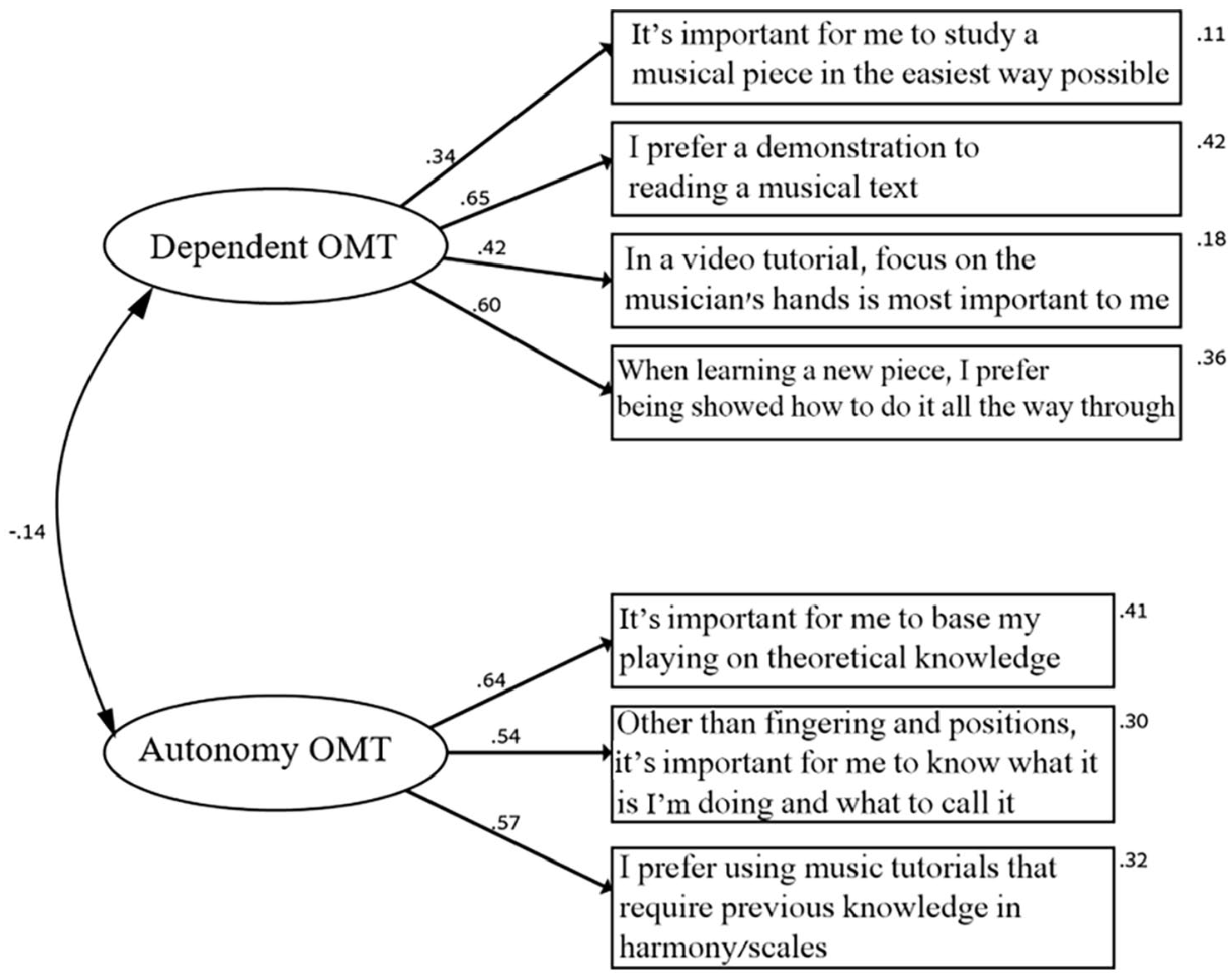
Item Loadings in Standardized Units.
Testing the research hypotheses
To perform the initial test of the research hypotheses, we calculated Pearson’s correlation coefficients between all continuous study variables. The results indicated support for the research hypotheses. Specifically, MSE was positively correlated with self-esteem, with grit, with autonomy OMT, and with weekly hours of practice, and negatively correlated with dependent OMT. Contrary to the research hypothesis, no correlation was found between MSE and years of playing. All descriptive statistics and Pearson’s correlations are presented in Table 1.
Descriptive Statistics and Correlations.
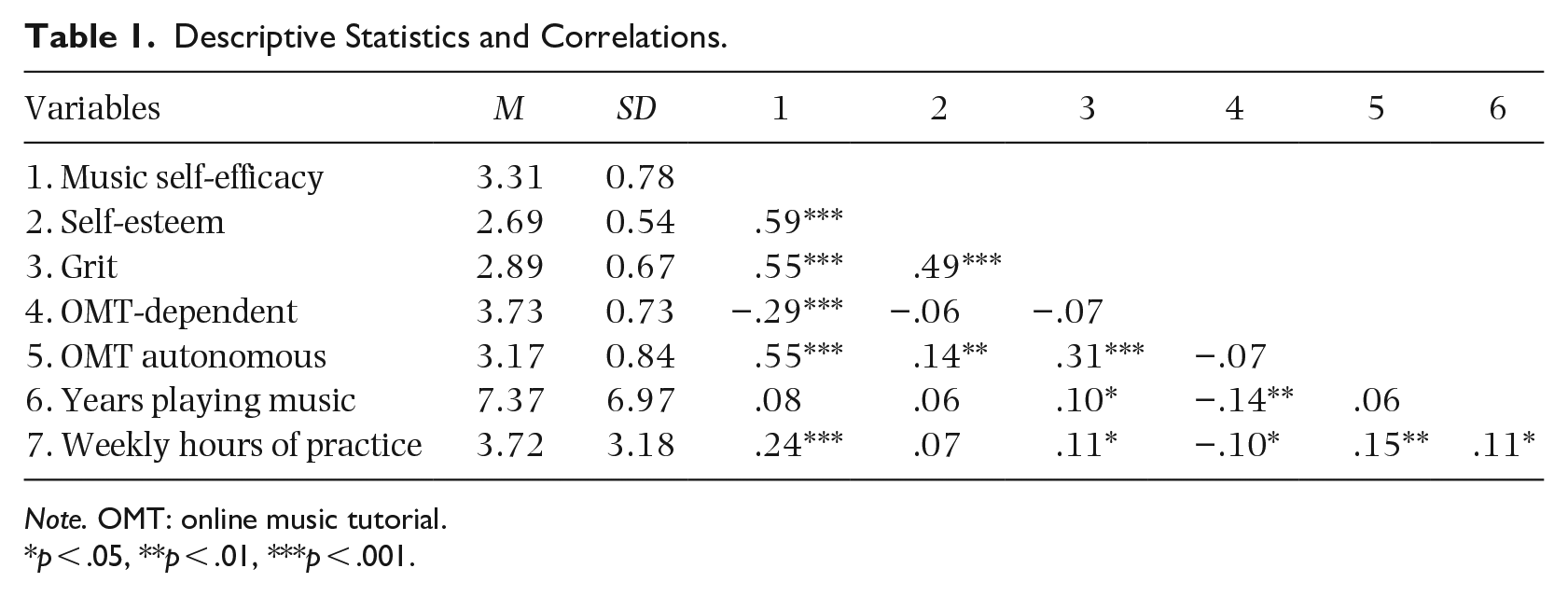
Note. OMT: online music tutorial.
p < .05, **p < .01, ***p < .001.
Subsequently, to test whether MSE differs between men and women, an independent sample t-test was conducted. A non-significant Levene’s test indicated equality of variances between the groups (p = .08). Furthermore, a non-significant t-test indicated no difference in means between the groups,
Similarly, to test whether MSE differs between those who were taught by a teacher and those who were not, an independent samples t-test was conducted. A significant Levene’s test indicated the equality of variances assumption between the groups was violated (p = .04). Furthermore, a non-significant Welch’s t-test indicated no difference in means between the groups,
To test whether MSE differs between those who play with other people and those who do not, we conducted an independent samples t-test. A non-significant Levene’s test indicated equality of variances between the groups (p = .16). Furthermore, a significant t-test indicated a difference in means between the groups,
Finally, to test the unique effects of all the independent variables on MSE, a hierarchical ordinary least square regression was conducted in three steps. In the initial step, only the background variables of age and gender were inserted into the model. In the second step, background variables related to expertise in music playing (years of playing, studying music with a teacher, playing with others, and weekly hours of playing) were inserted into the model. Finally, in the third step, to test the effect of the theoretical psychological independent variables on the dependent variable above and beyond the background variables, the theoretical variables (self-esteem, grit, autonomy, and dependent OMT preferences) were inserted into the model.
The results of the first model indicated that the demographic background independent variables were not significant predictors of the dependent variable. The second model, on the other hand, accounted for 10% of the variance of the dependent variable. Analysis of the regression coefficients indicated that while controlling for all other variables, weekly hours of practice have a positive effect on MSE. In addition, those who play with others have higher MSE than those who do not.
The results of the third and final model indicated that the independent variables accounted for 50% of the variance in the dependent variable and that the model was significant. Furthermore, the theoretical independent variables accounted for 40% of the variance in the dependent variable, above and beyond the variance explained by all of the background independent variables together. The results of the third model indicated that when controlling for all other variables, self-esteem had a positive effect on MSE. Similarly, grit and autonomy OMT has a positive effect on MSE. Moreover, both weekly hours of practice and playing with others retained their positive effect on MSE. Finally, age was found to have a negative effect on MSE. The models’ regression coefficients are presented in Table 2.
Hierarchical Regression Coefficients.
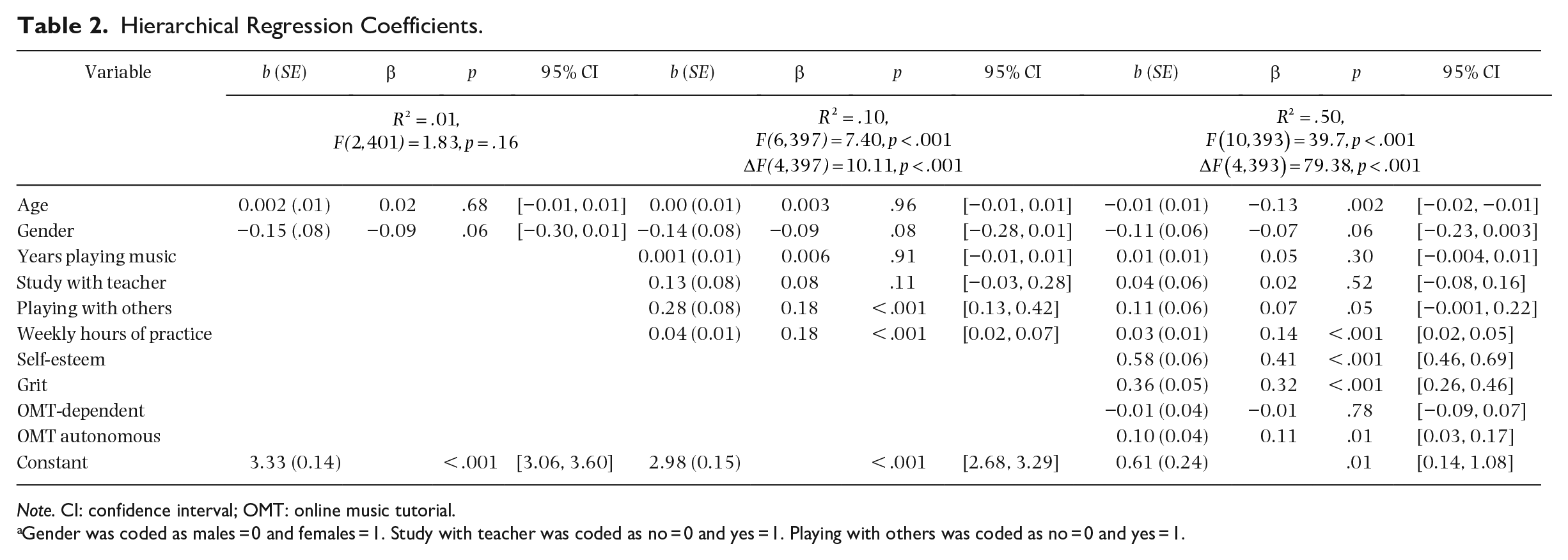
Note. CI: confidence interval; OMT: online music tutorial.
Gender was coded as males = 0 and females = 1. Study with teacher was coded as no = 0 and yes = 1. Playing with others was coded as no = 0 and yes = 1.
Discussion
The present study sought to shed light on MSE of amateur musicians by focusing on their learning and playing habits, preferences for OMTs, and their self-esteem and grit. In doing so, the study extended the limited literature on MSE of amateur musicians. Results confirmed the main research hypotheses: according to the hierarchical ordinary least squares regression, self-esteem, grit, and preferences for autonomy OMTs had a positive relationship with MSE as did playing with others and weekly hours of practice.
The connection between practicing and routine to both grit and self-efficacy had been previously demonstrated and, in the context of the present study, contributes to the understanding of the factors associated with MSE. Duckworth (2016) presents a number of studies that demonstrate the positive contribution of practicing to grit among musicians, dancers, academics, and athletes. Moreover, Tief and Gröpel (2020) showed that pre-performance routine as a set of cognitive and behavioral elements used by violin performance students improved their self-efficacy after performing.
Music educators can foster students’ MSE using two main action strategies whose impact should be examined in future studies: the first pertains to the students’ learning and playing habits, and the second is based on encouraging and cultivating grit. As for learning and playing habits, in the current research, we demonstrated the importance of pointing to the differentiation between the use of autonomy OMTs as well as the encouragement of co-playing experience. Furthermore, as grit is malleable and learnable (Duckworth, 2016) and the current study finds that grit significantly predicts MSE, we believe that this study could contribute to teachers’ understanding of the importance of encouraging students to learn perseverance and develop skills for coping with difficulties as they strive to maintain passion and interest in music.
Regarding the effect of teacher-student relations, Lewis et al. (2021) demonstrated teacher influence on students’ MSE. They examined collegiate music students’ perceptions of teaching methods that strengthened or weakened music performance self-efficacy belief. Students who reported studying with a teacher who influenced them to become greater than they imagined was possible indicated significantly higher music performance self-efficacy beliefs than those who had not. Although the findings our study do not replicate the significance that teachers have on their students’ MSE, it indicates that there might be additional ways in which teachers might foster it, an issue that requires further exploration.
Based on the current research findings and on extensive knowledge concerning the importance of MSE for those involved in playing (Ritchie & Williamon, 2012), we suggest that educators offer their experience in guiding OMT use among their students. An informed choice that potentially fosters MSE and expands the knowledge and possibilities of playing in the future could be in the form of using autonomy OMTs rather than dependent ones. The basis for this can be found in previous studies that have indicated the implications of autonomy versus dependent help-seeking orientation (Nadler, 1997; Other et al., 2009, 2017) and based on the relationships found in this study between autonomy versus dependent online tutorials with MSE.
Moreover, regarding the differentiation between autonomy and dependent OMT, it is possible that users have a predetermined preference for one type over the other. In this case, it would be interesting to understand the reason for that preference and what characterizes the amateur musician who prefers each type. In the current study, we chose to focus on the connection between each preference and MSE.
It should be stressed that the present study was conducted in the midst of the Covid-19 pandemic, when people were isolated for several periods during the year that affected their ability to study music with a teacher face-to-face. Unlike former studies that showed prediction of high MSE among music students who study with a teacher (Clark, 2013; Harpaz & Vaizman, 2021; Vaizman & Harpaz, 2022), the present study’s results were not replicated. A possible explanation for this might be the absence of a continuous learning routine throughout the year and during data collection. To thoroughly investigate this issue, further research should be conducted after returning to routine life, post-Covid-19 pandemic.
The possible effect of Covid-19 on amateur musicians’ personal characteristics, such as like grit, self-esteem, and self-efficacy should be taken into consideration and further explored in “normal” times. Another aspect that became challenging during Covid-19 was joint playing and it was found to be correlated with high MSE in both the current study and a previous study conducted before the virus spread (Harpaz & Vaizman, 2021). Co-playing experience by the study’s participants could have been gained pre-Covid-19 pandemic or during relief between lockdowns. Therefore, further research is required to address amateur musicians’ various characteristics of co-playing experience and its relation to MSE. It would be interesting to study this relationship in longitudinal research.
Regarding the limitations of the present study, it did not examine the relationship between MSE of amateur musicians and their well-being, which is especially relevant in the midst of the Covid-19 pandemic. Lonsdale and Day (2020) compared the psychological well-being of participants who engaged in diverse musical and sports leisure activities. They found that any activity that offers opportunities for mastery of a new skill, accomplishment, and improvement has the potential of having a beneficial effect on psychological well-being. Koehler et al. (2021) provide evidence for the importance of autonomous motivation in hobby music-making with regard to subjective well-being. MSE should be further researched in this context.
As for more research limitations and future contributions, causality conclusions could benefit from laboratory research that allows the independent variables (self-esteem, grit, OMT, and other learning and playing habits) to be manipulated. It would be interesting to examine in a follow-up study whether manipulation of these variables predicts higher MSE compared with control conditions.
One of the study’s findings was the negative prediction of MSE by age. Although a statistical variable in the current study, age could open new options for research regarding amateur musicians. The connection between amateurs’ ages and their MSE could be explored leaning on different suggestions. For instance, the claim that a learner’s option to boost their MSE is to observe another student of the same age and skills learning the same piece (Hendricks, 2016) and this might be reflected in adults’ OMT use and the instructors they tend to watch. However, as an older adult, it is less likely to encounter an OMT with peer group members who have the same skills.
Moreover, recreational musicians, as reflected in the ages of the participants in this study, can spend decades playing an instrument. While formal music students’ MSE presumably develops with age (Zelenak, 2015), amateurs may feel less capable with age, whether due to a late start (Zarza-Alzugaray et al., 2018) or to the prolonged status of amateurism. It would also be interesting to learn how mid-life adults learn new materials, what the characteristics of their web use are, and what their preferences regarding OMT instructors are. Qualitative research using interviews could lead to new understandings and research options.
Finally, the present study does not focus on the genre or musical style that the amateur musician chooses to play. For this reason, the piece that the musician is trying to play is not the focus of the current study but rather the preference for autonomy versus dependent OMTs that the amateur musician chooses to use to learn how to play the piece. A follow-up study that examines the findings while comparing musical pieces from different genres might contribute to a fuller picture.
Conclusion
The present study extends the knowledge on MSE of amateur musicians by pointing out the relationship between MSE and learning and playing habits, preferences for using autonomy OMT, self-esteem, and grit of amateur musicians. By shedding light on the connection between these personal characteristics and habits, the current study contributes to the understanding of the factors associated with MSE of the amateur musician, a scholar who has not received much attention so far. In addition, it is important to emphasize that a follow-up experimental study is recommended for establishing causality that would enable the construction of established interventions for the benefit of MSE development among amateur musicians. We therefore conclude that it is worth examining in future experimental studies the effect of a methodical fostering of every music student’s grit and self-esteem, along with providing the option for co-playing and a direction toward the use of autonomy OMT by the student’s teacher. We see value in encouraging future research that will lead to finding ways to cultivate the MSE of amateur musicians and students alike.
Footnotes
Declaration of conflicting interests
The author(s) declared no potential conflicts of interest with respect to the research, authorship, and/or publication of this article.
Funding
The author(s) received no financial support for the research, authorship, and/or publication of this article.
