




Abstract
This study uses identity process theory to understand the social–psychological processes that motivate individuals to construct an identity in which music, singing, and singing teaching feature prominently. We conducted reflexive thematic analysis of semi-structured interviews with 10 Australian singing teachers (with an average age 60) to understand how they enacted identity principles that motivate identity construction and maintenance. Findings were captured in two themes: (1) ‘It has just been music’: Living a musical life is my destiny; (2) ‘I know my value’: Achieving goals in music and teaching is motivating. Participants’ consistent musical engagement across the lifespan satisfied the identity principles of continuity and positive distinctiveness. The identity principles of self-efficacy and self-esteem were satisfied through the social connections created with peers and through teaching singing; participants derived self-worth from celebrating and contributing to the success of others. Teaching singing was a way to become ‘singular’, that is, distinctive, and distinctively valued by the self and others. This article provides an example of how identity process theory can be applied in musical identities research to uncover new insights into the psychological processes of identity construction, with implications for understanding identity resilience and musical engagement across the lifespan.
Identity has been a key focus of music psychology research. Identity serves as a powerful motivating force in the human psyche, driving thoughts, emotions, and behaviours (Breakwell, 2023, p. 2). The publication of Musical Identities (MacDonald et al., 2002) was a watershed moment for research on music and identities, which distinguished the role music plays in people’s lives (music in identities) from specific music roles people may have (identities in music). Since then, there has been growing global interest in the field (Burland et al., 2022), particularly in the relationship between the development of musical skills and musical identities (Hargreaves et al., 2018). Recent thinking has characterised individuals as having multiple musical identities that are performative, evolving, and contextual (Goopy, 2020, 2024; MacDonald & Saarikallio, 2022). Others have combined concepts of musical identities with different theories, including identity work (Barrett, 2011; Goopy, 2022), musical possible selves (Creech et al., 2020; Goopy, 2023), and 4E (embodied/embedded/enactive/extended) cognition (MacDonald & Saarikallio, 2022).
This article examines singing teachers’ identity construction and maintenance using identity process theory (IPT), which is another lens through which we might usefully view music and identity (Breakwell, 1986, 2023; Breakwell & Jaspal, 2022). Within IPT, identity is considered both as structure and process (Breakwell, 1986, 2023). IPT views the personal and social components of identity as being in dynamic, dialectical relationship, and existing in mental processes that can only be understood within social and historical contexts (Breakwell, 1986). Identity is unique, in that no two individuals have the same identity (although they may share some identity components) and identity is shared in the sense that we express our identity in social situations (Breakwell, 2023). Identity can be shared deliberately, incidentally, or unintentionally (Breakwell, 2023). For many musicians such as singers or singing teachers, performing or teaching can be understood as a deliberate and intentional act of identity sharing.
IPT views identity as holistic and singular; identity is dynamically comprised of multiple characteristics, roles, beliefs, values, and biological markers. Identity is therefore akin to the emergent psychological property of the complex dynamic system of the biological human organism (Breakwell, 2023). Accordingly within IPT, there are no ‘multiple identities’, but rather components of a singular identity, albeit one that is complex, multi-faceted, and dynamic. The treatment of identities in music as multiple within the musical identities literature (MacDonald et al., 2002, 2017) can make it challenging to understand how these identities interact with each other. Within IPT, these ‘multiple identities’ are not treated separately, but rather as facets of an identity constellation or as different roles an individual may adopt (Breakwell, 2023). IPT emphasises the identity structure as a whole and its regulating processes rather than the separate components of identity (Breakwell, 2023). The uniqueness of an identity derives from the multiplicity and interaction of its component parts (Breakwell, 2023). The dynamic interaction of these components within IPT is in line with a recent theoretical development, which views musical identities as dynamic, situated, and embodied (MacDonald & Saarikallio, 2022).
In this article, we use IPT as an ‘interpretative lens’ (Jaspal & Cinnirella, 2010, p. 849) to explore music and identity from a holistic perspective. We sought to better understand the social–psychological processes, which motivate singing teachers (as a subset of professional musicians) to construct an identity in which music, singing, and singing teaching feature prominently. In doing so, we seek to provide an example of how IPT can be used to better understand how and why certain individuals become and remain engaged in musical activity across the lifespan.
Identity process theory
IPT grew out of an interest in how individuals cope with threats to their identities (Breakwell, 1986). Since its original iteration, it has been developed, refined (see Breakwell, 2023), and researched both qualitatively (see Coyle & Murtagh, 2014) and quantitatively (see Vignoles, 2014). At the heart of IPT are the identity principles that motivate the universal processes of identity assimilation–accommodation and evaluation; these identity processes structure identity (Breakwell, 2023). Although researching identity threat and coping requires a comprehensive framework with several layers of analysis (from the intrapsychic right through to the societal levels) (Breakwell & Jaspal, 2022), the identity principles are subjective in nature (Breakwell, 2023) and have been investigated using qualitative methods designed to understand experience (Jaspal & Cinnirella, 2010, 2012; see Coyle & Murtagh, 2014).
Within IPT, the identity structure is said to be regulated by two universal processes that operate at the intra-psychic, interpersonal, and societal levels: (1) accommodation–assimilation in which new identity information is absorbed and adjustments are made; and (2) evaluation, namely the meaning and value for the individual of identity components (Breakwell, 2023). The assimilation–accommodation process refers to the individual absorbing new information into the identity structure; for example, during the COVID-19 pandemic, some musicians took on different types of work requiring the assimilation and accommodation of new elements of identity (Breakwell & Jaspal, 2022). Evaluation is a process of attributing significance and value to new and existing identity components (Breakwell & Jaspal, 2022). Identity is dynamically structured across two dimensions: (1) the content dimension, which is a unique ‘constellation’ of components (Breakwell, 2023, p. 2) in each person with psychological and social properties; and (2) the value dimension, which refers to the positive or negative value an individual ascribes to an identity component (Breakwell, 2023).
The identity processes are guided by four empirically observed identity principles or motivations: (1) positive distinctiveness – resulting from social comparisons whereby we differentiate ourselves in ways which we and others find meaningful, valuable, and worthwhile (Forbes et al., 2024); (2) self-esteem – our subjective evaluation of our own worth (Kruse, 2012); (3) self-efficacy – learning about ourselves through observation and interaction with others (Hendricks, 2016); (4) continuity – the subjective perception of connection between past and present identity (Forbes et al., 2024). Research on the identity principles is extensive and shows they are relevant across cultures; however, few studies have considered IPT (and the identity principles in particular) within the context of music psychology research (cf. Breakwell & Jaspal, 2022 who considered the identity processes of musicians during the COVID-19 pandemic with a focus on identity threat and coping).
Singing, singing teaching, and identity
Research on identity and singing has tended to focus on the performance component of singers’ identities rather than taking a comprehensive view of identity such as that espoused by IPT. Studies have considered the identity construction of performing singers in relation to the demands of their profession across various genres including jazz, pop (Schei, 2005, 2009), and opera (Oakland, 2014; Oakland et al., 2012, 2013, 2014). A unique aspect of performing singers’ identity experiences is the embodiment of the singing voice (Hughes, 2013; O’Bryan, 2015; Thurman & Welch, 2000). Phenomenological studies have identified the embodied voice as playing a fundamental role in performing singers’ identity construction and meaning making (Forbes, 2021; Forbes & Cantrell, 2023; Oakland, 2014; Oakland et al., 2012, 2013, 2014). From an IPT perspective, these findings could be interpreted as supporting the identity principle of distinctiveness. Similarly, vocal identity has been examined as a component of performing singers’ identity (Lemon-McMahon, 2019). Vocal identity captures the signature sound of a singer’s voice, which will depend on a variety of factors including physiology and vocal timbre (Welch, 2005), musical style (Hughes, 2013), and artistry (Hughes, 2014).
Welch’s (2017) framework for understanding singer identity development takes a broader view and considers socio-cultural identity context rather than just singing performance. The framework outlines the various factors throughout life, which influence singer identity construction, including age, vocal development, gender, sex, ethnicity, locality, and personal use of singing as an emotive form of expression (for a detailed discussion of the ways in which environment shapes musical development including singing, see Creech et al., 2020). This framework allows for both positive and negative singer identities. For example, singers who become singing teachers will likely have a positive evaluation of singing as a component of their identity, perceiving themselves as competent singers who have also been influenced by various social and cultural factors to teach others to sing – as Welch (2017) notes, it is common for professional musicians such as singers to teach (see Creech, 2014). In Western societies, the teaching of singing occurs in various contexts, most commonly in the private singing studio (usually involving one-to-one lessons) or formal educational environments such as schools, universities, and conservatoires (King & Nix, 2019). Lessons for professional singers systematically develop vocal technique to sing repertoire (Callaghan, 2019) and even for those adults self-labelled as non-singers, lessons can provide enabling strategies for singing re-entry (Knight, 2019). Therefore, at least within Western societies, singing teaching is an important vehicle for the ongoing development of both amateur and professional singers.
Although Welch’s (2017) singer identity framework outlines the social and cultural influences on singer – and by extrapolation, singing teacher – identity development, less emphasis is placed on the psychological processes at play. With the aim to explore these processes as subjectively experienced by singing teacher participants, in this study we asked: How have the identity principles within IPT been enacted in the lives of participant singing teachers? In using IPT in this way, what are the implications for understanding musical engagement across the lifespan?
Method
Study design
This article is the second reporting on analysis of a dataset comprised of semi-structured interviews with 10 singing teachers. The first article used Interpretative Phenomenological Analysis (Smith et al., 2022) to discover the meaning of music in identity for participants (see Forbes et al., 2024). Analysing the same dataset using different methods is a form of qualitative pluralism (Clarke et al., 2015; Frost et al., 2011). Coyle and Murtagh (2014) argue that qualitative pluralism is a helpful and justifiable approach when researching a complex phenomenon such as identity. As we were interested in gaining a rich, contextualised understanding of singing teachers’ identity experiences, we adopted a pluralist approach to analysing the dataset comprised of semi-structured interviews (Clarke et al., 2015; Frost et al., 2011). Pluralism acknowledges that the answers contained in the dataset depend on the questions being asked (Willig, 2013, 2016). Indeed, as Coyle and Murtagh (2014) note, Breakwell (1986, p. 44) has stated that within identity research, ‘methodological liberation [lies] in the acceptance that it is legitimate to use different approaches in unison’. Pluralism requires the analyst to approach the dataset with a fresh perspective for each analysis (Willig, 2012). Frost et al. (2011) argue that different analytic methods can be complementary and bring depth and breadth to our understanding of the data, enabling researchers to attend to experience from different angles.
In this article, adopting a critical realist perspective, we report on reflexive thematic analysis of the dataset to attend to the subjective experience of IPT’s identity principles. Read together with the original IPA study, which considered the meaning of music in participants’ identities (Forbes et al., 2024), these methods are complementary in that IPA attends to individual experience without guiding theory (apart from the theory inherent in the methodology itself), and critical realism allows for a theoretically driven approach to analysis (Braun & Clarke, 2021; Willig, 2016). Thus, adopting analytical pluralism can produce a richer and more nuanced understanding of participants’ experiences than would be possible with a single analytic approach.
Recruitment and participants
Participants were recruited through an online survey that investigated the social and cultural factors influencing the construction of musical identity. The survey was promoted through the researchers’ professional networks, including via an email invitation from the Australian professional association for singing teachers. As part of the survey, participants volunteered to do a follow-up interview about their experiences of identity construction relating to music. Participants’ (N = 10) average age was 60 years (range: 43–79), with an average of 28.6 years’ experience as singing teachers (range: 17–43 years; see Table 1). Seven of the 10 participants have several decades of professional performing experience. This study received approval by the Human Research Ethics Committees at the University of Southern Queensland and James Cook University. All participants provided written consent to the interviews. Participants have been de-identified and given pseudonyms for the reporting of findings.
Participants.
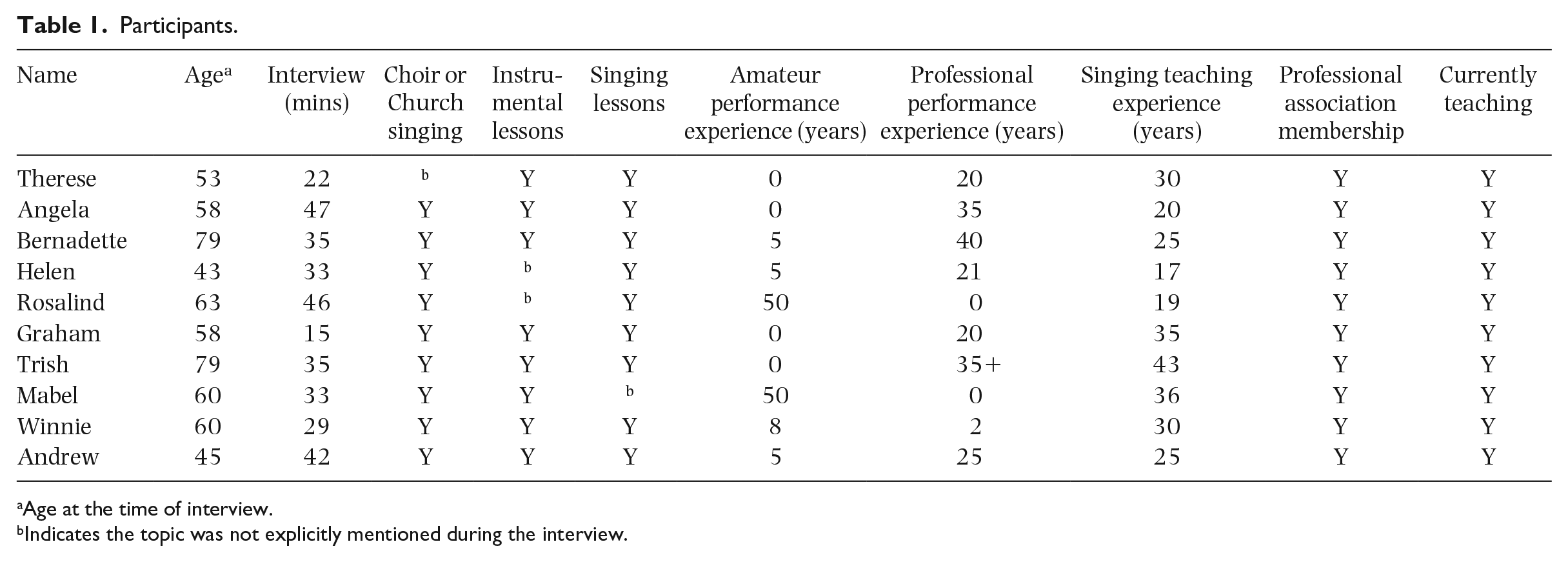
Age at the time of interview.
Indicates the topic was not explicitly mentioned during the interview.
Data collection
One-to-one semi-structured interviews were conducted and recorded via Zoom with each participant using an interview protocol based on Hallam’s (2017) social and cultural influences on music and identity (see Supplementary Materials). Interviews were conducted by members of the research team, and the first author (a member of the national association for singing teachers) interviewed participants not personally known to her. Participants were asked to reflect on their experiences of various social and cultural factors as they related to music and the role it plays in their lives including family, cultural environment, educational environment, self-belief, friends, love of music, opportunities, and musical preferences. Within qualitative IPT research, such contextualising data are important ‘to identify and distinguish key aspects of the theory with credibility’ (Coyle & Murtagh, 2014, p. 42).
Data analysis
The first author used reflexive thematic analysis (Braun & Clarke, 2021) to interpret shared patterns of meaning in the semi-structured interviews with singing teacher participants. Thematic analysis is considered the preferred method for qualitative research using IPT, because it allows for flexible and active use of theory (Coyle & Murtagh, 2014). Critical realism is one of the most frequently adopted theoretical positions for reflexive thematic analysis and combines ontological realism with epistemological relativism (Braun & Clarke, 2021; see also Willig, 2016). We adopted a view of critical realism, which acknowledges that there is a truth ‘out there’ that is ‘mediated by language and culture’ (Braun & Clarke, 2021, p. 170, emphasis in original; see also Willig, 2013). Such an approach allows for existing theory and literature to drive the inquiry, with coding proceeding via a ‘flexible deductive approach’ (Fletcher, 2017, p. 182).
Analysis was conducted flexibly and organically (Braun & Clarke, 2021) as follows: (1) data familiarisation (reading and re-reading transcripts, initial noting, listening to interviews); (2) initial coding (placing extracts from transcripts into Microsoft Excel, first, according to deductive codes derived from IPT and then developing inductive codes); (3) developing candidate themes (combining codes with shared meaning bearing in mind meaningfulness and relevance to the research questions); (4) reviewing, refining, and naming themes; (5) arriving at final themes by writing a narrative account in which final themes are supported by researcher interpretation and evidence from participants’ accounts. The second and third authors provided feedback on theme development and the narrative account.
Findings
Analysis of participant interviews yielded the following themes:
‘It has just been music’: Living a musical life is my destiny (satisfying the identity principles of continuity and distinctiveness)
‘I know my value’: Achieving goals in music and teaching is motivating (satisfying the identity principles of self-efficacy and self-esteem)
The four identity principles are reported in two themes because there was a sense of connection between accounts between distinctiveness and continuity on one hand, and self-esteem and self-efficacy on the other.
‘It has just been music’: living a musical life is my destiny
This theme presents evidence from participants’ accounts as satisfying the identity principles of distinctiveness and continuity. Bernadette’s quote (aged 79), ‘it has just been music’, was chosen to represent this theme. This phrase and the theme, ‘Living a musical life is my destiny’, capture the sense of totality and inevitability participants expressed about their musical engagement from an early age and throughout life (see also Forbes et al., 2024 for the meaning this foregrounding of music had for participants). For example, Rosalind (aged 63) ‘lives’ in a ‘musical soup’ and, by implication, sees herself immersed in music, and as one of its vital and unique ingredients. This musical soup is comprised of rich, varied ingredients drawn from social and cultural contexts. For all participants, musical engagement was encouraged and supported variously by family members and peers, and in church and school.
In IPT terms, the social influence, or the operation of the identity processes at the interpersonal level, are commonly evidenced by participants’ long-term engagement in musical activities involving others. Beginning in their younger years, participants participated in choral or church singing (n = 9), played an instrument/s (n = 8), and took singing lessons (n = 9), all activities strongly dependent on the input of others (note, not all participants necessarily engaged in these activities at the same time and duration of participation was not tracked in interviews). At the time of interviews, all participants were engaged in various musical activities, most notably singing teaching (n = 10), and either amateur (n = 2), professional performing (n = 4) or both (n = 4). Andrew (aged 45), for example, reported having over 30 years of singing lessons. Mabel (aged 60) recalls extensive musical activity as a younger person: I would be in the string group, I’d be in the orchestra, I’d be in the folk group, I’d be in the recorder consort. I would sing solo, sing duets, play piano, play piano duets, play the violin. You’d just do everything.
Participants’ long-term engagement evidences the assimilation of music-making (at the intrapsychic level) into the identity structure as represented by various roles within music which form components of that structure (e.g., ‘singer’, ‘choral singer’, ‘pianist’, ‘violinist’, ‘performer’).
As people who are continuously and consistently involved in musical activities, participants ‘are motivated by a desire to establish the continuity of their identity’ (Breakwell, 2023, p. 46). This engagement is positively evaluated by participants as a rewarding lifelong endeavour. For example, Angela (aged 58) carries with her treasured formative musical experiences. There is a strong sense of temporal continuity and even inevitability to participants’ musical experiences. Much like Bernadette, for Angela, ‘[music] was just always there’. Rosalind says her connection to music has remained ‘uninterrupted’ and is ‘what I had always done as a source of pleasure and identity’. For Trish (aged 79), music has been there ever since she can remember and has remained ‘front and centre’. The presence of music for Bernadette has been absolute (‘It has just been music’) and Andrew says, ‘there has been a soundtrack to my life for 45 years’. Breakwell (2023) notes that the identity principle of continuity is established by a person’s subjective perception of what constitutes continuity. For these participants, there is subjective perception of ‘seamless connection’ (Breakwell, 2023, p. 46) between past identity (from earliest memories) through to current identity. Six participants expressed the reason for this seamless connection as nature, fate, or pre-destiny. For Bernadette, ‘everything slotted in along the way as though it were meant to’; Mabel was ‘identified probably at the age of five that [she] could sing well, so from then on’. Others express musical ability as a natural component of their biology – ‘like my blood’ (Helen, aged 43), ‘innate’ (Winnie, aged 60), or as Trish describes herself, as having a natural ear for music: ‘I was the age of four and could hear music on the radio and go and play it on the piano . . . I’ve got such a strong innate ear’. Rosalind describes herself as a ‘natural singer’. These appeals to nature or fate strengthen participants’ subjective experiences of the stability and permanence of music as a component within the identity structure. They also evidence the intensity of motivation to maintain continuity because to do otherwise would be going against the natural or pre-destined order.
Within these accounts, the principles of continuity and positive distinctiveness interact and mutually reinforce each other; the identity component that supports the distinctiveness claim (Breakwell, 2023) is the association (or indeed, the natural connection) with music and singing. Seeing oneself as a ‘natural singer’ or having an ‘innate ear’ are ways in which participants consider themselves as positively distinct from others. Distinctiveness is fundamentally a result of social comparison where comparison positively marks an individual (Breakwell, 2023). Trish draws on others’ perceptions of her as positively distinctive through her music: ‘People see me as someone who is associated with, and interested in, music . . . My identity is strongly connected by people who don’t even know me terribly well, as someone who deals in and knows their way around music’. Because ‘people who don’t even know [her] terribly well’ associate Trish with music, she feels she strongly exhibits a distinctiveness that is obvious and undeniable. Distinctiveness can also result from internal comparison (Breakwell, 2023). For example, Angela feels that for her ‘music is a way to be heard’ and that through singing she was allowed to ‘say things’, which were prohibited for other children. Therese (aged 53) compares what she does as a singer to instrumentalists as being distinctive because singing is ‘more complex and layered’. Helen recalls how during high school, her knowledge of Gilbert and Sullivan repertoire set her apart from her peers. She claims this knowledge very proudly – ‘Nobody else knew it!’ – and, because of her familiarity, was cast in a lead role. Angela recalls she was ‘the only one in my class . . . [who] went to choir practice’. Mabel’s strong internal sense that she could ‘just do everything’ musically, and the depth of her musical skills, fuels her uniqueness. In all these examples, participants experience their musicality and singing ability as licences to be unique.
There was a somewhat paradoxical finding regarding distinctiveness. Although active musical engagement is positioned front and centre throughout participants’ lives, seven participants expressed a need to experience silence or a break from music listening in recreational time. Trish and Angela explained that they felt full of music, and therefore had no need to seek out more music when not working. For example, Trish says she has ‘a headful [of music]’ and that music is ‘going all the time’. Angela explained that her limited recreational listening was because ‘I always hear music’ and therefore ‘silence is often what I need and want, and I don’t listen then too much to music’. Helen links the need for silence to long days of teaching or listening to opera: ‘I actually find, to be honest, if after a day of teaching or being at the opera or what have you and I’m driving home, I tend to also sit in silence [laughs]’. Helen’s laugh hints that she understands at some level the irony of someone who is immersed in music not wanting to listen to it. Graham links his singing teaching job to a lack of urge to listen to music because his ‘brain’s too tired from analysing sound all day’: ‘I don’t actually listen to much music myself for enjoyment because I’m teaching seven and eight hours a day and by the end of day I crave silence’. Although Helen and Graham are clear that their exposure to music during the working day leaves them ‘craving silence’, Winnie struggles to understand why she listens to very little music: ‘This sounds really strange. I listen to very little music unless it’s for teaching purposes’. On a more subtle level, Bernadette notes the absence of music playing at home: ‘I can’t imagine my life without music and yet I can go around the house with no music on at all. Just in silence’. Rosalind also enjoys peace at home: ‘It’s generally a fairly quiet house’. In each of these cases, whether expressly or implicitly, participant singing teachers revealed the need for a break from music during downtime. The lack of desire to listen to music in non-work time (perhaps paradoxically) strengthens the positive distinctiveness of being professional musicians and music educators.
‘I know my value’: achieving goals in music and teaching is motivating
This theme presents evidence from participants’ accounts as satisfying the identity principles of self-efficacy (subjective evaluations of goal-attainment derived from observational learning) and self-esteem (subjective evaluations of an individual’s own worth).
Social interactions helped participants appreciate their own abilities and effectiveness. This was evident within participants’ teaching practice, and through peer influence and support. Bernadette recalls: ‘I always had people lining up to come and have lessons because it worked. It [my teaching] worked in a way that many other people didn’t want to try’. She says that ‘I’m able to help them [students] quite significantly improve what they’re doing in a very short time’. Through teaching, Bernadette experiences the goal-attainment of her students as attaining goals of her own; there is a synergy between what her students need and what Bernadette can offer them as a teacher. Trish describes the reciprocal nature of teaching and learning: ‘[my students] affect me and educate me and broaden . . . my terms of reference as a teacher, as a performer, as an artist’. Through interacting with her students, Trish becomes more efficacious in her various roles within music. For Helen, the observation of successful peer performers plays a ‘huge influence’ on her development as a singer and teacher: ‘there’s nothing like watching someone that you respect get up and do it to inspire you to do it as well’. Both Graham and Winnie discuss the strong influence of teachers and other musicians on their ability to attain goals and craft successful careers as singing teachers. As someone beset by performance anxiety throughout her career, Winnie repeatedly identifies people who ‘believed in her’ as being fundamental to rebuilding her confidence as a singing teacher and music educator. This belief of others in her abilities helped Winnie to understand her strengths as a teacher, enabling her to then relish her impact on her own students: ‘being able to see not just the results, which were great, but the enjoyment that came through the students and their striving to be better and better’. In Winnie’s words, we can see the vital role positive social interactions (and her ability to draw positive learning from them) play in creating the self-belief that her goals are within reach.
This self-efficacy derived from observing peers and students’ successes, or experiencing peer encouragement and support, interacts with participants’ sense of self-esteem – seven participants derive a strong sense of self-worth and social value from their work as teachers. For Angela who had a long career as a performer, ‘It is only through my teaching that I realised that I really had a talent and how musical I was’. She now considers herself ‘very musical’ – ‘I know my value’ (Angela). Like Winnie, Angela ‘was plagued with performance anxiety, crippling performance anxiety well into my 40s’ and discovers her true value as a singer and as a musician through teaching. Andrew expresses similar sentiments, positively evaluating himself as a teacher: Teaching’s interesting. Teaching is the first time that I can actually say I am really good at something. I’m actually a very, very good teacher. I can say that with complete belief in myself. I have never, ever been able to say that about myself as a performer. (Andrew)
Graham and Winnie derive value from enjoying students’ success: it is ‘very satisfying when you get to see [your students] become good performers but also decent humans’ (Graham); Winnie says that she is ‘highly immersed’ in working in educational settings, and this gives her ‘great joy’. She also believes that she is ‘far better as a teaching musician than a performing musician’. Therese seems proud of the fact that she earns her income from teaching singing. Rosalind understands that she is ‘helping people realise their own goals and get in touch with music and . . . giving them a sense of joy and identity and wholeness. That’s got to be good’. Rosalind’s reflection on her teaching reveals aspects of both self-efficacy (in terms of facilitating students’ goal-attainment, which, as an educator, is your goal) and in terms of self-esteem (she finds self-worth in giving to others).
Discussion
By using IPT as an interpretative lens, we sought to understand singing teacher participants’ identity construction and maintenance holistically, with an interest in identifying the underlying psychological processes. We asked: How have the identity principles within IPT been enacted in the lives of participant singing teachers? In using IPT in this way, what are the implications for understanding musical engagement across the lifespan? We do not seek to generalise from findings due to the small sample size and considering the underlying philosophical assumptions guiding the research design, which privilege subjective experience. However, the findings provide valuable insight into the underlying psychological processes of identity construction and maintenance for participant singing teachers, who may be considered a subset of professional musicians who teach. Because of the relatively novel application of IPT in the context of musical identities, we also suggest various avenues for future IPT research on music and identity and musical engagement across the lifespan.
Findings captured in the theme, ‘It has just been music’: Living a musical life, revealed that the identity principles of distinctiveness and continuity were strong, interconnected guiding forces in participants’ assimilation and maintenance (over many decades) of the identity elements of musician, singer, and music listener. Distinctiveness was derived from musical activities from an early age, which were positively evaluated by the participants themselves and others, and absorbed into the identity structure (e.g., choral singing, church singing, learning an instrument, or singing; see Welch, 2017). Participants’ experiences reinforce the vital importance of early and supportive musical experiences in promoting lifelong musical engagement (Creech et al., 2020; Goopy, 2020, 2022, 2024; Welch, 2017); they also evidence the underlying psychological identity processes at play, and how these experiences motivate the assimilation and accommodation of the personally and interpersonally valued role of music into the identity structure (Breakwell, 2023). These valued identity components are ‘carried with them’ (paraphrasing Angela) throughout life, satisfying the identity principle of continuity – there is a strong connection between past and present identity. Identity principles affect both the structuring of identity and the strength and direction of motivation they provoke (Breakwell, 2023). In participants’ accounts, distinctiveness was a central and salient facet of the identity structure and aroused strong motivations to pursue continuity across the lifespan.
Curiously, seven of 10 participants reported the need for silence or a lack of desire to listen to music in leisure time (Theme 1). This finding seems inconsistent with participants’ identities being comprised of salient music-related facets (see also Forbes et al., 2024 for the high salience of music in participants’ identities). Breakwell (1986) notes that there can be continuity in inconsistency. Participants’ accounts support this, in that only Winnie identified this tendency as ‘strange’ for someone who is a musician (and Helen laughed at the idea, appearing to acknowledge the irony). The participants’ offhandedness about their need for silence or lack of desire to listen to music could in fact be seen as satisfying the distinctiveness principle because it makes them different to ‘the norm’; it is because they so strongly distinguish themselves from others through music that they do not wish to engage with listening at times when others do. We contend that this finding warrants further research (noting similar findings in Reitan, 2013) because music listening has been associated with a range of health and wellbeing benefits (Dingle et al., 2021; Krause et al., 2018). It may be possible that some musicians miss out on these benefits because of the nature of their work.
There is no hierarchy of identity principles within IPT and no principle is prime; rather, the salience of principles fluctuates according to the identity structure and environment (Breakwell, 2023). There was a greater quantity and quality of evidence in participant accounts for the principles of distinctiveness and continuity; however, this may have been a function of the interview questions focusing more on gathering details of participants’ socio-cultural environment, rather than prompting participants’ self-evaluation.
Nonetheless, there was sufficient supporting evidence for the principles of self-esteem and self-efficacy to support a second theme, ‘I know my value’: Achieving goals in music and teaching is motivating. These identity principles were largely satisfied through social interactions and social support: via singing teaching, participants experienced supporting students to attain goals as teachers’ own goal attainment. Furthermore, participants were motivated by, and derived self-worth from, celebrating and contributing to the success of others. Regarding self-esteem, Andrew and Angela (both highly experienced professional classical singers) singled out teaching (over performing) as being the catalyst for self-worth. Perhaps the direct and regular access to students’ progress yields more immediate and consistent feedback for teachers on their efficacy than performing does. It was clear that for participants, others’ goal attainment was very important to them, and this is something less likely to be experienced by performers, especially those who are soloists.
We found the holistic nature of IPT to be useful as a framework for identity and for considering musical engagement across the lifespan and see many future avenues for its application. For example, IPT maintains that changes in the human biological organism ‘can be linked to modifications in the content and value dimension of identity’ (Breakwell, 2023, p. 27). Adopting IPT would be a useful approach for researching, by way of example, experiences of female singers undergoing menopause, transgender singers, or any singer/musician experiencing injury, ageing, or ill-health. Such experiences are likely to involve some level of identity threat or accommodation for musicians, giving rise to the need for identity resilience and coping strategies (see Breakwell & Jaspal, 2022). In relation to the identity principles, a fruitful and interesting avenue of inquiry would be to investigate music performer/teachers’ experiences of identity construction using IPT, particularly how the principles of self-esteem and self-worth guide the assimilation and accommodation (and evaluation) of the roles of performer and teacher (see also Mills, 2004).
It is evident from the analysis that participants experienced the motivational identity principles functioning at the intrapsychic and social or interpersonal levels to construct and maintain a positively evaluated identity over time with significant components of that identity derived from musical engagement. Although IPT is also concerned with identity processes at the societal level (Breakwell, 2023), there was little in participants’ accounts to evidence how societal mores, values, or beliefs may have influenced participants’ identity processes. Specific forms of the identity principles ‘will reflect what is then socially desirable’ (Breakwell, 2023, p. 48) and societal standards which evaluate identity worth evolve and change (Breakwell, 2023). Therefore, another worthy avenue for future research would be to use IPT to examine society’s valuing of musicians in the context of rapid technological innovation, particularly regarding the role of generative artificial intelligence in singing, music making, and music teaching. IPT has been used to consider musicians’ experiences of other forms of social upheaval, such as the COVID-19 pandemic (Breakwell & Jaspal, 2022). Our earlier phenomenological study of this singing teacher cohort found that music in identity was experienced as existentially salient, meaning that participants may be susceptible to identity threat (Forbes et al., 2024). IPT is useful to gain a view of both positive and negative aspects of identity. Although music can be a rewarding pursuit, it can also be painful to lose. IPT provides a comprehensive framework to derive a nuanced understanding of both the negative and positive consequences of forming an identity structure that foregrounds musical engagement.
Conclusion
This study contributes to our understanding of music and identity by approaching an individual’s identity holistically and evidencing the psychological identity principles, which interact with and respond to the social and cultural influences detailed in Welch’s (2017) singer identity framework. Thus deployed, IPT demonstrates that, rather than looking at different identities or roles in music, focusing on underlying psychological processes and motivating principles can create a nuanced understanding of the influential role music plays within the identity structure.
Returning to the title of this article, this study has identified that the process of becoming a singing teacher in fact begins very early in life and unfolds continually across the lifespan. Teaching singing is a way to become singular, that is, to be distinctive and distinctively valued by others. Through the interpretative lens of IPT, we can appreciate the significant role of music in participants’ lives, but also understand that building identity resilience is vitally important to cope with the inevitable challenges life will bring to ongoing musical engagement.
Supplemental Material
sj-docx-1-pom-10.1177_03057356241267863 – Supplemental material for Becoming singular: Musical identity construction and maintenance through the lens of identity process theory
Supplemental material, sj-docx-1-pom-10.1177_03057356241267863 for Becoming singular: Musical identity construction and maintenance through the lens of identity process theory by Melissa Forbes, Jason Goopy and Amanda E Krause in Psychology of Music
Footnotes
Acknowledgements
The authors wish to thank Xanthe Lowe-Brown for assisting with interviews and the participants in this study.
Author contributions
A.E.K. and M.F. collaboratively developed the study, gained ethical approval, and conducted participant recruitment. M.F. and A.E.K. oversaw data collection and M.F. conducted the reflexive thematic analysis. M.F., A.E.K., and J.G. collaborated on interpretation of findings and discussion. All authors collaborated to draft the article and approved the final version.
Declaration of conflicting interests
The author(s) declared no potential conflicts of interest with respect to the research, authorship, and/or publication of this article.
Funding
The author(s) received no financial support for the research, authorship, and/or publication of this article.

Supplemental material
Supplemental material for this article is available online.
References
Supplementary Material
Please find the following supplemental material available below.
For Open Access articles published under a Creative Commons License, all supplemental material carries the same license as the article it is associated with.
For non-Open Access articles published, all supplemental material carries a non-exclusive license, and permission requests for re-use of supplemental material or any part of supplemental material shall be sent directly to the copyright owner as specified in the copyright notice associated with the article.
