




Abstract
In this article, the representation of male and female musicians is compared between three major genres of music performance and across three geographical regions: the United Kingdom, Europe, and the United States. Relevant data of artists from 40 world-class orchestras, 40 competition brass bands, and 40 top-selling recorded popular music groups were obtained from the websites of the respective organizations and from other authenticated sources. Information collected included the instruments played by each artist, the artist’s status in the ensemble (e.g., principal/section leader/rank and file player). The membership of each instrumental section was then analyzed for balance of sex representation. Overall, across all three genres, male musicians considerably outnumbered females, but this imbalance was moderated by genre and regional differences. The lowest level of imbalance of sexes was observed in orchestras, with males occupying 60% of orchestral chairs compared with females 40%, but principal chairs/section leaders were found to be predominantly male. In brass bands, males predominated by a ratio of 76% males to 24% females, and section leader chairs were almost invariably occupied by males. In the genre of popular music, male performers massively outnumbered females by 85%–15% in every aspect of performers and group leader roles by 90% to 10%. Possible causes of these imbalances are explored for each genre. In all three genres representation of males and females was found to be closely related to the instruments played, for example, many more females than males were harpists, and many more males were trombonists and tuba players than were females. Reasons for these differences are explored with particular reference to differential patterns of education and musical training and to underlying historical and sociological issues.
Keywords
In this article, the representation of male and female musicians is compared between three major genres of music performance and across three geographical regions where these three modes of performance prosper: the United Kingdom, Europe, and the United States. Relevant data of artists from 40 world-class orchestras, 40 competition brass bands, and 40 top-selling recorded popular music groups were obtained from the web sites of the respective organizations and from other authenticated sources. Information collected included the instruments played by each artist, the artist’s status in the ensemble (e.g., principal/section leader/rank-and-file player). The membership of each instrumental section was analyzed for balance of sex representation.
A partial motivation for the study was extended commentary appearing in journals and the daily press claiming a marked disproportion in the numbers of males and female musicians in professional orchestras, typically reporting male players as substantially outnumbering women. Some of the commentary had been more characteristic of journalistic polemic than of evidenced reportage. Headlines such as “Sexism is rife in classical music” (Rhodes, 2014), “Orchestras still hostile to women” (BBC News, 2014), and “Women are held back in classical music” (Kennedy, 2014) have appeared regularly.
In a previous paper (Sergeant & Himonides, 2019), the authors reviewed the practices adopted by orchestras when appointing musicians to vacant positions and compared the rates of appointment, career patterns, and retirement ages of male and female musicians. Increases in the numbers of women appointed to orchestral posts over the last three decades were also compared with increases in the proportions of women in the general workforce. In each of these areas, statistically significant differences were evident between male and female musicians.
In this article, the roles and status of males and female musicians in three musically contrasting genres and styles of music are compared across three geographical areas where these three modes of performance prosper.
Marked contrasts in sex balance were noted which are substantially attributable to differences in the instruments played by the male and female musicians and the reasons for these differences explored. Particular issues that are explored are differential patterns of instrumental choice and of patterns of music education and training relating to each of the three musical genres.
Materials and method
World-class orchestras
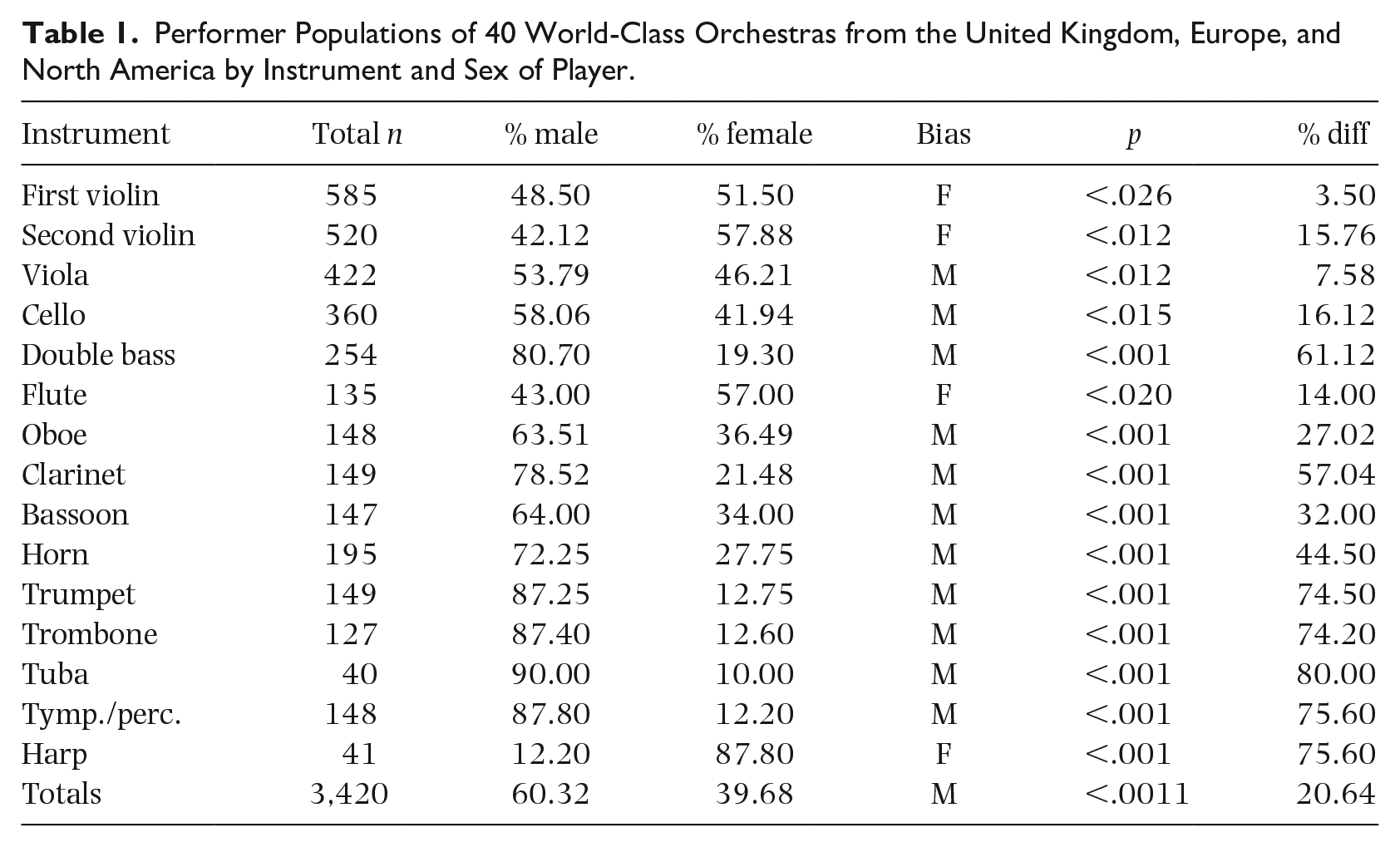
Data of musicians holding tenured positions in a sample of 40 leading orchestras from the United Kingdom, Europe, and North America were collected from the orchestras’ websites. Criteria for inclusion in the sample were that an orchestra should be fully professional, widely recognized as having world-class status, 1 have made published recordings under established labels, and have accessible data of member musicians. The current near-universal practice of major orchestras of posting on their websites details of each member player, including full name (unfamiliar forenames were checked using both “Gendernamefinder” and GenderAPI websites), a brief biography (which usually included use of personal pronouns), portrait photographs in their customary gender-specific concert dress, and listing the instruments they play enabled reliable identification of the sex and orchestral role of each player. Vacancies or pending appointments listed on the websites were not included. Results of the review are shown at Figure 1. The resultant database records a total of 3,420 musicians (Table 1) and shows that in the total sample of 40 orchestras, males currently outnumber females by a difference of slightly over 20% (difference significant p < .001; Figure 1).
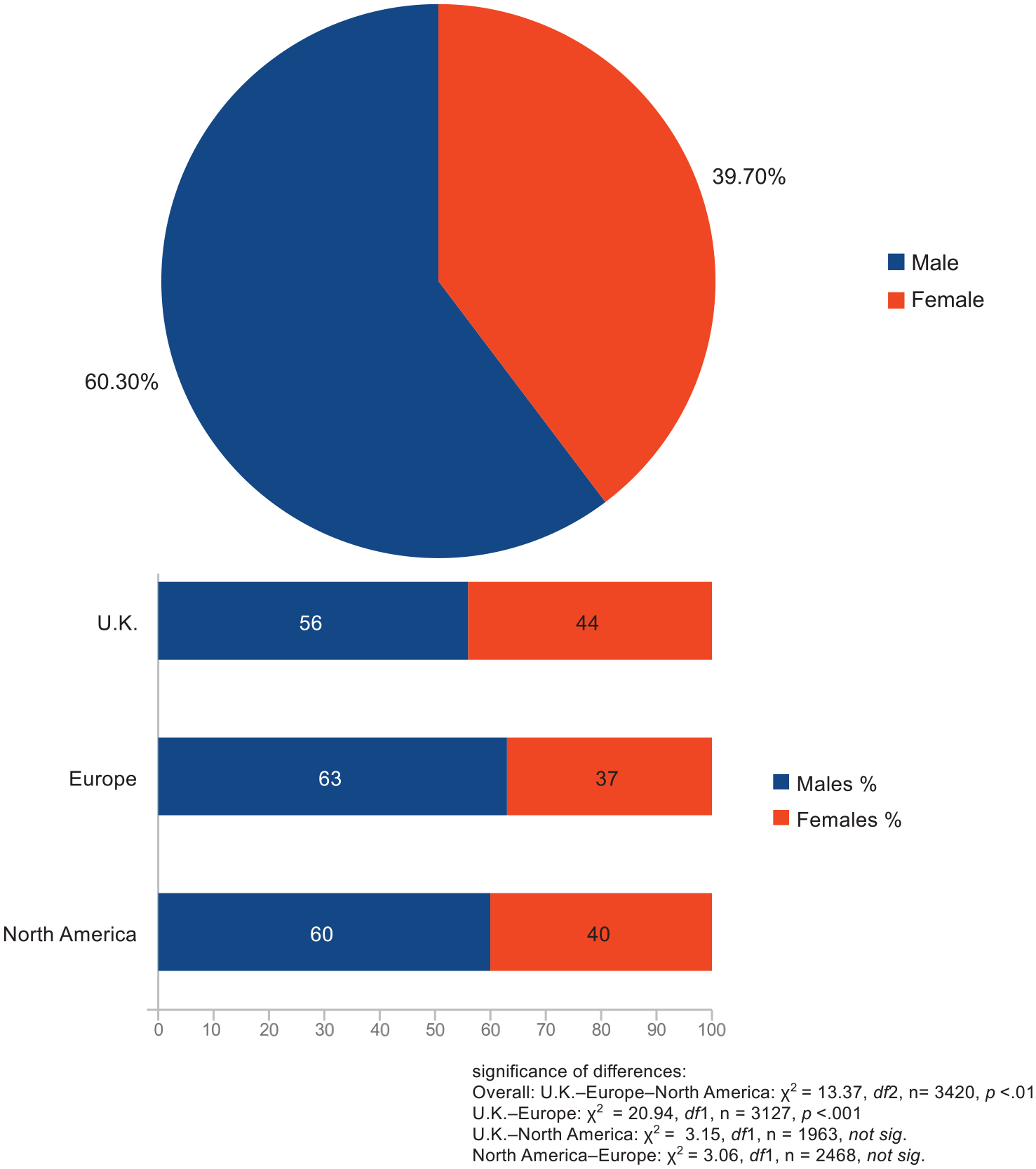
Representation of Male and Female Musicians in 40 World-Class Orchestras (Top). Percentages of Male and Female Orchestral Musicians by Region (Bottom).
Performer Populations of 40 World-Class Orchestras from the United Kingdom, Europe, and North America by Instrument and Sex of Player.
Modern symphony orchestras list an average of 100–120 musicians, though regional orchestras tend to be smaller than those in capital or major cities. Significant geographical differences are evident in the proportion of female musicians between orchestras based in the United Kingdom and North America and those based in Europe (Figure 1); European orchestras typically employ fewer women players, though there are exceptions, for example, the Royal Concertgebouw, whose women players constituted just below half of its total membership.
Significant differences between males and females are evident (Figure 2) in the instruments they played in the orchestral ensemble:
Violins: women are numerically predominant in both first and second violin sections (p < .001) but engagements of the sexes in first and second violin positions proved not to be significantly different, (
A majority of flutists are female (57%, p < .021).
Almost all harpists are female (p < .001). Approximately, one third of all orchestras do not list contracted harpists, engaging players whenever repertoire necessitated.
Males predominate in all-brass sections (p < .0011) but brass instruments are not an exclusively male province: where women are present, they are typically found among French horns. In two orchestras, principals in the trombone section are women. In one orchestra, the principal tuba is a woman.
No tympanists are women, and only 12.2% of other percussionists are female.
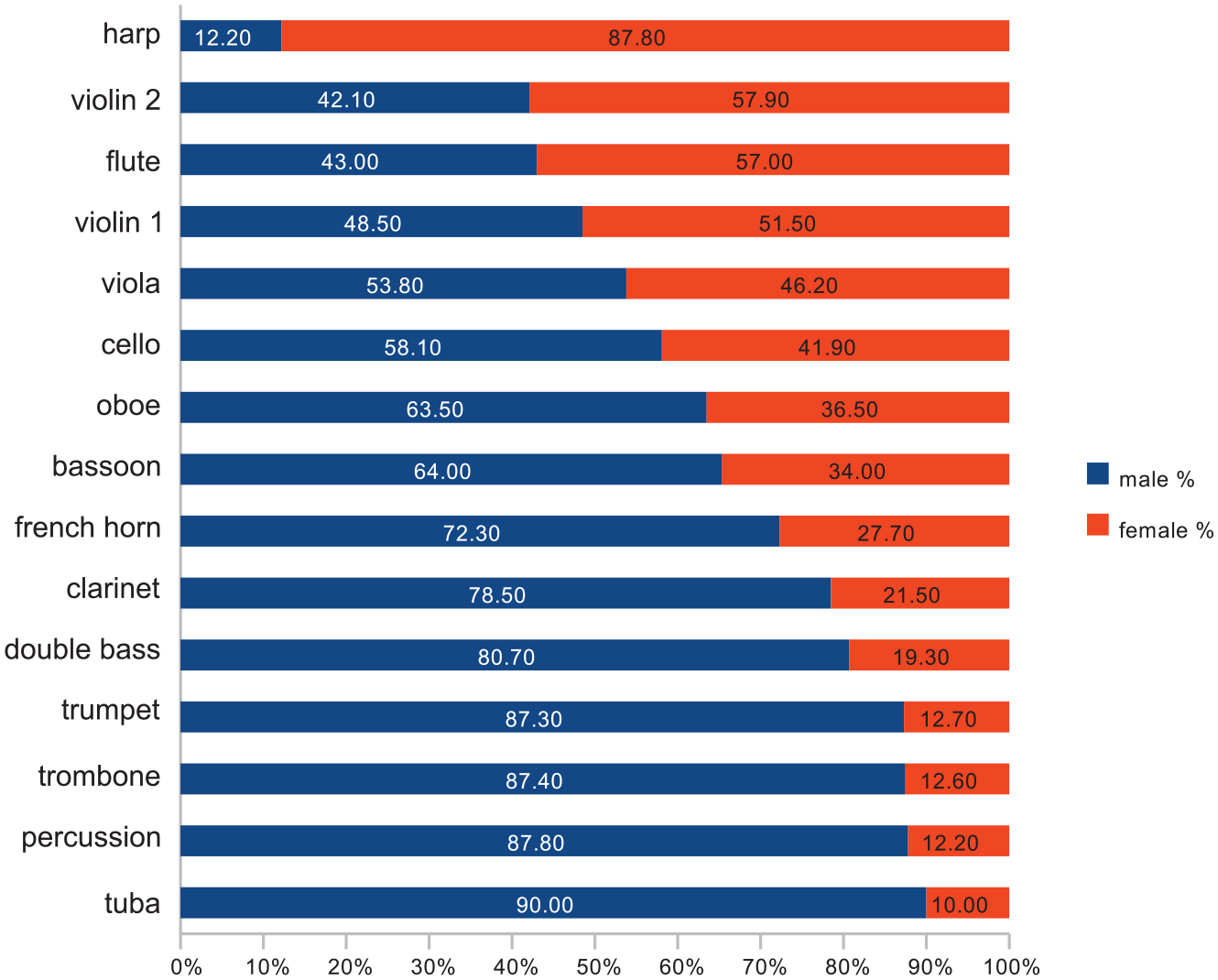
Representation of Male and Female Musicians in 40 World-Class Orchestras by Instrument and Sex of Player.
Goldin and Rouse (2000) have suggested that more prestigious and metropolitan orchestras have shown greater resistance to engagement of female membership whereas regional have included a greater proportion of women. This is consistent with Koskoff’s (1995) earlier statement that the proportion of females in an orchestra correlates with its status. To evaluate this proposition, representations of women in the so-called USA “Big Five” orchestras (i.e., New York Philharmonic, Philadelphia, Boston, Cleveland, and Chicago orchestras) were compared with those in 25 full-time professional orchestras of other cities in the United States. Results (Figure 3) confirmed that less prestigious orchestras include significantly more women players than do the orchestras of the “Big Five” (
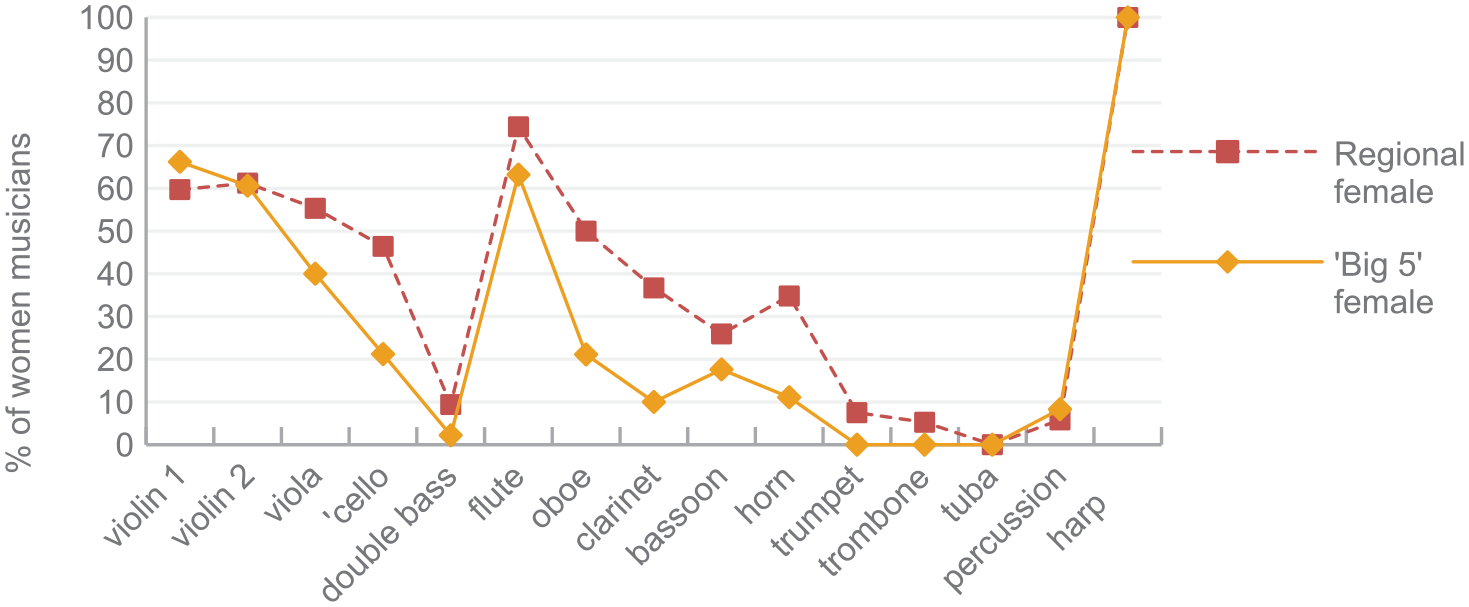
Percentage of Women in Each Orchestral Department in “Big 5” and 25 Regional Orchestras in the United States.
Each section of modern orchestras—cellos, flutes, horns, and so on—will have a designated Principal or section leader (sometimes called “title chairs”—nomenclature varies). Duties of these positions are rarely formally documented but are universally understood among professional players. The appointee to each section will be a highly skilled musician with extended experience of the orchestral repertoire and orchestral working practices. A Principal will normally take all solo passages and will be the agent of the conductor in achieving cohesion and unity among section members in all aspects of their collective performance. In a numerically large section co/sub-principals will be appointed, especially in the cases where “end-of-the-line” players whose roles are typically as soloists (piccolo, cor anglais, tuba, etc). Among the 40 orchestras reviewed, 83.2% of persons occupying Principal chairs were male and 16.8 were women (differences sig.
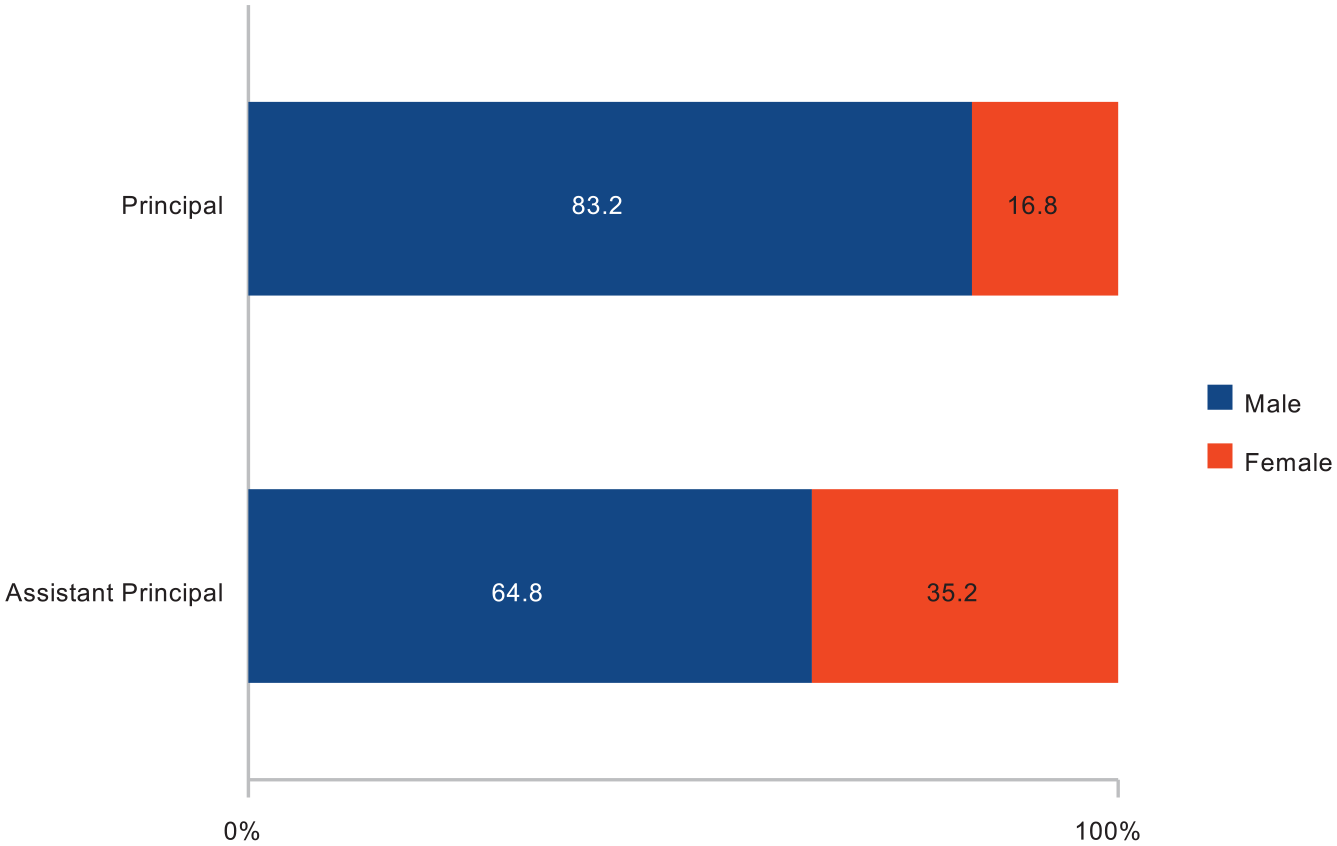
Male and Female Occupancy of “Principal” and “Co-/Sub- Principal” Chairs.
Although inter-region differences were not significant, it is clear that some leading European orchestras appoint very few women to Principal chairs: at the time of this updated review, the Vienna Philharmonic, and Bavarian Radio orchestras listed only two between them (both these orchestras have subsequently ceased listing Principals in public documents). In cases where European orchestras are generous with section leader appointments, the appointees are usually predominantly male; for example, Berlin Philharmonic, at the time of writing, listed 28 section leaders of whom 26 were male.
Instrument choice. A prominent feature of the instrument or sex-of-player relationship data is an affinity on part of women musicians for higher pitched instruments, which by their nature are also smaller and lighter, and males for instruments that are lower pitched, but also larger and heavier (Hallam et al., 2008; Sergeant & Himonides, 2019) this association is clearly evident in the profile formed by the data of Table 2.
Performer Populations of 40 Competition Brass Bands of the United Kingdom, Europe, and North America by Instrument and Sex of Player.
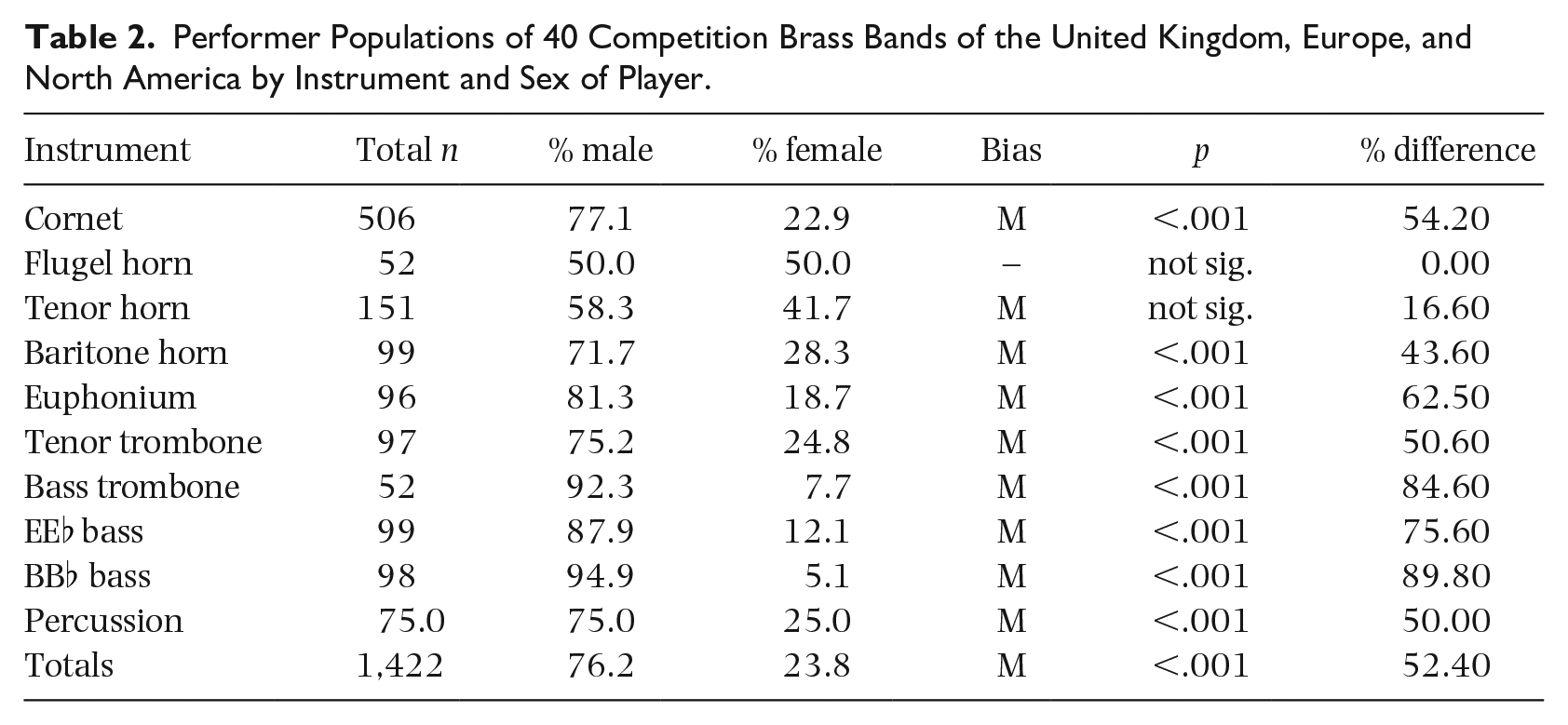
To assess the strength of this association, the median point of the pitch compass of each instrument was calculated by reference to standard guides on orchestration. These data were then compared with the number of women listed in our analysis as players of these instruments (see Sergeant & Himonides, 2019, for details of method). Results showed a highly significant association between sex-preferences for instruments and their sounding pitch ranges (
As a second measure of this association, the typical weight of each instrument type was ascertained by direct measurement of sample instruments, from websites of instrument manufacturers and dealers (e.g. Besson, Thomann) and from relevant publications (e.g. Sirr & Waddle, 1997; Waddle & Loen, 2003; Waddle et al., 2003). The order of weights was then compared with the female-sex-preference order. Results showed a highly significant association (
This relationship was further demonstrated by reference to the report by Hallam et al. (2005) whose study provides a substantial database of the sex and instruments studied by a large cohort of over 391,000 school-age students receiving tuition through state education provisions in a large geographical area of England. By comparing the numbers of male and female students recorded in the Hallam et al. study as receiving tuition on each orchestral instruments, a binomial probability could be calculated for the sex distribution of students for each instrument. By ranking these probabilities in order of magnitude, an order of gendering of instruments could be determined. Although the numbers of students relating to individual instruments varied widely (e.g., harp, n = 58; violin, n = 75,763), none had a student total that was sufficiently small for their associated probability to be considered unreliable. The percentages of boys and girls studying each instrument were then ranked to provide an index of sex-typing for each instrument (Figure 5).
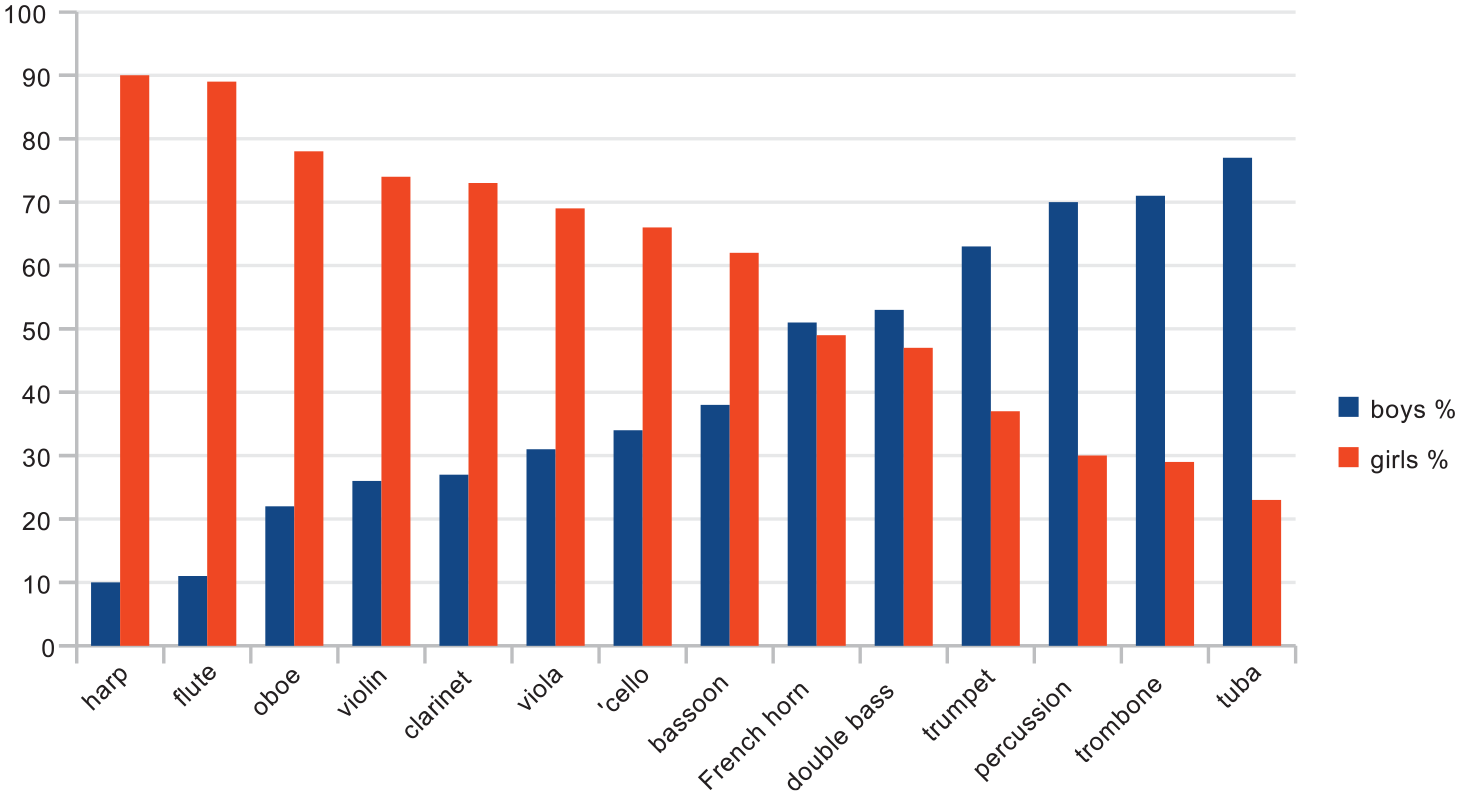
Instrument Choice: Percentages of Boys and Girls Studying Each Orchestral Instrument (Data from Hallam et al., 2008).
Highly significant correlations between sex-type order and median pitches of the sounding range of the instrument were found (
Data of representation of male and female musicians in orchestras were then compared with those reported in the Hallam et al. database for students receiving tuition on the same instruments. The comparison (Figure 6) showed that the number of males holding positions in orchestras was greater than would have been predicted from the Hallam et al. report, while the numbers of women in orchestral posts was substantially smaller than would be predicted by the Hallam data. Although a variety of reasons may be attributed for this difference, it suggests that women have more difficulty in securing an orchestral chair than do men.
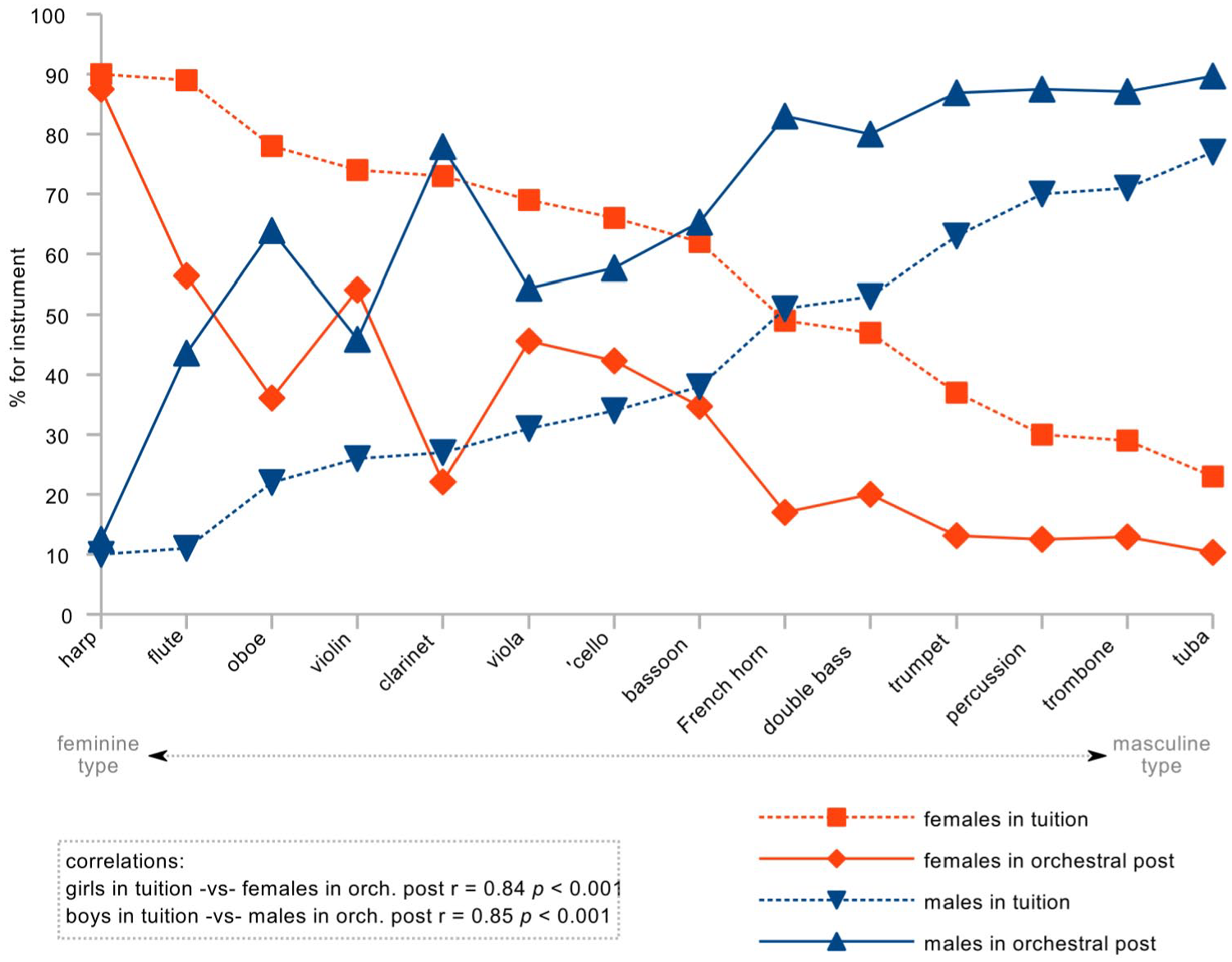
Percentages of Male and Female School-Age Students Receiving Tuition on Orchestral Instruments Versus Adult Musicians in Orchestras.
Brass bands
Brass bands represent a unique musical, cultural, and social form. Their origins lie in the town and city waits of the 15th and 16th centuries and the bands of local and private militias of the 17th and 18th centuries. There was no prescribed instrumentation for such groups and they were mostly gathered from whatever suitable woodwind and brass instruments were locally available. During the second quarter of the 19th-century improvements in instrument manufacture and the development of efficient valves brought ready availability of superior and reliable brass instruments that could play chromatically through their range and sounded well together in ensemble. As a consequence, bands began to proliferate: so much so that it is estimated that by the end of the 19th century there were as many as 5,000 bands in the United Kingdom. Many owed their existence to direct financial support from local industries, and some bands still reflect that allegiance in their nanes.2,3
A consequence of their industrial work-place origins was that brass bands developed as an essentially male-populated working class phenomenon (Hunt, 2002; Russell, 2005). Localized membership and financing brought a sense of community proprietorship—of a local band being “our band”—and band members began to adopt distinctive quasi-military costumes as marks of their individual identities. Bands enjoyed a strong sense of loyalty and connectedness among their players and supporters, and this fostered rivalry and competitiveness, leading to the growth of band competitions. The need for equivalence between competitor bands led in turn to a need for a common instrumentation to be adopted. Ultimately, an all-brass conformation evolved which excluded woodwind instruments. A common competition repertoire also became desirable with the consequent emergence of the concept of “the test piece.” Initially, contests were local, between neighboring bands, but as the band movement expanded, they became more extensive: by the 1840s, a lively contest circuit had developed. The first British Open Championship took place in 1853. Competitions have now become International and have been described as being the lifeblood of the brass band world (Herbert, 2000). In 1989, the wearing of uniforms became a requirement for performance at national competitions in the United Kingdom.
The instrumentation for competition bands is now fixed at the following:
10 cornets (1 soprano cornet in E♭, 1 × ripiano, 1 × principal, 1 × assistant principal, 2 × solo cornets, 2 × second cornets, 2 × third cornets—all pitched in B♭),
one flugel horn,
three tenor horns,
two baritone horns,
two euphoniums,
two tenor trombones,
one bass trombone,
two EE♭ bass tubas,
two BB♭ bass tubas,
percussion (to a maximum of three players).
For many years, brass bands played at “high pitch” tuning to approximately A4 = 452 Hz but in 1960, the lower standard orchestral pitch of A4 = 440 Hz was adopted.
Over the last 200 years, the brass band movement has acquired a powerful musical identity across the world, with its own specific rules, and separate traditions (Finnegan, 2007). Although it extends worldwide, it is mainly concentrated in Europe, North America, and Australasia. Band membership remains predominantly male, though there have always been women brass players, and all-female bands in the United States were especially prominent in the late-19th and early-20th centuries (Herbert, 2000; Hersey, 2006; Holman, 2019a; Woodbury, 1995).
Most brass band musicians have amateur status, but over the last 50 years, there has been an increasing recruitment of conservatoire-trained players who, though not directly financially remunerated for their band participation, are effectively professional musicians through their engagement at other times as instrumental teachers or other music-related employments. Despite their engagement status as amateurs, the most able brass band players achieve high standards of performance equal that of many professional orchestral musicians.
In common with orchestras, competition bands maintain comprehensive websites carrying information and photo images of member players and the instrumental positions at which they play. Using data from these sources, personnel of 40 bands from the three regions United Kingdom, North America and Europe were compared. Review of this population showed that of a total of 1,422 band musicians in the sample, 76.2% were male, 23.8% female (sig. p < 0.001), that is, a large majority male presence in this genre of ensemble music performance.
When the three regional populations were compared, although bands in the United Kingdom showed slightly higher representation of women players than did those of Europe or North America, contrary to the case of orchestras, differences between regions did not reach statistical significance (Figure 7).
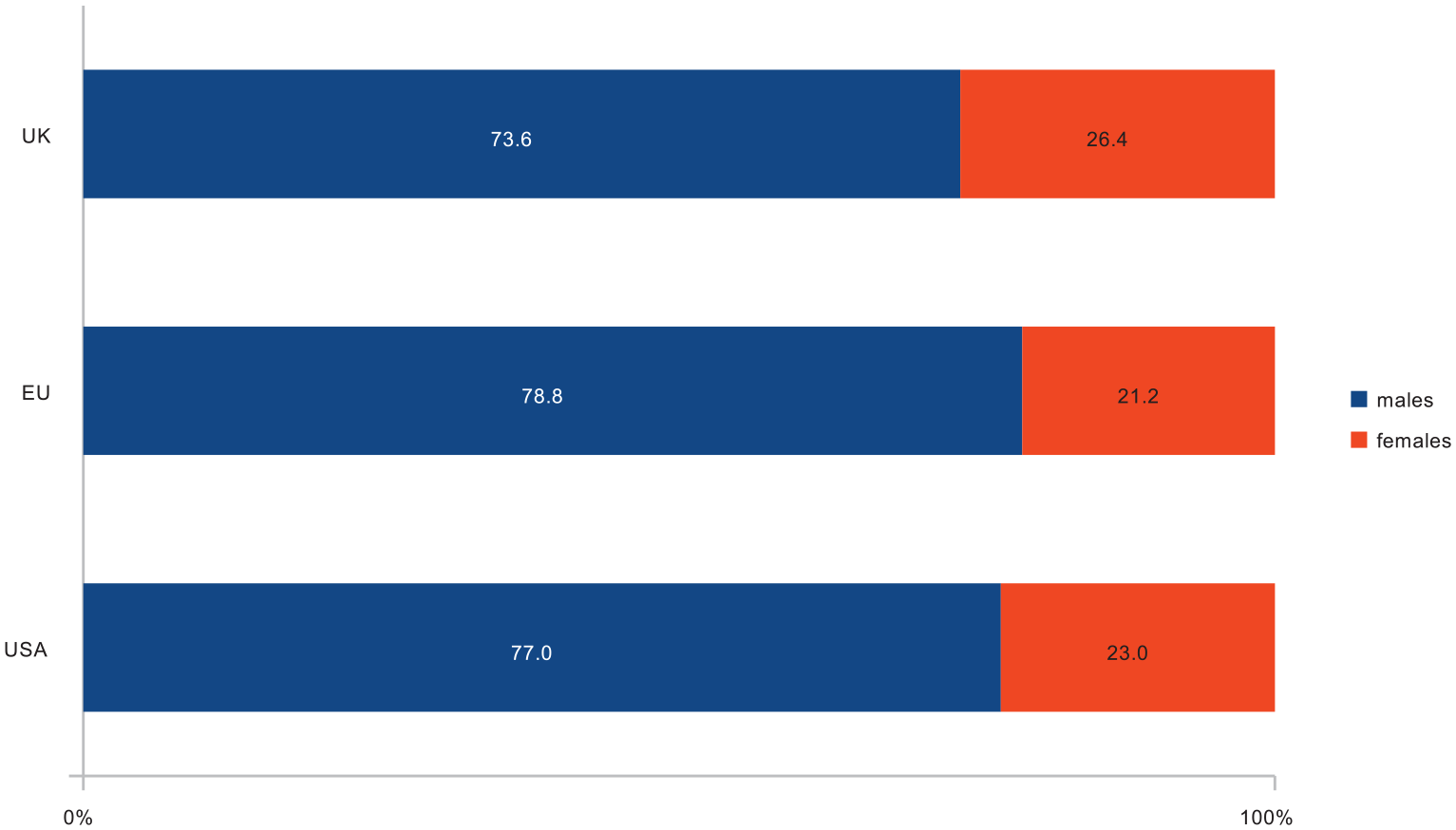
Representation (%) of Male and Female Band Musicians in Three Regions.
Analysis of instruments by sex of player showed that representation of male and female players is significantly related to the instrument they play.
It is evident from Figure 8 that although women players were prominent in the flugel and tenor horn sections they were thinly represented among the lower pitched instruments, especially in bass trombones, EE♭ and BB♭ basses.
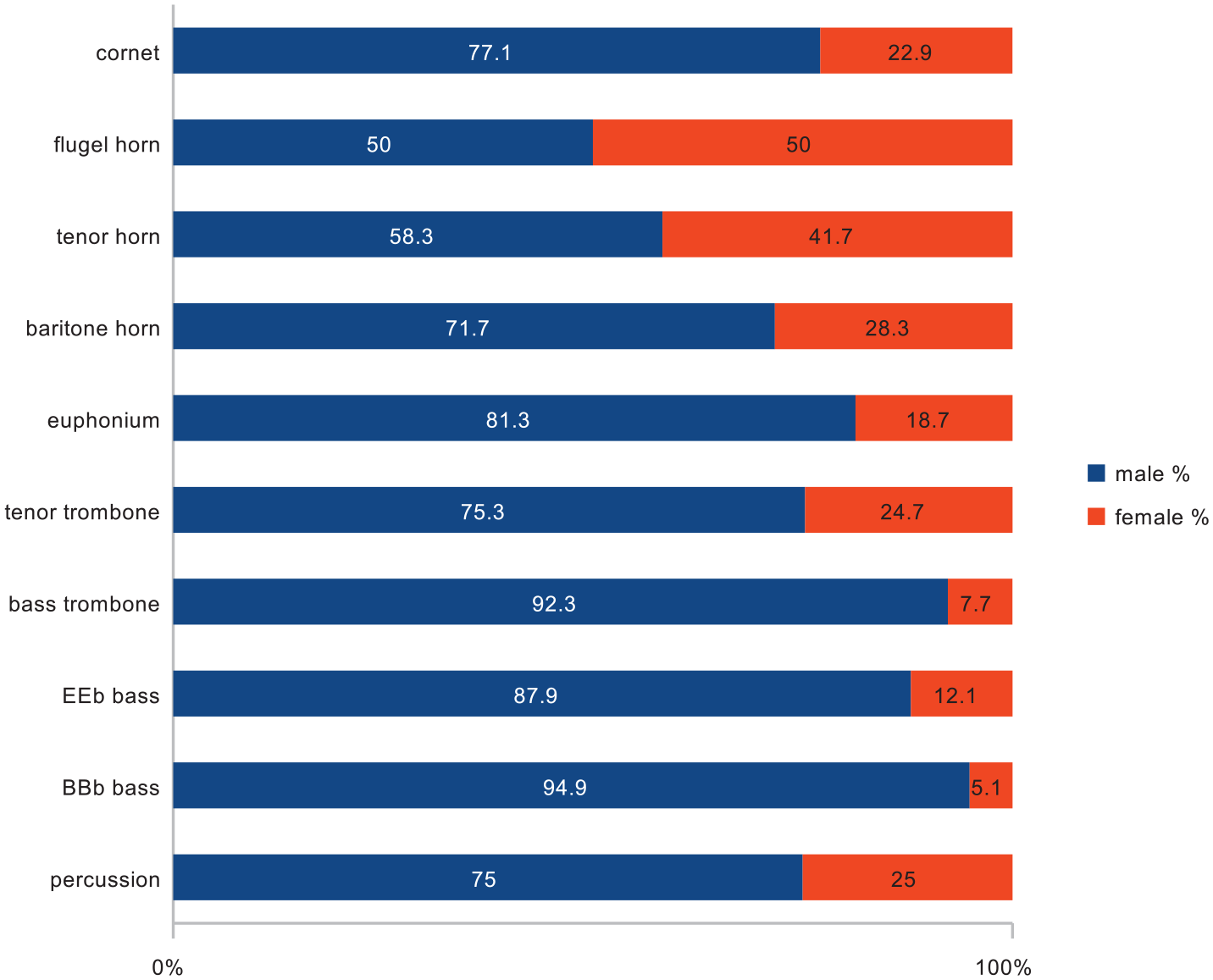
Performer Population of Males and Females in 40 Brass Bands in Three Regions.
Regional comparisons of players in these two band sections (Figures 9 and 10) showed that these differences were a consequence of a marked preference for flugel and tenor horns on the part of women players in UK bands that was not shared by women in bands from the other two regions. (Differences: flugel horns, significant
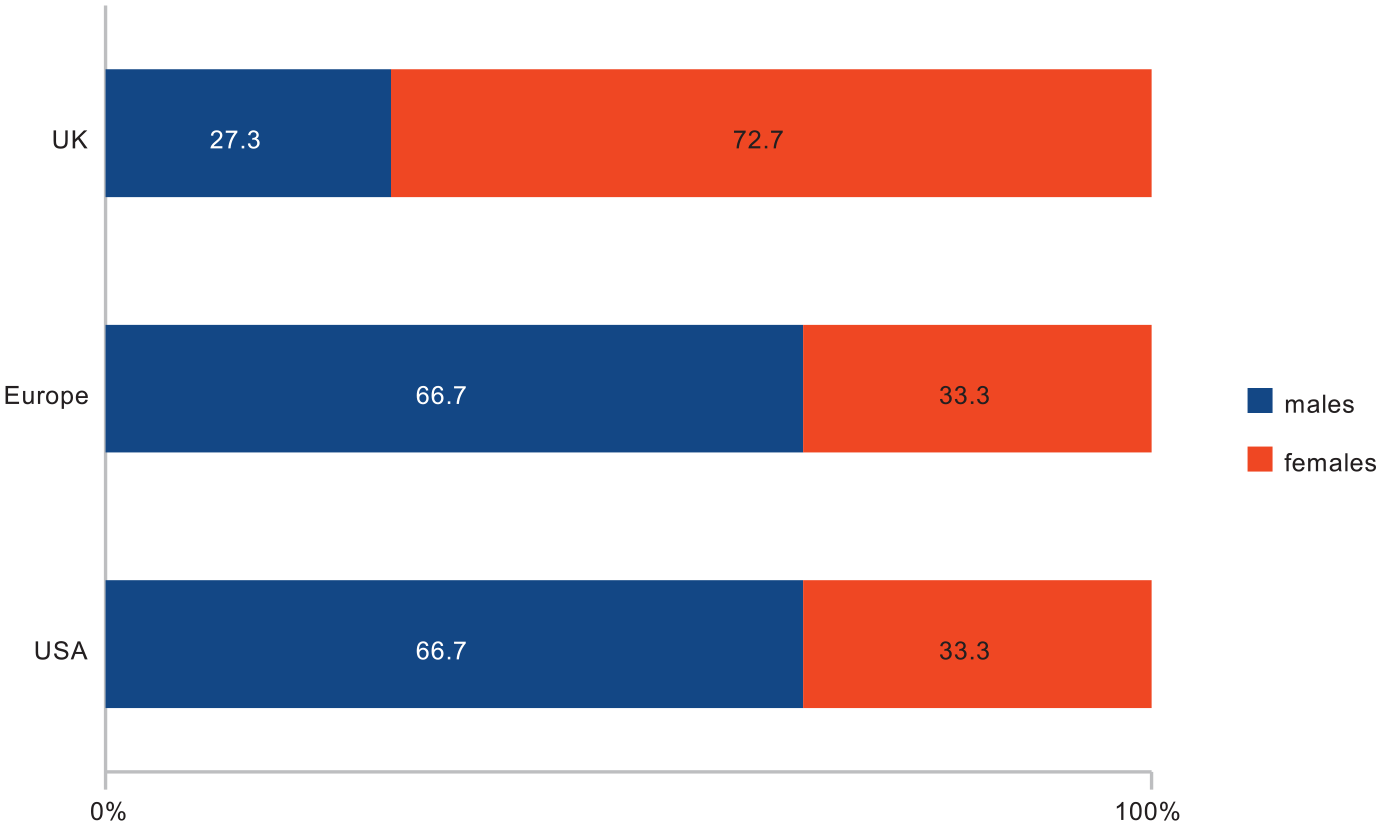
Flugel Horns of Three Regions.
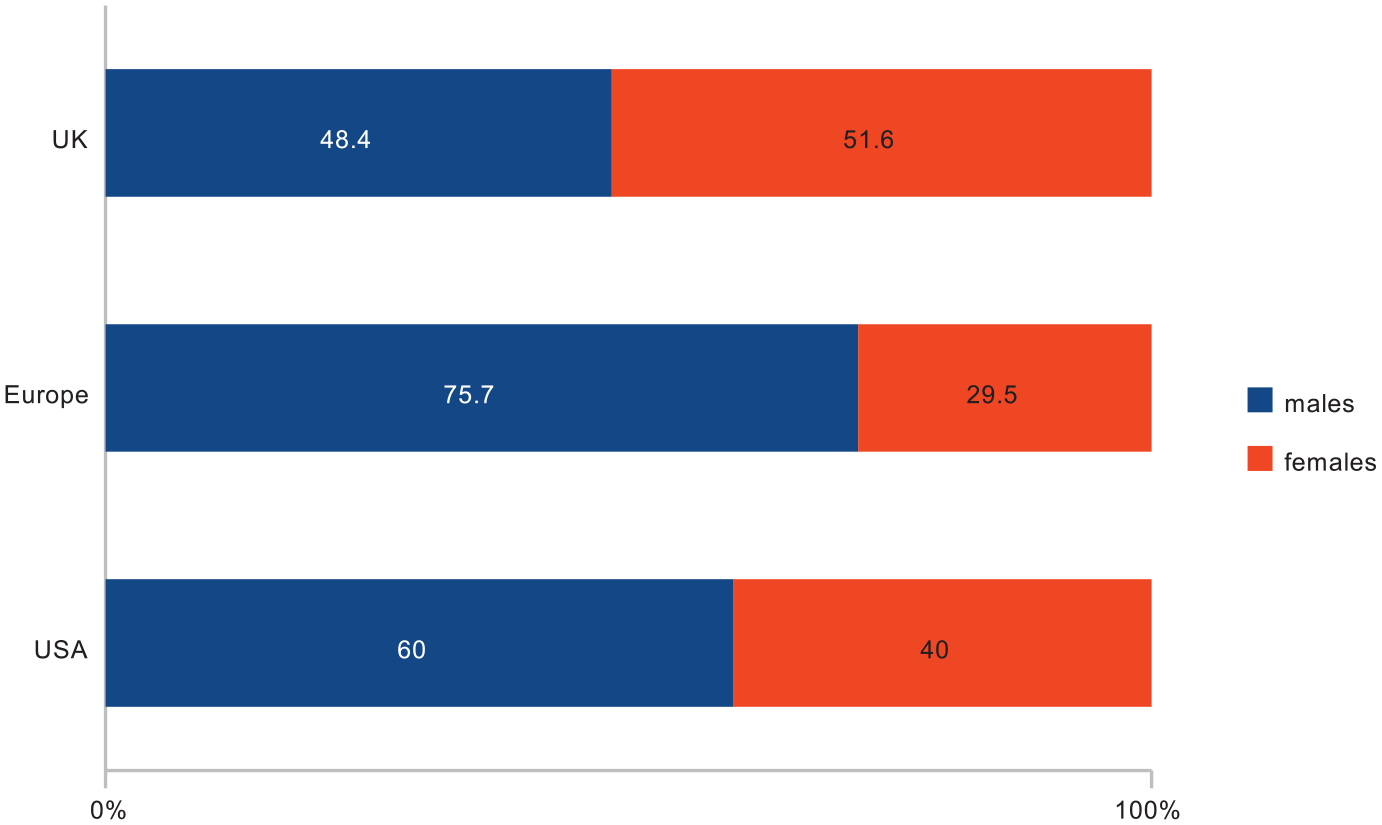
Tenor Horns in Bands of Three Regions.
As with the orchestral players, women in the brass band sector showed a consistent preference for higher pitched, lighter weight instruments, and male players for lower pitched instruments, with a significant correlation between numbers of associated women players and median pitch of instruments (r = .720, p < .05). This relationship between instrument pitch and sex-preference was also evident in the Hallam et al. data showing that the preferences of young students reflect those of older band members (Figure 11).
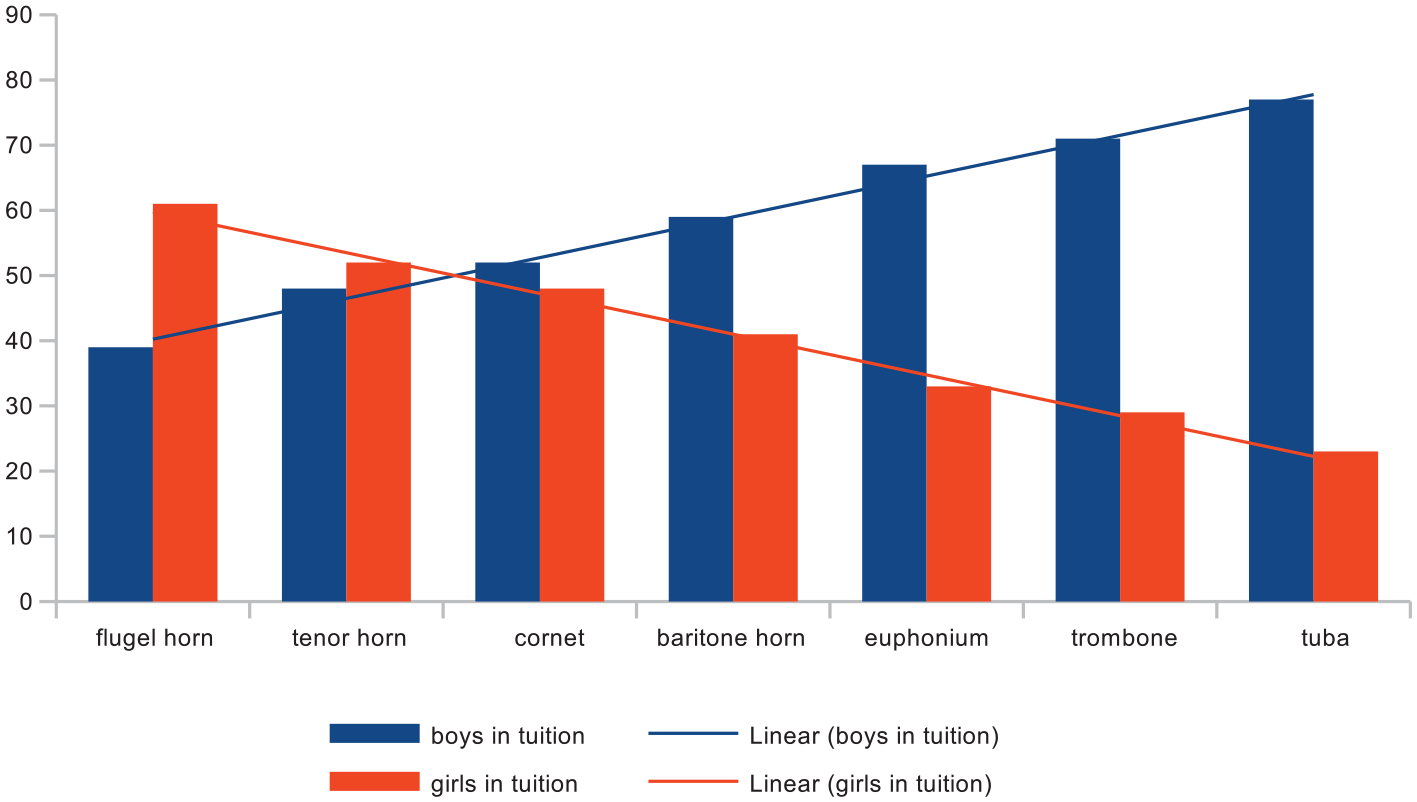
Percentages of School-Age Students Receiving Tuition on Brass Band Instruments (Data: Hallam et al., 2008).
Principals/Section leaders. As is the case in orchestras, each section in a brass band will have a nominal section principal/leader, who will normally be its most experienced and competent player. Because some departments comprise only two players, co-principals/section leaders are not listed on band websites. Over the three regions male occupants of Principal/Section leader chairs substantially outnumbered females by a ratio of more than 4:1 (p < .001; Figure 12), and this difference was common to in all three regions (Figure 13).
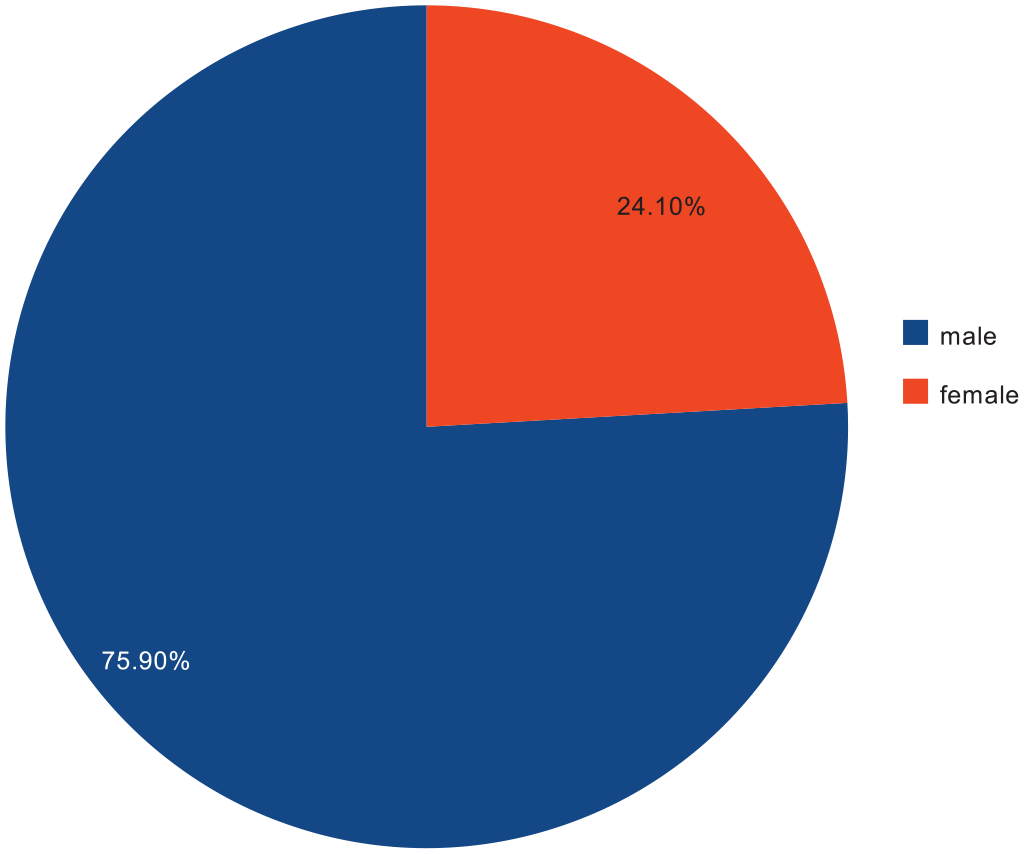
Male and Female Occupancy of Principal/Section Leader Positions.
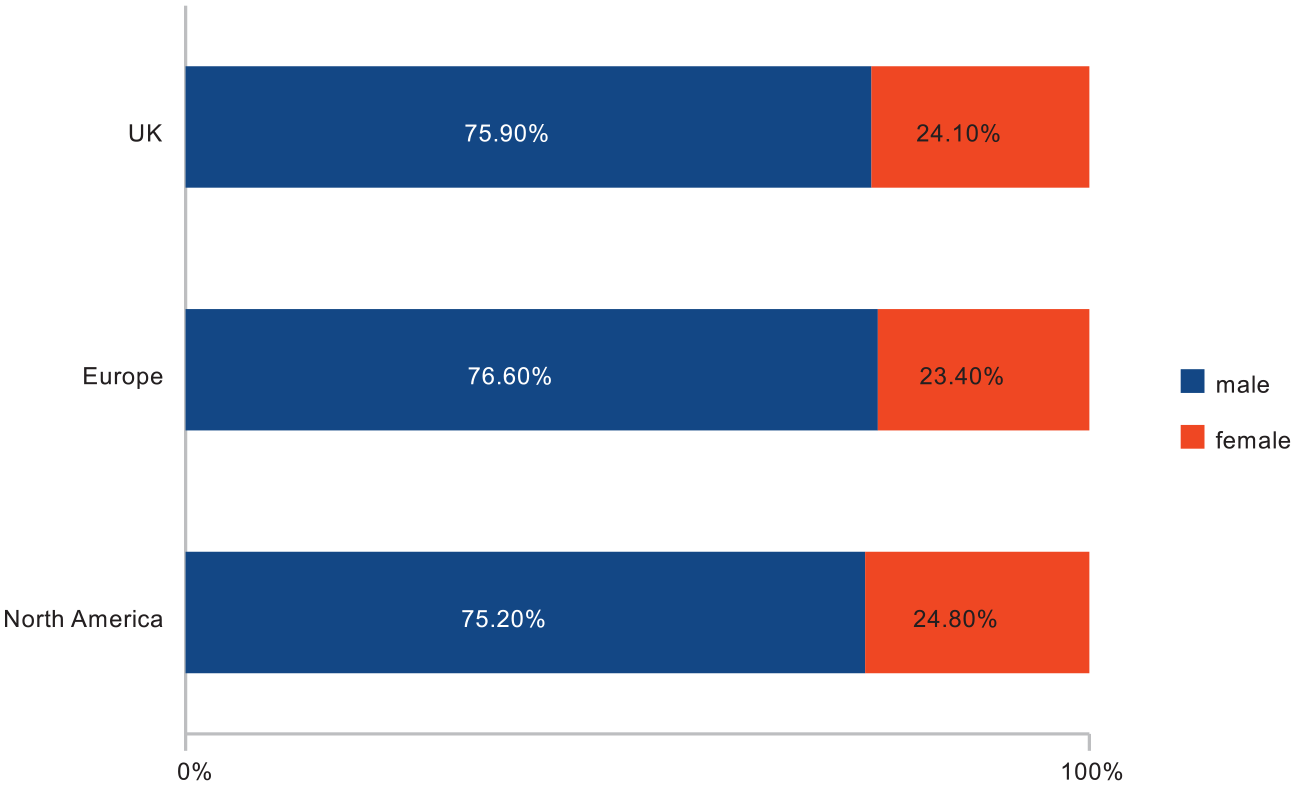
Male and Female Occupancy of Principal/Section Leader Positions by Region.
The numerical superiority of male leader over female is to some extent predictable, being a product of the greater number of male players overall in the brass band genre. Seating positions in bands are standardized and it is rare to see a band deviate from the pattern below (Figure 14). Cornet players are seated in two rows to the left of the band director, four players in the front row, and six in the back row.
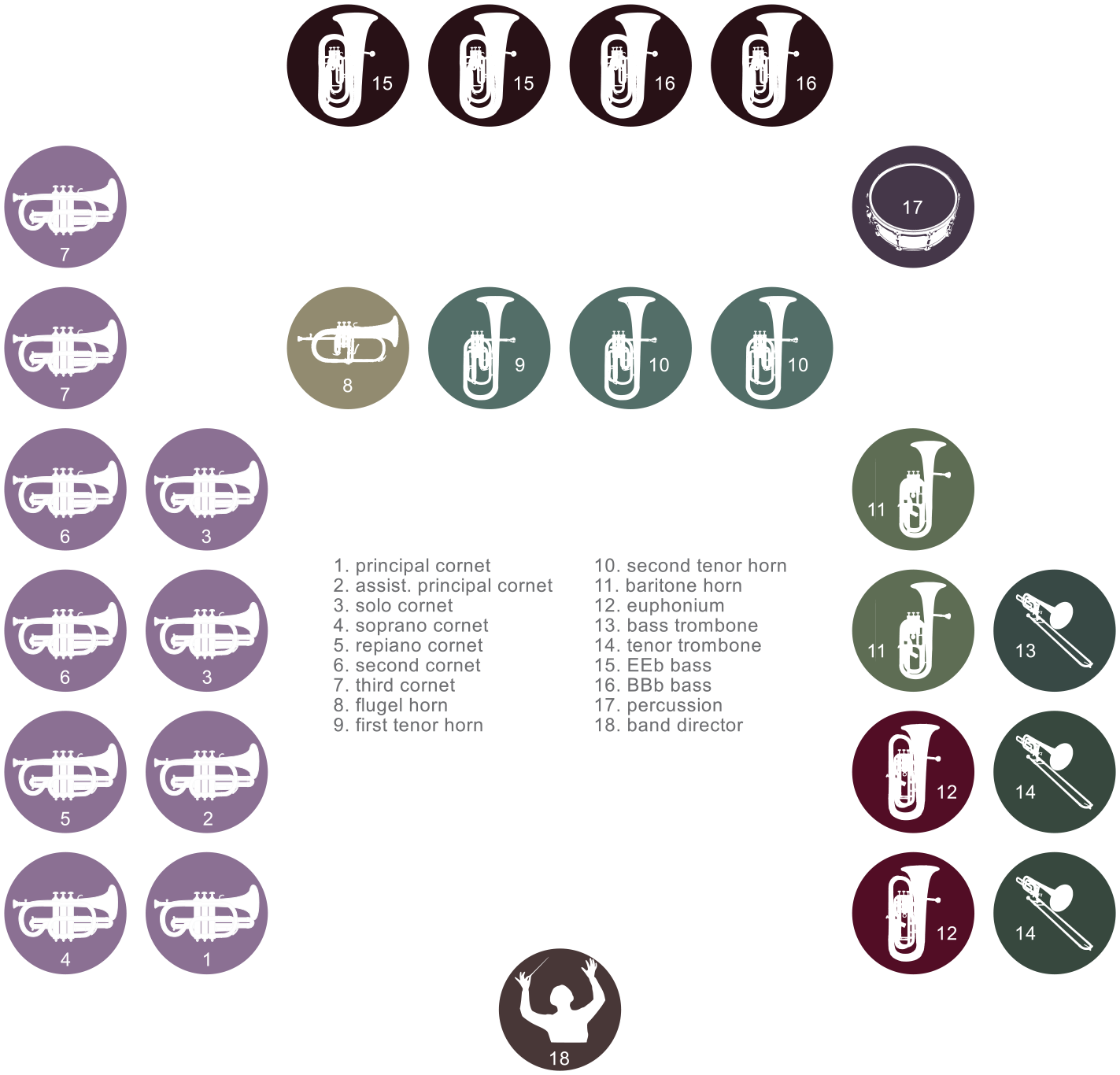
Seating Arrangements for Brass Bands.
Each instrumental part in a brass band makes a specific contribution to the overall aural texture of the band ensemble, and this applies especially in the cornet section. The 10 cornets do not play as tutti, each cornet part has its own role and in complex passages, there could be as many as seven separate lines of melodic cornet movement. The playing roles of the cornet section can be characterized as follows:
Principal/solo cornet: Equivalent to orchestral leader: important as band’s prominent melody-maker, takes all solos. Requires a reliable, competent player.
Assistant principal: Plays second to Principal and relieves Principal in taxing passages and solos, and so on.
Soprano cornet: Pitched in E♭ (a fourth higher than others). Comparable to the piccolo of an orchestra. Adds brightness to band tone. Requires high level of physical strength and good technical facility.
Ripiano 4 cornet: Plays important counter-melodies and prominent lines. A sought-after role in the band requiring a technically competent player.
Solo cornets 1 and 2: Usually play in unison: The parts rarely extend to the limits of the instrument’s pitch range.
2 × second/2 × third cornets: These may double a solo line, but often take tutti or “texture-filling” parts.
The cornet section can thus be perceived as comprising two groups representing “more prominent” and “less prominent” roles:
More prominent roles: Principal, Assistant Principal, Ripiano, Soprano.
Less prominent roles: Second and third cornets.
Figure 15 shows the representation of male and female players among cornet parts in our data.
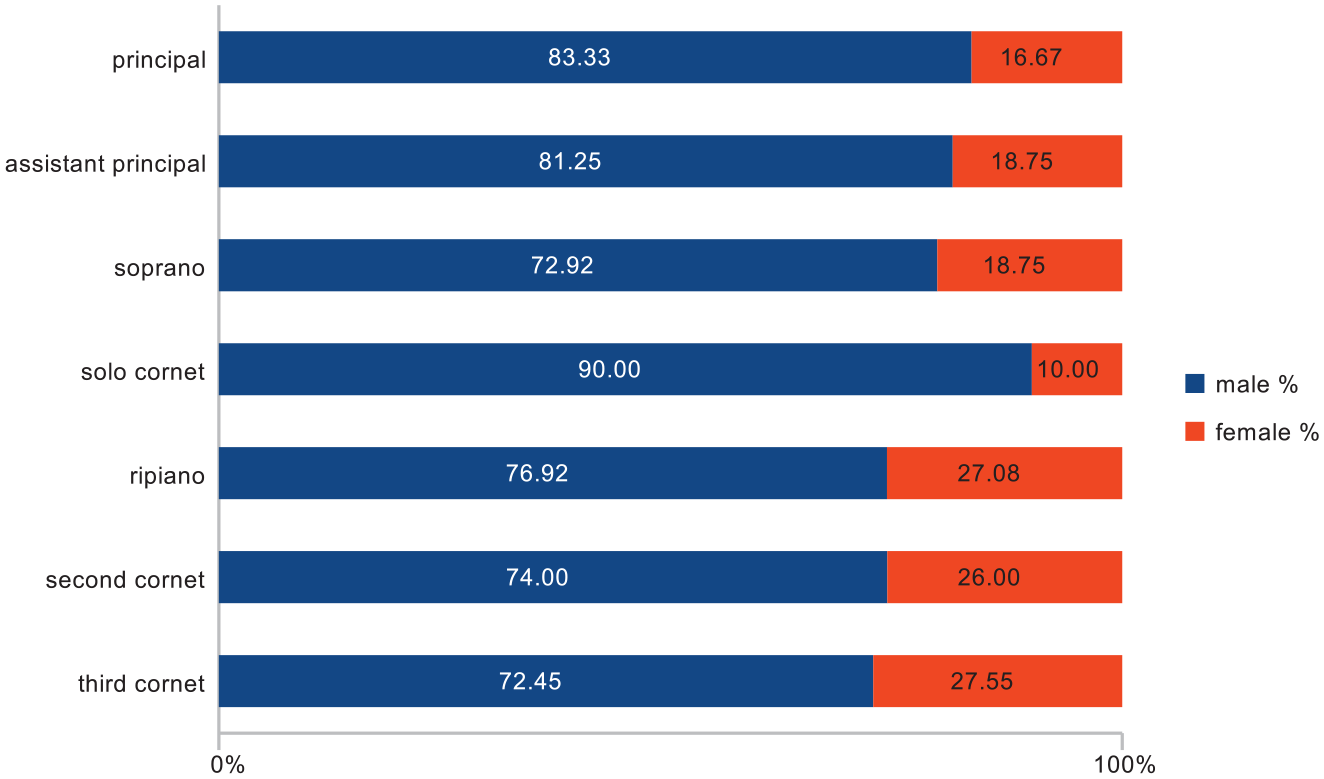
Occupancy of Cornet Section Roles by Sex of Player.
When the more prominent and less prominent groups were compared, women were found to have significantly smaller representation in the More prominent group and greater representation in the Less prominent groups (
When proportions of girls and boys receiving tuition on band instruments as listed in the Hallam et al. (2005) database (Figure 16) were compared with the corresponding distribution of in-band posts among male and female band members posts (Figure 17), it was evident that while there was less disparity between learners and holders of band positions than that observed in the orchestral setting, nevertheless, more males held positions in bands than would have been predicted by the Hallam et al. data and conversely fewer women held band chairs than would have been predicted by that data. This suggests that males are more successful in securing band positions than are females, though this is not the only possible interpretation of the differences.
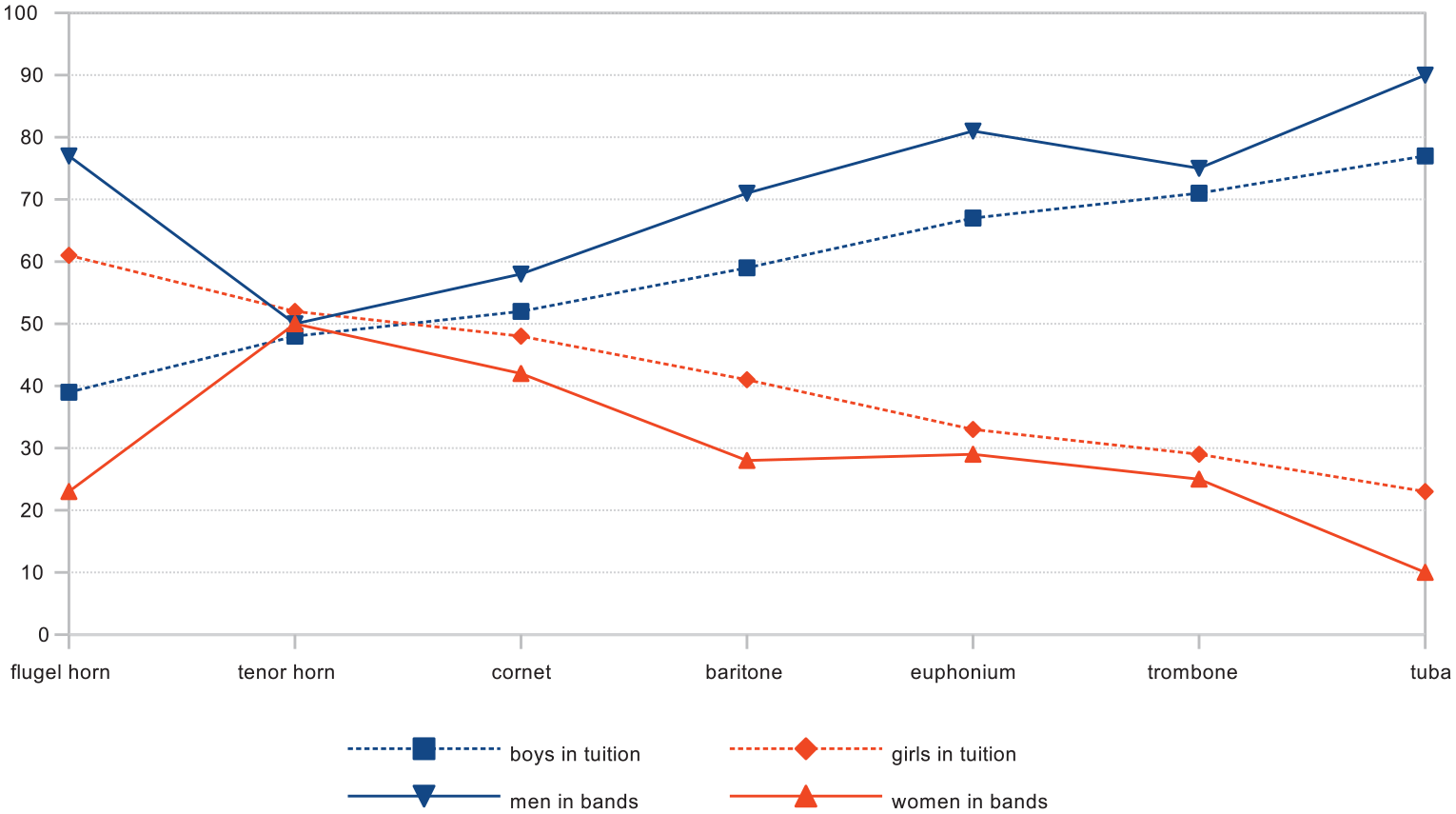
School-Age Students Receiving Tuition on Brass Band Instruments.
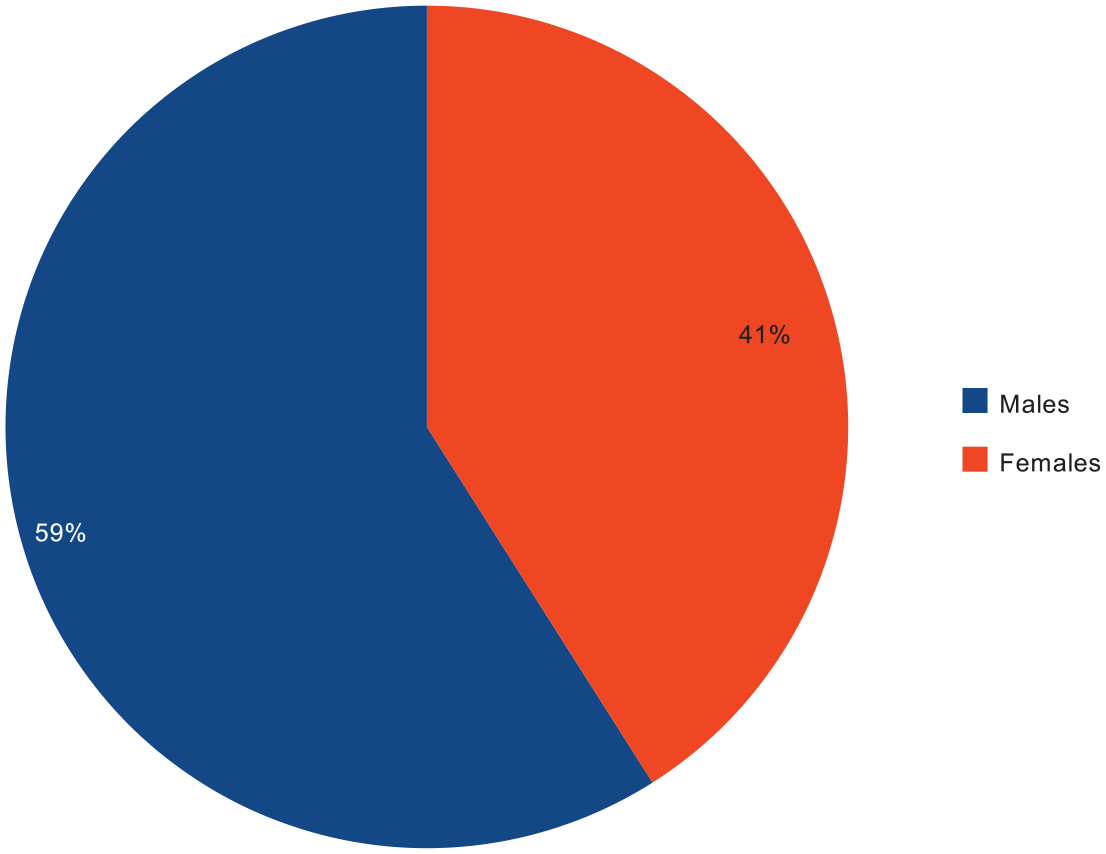
Percentages of Male and Female School-Age Students Receiving Tuition on Band Instruments Versus Male and Female Adults Holding Band Positions.
Popular music
Clear criteria for the term Popular music (or more familiarly, just Pop) are difficult to establish. The term is universally understood but is difficult to define (Frith, 2004; Shuker, 1994). Its characteristics and boundaries are even more difficult to determine and it could possibly be interpreted to include any musical style that has an established audience following. Here, we use the expression to mean that category of music intended for entertainment that appeals to a wide audience and is typically distributed to large audiences through the music and media industries. It contrasts with both art music and traditional or “folk” music (Popular Music, Wikipedia). Whilst therefore acknowledging the possibility of legitimate theoretical discussion as to the nature and concepts of popular music and indeed of a definition of popularity, here we employ a direct and self-evident criterion—that of consumer demand: we take sales of published recordings as markers of listener preference. A performing group that is sufficiently successful to sell over 10 million copies of a recording of their products we deem to be ipso facto “popular.” 5
Information on popular music groups and their member artists was extracted from data published in February 2017 by the Recording Industry Association of America (RIAA) in which are listed those certified record albums that have each sold in excess of 10 million copies. Popular music styles covered by the resulting list included the following: “Pop/Rock,” “Rhythm and Blues (R&B),” “Hip-hop,” “Rap,” “Country and Western,” “Blues,” “Indie,” “Big-band/swing,” “Alternative,” and “Heavy metal.” Details of the performance roles of individual artists in each performance group were obtained from credit listings for recordings published with the recordings at point of sale or on relevant reliable websites. Only performing musicians were included in the data: persons listed as contributing to recordings in non-music-performance roles such as technicians, computer programmers, producers, or in executive roles were excluded, as were the few unusual examples where non-group-member artists contribute to a particular item in an album, as for example in one instance, the chorus of the Metropolitan Opera supported a passage. To avoid artificial inflation of data, groups who had achieved the “10m copies” criterion with multiple albums, as for example, the Beatles, were counted once only. The resulting data covering 62 artist groups represents 788 artists and over 914,000,000 CD sales (Table 3, Figure 18).
Representation of Male and Female Artists From 62 Popular Music Groups by Instrument and Sex of Performer.
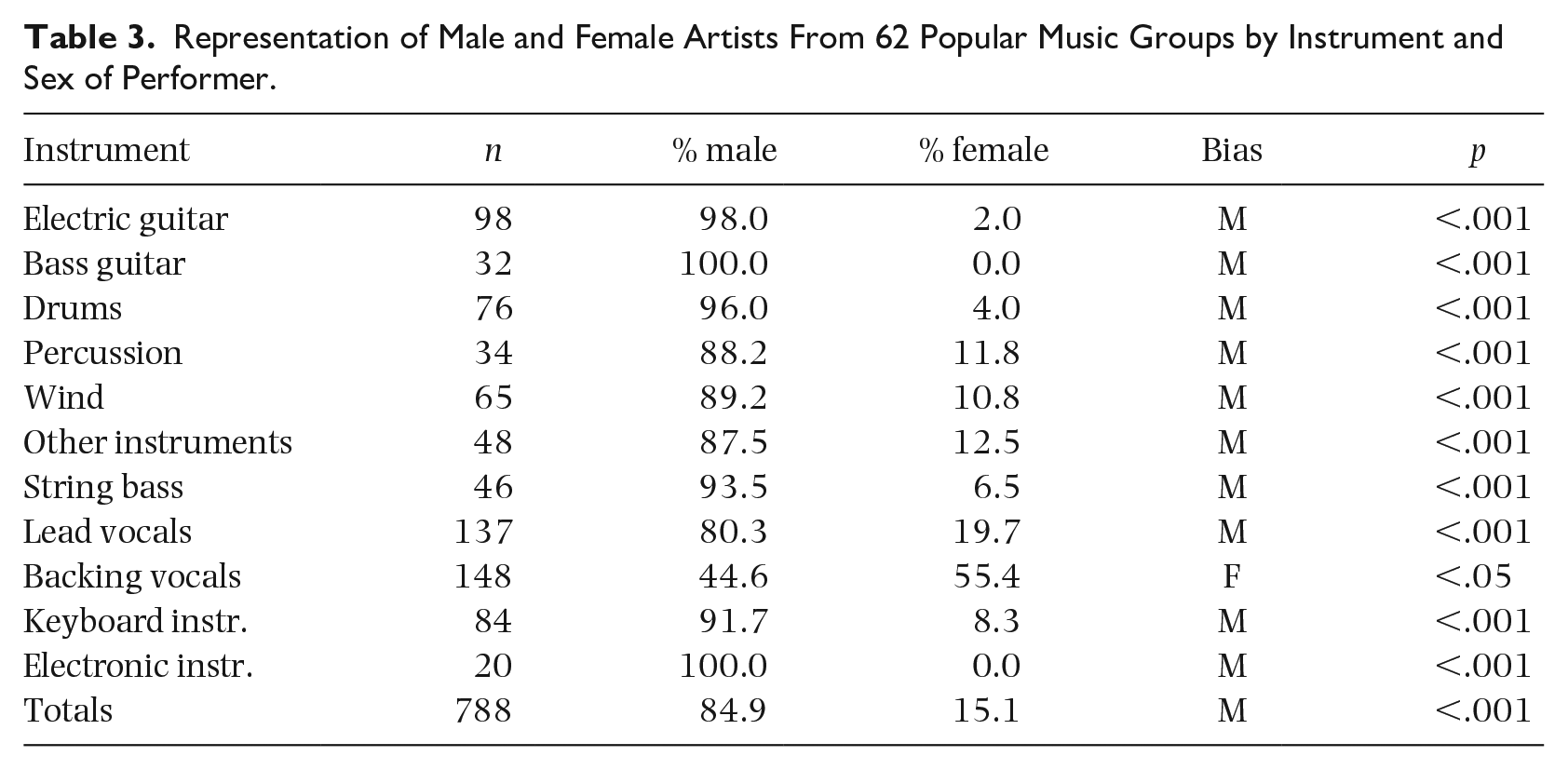
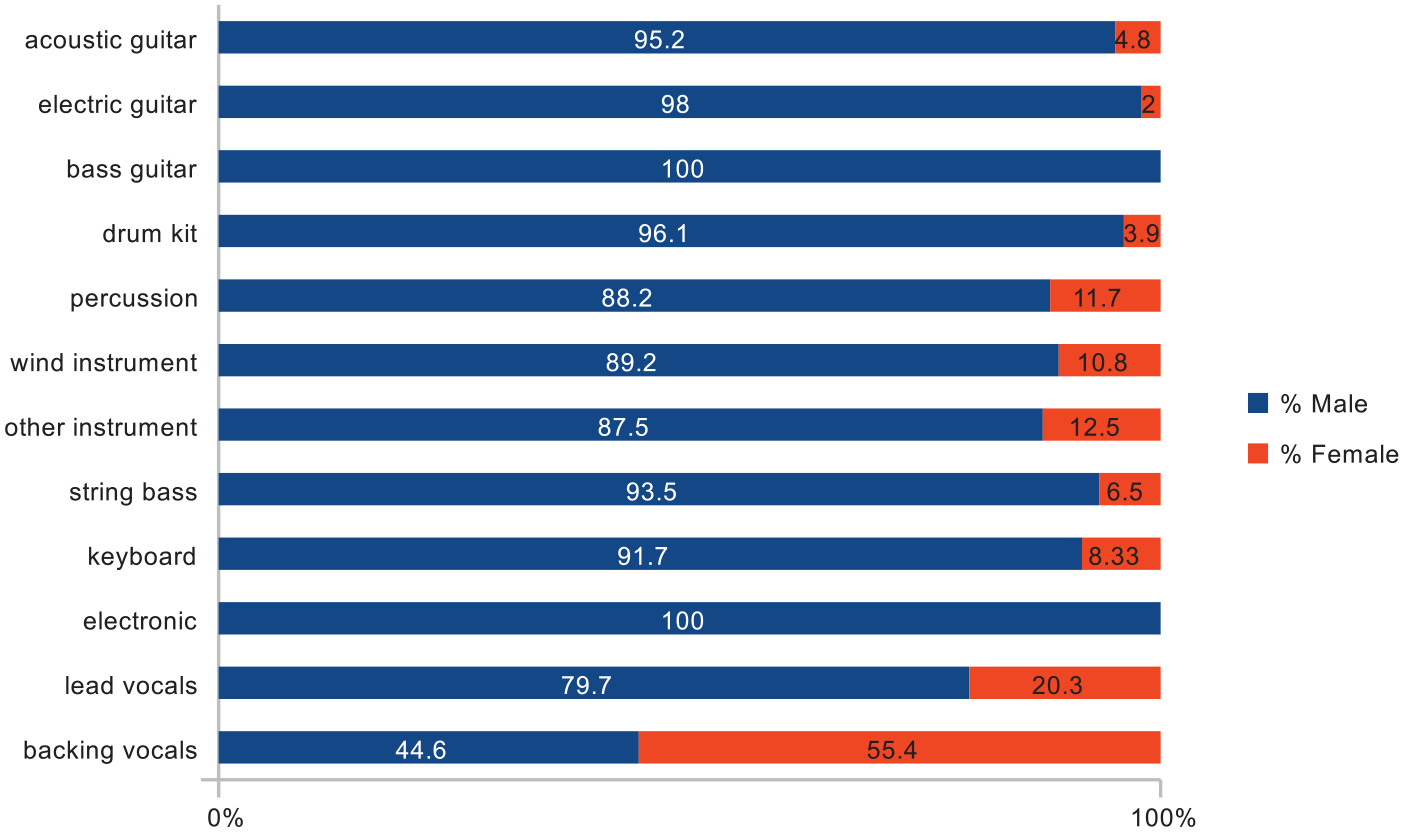
Percentages of Male and Female Artists in 64 Popular Music Groups by Sex and Instrument.
Our analysis shows that in the genre of popular music, male performers massively outnumber females (
Plotted linearly, the contrasts between presence of males and females become starkly apparent (Figure 19).
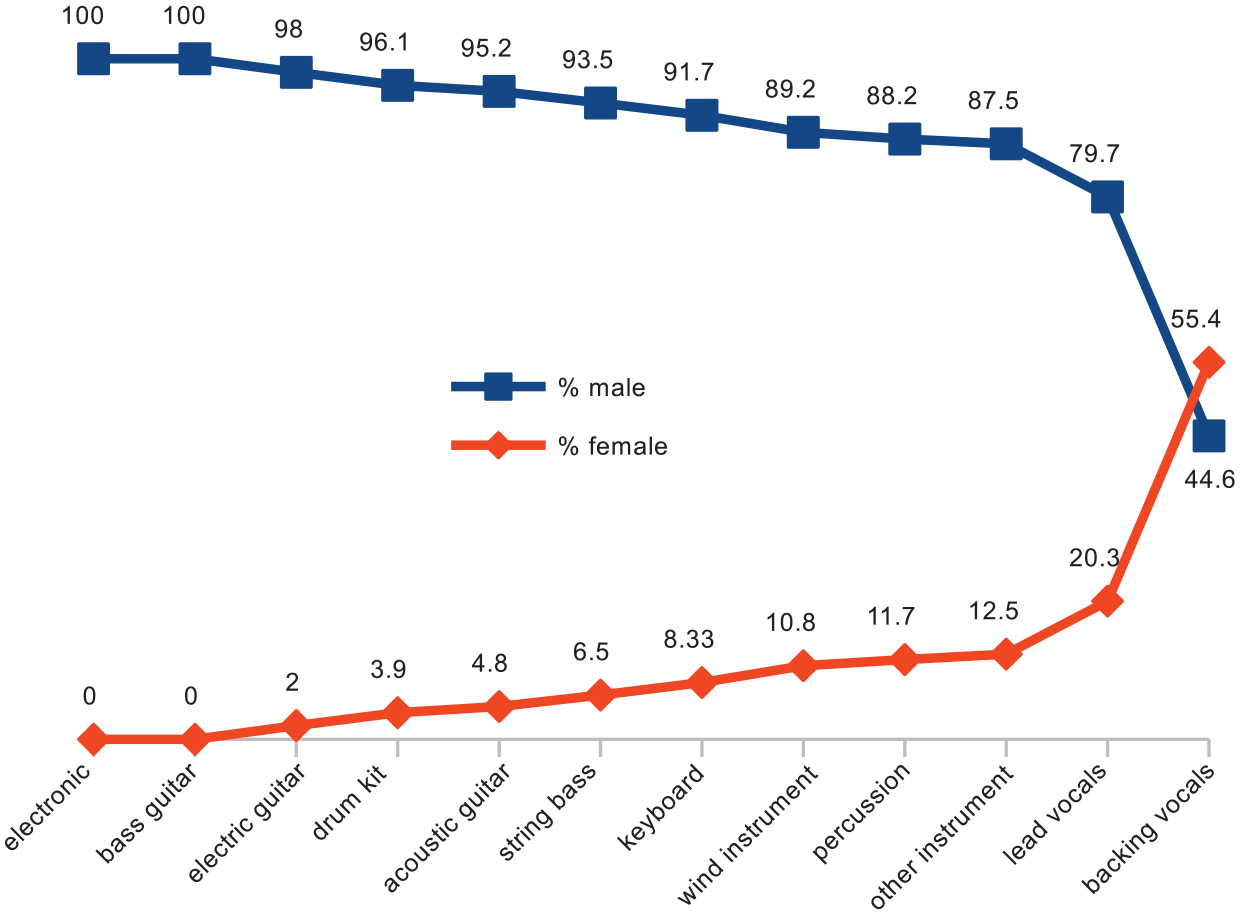
Contrasts of Male and Female Artists in Popular Music Groups by Instrument.
Our data therefore reflect the observations of Bayton published in 1998, and show that sex representation in this genre of music has not changed over more than two decades.
In the autumn of 1994, a special issue of Rolling Stone featuring articles on “Women in Rock” proclaimed that “A change has come to rock & roll” (Clawson, 1999a, 1999b) and that “an unprecedented number of female performers are now carving out a substantial place for themselves in the rock world.” The pronouncement was hardly a new one: the same claim has been a recurrent staple of music journalism for at least two decades (Gaar, 2002). Our analyses above show the actuality of the situation to be otherwise.
A typical “pop group” comprises four players: lead guitar, rhythm guitar, bass guitar, and drums/percussion with at least one of the members providing vocals (Finnegan, 2007) though there are many variant of this format, often including keyboards. Originally, the bass line was provided through acoustic string bass, but in the 1960s, this became replaced by the electric bass guitar (Brewer, 2003).
As with the evidence for orchestral membership, reference to the data of Hallam et al. (2008) revealed a marked disconnect between proportions of male and female school-age students who receive tuition on instruments relevant to popular music, and the proportions of males and females listed as performers in the professional groups represented in the RIAA data (Figure 20).
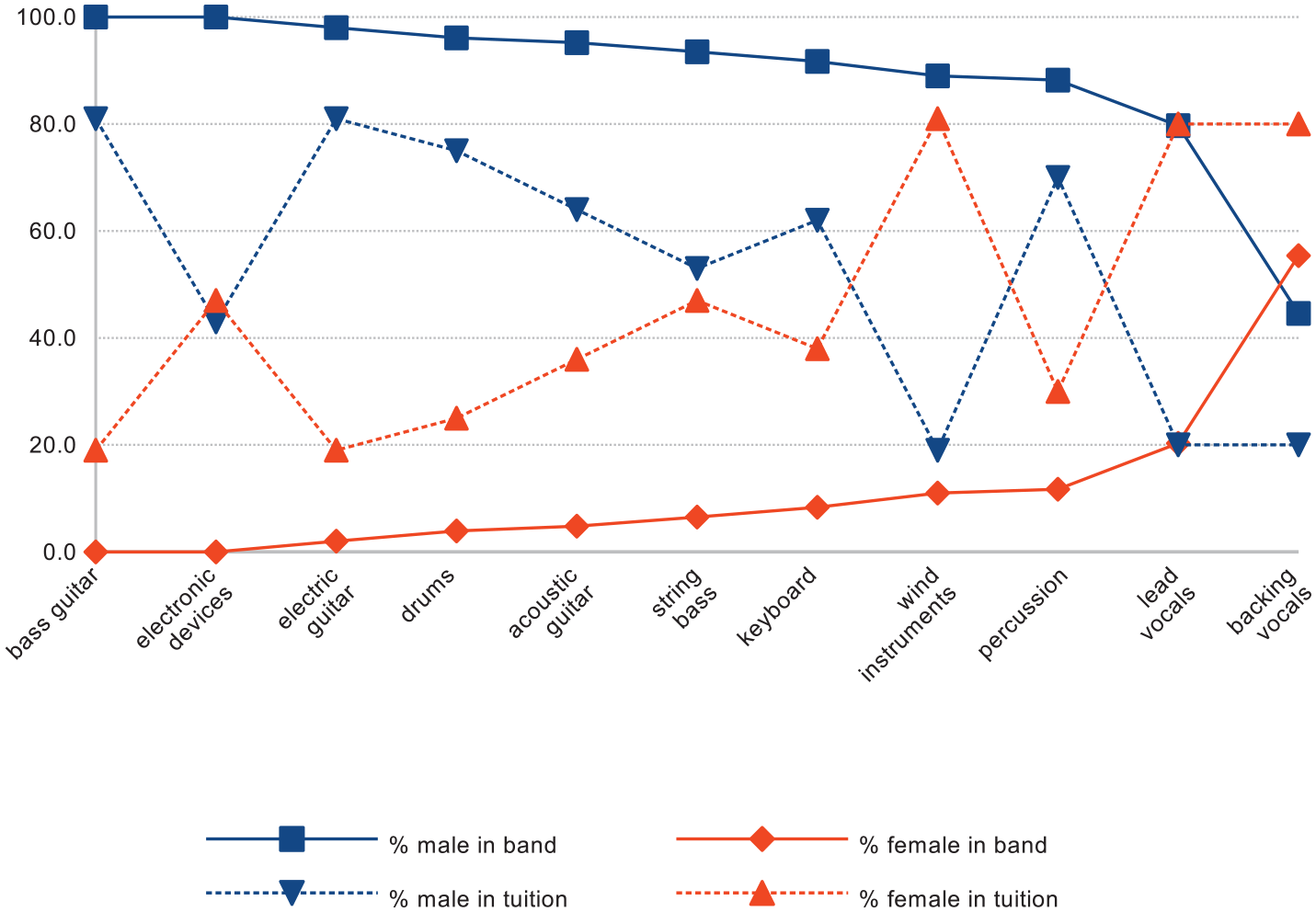
School-Age Students Receiving Tuition on Instruments of Popular Music Versus Musicians Engaged in Popular Music Groups.
Many more males have band membership than would be predicted by the proportions of males who receive tuition on relevant instruments, and conversely, significantly fewer women do so than would be predicted from the Hallam et al. database.
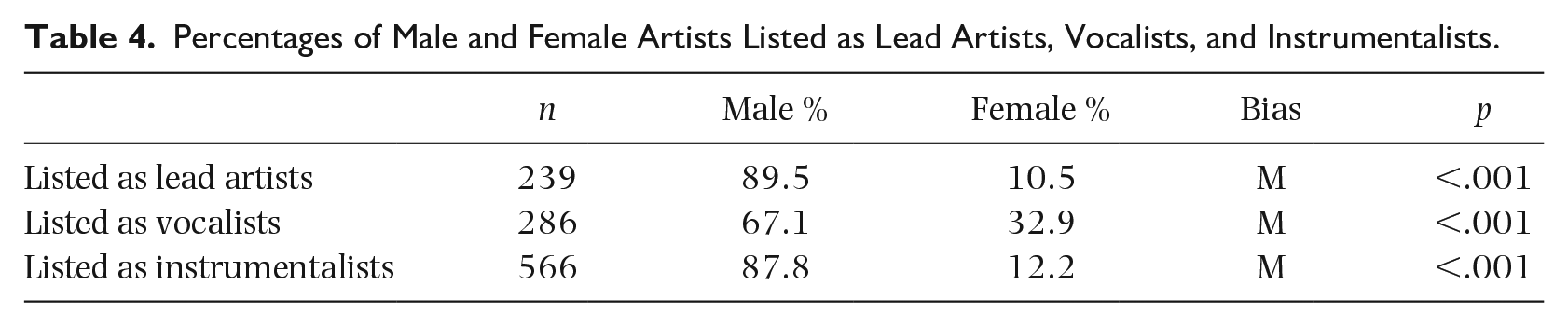
The ways in which artist roles are listed in presentation materials also show a male dominance: male artists listed as leaders of their groups substantially outnumber women artists so listed by a ratio of nearly 9:1 (Table 4). Published listings of instrumentalists and vocalists similarly reflect male dominance, with high significance of differences, p < .001.
Percentages of Male and Female Artists Listed as Lead Artists, Vocalists, and Instrumentalists.
The Hallam et al. database shows many more girls undertake vocal tuition than do boys (differences p < .001; Figure 21) but, contrarily, despite the presence of some notable individual female vocalists in the popular genre (Madonna, Britney Spears, Ariana Grande, Beyoncé, Celine Dion, etc.), the number of males listed as taking “lead vocal” roles in the RIAA data greatly exceeds the number of women so listed (p < .001). Our results therefore show a dramatic reversal of sex-role expectations (Figure 21): only 20% of boys are shown as receiving vocal tuition, yet 80% of listed lead vocalists are male. Furthermore, the number of women taking subsidiary roles in the groups as “backing vocals” significantly exceeds the number of males taking equivalent subsidiary roles (
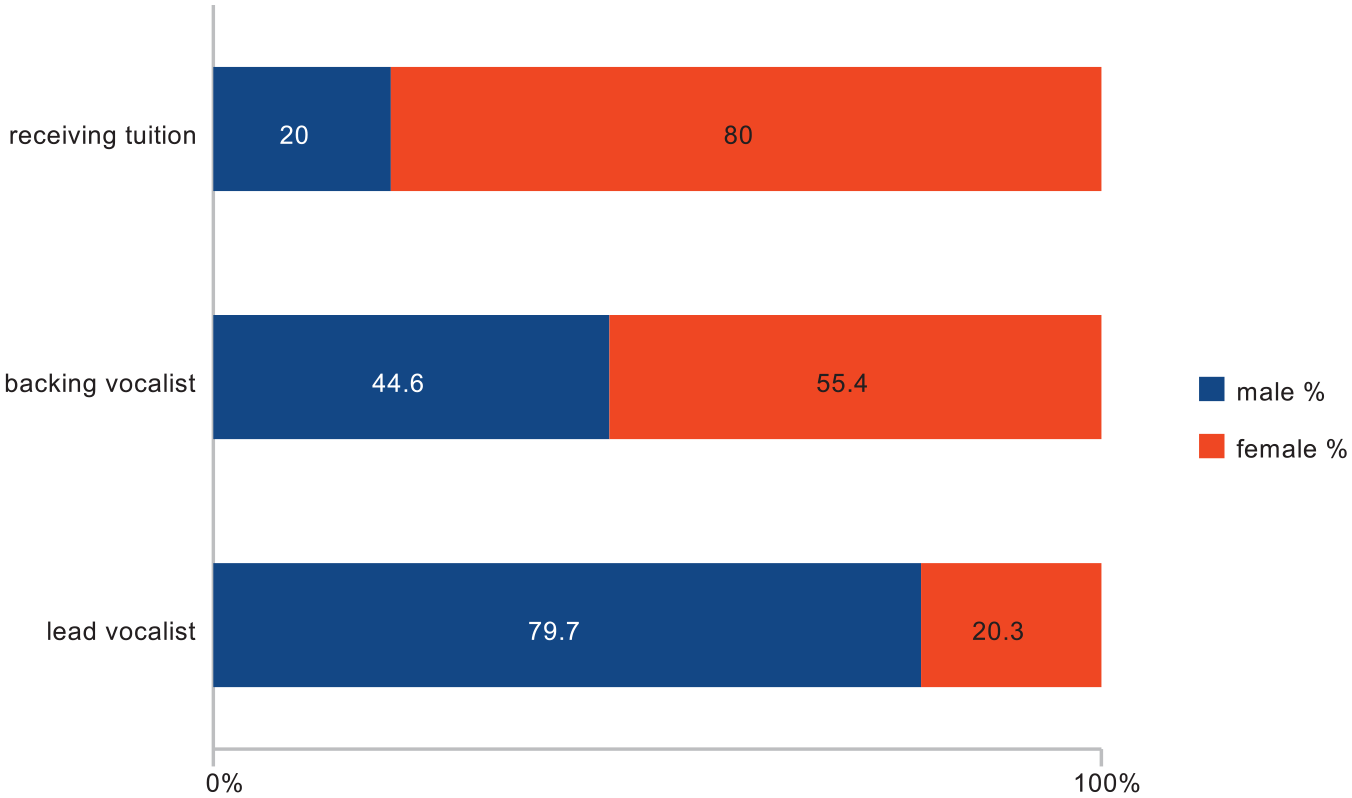
Percentages of Students Receiving Vocal Tuition in Relation to Vocalists in Popular Music Groups.
The now-familiar disconnect is therefore also evident throughout vocalist roles in popular music. 6
The same reversals of expectation are evident in data for guitarists: significantly fewer female guitarists appear in popular groups than would be expected from the numbers of girls listed in the Hallam et al. (2008) database as receiving tuition on guitars (
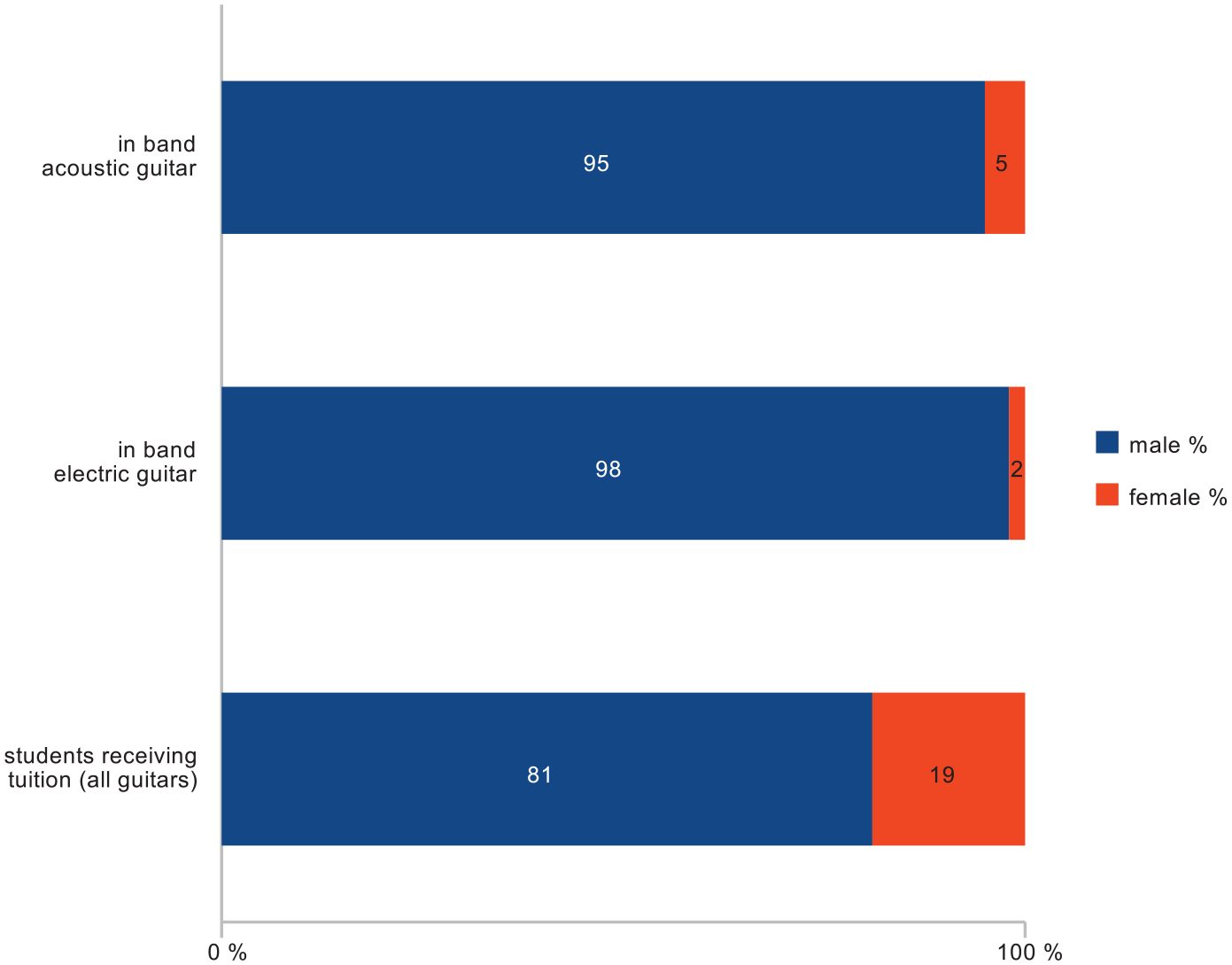
Percentages of School-Age Students Receiving Tuition on Guitar Versus Adult Guitarists in Groups.
Discussion
Data from the three reviews above facilitate comparisons of the representation of male and female musicians across the three genres of music performance (Figure 23).
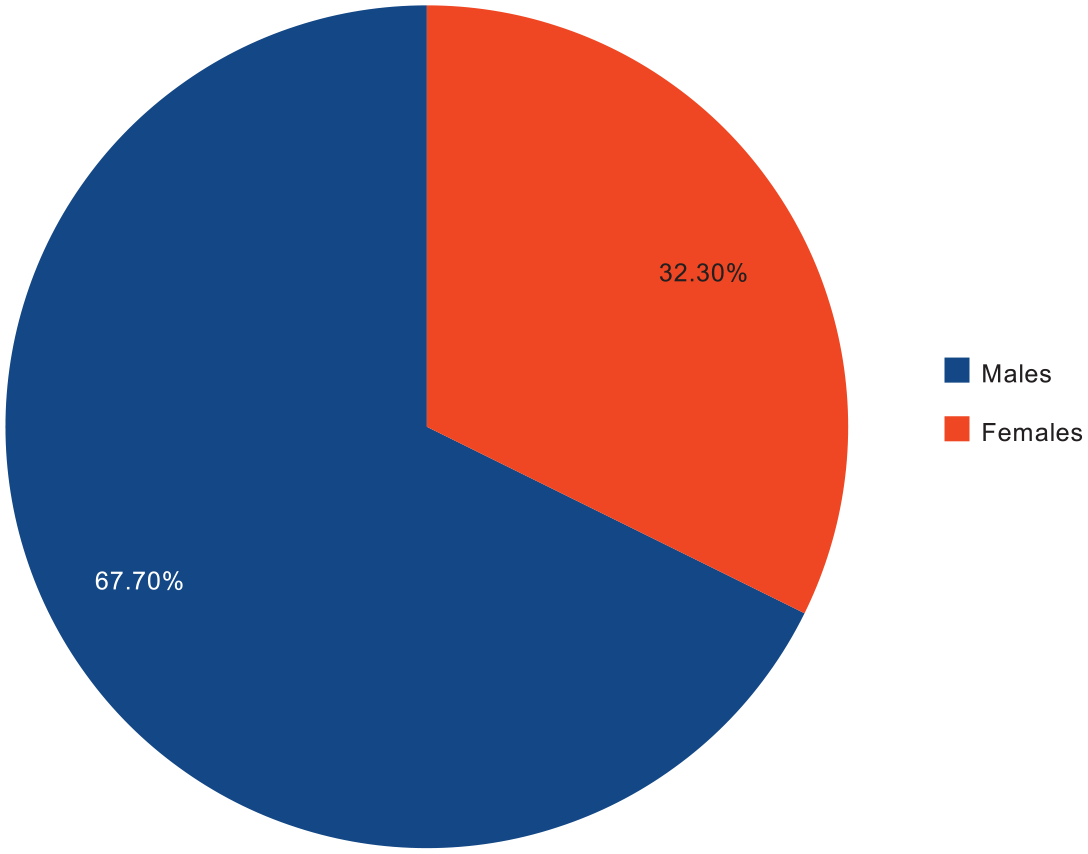
Overall Representation of Male and Female Musicians Across Three Genres of Music Performance (Total n = 5,693 Musicians).
The overall representation of male and female musicians shows a significant majority of male over female performers across these three major genres of music performance (67.7%/32.3%, p < .001, n = 5,693 musicians). Disregarding opera and other forms of vocal music, these areas collectively represent a substantial proportion of professional ensemble music performance activities. Within these overall proportions, however, statistically significant contrasts are evident between genres in the levels to which the sexes are represented (Figure 24), with women musicians having their largest representation in the sphere of orchestral music and the smallest in the genre of popular music.
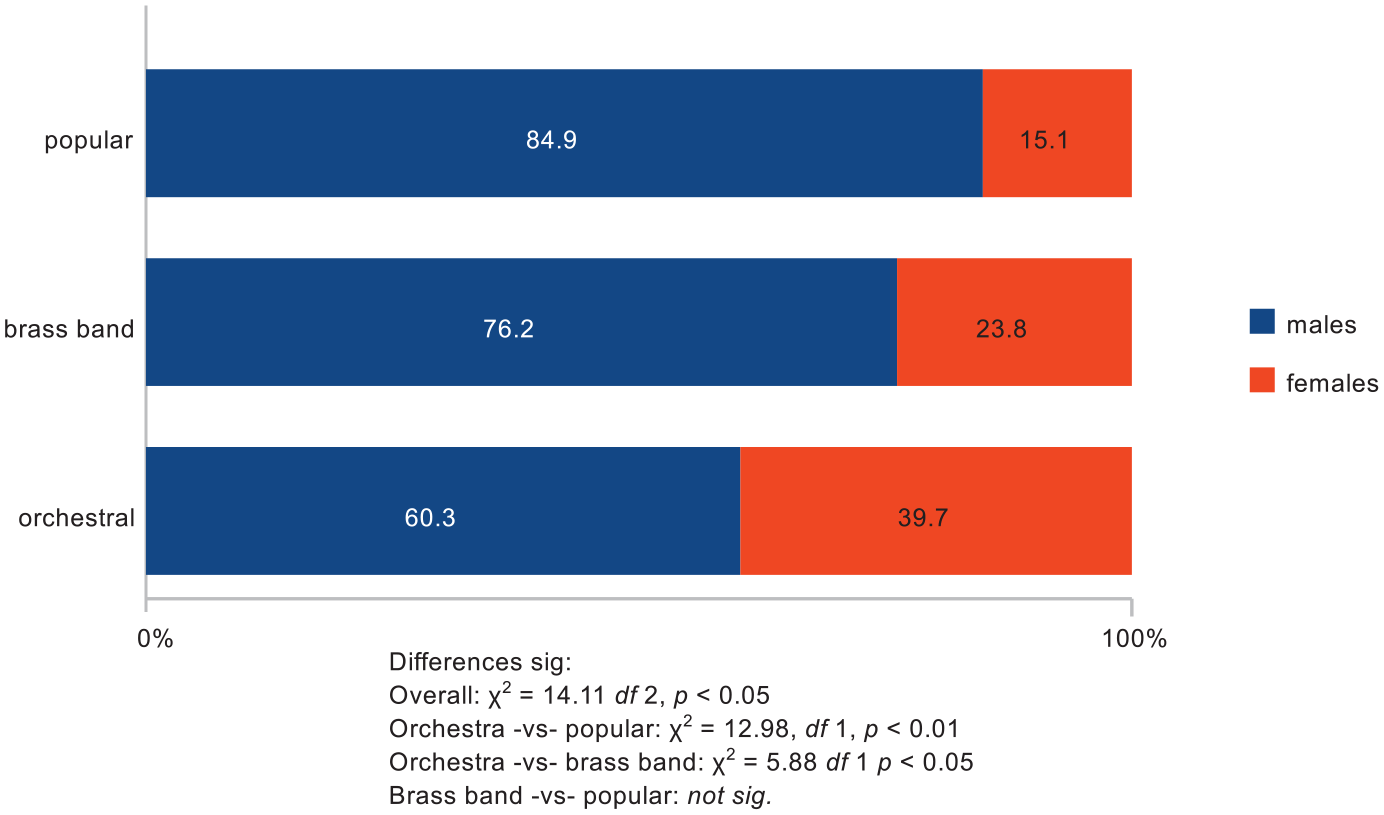
Representation of Male and Female Musicians in Three Genres of Music.
Comparison of the numbers of boys and girls undertaking tuition in each of the three genres with those of adult males and females performing in the corresponding performance groups (Figure 25) shows that in all three genres, the percentages of women appointed to performing groups are approximately 50% smaller than would be predicted from the numbers of girls undertaking tuition on relevant instruments shown in the Hallam et al. database.
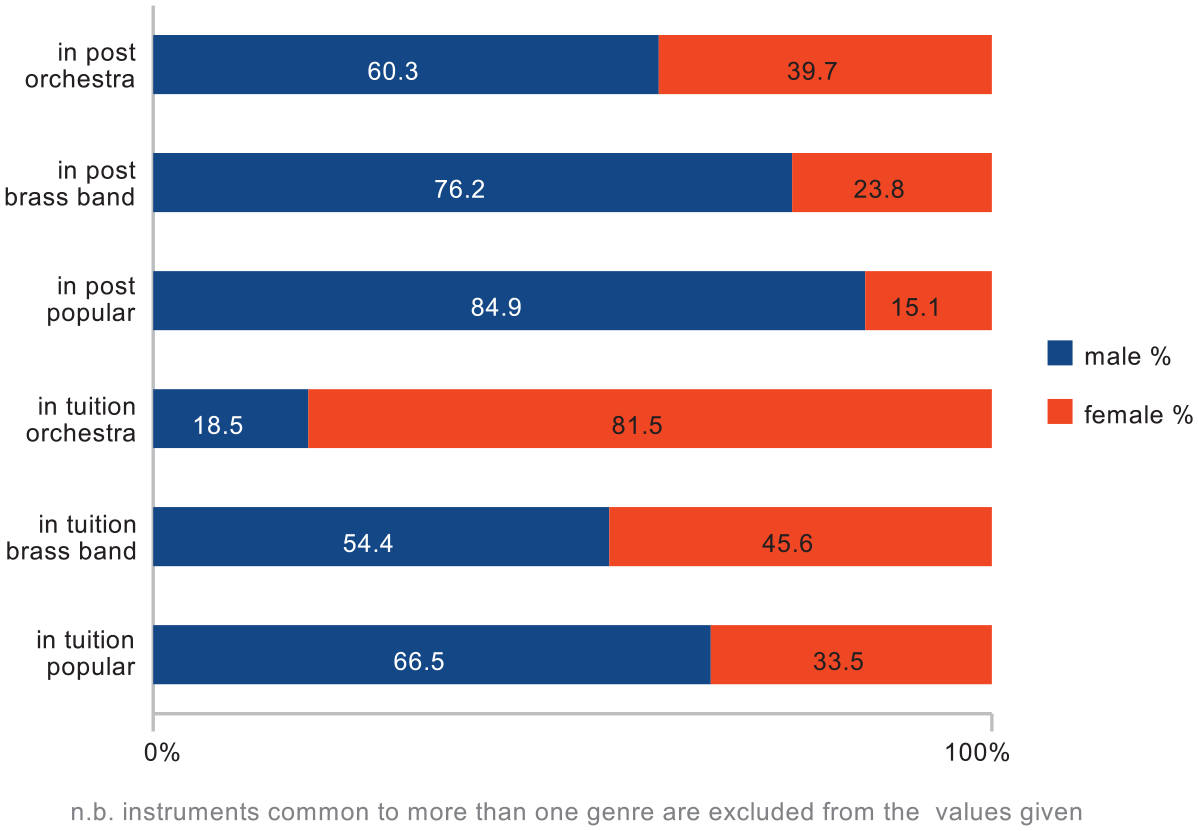
Percentages of Male and Female Musicians Performing with Adult Groups Compared With Those of School-Age Students Undertaking Tuition on Instruments Relevant to the Three Musical Genres.
Sex-related contrasts are evident in the choices of instruments by school-age students in both the orchestral and popular music arenas: instruments associated with popular music draw many more boys than girls (
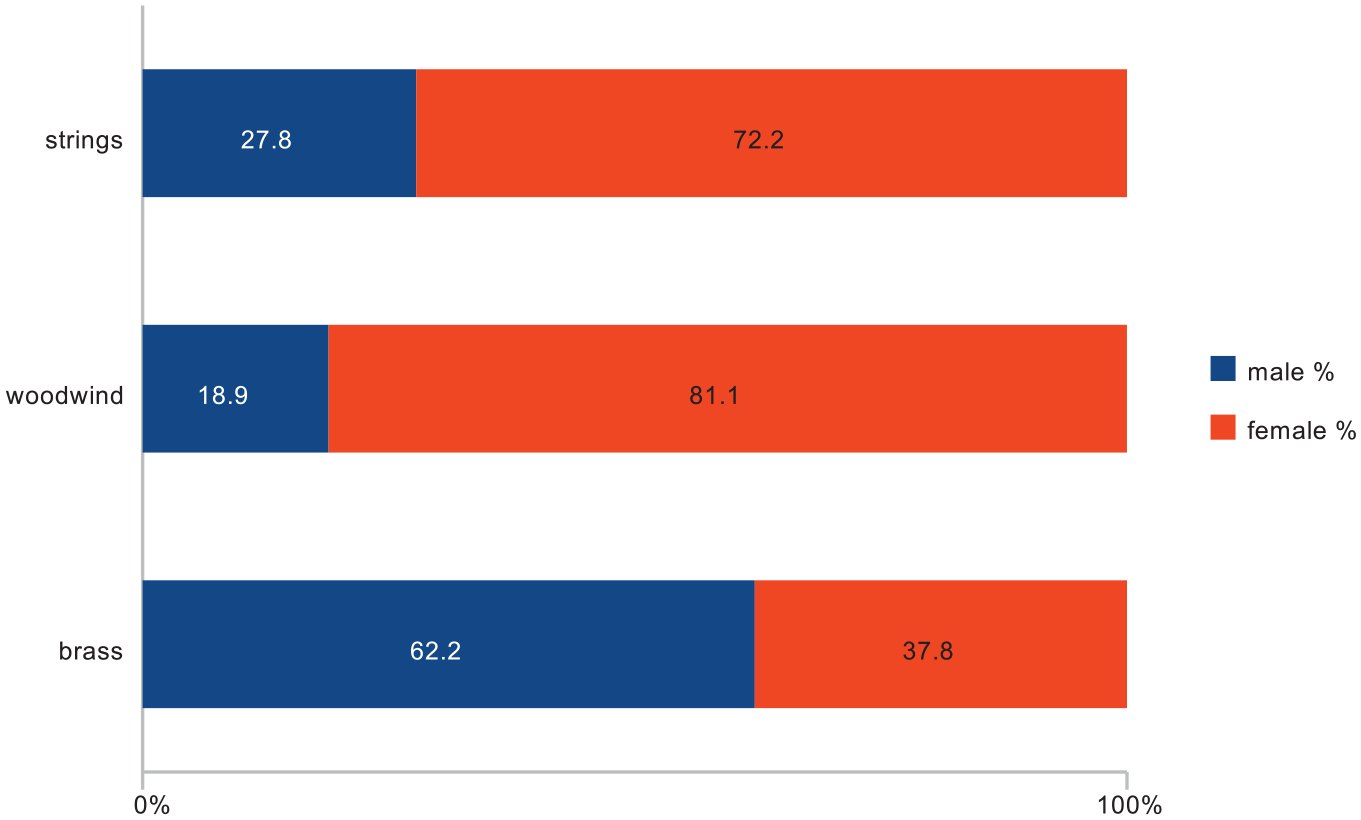
Sex-Related Differences in Choices of Orchestral Instruments of Male and Female School-Age Students.
Among instruments of popular music girls are less likely than boys to choose drum kit, guitar or electronic instruments, synthesizer, and so on (Figure 27).
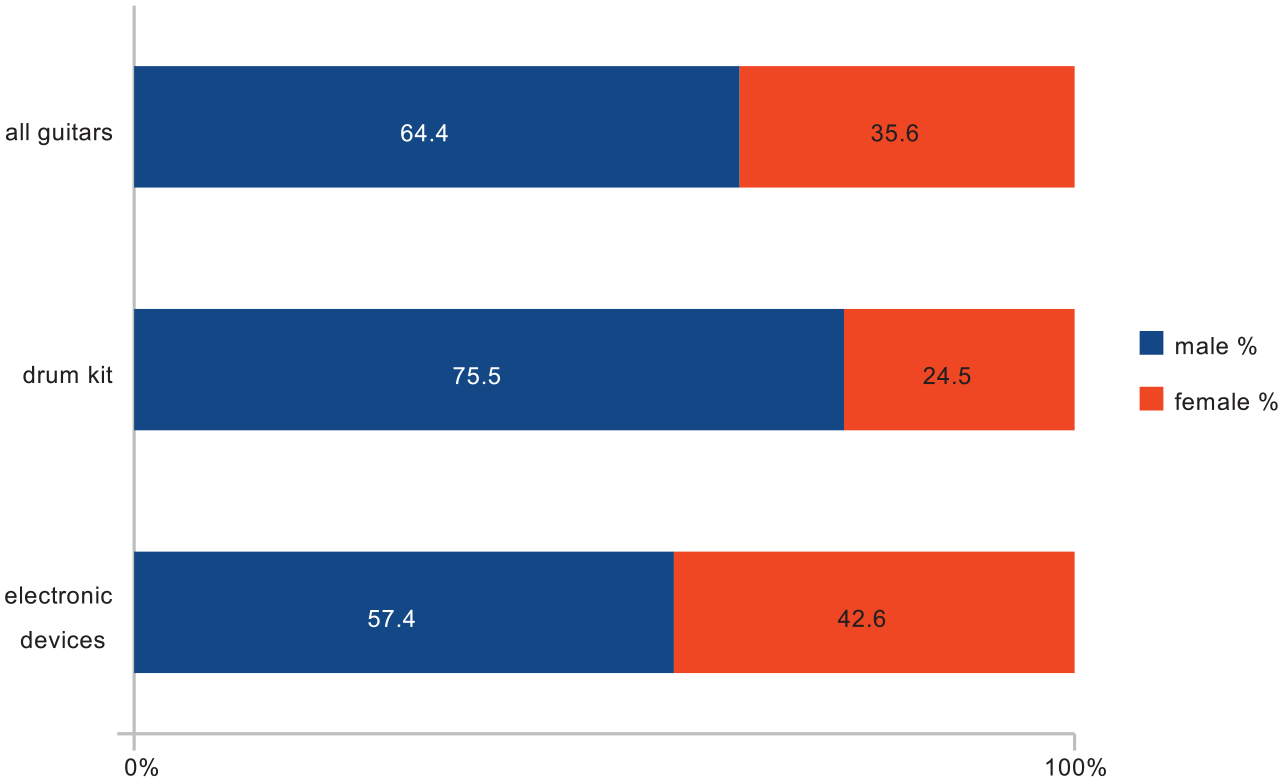
Sex-Related Differences in Choices of Male and Female School-Age Students of Instruments of Popular Music.
It is notable that although 43% of young female students were attracted to tuition on electronic musical instruments, not a single female is listed in the RISA data as associated with them, making this form of music a strictly masculine preserve.
Representation of the sexes in the world of orchestral music
The levels of sex (and perhaps, gender) inequality we have reported from our reviews of orchestral staffing are accountable on historical, societal, and employment issues intrinsic to the world of orchestra performance and management. There have been women-only orchestras of outstanding quality throughout the history of music, for example, those of the Ospadeli of 16th- and 17th-centuries Venice and Naples from whose female orphan and foundling inmates they were formed 7 (Berdes & Whittemore, 2012; Pincherle and Marble, 1938; Tonelli, 2013), and especially the 60-strong band of the Venetian Ospedale della Pietà, but societal attitudes over centuries regarding social roles and employment of women caused their general exclusion from performance roles in orchestral music, attitudes that began to change only in the early-20th century (Alwin et al., 1992; Lee et al., 2007). The way that employment of women in orchestras has increased proportionally in line with changing attitudes to the roles and status of women has previously been illustrated (Sergeant & Himonides, 2019: Figure 8). The evidence of our revised data is that in many orchestras in the United Kngdom and North America levels of staffing show little evidence of intentional sex bias, though some of those of Europe appear to be some way behind in this.
Men have been shown to have longer performing careers than do women owing to differences in patterns of retirement. Mean duration of engagement with their final orchestras are longer for male players than for women (19.3 years for males, 16.65 years for females, differences significant p < .001; Sergeant & Himonides, 2019). The mean career-long duration of women is also briefer than it is for men (males 47–78 years, females 23–57 years; Smith, 1988). These two factors create a built-in inevitability that male presence in orchestras will be greater than for women, even if equal employment and engagement policies are operational.
These differing career patterns have consequences that make differentials of remunerations for men and women musicians inevitable. Appointments to Section Principal/Leader posts are likely to be awarded to the most experienced and longest-serving players: as these will usually be males, and these posts carry supplements to salaries, 8 it is inevitable that average remuneration of males can be greater than for women. A further important factor in orchestral staffing is the marked preferences of women for smaller, lighter, higher pitched instruments (explored above), and their disinclination for brass instruments: this inevitably places limitations on the representation of women musicians in orchestras.
Sex representation in brass bands
As discussed earlier, the industrial origin of the brass band movement in the 19th century caused it to be characterized as a masculine activity, and this characterization has been sustained over the ensuing centuries. Brass bands have thrived more vigorously in the industrial areas of their origin than they have in more commercial and cosmopolitan areas. Comparison of the numbers of bands located within a 50-mile radius of the centers of two English cities: Leeds, located in the industrial heartlands of northern England, compared with the more commercial and administrative capital, London, in the south reveals very marked differences (Table 5).
Numbers of Brass Bands Located within 50 Miles of Two Major UK Cities in Relation to the Size of Their Populations.
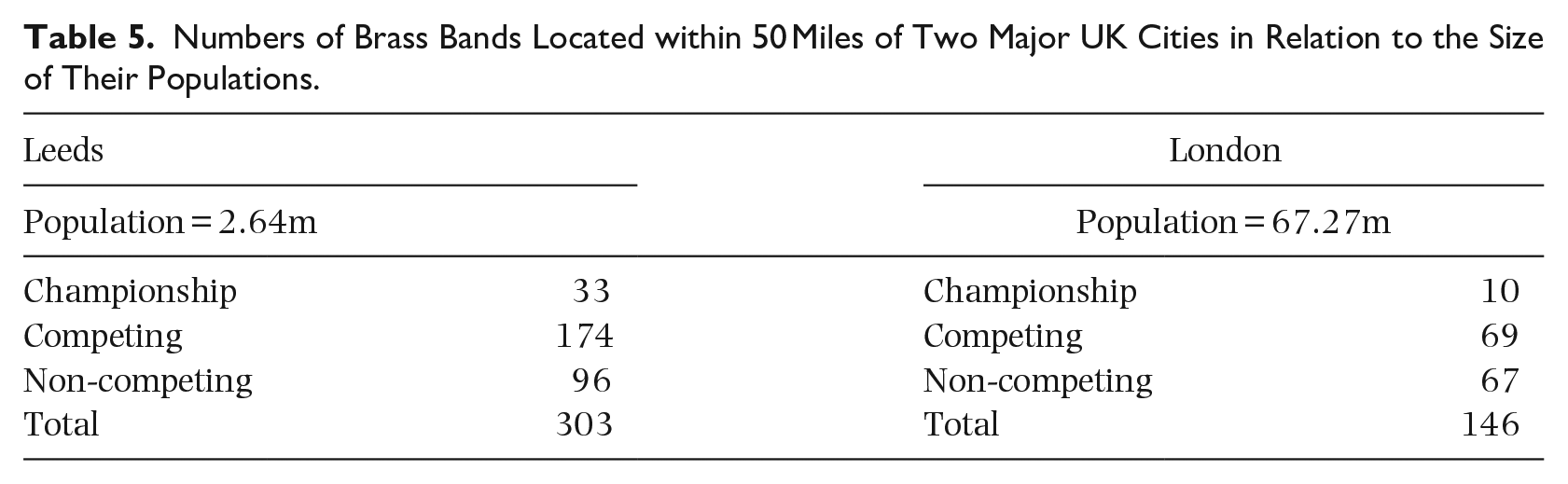
Taking into account the relative densities of the two populations, there are twice as many bands in the area of Leeds than are located within the same radius of central London—a city with 25 times greater population. The strength of the band competition movement is also reflected in the greater proportion of non-competing band in the south compared with the northern city, where competitions are a vibrant part of the activities of bands and of the lives of their players.
There have always been fine women brass players (Holman, 2019a, 2019b), and in the late-19th and early-20th centuries, there were several notable women’s groups especially in North America, but these groups were relatively small, sometimes domestic family ensembles: none were comparable to the size of the established modern competition band. Women have now achieved respected status in brass bands; their numbers have been increasing and complaints of sexism are rarely heard. As observed in the orchestral field, the numerical superiority of male players can be attributed substantially to the association of women with certain categories of instruments, notably flugel and tenor horns, and disfavor for others, discussed earlier. Whether the numbers of women musicians in brass bands will continue to increase will depend importantly on continuation of these partialities.
Representation of the sexes in popular music
The phenomenon of popular music in the form we know it today first emerged around the beginning of the 20th century, and it is entirely an idiom of the modern age. It is therefore a great irony that in an era of increasing equality between the sexes, popular music has developed as so male-dominated a form in which women musicians have only fractional representation in comparison to men. Why is there such a sex imbalance in this genre of music, and why is there a general assumption of it being part of a male culture, of male activities, behaviors, and values (Clawson, 1999a; Cohen, 1997), what Leonard (2007a) describes as the “normalization of male dominance in pop music”? We briefly explore possible causes.
One important reason is that the imagery popular music invokes is centered in sexuality, expressed with varying degrees of explicitness, in contexts that communicate an aura of male power and aggression, gender-authority, and the subjugation and objectification of women (Bretthauer et al., 2007; Cohen, 2001). Its gendered images are conveyed verbally, visually, and through its sonic data. Walser and Berger (2014) describe the more extreme forms of Heavy Metal and Cock Rock as “forging masculinity through instruments, sounds, lyrics, on-stage behaviour, with irregular dress-code, use of acoustic and technical resources, rasping throaty voice exploited at extremes of pitch and volume as symbols of male power.” Gill and Grint (1995) describe rock‘n’roll as a rampantly macho and masculinist form, and for Leonard (2007a, 2007b), it has been “essentialised as a male form.” Pop bands are male territory from which girls are discouraged from entry, if not actively excluded (Cohen, 1997). To have a girl as lead guitarist in a mixed-sex band would compromise the quintessential masculine imagery of the pop music scene.
It is important to recognize that the term “Popular music” refers to a broad genre within which many musical styles co-exist, differing not only in their musical vocabulary and sonic phenomena but also in the social and behavioral values on which they are predicated. These various styles have popularity with differing social and ethnic groups, although there is considerable crossover, and each new sub-style rapidly engenders further subspecies (Strasburger & Hendren, 1995; Weinstein, 2000).
Although sex and gender are central to all popular music, the ways in which sexuality is referenced and the explicitness with which it is communicated varies considerably, reflecting differing attitudes not only to sex, but also basic human values (Christenson & Roberts, 1998; Laiho, 2004; Selfhout et al., 2009). Marked differences were noted in Aubrey and Frisby’s (2011) comparison of the verbal content of Country and Western, R&B, Hip-Hop/Rap, and Pop/Rock in the sexual references, sexual narratives, and attitudes to women they purveyed. Andsager and Roe (1999) found that the Country Music songs of female signers were quantitatively different in their representation of women from those of men. The most extreme levels of sexual reference have been noted in Rap (Conrad et al., 2009; Grönevik, 2013; Weitzer & Kubrin, 2009). Although the extraordinary levels of verbal degradation of women that are rampant in this musical form are the subject of serious criticism and protest, particularly from women’s groups, condemnation is by no means universal: a rap song which sympathetically reported the difficulties of successful financial exploitation of women by prostitution: “It’s hard out there for a pimp . . . makin’ change off these women . . . When he tryin’ to get this money for the rent”
9
won the 2005 Academy Award for best original song in a feature film. Singer Ariana Grande, doyenne of R&B/hip-hop, the most streamed female artist on Spotify and Apple Music preference and adored of teenage girls, in her October 2020 release “34+35” (Album “Positions”) asks of her partner, Can you stay up all night?—Fuck me ‘til the daylight—34+35 (yeah, yeah, yeah!)—Means I wanna 69 witcha—but show me you can keep it up— . . . Baby, you might need a seat-belt when I ride it—I’ma leave it open like a door, come inside it, . . .| Got the neighbours yelling “Earthquake” 4.5 when I make the bed shake (https://bit.ly/37LtGdV, accessed February 24, 2021)
and moved to the top of the Billboard Hot 100 list 2020 in doing so. Rap artists who are purveyors of such pornographic lyrics have suggested that such matter is included because it assists them in securing record deals; that “hardcore is what sells” (Keyes, 2004; Krims, 2000; Kubrin, 2005; Lena, 2006; Quinn, 2004). Levande (2008) considers that media ownership and the deregulation of media companies in the United States together with the convergence of media ownership into megalith bodies that profit from adult entertainment have served to push pornographic imagery into the mainstream of popular music.
Studies that have examined lyrics by female rappers (Oware, 2009; Weitzer & Kubrin, 2009) report that although the products of some are unexceptionable, many have shown little resistance to sexism and that a majority uphold male hegemonic notions of femininity (Moody, 2011; Oware, 2009). Curious contradictions over meanings and acceptability arise: even the “N . . . ” word, whose use gives such offense and has in other contexts been the subject of legal prosecutions, apparently becomes acceptable in Rap in the form “Nigga” and is applied indiscriminately to any male (Young, 2007).
Sex, gender, and the electric guitar
In the order of gendering of instruments (Sergeant & Himonides, 2019), the electric guitar was listed as the most masculine instrument. The guitar is bought and played by males; the number of female guitarists in local bands has been estimated as only 2%–4% of the total (Bayton, 1997), and the vast majority of professional electric guitarists are male (Bourdage, 2011). The frequency with which male guitarists have featured on front covers, in photos, features, and news items in magazines has greatly exceeded representations of female players (Bayton, 1998). Guitar shops are seen to be male terrain, ring-fenced by male salesmen: women may be drawn toward the guitar but are alienated and intimidated by the multitude of technological “add-ons” that are regarded as must-haves of electric guitar performance and are defended as exclusively masculine areas of knowledge. Bayton (1997) summarizes, “Men buy a guitar, women buy a poster” (p. 40).
The well-documented greater aggressiveness and dominant behavior of the male is reflected in the strongly gendered modes of performance on the guitar. Male address to the instrument is significantly more aggressive and forceful than that of females, and there are differences in the manner of holding and playing. The stereotypical image of the male guitarist is holding the instrument low, near the crotch, giving an impression of it being a phallic extension. According to Bayton (1997, p. 43), held thus, while leaning back, a male guitarist can give an impression of engagement in sexual ecstasy. Female electric guitarists are more often seen holding the instrument at a higher, more natural position with the neck horizontal, avoiding the lower masculine “phallic” line. According to Bourdage (2011), “a woman who plays like ‘one of the boys’ gives an appearance of attempting to appropriate masculine characteristics.” Women guitarists face a dilemma on the issue of instrument position between physical comfort and convenience and the danger of appearing inadequate or “sissy” (Amelia, guitarist cited by Bayton, 1997, p. 44). The relative numbers of male and female guitarists in working bands found in our data above (males 98%:females 2%) show the extent to which the prevailing image projected in performance by males coupled with physical reasons of discomfort, most women and girls find the electric guitar inimical to their self-image.
Riot Grrrl
Leonard (2007b) describes the emergence in the early 1990s of Riot Grrrl, a strongly feministic movement in popular music characterized by all-female bands bearing titles ranging from self-derisive (Fragrance, Girls School, The Frumpies, Free kitten, Babes in Toyland) through rebellious feminism (Grrrl Trouble, Bikini Kill, Bratmobile, Girl Power, Riot Cats, Man Overboard) and irony (Hotskirt, Sweet Tart) to the stridently explicit (Intimate Wipe, Period Pains, Adickdid, Dickless, Crunt, Pussy Riot, Throbbing Organ, Juicy, Cocksucker Blues, etc.). Adopting a variety of dress styles—ironic baby doll with black Doc Martin boots below, dangerously scanty black lycra, pseudo military, often wearing exaggeratedly plastered make-up to create an intentional appearance of gormlessness, these bands imitated the extreme musical manner and writhing platform styles typified by the male Rolling Stones and heavy metal bands that had preceded them (Whiteley, 1997). Far from engaging with feminine grace, Barrowclough (1993) reports of their extreme on-stage behavior that “They screech, they spit, they swear. Every word they scream is a prayer against men.” Sandve (2017) refers to “iconographic gestures of crotch grabbing” as an integral part of their performance patterns.
Riot Grrrl bands were promoted through “Zines” and “fanzines”-home produced, small circulation magazines targeted at known fans. These productions were often written by the artists themselves and did not engage in formal journalism but used styles more akin to girl-chat mags. They expressed an extreme feminist identity, often in socially rebellious tones, emulating the macho-masculine style of sexuality and brutishness. Adopting a neo-punk style, they concerned themselves with politics and wider feminist issues such as domestic abuse, rape, and racism. In doing so, they deflected their movement from the domain of popular entertainment, causing it to drop into early obscurity.
Sex, gender, and voice
Popular music is rooted in vocalization: there are a few examples of purely instrumental pieces in this genre whose origins are other than song. Our data show that in the world of popular music even vocality is male-dominated, both in numbers of artists and in their musical roles. As our Figures 20 and 21 show, four times as many girls receive vocal tuition than do boys. Green (1997) reports that girls are considered by both teachers and pupils to be more successful than boys at singing, a view supported by O’Neill (1997). A prevailing perception of gender roles in relation to the voice is succinctly expressed by Green’s 11-year-old interviewee: “singing is girls’ jobs” (O’Neill, 1997, p. 152). Nevertheless, our data show that although girls who receive vocal tuition exceed boys who do so by 80%:20% the percentages of male and female lead vocalists of popular music groups are 80% males:20% females, exactly reversing the in-tuition values.
Possible causes of this dramatic reversal, apart from the general overriding male dominance of the popular music scene, are a probable mismatch between the vocal style fostered in the singing studio—substantially the bel canto method typically required in classical vocal music—and the throaty microphone-enhanced voice usage which is the gold standard of popular music, but is anathema to the classically trained voice teacher. Second, the verbal content of many songs in the popular genre may be of an order that many women might be disinclined to sing. Gems of poesy such as “bring your daughter to the slaughter” may be a song too far for many women.
There have always been songs containing explicit references to sex, sometimes coming from ostensibly respectable sources (witness the unmistakable double entendres of Robert Burns in his “Duncan MacLearie has a new fiddle”), but these have mostly had covert circulation, predominantly within masculine society. In recent decades, however, songs with blatantly sexual content have increasingly become the norm. Analyses of song lyrics over several decades (Arnett, 2002; Carpentier et al., 2007; Hawkins, 2017; Langdon, 2012; Scheff, 2016; Smiler et al., 2017) show that the percentage of popular songs with sexual content increased from around 20% in the 1940s to 90% in the 2000s, and that the number of sexual references per song also increased significantly. Whatever the lyric content of popular songs may be, they no longer concern roses or rainbows.
Music education and training
The Hallam et al. database (Hallam et al., 2005) shows that tuition on instruments of popular music is offered within state-funded provisions for music education, but how much this affects the performer population of the popular music industry is uncertain. Becker, in his forward to H. S.Bennett’s (2017) “On becoming a rock musician,” suggests that rock music is learned but rarely taught. The customary route to acquisition of instrumental skills is by receiving tuition from a professional teacher, but unlike classical musicians, rock musicians need membership of a group to develop. Even participation in a “garage band” enables members to share practical skills and musical knowledge, members constructing their own collective form of knowledge through which they progressively achieve success. But even this process has sex polarities: from her extensive interviews with popular musicians, Green (2002) reports that boys form bands earlier than girls (boys circa age 15, girls from age 21) so boys are likely to have acquired extended band experience by the time that girls normally begin. A. Bennett (2018) and Clawson (1999a, 1999b) both confirm this differential pattern. Our data (Figures 25 and 26) show that girls more often follow the orthodoxy of instrumental lessons during school ages, perhaps following parental and societal expectations, before making their way into popular music; boys are more inclined to gain their first musical experiences directly in popular music from the start without a preface of classical lessons.
H. S.Bennett (2017) proposes that this creates fundamental gender differences in the structural experiences of the nature of music. Boys tend to bypass the tradition of music stored, taught, and transmitted by written notation, building experientially an aural notation derived from experimentation and discovery and from listening to recorded examples. He argues that this establishes alternative ways in which music is stored and analyzed in the brain: memory traces replacing visual retrieval from the written page. Becoming a rock musician, he argues, is not a process steeped in the history, theory, and pedagogy of prestigious academies, or guided by a tradition of teaching and teachers but is learned to a greater extent than it is taught by teachers.
Sex differences in music publications
A number of studies have examined bias in the ways in which men and women are represented in the popular music press. Bayton (1998) reported that during the decade 1980–1990 considerably greater numbers of men than women were represented in music magazines in the United Kingdom, and that men were featured more frequently on cover illustrations, and treated in longer commentaries. When women were featured at all, it was their roles as vocalists that were stressed rather than as instrumentalists. They were frequently shown either scantily clad or represented as subservient to males (Lieb, 2018). In 2007, Leonard (2007a, pp. 28–35) reported a marked bias of music publications toward male bands, with all- or part-female groups rarely mentioned and an associated tendency to minimize female success even where it was evident. Subsequent studies have confirmed and documented this tendency: Lafrance et al. (2011) counting frequency and success scores as indicators, concluded that the “Top 40” charts are still characterized by considerable sex (and perhaps, gender) inequality. Watson (2019) reported that women in country music accounted for only 10% of daily radio spins; similar values were confirmed for Billboard by Lafrance et al. (2011, 2018). A majority of female daily airplay took place during overnight (29% of total spins) or evening slots (22%), periods known for reaching fewer listeners. Women accounted for only 10% of daily radio spins on Mediabase’s weekly airplay reports in 2019. There can be no doubt that the bias noted by Bayton (1997) in the 1990s continues.
Sex bias in management structures of popular music
The 20th century witnessed a shift away from the domestic music-making of previous times to a changed culture attributable to the growth of the recording industry. Low-cost production of recordings, circulated through radio to mass audiences, brought the emergence of a relatively small number of large and powerful record production companies, each promoting their own labels and artists, bringing the phenomenon of the “star” performer. This process has progressed inexorably, exploiting new forms of modern media, leading to a situation of corporate domination in which up to 90% of record production is in the hands of no more than five companies and 29% attributable to just one company. Many smaller companies that appear to be independent are in fact owned by one of the five. Bayton (1998) attributed male domination of popular music to its corporate management structure in which administrators and decision-makers at both senior and junior levels are male (Macdonald & Wilson, 2005), and the end product of the music itself is modified by teams of male producers, session musicians, studio engineers, and digital editors.
The technological nature of popular music production confirms it as a male possession, redolent of “masculine characteristics of mastery, skill and control” (Baxter et al., 1985), which causes it to be exclusionary for women who are regarded as “unplugged.” The entire industry has been described as a male form, male-run, with male musicians, writers, creators, technicians, engineers, and producers. Female roles are limited and are sanctioned by males in relation to male understandings of female abilities (Frith & McRobbie, 1978).
Sex differences in music videos
Popular music videos which have served as a primary marketing vehicle for singers and performers (Hawkins, 2017) provide a valuable aid to analysis of gendered contexts, as the participant musicians and dancers act out the ideas purveyed in the lyrics of the songs in visible ways. Utterback et al. (1996, cited in Arnett, 2002) examined 100 music video characters, finding that males were depicted as adventurous, aggressive, and dominant, but females as affectionate, fearful, and nurturing. Seidman (1992) reports that male characters appeared nearly twice as often as females, and he confirms Utterbach’s observations of differential characterization of males and females and the presentation of women in subservient behaviors, and their subjection to sexual depredation. Sandve (2017) refers to “iconographic gestures of crotch grabbing” as an integral part of hardcore videos, and other studies (Aubrey et al., 2011; Baxter et al., 1985; Brown & Campbell, 1986; Dibben, 1999; Seidman, 1992; Sherman & Dominick, 1986; Signorielli et al., 1994; Vandenbosch, 2017; Vincent et al., 1987; Wallis, 2011) have been unanimous in reporting music videos as representing women as sexual objects, dressed in sexually provocative clothing, showing sexually attractive bodies that equate to western body ideals, engaging in sexually provocative actions, shown in inferior, subservient roles, conveying notions of female inferiority, and often subject to sexual violence. Whiteley’s (2000) account of Madonna’s music video “Like a virgin” epitomizes the style of sexual innuendo that underlies many music videos in this genre. Significant levels of violence are displayed in Rap and Rock videos, and this is often associated with romanticization of weapon-carrying, normalization of killing, and confrontation with power (Aubrey & Frisby, 2011; Aubrey et al., 2011; DuRant, 1997).
The future of sex representation in popular music
Given the underlying causes of imbalance in the representation of men and women in the popular music industry, early change seems improbable. A shift toward a more feminized culture would first seem to be necessary and given the nature of the present established patterns of control of the industrial structure in this genre of music, this would seem to require an unlikely revolution. The present situation in popular music fits closely with the Muted Group Theory proposed by Ardener (1975). This theory proposes that in every society and its activities, there are cultural groups that experience suppression and become “muted” in their societal dealings through the supremacy of a parallel more dominant group, thereby having less access to public discourse and a consequent reduction in the effectiveness of their own voices. In the process, members of muted groups must adjust to the styles of communication of the dominant group to get their voices heard. With the dominant group contributing most notably to the formulation of the language system, including social norms and vocabularies, members of the subordinate group have to learn and use the language of the dominant group to express themselves (Meares, 2017). This theorization, which has usually been applied to sex and gender groups, precisely describes the situation that has prevailed when women have attempted to take a more striking role in popular music, for example, the Riot Grrrl phenomenon and the emergence of female rappers, their efforts have often been vitiated by retreat into emulation of masculine characteristics, values, behaviors, and language rather than maintaining characteristically feminine directions, engaging with a culture that reduces women to their sexual value whilst ignoring their sexuality (Attwood, 2007). The Riot Grrrls shrieked, swore, and adopted anti-establishment rhetoric in their songs (Barrowclough, 1993). Female rappers, instead of steering toward a restructured feminine repertoire have often subsumed male values and subject matter, even to endorsing verbal derogation of their sex by application of terms such as “bitch” and “ho” (whore; Cutler, 2007; Hooks, 1992; Krohn & Suazo, 1995; Vasan, 2011; White, 2011).
Rap and Hip-hop have become ubiquitous forms and constitute an increasingly significant part of the music industry (Morgan & Bennett, 2011). Henderson (1996) predicted that it would help to “create a new righteous, afro-centric standard in behaviour, away from guns, dope sexism and violence.” His optimism has not been fulfilled: boasting and bragging are omnipresent in rap music (Remes, 1991) and Moody’s (2011) research shows that while male rappers may fantasize about beautiful, overachieving women, female rappers are more sexually explicit, focusing on their own sexual prowess, often bragging about their “nookie” (sexual intercourse, and skills therein). American rapper Rasheeda informs that she “makes the fellas take a down-south tour!” (engage in oral sex) and in an obvious double entendre assures us of the freshness of her “dougie” (Rasheeda Buckner-Frost is an American rapper, fashion designer, and tv personality). Miss Kandi, another American rapper offers some candid observations about her vagina: “They say it feel a little tighter, get a little wetter—been told many times I’m the best ever” (Kandi Burruss [Miss Kandi] is an American R&B soloist and adult rapper). Brosnan (2020) says of Pelumi, a 16-year-old girl rapper of Liverpool’s Toxteth, “Her youthful energy and soft charming nature channels itself into venomous flows once she touches the microphone,” thus implicitly questioning the authenticity of her performances as genuine expression. Rose (1994) has suggested that “the ‘empowerment’ claimed for women by popular music has in fact (d)evolved to their taking only two roles: the vixen, or the female-gangster.”
Although masculine-orientated style and materials predominate in this genre, and until this fails to sell profitably, it seems certain that popular music will continue to pursue its present sexist path.
Conclusion
Sex and gendering are complex aspects of behavior and interaction, and no areas of human activity are innocent of allegations of sex bias. Even research itself, despite claims of a dispassionate, evidence-based independence of “ivory-tower-ism,” is argued to be subject to sex and gender bias (Cislak et al., 2018; García-González et al., 2019; Sleeman et al., 2019). The data in our study relate to differences in representation of male and female musicians in the three genres, that is, differences between the sexes, as that was our concern. We readily acknowledge that the boundary lines between behaviors that can be described as having origins in sex and those characterized by gender are imprecise and that the objective numerical contrasts we report are the consequences of subjective gendered human behaviors. This becomes particularly evident when we examine human behaviors in the profit-oriented popular music industry. Sex-and-gender-related differences are highly variable, proximally caused, and are context dependent.
There is no fixed overarching pattern of gendered behaviors in an artform such as music: they are context–specific, and dependent on social, historical, and behavioral factors and conditions specific to each particular musical activity, its form and style. This sits well with the views of Deaux and Major (1987) and Spears and Manstead (1989) that sex and gender influences are specific to social situations.
Supplemental Material
sj-docx-1-pom-10.1177_03057356221115458 – Supplemental material for Performing sex: The representation of male and female musicians in three genres of music performance
Supplemental material, sj-docx-1-pom-10.1177_03057356221115458 for Performing sex: The representation of male and female musicians in three genres of music performance by Desmond C Sergeant and Evangelos Himonides in Psychology of Music
Footnotes
Acknowledgements
The authors would like to thank Dr. Ross Purves for reading an earlier version of the manuscript and offering helpful comments.
Funding
The author(s) received no financial support for the research, authorship, and/or publication of this article.
Supplemental material
Supplemental material for this article is available online.

Notes
References
Supplementary Material
Please find the following supplemental material available below.
For Open Access articles published under a Creative Commons License, all supplemental material carries the same license as the article it is associated with.
For non-Open Access articles published, all supplemental material carries a non-exclusive license, and permission requests for re-use of supplemental material or any part of supplemental material shall be sent directly to the copyright owner as specified in the copyright notice associated with the article.
