




Abstract
Detriments to performance under pressure are common in many performance settings, from public speaking to skilled sports or music performances. In the last few decades, sports scientists have suggested that the quality and accuracy of movements can depend on what the performer attends to while executing the action, with an external focus of attention directed at the effects of the movement on the environment resulting in better performance than an internal focus, where attention is directed at the performer’s own body movements. Here we investigated the effects of attention focus instruction on the accuracy of piano performance. Amateur pianists were asked to practice a set piano piece for 7 days and then perform it to the experimenter under different performance instructions (no instruction, internal focus, external focus). An external focus of attention resulted in more accurate performance compared to an internal focus instruction, as evaluated by the difference in the number of note pitch errors and note corrections between the two conditions. Importantly, the advantage of an external over internal focus did not depend on pianistic expertise in our sample. Our research supports the idea that an external attention focus can improve music performance and should be considered in music teaching practice.
Performing music live to an audience can be a highly exhilarating and defining positive moment in a musician’s career. However, failure to perform well can negatively affect on a musician’s career as well as their mental health. In the last few decades, sports scientists have established consistent evidence supporting the idea that the quality and accuracy of movements can depend on what the performer attends to while executing the action (for a review, see Wulf, 2013; Wulf & Lewthwaite, 2016). More specifically, evidence across a range of sports disciplines (such as golf, baseball, basketball, and tennis) suggests that an external focus of attention, directed at the effects of the movement on the environment leads to better performance under pressure than an internal focus, where attention is directed at the performer’s own body movements. This benefit of an external over internal attention focus has been reported on performance measures such as accuracy, efficiency, speed, strength, and balance, and, interestingly, is effective for both instructions and feedback (e.g., Wulf, 2013). For example, Wulf and Lewthwaite (2010) provided participants with attention focus feedback referring specifically to either the physical movements themselves (internal focus) or to the movements’ effects (external focus) and found external focus feedback to result in more accurate and efficient execution of the athletic task (tennis serves). Similar results were found for attention focus instructions in other studies. For example, Benz et al. (2016) reported external attentional focus instructions to increase sprinting speed in runners compared to internal focus instructions. External over internal foci also resulted in improved performance among men from National Collegiate Athletic Association (NCAA) Division 1 Baseball Team in numerous performance outputs (Castaneda & Gray, 2007; Kershner et al., 2019) and has been shown to improve golf shot accuracy (Wulf & Su, 2007), basketball shooting (Al-Abood et al., 2002; Zachry et al., 2005), and volleyball serves and soccer passes (Wulf et al., 2002).
Some limited evidence suggests that the performance-enhancing benefit of an external focus instruction can be found in other, non-athletic domains (Wulf, 2007). For example, external attentional cues improved performance in general balance tasks compared to internal cues (Totsika & Wulf, 2003). Furthermore, external focus also reduced anxiety during social performance in individuals with social phobia (Woody, 1996). However, important for present purpose, very few studies to date have investigated the effect of attention focus in music performance. This striking gap in research conducted on attention focus in the area of music psychology seems surprising given that athletic and music performance share many similarities in the attentional and motor control processes and are both subject to substantial motivational and emotional pressures to perform well (e.g., Mornell & Wulf, 2019; Treinkman, 2021). Thus, one would expect the processes that benefit from an external attention focus to be similar for both skilled music and sports performance. One reason for the limited research in the music domain might be the relative difficulty to assess the quality of a music performance in comparison to an athletic performance, with the latter often using relatively discrete measures such as overall speed or putt/shot success. For example, Duke et al. (2011) tested participants’ performance of a simple keyboard passage with increasingly distant (external) foci. Participants were asked to play a short sequence of alternating notes as evenly as possible. The study showed that temporal consistency was higher for the more distal focus of attention. Atkins and Duke (2013) later replicated these findings in amateur singers that were asked to sing a simple 3-note pattern. Again, performance, as evaluated by expert ratings of tone quality, was better under external than internal focus instructions (see also Atkins, 2017 for similar results). Extending these findings to more ecologically valid music performance contexts, Mornell and Wulf (2019) asked expert musicians to perform a prepared piece of their choice in front of an evaluative audience under external or internal attention focus instruction. Expert ratings of musical expression and technical precision were found to be higher under external compared to internal focus instruction.
The Constrained Action Hypothesis (CAH) provides a theoretical framework for these consistent findings (e.g., Wulf et al., 2001). According to Fitts and Posner (1967), learning a new motor skill progresses through three main stages: the cognitive stage, where one acquires the basic procedural skills to perform a specific motor task; associative phase, where a transition from conscious to automatic control happens; and the automatic stage, where a motor task can be performed quickly and automatically without the need for much resource-demanding conscious effort. The CAH builds on this idea and proposes that when the focus of attention is aimed at the movement effects (external focus), an automatic mode of movement control is facilitated. In contrast, focussing attention on the movement itself (internal focus) potentially constrains the motor system, resulting in interference with the automatic mode of motor execution (see also self-focused attention theory [Baumeister, 1984] and explicit monitoring theory [Beilock & Carr, 2001], for related suggestions). These theoretical frameworks do also incorporate suggestions of why an external attention focus instruction might be beneficial to alleviate effects of performance anxiety. More specifically, the pressure to perform well in high-stake performance situations can result in an increase of conscious attention to the movement itself, with this shift to an internal attention focus potentially interrupting the well-learned, automatic mode of movement execution and resulting in choking under pressure (e.g., Baumeister, 1984; Beilock & Carr, 2001; Treinkman, 2021; Wulf, 2013; Wulf & Lewthwaite, 2016). Thus, sustaining an external attention focus during performance might be critically important for automatic movement execution.
The CAH is less specific about predicting how skill expertise might affect the attention focus effect. One could assume that motor actions that are well-rehearsed and have become automatic might benefit more than less practiced tasks from an external focus of attention compared to an internal focus, as the interruption of the automatic mode is only possible once an automatic mode of execution has been established. However, one could also argue that highly skilled and automatic actions might be less susceptible to attention interruption and thus, an external focus might provide less advantage over an internal focus for highly practiced and skilled performances. Only a small number of studies to date have investigated the question whether the attention focus effect is influenced by a participants’ skill level. Generally, the findings are inconsistent. Some researchers suggest the effect to be independent of skill level. For example, a consistent benefit of external over internal focus instruction among both beginner and expert golfers was reported by Wulf and Su (2013). In contrast, Perkins-Ceccato et al. (2003) found that although the benefit of external over internal attention focus was present for experts’ golf performance, no difference was found among beginners. Similarly, a recent study by Singh and Wulf (2020) found expert volleyball players to perform with higher accuracy under distal external focus instructions compared to proximal focus on the movement technique, whereas the opposite was found for novice players. The keyboard task study by Duke et al. (2011) again showed the opposite, whereas non-pianists benefited from an external over an internal focus, but expert pianists did not. Note, however, that this study had a very small sample size with only four participants in this expert group. Thus, it remains unclear to date whether an individual’s skill level can moderate the influence of attention focus instructions.
The present study
As mentioned above, only a small number of previous studies have investigated the effects of attentional focus in music performance. In several of these past studies, participants were not asked to perform an actual musical piece but only short, experimentally well-controlled but nevertheless artificial, sequences of simple note sequences, either on a keyboard or sung. To our knowledge only one study to date (Mornell & Wulf, 2019) asked participants to perform actual pieces of music in front of an evaluative audience. In that study, ratings of performance quality were used to evaluate the effectiveness of external compared to internal attention focus instructions. In addition, the participants tested in the Mornell and Wulf study were all expert musicians performing well-rehearsed musical material. The present study aims to extend these previous findings by testing amateur pianists in a performance of an easy J.S. Bach piece under external and internal focus instructions. More specifically, participants with at least basic keyboard skill levels were asked to learn “Little Prelude in D Minor” BWV 935 for 7 days. On the 8th day they performed the piece three times (sequentially), once with no instruction, once with an external focus of attention (focusing on the effect of the music), and once with an internal focus (focusing on the movements of the fingers). Instead of subjectively rating the performance quality, here we quantified different types of deviations from the music score. There are a range of methods to evaluate accuracy of piano performance, from simply counting the number of pitch and timing deviations from a set score to using complex classifications of different types of pitch errors that consider the harmonic and melodic context of the music, among other factors (e.g., Gudmundsdottir, 2010; Palmer & van de Sande, 1993; Repp, 1996). To avoid ambiguity and double coding of inaccuracies and taking into account the two-part nature of our chosen musical piece, we only evaluated a subset of possible error types, namely, the number of note and timing mistakes as well as note deletions and error corrections. In addition, to investigate whether musical skill level has an effect on the use of external versus internal instructions, a group split comparing intermediate with more advanced pianists was performed. From the findings reported in the sports psychology literature, we predicted our attention focus instruction would differentially affect participants of different skill levels.
Method
Participants
Fifty-one participants took part in the study. Participants were university students recruited through an advertisement posted in university Facebook groups. The advertisement stated that participants should be able to play piano at a minimum skill level equivalent to Grade 5 (Associated Board of the Royal Schools of Music [ABRSM]). Two participants were excluded from data analysis due to technical difficulties during recording (one participant) and the inability to play the required piece (one participant), resulting in a final sample of 49 participants (13 males, 36 females) with a mean age of M = 20.9 (age range: 18–35 years). Participants were split into 2 groups, depending on their level of piano expertise. Participants that currently played at Grade 8 level (ABRSM) or higher were classified as having “advanced expertise” (n = 16; 7 male; 9 female) and all other participants as “intermediate expertise” (n = 33; 6 male; 27 female), see Table 1 for demographic information about the two groups. The study was approved by the University of St Andrews Teaching and Research Ethics committee (Approval Code: PS 14880) and participants provided written informed consent.
Participant Demographics, Means (SD), and F-Values for Group Differences.
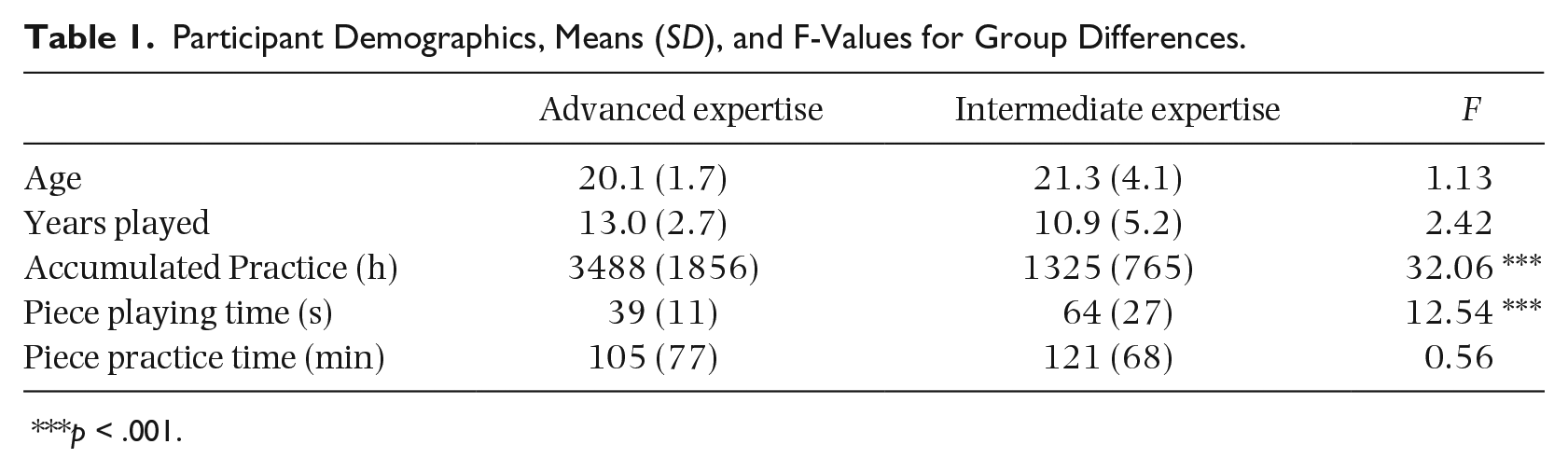
p < .001.
Materials
Participants were provided with the score for J. S. Bach’s “Little Prelude in D Minor” BWV 935 (Score on Line—Digital Sheet Music Library—partitions de musique classique, 2020) and asked to practice the first 24 bars, excluding any ornaments. They were also provided with a music experience questionnaire adapted from Jentzsch et al. (2014), asking for demographic information of the participants (age, gender, years played, accumulated practice time, start age of music training, formal examinations, evaluation of general music skills on a 5-point scale including knowledge of music theory, music history, and ability to read music) and how much they practiced the piece each of the 7 days prior to the final test performances. As the study was conducted during the COVID-19 pandemic, both practice and performance of the music piece took place at participants own homes using a variety of pianos, depending on availability (ranging from acoustic upright and grand pianos to digital pianos). Recordings of the final test session were done using participants own recording devices, such as their phones or tablets/iPads. The recordings were supervised online by the experimenter via Skype to ensure a “live-like” performance setting.
Procedure
Participants were provided with the questionnaire and sheet music and given 7 days to practice the piece, during which they were asked to keep a diary of their daily piece practice time. On day 8 they performed the piece to the experimenter via Skype three times under different instructions. They were asked to audio-record their performance on a separate device during the Skype session with the experimenter.
Before the performance, it was emphasized to participants that the performance does not need to be perfect and they should not feel stressed, and if they make a mistake, they should continue playing from the same spot rather than start over. Participants first performed a C Major scale to warm up and test the quality of their recording.
Participants then started with the baseline condition, which we also used as a further warm up in this study. For this first performance of the Bach piece, participants were asked to “play the piece the way you normally would,” with no further instruction. Directly after completion they continued either first to condition EF (external focus: “while you perform, I want you to focus on the sounds you’re creating”) or condition IF (internal focus: “while you perform, I want you to focus on the movements of your fingers”). The attention focus instructions were taken from the Duke et al. (2011) study. The order of conditions EF and IF for each participant was randomized (participants assigned an odd-numbered code were first given internal cues and even-numbered participants were first given external cues). Once the three performances were complete, participants were debriefed and instructed to email the three recordings and questionnaire to the experimenter.
Mistakes were coded as a “pitch error,” a “hesitation,” a “deletion,” or a “correction.” Errors constituted notes played that interrupted the correct sequence of notes as prescribed on the score (i.e., playing the wrong note or repeating the same note two or more times). Hesitations were classified as notes that interrupted the correct timing or rhythm of a passage (i.e., pausing before playing a note). Deletions were classified as pitches omitted from the sequence of notes. Corrections were classified as corrections of previously played incorrect notes. The recordings were coded by an experienced pianist, and a subset of 10 participants coded by a second experienced pianist to evaluate the coding reliability. The two raters were in very good agreement (rs > .85) suggesting that the rating approach is highly reliable.
The study used a mixed analysis of variance (ANOVA) design with within-subjects variable attention focus condition (internal focus [IF], external focus [EF]), and between-subjects variable expertise (intermediate, advanced). The dependent variables were the number of pitch errors, hesitations, note corrections, and deletions made in each condition.
Results
Pitch errors
More errors were made in the internal focus instruction (M = 8.6) compared to the external focus instruction (M = 6.8), F(1, 47) = 5.789, p = .020, ηp2 = 0.110. There was no main effect of expertise, F(1, 47) = 0.807, p = .374, nor an interaction between expertise and focus condition, F(1, 47) = 0.182, p = .672, see also Figures 1 and 2, left panels.
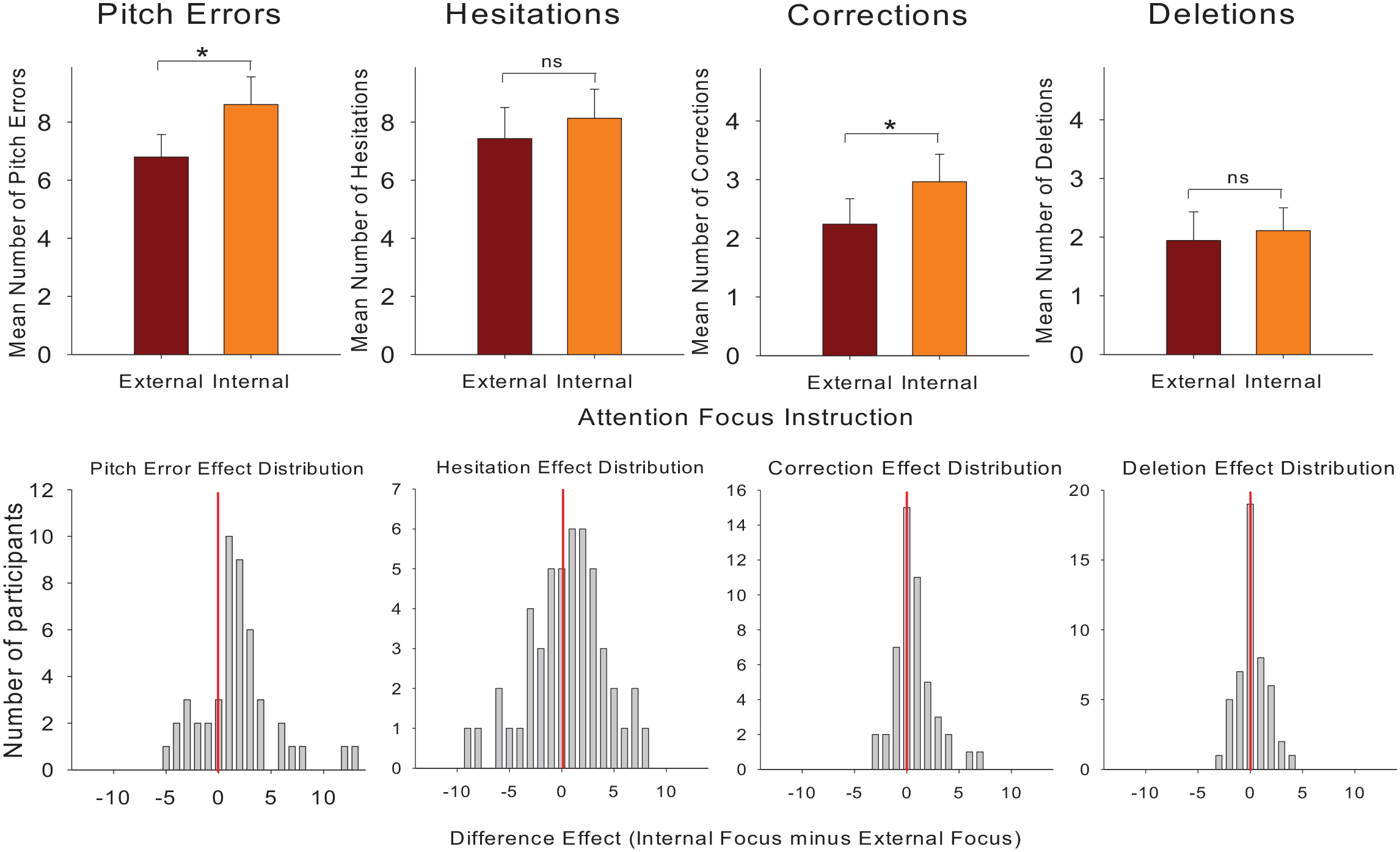
Top: Mean Number of Pitch Errors, Hesitations, Corrections, and Deletions (from Left to Right) Under External and Internal Attention Focus Instruction. Bottom: Distributions of the Attention Focus Effect Across Participants.
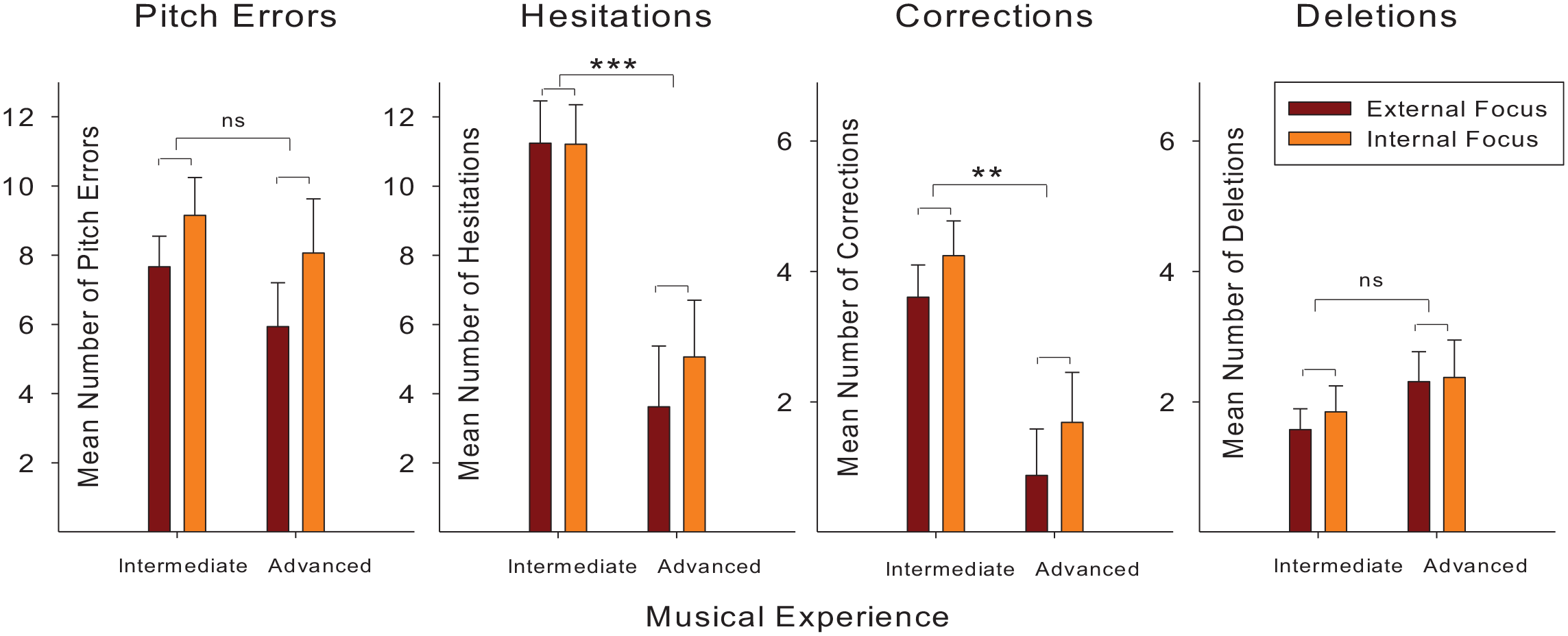
Mean Number of Pitch Errors, Hesitations, Corrections, and Deletions (from Left to Right) Under External and Internal Attention Focus Instruction, Separated for Intermediate and Advanced Pianists.
Hesitations
There was no effect of focus instruction on number of hesitations, F(1, 47) = 1.545, p = .220, There was a main effect of expertise, F(1, 47) = 11.951, p = .001, ηp2 = 0.203, with participants in the higher expertise group committing fewer hesitations (M = 4.3) than participants in the lower expertise group (M = 11.2). No interaction between expertise and focus condition was found, F(1, 47) = 1.681, p = .201.
Corrections
More corrections were made in the internal focus instruction (M = 3.0) compared to the external focus instruction (M = 2.2), F(1, 47) = 5.776, p = .020,
Deletions
No significant difference was observed in the numbers of deletions made under internal focus (M = 2.1) compared to external focus instruction (M = 1.9), F(1, 47) = 0.572, p > .10. Also, no difference in the number of deletions was observed between participants in the higher expertise group (M = 2.3) compared to the lower expertise group (M = 1.7), F(1, 47) = 1.136, p > .10, and there was no significant interaction between expertise and attention focus, F(1, 47) = 0.225, p > .10.
Discussion
Within the area of sports psychology, it has been well-documented over the last few decades that the choice of attention focus can strongly affect athletes’ performance, with an overall consensus that an external focus (attending to the effects of one’s actions) is more beneficial than an internal focus on the movement itself. To date, only a handful of studies have attempted to generalize this finding to other areas such as music performance research. Of these, research has either been limited to music performances that were well-controlled but limited in their ecological validity (e.g., using repeated 2- or 3-tone sequences) or by evaluating well-rehearsed expert musician performances using subjective performance quality ratings. The aim of the present study was to extend the knowledge base on attentional foci in music performance by addressing some of these limitations.
The results reported here are in general support of the idea that an external focus of attention is more beneficial to performance than an internal focus of attention and in line with previous studies evaluating the effects of attention focus in music performance (e.g., Atkins, 2017; Atkins & Duke, 2013; Duke et al., 2011; Mornell & Wulf, 2019). We found our amateur musician participants to commit fewer pitch (note) errors and make a smaller number of error corrections under external compared to internal focus instruction when performing an actual piece of piano music live-online to the experimenter. No difference between instructions was found for number of hesitations (timing errors) and deletions in our study.
In addition, we found that experienced musicians showed fewer hesitations and made fewer error corrections compared to less experienced musicians, irrespective of attentional focus. Importantly, the skill-dependent difference in error corrections remained significant after normalizing our error correction data by (a) the overall number or pitch errors and error corrections, F(1, 48) = 9.78, p = .003, and (b) the overall number of pitch errors, hesitations, and error corrections, F(1, 48) = 4.36, p = .042. In other words, compared to intermediate pianists, advanced pianists seemed better able to ignore mistakes and continue playing rather than stopping and correcting them. This fits nicely with previous results by Palmer and Drake (1997), who investigated performance monitoring in pianists and observed reliable numbers of note corrections only for beginner and intermediate, but not advanced pianists.
Interestingly, although an individual’s skill level affected the number of hesitations and error corrections made, with intermediate players having a higher number of hesitations and error corrections compared to more advanced pianists, the effect of attention focus was not modulated by level of expertise. This finding is in line with results by Wulf and Su (2013) that compared beginner and expert golf players. However, these results contradict findings by Perkins-Ceccato et al. (2003) and Singh and Wulf (2020), reporting larger benefits of external over internal attention focus instructions for expert over novice golf and volleyball players, respectively. Our findings also contradict results from Duke et al. (2011), who found only non-pianist musicians (n = 12) but not expert pianists (n = 4) to benefit from an external over an internal instruction, although that finding should be interpreted with caution as the keyboard task was very simple, possibly resulting in ceiling effects for expert pianists. One could potentially criticize our choice of group split as being relatively arbitrary. We therefore also run correlational analyses using expertise as a continuous variable, correlating the attention focus effect (internal minus external focus) on pitch errors, hesitations, and error corrections with number of years played and total accumulated practice time. None of the correlations (−0.06 < rs < + 0.07) reached significant levels. It is also worth noting that we did not test beginner pianists and only had a relatively small number of advanced pianists in this study, none of whom were professional players. It therefore remains to be tested whether attention focus instructions are effective for players at the more extreme ends of the skill spectrum.
Our study has several other limitations. First, one could argue that the observed benefit of an external over an internal attention focus might simply be due to the prevention of movement disruption as a result of an internal focus rather than a benefit created by the external focus. If that were the case, any attention focus instruction preventing the disruption of the automatic motor action should benefit performance, rather than specifically focussing on the external movement effects. However, although we did not test for this alternative explanation in the present study, past research strongly suggests that external focus instructions are most effective if they refer explicitly to the effects of the performers’ movements. Simply distracting attention away from the movement itself by asking participants to attend to a secondary, unrelated task does not result in a similar performance benefit (e.g., Wulf & McNevin, 2003). One could also argue that the use of a non-instruction control condition could shed further light on this issue as it should provide a baseline against which costs arising from an internal focus or benefits from an external focus could be measured. However, as pointed out by Mornell and Wulf (2019), a no-instruction baseline condition is problematic as musicians might automatically choose to focus internally during performance, even when no explicit instruction is provided.
Second, in the present study, we only used one type of external attention focus instruction, simply asking participants to focus on the sound they are making while playing. Previous research has suggested that the distance of the external focus from the body is important, with attention to more distal movement effects (further away from the body) often more beneficial than proximal foci (e.g., Duke et al., 2011; McNevin et al., 2003). On the contrary, evidence suggests that pianists make less mistakes in the voiced part of a multi-part polyphone piece compared to the non-voiced parts (e.g., Palmer & van de Sande, 1993). This finding is interesting in this context as one could argue that the attention allocated to the voiced part might create an external attention focus. However, voicing often requires sensitive balancing of force between fingers and hands. Thus, although the focus is external, it might in fact be relatively proximal. As we asked our pianists to listen to their produced sound while playing, they could have chosen a relatively proximal focus by paying attention to the hand playing one of the two parts. It therefore needs to be explored further what the effects of attention focus distance are for playing especially polyphone music that requires selective and individual interpretation of different parts/voices.
Third, we only investigated the effects of a short-term focus instruction on piano performance in a relatively stress-free performance environment. Participants practiced the piece for 7 days without any attention focus instructions and then performed the piece live via video call to the experimenter on the final day. Only on that final performance day were the attention focus instructions introduced and the performance was conducted in a relatively stress-free environment. Thus, although the results support the idea that an external attention focus instruction can benefit the pianists’ final performance under these conditions, it remains to be tested whether the observed external attention focus benefit can be sustained in a higher pressure public performance situation where making mistakes can be much more costly for the performer. It would also be interesting to further explore long-term retention effects of external focus instructions during practice. For example, longer practice of playing under an external attention focus might make it more likely to sustain an automatic mode of motor execution in high-pressure situations.
Finally, a musical performance differs in many aspects from a sports performance such as golf putting in that it not only requires high levels of technical precision, but also artistic skills such as the interpretive quality of the performance. Whereas technical aspects of the performance are relatively easy to quantify, it is much less straight forward to evaluate musical quality and doing so often relies on subjective ratings. The present study only focussed on evaluation of technical aspects of the piano performance and we therefore remain cautious as to the overall benefit of an external attention focus for musical performance. However, as an external focus facilitates automatic motor program execution, it more likely enables the performer to fully concentrate on the interpretive aspect of the performance (e.g., Mornell & Wulf, 2019), which might in return sustain a beneficial external focus. Indeed, a small number of studies have indeed shown an external focus to increase experts rating of the interpretive quality of a musical performance (e.g., Atkins, 2017; Atkins & Duke, 2013; Mornell & Wulf, 2019).
In sum, our study adds to the limited body of research into attention focus on music performance by proposing that an external focus of attention can facilitate more accurate music performance for both less and more experienced musicians. The present results have important implications for music teaching practice, where adoption of an external focus might benefit both learning and performance (see also Duke et al., 2011, for a similar suggestion). For example, when commenting on a students’ scale playing, a piano teacher might, instead of commenting on hand position or thumb transitions (internal focus), ask the student to focus on the smoothness of the produced sound (external focus). As an external focus of attention might facilitate automatic execution of well-rehearsed motor actions, it also has the potential to free up capacity to focus on expressive and interpretative aspects of the music during performance and could help reduce the impact of performance anxiety, claims that need further exploration in future studies.
Footnotes
Declaration of conflicting interests
The author(s) declared no potential conflicts of interest with respect to the research, authorship, and/or publication of this article.
Funding
The author(s) disclosed receipt of the following financial support for the research, authorship, and/or publication of this article: This work was supported by a Laidlaw Scholarship to Yukiko Braun and a St Andrews Restarting Research Funding Scheme (SARRFS) to Ines Jentzsch.
