



Abstract
High levels of mental pressure in musicians can lead to decrements in performance, but this effect may depend on individual dispositions. In this study, self-consciousness and trait anxiety were examined as predictors of decrements in performance in natural concert settings. The performance of 30 pianists was assessed in a condition without pressure (i.e., when playing alone) and in a condition with pressure (i.e., in a public concert). Audio recordings of the performances were evaluated on musical expression, technical precision, and overall performance by four independent jurors who were unaware of the condition in which they had been made. The differences between the pressure and no-pressure ratings were regressed on cognitive and somatic anxiety (assessed with an adaptation of the Competition Anxiety Inventory) as well as on public and private self-consciousness (assessed with the Self-Consciousness Scale). Participants performed better in the concert than when playing alone, despite increased state anxiety during the concert. The effect of the pressure condition on performance, however, was attenuated when participants scored high for private self-consciousness (i.e., the tendency to attend to one’s inner thoughts and feelings) but increased when they scored high for public self-consciousness (i.e., the tendency to see oneself from the outside as a social object). An attenuating effect of private self-consciousness emerged particularly for technical precision, whereas an enhancing effect of public self-consciousness emerged particularly for musical expression. The two subcomponents of self-consciousness were positively correlated, exerting a counteracting effect on overall performance ratings. Cognitive trait anxiety reduced performance quality, but only when somatic trait anxiety was not controlled for. The findings suggest a negative effect of inward-directed attention to the self (private self-consciousness) and a protective effect of habituation to outward-directed attention to the self as a social object (public self-consciousness) and may contribute to developing pedagogical activities or interventions to prevent fluctuations in performance.
Musicians occasionally have to deal with emotional stress when playing in front of an audience (LeBlanc et al., 1997). But why do some musicians suffer less from the pressure of doing so and, in turn, perform better than others? Research findings suggest that certain personality traits, such as self-consciousness and trait anxiety, have a role in high-pressure situations as predictors of fluctuations in performance (Baumeister, 1984; Craske & Craig, 1984; Geukes et al., 2012, 2013; Wang et al., 2004). However, previous studies of these fluctuations have mainly been undertaken in the domain of sports. The present research investigated the influence of self-consciousness and trait anxiety on musicians’ performance in situations with and without pressure.
Music performance anxiety
Many performing musicians suffer from music performance anxiety from time to time (Brugués, 2011; Steptoe & Fidler, 1987). However, being able to perform on a high level consistently under pressure is essential if musicians are to enjoy long and successful musical careers (Kenny, 2011; Williamon et al., 2013). Some musicians can adapt to music performance anxiety, but others show decrements in performance. A frequent manifestation of such decrements is a deterioration of motor control, which is also known as choking under pressure (CuP). The term CuP is widely used in the sports domain, although it has not yet been adopted to any great extent by music psychologists. The phenomenon of CuP shows that high-level performers are often less capable of adapting to pressure-induced anxiety than lower-level performers, which is why the effect is described as paradoxical performance (Baumeister, 1984). CuP is defined as an acute and meaningful deterioration in performance despite high levels of skill and motivation (Beilock & Gray, 2007). Forms of pressure include an evaluative audience (Wallace et al., 2005) and competitive factors that signal reward or punishment (Baumeister & Showers, 1986). Thus, CuP occurs in situations in which the performer is concerned with the way they present themself (Mesagno & Hill, 2013), such as when giving a music performance.
The explicit monitoring hypothesis (Baumeister, 1984; Masters, 1992; Masters & Maxwell, 2008) explains the mechanism that underlies CuP. Like people who play sports, musicians—sometimes called small-muscle athletes (Altenmüller et al., 2014)—must have a strong command of highly overlearned and accurate motor processes to play an instrument professionally. Although they must monitor these step-by-step at the beginning, they begin to carry out the processes more and more automatically, and finally, they work without conscious control (Fitts & Posner, 1967). According to the explicit monitoring hypothesis, pressure makes the performer more anxious to perform well and thus more self-focused (Beilock & Carr, 2001). A heightened self-focus, in turn, can result in the attempt to control automatic motor processes, thereby hampering the fluidity and efficiency of movements and negatively affecting performance outcomes (Beilock & Carr, 2001; Lewis & Linder, 1997). Evidence supporting this process has been found particularly for highly overlearned motor tasks in sports that are performed at an expert level (Beilock et al., 2002; Beilock & Gray, 2007; Gray, 2004). In music, too, performance anxiety has been shown to lead to a deterioration in motor capabilities (Altenmüller et al., 2014). In one study, for instance, professional pianists showed increased muscle activity and poorer motor control in a high-pressure, evaluative situation than in a non-stressful situation (Yoshie, Kudo, et al., 2009). The high-pressure situation was designed as a real piano competition in front of a large audience and five judges; the non-stressful situation involved participants playing in a small music practice room. The participants performed a piece of their own choice and could not be seen by the jury in the competition condition. Both the performance in the competition and the audio recordings of the practice room condition were evaluated by the judges. Performance quality was impaired in the high-pressure condition. The results were attributed to higher levels of anxiety and increased electromyographic reactions, which hampered the pianists’ fine muscle control on stage. Although not discussed by Yoshie, Kudo, et al. (2009), an increased self-focus may also have contributed to the effect.
Support for the detrimental effects of heightened self-focus comes from research identifying an external focus of attention as more beneficial for motor learning than an internal focus of attention (Atkins, 2017, 2018 for reviews; see Wulf, 2013; Wulf & Lewthwaite, 2016). The beneficial effect of an external focus of attention and the detrimental effect of an internal self-focus has been explained by the constrained action hypothesis and related research findings (McNevin et al., 2003; Wulf, McNevin, & Shea, 2001; Wulf, Shea, & Park, 2001), which claimed that focusing on the effects of movement (external focus) involves, in particular, unconscious and automatic processes. Thus, the performer can benefit from the automatic control abilities of the motor system. By contrast, focusing on the movements (internal focus) requires more conscious control and hampers automatic control processes. Also, directing attention to internal rather than external events led to increased muscle activity and movements that are less accurate, flexible, and coordinated (Vereijken et al., 1992; Zachry et al., 2005). Both, in turn, could cause poorer performance (Duke et al., 2011; Mornell & Wulf, 2019). For instance, directing attention to the audience and expressive sound quality (external) resulted in better performance than concentrating on finger movements (internal) (Mornell & Wulf, 2019).
Additional support for the explicit monitoring hypothesis comes from studies demonstrating that habituation to heightened self-focus while performing motor tasks could prevent negative performance outcomes (Beilock & Carr, 2001; Lewis & Linder, 1997; Wan & Huon, 2005). In one study, amateur musicians were trained to carry out a task on a keyboard; the researchers ensured that all participants carried out the task to the same degree of automaticity (Wan & Huon, 2005). They subsequently performed the task under pressure generated by video-recording their performances. Most of the participants showed decrements in performance that could be attributed to their heightened self-focus due to the video recording, which disrupted the fluency of their performances. Participants who were video-recorded while undergoing training and were therefore used to it did not show decrements in performance.
Taken together, the evidence suggests that heightened internal self-focus can reduce the quality of music performance in high-pressure situations. However, few studies have been conducted to investigate this phenomenon in the domain of music, rather than sports. To our knowledge, none so far has investigated the interaction of personality characteristics related to heightened self-focus (namely, self-consciousness and trait anxiety) and situational factors.
Self-consciousness
Self-consciousness is a stable personality trait that can be divided into two subcomponents: private and public. Private self-consciousness is the tendency to introspect, attending to one’s feelings, thoughts, and body sensations. Public self-consciousness is the tendency to perceive oneself through other people’s eyes (Fenigstein et al., 1975). The latter may occur particularly when one is being observed or evaluated. Self-consciousness seems to cause people to perform less well than they would otherwise in high-pressure situations, although the findings of research in this area are somewhat contradictory.
In a study by Baumeister (1984), for instance, participants performed a newly learned coordination task (sinking a ball into various specified holes) that required motor and visual skills. A stressful competitive situation was induced by announcing a reward for improved performance. A questionnaire assessed private and public self-consciousness, producing a score for a combination of the two. Participants who scored low for self-consciousness performed worse in the stressful situation than those who scored high. Baumeister argued that the high-pressure situation increased self-focus to a greater extent in participants who scored low for self-consciousness than those who scored high and were thus already predisposed to a high level of self-focus. In line with the explicit monitoring hypothesis, the pressure-induced incremental self-focus may have decreased performance because participants’ attention was directed to executing individual movements.
In contrast, Wang et al. (2004) found that individuals scoring high for private self-consciousness performed less well in a high-pressure situation. Participants were experienced basketball players who were asked to complete a well-trained ball-throwing task. Pressure was induced by promising a reward for an improvement in performance and filming it so an audience could watch it. According to Wang et al., the finding that high self-consciousness predicted worse performance, in contrast to Baumeister’s (1984) finding that low self-consciousness predicted better performance, may have been due to participants’ relatively high levels of expertise. Wang et al.’s participants showed decrements in performance because, as a result of their increased self-focus, they were attending to the execution of individual movements in a task that they could already carry out automatically. In Baumeister’s study, by contrast, the task was relatively new to participants, so they were not used to it. It may be that inexperienced, highly self-conscious participants were less likely to show decreased levels of performance under pressure because they were already attending to the execution of the required movements; in short, they had not achieved a level of automaticity sufficient for negative effects on the sequence of movements to be observed. To reiterate, Baumeister used a combined score for private and public self-consciousness, but Wang et al. administered the two subscales for self-consciousness separately and found that only private self-consciousness predicted worse performance, not public self-consciousness.
Also, for athletes in a real performance situation, a high score for public self-consciousness was related to a shallower decrease in the level of performance than a low score (Geukes et al., 2012, 2013). Like Baumeister (1984), Geukes et al. (2012, 2013) argued that athletes who score high for public self-consciousness are used to perceiving themselves from the outside and therefore find public performance less threatening than people who score low. Hence, they are less likely to choke under pressure.
Taken together, the evidence suggests that dispositional self-consciousness may be essential in attentional processes during public performance. The research findings into the relationship between private self-consciousness and decrements in performance under pressure are inconsistent, however, and this has not yet been satisfactorily explained. As far as we know, the relationship between self-consciousness (public vs. private) and music performance under pressure has not yet been studied.
Trait anxiety
As discussed above, anxiety can make the performer more self-focused, hampering the fluidity of well-learned and automatic movements (Beilock & Carr, 2001). This is typically argued to be the case for state anxiety. However, it is also true for trait anxiety because those who score high for trait anxiety were more likely than those who score low to perceive certain situations as more threatening and, therefore, to react to them with heightened anxiety (Spielberger, 1966). The correlation between trait and state anxiety has been shown conclusively in the domains of both sports (e.g., Marchant et al., 1998; Williams & Krane, 1992) and music (e.g., Cox & Kenardy, 1993; Hamann, 1982). High levels of trait anxiety can lead to higher levels of state anxiety and increase performers’ vulnerability to performance decrements in stressful situations. This was demonstrated by Craske and Craig (1984) in a study in which highly anxious pianists performed worse than less anxious participants in a high-pressure situation.
Anxiety has two components: somatic and cognitive (Martens et al., 1980; Morris et al., 1981). Somatic anxiety is the physical manifestation of anxiety, such as sweating and increased muscle tension. Cognitive anxiety is defined as a state of worry, for instance, about the consequences of a bad performance. Both components are usually assessed by questionnaire. Yoshie, Shigemasu, et al. (2009) asked experienced pianists to perform a piece of their own choice in front of a large audience and found that their rating of cognitive anxiety predicted performance decrements in this high-pressure situation. Heightened cognitive anxiety may have caused them to control already automatized movements, in line with the explicit monitoring hypothesis. Likewise, somatic anxiety predicted performance decrements (Wang et al., 2004). Heightened somatic anxiety may have caused the musicians to focus more on physiological changes related to nervousness, hampering the execution of their movements. Therefore, we predicted that in our experiment, both high cognitive and high somatic trait anxiety would decrease performance quality.
In sum, previous studies of the psychological predictors of fluctuations in performance in high-pressure situations have mainly been carried out in the domain of sports. Surprisingly, very few such studies have been carried out in the domain of music, and those experiments that have been reported took place in the laboratory (Hill et al., 2010; Mesagno et al., 2015).
The present study
To the best of our knowledge, no study has examined the detrimental effects of a heightened self-focus in real-life playing situations. However, such an ecologically valid approach seems desirable for at least two reasons. First, real-life performances differ from laboratory-based tasks in that they mostly involve larger audiences and career- and identity-related consequences (Mesagno et al., 2015). Even though the presence of an audience can boost performance (i.e., by social facilitation; Cottrell, 1972; Zajonc, 1965), it may lead to performance decrements induced by elevated self-presentation concerns and psychological pressure (LeBlanc et al., 1997; Wallace et al., 2005). Second, the tasks used in a laboratory setting are often less complex than those in a real-life setting, thereby requiring different attentional demands (Christensen et al., 2015; Oudejans et al., 2011).
To investigate the effects of personality traits associated with increased attention to the self (i.e., self-consciousness and trait anxiety) on the quality of musicians’ performances in real-life playing situations, we conducted an experiment that addressed the lack of ecological validity in previous research. Professional musicians in public performances were confronted with a social-evaluative and stressful situation due to the presence of an audience at a public concert. Private and public self-consciousness, and the somatic and cognitive trait anxiety of the musicians, were assessed separately. Since private self-consciousness and trait anxiety should increase the tendency to focus on inner aspects of the self, we predicted that higher levels of these traits would be associated with poorer performance in a pressure condition compared to a condition in which a pianist played with no pressure (see Wang et al., 2004; Yoshie, Shigemasu, et al., 2009), and higher levels of public self-consciousness would be associated with better performance (see Geukes et al., 2012, 2013).
Method
Participants and design
Thirty experienced pianists (16 women, 14 men) were recruited via personal contacts or emails to their current or former piano professors at German and Austrian music universities. Their ages ranged from 19 to 60 years (M = 34.2, SD = 13.3, Mdn = 28.5). Half of the participants were music students, and half were expert pianists. Participants indicated that they had regularly performed in concerts for an average of 19 years (SD = 11.6), with a mean of 22.2 performances per year (SD = 26.4). A prerequisite for participation in the study was an upcoming solo concert within the next three months at which a piece of music was to be performed by heart. We focused on pianists (and not, for instance, orchestra musicians) for two reasons. First, compared to playing together with other musicians, playing alone—which is usually the case for pianists—leads to higher anxiety levels (Cox & Kenardy, 1993), which is necessary for creating a high-pressure situation. Second, the experts who rated the participants’ performances were pianists, too, and judges are more consistent when rating their own instrument (Thompson & Williamon, 2003).
The study employed a one-factorial within-subject design with the factor pressure (no pressure: playing alone; pressure: public concert). The order of the two conditions was counterbalanced across participants.
Materials
Demographic questionnaire
The questionnaire included demographic questions (i.e., sex, age, educational level, the age at which the participant started playing the piano) as well as questions about task-relevant factors (i.e., years of regular performances, the number of performances per year, experience playing the piece in public).
Self-consciousness
The German version of Fenigstein et al.’s (1975) Self-Consciousness Scale (Filipp & Freudenberg, 1989) was used to measure dispositional private self-consciousness (13 items, e.g., “I’m always trying to figure myself out”; “I realize that I am observing myself”; Cronbach’s α = .79) and dispositional public self-consciousness (14 items, e.g., “I’m concerned about the way I present myself”; “I feel uncomfortable when observed by others”; Cronbach’s α = .86). Participants responded to the items on a 5-point Likert-type scale ranging from 1 (very rarely) to 5 (very often).
Trait anxiety
Two subscales of the Wettkampf–Angst–Inventar (WAI) (Brand et al., 2009) were adapted to the musical context and used to assess somatic trait anxiety (four items, e.g., “Before performances, my heart is racing”; “Before performances, my body feels tight”; Cronbach’s α = .78) and cognitive trait anxiety (four items, e.g., “Before performances, I am concerned about performing poorly”; “Before performances, I am concerned that others will be disappointed with my performance”; Cronbach’s α = .89). The WAI is an adapted German version of the Competitive State Anxiety Inventory-2 (CSAI-2) (Martens et al., 1990) and is widely used to evaluate competitive sports performance. This questionnaire was used because it allows the cognitive and somatic components of anxiety to be studied separately. Furthermore, the CSAI-2 shows adequate psychometric properties when measuring music performance anxiety (Yoshie, Shigemasu, et al., 2009). The items were rated on a 4-point Likert scale ranging from 1 (not at all) to 4 (very much so). 1
Manipulation check
Eight items of the WAI (Brand et al., 2009) were administered to assess the effectiveness of the pressure situation—that is, if playing a concert provokes more state anxiety than playing alone. Four items measured somatic state anxiety (e.g., “Right now, my heart is racing”; Cronbach’s α = .70), and four items measured cognitive state anxiety (e.g., “Right now, I am concerned about performing poorly”; Cronbach’s α = .75). The items were rated on a 4-point Likert scale ranging from 1 (not at all) to 4 (very much so).
Procedure
After recruitment, participants were informed about the study procedure and their right to stop participating without providing a reason. Next, participants were asked to complete the demographic questionnaire and the self-consciousness and trait anxiety measures (as described in the “Materials” section), which took about 15 min. The trait measures were completed before and independently of both the playing-alone and public-performance conditions. Participants were asked to select a piece of music they would soon be playing in an upcoming concert. To ensure a comparable difficulty level for all participants, participants were instructed to select a very well-learned piece of music they were familiar with, proficient in, and could play confidently. On average, participants performed their selected piece in concert 5.9 times (SD = 13.5, Mdn = 2) before the current study, with 12 participants having never performed the piece publicly.
Participants were audio-recorded playing the selected piece of music on two occasions—a no-pressure condition (playing alone) and a pressure condition (public concert). We decided to assess the performance via audio instead of video recording because being video-recorded can raise self-consciousness (e.g., Beilock & Carr, 2001; Lewis & Linder, 1997), and therefore, video-recordings in the no-pressure condition could have induced a state of increased self-consciousness that could mask the effect of raised self-consciousness due to the presence of the audience in the pressure condition. To avoid confounding between the condition (pressure vs. no pressure) and the position of the condition (first vs. second), we controlled the order of the two conditions in the experiment. For half of the participants, the no-pressure condition took place before the pressure condition. To avoid increased anxiety in the no-pressure condition when it happened too close to the pressure condition, the no-pressure condition took place at least two days before the pressure condition. For the other half of the participants, the pressure condition took place before the no-pressure condition. To avoid the possibility that the performance in the no-pressure condition might be impaired because the no-pressure condition was too far from the concert and participants thus had reduced their time spent practicing, the no-pressure condition took place no more than four days after the concert. Nevertheless, because of other obligations, four participants could not accommodate the maximum 4-day time interval between the two conditions. For these participants, the no-pressure condition took place six, seven, or 10 days after the public performance.
The recordings in the no-pressure condition were produced in rooms at the music universities or private practice rooms. State anxiety was assessed first. Next, participants were instructed to warm up if necessary, start a portable audio-recording device, and perform the piece of music once they felt comfortable. After these instructions, a rough timeframe for the recording session was agreed on, and the experimenter left the room until participants signaled that they had finished the recording.
The public performances were concerts at music universities, solo recitals, or group recitals in which participants played a piece of music by heart alone on stage, separately one after the other performer. Although the performance situations were slightly different, there were important similarities in terms of the pressure of the condition. All performances were public; the audience was mainly unknown to the pianist, and the pianist was alone on stage. Thus, the performance situations were comparable to each other. Half an hour before each public performance, the experimenter arranged a pre-concert meeting with the participants to assess their state of anxiety. During the concert, the experimenter sat in the audience and audio-recorded the performance using a portable recording device. The approximate number of listeners was recorded to control for the possible influence of audience size. To provide a setting that was as natural as possible, the experimenter recorded the performance as inconspicuously as possible.
The quality of all performances was measured as follows. Four raters who were experienced pianists with performance careers, had experience as jurors in national and international competitions, and were not familiar with the participants, were asked to evaluate the performance of the participants. The raters evaluated the performances independently and were not aware of the condition in which each recording was made. For this purpose, the raters received anonymized audio files of all performances. The recordings of the no-pressure condition and the pressure condition of each participant were presented one after the other, but the order of the two conditions was alternated across all participants. To control for the different durations of the selected pieces of music, the raters were asked to evaluate only the first three minutes of each recording. The evaluations were based on three criteria: (1) musical expression (tone, articulation, interpretation), (2) technical precision (accuracy, rhythm precision, technical dexterity), and (3) overall performance. 2 The raters judged each performance on the three dimensions on 5-point Likert-type scales ranging from 1 (bad) to 5 (excellent). Definitions of the categories were discussed with the jurors before the evaluation, using example audio files. This was done to ensure a high degree of consistency. To measure agreement between raters, a two-way random intraclass correlation (ICC) for consistent agreement was calculated (Landers, 2015; Shrout & Fleiss, 1979). Overall, satisfactory to good agreements were found (.69 < ICCs < .78; Koo & Li, 2016). The full results of the inter-rater agreement are displayed in Appendix 1, Table 5.
The stimulus materials and data of the experiment are available at the Open Science Framework at the following link: https://osf.io/6u5pm/.
Results
Manipulation check
As expected, participants showed higher somatic state anxiety levels in the pressure condition (M = 5.97, SD = 1.89) than in the no-pressure condition (M = 4.12, SD = 1.18), t(29) = 4.462, p < .001, d = .814. Cognitive state anxiety levels were also higher in the pressure condition (M = 5.76, SD = 2.08) than in the no-pressure condition (M = 4.6, SD = 1.46), t(29) = 3.268, p = .003, d = .569. These findings corroborate the effectiveness of the concert situation in increasing pressure.
Performance quality
Contrary to our expectations, participants performed better, on average, in the pressure condition than in the no-pressure condition. They received higher ratings for overall performance in the pressure condition (M = 3.52, SD = .82) than in the no-pressure condition (M = 3.32, SD = .68), t(29) = 2.693, p = .012, d = .492. They also received higher ratings for musical expression in the pressure condition (M = 3.57, SD = .77) than in the no-pressure condition (M = 3.17, SD = .69), t(29) = 4.889, p < .001, d = .893. There were no differences between the ratings for technical precision in the two conditions (public concert: M = 3.59, SD = .88; playing alone: M = 3.59, SD = .77), t(29) = 0.000, p = .999, d = .000.
To check whether our control variable (i.e., the order of the conditions) interacted with condition to affect the differences between the performance ratings in the two conditions, we ran an analysis of variance with order as a between-subjects variable and condition as a within-subject variable. Order had no effect on ratings representing overall performance, F(2, 27) = 0.405, p = .671, ηp² = .029., musical expression, F(2, 27) = 1.075, p = .355, ηp² = .074, or technical precision, F(2, 27) = 0.335, p = .718; ηp² = .024. Nor did order interact with condition in predicting ratings representing overall performance, F(2, 27) = 1.516, p = .238, ηp² = .101, musical expression F(2, 27) = 1.367, p = .272, ηp² = .092, or technical precision, F(2, 27) = 1.356, p = .275, ηp² = .091.
Personality traits and performance
To test the hypothesis that personality traits affect the performance of musicians in a pressure situation, several hierarchical multiple regression analyses were conducted. In these analyses, either private and public self-consciousness or somatic and cognitive anxiety, respectively, served as predictors of the performance ratings in the pressure condition. The ratings of the performance in the no-pressure condition were controlled for. For all analyses, an alpha level of .05 was used. The means, standard deviations, and intercorrelations between the variables are presented in Appendix 1, Table 6.
Self-consciousness
Private and public self-consciousness were positively correlated, r(28) = .48, p = .004. When we regressed ratings representing overall performance in the pressure condition separately on private and public self-consciousness (with ratings representing overall performance in the no-pressure condition serving as an additional predictor to control for the no-pressure condition), neither private self-consciousness, β = −.11, t(26) = −1.198, p = .241, nor public self-consciousness, β = .11, t(26) = 1.177, p = .250, predicted ratings representing overall performance (see Table 1). However, when we entered both variables simultaneously into the regression model, private and public self-consciousness emerged as significant predictors, although in opposite directions. As we expected, private self-consciousness was a negative predictor of ratings representing overall performance, β = −.213, t(26) = −2.096, p = .046, whereas public self-consciousness emerged as a positive predictor, β = .207, t(26) = 2.083, p = .047. The model explained 80% of the variance, R2 = .80, adjusted R2 = .78, F(3, 26) = 34.879, p < .001. In other words, private self-consciousness would have lowered the ratings representing overall performance in a pressure situation if there had not been public self-consciousness to attenuate this effect when not controlled for. Alternatively, public self-consciousness would have enhanced the ratings representing overall performance in a pressure situation if there had not been private self-consciousness to attenuate this effect when not controlled for. Controlling for other variables, such as order of the conditions, sex, age, educational level, the age at which the participant started playing the piano, the number of years of regular performances, the number of performances per year, public playing experience with the piece, the number of listeners in the concert, and the distance between the conditions, did not change the pattern of this finding.
Results of three regression analyses testing the effect of private self-consciousness, public self-consciousness, or both, on overall performance in the public concert condition.
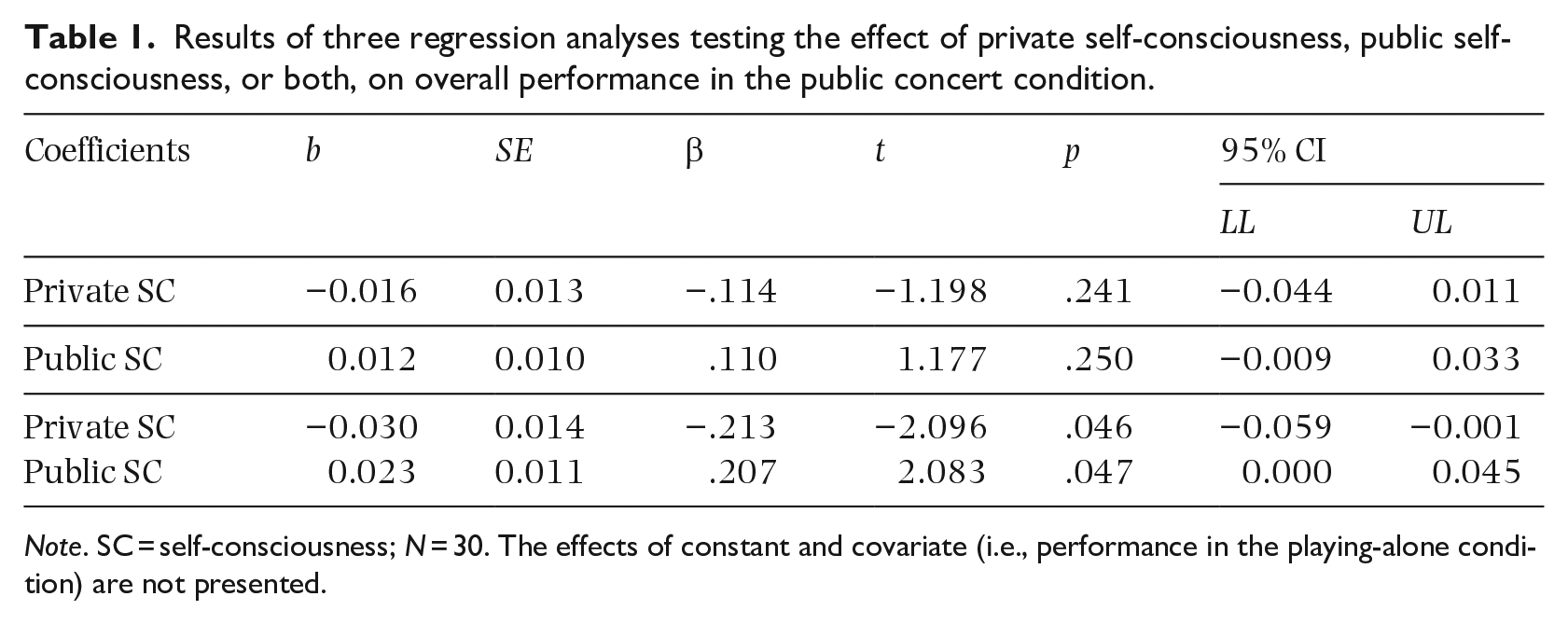
Note. SC = self-consciousness; N = 30. The effects of constant and covariate (i.e., performance in the playing-alone condition) are not presented.
To test whether these effects were due to musical expression or technical precision, we repeated the hierarchical regression analyses with these two dependent variables. When using musical expression in the pressure condition as criterion and private and public self-consciousness simultaneously as predictors (controlling for musical expression in the no-pressure condition), private self-consciousness did not reduce ratings representing musical expression in performance, β = −.143, t(26) = −1.181, p = .248, whereas public self-consciousness tended to increase such ratings, β = .232, t(26) = 1.937, p = .064 (see Table 2). The model explained 71% of the variance, R2 = .713, adjusted R2 = .680, F(3, 26) = 21.511, p = < .001. Thus a high level of public self-consciousness helped enhance ratings representing musical expression in the pressure condition.
Results of three regression analyses testing the effect of private self-consciousness, public self-consciousness, or both, on musical expression ratings in the public concert condition.
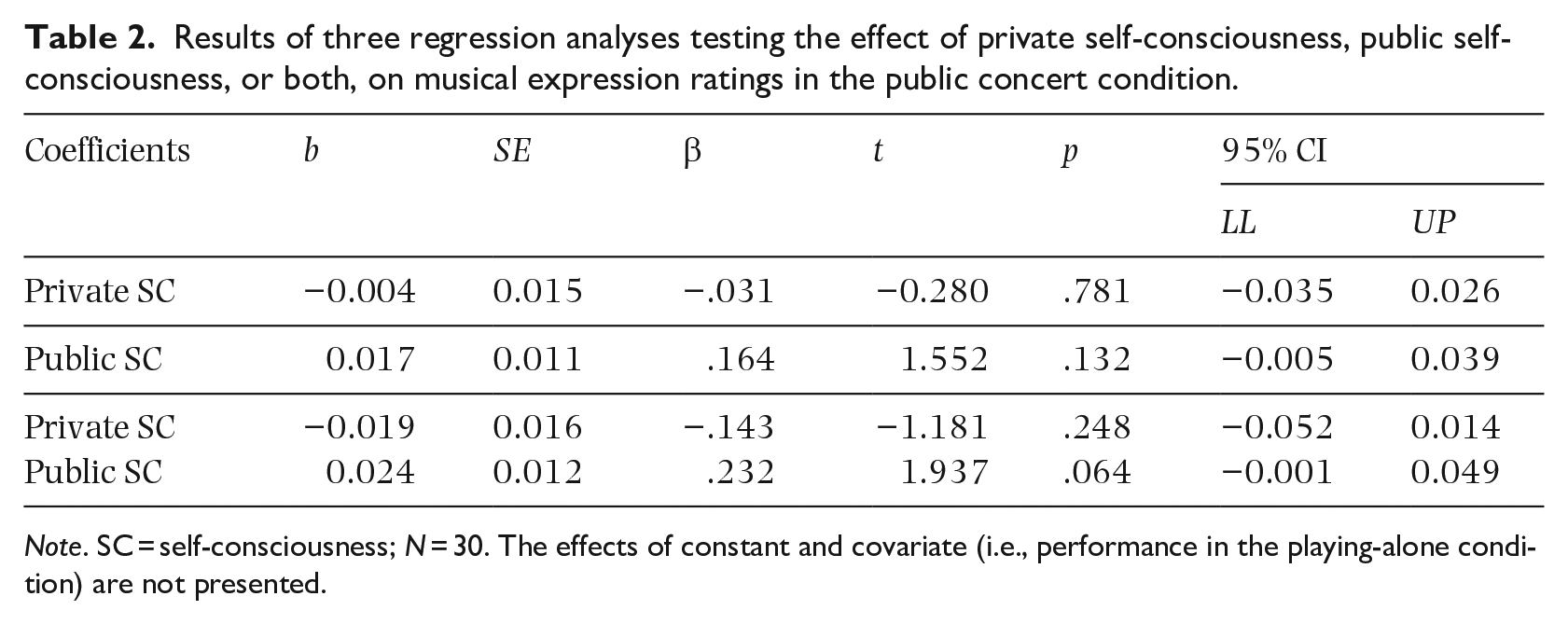
Note. SC = self-consciousness; N = 30. The effects of constant and covariate (i.e., performance in the playing-alone condition) are not presented.
When we used technical precision as criterion and private and public self-consciousness simultaneously as predictors (controlling for technical precision in the no-pressure condition), private self-consciousness reduced ratings representing technical precision in performance, β = −.254, t(26) = −2.221, p = .035, but public self-consciousness did not increase such ratings, β = .155, t(26) = 1.393, p = .176 (see Table 3). The model explained 76% of the variance, R2 = .756, adjusted R2 = .728, F(3, 26) = 26.835, p = < .001. Thus, a high level of private self-consciousness reduced ratings representing technical precision in the pressure condition.
Results of three regression analyses testing the effect of private self-consciousness, public self-consciousness, or both, on technical precision ratings in the public concert condition.
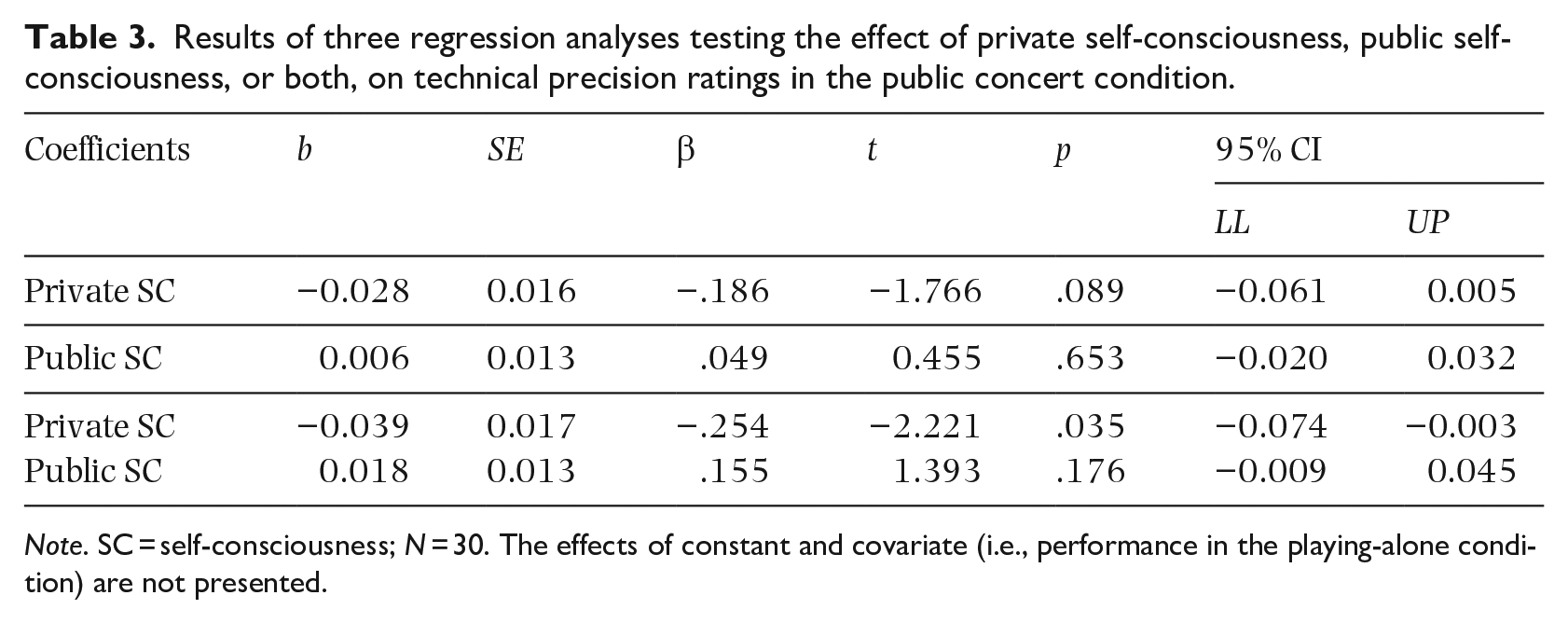
Note. SC = self-consciousness; N = 30. The effects of constant and covariate (i.e., performance in the playing-alone condition) are not presented.
Trait anxiety
Somatic and cognitive trait anxiety were positively correlated, r(28) = .46, p = .005. When we regressed ratings representing the overall performance in the pressure condition separately on somatic and cognitive trait anxiety (with ratings representing overall performance in the no-pressure condition serving as an additional predictor to control for the no-pressure condition), only cognitive trait anxiety reduced ratings representing overall performance as predicted, β = −.206, t(26) = −2.336, p = .027, whereas somatic trait anxiety did not, β = −.134, t(26) = −1.455, p = .157. These effects were lower when we entered both anxiety components simultaneously into the regression analysis, cognitive anxiety: β = −.182, t(26) = −1.816, p = .081; somatic anxiety: β = −.053, t(26) = −0.532, p = .599; see Table 4.
Results of three regression analyses testing the effect of somatic trait anxiety, cognitive trait anxiety, or both, on overall performance in the public concert condition.
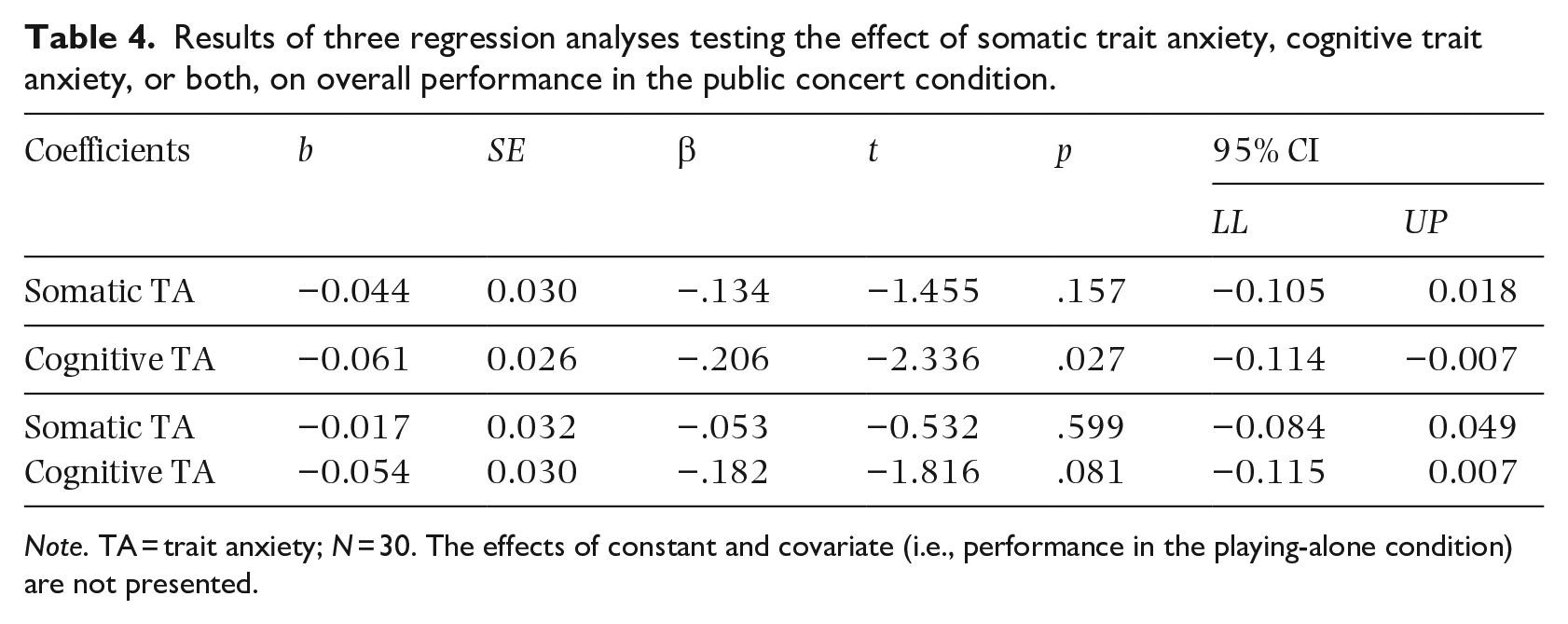
Note. TA = trait anxiety; N = 30. The effects of constant and covariate (i.e., performance in the playing-alone condition) are not presented.
In sum, ratings representing music performance indicated that, despite significantly elevated anxiety levels, participants performed better in the pressure than in the no-pressure condition. Private and public self-consciousness were significant predictors of ratings representing music performance under pressure (i.e., in a public playing situation), which—although correlated—worked in opposite directions: Private self-consciousness reduced ratings representing performance quality (particularly for technical precision), whereas public self-consciousness increased them (particularly for musical expression). Cognitive trait anxiety reduced ratings representing performance quality, but only when somatic trait anxiety was not controlled for.
Discussion
In this study, we tested the effects of self-consciousness and trait anxiety on music performance quality in a real-life stressful situation. To this end, the performances of experienced pianists in a pressure condition (a public concert) were compared to their performances when playing the same piece of music under no pressure (playing alone). Ratings representing performances in the pressure condition were higher than those representing performances in the no-pressure condition. Interestingly, we found less of a difference when participants scored high for private self-consciousness. In contrast, when participants scored high for public self-consciousness, ratings between conditions showed a more significant difference. These results indicate that private and public self-consciousness, although correlated, exerted counteracting effects on ratings representing performance under pressure.
Surprisingly, despite significantly elevated anxiety levels, the pressure manipulation (i.e., playing a public concert) led to higher ratings representing overall performance than the no-pressure manipulation (i.e., playing alone). A possible explanation for this unpredicted effect might be that participants did not find the pressure condition in this study particularly stressful (compared to, for instance, a competition), even though it was an actual public performance. That is, although there was an (albeit benevolent) audience, there was no reward to be expected, and no jury was present. The lack of a competitive and evaluative character may have reduced the detrimental effect of pressure on ratings representing performance. Although the presence of an audience generates psychological pressure, this pressure may be higher in competitive situations, especially when the performance is assessed directly by judges or jurors (Craske & Craig, 1984; Hamann & Sobaje, 1983). Generally, the pressure caused by an audience may not automatically have detrimental effects on performance. Rather, depending on the individual’s level of expertise or command of a task, heightened anxiety in a public situation can enhance performance (Bond & Titus, 1983; Hanin, 2000; Miller & Chesky, 2004; Steinmetz & Pfattheicher, 2017; Yao & Li, 2022; Yerkes & Dodson, 1908; Zajonc, 1965). This was also the case in our study. Interestingly, we still found the predicted effects of public and private self-consciousness as high private self-consciousness reduced and high public self-consciousness enhanced ratings representing performance quality in the concert, compared to low private and low public self-consciousness, respectively.
The results concerning self-consciousness might be explained by the explicit monitoring hypothesis. On one hand, high private self-consciousness may have led to heightened self-focus, forcing the participants, for instance, to think about single sequences of movements or the correct fingering. Thus, it is possible that they attended to a step-by-step execution of already automatized motor movements, thereby hampering performance quality. This interpretation is underpinned by the finding that private self-consciousness predicted lower ratings representing technical precision, in particular, which is primarily associated with the motor component of performance. This result is consistent with other research that found that attention to one’s own body can cause increased muscle activity and impaired motor coordination (Vereijken et al., 1992; Yoshie, Kudo, et al., 2009). Additionally, the findings support previous research suggesting a detrimental effect of an internal compared to an external attentional focus on performance (Mornell & Wulf, 2019; for reviews, see Wulf, 2013; Wulf & Lewthwaite, 2016). High private self-consciousness may have led participants to pay attention to their own body or body movements (internal focus), thereby hampering their execution.
On the other hand, high public self-consciousness was associated with higher ratings representing performance in the pressure condition than in the no-pressure condition. This outcome may be explained by a habituation effect such that the more one is used to the state of being publicly aware (i.e., high public self-consciousness), the less one is negatively influenced by pressure due to the presence of an audience. 3 Interestingly, high public self-consciousness tended to be associated particularly with higher ratings representing musical expression. A possible explanation for this effect is that people scoring high for public self-consciousness tend to behave in such a way that maximum social consent is achieved and negative evaluation by others is reduced (Doherty & Schlenker, 1991). Furthermore, previous research suggests that high public self-consciousness is related to high sensitivity to social feedback (Tobey & Tunnell, 1981). Thus, it might be that the participants in this study tried to make a special effort in musical expression, which was more effective than technical precision in enabling them to communicate with the audience to convince them of the quality of their performance. The findings also align with those of two studies that found that listeners preferred music performances in which the performer had an expressive and audience-directed focus rather than a technical or introspective focus (Van Zijl et al., 2014; Van Zijl & Luck, 2013).
In contrast to the effects of self-consciousness and contrary to our expectations, the effects of trait anxiety on ratings representing performance quality were less clear. That is, only cognitive trait anxiety reduced ratings representing performance quality as predicted, and only when somatic trait anxiety was not controlled for. Somatic trait anxiety was not systematically related to lower ratings representing performance under pressure. This finding may have been the result of positive effects of higher somatic anxiety. For instance, highly experienced athletes tended to interpret their tendency to be anxious in competitions as more positive and supportive than less experienced athletes (Mellalieu et al., 2004). Furthermore, high somatic trait anxiety may motivate people to engage in helpful coping strategies, such as focusing on the task at hand or working harder on the task (Nicholls et al., 2006). In our study, for instance, increased somatic anxiety among musicians in the run-up to a concert may have led to more intensive and concentrated practice, thus mitigating or even preventing detrimental effects on performance in the pressure condition.
Interestingly, we found support for the detrimental impact of cognitive trait anxiety on performance under pressure. This finding aligns with a previous study with pianists (Yoshie, Shigemasu, et al., 2009) that also showed that cognitive but not somatic anxiety predicted lower performance. One possible explanation is that heightened cognitive anxiety may have led to conscious control of already automatized movements. In line with the explicit monitoring hypothesis, this may have been the case in our study, as well.
Strengths and limitations
This study was designed to look for possible effects of self-consciousness and trait anxiety on performance in a real-life setting. This approach was used because giving a public performance represents a complex task in that it is characterized by many factors that can increase pressure and make musicians prone to CuP (e.g., the presence of an audience, personal importance to the performer, command of the music to be performed). Moreover, the natural setting enabled us to recruit participants across a wide age range. So, on one hand, the ecological validity of our study was relatively high.
On the other hand, our sample size was relatively small, so the findings should be interpreted as preliminary. Additionally, because of the relatively non-standard setting, there may be confounding variables that were not controlled for. For instance, the difficulty of the task differed among participants, which could have affected their performance. Given the within-subject design, however, such limitations may not be too severe.
Moreover, there was considerable variability in the sample regarding the participants’ general performance experience, the length of the chosen piece of music, the participants’ previous experience of performing it in public, and their level of expertise. The large variability is a limitation of this study because it may have affected participants’ readiness to deal with pressure and, thus, their perceived level of stress in the concert situation. However, statistically controlling for variables such as number of years of performing regularly, number of performances per year, and experience of playing the piece in public did not change the results, which assured us that the variability in the sample does not challenge the main findings. Consistent with this argument, previous research has demonstrated that music performance anxiety is experienced in similar ways by musicians with different levels of expertise (Brugués, 2011; Fehm & Schmidt, 2006; Osborne & Kenny, 2008). Thus, it may be assumed that the pressure was also comparable for the participants in our sample.
Implications and further research
The main finding of this study is that private and public self-consciousness had counteracting effects on the ratings representing overall performance. This raises important questions. How can one manage to reduce private self-consciousness in a public performance situation and increase public self-consciousness at the same time? How can one prevent the negative effects of a strong inward gaze when performing in public? Understanding the advantages of an external versus an internal focus of attention is critical. Both in practice and in pedagogical activities, the focus on broad attributes such as sound and musical expression should predominate. If a performer focuses too much on technical details, they may experience from a high level of private self-consciousness in the performance, and their performance can suffer because they are not used to paying attention to music-related features such as sound and expression. Focusing on these features when playing could protect performers from the adverse effects of too much inner self-focus.
In terms of specific pedagogical activities, the findings of this study align with those of other research on the development of strategies for expressive music performance. As shown in two studies, young musicians could benefit from pedagogical methods promoting reflection on the musical features of the pieces they are learning—such as their character and structure—rather than on technical details (Meissner, 2018; Meissner & Timmers, 2020). However, what could they do to develop an external attentional focus and thereby improve their performances in public, high-pressure situations? Interventions to help musicians get used to performing in public have already been developed, such as video-recording them; this has been shown to be effective with golfers, whose putting was improved in a study by Gröpel and Mesagno (2017). Music performance students have been shown to benefit from playing to virtual audiences in a performance simulator (Williamon et al., 2014) and using virtual-reality methods (e.g., Osborne et al., 2022). In a study by Bissonnette et al. (2015), for instance, participants’ performance-related anxiety diminished after several performances to a virtual audience, perhaps because the use of the technology increased their public self-consciousness. Also, increasing musicians’ awareness of the influences of public and private self-consciousness could help them search for and develop strategies for managing performance conditions themselves, according to their individual preferences.
Generally, musicians are helped to deal with stressful performance situations using cognitive approaches. One such approach to managing music performance anxiety is acceptance and commitment therapy (Juncos et al., 2017). This aims to enhance psychological flexibility in the presence of unwanted symptoms rather than to reduce them or remove them altogether. The therapy involves encouraging a focus on the present moment (mindfulness), acceptance of unwanted experiences, defusion from thoughts and feelings (e.g., about anxiety), and adopting a contextual sense of self rather than one that is fixed. Musicians could also be trained to differentiate between public and private self-focus and to use abstract, holistic processing, for example, to develop their public self-consciousness (Hansen et al., 2023).
Similarly, it would be possible in future research to examine the potential effects of self-consciousness on public performance more closely, for example, by exploring whether a high level of private self-consciousness is more likely to produce negative thoughts or attention to the performer’s body. These questions have not yet been addressed using retrospective self-reports of real-world performances, and studies using this method could provide valuable insights. Likewise, the effects of a high level of private self-consciousness on motor behavior could usefully be investigated using electromyographical methods.
Conclusion
To our knowledge, this study is the first to show a relationship between trait self-consciousness and ratings representing performance quality in a real-life music performance. The results demonstrated that high public self-consciousness, which is related to an external attentional focus, increased musical expression. In contrast, high private self-consciousness, which is related to an internal attentional focus, decreased technical precision. Together, these findings suggest that higher quality public performances can be given by musicians if their attentional focus is on external characteristics (i.e., of the music) such as sound quality and expression rather than on internal characteristics (i.e., of themselves) such as their bodily movements.
Our findings may support the usefulness of interventions to acclimatize musicians to giving public performances, as these are likely to be better, in stressful playing situations, when the musician is used to being in a state of public self-consciousness. Learning to see oneself through this lens is a useful strategy for developing an external attentional focus. Our findings make a particularly useful contribution to the literature on choking since they are derived from an ecologically valid study in which real-world performances were given. Even when such performances are non-competitive, it is demanding for musicians to playing in public, and they often experience heightened levels of anxiety. These could be managed in future using interventions designed specifically to target attentional focus.
Footnotes
Appendix 1
Means, standard deviations, and intercorrelations between performance, self-consciousness, and trait anxiety.
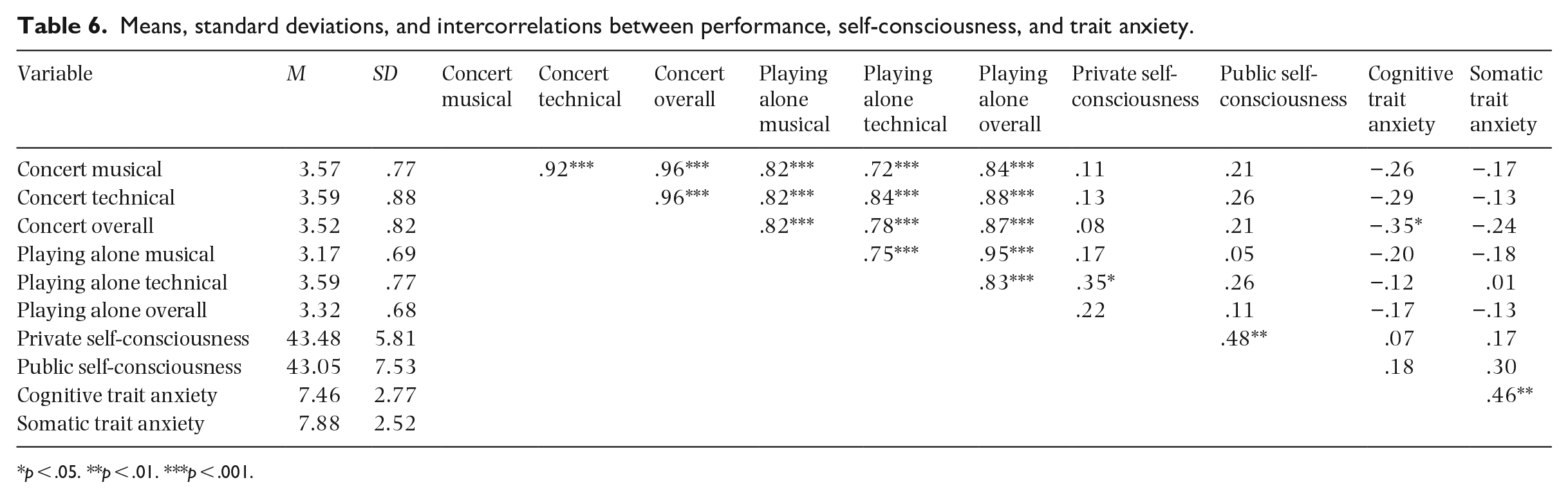
| Variable | M | SD | Concert musical | Concert technical | Concert overall | Playing alone musical | Playing alone technical | Playing alone overall | Private self-consciousness | Public self-consciousness | Cognitive trait anxiety | Somatic trait anxiety |
|---|---|---|---|---|---|---|---|---|---|---|---|---|
| Concert musical | 3.57 | .77 | .92*** | .96*** | .82*** | .72*** | .84*** | .11 | .21 | −.26 | −.17 | |
| Concert technical | 3.59 | .88 | .96*** | .82*** | .84*** | .88*** | .13 | .26 | −.29 | −.13 | ||
| Concert overall | 3.52 | .82 | .82*** | .78*** | .87*** | .08 | .21 | −.35* | −.24 | |||
| Playing alone musical | 3.17 | .69 | .75*** | .95*** | .17 | .05 | −.20 | −.18 | ||||
| Playing alone technical | 3.59 | .77 | .83*** | .35* | .26 | −.12 | .01 | |||||
| Playing alone overall | 3.32 | .68 | .22 | .11 | −.17 | −.13 | ||||||
| Private self-consciousness | 43.48 | 5.81 | .48** | .07 | .17 | |||||||
| Public self-consciousness | 43.05 | 7.53 | .18 | .30 | ||||||||
| Cognitive trait anxiety | 7.46 | 2.77 | .46** | |||||||||
| Somatic trait anxiety | 7.88 | 2.52 |
p < .05. **p < .01. ***p < .001.
Acknowledgements
The authors thank Marcus Reissenweber, Berno Scharpf, Ritva Sjöstedt, und Joseph Paratore for rating the music performances.
Funding
The authors received no financial support for the research, authorship, and/or publication of this article.
