




Abstract
This study aimed to validate the psychometric properties of the Italian version of the 40-item Kenny Music Performance Anxiety Inventory-Revised (K-MPAI-R). The certified Italian version was used and answered by 419 student musicians (aged M = 23.18 years, SD = 5.26 years) all were university-level students of a Bachelor’s or Master of Arts degree course in Italy. The revised Kenny Music Performance Anxiety Inventory is based on Barlow’s model of anxiety and was recently validated in different languages. Regarding the stability of the scales, there were differences with the original scale and the factor loadings, because six items were smaller than .40 and for this reason they were deleted and not considered for the following analyses. However, the results are a platform for developing future research on music performance anxiety (MPA) in association with other variables in the Italian speaking contexts. The Italian version of K-MPAI-R could be useful for understanding the ways in which music students experience MPA and to examine the correlation with other variables
Keywords
Musical performance is a physically and psychologically demanding activity which involve cognitive, emotional, and motor skills (Williamon, 2002). Professional musicians must be equipped with a high level of technical skills to accomplish the demands of musical training and performance (Papageorgi & Welch, 2020). The requirements that must be met to perform properly often create stress and anxiety for musicians (Finch & Moscovitch, 2016; Juncos et al., 2017). Performance anxiety, is often referred to as stage fright by researchers (Brodsky, 1996; Papageorgi et al., 2007), can be experienced in many situations by people, whether as amateurs or professionals, who have to perform in front of others (Ford et al., 2017; Kenny, 2005; Kokotsaki & Davidson, 2003; Patel et al., 2010; Steptoe et al., 1995; Walker & Nordin-Bates, 2010). Recent studies demonstrate that music performance anxiety is a concern for a significant majority of undergraduate and professional career musicians (Braden et al., 2015; Fernholz et al., 2019; Kenny et al., 2014; Osborne & Kenny, 2008; Papageorgi et al., 2013; Ryan, 2005; Steptoe, 2001). For this reason, music schools and conservatoires have the responsibility to educate and prepare performers for the demands of their chosen profession.
Music Performance Anxiety (MPA) is a long known concern (Craske & Craig, 1984; Fishbein & Middlestadt, 1988) and was defined by Kenny as The experience of marked and persistent anxious apprehension related to musical performance that has arisen trough underlying biological and/or psychological vulnerabilities and/or specific anxiety conditioning experiences. [. . .] It may occur in a range of performance settings, but is usually more severe in settings involving high ego investment, evaluative threat (audience), and fear of failure. (Kenny, 2009, p. 433)
In developing this definition, Kenny (2009a, 2009b) readjusted Barlow’s model (2000) and explained anxiety as an interconnection of three factors (i.e., vulnerabilities): (a) a generalized biological (heritable) vulnerability; (b) a generalized psychological vulnerability created thanks to earlier experiences in developing a sense of control over significant situations; and (c) a more specific psychological vulnerability in which anxiety is associated with certain environmental stimuli. According to this model, the systems involved in anxiety are (a) the somatic (the response known as “flight or fight,” which prepares the body for escaping or fighting); (b) the emotional and cognitive (worry, dread, lack of concentration, memory loss); and (c) the behavioral manifestations (technical errors, memory loss, performance breaks, avoidance of performance opportunities).
Recent research shows that MPA has been understood in a multi-factor model, in which the extent of the arousal depends on: the performer’s sensitivity to experiencing anxiety and personal characteristics (gender, age, trait anxiety, self-esteem, self-efficacy); the performer’s preparation and motivation to learn and learning approach; the characteristics of the specific environment where the musician has to perform (e.g., audience presence and venue characteristics) (Biasutti & Concina, 2014; Burin et al., 2019; Fernholz et al., 2019; González et al., 2018; Kenny, 2011; Kenny et al., 2004; Papageorgi et al., 2007, 2010, 2013; Robson & Kenny, 2017; Zarza-Alzugaray et al., 2020). Low-quality outcomes may result from inadequate preparation, lack of confidence, and relative incapacity to master the chosen repertory. An insufficient preparation and choice of repertory that exceeds one’s capabilities and limitations may increase performance anxiety (Papageorgi et al., 2007). Finally, situational stress is a decisive contributor to performance anxiety (Abel & Larkin, 1990; Brotons, 1994; LeBlanc et al., 1997 in Williamon, 2002), and components related to the performance environment, such as the presence of a large audience, the perception of high self-exposure, and unsatisfactory performance conditions (humidity of the venue and readability of the music score) are considered to be significant variables. Different strategies are used by performance professionals to reduce or overcome the demands of performance and to keep their anxiety under control (Papageorgi & Welch, 2020). However, some uses of self-medication as β-blockers or sedatives may generate addictions (Fernholz et al., 2019; Matei & Ginsborg, 2017). According to Radocy and Heller (1982), being a musician is one of the main stressful and demanding occupations. They often tend to be devoted to their work, frequently pushing beyond psychological and physical limits. This can be brought on by high expectations and unrealistic goals, which often lead to feelings of inadequacy.
Research on MPA has increased over the last years. Several clinics, journals, and conferences have dedicated their efforts to study the psychological and physiological aspects of musical performance (Valentine, 2002); more specifically, the studies that have been carried out so far are mainly focused on the diagnosis (American Psychiatric Association [APA], 2015; Kenny, 2011), assessment (Antonini Philippe et al., 2021; Kenny et al., 2004; Osborne et al., 2005; Rocha et al., 2011; Zarza-Alzugaray et al., 2015) prevention (Pfeifer et al., 2020; Spahn, 2015), and treatment (Burin & Osorio, 2017; Hoffman & Hanrahan, 2012; Kenny et al., 2014) of maladaptive performance anxiety, which has a negative impact on the quality of playing and may have significant consequences for musicians’ personal and professional lives (Kaspersen & Götestam, 2002; Kenny, 2011; Matei & Ginsborg, 2017; Paliaukiene et al., 2018; Studer et al., 2011; Wesner et al., 1990).
With the aim of evaluating the level of MPA, Kenny and colleagues developed in 2004 a 26-item questionnaire, the Kenny Music Performance Anxiety Inventory (K-MPAI), which was further revised and extended into a 40-item version Kenny Music Performance Anxiety Inventory-Revised (K-MPAI-R) (Kenny, 2009). Additionally, different versions of the questionnaire currently exist, such as Brazilian Portuguese (Rocha et al., 2011), French (Antonini Philippe et al., 2021), Spanish (Zarza-Alzugaray et al., 2015), Ukrainian (Ksondzyk, 2020), and Romanian (Faur et al., 2021). A German version of the K-MPAI has also been used in at least two studies but has not yet been validated (Spahn et al., 2016; Wiedemann et al., 2022). Results showed that all the translated versions have adequate reliability properties to measure anxiety levels even though there is a diversity of factors retained as well as omitted items (Antonini Philippe et al., 2021). The recent development of K-MPAI validations in different languages shows a growing interest in research on music performance anxiety.
Although a certified Italian version of the K-MPAI-R “was available online, a test of its psychometric properties has not currently been performed.” The aim of the present study was to test the psychometric properties of the certified Italian version with a cohort of university-level music students in Italy. Faur et al. (2021) validation encompassed only an exploratory factor analysis (EFA) to investigate the factor structure of the Romanian version for three main reasons: (1) a new instrument translated from a different language emerged, (2) the number of studies on this particular inventory is rather small, and (3) other studies which investigated the factor structure of K-MPAI reported different number of factors for it. (Faur et al., 2021)
Because their arguments are sound and our validation is in the same scientific journal, we decided to perform the same procedure, procedure that we complemented with Rocha and colleagues (2011) study of convergent validity with Spielberger test of state-trait anxiety (State-Trait Anxiety Inventory [STAI]; Spielberger, 1983).
Method
Participants
The students of two conservatoire universities of music in Italy were invited to participate in this study sending them the link to a web-based questionnaire to their students’ group (total potential student numbers available: n = 2,000 students).
Inclusion criteria for participants were university-level students of a Bachelor’s or Master of Arts degree course (both women and men), whose mother tongue was Italian and aged over 18 years old. Exclusion criteria included amateur musicians who studied music as a hobby or as part of an extracurricular activity.
This resulted in a sample of 419 participants (46.78% female, mean age = 23.18 years, range = 18–38 years, SD = 5.26).
Materials
Kenny M tory-Revised (K-MPAI-R)
By revising her MPAI (Kenny et al., 2004), Kenny (2009) was able to propose a new revised version, the K-MPAI-R.
Initially, the self-reported K-MPAI questionnaire was composed of 26 items presented as a Likert scale ranging from −3 to +3 with a possible total score between −78 to +78. Its purpose was to measure symptoms associated with music performance anxiety such as anxiety, tension, memory impairment, and negative cognitions. This instrument has an internal reliability of .94 Cronbach’s alpha, adequate predictive validity, and positive and significant correlations with the STAI (Spielberger, 1983) and the Performance Anxiety Questionnaire (Cox & Kenardy, 1993), which is a specific tool to assess MPA and which supports the K-MPAI concurrent validity (Kenny, 2011).
The revised version of the K-MPAI (Kenny, 2009) is composed of 40 items also presented as a 7-point Likert scale ranging this time from 0 (strongly disagree) to 6 (strongly agree), or inversely, depending on the direction of the statement regarding anxiety-related discomfort during musical performances. A high total score indicates a high level of performance anxiety and distress. The original version of the K-MPAI as well as the revisited version have the same internal consistency (α = .94; Kenny, 2009).
State-Trait Anxiety Inventory
The participants also filled in the trait scale of the STAI composed of 20 items, for example, “I am tense,” proposed in the form of a 4-point Likert scale ranging from 1 (not at all) to 4 (a lot) with a total score ranging from 20 to 80 (Spielberger, 1970). The higher the score, the more severe the anxiety, whereas the lower the score, the less anxiety. The participants completed an Italian version of the questionnaire (Lazzari & Pancheri, 1980). To ensure that the statements corresponded to the participants’ experienced musical performance situations, we adapted the instructions by asking them to respond to each item with reference to how they typically feel during solo performances. The general level of MPA has often been assessed using this questionnaire (e.g., Nielsen et al., 2018; Studer et al., 2011; Widmer et al., 1997), which has excellent internal consistency (Cronbach’s alpha > .90; Nielsen et al., 2018; Studer et al., 2011).
A questionnaire to collect basic demographic information has also been used. (age, sex, year of study, main instrument played, and the students’ Italian level).
Procedure
The publicly available Italian version of the inventory approved and certified by was used to validate the K-MPAI-R in Italian. The directors of two universities of music in Italy were contacted with a request for assistance in forwarding the recruitment email containing the link of the web-based questionnaire. The study was carried out in accordance with the recommendations of the British Psychological Society and all participants gave informed consent in accordance with the Declaration of Helsinki. Participants were informed about the general goal of the study and that data would be used only for scientific purposes. Participants had the possibility to withdraw in any moment of the study. Participation was entirely voluntary, and confidentiality was ensured by assigning an identification code number to every participant who completed the questionnaire.
The web-based questionnaire was constructed using the environment provided by Surveymonkey, to which the various research measures were adapted. Firstly, the welcome page provided an opportunity to give informed consent immediately after reading through the general information. Before starting any procedure and thus continuing with basic demographic information and with the questionnaires on the next pages, students had to complete and sign the informed consent form. Research on personal health-related data collected anonymously do not enter in the scope of the Commission for Ethics in Human Research of the canton Vaud regulated by the Swiss Law on Human Research.
Data analysis
All the reverse-scored items were re-coded prior to data analysis. Descriptive analyses were performed on the 40 items of K-MPAI, with means, standard deviations, measures of skewness, and kurtosis. There was no missing data.
The validation of the K-MPAI followed the procedure of Faur et al. (2021) that encompasses only an EFA. There is no consensus regarding sample size calculation for an EFA but DeVellis (2003, p. 137) recommended from five to 10 participants per item. As we had 40 items, the sample size fulfilled the empirical rule.
Bartlett’s test of sphericity test and Kaiser–Meyer–Olkin (KMO) measure of sampling adequacy were performed and rejection of test and a KMO value higher than .50 is expected. The EFA was realized on Pearson correlation matrix because the univariate distributions of the items are not asymmetric or have not an excess of kurtosis (Bryant & Satorra, 2012). For verification, we have performed the same analysis on the polychoric correlation matrix (library psych in R) and we have found the same results (Factor 1 has items 24 and 39 in addition and Factor 2 has item 27 in addition). We choose principal axis factoring with oblimin rotation. This rotation is recommended by Preacher and MacCallum (2003) and was proven suitable on the K-MPAI by Zarza-Alzugaray et al. (2015) and Faur et al. (2021). For the retention of factors, we used a combination of criteria—Kaiser’s criterion (eigenvalue greater than 1) and parallel test (Tabachnick & Fidell, 2013)—and compared the results. As we had 40 items and more than 400 participants, we followed Field’s (2009) recommendation not to use Kaiser criteria as the main criteria, but to focus mainly on the parallel test which was described by Preacher and MacCallum (2003) as very reliable. Items with loadings below .40 were removed from interpretation of factors; items were attributed to the factor for which they have the highest loadings.
To examine scales reliability, we calculated the internal consistency coefficients (Cronbach’s alphas and McDonald’s model-based Omega). According to DeVellis (2003, p. 95), a Cronbach’s alpha between .65 and .7 is a “minimally acceptable” threshold for a scale, whereas thresholds greater than .7, .8 and .9 indicate, respectively, “respectable,” “very good,” and “excellent” scales.
The aggregate score of the STAI was calculated, as well as the aggregate score of K-MPAI-R that is used in most research working with K-MPAI-R instrument (e.g., Kenny et al., 2014). Descriptive statistics (mean and standard deviation) and reliability statistics (Cronbach’s alpha, McDonalds omega, and standard error of measurement) were performed. Convergent validity of K-MPAI-R factors were assessed with Pearson correlation coefficients with STAI scores.
Statistical significance was set at an alpha level of p < .05. Statistical analyses were performed with SPSS 26 software (Chicago, IL, USA).
Results
Descriptive analysis
The response distribution in Table 1 indicated that the respondents on average disagreed with 25 items (i.e., average smaller than 3, minimum 1.59 item 24) and agreed with 15 items (average higher than 3, maximum 4.16 item 25). The skewness and kurtosis coefficients were examined to verify Tabachnick and Fidell (2013) recommendation that skewness and kurtosis coefficients be ±1.5 to perform factor analysis on items measured using a Likert scale. Results on the 40 items indicated that no items exceeded the criterion.
Descriptive Statistics for Items of K-MPAI-R (n = 419).
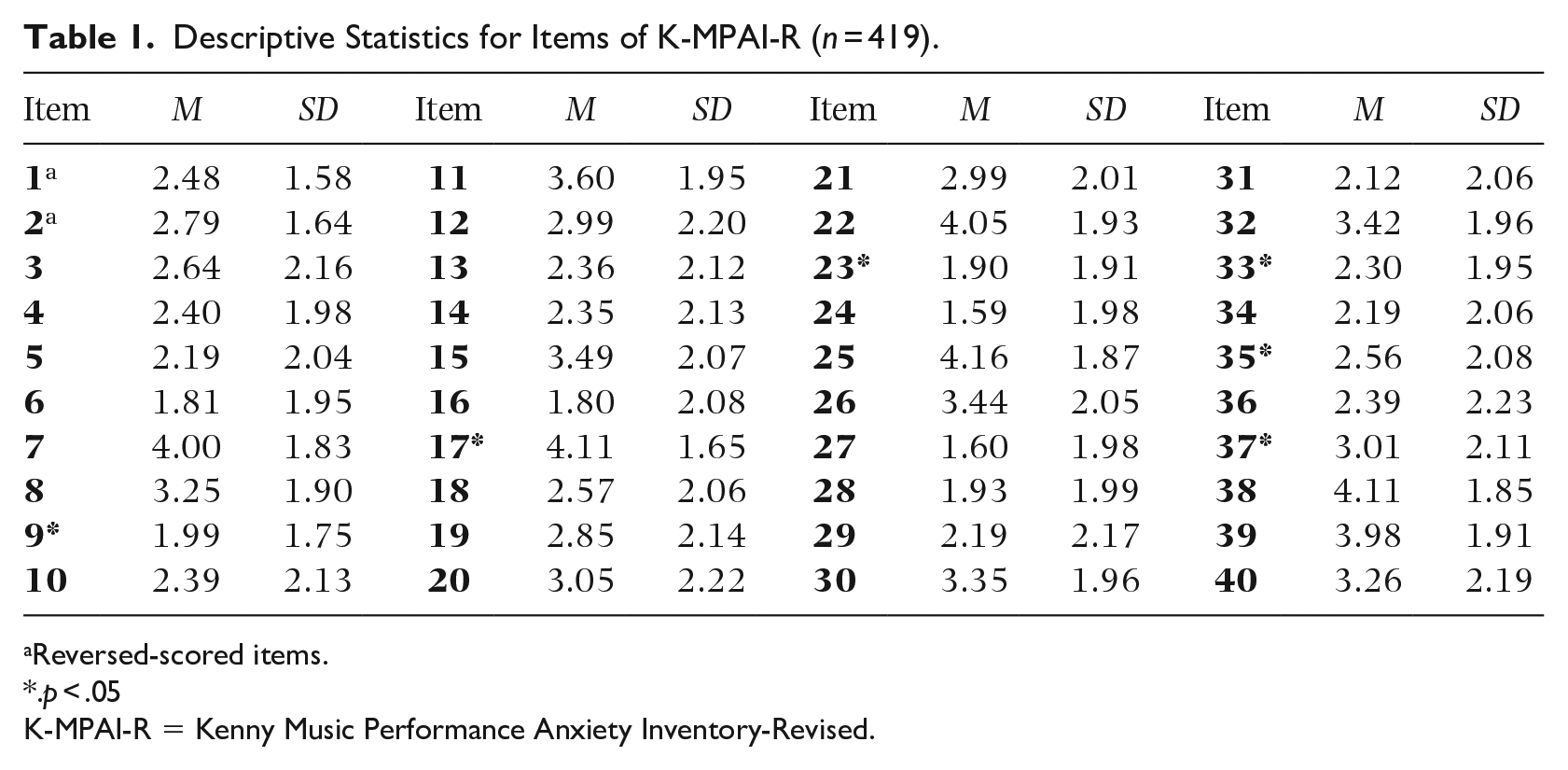
Reversed-scored items.
K-MPAI-R = Kenny Music Performance Anxiety Inventory-Revised.
Exploratory factor analysis
On the data, an appropriate KMO measure and a statistically significant Bartlett’s test of sphericity were obtained (KMO = .91), χ2(780) = 3937.90, p < .001, and all the KMO values for individual items were above the acceptable limit of .50 (Field, 2009); therefore, the EFA was possible. Kaiser’s criterion identified nine factors, but the parallel analysis retained five factors, for a total of 45.8% of variance explained. In the five factors solution retained, six items obtained a factor loading smaller than .4: Items 2, 7, 8, 24, 27, and 39. Factors were named with items having factorial loadings equal to or higher than .40 (Table 2).
Standardized Factor Loadings of the EFA on K-MPAI-R (n = 419).
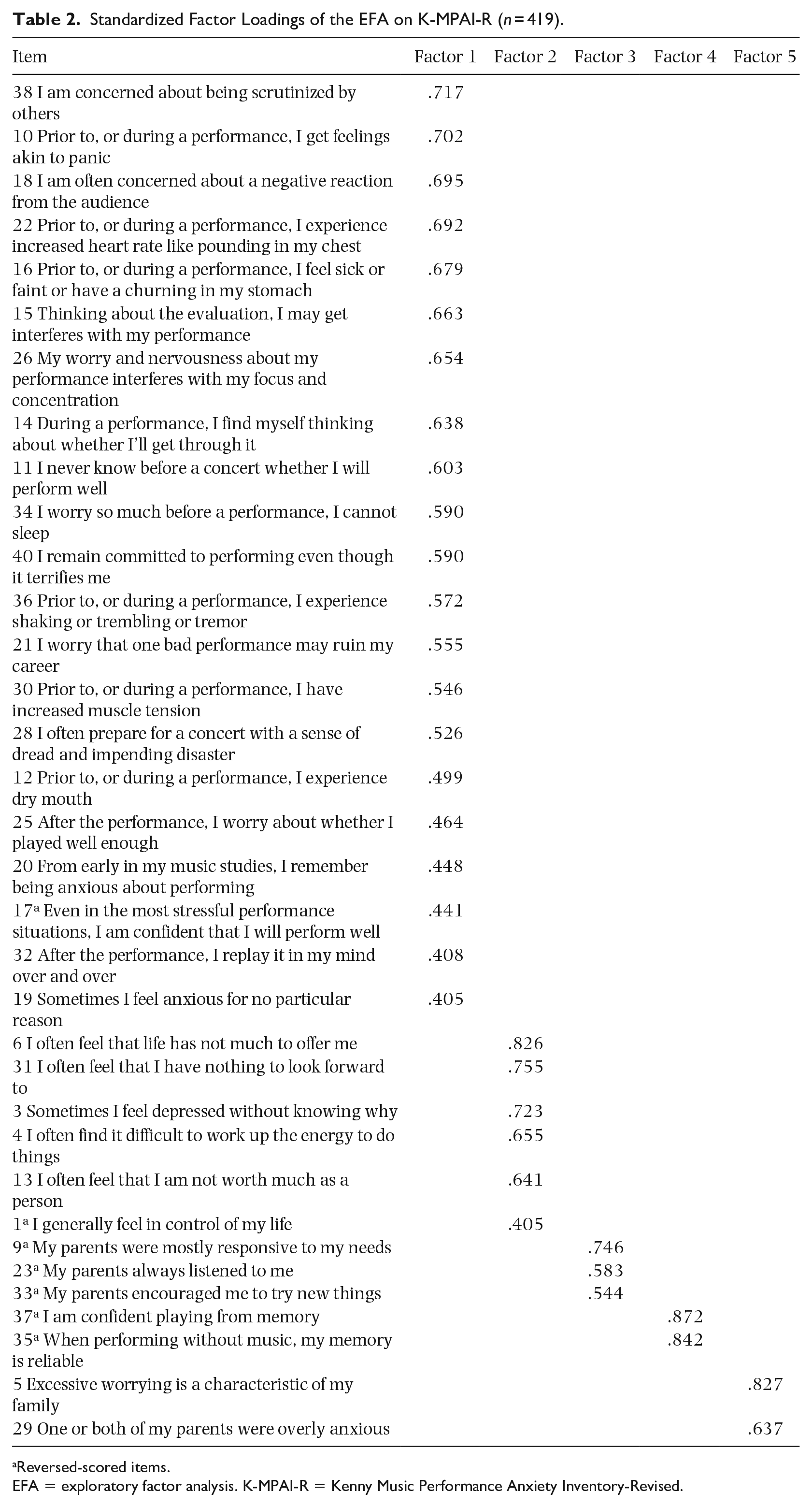
Reversed-scored items.
EFA = exploratory factor analysis. K-MPAI-R = Kenny Music Performance Anxiety Inventory-Revised.
The first factor, that included 21 items, was named “Music performance anxiety symptoms.” The second factor (6 items) was named “Depression and hopelessness.” The third factor (3 items) was named “Parental support.” The fourth factor (2 items) was named “Memory self-efficacy.” The fifth factor (2 items) was named “Generational transmission of anxiety.”
Table 3 presents the descriptive statistics and internal reliability of the four factors of the K-MPAI-R. Participants generally had moderate scores on the factors (M = 2.03–3.09), with similar standard deviations among factors (SD = 1.27–1.98). Cronbach’s alpha and omega indicated that internal reliability was adequate for validation on both criteria. The coefficients indicated that Factor 1 was “excellent,” Factors 2 and 4 were “very good,” Factor 5 was “respectable,” and Factor 3 was “minimally acceptable” according to DeVellis (2003).
Descriptive Statistics, Internal Consistency, and Correlations Between K-MPAI-R Factors (Five Factors and Aggregate Score) and STAI (n = 419).
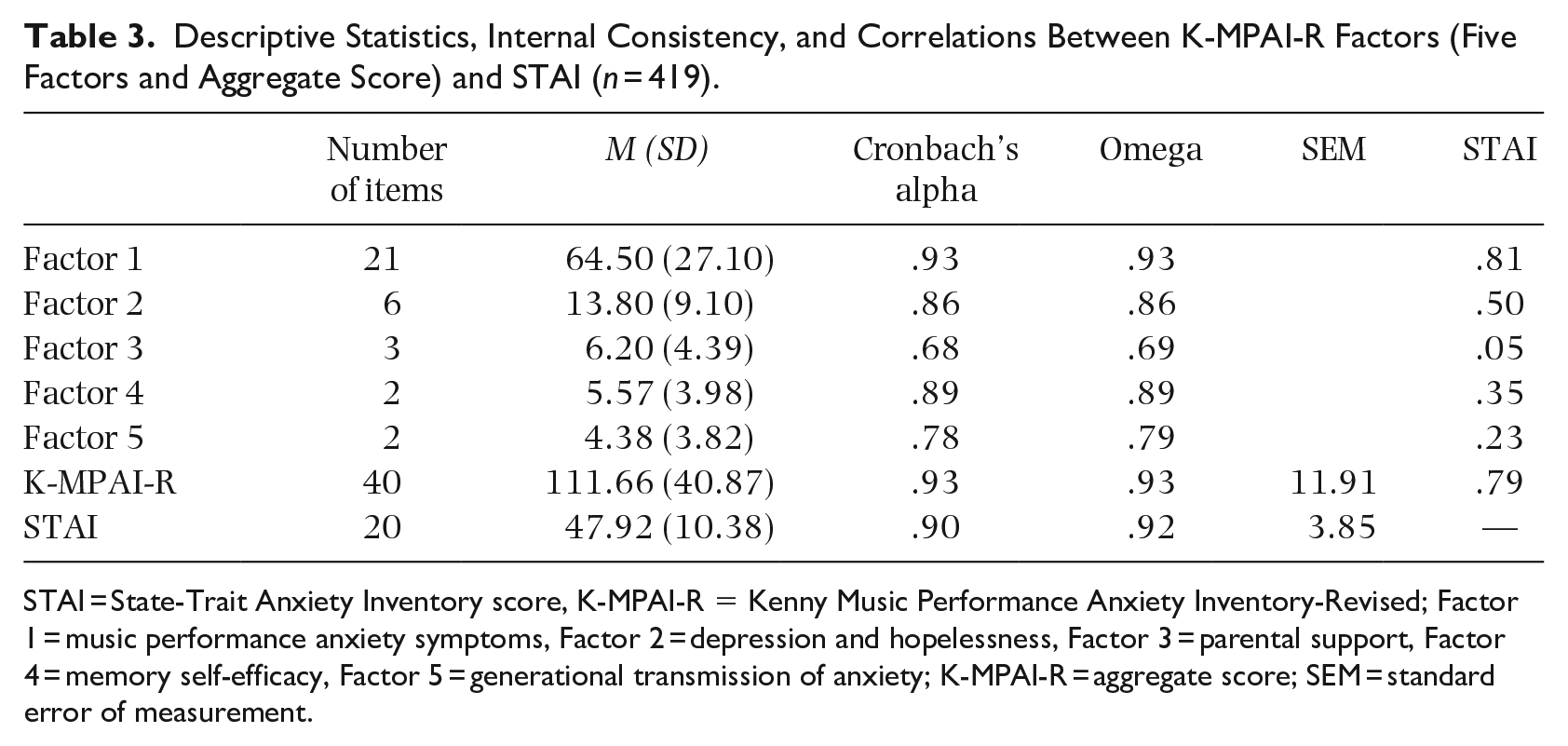
STAI = State-Trait Anxiety Inventory score, K-MPAI-R = Kenny Music Performance Anxiety Inventory-Revised; Factor 1 = music performance anxiety symptoms, Factor 2 = depression and hopelessness, Factor 3 = parental support, Factor 4 = memory self-efficacy, Factor 5 = generational transmission of anxiety; K-MPAI-R = aggregate score; SEM = standard error of measurement.
K-MPAI-R and STAI
The scores of the STAI ranged from 28 to 80 with an average of 47.92 and the global K-MPAI-r score ranged between 19 and 216 with an average of 111.66 (Table 3). The score of the K-MPAI-R factors, except the third, were positively correlated with STAI between .23 and .81 (Table 3; p
Discussion
The present research answers the call to validate tools in different languages such as K-MPAI-R, which was available in Italian but its validation was not currently performed. Several aspects could be discussed associated to the construct-related evidence regarding the factors structure and the correlation of K-MPAI-R with the STAI.
Regarding the scale there were differences with the original scales and their factor loadings, because six items were smaller than .40 and for this reason they were deleted and not considered for the following analyses (items 2, 7, 8, 24, 27 and 39). This finding is in agreement with a previous study by Chang-Arana et al. (2018) in which 10 items were omitted because they did not reach a minimum factor loading of .30, and with Faur et al. (2021) in which 10 items were omitted with a thresholds of .40. However, the items omitted vary among studies. For example, items 2, 7, 8, 39 are deleted in Faur et al. (2021) and in our study, but items 35 and 37 are deleted in Faur et al. (2021) whereas they constitute a factor in our study. These findings could be due to the different statistical analyses that were used in several studies. In the Chang-Arana et al. (2018) study, HOEFA with Minimum Rank Factor Analysis (MRFA) as the extraction method was performed adopting an oblique rotation of promin type because the estimation of a higher/second order factor (G) implies a theoretical dependence between the first order factors. The HOEFA (Higher Order Exploratory Factor) was repeated several times in accord to every item deletion and adjustments to factorial loadings and the procedure was repeated until a stable structure was achieved.
The EFA’s results of the current study showed that some items have been omitted and the remaining ones have been regrouped in five factors. The same number of factors, but not the same factors, has also been found in a previous study of validation of the French version of the scale (Antonini Philippe et al., 2021), and the two first-order factors group under a high-order one obtained with Peruvian professional music students (Chang-Arana et al., 2018). A great variability in factors emerged because in the current study factors were music performance anxiety symptoms, depression and hopelessness, parental support, memory self-efficacy, and generational transmission of anxiety, which are different from the previous study by Antonini Philippe et al. (2021) in the Swiss French–speaking context. The following factors emerged in Antonini Philippe et al. (2021): proximal somatic and cognitive anxiety, self/other scrutiny and evaluation, psychological vulnerability, confidence in memory, and early parental relationship context. These results could be due to the different statistical analyses performed and to cultural variables. In the Antonini Philippe et al. (2021) study, the number of factors to retain was determined by parallel analysis performing a series of factor analyses such as a first-order exploratory factor analysis with principal axis extraction method and varimax rotation, and a higher order exploratory factor analysis with a minimum residual extraction method and oblique (oblimin) rotation. The different statistical techniques used for carrying out the factor analysis in the two studies could have influenced the factors obtained. In addition, cultural variables, namely the different contexts in which the scales were validated—French-speaking part of Switzerland and Italy—could have biased the findings acquired.
The different psychometric analyses of the K-MPAI-R performed in several studies (Antonini Philippe et al., 2021; Chang-Arana et al., 2018; Faur et al., 2021) induced different results. It is difficult to state if they were due to the different statistical analyses performed or to the cultural variables or to the interactions of both aspects. It would be helpful in further studies about the cross-validations of tools such as K-MPAI in different countries and cultural contexts to use the same statistical approach to minimize biases due to data analyses.
Regarding the correlations, the K-MPAI-R factors, except the third, were positively correlated with STAI and the global K-MPAI-R score had a very high correlation with STAI (.79). These findings are consistent with previous studies in which high correlations between K-MPAI-R and STAI were shown (Antonini Philippe et al., 2021; Chang-Arana et al., 2018).
The analyses have highlighted that the instrument meets the reliability criteria well, and the K-MPAI-R seems to be appropriate for measuring MPA in conservatory students in Italy. Additional comparisons of the K-MPAI-R could be performed to test the scale in different cross-cultural contexts and stages of musical development.
There are limitations of the current study regarding the characteristics of the group of participants. They are coming from only two conservatories of music in Italy, which could reduce the generalizability of the study. However, the results are a platform for developing future research on MPA in association with other variables in the Italian speaking contexts. The Italian version of K-MPAI-R could be used when evaluating attitudes and strategies in Italian music students for reacting and copying with MPA. In addition, Italian version of K-MPAI-R could be useful for understanding the ways in which music students experience MPA and to examine the correlation with other variables. However, more research is needed to further test the Italian version of K-MPAI-R, including music students from different backgrounds who attend a variety of music programs and degrees.
Supplemental Material
sj-docx-1-pom-10.1177_03057356221101430 – Supplemental material for The Kenny Music Performance Anxiety Inventory-Revised (K-MPAI-R): Validation of the Italian version
Supplemental material, sj-docx-1-pom-10.1177_03057356221101430 for The Kenny Music Performance Anxiety Inventory-Revised (K-MPAI-R): Validation of the Italian version by Roberta Antonini Philippe, Cinzia Cruder, Michele Biasutti and Fabienne Crettaz von Roten in Psychology of Music
Footnotes
Acknowledgements
We would like to thank Prof. Dianna T. Kenny for making available the certified Italian version of the Kenny Music Performance Inventory-Revised and all the students who participated in the data collection, as well as the Director of the Conservatory of Milan, Dr Cristina Frosini for her help in circulating the questionnaire and Laurie Schwab for helping with revising the literature part and the methodology.
Author contributions
All authors contributed extensively to the work presented in this paper and were involved in drafting or revising critically for important intellectual content. R.A.P. C.C., and M.B participated in the conception and design of the manuscript. R.A.P, C.C., and M.B. contributed to the drafting of the manuscript and C.C. conducted data collection. F.C.R analyzed the data. All the authors discussed the implications and study procedures, contributing extensively to the work presented in this manuscript, and approved the final version to be submitted for publication.
Declaration of conflicting interests
The author(s) declared no potential conflicts of interest with respect to the research, authorship, and/or publication of this article.
Funding
The author(s) received no financial support for the research, authorship, and/or publication of this article.

Supplemental material
Supplemental material for this article is available online.
References
Supplementary Material
Please find the following supplemental material available below.
For Open Access articles published under a Creative Commons License, all supplemental material carries the same license as the article it is associated with.
For non-Open Access articles published, all supplemental material carries a non-exclusive license, and permission requests for re-use of supplemental material or any part of supplemental material shall be sent directly to the copyright owner as specified in the copyright notice associated with the article.
