



Abstract
This study aimed at validating the psychometric properties of the French version of the 40-item revised Kenny Music Performance Anxiety Inventory (K-MPAI-R). The certified French version was used and answered by 211 student musicians (aged 16–65 years, SD = 9.58) from different music schools and music colleges in the French-speaking part of Switzerland. The K-MPAI-R is based on Barlow’s model of anxiety and was designed to measure performance anxiety in musicians. Through descriptive statistics and confirmatory factor analysis, the correlation matrix and the Kaiser–Meyer–Olkin (KMO) measure of sampling adequacy and Bartlett’s test of sphericity were performed. The confirmatory factor analysis showed evidence of validity (Cronbach’s α, Factor G = .91) with internal reliabilities going from α = .78 to .86. Nine items present low factor loading (<.30). Given the adequate psychometric properties of the French K-MPAI-R, this instrument is valid and reliable for the measurement of performance anxiety among French-speaking musicians. When accompanying musicians in mental preparation (e.g., psychologists, mental trainer), the total score should be taken as a general information, but factors and their associated lowest items could be interesting to work on pertinent aspects with the musician.
According to the Diagnostic and Statistical Manual of Mental Disorders (5th edition; DSM-V, performance anxiety and stage fright are often familiar during performances and judged situations, therefore are common and should not be diagnosed as a psychological disorder unless the anxiety or avoidance leads to clinically significant impairment or marked distress (American Psychiatric Association, 2015). Performance anxiety refers to a nervousness and apprehension felt by individuals when they anticipate activities that require or seem to require a certain performance level. It can occur in a variety of situations, for example, at work, during school exams, in sport competitions or in artistic domains like dance, acting, and music (Kenny, 2005; Steptoe et al., 1995; Walker & Nordin-Bates, 2010). Especially among musicians, music performance anxiety (MPA) is one of the leading occupational health problems (Fernholz et al., 2019; Steptoe, 2001). Researchers often use the terms stage fright, performance anxiety, and music performance anxiety interchangeably (Brodsky, 1996; Papageorgi, Hallam, & Welch, 2007) but the term music performance anxiety is now preferred. MPA has been defined as “the experience of persisting, distressful apprehension and/or actual impairment of performance skills in a public context, to a degree unwarranted given the individual’s musical aptitude, training, and level of preparation” (Salmon, 1990, p. 3). More recently, Kenny (2010) defined MPA as “the experience of marked and persistent anxious apprehension related to musical performance that has arisen through specific anxiety conditioning experiences, and which is manifested through combinations of affective, cognitive, somatic and behavioral symptoms” (p. 433).
MPA can impair the quality of a performance (Craske & Craig, 1984; Fredrikson & Gunnarsson, 1992; Wesner, Noyes, & Davis, 1990), lead to avoidance or interruption of performance situations (Kaspersen & Götestam, 2002; Studer, Gomez, Hildebrandt, Arial, & Danuser, 2011; Wesner et al., 1990), and consequently have debilitating effects on musician’s well-being, personal life, and career (Kenny, 2011). Coping efforts, often used by musicians in their attempts to manage MPA such as self-medication by β-blockers or sedatives, can lead to addiction and endanger musician’s health (Fernholz et al., 2019; Matei & Ginsborg, 2017). Thus, MPA represents a significant occupational health problem that needs to be addressed. Moreover, Kenny and Holmes (2015) have shown that musicians can suffer from a focal anxiety centered on the proximal somatic and cognitive anxiety symptoms. Musicians who experience MPA often have other symptoms/syndromes such as social anxiety disorder, panic disorder, and/or depression states. Therefore, MPA cannot be considered a unidimensional construct occurring on a continuum of severity from career stress at the low end to stage fright at the high end. In response to this, Kenny (2011) proposed three forms of MPA—focal, with social anxiety, and with panic and depression. Severity levels vary through each form. The individual’s developmental story concerning focal anxiety and psychosocial factors related to the musicians’ conditions (performance, training, stress, etc.) can help better understand MPA.
To better understand MPA, Barlow’s (2000, 2002) model of anxiety was used by Kenny, Davis, and Oates (2004). Barlow (2000, 2002) proposed that three vulnerabilities contribute to the etiology of anxiety: (1) general biological vulnerability (i.e., dimensions of temperament such as neuroticism and extraversion); (2) general psychological vulnerability (i.e., perceived control over life stress and emotional states); (3) disorder-specific psychological vulnerability (e.g., thought-action fusion for obsessive-compulsive disorder). Barlow (1988) introduced an integrative model explaining different levels of causality. Kenny (2009), based on Barlow’s model, presented anxiety according to interactions between three vulnerabilities. These three vulnerabilities correspond to the context of early interactions and relationships, psychological vulnerability or helplessness, and concerns related to a proximal performance situation (Kenny, 2009). These interactions can lead to a higher or lower level of anxiety. Based on biological vulnerabilities (Barlow, 1988), negative events would induce a stress response (real alarm) and these events can be perceived as a life-threatening situation by the subject. These real alarms associated with real negative events are of sufficient intensity to trigger false alarms in other situations, either immediate or delayed. The subject “thinks” that the initial event is unpredictable (learned alarm); therefore, when the musician re-lives this specific situation, he or she will not be able to control it, resulting in a psychological vulnerability in which the subject perceives himself or herself as incapable. For example, if a bad performance is linked to a specific piece and a learned alarm resulted from this bad performance, it may be possible that when the musician will play this piece again, he or she will feel some anxiety and will not be able to control the anxiety. The individual will, presumably, develop an anxious apprehension centered on learned alarms. This cognitive-affective structure is maintained in the long-term memory, which would explain these ongoing behaviors until the triggering event is resolved. Vegetative and/or cognitive symptoms of anxiety as well as somatic manifestations set off the learned alarm’s responses in an unpredictable way. In the music context, musicians may encounter more triggering events of serious anxiety responses if they have both high negative affect and high anxiety sensitivity (Kenny, Arthey, & Abbass, 2014; Kenny & Holmes, 2015).
With the aim to assess the underlying symptoms of MPA, based on the emotion theory of anxiety proposed by Barlow (2000), Kenny et al. (2004) developed the Kenny Music Performance Anxiety Inventory (K-MPAI) in English. This is a 26-item questionnaire designed to evaluate symptoms that could indicate performance anxiety, tension, memory alterations, and negative cognitions associated with MPA. The K-MPAI was revised and expanded into a 40-item version (Kenny Music Performance Anxiety Inventory–Revised [K-MPAI-R]; Kenny, 2009). Many researchers have shown interest in this instrument and have developed and tested versions in different languages.
Rocha, Dias-Neto, and Gattaz (2011) validated the Portuguese version of the K-MPAI-R. The authors investigated 218 amateur and professional musicians of both genders. The results showed an internal reliability of .96 Cronbach’s alpha. The authors concluded that the Portuguese K-MPAI-R is reliable to measure anxiety levels among musicians. Also, de Lima Osório, de Souza Crippa, and Loureiro (2012) validated the K-MPAI 26-item version, in Portuguese language in a sample of 230 Brazilian adult musicians. Results of the study demonstrated that the K-MPAI shows appropriate discriminant validity, with a marked association between MPA and social anxiety.
The K-MPAI 26-item version was also adapted in Spanish. Zarza Alzugaray, Hernández, López, and Gil (2015) validated the K-MPAI among 490 musicians, training in six Spanish music conservatories. Results showed good internal consistency (Cronbach’s α of .87) and only minor modifications were made. Also, the scale was validated through a confirmatory factor analysis (CFA) procedure. In Peru, Chang-Arana (2017) adapted the 40-item version of K-MPAI-R with a sample of 455 Peruvian tertiary music students. One of the important findings was a higher order factorial structure. In fact, “negative affectivity in relation to music performance” was found to underlie two first-order factors: “music performance anxiety” and “depression.” Thus, with this Spanish version, it is possible to measure the MPA as a unidimensional construct comprising two first-order factors, measuring MPA and depression. Finally, Chang-Arana, Kenny, and Burga-León (2018) found, with a sample of 455 Peruvian tertiary music students and 368 Australian professional orchestral musicians, that the factorial structure obtained supported a unidimensional interpretation of the construct of MPA. High-order factorial structure and consistent theoretical interpretation were found across both Australian and Peruvian populations.
To our knowledge, there is no French instrument that is valid and widely used in the literature; therefore, the aim of this study is to validate the certified French version of the K-MPAI-R (Kenny, 2009) in the cultural French-speaking part of Switzerland. Construct validity of the French version was assessed by first conducting a CFA to assess the fit of our measurement model hypothesized on the basis of the three forms of MPA suggested by Kenny (2011) and then by examining the convergent relationship with Spielberger (1983) State-Trait Anxiety Inventory (STAI).
Method
Participants
We recruited 211 music students from different music schools and music colleges by contacting directors, teachers and also via our personal contacts in the French-speaking part of Switzerland. The mean age of the participants was 25.34 years (ranging from 16 to 65, SD = 9.58), 55% of the sample were female musicians. There is no consensus regarding the sample size needed for using CFA; empirical rules vary between 5 and 10 participants per item (DeVellis, 2003). Since the K-MPAI-R consists of 40 items, our sample size (n = 211) fulfills these empirical recommendations.
Measures
K-MPAI-R
In 2009, Kenny revised her Music Performance Anxiety Inventory (Kenny et al., 2004) and proposed a revised Kenny Music Performance Anxiety Inventory (K-MPAI-R; Kenny, 2009).
The original K-MPAI self-assessment questionnaire was composed of 26 items graded on a 7-point Likert-type scale (from −3 to +3), with total scores ranging from −78 to +78. It was designed to evaluate symptoms that could indicate anxiety, tension, memory alterations, and negative cognitions associated with MPA. It has an internal reliability of .94 Cronbach’s alpha, with adequate predictive validity, and positive and significant correlations with the STAI (Spielberger, 1983) and with the Performance Anxiety Questionnaire (Cox & Kenardy, 1993), a specific instrument to assess MPA, which certifies the K-MPAI concurrent validity (Kenny, 2011).
The K-MPAI-R (Kenny, 2009) consists of 40 items and also uses a 7-point Likert-type scale (where 0 = strongly disagree and 6 = strongly agree, or inversely, depending on the statement) to assess the degree to which participants agree with statements about anxiety-related discomfort during music performances. Higher total scores indicate greater levels of anxiety and MPA-related distress. The K-MPAI-R shows the same internal consistency (α = .94) as the original version (Kenny, 2009).
STAI
A subsample of the participants (n = 50, 72% female, mean age = 24 years, range = 24–36 years, SD = 3.39) also filled in the state scale of the STAI (French version by Spielberger, Bruchon-Schweitzer, and Paulhan (1993)). This questionnaire consists of 20 items, for example, “I am tense,” rated on a 4-point Likert-type scale (1 = “not at all” to 4 = “very much so”). The score ranges from 20 (no anxiety) to 80 (severe anxiety). For the purpose of the study, we adapted the instructions to music performance situations and asked the participants to answer each item by referring to how they generally feel during solo performances. This questionnaire has been often used to assess the general MPA level (e.g., Nielsen et al., 2018; Studer et al., 2012; Widmer, Conway, Cohen & Davies, 1997), and excellent internal consistency has been reported (Cronbach’s α > .90; Studer et al., 2011).
Procedure
To validate the K-MPAI-R in French, we used the existing French version, which was translated and back translated (Brislin, 1970) by the third author together with a bilingual colleague and approved/certified by Kenny (2017). 1 This French version has not yet been validated.
The sample was determined by voluntary and convenience sampling. School, conservatory, and orchestra directors in several Swiss cantons were contacted to forward the paper or online versions of the questionnaire to their musicians. Musicians were then free to participate or not in the data collection. Participants gave their written informed consent to participate. We insisted on the anonymity of the responses and specified that participation was entirely voluntary. Research on personal health–related data collected anonymously does not enter in the scope of the Commission for Ethics in Human Research of the canton Vaud regulated by the Swiss Law on Human Research.
Data analysis
Three participants did not answer one item (1, 4, 10) of the K-MPAI-R. These missing data were imputed with regression imputation (Little & Rubin, 1987).
Descriptive statistics were performed on the 40 items with means, standard deviations, and measures of skewness and kurtosis. Following Kenny (2009), some items are reversed. To ensure the adequacy of factor analysis, we estimated the correlation matrix and the Kaiser–Meyer–Olkin (KMO) measure of sampling adequacy and performed Bartlett’s test of sphericity. The criteria used to compose the factors were KMO index above .60; significant Bartlett’s test, parallel analysis, eigen-values above 1; minimum variance accounted by factors of approximately 50%; and minimum factor loading of approximately .40 (Floyd & Widaman, 1995). A series of factor analyses were performed: first a first-order exploratory factor analysis with principal-axis extraction method and varimax rotation, then a higher order exploratory factor analysis with a minimum residual extraction method and oblique (oblimin) rotation, and finally a confirmatory higher order factor analysis. These methods are similar to those used by authors working previously on K-MPAI to allow comparisons. Dimensionality was examined by performing a higher-dimension CFA with maximum likelihood estimation. The number of factors to retain was determined by parallel analysis, which is considered the most reliable method in most cases (Zwick & Velicer, 1986).
The evaluation of model fit was performed with χ2/df and complemented with measures selected from other classes of fit indices (Nunnally & Bernstein, 2010): the comparative fit index (CFI), the Tucker–Lewis index (TLI), the root mean square error of approximation (RMSEA), 90% confidence interval (CI) of RMSEA, and the standardized root mean square residual (SRMR). From the abundant but not fully consonant literature, we chose the following criteria to consider the model fit as acceptable: χ2/df < 2 (Ullman, 2001), CFI and TLI ⩾ .90, and RMSEA and SRMR ⩽ .08 (Hu & Bentler, 1999).
To examine scale reliability, we calculated the internal consistency coefficients (Cronbach’s alpha and ordinal alpha). According to DeVellis (2003), Cronbach’s alpha between .65 and .7 is a “minimally acceptable” threshold for a scale, while thresholds greater than .7, .8, and .9 indicate “respectable,” “very good,” and “excellent” scales, respectively. Following McNeish (2018), we provide also McDonald’s model-based omega reliability coefficient.
Descriptive statistics were performed on the scores of the factors of K-MPAI-R and STAI with means and standard deviations. Validity evidence of K-MPAI-R score and factors was assessed with correlations with STAI score.
Statistical analyses were performed with SPSS 24 software (Chicago, IL, USA). Factor analysis with polychoric correlation was performed with R, package Hetcor, and Psych. Higher order CFA was performed with AMOS. Ordinal Cronbach’s alphas were calculated with package Userfriendlyscience.
Results
Descriptive analysis
The response distribution in Table 1, taking into consideration the fact that some items are reversed, indicated that the respondents on average disagreed with 26 items (i.e., average smaller than 3, minimum 1.06, Item 6) and agreed with 14 items (average higher than 3, maximum 4.22, Items 22 and 40). The coefficients of all items had values below the threshold of ±1 for skewness, except five items with skewness between 1.0 and 1.4 (Items 6, 9, 24, 28, and 31). The coefficients of all items had values below ±1.5 for kurtosis except Item 6, which had a skewness of 1.6 (18 items between ±1.0 and ±1.4). The item distribution deviations were thus not too severe, and CFA was possible.
Descriptive Statistics for Items of K-MPAI-R (n = 211).
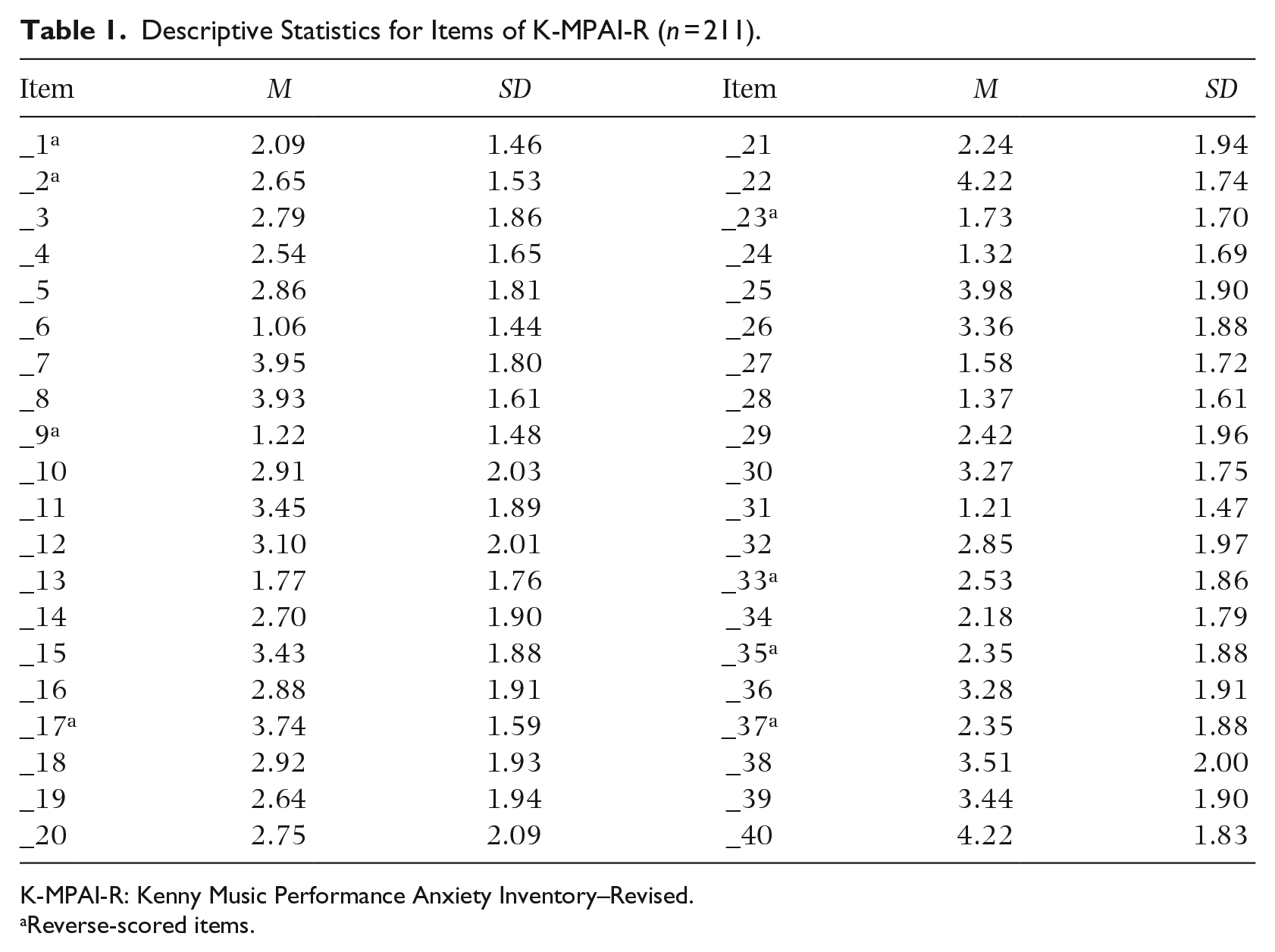
K-MPAI-R: Kenny Music Performance Anxiety Inventory–Revised.
Reverse-scored items.
The structure of the relations among the items was analyzed to document the adequacy of factor analysis: the KMO measure of sampling adequacy reached 0.85 and Bartlett’s test of sphericity signaled that the scale was psychometrically adequate for factor analysis, χ2(780) = 3,160.3, p < .001.
First-order exploratory factor analysis
A principal-axis factoring with varimax rotation of the 40 items of the K-MPAI-R was performed (Model 1). Five factors were extracted according to the parallel analysis. The five factors explain 39.3% of variance (Table 2). Factors were named with items having factorial loadings equal to or higher than .40:
- F1 = Proximal somatic and cognitive anxiety (11 items: 7, 10, 11, 12, 14, 16, 22, 26, 30, 34, 36; α = .87; ω = .86);
- F2 = Self/other scrutiny and evaluation (6 items: 15, 18, 21, 25, 38, 39; α = .78; ω = .79);
- F3 = Psychological vulnerability (7 items: 1, 3, 4, 6, 13, 19, 31; α = .80; ω = .81);
- F4 = Confidence in memory (2 items: 35–37; α = .78);
- F5 = Early parental relationship context (2 items: 9, 23; α = .61).
Principal-Axis Factor Analysis: Factor Loadings (Standardized) of the K-MPAI-R (n = 211).
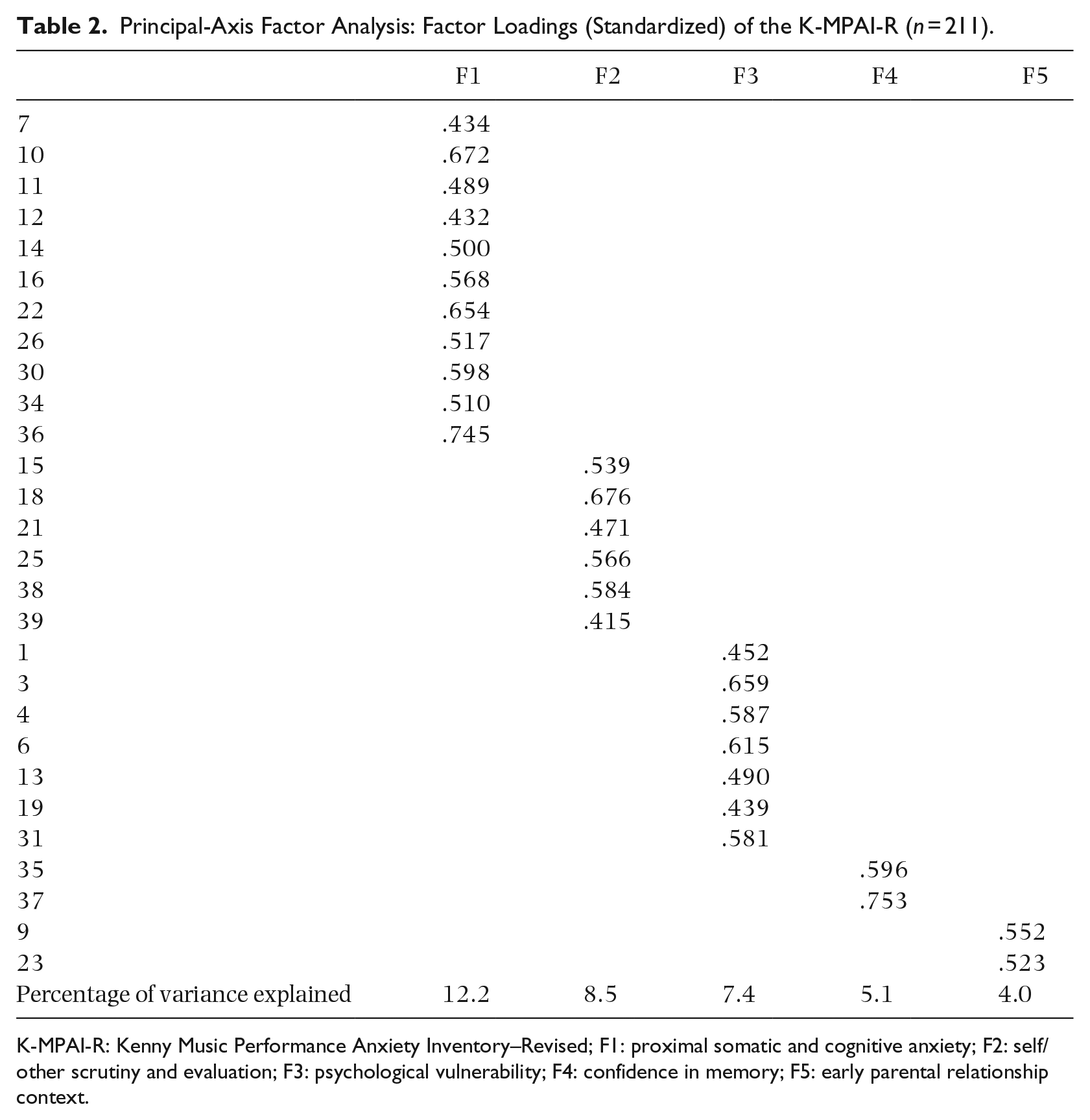
K-MPAI-R: Kenny Music Performance Anxiety Inventory–Revised; F1: proximal somatic and cognitive anxiety; F2: self/other scrutiny and evaluation; F3: psychological vulnerability; F4: confidence in memory; F5: early parental relationship context.
The root mean square of residuals was .05, which is acceptable. The RMSEA index was 0.05, which indicated good model fit. The structure is similar to the one found by factorizing a polychoric correlation matrix because items were ordinal variables.
Higher order factor analysis
The parallel analysis method suggested five factors. We undertook a higher order exploratory factor analysis. First, we performed a factor analysis with a minimum residual as the extraction and an oblique (oblimin) rotation since the estimation of a second-order factor implies a theoretical dependence between the first-order factors (Model 2) and selection of number of factors with parallel analysis. Items with factorial loadings equal to or higher than .30 were retained; therefore, iteration was undertaken to remove unnecessary items, until a stable structure was achieved (31 items, Model 3). Nine items from Kenny (2011) were eliminated. Two items were eliminated from Kenny’s Factor 2 “Worry/dread (negative cognitions)” (e.g., Item 28 “I often prepare for a concert with a sense of dread and impending disaster”) and Factor 7 “Generational transmission of anxiety” (e.g., Item 29 “One or both of my parents were overly anxious”). And, in each of the following factors, one item was removed and some factors were combined with another factor to create an extended factor: F1 “Depression/hopelessness (psychological vulnerability)” (Item 2), F3 “Proximal somatic anxiety” (Item 40), F6 “Post-performance rumination” (Item 32), F8 “Self/other scrutiny” (Item 25), F9 “Controllability” (Item 11), and F11 “Trust” (Item 8).
After removing these nine items, the parallel analysis still suggested five factors. The corresponding model expressed 41.5% of common shared variance, KMO = 0.86, χ2(346) = 401.5, p = .001.
A confirmatory higher order factor analysis was undertaken on 31 items, with five factors and the first three factors providing a general factor, as proposed in the research of Chang-Arena et al. (2018). The model showed adequate fit for all criteria: χ2(405) = 573.0, p < .001, ratio χ2/df = 1.41, TLI = .903, CFI = .915, RMSEA = .044, 90% CI = [.036, .053]. The standardized regression weights are presented in Table 3. For all of the 26 items of the higher order factor, loadings were significant. We named the higher order factor, G, “Negative affectivity in relation to music performance.”
Higher Order Factor Analysis: Factor Loadings (Standardized) of the K-MPAI-R (n = 211).
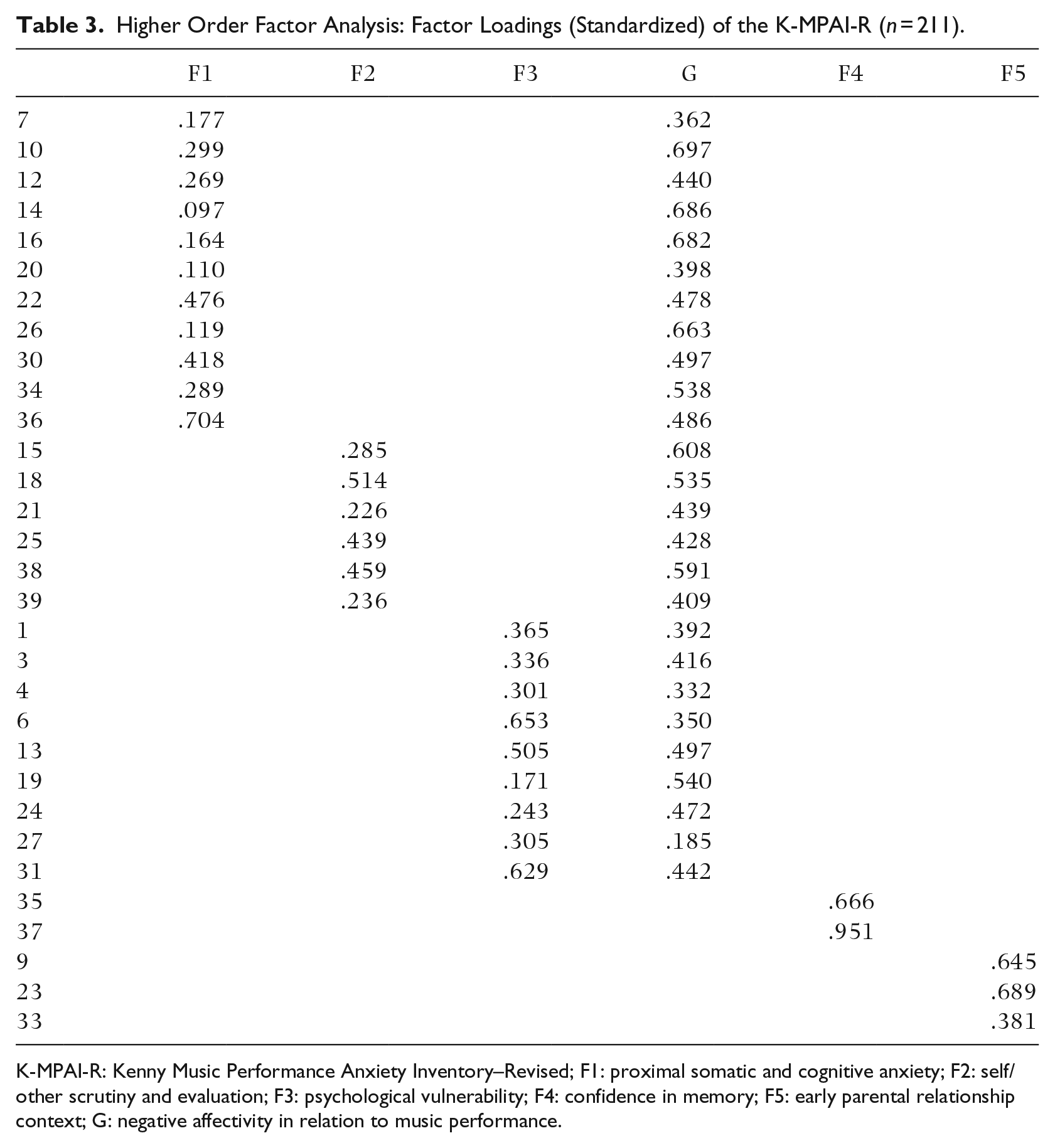
K-MPAI-R: Kenny Music Performance Anxiety Inventory–Revised; F1: proximal somatic and cognitive anxiety; F2: self/other scrutiny and evaluation; F3: psychological vulnerability; F4: confidence in memory; F5: early parental relationship context; G: negative affectivity in relation to music performance.
On the first-order factors, Cronbach’s alpha and omega indicated that internal reliability was adequate: the coefficients indicated that Factors 1 and 3 are “very good,” Factor 2 was “respectable” (Table 4). According to Cronbach’s alpha and omega, the general factor was “excellent.” The coefficients for ordinal alpha confirm those for Cronbach’s alpha. The correlations between the first-order and second-order coefficients were high (between .78 and .90).
Cronbach’s Alpha, Ordinal Alpha, and Correlations of the First-Order Factors and the General Factor (n = 211).
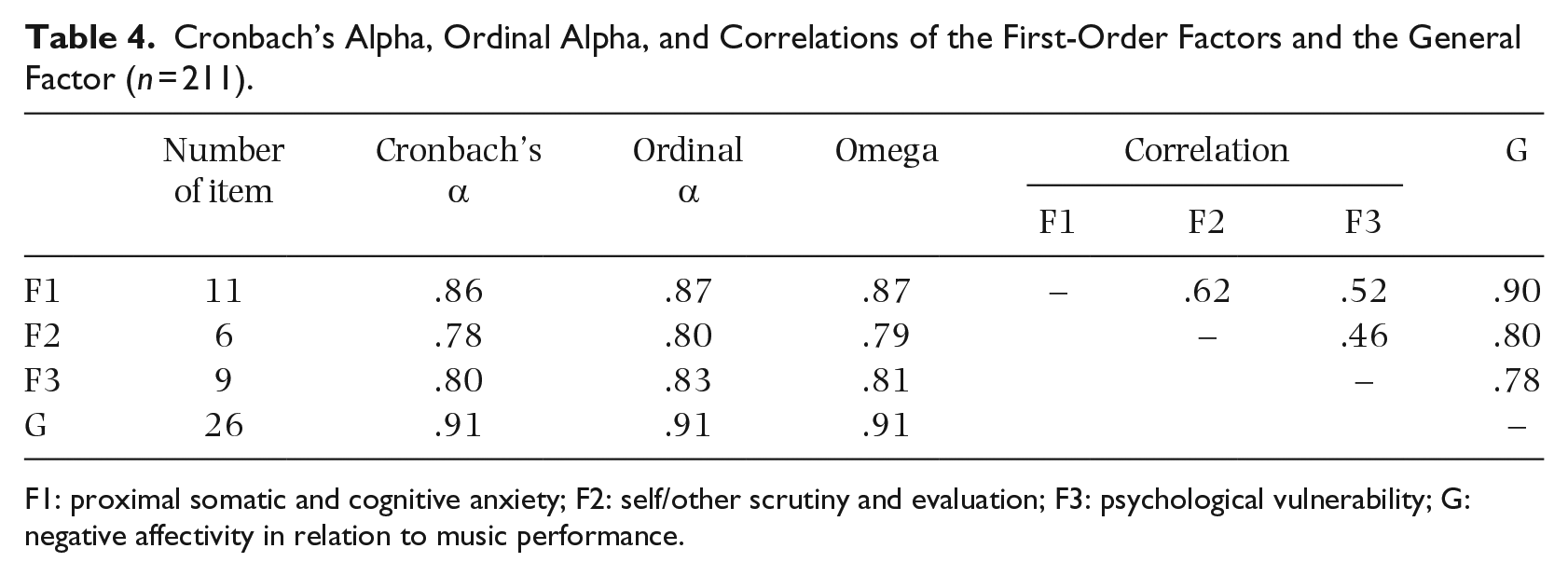
F1: proximal somatic and cognitive anxiety; F2: self/other scrutiny and evaluation; F3: psychological vulnerability; G: negative affectivity in relation to music performance.
K-MPAI-R and STAI
The scores of STAI ranged from 30 to 73, with an average of 48.68 (Table 5). There was no significant difference of STAI between genders: for men M = 43.79, SD = 9.80 and for women M = 50.58, SD = 11.56; t(48) = 1.948, p = .058.
Descriptive Statistics and Correlations Between K-MPAI-R Factors (First and Second Order) and STAI (n = 50).
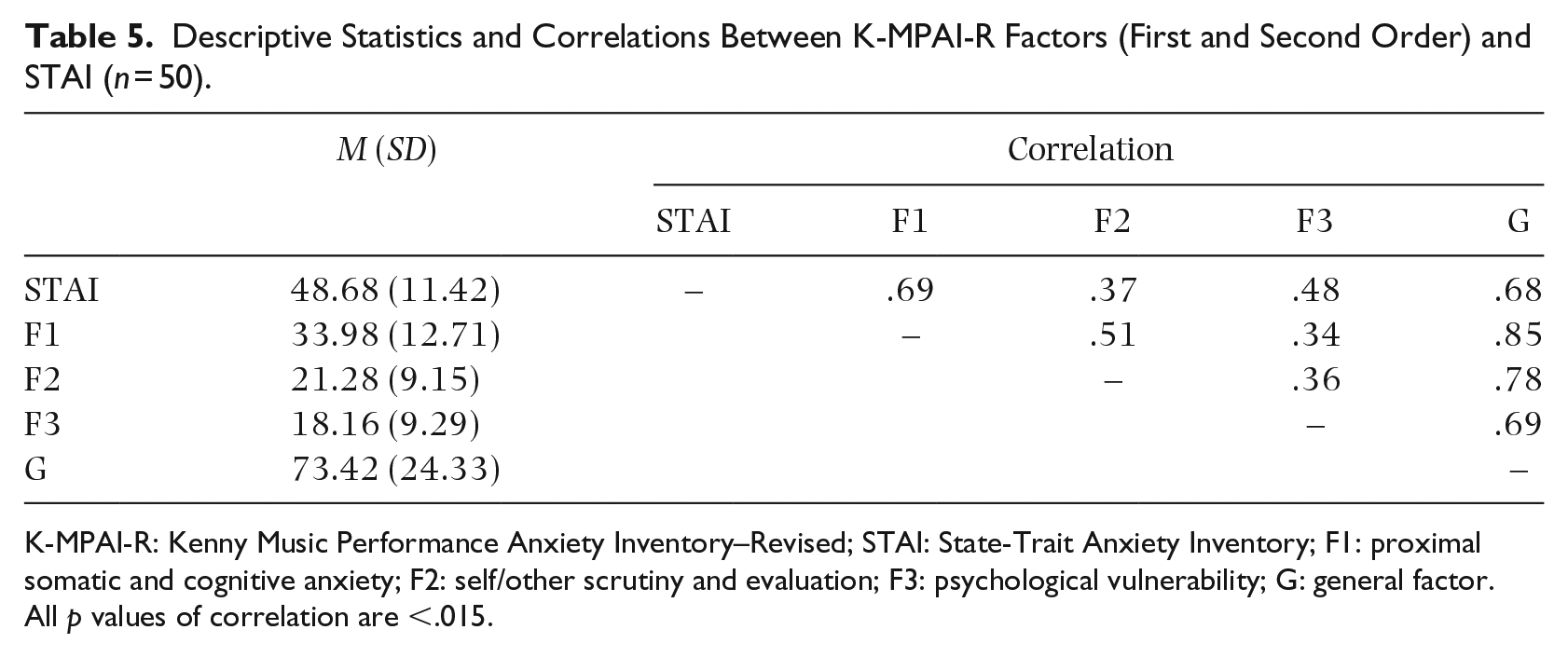
K-MPAI-R: Kenny Music Performance Anxiety Inventory–Revised; STAI: State-Trait Anxiety Inventory; F1: proximal somatic and cognitive anxiety; F2: self/other scrutiny and evaluation; F3: psychological vulnerability; G: general factor.
All p values of correlation are <.015.
K-MPAI-R factor scores were positively correlated with STAI: between .37 and .69 for the first-order factors (ps < .01). The correlation between the second-order—general—Factor G and STAI reaches .68 (p < .001). Finally, the correlation between K-MPAI-R and STAI total scores reaches also .68 (p < .001).
Discussion and conclusion
Previous studies have highlighted that musicians’ performance anxiety can be debilitating for their health and personal and musical development (Studer et al., 2011; Wesner et al., 1990; Williamon, Aufegger, Wasley, Looney, & Mandic, 2013). Various instruments exist to assess anxiety among musicians (Cox & Kenardy, 1993; Craske & Craig, 1984), with Kenny’s (2009) remaining the most used and recent. The third author created a French version that was certified by Kenny (2017) 1 and the aim of this study was to validate this French K-MPAI-R. Our results show satisfactory evidence of validity (positive correlation with STAI: between .37 and .69 for the first-order factors, ps < .01; the second-order—general—Factor G). Also, factors showed relatively good reliability (.61–.88) and Cronbach’s alpha/omega are good (.91).
Nine items of the original English version of the K-MPAI-R were excluded (2, 5, 8, 11, 17, 28, 29, 32, and 40) because of their low factor loadings. Five out of these nine items are also absent from the 26-item version of K-MPAI. Five factors resulted from the statistical analysis, comparable with Kenny’s factors. Precisely, we found Kenny’s Factors 1, 4, 5, 8, and a mixture of her Factors 2 and 3 that Kenny grouped together in the higher category (i.e., proximal performance concerns). Factor 1 “Depression/hopelessness,” Factor 9 “Controllability,” and Factor 11 “Trust” of the English K-MPAI-R were composed of, respectively, one item each. These items have been associated with combined factors or excluded from the questionnaire. Items 5 and 29 correspond to Kenny’s Factor 7 “Generational transmission of anxiety” and were removed from the K-MPAI-R French version. This can be partially explained because our sample was not only composed of young music students, but also older ones that may not relate to their family as much as young musicians, still living with and depending on their parents. Also, two items of the Factor 2 “Worry/dread” and, respectively, one item in Factor 3 “Proximal somatic anxiety” and Factor 8 “Self/other scrutiny” were eliminated. These items mainly refer to the musician’s ability to mentally cope with a performance situation (e.g., “Even in the most stressful performance situations, I am confident that I will perform well” or “I remain committed to performing even though it terrifies me”).
The French re-specified K-MPAI-R consists of five factors (F1 = Proximal somatic and cognitive anxiety, F2 = Self/other scrutiny and evaluation, F3 = Psychological vulnerability, F4 = Confidence in memory, and F5 = Early parental relationship context). Almost all factors showed satisfactory internal reliability (.78–.88), except for F5 with .61, which is under the minimum recommendation of .65. The general Factor G has Cronbach’s alpha and omega of .91. The general Factor G, as proposed by Chang-Arena et al. (2018), allows the comparison with other works, done in other languages, for example. Compared to the general factor found by Chang-Arena et al. (2018) in Australian professional musicians (English questionnaire), our general factor has some items less (Items 2, 5, 8, 17, 28, 29, 32, 40). Compared to the general factor found by Chang-Arena et al. (2018) on Peruvian professional musicians (Spanish questionnaire), our general factor does not include the following items: 5, 11, 17, 28, 29, 32. Our general factor is also equivalent to the Peruvian sample (.92), and slightly smaller than the Australian sample (.95; Chang-Arena et al., 2018). The certified French K-MPAI-R (40 items) can be used for comparison with the English K-MPAI-R. However, the interpretation of the factors should be done cautiously. It is preferable to compare the total score of MPA. Therefore, researchers should remain cautious with international comparison in other languages. However, this instrument can be useful for applied interventions with musicians.
Finally, in addition to the construct-related evidence regarding the factor structure, there was also first evidence regarding a convergent relationship with an adapted version of the STAI (Spielberger, 1983). At levels below .70, convergence was sufficiently low for the adapted STAI to not supersede the development of a music performance–specific scale. Future research has to present further evidence (e.g., regarding criterion-related validity) to support the intended interpretation of K-MPAI-R scores.
Some limitations must be highlighted. First of all, the French version of the K-MPAI-R should be validated in other populations and settings—for example, with professional musicians or music students, separately, and/or at earlier stages of their training. Second, as mentioned above, the instrument was assessed in a French-speaking Swiss cultural context. However, music students from tertiary music schools in Switzerland may come from different country and be influenced by their origins when answering the questionnaire (South American, German, Spanish, etc.). Therefore, when interpreting the results, this point should be considered. Also, researchers such as Papageorgi et al. (2007) have shown that the previous training context, experiences of previous bad performances, the type of repertoire to be played, and the problem of limited and inadequate mental preparation can have significant influences that can generate and maintain performance anxiety. When studying MPA, it can be useful and interesting to combine it with qualitative data (e.g., narratives, interviews). Finally, it would also be of interest to analyze the measure’s capability to detect changes in the population after they have undergone a mental preparation program.
Given the adequate psychometric properties of the French K-MPAI-R, this instrument is valid and reliable for the measurement of performance anxiety within French-speaking musicians by researchers and allows the use of this tool by psychologists when accompanying musicians in mental preparation. However, as mentioned earlier, the tool was validated in a Swiss cultural context including musicians from many different origins; in fact, the instrument should be used and interpreted with precaution when employing it in other French-speaking countries. The French K-MPAI-R is a useful instrument to evaluate MPA and can serve as a screening tool for scientific research to have a better comprehension of musicians’ experiences and their needs to cope with anxiety. And, this type of screening can also interest professionals working in this domain (e.g., psychologists) and allows them to develop or monitor interventions. Professionals working with musicians (e.g., psychologists, mental trainer) could follow some general guidelines to evaluate and discuss performance anxiety with their musicians. The total score should be taken as a general information, attesting that the musician presents some performance anxiety symptoms or not. The subscores may warrant more cautious interpretation given the partial fulfillment of the validity’s expectation. We hope that the availability of the K-MPAI-R will promote further research projects on this topic in French-speaking countries and provide a better understanding of the factors influencing musicians’ MPA. However, even if it is necessary to remain cautious with the international comparison, this instrument can be useful for purposes of musicians’ accompaniment. As it is a multidimensional scale, the most important is to check each factor and their associated lowest items to work on pertinent aspects with the musician. Also, more studies on items and factors criteria should be undertaken to confirm these guidelines.
Footnotes
Acknowledgements
We would like to thank Professor Dianna T. Kenny for making available the certified French version of the Kenny Music Performance Inventory–Revised.
Funding
The author(s) received no financial support for the research, authorship, and/or publication of this article.
