



Abstract
This study investigated physiological manifestations and self-perceived trait levels of performance anxiety for higher education contemporary commercial music vocalists undertaking tasks of increasing difficulty in a studio setting. Research has documented the prevalence of performance anxiety across musical genres generally, but understanding of how individual trait levels of performance anxiety affect physiological indicators across a range of task difficulty is limited. Studies measuring physiological manifestations of anxiety among instrumentalists, woodwind players and singers have reported varying results regarding heart rate (HR) and electrodermal activation (EDA) in high-stress settings and when performing challenging musical tasks. In this study, contemporary commercial music singers completed 10 different vocal tasks while wearing a device that measured their HR and EDA (physiological stress). Participants also reported their trait level of music performance anxiety in a survey (K-MPAI measure). The results show that electrodermal activation increased with task difficulty, but the results for HR were less clear, with average levels not consistently related to task difficulty in a linear fashion. This study demonstrated that when performing increasingly challenging singing tasks, contemporary commercial music vocalists with higher trait levels of music performance anxiety experienced elevated levels of EDA. Those with low levels of trait music performance anxiety did not experience higher levels of EDA with increasing task difficulty. The results provide new insights to contemporary commercial music vocalists regarding non-invasive ways of monitoring anxiety levels during individual practice and lessons that could lead to targeted interventions to address performance anxiety triggers in their individual systems.
Keywords
Background
Music performance anxiety is an ongoing issue for many musicians of all ages and experience levels. A recent overview of the field has focused on definitions, characteristics, incidence, associated factors, and treatment methodologies (Osborne & Kirsner, 2022). In a summary of approaches to management of music performance anxiety the following strategies were highlighted as effective: relaxation techniques such as deep breathing, yoga and meditation for reducing physical symptoms; cognitive restructuring, realistic goal-setting, systematic desensitisation and psychotherapy for management of cognitive symptoms; and combining behavioural and cognitive techniques to create tailor-made solutions for problems specific to the individual (Zhukov, 2019a). Notwithstanding, generalising such approaches across all styles of music performance may be misleading.
Vocalists of contemporary commercial music (CCM) styles face vastly different tasks and challenges to Classical or Jazz vocalists, yet research into the field is limited. Artistic choices and CCM style expectations demand vocalists produce sounds closer to speech inflections and tonality, maintaining breathy and distorted vocal sounds across the complete vocal and dynamic range (e.g., Aaen et al., 2022; Bartlett & Naismith, 2020; Sielska-Badurek et al., 2018; Soto-Morettini, 2014; Turner & Kenny, 2012). Making short sounds at the individual’s speaking pitch is easiest for the human larynx, since it is not built to speak or sing high, loud, or long. Its primary anatomical function is to protect the airway and regulate airflow, while its secondary function is to produce sound and communication (e.g., Moore et al., 2018). When the autonomic nervous system is activated due to stress, danger, or difficulty of task, the primary function tends to override the secondary function by constricting the airway (Helou et al., 2013), which interferes with or stops any sound production at the level of the true vocal folds (e.g., strain and breathiness). Due to the enhanced requirement of authenticity and constant change of vocal tone, which can lead to a perceived lack of control, a range of performance anxiety triggers may be present in CCM vocal performance that differ from other music genres. Yet, non-invasive ways of monitoring anxiety levels in relation to task difficulty are lacking. This limits our understanding of performance anxiety specific to CCM, which hinders our ability to develop effective style-specific interventions and coping mechanisms during studio sessions and performance.
Performance anxiety across different musical genres
The impact of musical genre on the level of experienced performance anxiety has been considered by researchers across several non-CCM styles. A large survey of 244 musicians (170 undergraduates and 74 professionals) across Western classical, popular, jazz and Scottish traditional genres focused on performance anxiety 1 hr before, immediately before, and during a performance (Papageorgi et al., 2013). The results highlighted higher anxiety levels for solo performance versus a group performance, and for classically trained musicians as opposed to popular music or jazz. No separate results were presented for popular music vocal students. Contrary to a common perception of relaxed jazz musicians, a Canadian study reported high levels of performance anxiety and trait anxiety among 73 university jazz music students (Martin-Gagnon & Creech, 2019). There was no comparison to non-jazz students and no breakdown of data by instrument. A German study mapped perceived performance anxiety and musical background of 239 music students aged 7–20 years (Nusseck et al., 2015). Results showed that classical musicians experienced high performance anxiety during the age of 7–16 years, but this reduced for older students. In popular music, the trend was reversed: lower performance anxiety in younger musicians and higher performance anxiety in 16+-year-olds. The study demonstrated differing trajectories of performance anxiety between musical genres across student age, but did not include CCM vocalists. These studies illustrate the preponderance of performance anxiety research on instrumentalists across different musical genres, and less focus on CCM vocalists.
Performance anxiety in vocal contexts
Researchers have been investigating vocal performance anxiety for the past 20 years, however, most do not consider singers’ specialisation: classical, opera, musical theatre, jazz or popular music. One of the early studies compared 43 university vocal students in the United Kingdom (29 female and 14 male) to published norms for a general population of undergraduate students by implementing the Spielberger State-Trait Anxiety inventory over three timepoints: 2 weeks before a performance, 10 min before and immediately after a performance (Kokotsaki & Davidson, 2003). The results indicated higher trait anxiety levels among the vocal students, particularly the females, in comparison to the general population. A large survey of 201 semi-professional choristers aged 17–70 in the United States confirmed performance anxiety as a common experience, with solo performances being more stressful than ensemble performances (Ryan & Andrews, 2009). Interestingly, singers with higher music education training “reported less frequent, although not less severe, episodes of performance anxiety than those without” (p. 108). This finding suggests that vocal training can improve management of performance anxiety symptoms but not necessarily reduce their acuteness. Similar findings have been reported from Canada, where a performance anxiety survey of 85 community choristers aged 14–75 showed that 95% of singers experienced performance anxiety symptoms prior to performing, with anxiety being more acute prior to rather than during a performance (Stothert, 2012). A survey of 48 chorus members of Opera Australia reported higher trait anxiety than in the general population, but at the same time, more personal coping resources and support to manage anxiety (Kenny et al., 2004). How vocalists’ differing levels of anxiety interact with symptoms of performance anxiety is an area still largely unexplored and is the focus of this research.
Measuring music performance anxiety
Music performance anxiety studies typically utilise established survey instruments such as K-MPAI (Kenny, 2023) to assess the emotion-based theory of anxiety, with higher scores indicating more severe performance anxiety and psychological distress generally. K-MPAI has been translated into Spanish and French and validated in several studies (e.g., Antonini Philippe et al., 2022; Chang-Arana et al., 2018), including higher education music students (Kenny et al., 2013; Paliaukiene et al., 2018).
Some researchers have focused on examining physiological indicators of performance anxiety in musicians to evaluate the veracity of symptoms described in self-report survey studies. For example, Chanwimalueang et al. (2017) used EEG to measure heart rate (HR) variability of 16 students from the United Kingdom and Switzerland Conservatories (11 violinists and 5 flautists) in low stress (no audience) and high stress (audition panel) conditions before and during performance. The results showed that HR was higher in the high-stress condition than in the low-stress condition and among the female participants. Small variations in HR were observed between before and during performance periods, suggesting that managing performance anxiety symptoms just before a performance might have beneficial flow-on effects on the performance itself.
Musicians who use breath to generate sound on their instruments are particularly vulnerable to hyperventilation caused by MPA. A survey by Studer, Danuser, et al. (2011) demonstrated a higher frequency of respiratory symptoms among wind players and singers, particularly females. However, these results need to be confirmed with physiological measurements. An Australian study of 46 advanced students aged 19–67 (mostly woodwind, brass and voice) investigated the impact of 30 min intervention consisting of slow breathing with and without HR variability biofeedback on performance anxiety during sight-reading of two difficult tasks (Wells et al., 2012). Slow breathing groups improved significantly in reducing their anxiety versus the control group, but the addition of biofeedback to slow breathing did not produce a significant difference. This study demonstrated the efficacy of slow breathing to moderate performance anxiety symptoms for a range of musicians who rely on breath control to produce sound. How the efficacy of such interventions differs across tasks of varying levels of difficulty was left unexplored.
Kenny et al. (2013) investigated MPA in skilled flute players, utilising several surveys and measuring HR and muscle tension during an audition-like experiment. The participants performed technical work (an easy and a difficult scale) and two contrasting orchestral excerpts. The results showed highly variable HR across the experiment and “no significant differences in HR between high and low MPA groups for any of the musical tasks” (p. 317). Zhukov (2019b) scrutinised stress levels of six instrumentalists (woodwind higher education students) during sight-reading. Electrodermal activity (EDA) and HR were measured across 11 tasks of increasing difficulty, with EDA tracking higher as musical examples became more challenging and HR varying widely among the participants. Statistical analyses confirmed the physiological results: EDA was strongly correlated to the task difficulty and strongly negatively correlated to sight-reading accuracy, and HR was moderately correlated to sight-reading accuracy. The study provided new physiological evidence of stress experienced by instrumentalists during sight-reading, suggesting that task difficulty can worsen performance anxiety symptoms.
A study of 31 first- and second-year vocal students at the Belgium Conservatory utilised electrocardiogram (ECG) and surveys to measure stress levels when singing a solfeggio melody in non-stressful (quiet room and researcher) and stressful contexts (a four-jury panel during examination) (Larrouy-Maestri & Morsomme, 2014). HR activity and survey results were both significantly higher in the stressful situation for all participants, but first-year students outperformed second-year students on vocal accuracy against expectation. This could be explained by the fact that second-year students had to pass this examination in order to continue their studies, while the first-year students were not affected by the outcome, thus making the context particularly stressful for the second-year students. This study demonstrated how the importance of evaluation can increase the physical symptoms of performance anxiety and negatively impact performance outcomes.
Seven opera singers from a German opera company were monitored during rehearsals and performances for HR and systolic blood pressure (Spahn et al., 2010). While none of the singers met the criteria for a pathological performance anxiety on the Spielberger State-Trait Anxiety inventory and all “declared they could cope well with the requirements of a stage appearance and already had ample stage experience”, all participants recorded higher HR and blood pressure before and during performance in comparison to after performance (p. 180). This study demonstrated professional singers’ ability to perform successfully despite physical symptoms such as increased HR. Cui et al. (2022) measured HR variability of 10 opera trainees during performance onstage and offstage, showing that “there are two relevant types of stress for opera performance: psychological stress, which is felt more keenly offstage, and physiological stress, which is greater onstage” (p. 797). A Canadian study of 24 opera trainees measured HR variability during a resting period 1 hr before a performance and during a live performance using ECG (Yeganeh et al., 2023). Additionally, participants completed a battery of neuropsychological tests during a 4-week period post-performance. The results showed that greater cognitive function was related to lower stress during opera performance.
The overview of literature has demonstrated that across different musical genres, performance anxiety is associated with a range of physiological manifestations. While most extant research has explored instrumentalists during one or two contexts (i.e., stress level or difficulty), and measured performance anxiety repeatedly (e.g., before and after performance), less is known about performance anxiety across a larger range of activities within genres, especially for CCM vocalists (which is the focus of this study). Furthermore, while state-anxiety has been utilised in several studies, we acknowledge that students also have differing levels of trait anxiety which is considered more stable over time. This may suggest that not all CCM vocalist students may react physiologically in the same way to tasks of varying levels of difficulty. While the debate regarding whether HR or HR variability provides a more nuanced measurement of MPA symptoms is ongoing, in vocal MPA research, Cui et al. (2022) reported that in opera performance, “HRV is linked to general (not performance-specific) stress” (p. 797). Therefore, we chose to utilise HR when measuring the physiological responses of our participants during various vocal tasks.
The study aims to address this gap in research and asks the following research questions:
(1) Do physiological indicators of performance anxiety (i.e., EDA and HR) increase during a range of vocal tasks of increasing difficulty in a studio setting?
(2) Does this positive relationship between task difficulty and physiological indicators (if it exists) differ across levels of self-perceived performance anxiety? Specifically, we hypothesise that physiological indicators will increase with task difficulty more for participants with higher levels of performance anxiety than for participants with lower levels of performance anxiety.
Methodology
The study received ethical clearance from the Human Ethics Committee of an Australian university. The experiments were conducted on an individual basis in a vocal studio familiar to students by a staff member known to them.
Participants
Eleven CCM vocalists from the first and second year of a degree programme took part in the study (mean age = 20.8 years; seven females, two males, two non-binary; mean years of singing = 10.5 years). The tested non-binary students did not show any marked changes in their vocal production during their university study and during the experiment, despite any potential hormonal interventions.
Experiment protocol
The experiment measured physiological indicators of performance anxiety with regard to task difficulty and not due to public performance. Each participant completed 10 vocal tasks in a studio setting. The tasks were constructed in a sequence across three categories (speaking, singing single notes and singing songs) and performed approximately 30 s apart, to establish a sequential comparison beginning with easy tasks and progressing to more difficult tasks.
In line with prior research on anatomical function, the order of tasks was guided by the challenge to the primary function of the larynx and its response to protect the airway under duress (Helou et al., 2013). The result was a series of tasks of increasing difficulty, starting at most comfortable (Speech Normal), then change of dynamics (Speech Loud, Speech Soft), change of duration (Note Normal), change of pitch (Note High), moving across the range in a scale (Scale, from Note Normal to Note High), and finally moving across the range in varying intervals that are comfortable for the participant (Song 1, easy), and challenging (Song 2, hard).
The experimental tasks began with reading of a short passage: first, in a normal voice, then loudly, and then very softly. The text used comprised the opening paragraph from the Rainbow Passage (Fairbanks, 1960). It contains all phonemes for American English and is usually applied in speech pathology to gather speech samples when monitoring speech therapy approaches such as Parkinson’s disease (Xu et al., 2020), muscle tension voice disorder (Madill et al., 2021) or voice therapy for injured singers (Childs et al., 2022).
After passage reading, each participant sang a long comfortable note (twice), then the same note an octave higher (twice), followed by a scale connecting these two notes. Portions of an own-choice comfortable song and a challenging song were also performed.
On completion of the 10 vocal tasks, a survey was administered to collect demographic measures and participants’ self-reported measures of trait performance anxiety. Surveys took approximately 10 min to complete and were anonymised prior to the analysis.
Measures
The Empatica-4 wristband was utilised to collect arousal data related to stress, including EDA and HR outputs during the ten tasks. This tool is being increasingly used across a wide range of disciplines, for example, pain management, allowing researchers to compare “subjective users answers with physiological values given by the device” (Perales et al., 2019, p. 32869). By pressing a button on Empatica-4 before the commencement of each task, time stamps were created so that the continuous data output could be spliced into data for each individual task.
Time
Data was collected from the Empatica-4 device in intervals of 1 s. For this study, the first 15 s of data were utilised for all tasks, except for the Scale task. The Scale task took less time on average, with three participants completing the task in 6 s; therefore, only the first 6 s of the Scale task were included in the analysis. Using a set timeframe for each task greatly enhanced the ability of the study to account for residual variance components common to intensive longitudinal designs (Bolger & Laurenceau, 2013).
Electrodermal activation (EDA)
EDA measured sympathetic nervous system arousal related to stress experienced by a participant, with a normal range of 1–20 μSiemens.
Heart rate
The device sensor measured blood volume pulse and HR, with a normal resting HR for adults ranging from 60 to 100 beats per minute.
Performance anxiety
Participants’ self-perception of music performance anxiety was assessed by the 40-item K-MPAI measure (Kenny, 2023), with a maximum score of 240 points (e.g., “I worry that one bad performance may ruin my career”). This was a single measure collected by survey after participants completed the 10 vocal tasks.
The aim of the study was to explore whether increasing task difficulty was associated with elevated EDA and the HRs measured over time and whether this relationship differed across participants’ reported levels of performance anxiety. It was hypothesised that task difficulty would raise EDA levels and HR, specifically in participants with high performance anxiety levels.
Analytical approach
The repeated measures of EDA and HR for 15 s were assessed across tasks using linear mixed modelling (West et al., 2022). This statistical approach accounts for repeated measures from the same individuals (random intercept) to explore differences in mean values of EDA and HR (separately) across the 10 tasks (random Task slope). It is worth noting that linear model residuals are assumed to be random and identically distributed over time. This is rarely the case for intensively repeated measures (i.e., outcomes measured close in time). For instance, a measure of HR at one timepoint is likely to be related, or similar, to the prior measurement 1 s earlier; therefore, it is not random. Linear mixed modelling supports exploration of residual covariance structures to account for such relationships (Garson, 2020). It was for this reason that we included the first 15 s for each task (except the Scale task for 6 s) when most participants had data. Including all data resulted in some later timepoints in a Task that were too sparsely populated for the model to converge. All analyses utilised IBM SPSS Statistics (Version 27).
This analysis was conducted in two steps. In the first step, the average level of EDA and HR was reported for each task. A post hoc comparison was conducted to ascertain whether Speech Normal (the easiest task we viewed as a baseline) significantly differed from more difficult tasks, using a Dunnett test which accounts for multiple comparison tests (Dunnett, 1955). Time was included as a direct effect and the mean was calculated at the approximate middle timepoint for each task. Time was not considered the focal point of this study but was treated as a control variable.
In the second step, the relationship between trait levels of performance anxiety with EDA and HR was explored as a direct effect and an interaction (i.e., Task × Performance Anxiety). A significant direct effect will suggest a consistent (i.e., linear) relationship on EDA/HR for each task. A significant interaction will suggest that this relationship between the outcomes and tasks depends on the level of performance anxiety.
In addition to modelling task effects categorically, we also conducted an exploratory analysis using average perceived task difficulty ratings as a continuous predictor. These difficulty ratings were collected from a separate cohort of 25 students who rated each experimental task on a 5-point Likert scale. To explore whether physiological responses were due to task difficulty rather than task order or duration, we replaced the categorical Task variable with perceived task difficulty in a linear mixed model. We also included within-task time (seconds 0–15, centred) as a predictor to examine changes over the course of each task. Separate models were estimated for EDA and HR.
To explore whether physiological changes could be attributed to elapsed time rather than task characteristics, we created a continuous variable (Cumulative Time) representing the number of seconds elapsed since the beginning of the first task. This variable ranged from 0 to 141, across all task duration. 1 We included both Task (categorical) and Cumulative Time (centred) as fixed effects in a linear mixed model to evaluate their relative contributions to changes in EDA and HR. We also tested a quadratic term for cumulative time to assess potential nonlinear trends.
Results
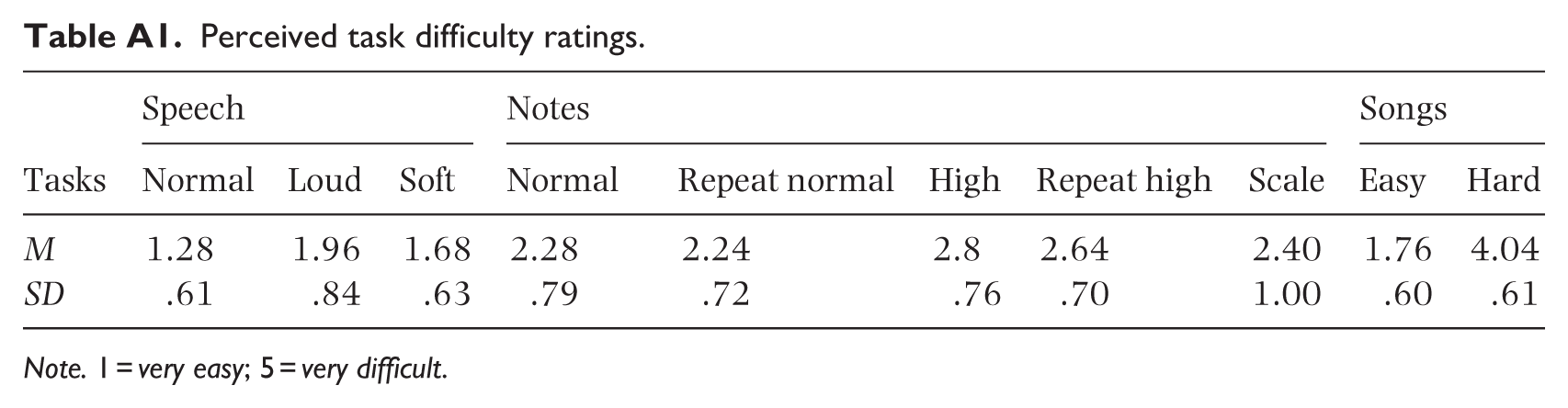
In a class activity, 25 higher education CCM vocal students were asked to rate the difficulty of experiment tasks on a 5-point Likert scale. Average scores demonstrated a generally increasing perception of difficulty across the three categories of speaking, singing individual notes and singing songs: speaking tasks ranging 1.28–1.96, singing individual notes ranging 2.24–2.8, and singing songs ranging 1.76–4.04 (see Appendix 1, Table A1, Figure A1).
All 11 participants completed the 10 tasks, starting with Speech Normal, followed by 9 other tasks. The average EDA score across all tasks was 3.55 (SD = 3.35), ranging from 0.18 to 16.92. The average HR across all tasks was 90.93 (SD = 14.34), ranging from 60.07 to 121.57. For both EDA and HR, there were 1,520 recorded seconds. Missing data was minor (i.e., 2.04%) due to some participants finishing the tasks in less than the allotted time. The assumed error covariance structure that fit the data best was a first-order autoregressive structure with homogeneous variances (AR1) after testing against other error covariance structures. Residual diagnostics revealed two outliers for EDA, which were plausible and not influential to the results. Apart from these outliers, the inspection of homogeneity of variance and normality of residual graphs for both outcomes indicated that the assumptions of the linear mixed model were met.
In the first step, we modelled the marginal means of EDA and HR for each task utilising linear mixed modelling (see Table 1). The marginal means for EDA revealed increasing levels for tasks of greater difficulty (see Figure 1). Each task’s EDA mean was compared to Speech Normal, the easiest task (i.e., Dunnett test). Although Speech Loud and Speech Soft were not statistically different from the baseline Speech Normal, all other tasks afterwards were significantly higher statistically in their mean level of EDA.
Means, standard errors, and post hoc comparisons to baseline task for EDA and heart rate.
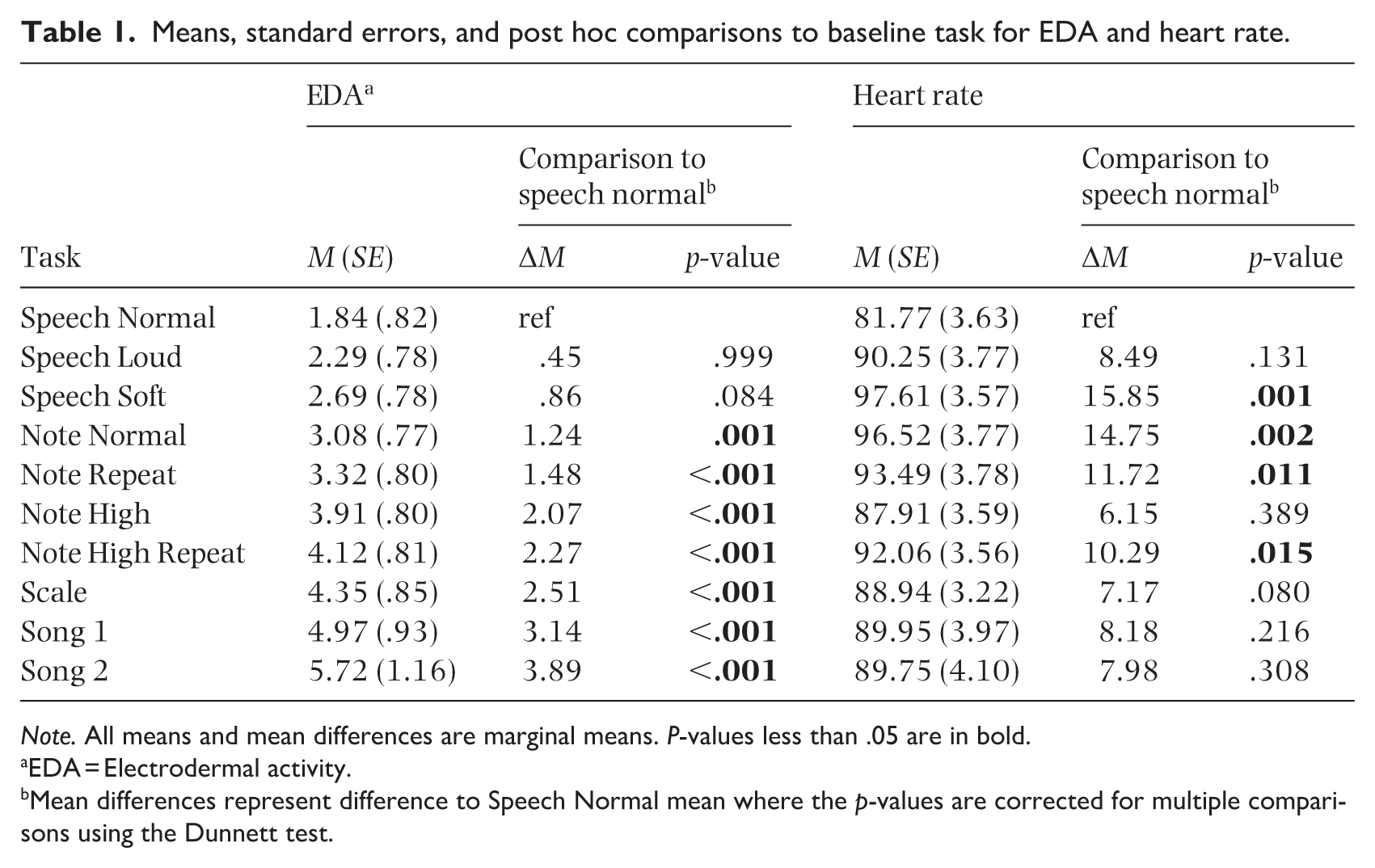
Note. All means and mean differences are marginal means. P-values less than .05 are in bold.
EDA = Electrodermal activity.
Mean differences represent difference to Speech Normal mean where the p-values are corrected for multiple comparisons using the Dunnett test.
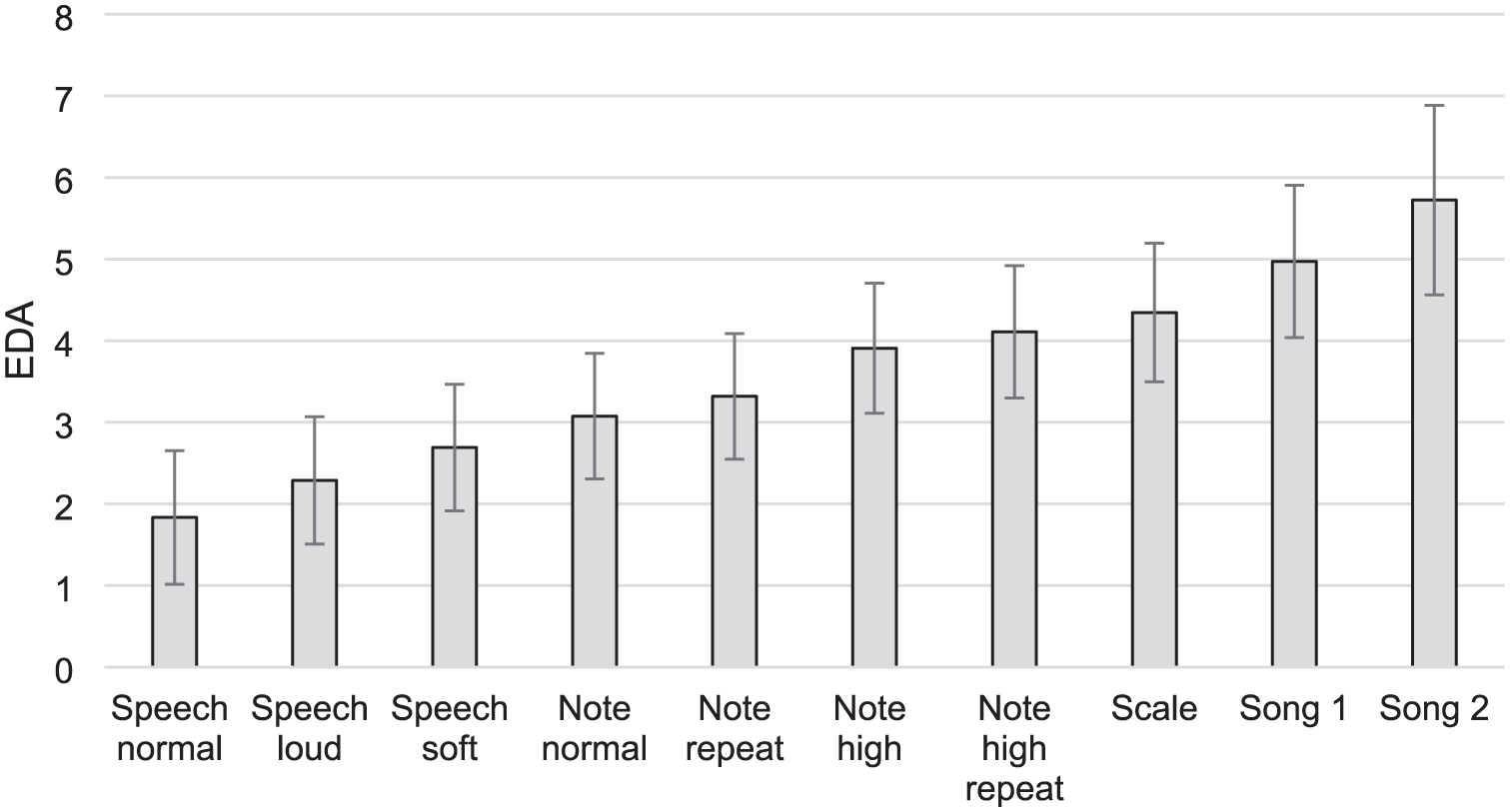
EDA average levels by task.
The marginal mean for HR across all tasks revealed a slightly more complex relationship with task difficulty (see Figure 2). Speech Normal had the lowest average HR (M = 81.77) of all tasks, while Speech Soft had the highest (M = 97.61). Only four of the tasks had statistically higher average HRs compared to Speech Normal, the easiest task. These tasks were: Speech Soft, Note Normal, Note Repeat, and Note High Repeat. The other tasks had higher mean HRs, but the difference was not sufficient to reach statistical significance. These tasks included: Speech Loud, Note High, Scale, Song 1 and Song 2.
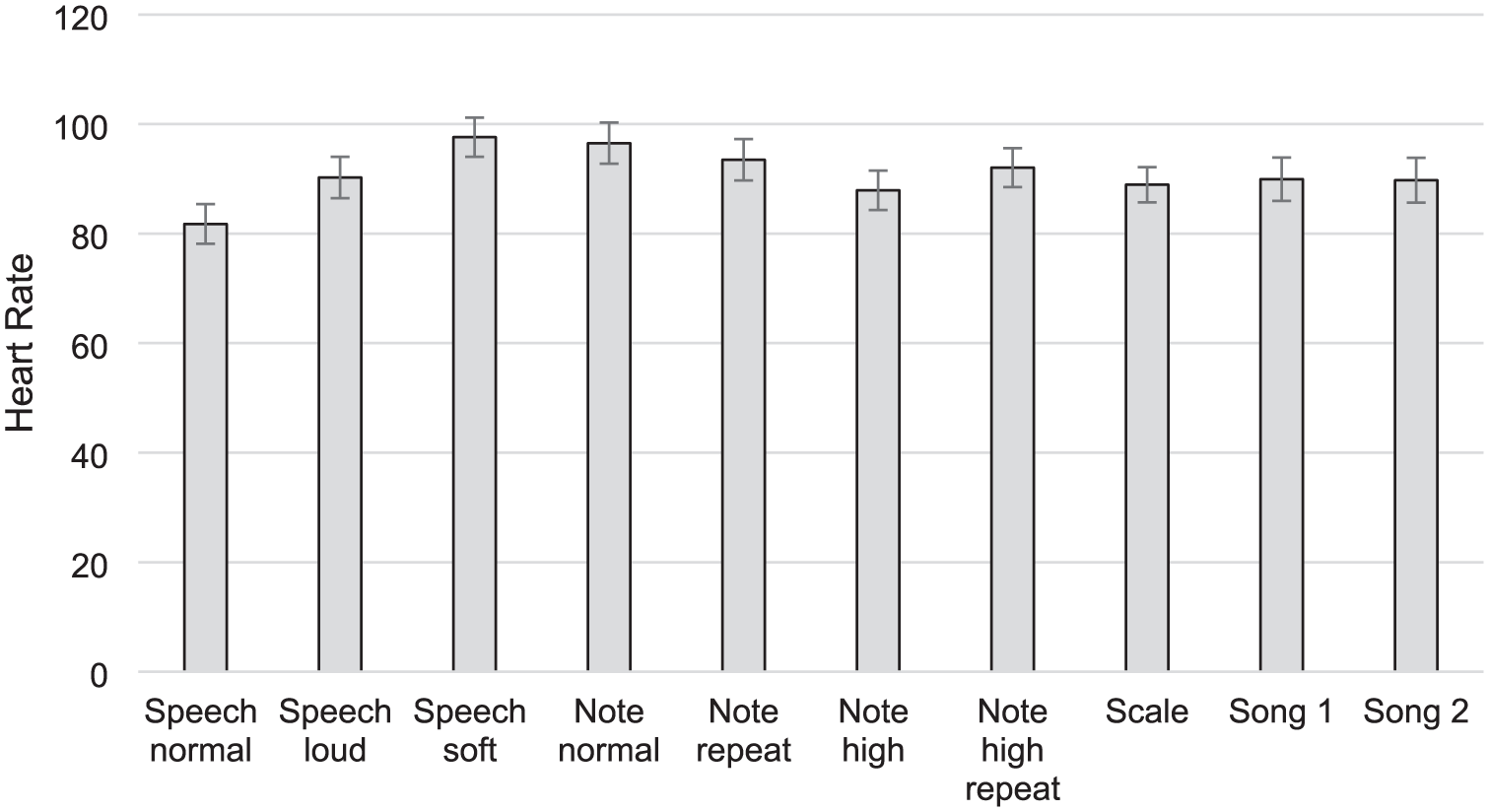
Heart rate average levels by task.
In the second step, we explored the relationship between trait levels of performance anxiety and the mean level of EDA and HR across tasks. The mean level of performance anxiety as measured by K-MPAI was 130.91 (SD = 14.33) for the 11 participants, ranging from 114 to 159. Previous research adopted clinical cut-off of 105 points as inclusion criteria (e.g., Clarke et al., 2020; Juncos et al., 2017). All participants in this study scored higher on performance anxiety than the clinical cut-off. While this might be a surprising finding in a random sample, the fact that these students volunteered to take part in the study may suggest that many had performance anxiety issues and were interested to learn more about their individual triggers.
Performance anxiety was significantly related to EDA, but not HR. For EDA, both the direct effect and the interaction (Performance Anxiety × Task) were significant predictors of EDA across tasks. This indicated that the relationship between EDA and tasks depends upon the level of performance anxiety. Given that performance anxiety is a continuous measure (K-MPAI), this can be visualised by comparing the marginal means for three levels of performance anxiety. This is typically done at the mean and ± 1 SD from the mean. This entailed estimating the task means at performance anxiety values of 130.91 (the mean), 116.6 (M – 1 SD), and 145.2 (M + 1 SD).
Higher levels of individual performance anxiety resulted in a greater increase in EDA as task difficulty increased (see Figure 3). For low levels of performance anxiety, we did not detect any significant differences in mean EDA levels across Tasks when compared to our baseline task of Speech Normal, F(9, 25.6) = 1.26, p = .304. For average levels of performance anxiety, F(9, 31.2) = 5.66, p < .001, and higher levels of performance anxiety, F(9, 26.51) = 10.61, p < .001, each task beyond Speech Loud was significantly higher than Speech Normal. The mean and post hoc comparison results are presented in Appendix 1, Table 1 and 2 respectively.
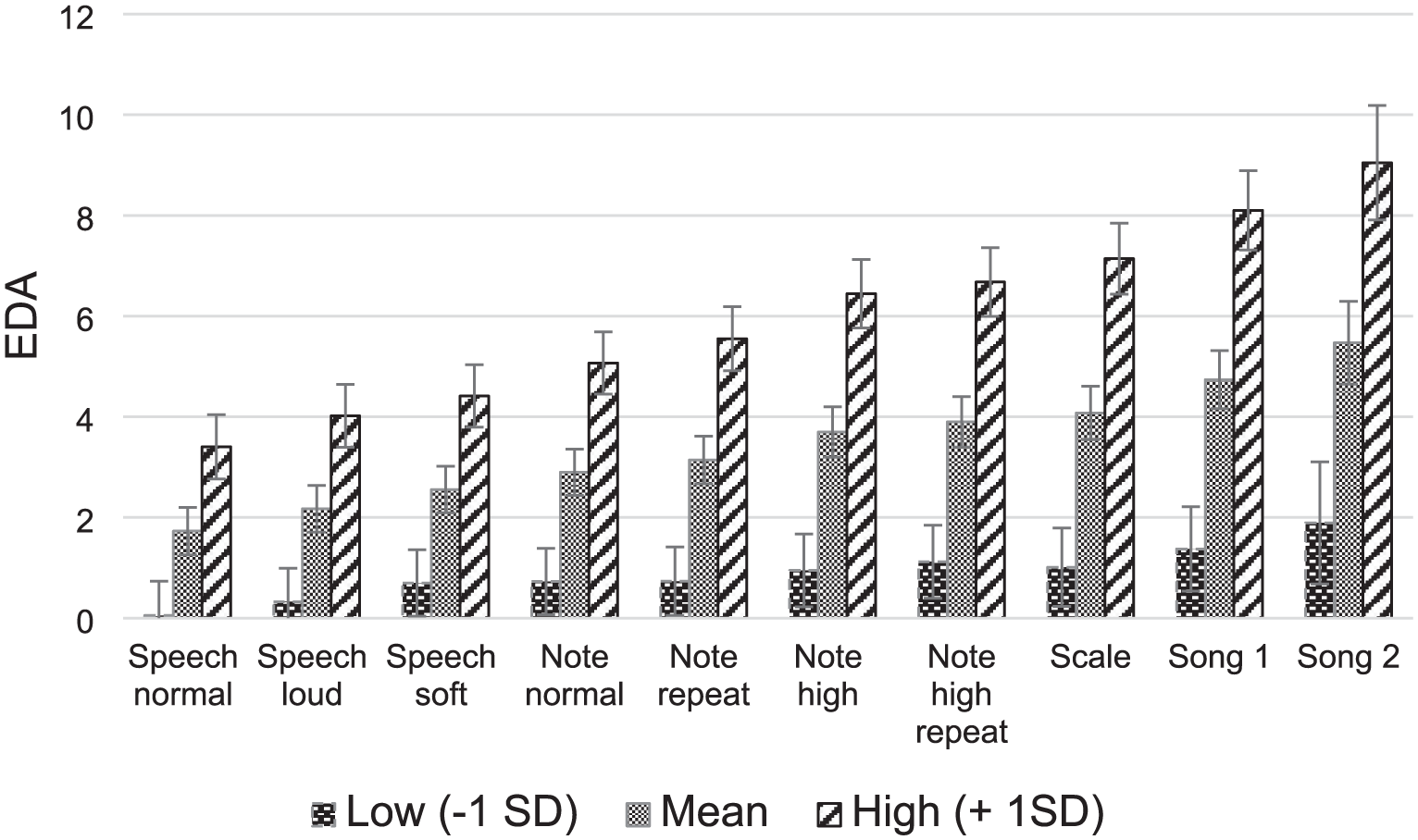
Mean EDA by task for three levels of performance anxiety.
Exploratory analysis using perceived difficulty
Linear mixed models were re-estimated with perceived task difficulty (continuous) and within-task time as predictors, instead of the categorical Task variable. This approach enabled a more parsimonious model to explore the effect of perceived challenge and time on physiological arousal.
EDA outcome
For EDA, Perceived Difficulty was a significant predictor (β = .088, SE = .028, p = .002), indicating greater sympathetic nervous system arousal for tasks perceived as more difficult. A small but significant effect of time was also observed (β = –.023, SE = .008, p = .004), suggesting a slight reduction in EDA over the 15 s measurement window. The interaction between Perceived Difficulty and time was not significant (β = .003, SE = .004, p = .446), indicating a consistent time pattern across difficulty levels.
Heart rate outcome
In contrast, HR was not significantly associated with Perceived Difficulty (β = .177, SE = .257, p = .490). However, a strong linear decline in HR was observed over time (β = –.553, SE = .073, p < .001). The interaction between difficulty and time was significant (β = .246, SE = .033, p < .001), showing that HR declined more sharply during easier tasks and remained more elevated during more difficult tasks. This suggests that while mean HR did not differ by difficulty, temporal regulation of HR varied according to task demands.
Analysis of cumulative time across tasks
To determine whether physiological responses were influenced by the passage of time rather than task-specific effects, we estimated linear mixed models for both EDA and HR with Task as a categorical predictor and Cumulative Time as a continuous covariate.
EDA outcome
Task remained a strong predictor of EDA, F(9, 1,506.37) = 26.44, p < .001, while cumulative time also showed a statistically significant but modest linear effect, F(1, 835.44) = 4.13, p = .043. A quadratic term was tested but was not significant, indicating a linear trend. These results suggest that while EDA increased slightly over the course of the session, the majority of variance was attributable to task differences.
Heart rate outcome
Task significantly predicted HR, F(9, 1493.07) = 45.85, p < .001, while cumulative time was not statistically significant, F(1, 29.12) = 3.37, p = .077, nor was the quadratic term. This indicates that HR changes are primarily task-driven, with no systematic change attributable to time.
Discussion
Extant research has documented evidence of music performance anxiety among higher education vocal students and amateur and professional choristers (Cui et al., 2022; Kenny et al., 2004; Kokotsaki & Davidson, 2003; Ryan & Andrews, 2009; Stothert, 2012), but not specifically among the CCM vocalists. Similar to Kenny et al. (2004), the student cohort in our study reported higher performance anxiety than the general population. Notably, Papageorgi et al. (2013) reported varying levels of performance anxiety across a range of genres. However, Nusseck et al. (2015) highlighted increased performance anxiety in popular music students aged 16+ in comparison to younger students. CCM vocalists face unique challenges from vocalists singing different musical styles. With this in mind, the study was structured to be ecologically valid by including the types of tasks that CCM vocalists are likely to encounter in professional life. Little is known about the incidence of performance anxiety in CCM vocalists for varying levels of task difficulty. This study examined the relationship between physiological measures (i.e., HR and electrodermal arousal) and vocal task difficulty and whether this relationship was moderated by students’ self-perception of performance anxiety (K-MPAI).
We hypothesised that task difficulty would raise EDA levels and HR, specifically in participants with high performance anxiety levels. Recently, Papageorgi (2022) suggested that “arousal and anxiety levels depend upon the interaction between the trait anxiety of the performer, task difficulty, and the prevailing degree of situational stress” (p. 102). Her modelling of task-efficacy variables indicated that low perceived self-efficacy level was associated with higher MPA in adolescent musicians. Kenny et al. (2013) reported increased muscle tension (measured by EMG) during performance of challenging in comparison to easier flute repertoire and technical work during a mock audition experiment. Their study also demonstrated the impact of task difficulty on MPA symptoms. The results of our study showed that average levels of electrodermal arousal reflected (EDA) increased with task difficulty. The increase in EDA reflected higher physiological stress levels experienced by the vocalists when undertaking more challenging musical tasks. Similar results were reported in a study by Zhukov (2019b) who measured EDA in instrumentalists (woodwind university students) sight-reading across increasingly difficult music exercises.
The HR results were not as consistent in their relationship with task difficulty. Although the average level of HR for various tasks was higher than the baseline level, the relationship with more difficult tasks was not consistent, or linear. Only four of the tasks were significantly higher than the easiest task (i.e., the baseline comparison). This sits in contrast with higher HRs reported among violin and flute students in high stress contexts (Chanwimalueang et al., 2017), vocal students in a high-evaluation setting (Larrouy-Maestri & Morsomme, 2014), and opera singers during performances (Spahn et al., 2010). These studies compared participants’ HRs in two contrasting settings—low stress and high stress—and not across a wider range of challenging tasks, as was done in this study. Perales et al. (2019) state that EDA “is a reliable physiological signal for monitoring sympathetic nervous system . . . [and] can be a source of effective markers for the assessment of the emotional states in humans” (p. 32871). However, Čegar et al. (2020) warned that despite being predictive of arousal and estimation of human emotional state “HR[heart rate] and EDA are different types of psychophysiological signals” (p. 19823). This difference might account for the results reported here and also explain similar results described by Zhukov (2019b), where woodwind students’ HR varied during sight-reading tasks of increasing difficulty. One possible explanation is that singers and woodwind players rely on their breath to produce sound, and the continued exhalation helps to regulate HR and limit HR increases. Another reason might be that the durations of tasks in the present study were too short to register substantial change in HR while sufficient to demonstrate changes in skin conductance (EDA) of the participants. Similarly, Kenny et al. (2013) suggested that HR does not appear to be a good predictor of MPA as it “can be affected by many factors and may be difficult to interpret in experimental studies” (p. 323).
One of the most interesting results in this study is the relationship between performance anxiety (as measured by K-MPAI score) and EDA across the range of challenging tasks. The interaction between performance anxiety and task indicated that the relationship between EDA and task difficulty depended on the level of self-perceived performance anxiety. Participants with lower performance anxiety scores remained relatively calm throughout the range of vocal tasks, showing no significant mean EDA increase with task difficulty. Conversely, participants who scored higher on performance anxiety demonstrated higher EDA increases across more challenging tasks. The initial modelling of average levels of EDA by task did not tell the whole story. Without taking into account trait levels of performance anxiety, it appeared that EDA of all participants increased as tasks became more challenging. However, participants’ reported performance anxiety is important, and informs their management of anxiety symptoms. Modelling interaction between performance anxiety and EDA across tasks generated a more nuanced understanding of physiological responses to challenging musical tasks, highlighting differences between participants with higher and lower scores of performance anxiety. The findings of this study are limited to CCM vocal students and are in line with results reported by Zhukov (2019b) for instrumental students (i.e., woodwind). Further research on EDA measures across genres may be informative to future understanding of performance anxiety extending prior research which tended to utilise EEG, ECG and biofeedback.
The present study found that EDA increased systematically with vocal task difficulty, particularly for participants reporting higher levels of performance anxiety. To further explore whether this effect was attributable to task challenge rather than task order or duration, we modelled perceived task difficulty as a continuous predictor. The results confirmed that EDA increased for more difficult tasks, and although a small decline over time was observed during each task, this pattern was consistent across difficulty levels. These findings reinforce the interpretation that EDA reflects task-related physiological arousal. In contrast, HR demonstrated a distinctly different pattern. HR did not differ significantly by task difficulty, but showed a marked decline over the course of each task. Crucially, this decline was moderated by difficulty level. That is, HR decreased more rapidly during easier tasks and remained elevated for longer during more difficult ones. This suggests that HR reflects not just arousal intensity, but also regulated over time by anxiety load in response to challenging tasks.
Our additional modelling of cumulative time confirmed that changes in physiological arousal were not simply a function of time-on-task or task order. While a modest linear increase in EDA was observed over the session, task differences accounted for a substantially greater proportion of variance. For HR, time was not a significant predictor. These findings reinforce the interpretation that physiological responses were driven by the demands of each vocal task rather than fatigue, anticipation, or temporal effects.
Together, the findings highlight that EDA and HR provide complementary physiological indicators of music performance anxiety. EDA appears to track perceived challenge directly, while HR may capture more subtle aspects of effort, breath control, or sustained arousal across time. These different physiological patterns show how the body and mind work together in complex ways to respond to stress during singing.
Conclusions and implications
This study demonstrated that CCM vocalists experienced physiological stress when performing increasingly challenging singing tasks in a studio setting, and that the relationship between task difficulty and EDA was moderated by an individual’s level of perceived performance anxiety. The results indicated that CCM vocalists with higher perceived performance anxiety scores were more likely to exhibit higher EDA symptoms when performing increasingly difficult music tasks, and, conversely, students with lower levels of perceived performance anxiety did not demonstrate elevated levels of EDA with increasing levels of task difficulty. EDA appeared to be a superior measure of this relationship, whereas HR measures were not related to task difficulty or performance anxiety.
The results suggest the need for a greater focus on supporting vocal students with higher levels of performance anxiety. Effective teacher strategies for managing student performance anxiety may be better targeted. Such strategies include simulated performance, positive outlook, preparation and breathing as identified through a systematic review of scientific and professional literature (Mazzarolo et al., 2023). An earlier survey of 190 classically trained Swiss university music students showed that the participants utilised breathing exercises and self-control techniques most frequently to manage performance anxiety and rated such approaches as highly effective (Studer, Gomez, et al., 2011). However, these approaches were geared towards managing performance anxiety in performance, whereas this study highlights the issue during studio sessions and lessons.
Completing the K-MPAI survey could generate a better understanding of one’s self-perception of performance anxiety and provide CCM vocalists with insights that could inform their approaches to managing performance anxiety symptoms, where necessary. In addition, a wearable device such as Empatica-4 could provide a non-invasive way of monitoring anxiety levels during practice and lessons. It could help students and educators measure stress levels experienced by students during particular musical tasks and diagnose personal challenges that are specific to the singer. This would facilitate the development of interventions and coping mechanisms tailor-made for CCM vocal practice and performance settings.
The results of this study suggest music performance anxiety should be addressed and monitored in higher music education institutions as a best practice approach for several reasons. Firstly, discouraging views of performance anxiety as being taboo and shameful is essential to equip young artists with adequate responses and coping strategies to inform practice and improve performance. Secondly, higher education institutions should be encouraged to include music performance anxiety interventions as part of their pedagogical approaches and target students with higher levels of music performance anxiety. Thirdly, new research questions emerge regarding how high levels of performance anxiety can be recognised in vocalists without directly monitoring EDA and/or blood pressure/HR levels. For example, does higher EDA interfere with vocal quality (e.g., breath control and vibrato stability)? Identifying such objective acoustic parameters could provide early indicators of performance anxiety in vocalists, especially if they are non-invasive and do not rely on special equipment or surveys.
Limitations and future research
This study was conducted with a small sample of higher education CCM vocalists, limiting the results to specific participants. Randomising the tasks in future studies will assist in determining the impact of task difficulty on outcomes more directly without being confounded by time. Future research could also include additional measures such as expert panels to evaluate the recordings of the most difficult song samples, to investigate whether the severity of MPA impairs the quality of musical performance, salivary cortisol, and a depression screen. Replication of this research with larger samples of CCM vocalists will provide further nuance regarding physiological manifestations of performance anxiety across gender, age and years of experience.
Footnotes
Appendix 1
Perceived task difficulty ratings.
| Speech | Notes | Songs | ||||||||
|---|---|---|---|---|---|---|---|---|---|---|
| Tasks | Normal | Loud | Soft | Normal | Repeat normal | High | Repeat high | Scale | Easy | Hard |
| M | 1.28 | 1.96 | 1.68 | 2.28 | 2.24 | 2.8 | 2.64 | 2.40 | 1.76 | 4.04 |
| SD | .61 | .84 | .63 | .79 | .72 | .76 | .70 | 1.00 | .60 | .61 |
Note. 1 = very easy; 5 = very difficult.

Funding
The authors received no financial support for the research, authorship, and/or publication of this article.
Declaration of conflicting interests
The authors declared no potential conflicts of interest with respect to the research, authorship, and/or publication of this article.