




Abstract
Practice is the process through which musicians improve their performance abilities and increase their level of expertise. Deliberate Practice (DP) is a theory of expertise based on the concept that interindividual differences in the level of proficiency in a specific domain can be mostly explained by interindividual differences in the amount of deliberate practice; despite its popularity, subsequent studies have demonstrated several critical issues in Ericsson’s DP concept, due to its vagueness in definitions, arbitrary measurements of expertise, and inability to account for the possible role of genes. The present project aimed at creating a new questionnaire, capable of measuring practice quality in terms of deliberate practice for the music domain, regardless of the instrument and musical genre played, at any level of expertise. Based on data from a sample of 1,558 musicians, ranging from amateurs to world-renowned soloists, the Deliberate Practice in Music Inventory (DPMI) was created, a self-report questionnaire and measurement instrument for practice quality consisting of a main DP scale and four subscales: Process improvement, Practice competences, Mindless practice (inverted scale), and Task decomposition. Results indicated that musicians who implement effective practice habits are focused on solving problems related to music playing and often refine their practice routines to increase their effectiveness. In addition, musicians who usually exhibit high amounts of DP behavior often decompose long and complex tasks into shorter and simpler elements, aiming to master them more easily and in shorter time. The DPMI instrument shows good convergent validity with measures related to expertise in music as well as good predictive validity for performance improvement. The DPMI generates new perspectives for the field of musical expertise research.
Practice is a process that allows musicians to improve their performance abilities in the short term and increase their level of expertise in the long term, mastering a broader and more difficult repertoire. Practice can be more or less effective and knowledge on its effectiveness is of high relevance as it can be used to improve musicians’ strategies by monitoring their practice sessions. Available evidence-based research on practice effectiveness often has a narrow focus on specific aspects of practice routines, as in the case of contextual interference (Carter & Grahn, 2016; Rose, 2006), or may not be directly applicable to the music domain: in the case of the Deliberate Practice approach (Ericsson et al., 1993), some of its constituent factors (i.e., effort and tutoring) may manifest themselves differently in music compared to other domains and they may not generalize across instruments, genres, and levels of expertise in music. Hence, there is the need for a clearer operational definition of deliberate practice in music (Hambrick et al., 2020) as well as for an instrument to measure it. In two independent studies, the present work aims at developing a new assessment tool (Study 1) and at presenting evidence for its validity with measures related to expertise in music and improvements in performance (Study 2).
Effective practice in music
Different pedagogical traditions, such as the Suzuki and Kodaly methods (Choksy, 1757; Suzuki, 1993), provide a wide variety of strategies that may serve musicians as possible means of improvement. However, these indications are mostly the product of cumulative infield experiences of professional performers and educators that had been rarely tested under rigorous empirical conditions. Furthermore, some of these strategies happen to be incompatible and even in contradiction with one another. Over the last decades, studies related to learning and skills acquisition have produced insights into effective practice strategies that have been successfully extended to the music domain: contextual interference, for example, is the improvement achieved by practicing multiple tasks at the same time, frequently shifting from one to the other, that results in increased quality of retention as well as transfer abilities. Tested in many contexts, such as music (Bangert et al., 2014; Carter & Grahn, 2016), sports (Feghhi et al., 2011), and word pairing (Shea & Morgan, 1979), its benefits may be at least in part due to the complex and elaborated processing of information required when motor tasks are presented in interleaved conditions. Similarly, distributed practice, a strategy by which practice is spread across multiple sessions instead of being massed into a single one, has been shown to have an advantage in retention (Dail & Christina, 2004; Rubin-Rabson, 1940; Simmons, 2012), possibly due to memory consolidation during resting periods and sleep (Duke et al., 2009; Simmons & Duke, 2006). Task decomposition, dividing difficult and long tasks into simpler and shorter elements, has been shown to enhance performance quality (Gobet et al., 2001; F. J. Lee & Anderson, 2001; Newell, 1982). Finally, self-regulation is the ability of autonomously monitoring and controlling behaviors, emotions, and thoughts in order to achieve specific goals (Schunk & Zimmerman, 2011); recent studies have shown that musicians who design their practice routines based on the repertoire they are currently practicing are more likely to succeed and achieve their professional goals (Bonneville-Roussy & Bouffard, 2015; Miksza, 2011).
Psychological factors may as well have indirect positive effects on performance quality: intrinsic motivation has been often addressed as a necessary characteristic in musicians to endure long and tiring practice routines, in preparation to examinations or concerts (Ryan & Deci, 2000; Stoeber & Eismann, 2007); self-efficacy, “the conviction that one can successfully execute the behavior required to produce the outcome” (McPherson & McCormick, 2006), can as well influence musical achievements, as young music students’ expectancies about their proficiency during academic examinations seem to be greatly related to their academic results (McCormick & McPherson, 2007; McPherson & McCormick, 2006). Finally, musical flow, a state of intense enjoyment and effortless concentration while performing music, can sustain musicians in overcoming the great emotional and physical distress related to music practice and performance (Butkovic et al., 2015; Marin & Bhattacharya, 2013).
Despite these promising results, most empirical findings in the literature only relate to narrow aspects of practice routines, failing to address the quality of music practice in a comprehensive way and to integrate factors contributing to practice effectiveness into a unifying theoretical framework; for example, contextual interference has been tested by varying participants’ practice schedules and practice strategies (Carter & Grahn, 2016; Rose, 2006), without considering other qualitative aspects of practice, as motivation and self-regulation, thus lacking a more comprehensive perspective on practice effectiveness.
Deliberate Practice theory
Anders Ericsson and colleagues (1993) developed the Deliberate Practice theory aimed at finding general factors that make practice productive, irrespectively of the achievement domain considered. According to Bonneville-Roussy and Bouffard (2015), “Deliberate Practice can be defined as goal-directed practice aimed at improving performance. It requires effort, determination and concentration and is usually closely monitored by a music tutor” (p. 688). Moreover, Ericsson and colleagues (1993) claim that interindividual differences in level of proficiency in a specific domain can be mostly explained by interindividual differences in the amount of deliberate practice.
In their 1993 study, Ericsson, Krampe, and Tesch-Römer analyzed practice habits and routines of musicians from the Hochschule für Musik Hanns Eisler, in Berlin; the study consisted in retrospective estimations of the amount of deliberate practice achieved during lifetime in three groups of violin students, differing in their level of technical proficiency. The procedure required participants to recall their past practice habits and track their activities during a 7 days monitoring period through ad-hoc diaries: 30 categories of activities were used to encode participants’ routines, varying from music related, such as “practice alone” and “taking lessons,” to everyday ones, that is, “body care” and “leisure.” Musicians additionally evaluated each activity on three dimensions using a scale from 1 to 10, assessing their relevance for improving performance quality, the effort they required and their enjoyability. The results indicated that the best musicians had achieved greater amounts of practice during lifetime and spent less time on leisure activities. Moreover, “practice alone,” “practice with others,” and “taking lessons” were generally evaluated the most important activities in order to enhance performance quality and required the greatest amount of effort.
Critique of Deliberate Practice theory
Several studies and metanalyses identified problems in Ericsson’s DP concept, due to the theory’s vagueness in definitions, arbitrary measurements of expertise and inability to account for the possible role of genes. Hambrick and colleagues (2017, 2020) summarized this skeptical perspective toward Ericsson’s DP concept, providing an exhaustive analysis of its most relevant critical points:
The distinction between deliberate, purposeful, structured, and naïve practice suggested by Ericsson and Harwell (2019) is difficult to apply in the music domain, as it does not take into consideration the prolonged periods of self-driven practice necessary for building broad repertoires; such a categorical distinction complicates the evaluation and measurement of practice effectiveness. The role of effort in musical practice is debatable as different instruments may require different amounts of physical force and concentration. For example, expert pianists can perform musical sequences employing significantly less force and showing greater neural efficiency than amateurs (Furuya & Kinoshita, 2008; Krings et al., 2000; Lotze et al., 2003; Parlitz et al., 1998); accordingly, effortful practice routines may not make pianists improve but they may instead increase the risk of professional injuries (Ackermann et al., 2012). Moreover, it is unclear whether and to what extent deliberate practice needs the active involvement of teachers; the relationship between self-driven and supervised deliberate practice has not been clarified yet.
Deliberate practice has been assessed by different procedures which may have significantly affected previous findings. For example, studies involving retrospective estimations of DP reported larger effect sizes than others based on logs and daily tracking (Hambrick et al., 2016). In addition, the scientific literature does not contain any established instrument measuring deliberate practice and distinguishing it from other non-effective activities; previous studies are mostly based on participants’ self-evaluation of the effectiveness of their own practice behaviors (Hallam et al., 2012; Williamon, 2004; Zhukov, 2009) and thus liable to misjudgments and misbeliefs. Musicians may in fact consider routines and habits as productive despite the fact that there is a little or no empirical evidence for any direct benefits in terms of improving performance quality, as for example, slower tempo practice (Duke & Pierce, 1991), massed practice (Carter & Grahn, 2016), or the employment of mindless repetitions (T. D. Lee et al., 1991).
There is no clear empirical support for the assumption that the amount of DP is the only explaining factor of differences in level of proficiency in music; the error-corrected correlation between practice and musical performance is r = .61, according to Platz and colleagues (2014). Moreover, some musicians may need more practice than their learning peers in order to reach similar levels of expertise (Hambrick et al., 2014; Sloboda et al., 1996).
These limitations suggest the need for a clearer definition of deliberate practice in music as well as for an instrument to measure individual differences in the degree to which musicians habitually apply deliberate practice principles in their practice routine. The present work aims at providing a clearer understanding of DP in the context of musical practice by identifying a coherent set of behaviors that increases practice efficacy and that can be generalized across different musical genres, instruments, and levels of expertise. For assessing the degree to which an individual incorporates DP practice behaviors in their own practice habits, we aim to create a self-report questionnaire and construct a DP scale through factor analysis (Study 1). The DP scale is then assessed for its convergent validity with related measures and for its predictive validity in terms of performance improvement (Study 2).
Study 1
The first part of the study consisted of interviews to outstanding professional musicians and professors of music in order to collect expert knowledge about practice strategies and combine their professional experience with previous findings from the literature; this helped clarify the construct Deliberate Practice in music and achieve a set of effective practice habits. The second part focused on the creation and development of the Deliberate Practice in Music Inventory (DPMI), a self-report instrument of 23 items aimed at assessing practice effectiveness in the domain of music. The Ethics Committee of Goldsmiths, University of London approved the studies here presented.
Part 1: expert interviews and items creation
Methods
Design
Ten expert interviews with outstanding professional musicians and professors of music were conducted in order to achieve better understanding of the research topic, supplementing empirical findings from the literature with musicians’ practical knowledge; the choice of interviewing eminent artists was justified by the need of collecting valid information about effective practice, considering the higher level of metacognitive competence evidenced in experts compared to less experienced musicians (Concina, 2019). Data were qualitatively analyzed following a thematic analysis approach and organized into a thematic map that served as basis for the creation of the DPMI prototype.
Participants
Ten participants were recruited from world-famous orchestras such as “Orchestra del Teatro alla Scala” and “London Symphony Orchestra” as well as music academies such as “Royal College of Music” in London and “Hochschule für Musik und Theater München.” They were 90% male, 10% female, with a mean age of 55.3 years, SD = 19.6, playing different musical instruments and genres; the study included three string players, five woodwind players, and two pianists. Eight participants were specialized in classical music, the remaining two were jazz musicians. In conjunction with their teaching occupation, 70% of the interviewees had principal orchestra positions while 30% were members of smaller ensembles or soloists.
Materials
The interviews consisted of five open-ended questions about basic aspects of practice in music (see Table 1); these included the definition and purpose of practice, practice effectiveness, the relationship between practice quantity and quality, and the effect of non-musical activities on daily improvement. Any reference to the deliberate practice theory (Ericsson et al., 1993) was avoided in order not to influence participants’ responses.
Study 1—Expert Interview Questions.
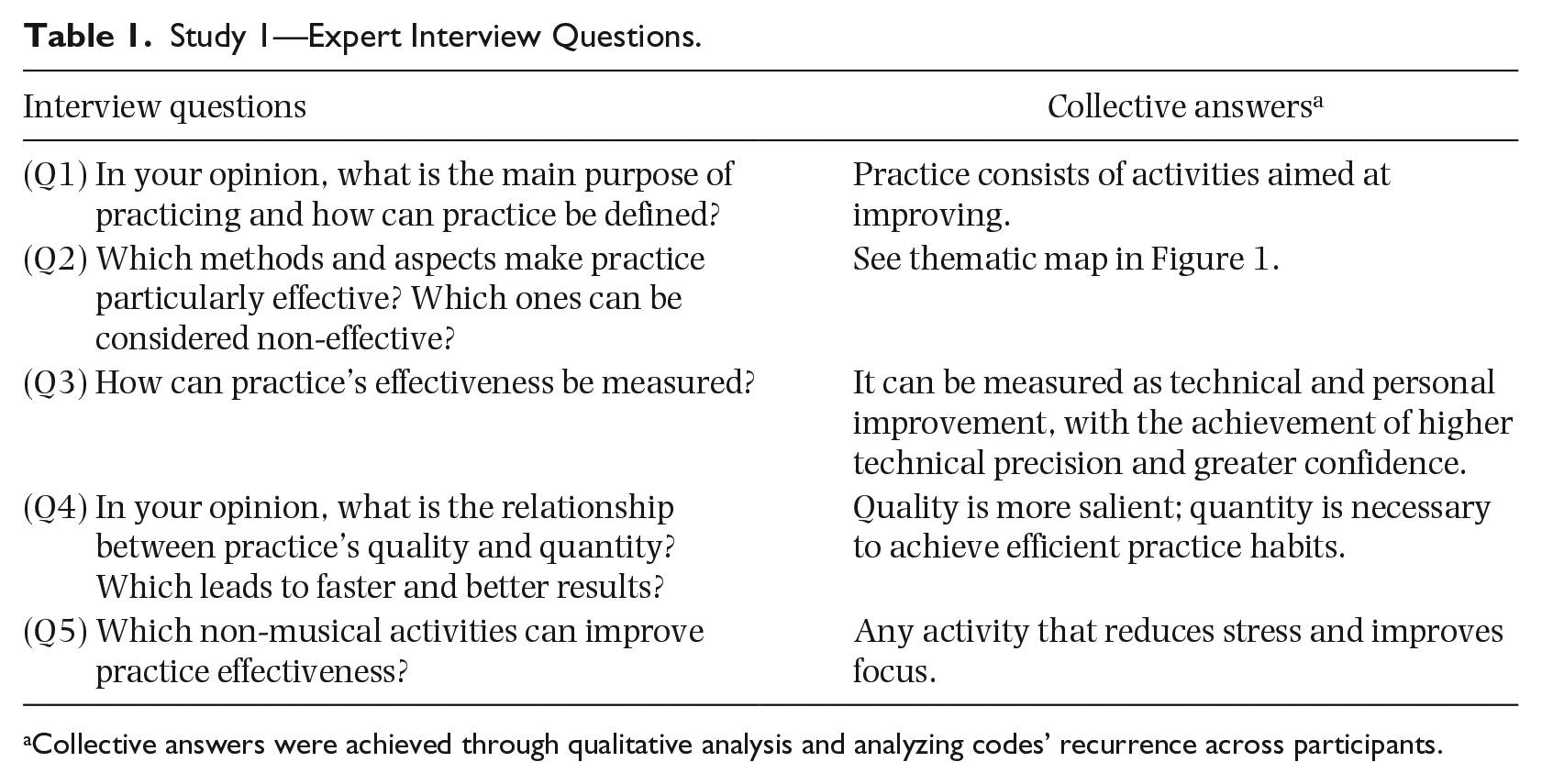
Collective answers were achieved through qualitative analysis and analyzing codes’ recurrence across participants.
Procedure
Participants were invited to participate to the study through email, using their academic email addresses which were publicly available online. Nine interviewees answered the research question in written form: one participant was interviewed during a phone call and his contribution was subsequently transcribed.
Results
Data were analyzed following a deductive thematic analysis approach (Braun & Clarke, 2006; Nowell et al., 2017), as the process was driven by the research interests as well as theoretical knowledge from the literature. The first part of the analysis consisted of the analyst getting familiar with the interview data, thoughtfully reading the interview transcripts and annotating preliminary considerations, in order to get accustomed with the structure and content of the text. Subsequently, the analyst produced the initial codes from the data, with the aim at effectively and parsimoniously representing features in the text which were deemed relevant to the research questions. The salience of codes was assessed by analyzing their recurrency within contributions and across different interviews: only 1% of the resulting codes was specific to single instruments, and only 2% to specific musical genres, while the rest applied to music practice in general. In the third part of the analysis, codes were grouped into themes which were chosen to effectively summarize substantial sections of the data: the interview transcripts were iteratively reinspected to refine the allocation of codes across themes as well as themes’ labeling. Several of the identified themes corresponded to practice strategies discussed in the scientific literature where their effectiveness has been experimentally probed. These practice strategies included automatisms (Logan, 1988), repetitions (Maynard, 2006), contextual interference (Carter & Grahn, 2016), task decomposition (F. J. Lee & Anderson, 2001), slow-practice (Henley, 2001), meta-practice (Feltovich et al., 2006; Hallam, 2002) and breaks (Duke et al., 2009).
Themes were subsequently aggregated and organized into a thematic map (see Figure 1): given their affinity, 10 themes were grouped under problem solving, a practice method suggested by Klickstein (2009) that consists in identifying problems related to music playing, applying adequate practice strategies (slow practice, task decomposition, repetitions, practice routines, automatisms) and evaluate their effectiveness. Routines, fixed sequences of practice behaviors regularly performed, were included among the practice strategies which musicians may use to effectively solve problems; contextual interference and breaks were also incorporated among the subthemes of problem solving, given their beneficial effects on motor learning by employing specific practice schedules (Carter & Grahn, 2016; Duke et al., 2009). Attentional state, attitude, and meta-practice represent factors related to musicians’ mental state and knowledge about practice which might increase practice effectiveness.
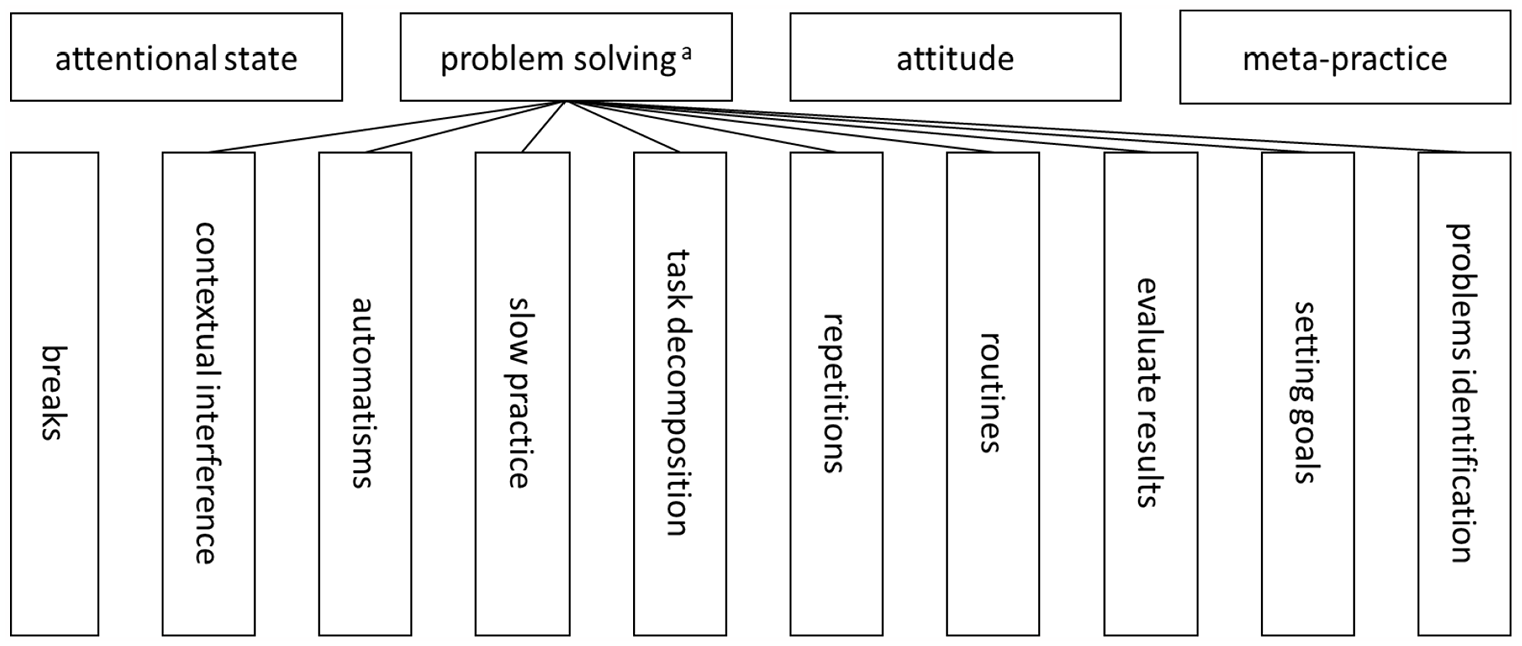
Study 1—Thematic Map Derived From the Expert Interviews.
In the final stage of the qualitative analyses, codes and transcripts were reexamined in order to achieve collective answers to the research questions, which are reported in the right column of Table 1.
The generalized definition of effective practice obtained from the interviews was compared to the original definition of deliberate practice, summarized by Bonneville-Roussy and Bouffard (2015, p. 688); both consider practice as a set of activities aimed at improving which require setting goals, concentration, and motivation. However, proper tutoring was not mentioned among the main factors of effective practice, as interviewees gave more importance to students’ self-regulation of practice behaviors during practice sessions. Moreover, effortful practice behaviors seem to conflict with automatisms and easiness in playing achieved through practice which have been suggested by several participants. Therefore, in the present study tutoring and efforts will not be considered among the fundamental aspects of deliberate practice in music and the assessment of their relationship with practice and improvement will be left to future research.
Finally, the thematic map served as basis for the generation of 68 DP items, according to guidelines given by Devellis (2016); these items were thus constructed on the generalized definition of practice given by the interviewees (see Table 1, Q1) as well as the activities that they mentioned as effective. Items were approximately 5 per theme and constituted the DP questionnaire prototype.
Part 2: development of the DPMI
Methods
Design
The second part of Study 1 collected responses from a large sample of musicians filling out an online questionnaire. Data were analyzed with exploratory factor analyses, reducing the number of items and identifying the factor structure of a DP scale.
Participants
Participant recruitment was limited to musicians, regardless of the musical genre and instrument played, at any level of expertise; the study was advertised on websites specialized in music, musicians, and musical instruments. In total, 1,224 participants above 18 years of age took part in the study but only 694 respondents satisfied the inclusion criteria; participants who completed fewer than 50% of all questionnaire items were excluded from further analysis. In addition, participants who gave constant or near constant responses across all questionnaire items (i.e., variance across all items <1) were excluded as well. The mean age of the selected sample was 37.7 years (SD = 16.4), 55.5% were female, 43.9% were males while the remaining 0.6% indicated a non-binary gender or omitted this information. On average, participants had 13.3 years (SD = 10.4) of formal musical training, currently practicing 14.3 hr per week (SD = 10.2); 62.9% of them played classical music, while keyboard instruments were the most frequent instrumental specialization, corresponding to 22.2% of the total sample. Participation was voluntary and no compensation was provided. Further information about the sample can be found in Appendix A in Supplemental material.
Materials
The DPMI prototype consisted of 68 items that were derived from statements from the interviews and associated with themes of the thematic map from Study 1 (see Figure 1); these included 22 statements with negative valence and 55 requiring the introductory statement “When I practice . . . .” All items were scored on seven-point frequency scale, with values ranging from Never to Always.
Procedure
Participants filled in the questionnaire online, which required about 15 min to be completed, as estimated during pilot testing. All items were administered in random order for each participant, as a means of avoiding order effects. Data were collected during a 2 months period, aiming at achieving approximately 680 valid responses, which granted items to participants’ ratio above 1:10 (Boateng et al., 2018).
Additional information regarding participants’ musical background and demographics were also collected; these included main musical instrument and genre, current amount of practice per week, former years of musical training as well as the highest level of musical education achieved.
Results
The goals of the subsequent exploratory factor analyses were (a) to reduce the itemset to 20–25 to increase its useability in practical research contexts and (b) the identification of a clear factor structure including a general factor as well as any potential factors for sub-facets of DP. Three items with kurtosis >|2| (Anderson et al., 2009; George & Mallery, 2007) were excluded from the subsequent analysis. The hierarchical omega coefficient was computed for the set of the remaining 65 variables using the function omega from the R package psych (Revelle, 2017) which yielded a value of .8. According to the guidelines given by McDonald (2013), hierarchical omega values >.6 indicate the presence of a general factor.
Dimension and item reduction followed an iterative process (see Fancourt et al., 2019). As a first step, a minimum residual factor analysis was computed specifying only a single factor to represent the DP general factor. Twenty-four items were removed due to poor factor loadings of <|0.4|, in line with the suggestion by Pituch (2016). On the remaining 41 items, a parallel analysis based on data simulations (Horn, 1965) was computed and suggested four group factors in addition to the general DP factor, representing the sub-facets of musical DP. Subsequently, another minimum residual factor analysis with oblimin rotation was performed and 12 additional items were removed, having factor loadings lower than |0.4| on any of the group factors. The remaining 29 variables were further reduced to 23, increasing the cutoff value for factor loadings to |0.5| and thus obtaining an even more compact item set.
The final model had a bifactor structure with one general and four group factors and included 23 items in total. Subsequently, the model was assessed for through exploratory bifactor analysis through the omega function from the R package psych (Revelle, 2017), using minimum residual factor extraction, oblimin rotation, and a Schmid–Leiman transformation; it showed a good model fit, χ2 = 403.34, df = 167, p < .001, RMSEA = .045, SRMR = .03, general omega coefficient (.94), and eigenvalues greater than 1 for all group factors as well as for the general factor (eigenvalue = 6.2). Moreover, all items showed substantial loadings on the general as well as on one group factor each, with values ranging from .30 to .76 and no relevant cross-loadings between group factors (see Appendix B in Supplemental material).
The items of the four group factors were examined to provide an interpretation of the factors. Factor 1 comprised 10 items, mainly related to the themes Routine, Problems identification, Planning goals, Evaluating results, and Meta-practice from the qualitative analysis of the expert interviews. Factor 1 included items related to problem solving in music (Klickstein, 2009), in the form of self-monitoring of the effectiveness of single practice strategies. The factor also contained items related to general refinements of the practice routine (i.e., “I check the effectiveness of the technique I am using” and “I refine the way I practice”), in line with previous findings (Bonneville-Roussy & Bouffard, 2015; Leon-Guerrero, 2008; McPherson, 2017). To accommodate these two complementary concepts, Factor 1 was named Process Improvement.
Factor 2 included six items from the themes Attentional state, Routine, Planning goals, and Meta-practice: the items statements referred to participants’ explicit knowledge in terms of practice and music performing (i.e., “I know what I need to achieve”). This factor was thus labeled Practical competences, representing musicians’ experience and knowledge required to solve problems related to music playing. Despite the similarities with Factor 1, Factor 2 Practical competences relates more to musicians’ crystallized intelligence and metacognitive knowledge, while Factor 1 Process Improvement emphasizes their fluid intelligence and self-regulation of practice behaviors.
Factor 3 comprised four items, all characterized by negative valence and related to the themes Repetitions and Attitude: the role of repetitions in the field of learning music is controversial (T. D. Lee et al., 1991; Maynard, 2006), but forms the basis of some practice strategies discussed earlier, such as contextual interference (Shea & Morgan, 1979) and distributed practice (Rubin-Rabson, 1940). Only statements referring to improper or ineffective uses of repetitions were grouped under this factor. Therefore, the factor was labeled Mindless practice, in order to reflect purposeless repetitive behaviors with hasty and superficial attitudes toward practice (i.e., “I repeat passages without a purpose” and “I rush my musical work”).
Factor 4 comprised three items from Task decomposition (F. J. Lee & Anderson, 2001): this is the only theme from the thematic map of the pilot study that has an exact correspondence to a single group factor. Hence, Factor 4 was labeled Task decomposition.
In summary, in Study 1, a set of 68 items was generated describing DP behaviors and based on a thematic analysis of 10 qualitative interviews with musical practice experts, including outstanding soloists and educators. By virtue of the data collected from a large sample of musicians, the itemset was reduced through a series of exploratory factor analyses. This resulted in a bifactor model with one general and four group factors, comprising 23 items in total.
Study 2
Study 2 aimed at validating the DPMI and assessing the invariance of its factor model across genders, musical genres, musical instruments, and academic degrees in music. These investigations reveal if the questionnaire can be used in the same way across these different groups. The convergent validity of the questionnaire was evaluated by testing to what extent it correlated with measures of musical expertise from the literature. External validity was investigated by reproducing the results of an earlier study by Butkovic et al. (2015), who showed that practice quantity is significantly and positively correlated with openness to experience (Greenberg et al., 2015), motivation (Stoeber & Eismann, 2007), and flow proneness (Sinnamon et al., 2012). Consequently, it was possible to identify variables closely associated with efficient practice habits in musicians.
Methods
Design
Study 2 used confirmatory factor analysis (CFA) to assess the structural validity of the factorial model identified in Study 1 on a new sample of musicians (N = 236) as well as its factorial invariance to different genders, musical genres, musical instruments, and music degrees. Furthermore, correlations between DPMI scores and other measures of musical expertise as well as external criteria also used in Butkovic et al. (2015) were computed and compared to results from the literature. Finally, multiple linear regressions were employed to identify a significant model of predictors for DPMI scores and thus identify variables that are closely associated with efficient practice habits in musicians.
Participants
Participation was only open to adult musicians, playing any musical instrument, genre, and at any level of musical expertise: the study was advertised on websites specialized in music, musicians and musical instruments. In total, 324 musicians took part to Study 2: participants who did not complete the DPMI or gave near constant responses across the questionnaires’ items (i.e., variance across all items <1) were subsequently excluded from the analyses (n = 74). In addition to this, 12 cases were discarded where the total number of years of practice was greater than the age of the participants. Two more cases were removed for the suspicious information provided at “total number of hours of practice per week during the 0 to 5 years old period,” as they were 11.6 and 5.6 standard deviations above the mean value of 1.33 years (SD = 5.12). The final number of participants considered during the analysis was thus reduced to 236.
Of the total 236 participants, 49.6% were males, 48.7% were females, while the remaining 1.7% indicated other genders or omitted this information. The general mean age was 43.0 years (SD = 16.2). On average, participants had practiced music for 23.3 years (SD = 16.0). Classical musicians represented 52.8% of the total sample while plucked instrument were the most frequent instrumental specialization, 32.3% of the total sample. Participation was on a voluntary basis and no compensation was provided. Further information can be found in Appendix A in Supplemental material.
Sampling
Incomplete responses were considered on a case-wise basis, resulting in variable sample sizes, ranging from 198 to 214 participants. Note that factorial invariance was tested on Study 1 database, given its substantially greater sample size. To overcome the uneven distribution of participants across groups of instruments, musical genres, and formal degrees obtained (Yoon & Lai, 2018), the factorial invariance of the model was tested on samples with equal numbers of participants in each factor group: samples for factorial invariance testing were randomly selected from Study 1 database. More specifically, the following solutions were adopted: classical musicians were compared to non-classical musicians, n = 94 per group. Musical instruments were grouped under two meta-categories suggested by von Hornbostel & Sachs (1914): aerophones (n = 158), including brass and woodwind instruments, and chordophones (n = 160), including stringed keyboards, strings, and plucked instruments. Instrument groups having a sample size of n < 90 as well as musicians playing multiple musical instruments or genres, were not considered in the analysis. Participants who indicated music degrees that did not conform with the official European and North American educational systems were also excluded (n = 72): the factorial invariance of the model was tested on samples of musicians having achieved pre-professional certificates (n = 94), bachelor’s degrees (n = 134), master’s degrees (n = 136) as well as amateur musicians (n = 131).
Materials
The procedure involved the completion of the DPMI (see Appendix C in Supplemental material) as well as the Openness to experience subscale taken from the Big Five Inventory of personality traits (John et al., 2008), the Musical flow subscale from the Swedish Flow Proneness Questionnaire (Ullén et al., 2012), in its English version with modifications suggested by Butkovic et al. (2015), the Intrinsic motivation (IM), Extrinsic motivation (EM), and Amotivation (AM) subscales of the General Motivation Scale (Guay et al., 2003), the Musical Training subscale of the Gold-MSI questionnaire (Müllensiefen et al., 2014), and finally the Practice quantity scale from Butkovic et al. (2015).
Procedure
Data collection was run during a 2-week period with the goal to recruit at least 200 participants which was deemed sufficient according to a power analysis with statistical power of .80 for moderate pairwise correlations (Pearson’s r > .2), and for small effect sizes in multiple linear regressions (R2 = .1). All questionnaires and items within questionnaires were displayed in random order per participant, except for the DPMI, that was always presented first. The total completion time, estimated through pilot testing, was approximately 15 min.
Results
The first part of the analyses consisted in a statistical validation of the bifactor model created during previous stages of this study. This model, consisting of one general and four group factors, was run as CFA on Study 2 database. The results confirmed the factor structure with very good fit indices, χ2 = 292.413, df = 207, p < .001, RMSEA = 0.042, SRMR = 0.045, TLI = 0.956, CFI = 0.964, as well as strong internal consistency values for the general factor, with McDonald’s ω = .921 and Cronbach’s α = .920. For the group factors, ω-values ranged from .720 to .897 and α-values ranged from .715 to .893.
Using data from Study 1, the factorial invariance of the model was assessed in terms of gender, musical genres, musical instruments, and music degrees using the function sem from the R package lavaan (Rosseel, 2012). For each grouping variable, factorial invariance was tested on nested models (using minimum residual factor extraction), according to the following order: configural invariance, constraining only factors’ structure, metric invariance, adding constraints to means and factor loadings, and scalar invariance, additionally constraining intercepts. The analyses consisted in comparing fit indices of the models, in particular χ2 values, in order to assess significant differences between constriction levels.
The results are listed in Table 2; genders and musical genres achieved metric and scalar factorial invariance as their nested models did not significantly differ (p > .05). Configural and metric models for music degrees resulted invariant while partial scalar invariance was achieved after freeing the intercept for the item “I do not know how to achieve what I want.” Musical instruments models were partially invariant at metric and scalar levels, removing constrictions on factor loadings for items “I do not know how to fix problems” and “I check the effectiveness of the technique I am using,” in relation to their group factors (see Appendix B in Supplemental material).
Study 2—Factorial Invariance of the Bifactor Model Across Groups of Musicians.
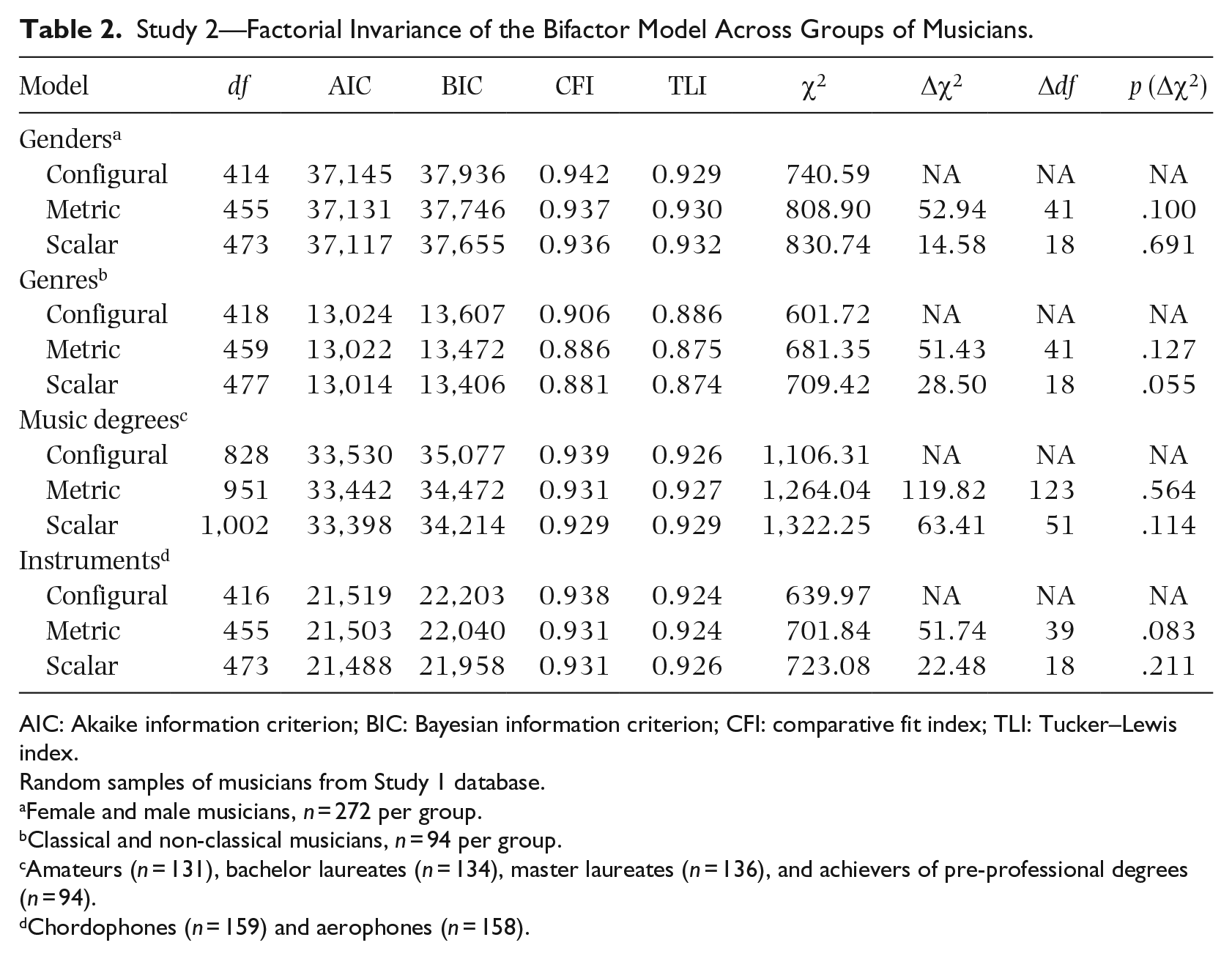
AIC: Akaike information criterion; BIC: Bayesian information criterion; CFI: comparative fit index; TLI: Tucker–Lewis index.
Random samples of musicians from Study 1 database.
Female and male musicians, n = 272 per group.
Classical and non-classical musicians, n = 94 per group.
Amateurs (n = 131), bachelor laureates (n = 134), master laureates (n = 136), and achievers of pre-professional degrees (n = 94).
Chordophones (n = 159) and aerophones (n = 158).
In line with Butkovic et al. (2015), correlations between the DPMI and other psychometric measures were examined (see Table 3): scores from the general DPMI scale were significantly and positively correlated with Openness, Musical Flow, Musical Training, two dimensions of Intrinsic Motivation and one of Extrinsic Motivation as well as Practice quantity, with Pearson’s r values ranging from .349 to .581. The DPMI general scale also had a significant negative correlation with Amotivation, r(206) = –.368, p < .001. While DPMI subscales mostly followed the main scale trends, it is worth mentioning the significant positive correlation between Mindless Practice and Amotivation, r(206) = .334, p < .001, suggesting a significant association between lack of awareness and lack of motivation.
Study 2—Correlations Between DPMI Main Scale, DPMI Subscales and Other Psychometric Measures.
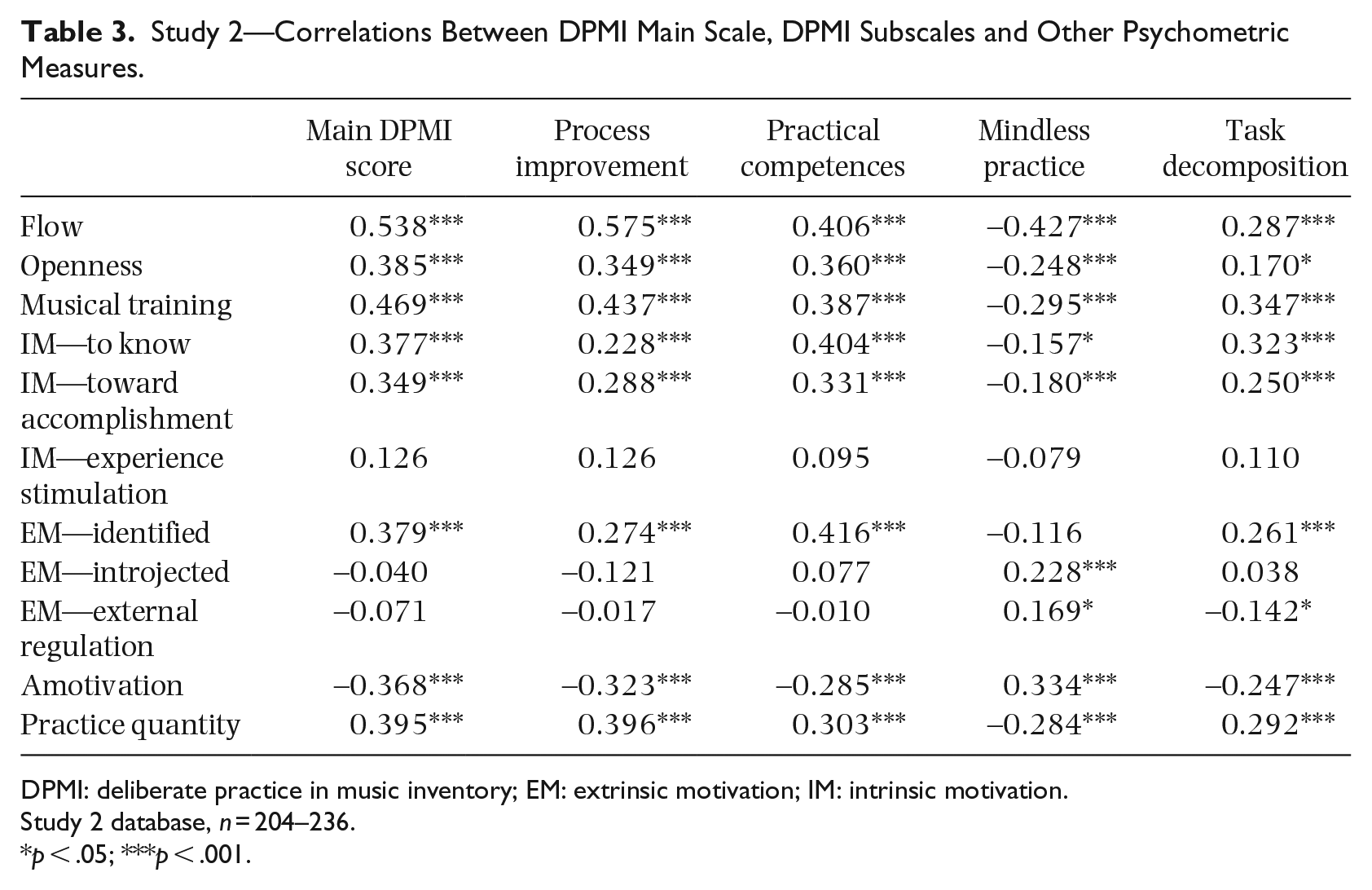
DPMI: deliberate practice in music inventory; EM: extrinsic motivation; IM: intrinsic motivation.
Study 2 database, n = 204–236.
p < .05; ***p < .001.
For the final part of the analysis, multiple linear regressions were run to identify a significant model of predictors for DPMI scores and thus a profile of musicians with efficient practice habits. In line with Butkovic et al. (2015), age and gender were included in a preliminary multiple linear regression using the Study 1 database, given its greater sample size: the model was non-significant, F(2, 592) = .662, p = .516, R2 = .002, indicating non-significant effects of age and gender on DPMI scores. A second regression model was constructed on Study 2 database, including all the 11 correlates of expertise as predictors of DPMI scores. The model was significant, F(11, 185) = 19.43, p < .001, R2 = .536: it was subsequently reduced through the function stepAIC from the R package MASS (Venables & Ripley, 2002), specifying the BIC criterion to indicate the model-data fit and backwards-forwards stepwise selection. The reduced model reported in Table 4 was significant, F(6, 190) = 31.87, p < .001, BIC = 1603, R2 = .501. In addition, all six remaining predictors (Flow, Intrinsic Motivation-to know, Intrinsic Motivation-to experience stimulation, Amotivation, Musical Training, Practice quantity) had significant coefficients, explaining together approximately 50% of variance in DPMI scores.
Study 2—Multiple Linear Regression, Final Model.
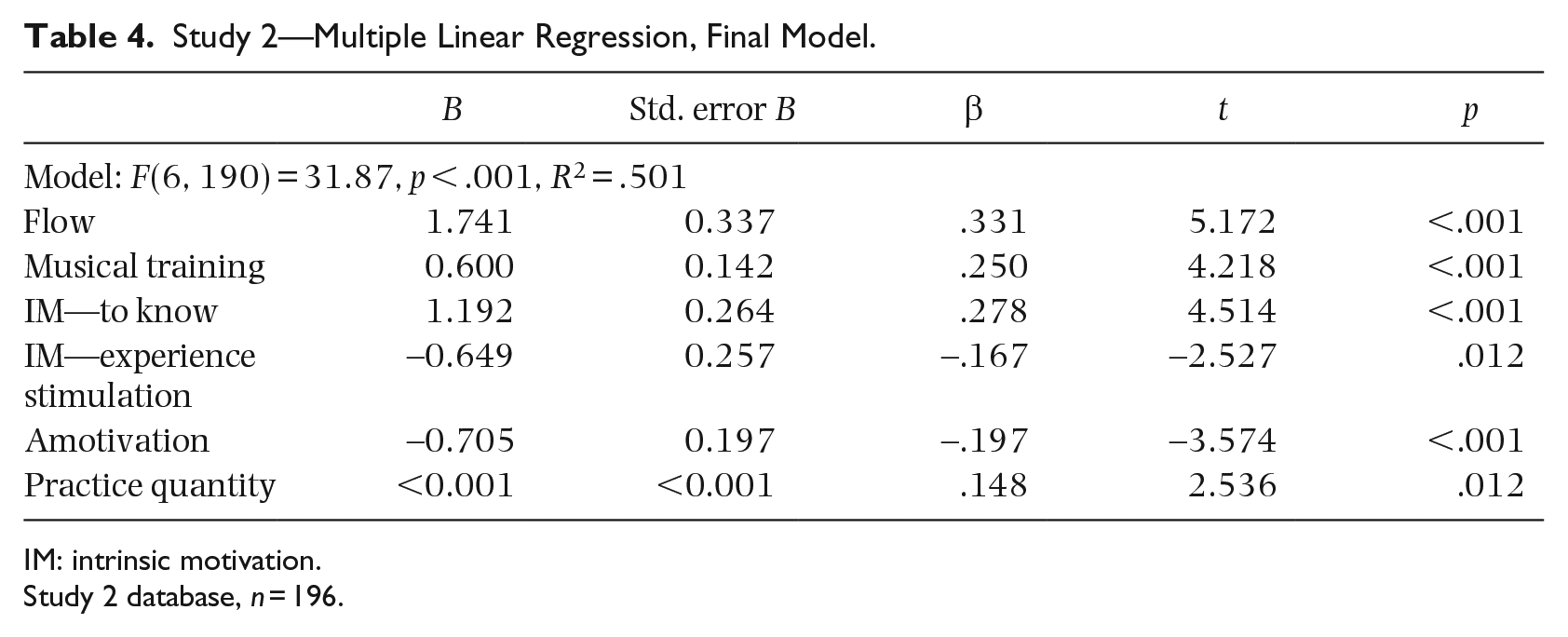
IM: intrinsic motivation.
Study 2 database, n = 196.
In summary, Study 2 consisted of validations of different aspects of the DPMI. During the first part, the factorial structure of new instrument was validated through confirmatory factor analysis. Moreover, the scale was measurement invariant across gender, musical instruments, musical genres and academic degrees in music. As in Butkovic et al. (2015), the new instrument was correlated with psychometric measures suggested by previous studies in the field of practice and musical expertise. Results were in line with previous findings, suggesting the external validity of the new measure. Finally, applying variable selection resulted in a model of significant predictors for deliberate practice, which explained almost 50% of variance in DPMI scores.
Discussion
The aim of this study was to create a new questionnaire, capable of measuring practice quality in terms of deliberate practice for the music domain, regardless of the instrument and musical genre played, at any level of expertise. Moreover, the questionnaire served as means of empirically investigating characteristics of deliberate practice in music.
The DPMI prototype was created from a review of the existing literature and the qualitative analysis of interviews with 10 outstanding soloists and music performance teachers. Using a large online sample, the number of items was subsequently reduced while also identifying the factorial structure among the items. A series of factor analyses suggested a bifactor structure, consisting of a main DP scale and four subscales: Process improvement, Practice competences, Mindless practice, and Task decomposition.
Subsequently, the DPMI was confirmed to be measurement invariant across genders, musical instruments, and genres as well as academic degrees in music. Finally, DPMI scores were compared with other correlates of musical expertise and a multiple regression comprised Flow, Intrinsic Motivation-to know, Intrinsic Motivation-to experience stimulation, Amotivation, Musical Training, and Practice quantity as significant predictors of deliberate practice quality which explained almost 50% of variance in DPMI scores.
The construct validity of the DPMI was analyzed according to Messick’s (1995) taxonomy; expert interviews and literature review assured content validity while good fit indices from Exploratory Factor Analysis and Confirmatory confirmed its structural validity. Measurement invariance of DPMI’s factorial structure tested the generalizability aspect of validity and the extent to which its scores generalize across groups of musicians; external validity was subsequently assessed through correlations with other measures related to DP and musical expertise.
The role of motivation in music has been suggested to be a necessary means for investing time and attaining professional careers, granting the necessary resilience to tiring and often frustrating daily practice sessions (Ryan & Deci, 2000; Stoeber & Eismann, 2007). The current study confirmed the importance of motivation and showed that practice quality is related to intrinsic motivation (i.e., engaging in activities for their own sake and enjoyment): musicians, who have efficient practice habits, are driven by the pleasure they get from acquiring new knowledge. However, the need to experience immediate positive sensations as well as the general lack of motivation are negatively related to practice quality. Flow proved to be another highly important predictor of deliberate practice, in line with previous findings (Marin & Bhattacharya, 2013; Marion-St-Onge et al., 2020; O’Neill, 1999; Sinnamon et al., 2012): flow proneness in music may encourage musicians to engage in demanding practice routines in view of the positive sensations and states of mind that they will experience while performing music. Despite the significant correlations with DPMI main scale and subscales (see Table 3), Openness to experience was not a significant predictor in the DPMI regression model: this may indicate that personality traits have marginal importance in predicting practice quality, especially when compared with other predictors related to musical education as Musical training and Practice quantity. To summarize, it can be affirmed that deliberate practice is enhanced by musicians’ active engagement in practice activities designed to improve, even if they are not enjoyable: lack of such a motivation may have negative impacts on practice effectiveness. This interpretation is in line with previous publications (Hyllegard & Bories, 2008; Stoeber & Eismann, 2007) and suggests the appropriateness and validity of the new instrument for measuring DP in music.
With regard to musical expertise, this study included Practice quantity (Ackerman, 2014; Butkovic et al., 2015; Jørgensen, 2002) and Musical training (Müllensiefen et al., 2014) in the analysis, measuring the amount of practice and musical training received during lifetime. Results indicated positive significant bivariate correlations between DPMI scores and the two variables, with DPMI scores explaining approximately 16% of variance in Practice quantity and 22% in Musical training: these results are in line with the fact that DP is only one among several predictors of musical expertise (Hambrick et al., 2017; Platz et al., 2014).
Limitations of this study are intrinsically related to its design and the choice of employing a self-report questionnaire as quantitative measure: despite the practical advantages of self-report scales (Pekrun, 2020), this choice may have implications for the instrument’s validity especially in between-subjects comparisons, as the instrument may be affected by participants’ misjudgment of their own practice habits. Nonetheless, a previous study by McPherson and McCormick (2006) has investigated the relationship between musicians’ perception of self-efficacy and academic achievements, evidencing the crucial role of the former for achievements on music performance examination. In addition, the new instrument does not provide concrete indications of how to improve on musical performance skills. This limitation is the result of its neutrality to different musical instruments and genres, as a higher methodological specificity could have affected its validity for certain categories of instruments; for example, practice strategies related to bowing may have been meaningless for woodwind and keyboard players. The sample of musicians considered in the Study 1 was predominantly involved with western classical music tradition. Thus, despite the factorial invariance achieved across different musical genres in Study 2, the results reported may not apply across all musical genres (i.e., folk music, non-western music styles). Finally, it was not possible to test factorial invariance of the DPMI across individual instrument groups and musical genres, given the limited sample size for most individual instruments.
Future research will continue the development of the DPMI by validating the new instrument through longitudinal study designs, monitoring musicians’ practice behaviors through diaries and audio recordings. Moreover, the present findings suggest important directions for future investigations in the field of music practice: the role of teachers in achieving professional results could be clarified through the comparison of DPMI scores with other measures assessing the quality of interpersonal-relationships and environmental conditions. Future studies may compare the DPMI with measures of DP in other domains, in order to assess the generalizability of the results reported here. Moreover, the new instrument could be adapted to provide retrospective estimations of DP and used as diagnostic tool for dysfunctional practice habits, assessing their possible correlation with specific pathological conditions, such as in the case of focal dystonia (Altenmüller & Jabusch, 2009).
In conclusion, this study addressed important limitations of research on deliberate practice providing clearer definitions and a new quantitative measure for the domain of music: the results presented suggest the existence of effective practice behaviors which apply to the music domain in general, despite differences in playing techniques and styles among diverse musical instruments and genres. Moreover, such practice behaviors seem to be generalizable across different levels of expertise, thus characterizing amateurs as well as professional musicians.
The DPMI and its subscales indicate deliberate practice in music as a process aimed at improving, by virtue of solutions to problems related to music playing as well as continuous refinement of practice routines, with the purpose of enhancing their effectiveness and time efficiency. Additionally, part of DP routine is the decomposition of long and complex tasks into shorter and simpler elements, with the aim of mastering complex tasks more easily and in shorter time, while also avoiding purposeless repetitions and unfocused practice.
Employing the new self-report instrument in future research on musical talent and achievement (i.e., Preckel et al., 2020) may help to open new perspectives in the nature–nurture debate, letting researchers assess to what extent practice can enhance individuals’ potential to become accomplished professional musicians.
Supplemental Material
sj-pdf-1-pom-10.1177_03057356211065172 – Supplemental material for Deliberate practice in music: Development and psychometric validation of a standardized measurement instrument
Supplemental material, sj-pdf-1-pom-10.1177_03057356211065172 for Deliberate practice in music: Development and psychometric validation of a standardized measurement instrument by Edoardo Passarotto, Franzis Preckel, Michael Schneider and Daniel Müllensiefen in Psychology of Music
Footnotes

References
Supplementary Material
Please find the following supplemental material available below.
For Open Access articles published under a Creative Commons License, all supplemental material carries the same license as the article it is associated with.
For non-Open Access articles published, all supplemental material carries a non-exclusive license, and permission requests for re-use of supplemental material or any part of supplemental material shall be sent directly to the copyright owner as specified in the copyright notice associated with the article.
