



Abstract
Popular musicians are embedded in dynamic networks supporting their expertise development across different phases. During these phases, network actors support different aspects of deliberate practice in which a musician needs to engage to become an expert. Research in the domain of music is scarce in terms of investigating the change in the supportive networks of deliberate practice over time. Semi-structured interviews with five expert and five intermediate popular musicians were used to explore changes in networks supporting the deliberate practice during their childhood, apprenticeship, and career phases. Egocentric network analysis revealed that networks supporting the deliberate practice of expert musicians are more dynamic and less stable when considering the different phases than the networks of intermediates. In addition, experts are supported by a larger number of network actors during the developmental phases. In both groups, the number of network actors decreased as the musicians progressed through the phases. This decrease was more precipitous between the childhood and apprenticeship phases. Overall, expertise development as a popular musician depends not only on deliberate practice but also on the diversity and change in an adaptive support network from childhood to adulthood.
While musicians undergo different phases during the development of their musical expertise (Bloom, 1985; Papageorgi et al., 2009), the relationships within their social networks change over time (Feld, Suitor, & Gartner Hoegh, 2007). During these developmental phases, deliberate practice plays a key role in the acquisition of musical expertise (Platz, Kopiez, Lehmann, & Wolf, 2014). Thus, learning content should aim to improve and expand the musician’s musical knowledge (Bonneville-Roussy & Bouffard, 2015). Ericsson (2016) mentioned five aspects for successful deliberate practice: goal setting, content structuring, immediate feedback, the correction of errors, and motivation. To date, research investigating these aspects of deliberate practice in relation to the support gained by a changing network during different developmental phases to date has been scarce. This article aimed to provide a greater understanding and contribute to expanding the current body of knowledge in the fields of expertise development and social networks in music (and in other domains).
Musicians have contact with different persons within their social network, who support different aspects of deliberate practice during the developmental phases (Längler, Nivala, Brouwer, & Gruber, 2020). The development of musical expertise seems to benefit from changes that occur over time within learning networks (Moore, Burland, & Davidson, 2003) because the musician may gain access to various resources that provide new learning goals and content. Understanding the nature of the relationship between network actors and the individual musician helps to suggest implications for music learning and continual music practice (Kenny, 2016). Although the role of network actors is emphasized in research on persons in the shadow (Gruber, Lehtinen, Palonen, & Degner, 2008; Lehmann & Kristensen, 2014), little research exists to date that has systematically investigated changes during the musical development of individuals (Lamont, 2016).
Individual development and changes in networks of musicians can be addressed systematically with social network analysis. For example, Crossley, McAndrew, and Widdop (2015) focused on the development of particular music scenes, rather than on musicians’ expertise development. Egocentric social network analysis is a tool that helps to explore the relations within a network from the viewpoint of the individual musician (called the “ego”). Although it can be used to investigate the multidimensional construct of support (e.g., for deliberate practice) provided by various network actors (Hlebec & Kogovšek, 2013), only a few attempts have been made to investigate changes in networks through the measurement of stability and change over time (see Cornelissen et al., 2014; Van Waes, van den Bossche, Moolenaar, Stes, & van Petegem, 2015). The current article provides an innovative approach that allows examining change in egocentric networks through stability ratios and change ratios. Thus, it makes a valuable contribution to further theorizing on the interactions that occur during developmental phases of individuals in music.
This study explored how networks and their support for the deliberate practice of expert and intermediate popular musicians changed during three developmental phases. The study investigated Bloom’s (1985) phase model of acquiring expertise in music and Ericsson (2016) and Bonneville-Roussy and Bouffard’s (2015) definitions of deliberate practice through the lens of egocentric network analysis. Therefore, this study was theoretically rooted in three ways. First, Bloom’s (1985) model structures the development of musical expertise, and this model is widely accepted in music research. Second, Ericsson (2016) and Bonneville-Roussy and Bouffard (2015) outline a concise overview of different aspects of successful deliberate practice. Third, egocentric network analysis provides the possibility to investigate change in networks.
Phases of acquiring expertise in music
An expert is an individual who has acquired a superior long-term retention of domain-related material through changes in cognitive, physiological, or perceptual-motor functioning (Lehmann, Gruber, & Kopiez, 2018). Phase models help to structure investigations of these changes and to describe what is required for the transformation from a novice into an expert, for example, by comparing experts with intermediates and/or novices (Boshuizen, Gruber, & Strasser, 2020). Over various domains, a large number of phase models have been developed to try to illustrate expertise development across a lifetime. Three phases are typically of interest: childhood, apprenticeship, and career. In music, the model by Bloom (1985) similarly divides expertise development into three phases. In the first phase, the individual is introduced to the instrument and playfully engages with it. This is often the case during childhood, although differences exist in the starting age for playing certain instruments (McPherson, Davidson, & Evans, 2006). In the second phase, the individual engages in formal training with support for deliberate practice. This phase often starts during childhood and continues to an apprenticeship if the individual is interested in pursuing the profession. In the third phase, the individual fully commits to a career in music. Phase theories implicitly address dynamic relationships in networks, for example, relationships are created or dissolved, but these are rarely assessed (Pitariu & Ployhart, 2010). The current study explored and compared the dynamics in the relationships in networks supporting deliberate practice during the three career stages of expert-level and intermediate-level musicians.
Changes in network support for the deliberate practice of popular musicians
Most studies in the field of expertise research focus on interindividual (e.g., the ranking of chess players) or intraindividual change (e.g., the transition from novice to expert), assessing the growth (or the decline) of skills over time (Ackerman & Beier, 2018). The construct of change is widely used for the investigation of the acquisition of expertise, but it is far from being fully understood. Similarly, learning is considered as leading to relatively permanent changes in behavior over time, which can be sustained through intensive practice. Thus, time is a metric that is indicative of change (Singer & Willett, 2003). Ployhart and Vandenberg (2010) explained that change should be measured minimally at three time points and that it should be distinguished if the research object is dynamic or static. Moreover, descriptive longitudinal research can be used to illustrate how a phenomenon changes over time—in the current study, networks that support deliberate practice. The analysis of change ratios focuses on new ties and lost ties between network actors and an individual, while the analysis of stability ratios addresses the ties that were kept between two time points.
Professional expertise depends on the relationships between an individual and others in the network (Palonen, Boshuizen, & Lehtinen, 2014). Ericsson and Harwell (2019) affirmed that the support for deliberate practice strongly depends on activities guided by teachers or coaches. In popular music, peers are strongly supportive during the learning process (Lebler, 2008) and support the aforementioned aspects that constitute successful deliberate practice (Längler et al., 2020). This is in line with Nielsen, Johansen, and Jørgensen (2018), who found that the influences of both peers and instrumental teachers overlap and do not exclude each other. Although it is obvious that relationships change as time passes, research on support for musical practice has usually focused on particular groups within a network during specific time periods, such as peers supporting the learning of bachelor students (Nielsen et al., 2018) or teachers supporting the learning of high school students (Freer & Evans, 2019), rather than studying these changes across the phases of childhood, adolescence (apprenticeship), and adulthood (career).
The current study
In the current study, we explored and compared changes in the networks of expert and intermediate popular musicians that supported deliberate practice during three phases of expertise development (childhood, apprenticeship, career). We considered the following aspects of deliberate practice: goal setting, content structuring, immediate feedback, the correction of errors, motivation, and new learning content. This study’s goal was to provide insights into how the phenomenon of change in networks was perceived throughout the careers of musicians and how such changes in support networks might have contributed to deliberate practice. We compared the networks of experts with those of intermediates. Novices were not included, based on the assumption that they had not (yet) had the opportunity to go through all the phases specified by Bloom (1985) and potentially had not had enough time to build a network. Descriptive statistics and change ratios and stability ratios were used to explore the changes in networks in a unique sample consisting of ten popular musicians from Germany and Austria.
Two research questions were posed:
To what extent does the total number of network actors that support the practice of expert and intermediate popular musicians change during the three developmental phases?
To what extent does the number of network actors that support different aspects of the deliberate practice of expert and intermediate popular musicians change during the three developmental phases?
Method
Design
A mixed methods egocentric network analysis of musicians in popular music with two distinct skill levels (expert and intermediate) was used to retrospectively examine change in networks supporting six prerequisites for deliberate practice (goal setting, content structuring, feedback, the correction of errors, motivation and new learning content) during three different developmental phases (childhood, apprenticeship, career). A demographic questionnaire, an interview, and network visualizations were used for the data collection.
Sample
Ten male popular musicians (five experts, five intermediates) from Germany and Austria participated in this study. This sample size was considered appropriate for exploratory and phenomenological studies (Dukes, 1984), and suggestions for sampling in qualitative research were followed (Malterud, Siersma, & Guassora, 2016). Participants were aged from 25 to 54 years (M = 33.6, SD = 4.8). As Boshuizen et al. (2020) suggested that strong criteria need to be used for the definition of the group statuses that are under investigation, the expert and intermediate statuses were determined by a theoretically driven multi-criteria catalog (Table 1). To be assigned to the expert group, all the allocation criteria for experts had to be fulfilled. To be assigned to the intermediate group, as a minimum, the allocation criteria for intermediates had to be fulfilled. It was required that both experts and intermediates had at least 10 years of experience in the field of music so that they had established a network for musical practice. The experts had M = 25.2 (SD = 11.32) years of experience, while the intermediates had M = 17.8 (SD = 4.76). A detailed description of the participants’ musical backgrounds is provided in Appendix A.
Allocation Criteria for Experts and Intermediates.

The ISCED Level (International Standard Classification System of Education) indicates the educational level of individuals. To be assigned to the expert group, all allocation criteria for experts needed to be fulfilled. To be assigned to the intermediate group, at least the allocation criteria for intermediates needed to be fulfilled.
Instruments and procedure
The first author collected the questionnaire data and conducted the semi-structured interviews together with the visualizations to generate the network data.
Demographic questionnaire
A demographic questionnaire was used to collect general background information (name, age, gender, contact information), music-related background information (musical education, duration of engagement in music, published records, music prizes), and practice-related background information (frequency and quantity of practice over the three different developmental phases) to confirm the allocations to the status groups.
Definitions of the three developmental phases were provided to the participants. Childhood was defined as the time span between the start of instrumental play and finishing secondary education, apprenticeship as the time span between the end of secondary education and the end of their apprenticeships, and career as the time span between the end of their apprenticeships and the present.
Interview and visualizations
An introduction about the purpose of the study was read to the participants. Confidentiality in terms of the participants’ identities and their network actors was assured. Data on the egocentric network of each participant were collected by means of a semi-structured interview and a network visualization (created with VennMaker 2.0.1) separately for each developmental phase (childhood, apprenticeship, career).
A name-generating question asked the participants to recall all the network actors who had supported their musical practice during that particular phase (e.g., Who supported your musical practice during your childhood/apprenticeship/career?). The open recall process facilitated an individual definition of their network boundaries and triggered reflection on their network (Hollstein, 2011). When the participant had difficulty recalling network actors, questions focusing on certain groups of people were asked (e.g., Did your parents support you during musical practice?). When a collective of network actors (e.g., band, music community) was mentioned as equally supporting the same aspects of deliberate practice, the relationship was counted as a single one. All names of network actors mentioned during each interview were entered into a network map by the interviewer. Once the participant could not recall any more network actors, the role of each network actor in relation to the aspects of deliberate practice was discussed. The participant was asked to identify network actors who provided support for each aspect of deliberate practice (e.g., Did person X support your goal-setting?). If new network actors were mentioned during this phase, they were added to the map, and missing information about their support was appended. After collecting the names of network actors and data on practice support, each network actor was allocated to a sector indicating an affiliation (parents, family members, schoolteachers, instrumental teachers, band members, friends, others; see Figure 1 for an example). To collect data on the apprenticeship and career phases, the same interview procedure was repeated. The interviews were held in the German language and lasted from 60 to 120 min.
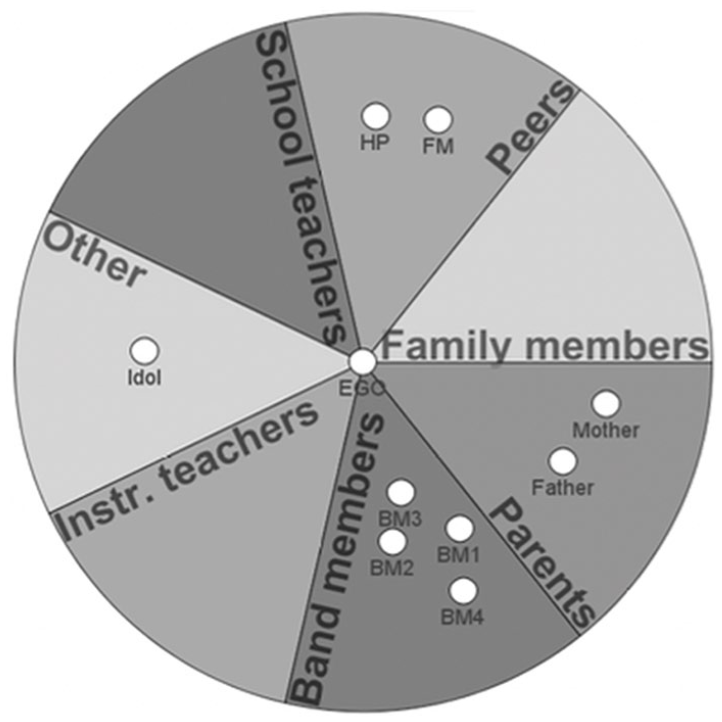
Prototype of a Network Map used for Data Collection.
After the analysis of the interview data, new network maps for each participant were produced. The maps were presented to four participants in a second meeting because uncertainties in the interpretation of the data needed to be clarified.
Analysis
All interviews were recorded with Audacity software and transcribed verbatim. The interviews were analyzed according to the three developmental phases. For each phase, a table was produced containing the relevant network actors in the rows and their support for goal setting, the structuring of content, feedback, correcting errors, motivation, and providing new content in the columns. If a relationship with a network actor was present for an aspect, it was counted as 1, and if a relationship was not present, it was counted as 0. A second rater examined all the interviews independently to calculate the inter-rater reliability. In the first round, inter-rater reliability had a Cohen’s kappa (κ) of .72. Both raters discussed the roles of each network actor for each participant based on the interviews (Armstrong, Gosling, Weinman, & Marteau, 1997). After the discussions, the agreement between both raters was excellent, and inter-rater reliability had a Cohen’s kappa (κ) of .96 (Bernard, Wutich, & Ryan, 2017).
Descriptive analysis was used to provide an overview of the entire networks (RQ1) and of the specific networks regarding the aspects of the deliberate practice (RQ2) of experts and intermediates. Therefore, the means, standard deviations (SDs), minimums, and maximums of the network actors involved were calculated for both experts and intermediates and for each of the three phases. To indicate the dynamic and stability of change processes in relation to network actors, change and stability ratios were calculated based on procedures proposed by Cornelissen et al. (2014) and Van Waes et al. (2014). The stability ratio between the childhood and apprenticeship phases was calculated using the following formula

The change ratio between the childhood and apprenticeship phases was calculated using the formula below

Similar calculations were applied for the transition from the apprenticeship phase to the career phase. Stability and change ratios varied between zero and one. A change ratio close to one suggested a dynamic network. A stability ratio close to one suggested a stable network. For each group, the means and SDs of the network actors involved were calculated for each time span.
The comparison of change in experts and intermediates’ networks was based on a descriptive analysis of the means and SDs of the entire networks and of the change and stability ratios. Visualizations of networks provided additional opportunities to represent and compare changes in relationships over different time spans (Lanum, 2016). Therefore, tables of the change and stability ratios and figures of the networks were produced to enable a visual comparison of changes in the experts’ and intermediates’ networks during the phases. As this was an exploratory study with a small sample, inferential statistics comparing the means were not considered appropriate because of their limited power.
Results
Changes in the total number of network actors supporting practice
During all the phases, the average network size was greater for the experts compared with that of the intermediates (see Table 2). The entire networks of the experts contained about five more network actors during childhood and about three more actors during the apprenticeship and career phases. For both experts and intermediates, the average number of network actors decreased over time, from the childhood to the apprenticeship to the career phase.
Descriptive Statistics of the Total Networks of Experts and Intermediates.

A visual overview of the changes in the total number of network actors in both groups indicated that the decrease in network actors was more precipitous in the expert group between the childhood and apprenticeship phases compared with that between the apprenticeship and career phases (see Figure 2). The decrease in network actors was more precipitous in the expert group over both time spans compared with that of the intermediates.
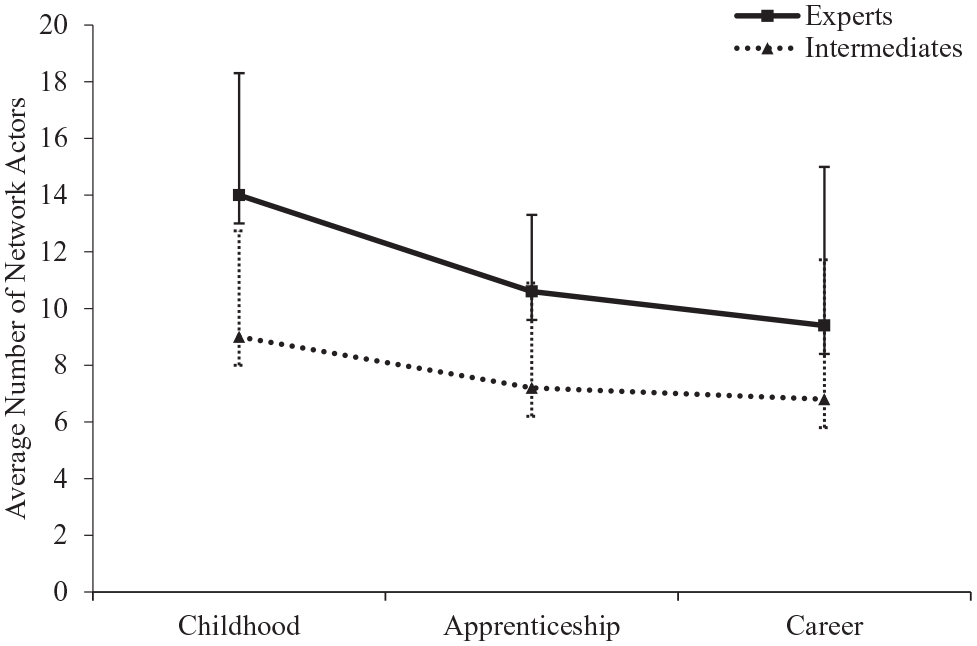
Change of the Average Number of Network Actors in Total of Experts and Intermediates During Three Developmental Phases.
Over both time spans, the stability ratios indicated that the experts’ networks were on average less stable, and the change ratios suggested that the experts’ networks changed more on average compared with those of the intermediates (see Table 3).
Stability Ratios and Change Ratios of Experts’ and Intermediates’ Total Networks.

Note. The stability ratio and change ratio do not add up to 1, as the underlying total values are different. Please see the analysis section for the calculations of the ratios.
Changes in the number of network actors supporting different aspects of deliberate practice
Changes in networks supporting goal setting
During all the phases, the average network size regarding goal setting was greater for the experts compared with the intermediates (see Table 4). The networks of the experts contained about five more network actors that supported goal setting during childhood and about four more actors during the apprenticeship and career phases. For both experts and intermediates, the average number of network actors decreased over time, from the childhood to the apprenticeship to the career phase.
Descriptive Statistics of the Networks Supporting Goal Setting of Experts and Intermediates.

A visual overview of the changes in the average number of network actors that supported goal setting showed that the decrease in network actors was more precipitous in the expert group between the childhood and apprenticeship phases compared with that in the time between the apprenticeship and career phases (see Figure 3). The decrease in network actors was more precipitous in the expert group between the childhood and apprenticeship phases compared with that of the intermediates. Between the apprenticeship and career phases, the decrease was equal for both groups.
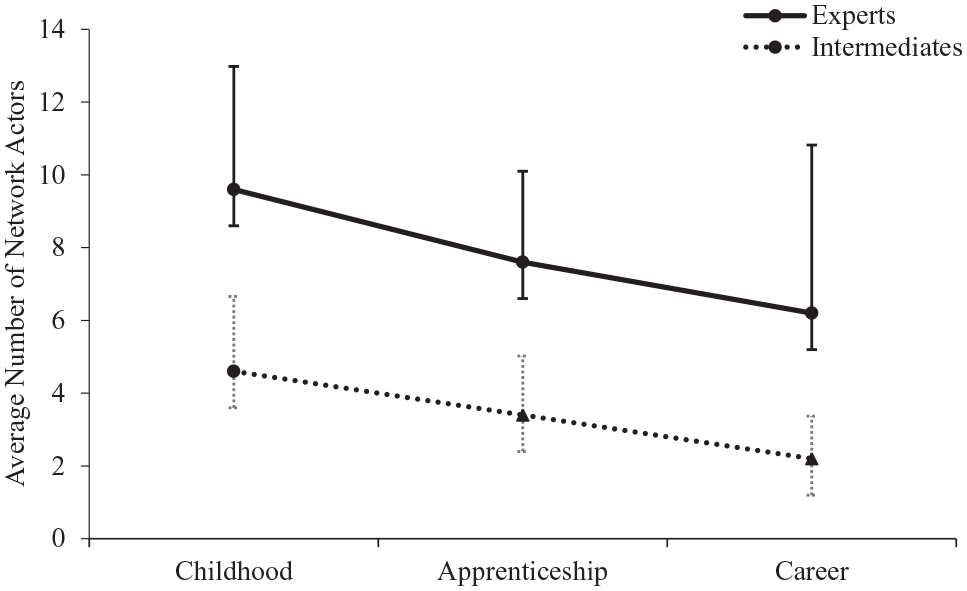
Change in the Average Number of Network Actors Supporting Goal-Setting of Experts and Intermediates During Three Developmental Phases.
Over both time spans, the stability ratios revealed that the experts’ networks were on average less stable compared with those of the intermediates (see Table 5). The change ratios indicated that the experts’ networks changed more on average compared with the intermediates’ networks.
Stability Ratios and Change Ratios of Networks Providing Goal Setting.

Note. The stability ratio and change ratio do not add up to 1, as the underlying total values are different. Please see the analysis section for the calculations of the ratios.
Changes in networks supporting content structuring
During all the phases, the average network size regarding support for structuring the learning content of the experts was greater than that of the intermediates (see Table 6). Compared with the networks of the intermediates, the networks of the experts contained about three more network actors that structured learning content during childhood, four more network actors that did this during the apprenticeship phase and three more actors that provided this structuring during the career phase. Between the childhood and apprenticeship phases, network size decreased in both groups. Between the apprenticeship and career phases, the average network size of the experts decreased, while the average network size of the intermediates remained the same.
Descriptive Statistics of the Networks Supporting Structuring of Learning Content of Experts and Intermediates.

A visual overview of the changes in the average number of network actors supporting learning content showed that the decrease in network actors was less precipitous in the expert group between the childhood and apprenticeship phases compared with during the time between the apprenticeship and career phases (see Figure 4). The decrease in network actors was less precipitous in the expert group between the childhood and apprenticeship phases compared with that of the intermediates. Between the apprenticeship and career phases, the decrease was more precipitous for the experts compared with the intermediates.
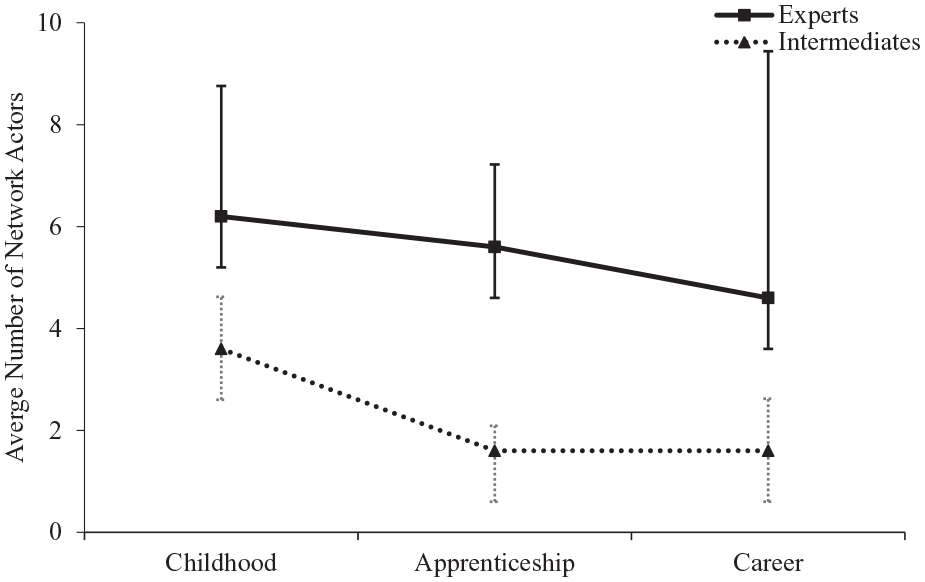
Change in the Average Number of Network Actors Supporting Structuring of Learning Content of Experts and Intermediates During Three Developmental Phases.
Between the childhood and apprenticeship phases, the stability ratios and change ratios of both groups indicated low stability and a high degree of change in both groups (see Table 7). The stability ratio was lower and the change ratio higher for the experts compared with the intermediates. Between the apprenticeship and career phases, the networks of the experts had a lower stability ratio and a marginally lower change ratio compared with the networks of the intermediates.
Stability Ratios and Change Ratios of Networks Structuring Learning Content.

Note. The stability ratio and change ratio do not add up to 1, as the underlying total values are different. Please see the analysis section for the calculations of the ratios.
Changes in networks providing feedback
During all the phases, the average network size regarding feedback was greater for the experts compared with the intermediates (see Table 8). The experts’ networks that provided feedback contained about one more network actor during childhood, two more network actors during the apprenticeship phase, and two more actors during their careers. For both experts and intermediates, the average number of network actors providing feedback decreased over time, from the childhood to the apprenticeship to the career phase.
Descriptive Statistics of the Networks Providing Feedback for Experts and Intermediates.

A visual overview of the average number of network actors that provided feedback indicated a steady decrease in the number of network actors. It is less precipitous during all the phases for the experts compared with the intermediates (see Figure 5).
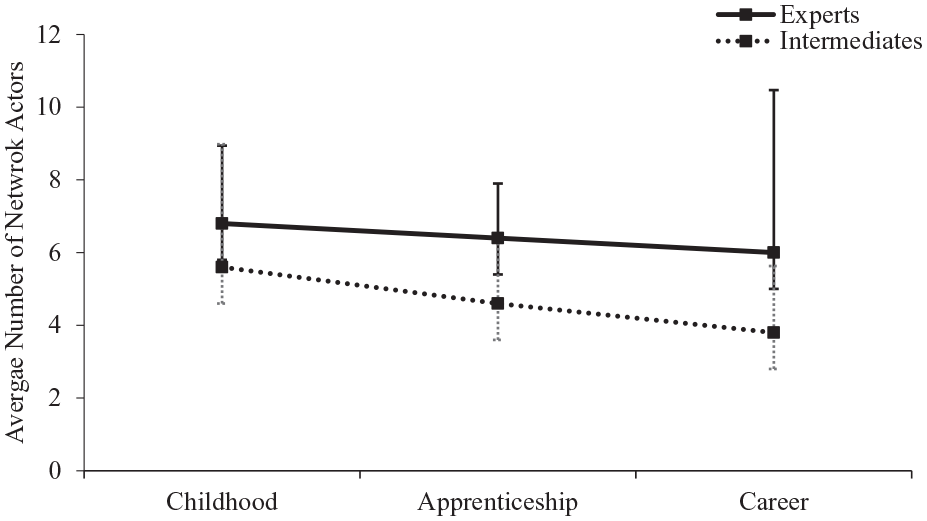
Change in the Average Number of Network Actors Providing Feedback for Experts and Intermediates During Three Developmental Phases.
Over both time spans, the stability ratios suggested that the experts’ networks were on average less stable, and the change ratios revealed that the experts’ networks changed more on average compared with those of the intermediates (see Table 9).
Stability Ratios and Change Ratios of Networks Providing Feedback.

Note. The stability ratio and change ratio do not add up to 1, as the underlying total values are different. Please see the analysis section for the calculations of the ratios.
Changes in networks supporting the correction of errors
During all the phases, the average network size supporting the correction of errors was greater for the experts compared with the intermediates (see Table 10). The networks of the experts contained about two more actors that supported the correction of errors during childhood, three more actors during the apprenticeship phase, and two more network actors during the career phase. Between the childhood and apprenticeship phases, the network sizes of both the experts and intermediates decreased. Between the apprenticeship and career phases, the network size of the experts remained the same, and the network size of the intermediates increased.
Descriptive Statistics of the Networks Supporting the Correction of Errors of Experts and Intermediates.

A visual overview of the changes in the average number of network actors supporting error correction indicated a less precipitous decrease in the average number of network actors in the expert group between the childhood and apprenticeship phases (see Figure 6). Between the apprenticeship and career phases, the number of network actors remained the same for the experts, while the number of network actors increased precipitously for the intermediates.
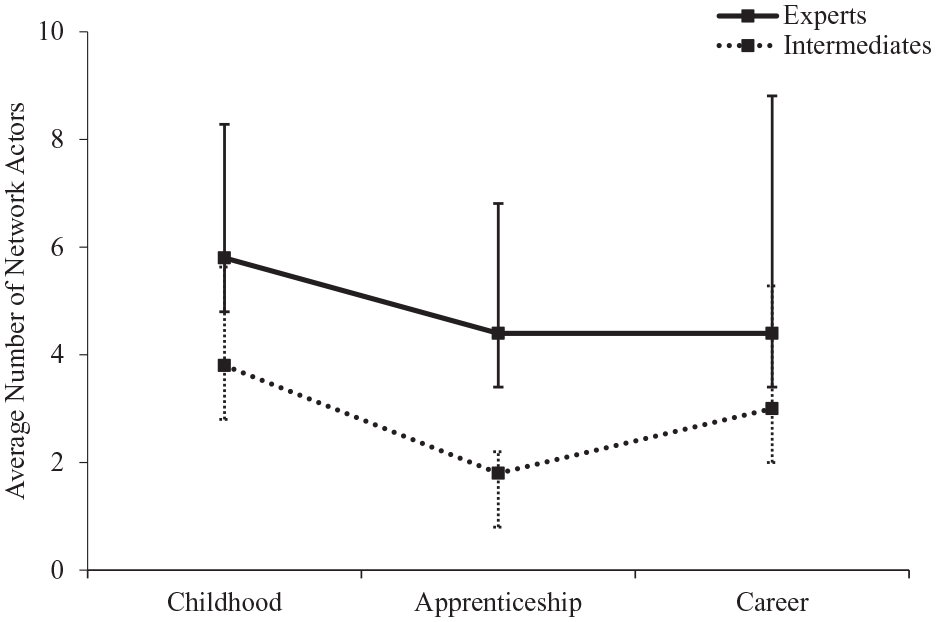
Change of the Average Number of Network Actors Correcting Errors of Experts and Intermediates During Three Developmental Phases.
Over both time spans, the stability ratios showed that the experts’ networks were on average less stable, and the change ratios suggested that the experts’ networks changed more on average compared with those of the intermediates (see Table 11).
Stability Ratios and Change Ratios of Networks Supporting the Correction of Errors.

Note. The stability ratio and change ratio do not add up to 1, as the underlying total values are different. Please see the analysis section for the calculations of the ratios.
Changes in networks providing motivation
During all the phases, the experts’ average network size regarding motivation was greater compared with that of the intermediates (see Table 12). Compared with the intermediates, the networks providing motivation for the experts comprised about one network actor more during the childhood and apprenticeship phases and about two network actors more during their careers. During the childhood and apprenticeship phases, the average number of network actors decreased in both groups. Between the apprenticeship and career phases, the number of network actors increased marginally for the experts, and the number of network actors decreased marginally.
Descriptive Statistics of the Networks Providing Motivation for Experts and Intermediates.

Between the childhood and apprenticeship phases, the decrease in the number of network actors providing motivation for both groups was equally precipitous (see Figure 7). Between the apprenticeship and career phases, the number of network actors increased precipitously for the experts. For the same period of time, the number of network actors of intermediates decreased less precipitously compared with the decrease during the time between the childhood and apprenticeship phases.
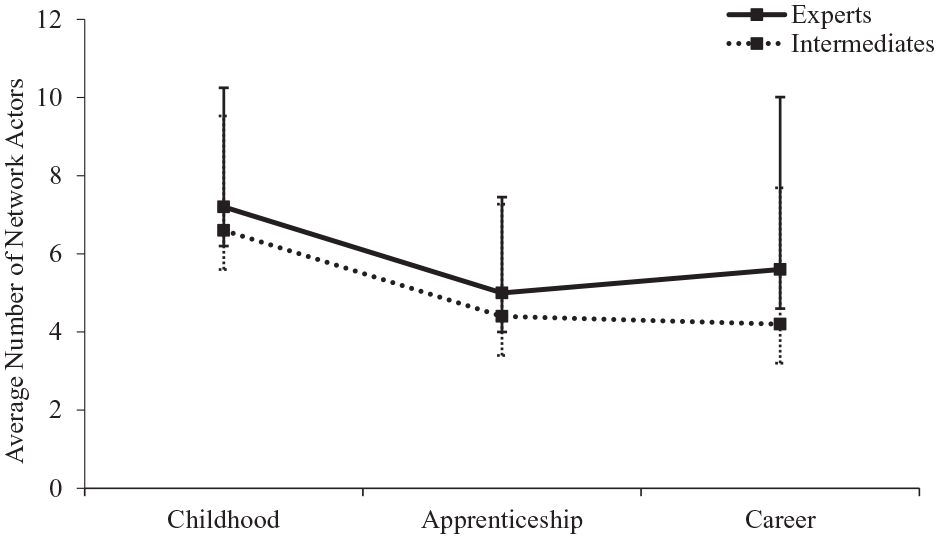
Change in the Average Number of Network Actors Providing Motivation for Experts and Intermediates During Three Developmental Phases.
Over both time spans, the stability ratios indicated that the experts’ networks were on average less stable, and the change ratios showed that the experts’ networks changed more compared with those of the intermediates (see Table 13).
Stability Ratios and Change Ratios of Networks Providing Motivation.

Note. The stability ratio and change ratio do not add up to 1, as the underlying total values are different. Please see the analysis section for the calculations of the ratios.
Changes in networks providing new learning content
During all the phases, the average network size regarding new learning content was greater for the experts compared with the intermediates (see Table 14). The networks of the experts contained about five more network actors that provided new learning content during childhood, four more network actors during the apprenticeship phase, and one more network actor who provided such content during their careers. For both experts and intermediates, the average number of network actors providing new learning content decreased over time, from childhood to apprenticeship to the career phase.
Descriptive Statistics of the Networks Providing New Learning Content for Experts and Intermediates.

A visual overview of the changes in the average number of network actors providing new learning content indicated that the decrease in network actors was more precipitous for the experts over both time spans compared with the intermediates (Figure 8).
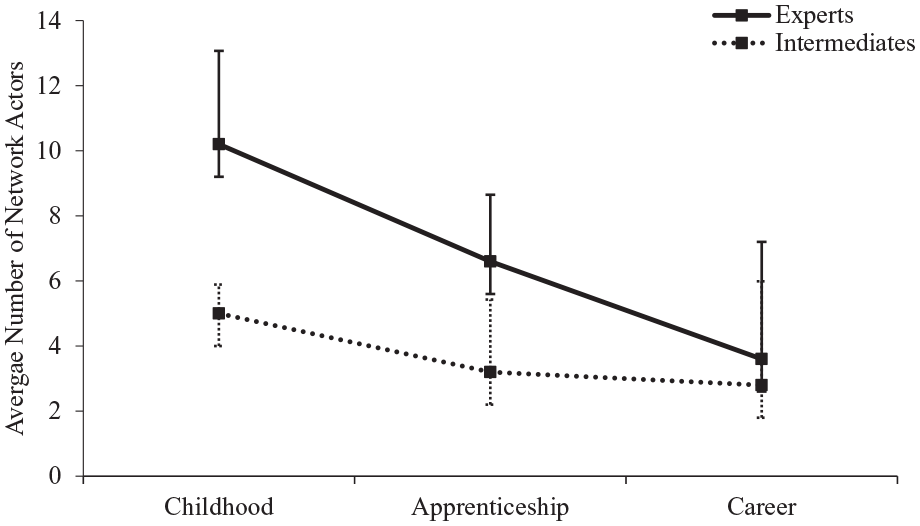
Number of Network Actors Providing New Learning Content for Experts and Intermediates during Three Developmental Phases.
Over both time spans, the stability ratios and the change ratios revealed low stability and a high degree of change in both groups (see Table 15). Between the childhood and apprenticeship phases, the stability ratios were marginally lower and the change ratios marginally higher for the experts compared with the intermediates. Between the apprenticeship and career phases, the stability ratio of the experts was lower compared with that of the intermediates, and the change ratio was marginally higher for the experts.
Stability and Change Ratios of Networks Providing New Content.

Note. The stability ratio and change ratio do not add up to 1, as the underlying total values are different. Please see the analysis section for the calculations of the ratios.
Discussion
The aim of this study was to explore changes in networks supporting the deliberate practice of expert and intermediate popular musicians during three developmental phases. A mixed methods egocentric network analysis was used to retrospectively examine changes in networks supporting six aspects of deliberate practice.
The results indicated that, in total, networks supporting the deliberate practice of expert popular musicians were less stable than those of intermediates. Experts experienced more changes during the developmental phases. Not only deliberate practice but diversity and change in the network actors supporting deliberate practice were found to be conducive to the development of expertise in popular music. Similar results were found for jazz music by Gruber et al. (2008), who stated expertise is created through transitions, change, and new network relations. In total, the networks of expert musicians changed more between the childhood and apprenticeship phases compared with those of the intermediates. Possibly, experts left their childhood networks behind and entered new vibrant learning communities in conservatories or music universities (De Bruin, Williamson, & Wilson, 2020). In contrast, intermediates tended to stay in the networks they had developed in childhood. Between the apprenticeship and career phases, the stability ratios were marginally higher and the change ratios were marginally lower for the experts. Nevertheless, both ratios still showed that the networks of the experts changed more than those of the intermediates. It is conceivable that experts entered their careers as professional musicians and engaged in various bands, while the intermediates tended to stay in their former bands.
Regarding the networks supporting the six aspects of deliberate practice, the highest change ratios were found for network actors providing motivation and feedback between the childhood and apprenticeship phases and for feedback and new learning content between the apprenticeship and career phases. Different aspects of motivation (e.g., self-beliefs), which strongly depend on the support by network actors, tend to change during the development of expertise (Hallam et al., 2016). The study showed that changes in the network actors supporting motivation are beneficial for expertise development. Immediate feedback is a crucial aspect of deliberate practice leading to improvements in performance (Ericsson, 2016). Therefore, feedback and new learning content provided by different supportive network actors enabled musicians to make use of different suggestions of improvement throughout the phases of expertise development.
Experts’ networks comprised more network actors, both general and concerning all six aspects of deliberate practice during expertise development. This finding is consistent with Zwaan, ter Bogt, and Raaijmakers (2010) who showed that successful musicians receive more social support and have a more extensive professional network. The largest differences in the number of supporting network actors were found for goal setting and for providing new learning content during childhood, and for goal setting and structuring content during the apprenticeship and career phases. Structured practice goals are generally set by the individual or by their learning environment (Hallam, 2016). Having more network actors providing learning goals during childhood probably helped the experts to set more diverse and challenging goals from the onset of their expertise development. Having more network actors during the apprenticeship phase could possibly be due to the enrolment in a conservatory, as teachers are mainly responsible for setting learning goals and providing structured content (Platz et al., 2014). During their careers, performing in changing band constellations might explain why the experts had more actors setting goals for them and providing them with structured learning content. The access to new learning content from more and changing network actors provided them with access to different domain-specific learning content, enhancing their musical knowledge during childhood.
In total, the number of network actors decreased in both groups throughout the three phases. Possibly, support from fewer network actors is needed as expertise development progresses. The most precipitous decrease was found for network actors providing new learning content for experts over all phases of expertise development. A reason might be the high number of network actors that provided new content in childhood. Also, it might have been more difficult for experts to find network actors who could show them new content. Surprisingly, the lowest decrease was found for the number of network actors providing feedback for the experts during the phases of expertise development, although network actors providing feedback had the highest change ratios. This could indicate that not only changes in network actors providing feedback but also a constantly high number of actors providing feedback are conducive to promoting development during deliberate practice.
The decrease in network actors supporting most aspects of deliberate practice was more precipitous between the childhood and apprenticeship phases compared with that between the apprenticeship and career phases. A different pattern was found in the decrease in network actors providing structured content for experts, which was less precipitous between the childhood and apprenticeship phases. Possibly, when entering the conservatory, the experts had access to different teachers providing them with structured learning content. A different pattern was also found for the network actors who corrected errors, which was stable for experts and increased for intermediates between the apprenticeship and career phases. To develop expertise, it seems to be important to have a relatively constant number of network actors during these phases. For intermediates, more support is probably needed during their careers, as they tend to make more errors in their performances. A further deviation from the general pattern was an increase in the number of network actors providing motivation for experts during the apprenticeship and career phases. It appears that the experts motivated themselves more intrinsically during their time in conservatories. As they entered their professional careers, contact with different band members might have led to an increase in the motivation they received externally. This was also found by Längler, Nivala, and Gruber (2018) for guitarists in popular music.
Implications
The results of this study provide practical implications for research and for musicians and teachers. They indicate that change in networks is a promising field for future investigation because the development of expertise depends on the support and on changes in the network. By providing a structured analysis method, change in networks can be further theorized. This study thus contributes to a general understanding of expertise and how it can be supported through developmental phases by changing networks.
Musicians (especially young ones) can benefit from this research because it might trigger their reflection on their own network and increase their awareness that change might be crucial for their future musical development. It might also motivate them to engage in music making with various musicians, which seems beneficial for acquiring expertise.
The results inform music schools, higher music education institutions, and teachers in reference to both general practice and ensemble practice. General practice could be provided by different teachers who present various points of view on a subject. Ensemble practice could be designed in such a way that opportunities are provided to perform with different musicians.
Future research and limitations
A limitation of the current study is that the results are not generalizable to a larger population of musicians from other genres. Future research could focus on musicians with diverse backgrounds and/or larger samples of musicians from multiple genres to illustrate changes in these networks. Future research might also focus in more detail on social networks by examining networks from a socio-centric network perspective (e.g., who supported whom within a network?) and from a more detailed temporal perspective (e.g., when and who long do certain network actors support each other).
However, the current study determined conclusively that experts have access to more and constantly changing network actors that supported deliberate practice and the development of their expertise in popular music.
Footnotes
Appendix
Background Information of the Participants.

| Participant | Experience | Profession | Music Genres; Instrument(s) |
|---|---|---|---|
| E1 | 48 years | Musician and instrumental teacher, ISCED Level 6, professional musician in three bands, several published records, more than 50 live performances per year | Pop, Rock, Jazz; Drum |
| E2 | 25 years | Musician and music teacher at a music college, ISCED Level 7, active in five bands, several published records, more than 60 live gigs per year | Jazz, Rock, Prog, Funk; Drums, Percussion |
| E3 | 38 years | Musician and music teacher at a music college, ISCED Level 7, active musician in five bands, several published records, more than 130 live gigs per year | Jazz, Rock, Easy Listening; Bass, Guitar, Piano |
| E4 | 13 years | Musician and music teacher at a school, ISCED 6, active in one band, record contract, 40 live gigs during the year | Pop, Rock; Guitar, Piano |
| E5 | 15 years | Musician and instrumental teacher, student of philosophy/music pedagogic, ISCED Level 6, active in one band and as solo musician, record contract, more than 45 live gigs during the year | Blues, Rock, Klezmer; Guitar, Bass, Contrabass, Rhythm Instruments |
| I1 | 14 years | Non music related profession; ISCED Level 2, active as jam musician | Rock, Blues; Drums, Guitar |
| I2 | 23 years | Non music related profession; ISCED Level 3, active in three bands | Rock Folk, Pop; Drums |
| I3 | 23 years | Non music related profession; ISCED Level 3, active in one band | Rock, Pop, Jazz; Guitar, Flute |
| I4 | 15 years | Non music related profession; ISCED Level 3, active in one band | Rock, Pop; Guitarist, Synth |
| I5 | 14 years | Non music related profession; ISCED Level 3, active in one band | Blues, Rock; Bass, Guitar |
Note. The abbreviation “E” stands for expert, “I” for intermediate. The ISCED Level (International Standard Classification System of Education) indicates the educational level of the experts and intermediates.
Declaration of conflicting interests
The author(s) declared no potential conflicts of interest with respect to the research, authorship, and/or publication of this article.
Funding
The author(s) received no financial support for the research, authorship, and/or publication of this article.
