




Abstract
Although the majority of previous research on music-induced responses has focused on pleasurable experiences and preferences, it is undeniable that music is capable of eliciting strong dislike and aversion as well. To date, only limited research has been carried out to understand the subjective experience of listening to aversive music. This qualitative study explored people’s negative experiences associated with music listening, with the aim to understand what kinds of emotions, affective states, and physical responses are associated with listening to aversive music. One hundred and two participants provided free descriptions of (1) musical features of aversive music; (2) subjective physical sensations, thoughts and mental imagery evoked by aversive music; (3) typical contexts where aversive music is heard; and (4) the similarities and/or differences between music-related aversive experiences and experiences of dislike in other contexts. We found that responses to aversive music are characterized by embodied experiences, perceived loss of agency, and violation of musical identity, as well as social or moral attitudes and values. Furthermore, two “experiencer types” were identified: One reflecting a strong negative attitude toward unpleasant music, and the other reflecting a more neutral attitude. Finally, we discuss the theoretical implications of our findings in the broader context of music and emotion research.
Over the past decades, emotions evoked by music have been widely studied in the field of music psychology. There is a rather strong consensus that an important reason for listening to music is to experience emotions, and that the majority of music-evoked emotions are positively toned (Juslin & Sloboda, 2010). This idea has led to negative emotions often being considered as irrelevant in a musical context; for example, Zentner and Eerola (2010, p. 197) describe how sometimes, in experimental studies on musical emotions, “traditional emotion categories have been modified by replacing musically inappropriate categories such as disgust and surprise with more fitting categories such as tenderness or peacefulness.” Similarly, Gabrielsson (2011, p. 130) stated that negative emotions may occur when listening to music, but that they are “mainly dependent upon circumstances other than the music.” These ideas may also arise from centuries-old Western tradition of considering music as “a pacifying, healing medium” (Garratt, 2018, p. 42). However, if we consider the number of articles in popular media, listing “The 50 most hated songs ever” on a regular basis, 1 it becomes evident that music is also associated with strong negative emotions and aversion.
Previous research on unpleasant aspects of music has mostly focused on specific musical features or the identification of annoying sounds (Cunningham, Downie, & Bainbridge, 2005; McDermott, 2012). Annoying or “bad” music has also been studied as a historical and cultural phenomenon, from the perspectives of music philosophy and aesthetics, music history, sociology, and music criticism (Washburne & Derno, 2004). Firth (2004) has argued that music that is considered as “bad” is not only a matter of personal taste, but is intertwined with ideological arguments, because the judgments made on “bad music” serve people’s identity-constructing formulations, and thus become part of their musical identities (MacDonald, Hargreaves, & Miell, 2002). Thus, musical preferences can play a crucial role in constructing, maintaining, and expressing social identities, and can be used to make distinctions between the self and others. However, as Firth (2004, p. 30) states, our responses to music seem to be foremost emotional ones: “what’s equally at issue is feeling: what is happening when we listen to music? ‘Bad music’ describes to begin with an emotional not an ideological response.”
Although negative emotions have received increasing attention in the field of music psychology, the majority of studies have concentrated on the “paradoxical enjoyment” of music-induced negative emotions, such as sadness or aggression (e.g., Eerola, Vuoskoski, Peltola, Putkinen, & Schäfer, 2018; Garrido & Schubert, 2013; Thompson, Geeves, & Olsen, 2019; Weth, Raab, & Carbon, 2015). Aversive, negative responses to music, or the possible reasons behind these experiences are not yet well understood. This paper aims to shed some light on the unpleasant sides of music listening by exploring people’s subjective experiences of listening to aversive music.
Unpleasant sounds and disliked music
Although the main focus of previous research has been on the paradoxical enjoyment of negative emotions, some work on the unpleasant aspects of music and sounds has been carried out. Dermott (2012) summarized neuroscientific findings relating to auditory preferences, and presented typical aversive features of non-musical sounds. In general, loud and distorted sounds are usually considered as unpleasant, and certain frequencies are likely to trigger aversive responses: Sharpness (high-frequency energy of a sound) and roughness (rapid amplitude modulation of a sound) are major determinants of unpleasantness, but they can be less aversive at low volume. However, in the context of music, aversion to sounds is at least partially context-dependent and a matter of exposure and familiarization. For instance, the development of music technology and the introduction of distortion in rock music has challenged the traditional Western concepts of music aesthetics (Dermott, 2012). Cunningham et al. (2005) investigated aversive musical features, and discovered certain features explaining why a piece of music was hated: Bad or clichéd lyrics, catchiness (the “earworm effect”), voice quality of a singer, over-exposure, perceptions of pretentiousness, and extramusical associations (such as the influence of music videos or unpleasant personal experiences) were identified as the main factors making music unpleasant.
Furthermore, listeners’ psychological strategies in relation to musical taste have been preliminarily investigated. Ackermann (2019) used interviews to explore negative attitudes toward disliked music, and synthesized four themes of “legitimization strategies” that are used to justify these attitudes. The themes cover (1) music-specific legitimization strategies, where the focus is on the compositional aspects of music, the interpretation of the musician or composer, the lyrics and semantic content, and other aesthetic criteria; (2) listener-specific legitimization strategies, where the focus is on the emotional or mood-related responses to music, physical reactions, and other aspects relating to the self and identity; (3) social legitimation strategies, where the focus is on in-group and out-group relations; and finally (4) cross-category subject areas, consisting of aspects such as the exaggerated emotionalization (Kitsch) of music, the authenticity and commerciality of music, and differing definitions between music and noise. The first three strategies seem to be applicable for disliking singing voices in popular music as well. Merrill and Ackermann (2020) found that emotional reasons, factual reasons, bodily reactions and urges, and social reasons were rationales for the negative evaluation of pop-singers’ voices (see also Merrill, 2019). The preliminary work of these two scholars show that, in addition to socio-cultural perspectives and aspects relating to social identity, psychological, emotional, and physical responses play a crucial role in aversive musical experiences.
Krueger (2019) has proposed that music’s materiality is the key reason behind its power over listeners. The fact that we resonate (physically) with sounds explains why humans react to high volume and certain frequencies, but particularly musical sounds “seem to penetrate consciousness in a qualitatively deeper way than input from other perceptual modalities,” as Krueger (2019) states. Thus, music and soundscapes that are not made or chosen by the listener, can strongly affect them, and potentially even negate individual agency and consent by “hacking” their self-regulatory system. These mechanisms have been previously investigated in studies focusing on music and affect regulation, highlighting the positive effects of intentional music listening for self-regulative purposes (for a review on different approaches to affective self-regulation through music, see Baltazar & Saarikallio, 2017). According to Krueger (2019), it is possible to weaponize these processes, and thus use music as a technology for “affective mind invasion” and, in the worst case, torture, as was done by the United States military in the so-called “global war on terror.” Recorded cases of the military playing loud rock music from speakers during operations, as well as looping offensive unfamiliar heavy metal music or endless repetitions of Western children songs to “soften up detainees prior to questioning” instead of weaponizing sheer noise suggest that symbolic musical “messages” combined with high-volume sounds are effective and subtle ways of affecting one’s mind compared to more apparent forms of violence (Garratt, 2018, pp. 42–44).
The aim of the present study is to explore people’s negative experiences associated with music listening. We aim to understand what kinds of emotions, affective states, and physical responses are associated with aversive music, identify commonalities in the verbal descriptions, and reflect on the theoretical implications of these aversive musical experiences for the wider music and emotion research community.
Method and data
Research approach and data collection procedure
We selected an exploratory, content-driven qualitative research approach, aiming to generate new theoretical perspectives and concepts for further study. This relatively unstructured and inductive approach is typical for qualitative psychology (Howitt, 2010). Similar to Gabrielsson (2011), we formulated the task in a fairly open manner in order to gain an overview of people’s experiences. The data were collected in-between December 2018 and January 2019 via an online questionnaire. There were four open-ended questions concerning aversive or disliked music and the experiences associated with that kind of music. In the instructions, “aversive music” was defined as the kind of music that the respondents themselves considered as unpleasant, disliked, or appalling.
The respondents were asked to give free descriptions of (1) musical features of aversive music; (2) subjective physical sensations, thoughts and mental imagery evoked by aversive music; (3) typical situations where aversive music is heard, and finally, they were asked to (4) compare the aversive experiences relating to music to experiences of dislike in other contexts. These questions were loosely based on Gabrielsson’s (2011) previous qualitative research on strong experiences with music, but with a focus on negatively toned experiences. In addition to basic demographic information (gender, age, education, musical background), the respondents were asked to rate how often they experienced certain emotions in the context of music listening, to gain indirect information of the respondents’ overall emotional experiences induced by music.
Data and participants
The qualitative dataset of this study consisted of free descriptions provided by 102 anonymous volunteers. They were invited to partake in the study via an invitation and a direct link to the questionnaire distributed on social media sites. The respondents’ age ranged from 18 to 65 years (M = 41.04, SD = 11.65). Of all the participants, 74 identified themselves as women (72.6%), 26 (25.5%) as men, and 2 (2%) as non-binary. The majority of the respondents were highly educated (62% had a university level degree), and were regularly listening to music (43% listening to music daily, and 46% listening to music multiple times a day). In all, 17% of the respondents identified themselves as non-musicians, 33% as “music-loving non-musicians,” 22% as amateur musicians, and 28% as semi-professional or professional musicians.
Respondents were each coded with a letter and number: the letter indicating their gender (F = female, M = male, N = non-binary), and the number ranking them according to the order of response.
Applied thematic analysis and typology development
The research epistemology of the study can be defined as “a moderate version of social constructionism” (Schwandt, 2000, pp. 198–199), which considers knowledge and reality as constituted “by a context of intersubjectively determined background assumptions” of situational, culturally variable social values and practices (pp. 198–199). However, the analytical procedures were systematic and employed data reduction techniques, such as quantification and intermediate comparison of data coding between the authors (Guest, MacQueen, & Namey, 2012).
We analyzed the data by utilizing inductive applied thematic analysis (Guest et al., 2012), focussing on overarching themes identified in the text. The first author coded the data by using the data-led approach (e.g., Braun & Clarke, 2006), and aggregated them in a codebook consisting of the initial code definitions (see Guest et al., 2012, p. 71). The analysis was congruent with an exploratory approach, as the first author read and reread the data looking for key words and trends before the actual analysis took place, so no analytic categories were predetermined but all the codes derived from the data (see Guest et al., 2012, p. 7). The second author completed the second round of analysis by coding the data using the same codes as the first author. She also made additions to the set of codes when necessary. After the second round of coding, all the codes were inspected for possible divergences, and dissimilar codes were highlighted. All the highlighted codes were then reviewed, and mutual interpretations discussed and negotiated. The codes were organized hierarchically, resulting in 8 structural code groupings with 151 sub-codes (see the codebook in https://osf.io/mehwd/?view_only=8dccc78f17f74ea9981fd2a4773cd2a3). These groupings were further analyzed in relation to the aspects that contribute to “aversive musical experiences” in the participants’ descriptions.
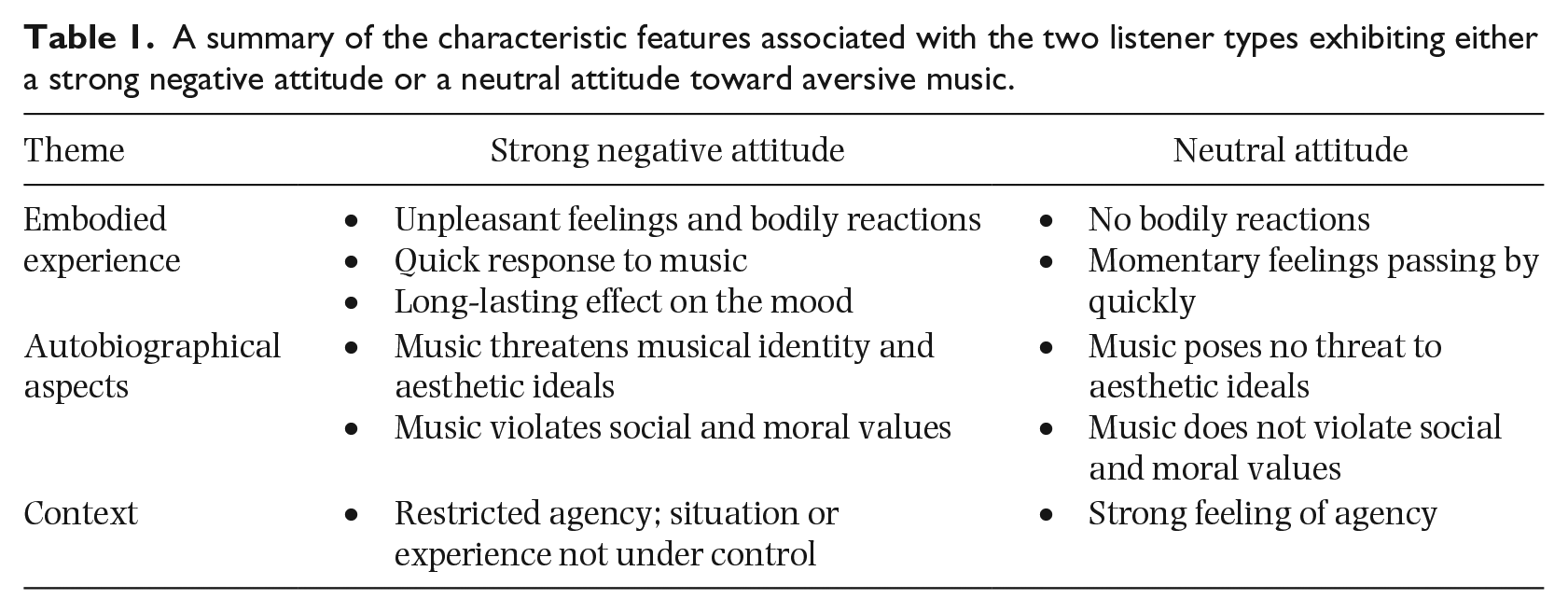
During the analysis, we identified significantly different qualia of experiences and attitudes toward aversive music existing in the data. In order to bring forth these patterns of commonality and variety, we conducted typological analysis (Given, 2012) resulting in the reconstruction of two ideal types: (1) a strong negative attitude toward unpleasant music and (2) a more neutral type of attitude. The differences between these two types will be discussed in more detail below. Yet, the two types are reductionist and distinguished only for the sake of the data analysis, as there was a degree of overlap in practice; thus, although there were individual respondents who visibly had a strong negative attitude (37% of all respondents) and other individuals with a visibly neutral attitude (15% of all respondents), some respondents could not be classified as representing either of these types, since their accounts included elements of both, often describing multiple different experiences, and where the qualia of each experience were depending on the context where the aversive music was present.
The final analysis, as well as interpretations of the themes, were also a result of mutual interpretative endeavors. This kind of collaboration was considered necessary in both making the interpretation stronger and highlighting the fact that the interpretation was the product of processes of social negotiation (cf., Schwandt, 2000). Both the data collection and analysis were conducted in the native language of the researchers and participants, and the selected direct quotes and the codebook were translated into English only in the reporting phase of the process.
Aspects of aversion associated with music
The data demonstrate that aversive affective experiences may not be as rare a phenomenon as implied by the previous music psychology literature. Nearly half of the respondents mentioned experiencing emotions such as disgust or irritation while listening to music. In the analysis, we constructed four broad thematic categories with subcategories illustrating the aspects of aversive musical experiences: (1) material, (2) embodied experience, (3) autobiographical aspects, and (4) context. In addition to describing each theme, the analysis aims to compare how certain aspects of these categories manifest in descriptions reflecting (1) a strong negative attitude toward unpleasant music, and (2) a more neutral type of attitude. However, since there was a prominent resemblance between the first theme and the features identified by both Cunningham and colleagues (2005) and Ackermann (2019), for the sake of brevity, the first theme will be omitted from the present report (The full analysis, including additional data quotes, can be accessed in https://osf.io/mehwd/?view_only=8dccc78f17f74ea9981fd2a4773cd2a3.)
Embodied experience
This theme consists of accounts describing the subjective experiences evoked by music. Three subcategories were identified: Feelings, Physical sensations, and Temporality, which all refer to aspects of embodied experience. Since feelings and physical sensations were often inseparable in the participants’ accounts, we merged these two themes into one category.
Feelings and physical sensations
For strong musical aversion, bodily reactions and feelings played a crucial role in the experience. The descriptions with a strong negative attitude consisted of unpleasant bodily feelings of actual physical disgust, or even physical pain especially in the head and the upper body. Feelings of muscle tension, increased pulse and changes in breathing, or involuntary motor-responses, such as a scrunched-up face or a shrinking posture were common among the respondents. These descriptions illustrate how negative emotions and bodily reactions are inseparable in strong affective experiences:
[j]ust hearing the first notes makes [. . .] feelings of being horrified,
Furthermore, multimodal, inexplicable responses can occur in response to unpleasant music:
My
The experience could vividly be felt in the body:
It can make me
This description seems to be a typical example of emotional contagion, a mechanism where the listener is—unintentionally—internally mimicking the emotional expression they hear in the music, which is widely considered as one of the key mechanisms of emotion induction in the context of music listening (e.g., Juslin, Liljeström, Laukka, Västfjäll, & Lundqvist, 2011). Negative emotions evoked by music have often been explained by referring to emotional contagion (see, for example, Peltola & Eerola, 2016; Vuoskoski & Eerola, 2012).
Moreover, the feeling of muscle tension in response to aversive music was reported in association with other reactive motor-responses:
[m]y [m]y
In addition to muscle tension, nausea and the urge to escape were something that could be experienced in response to music:
I
Negative affect can also lead to impolite behavior directed to other people:
I feel disorganised, I start feeling nervous, I’m
Inexplicable aggression toward other people was recurrently described across different accounts, which will be examined in a more detailed way when presenting the last main category.
Although bodily reactions were typically arising as a response to specific acoustic features, unpleasant embodied experiences could be triggered by semantic content alone:
If [the singer] is shaming female bodies, it makes me There’s this one song that would be catchy, but goddamit, when I hear the lyrics, thick with references to rape culture, it just
These accounts illustrate how personal values are intertwined with affective meanings and the overall experience, and how they can be felt even on an embodied level.
In those accounts with a more neutral attitude toward aversive music, the experience was described as not really felt in the body:
It can be irritating. But I [. . .] my aversion is
Temporality
For strong musical aversion, temporal aspects of the experience were a distinguishing feature. The descriptions relate how the negative response to music takes place immediately and be inexplicable:
[i]t happens Some inexplicable frustration is evoked
Furthermore, negative moods caused by aversive music can last for a rather long time. These long-lasting consequences of disliked music were also mentioned by many respondents:
I feel angry It’s hard to explain why, but compared to other aversive things, musical disgust can
In the descriptions with a more neutral attitude toward aversive music, unpleasant experiences seemed to be rare, or they were mild and passed quickly:
The feeling is quite harmless and These feelings
Autobiographical aspects
The third theme consists of descriptions relating to autobiographical aspects with subcategories Musical identity and Social or moral attitudes and values. This theme illustrates how aversive music can violate listeners’ personal values relating to their musical and social identities, beliefs, and attitudes.
Musical identity
The violated values relating to a person’s musical identity can be identified as expressing specific subjective musical ideals and aesthetic appreciation. Typically, musical expertise of the respondent was brought up in these accounts:
I get extra-irritated by
This kind of violation of the fundamental, subjective ideas of what music is for and how it should sound like, was repeatedly described in the data. The overlap with the first theme of disliked musical features were noticeable within these descriptions:
I find aggression in music (like in heavy metal or rap) appalling because I can recognize the motivation behind the music: whether it’s
Furthermore, if music is an important aspect of one’s identity, the negative affective experience evoked by “the wrong kind of music” can be especially strong:
In the descriptions with a more neutral attitude toward aversive music, references to musical identity or aesthetic ideals were close to non-existent, with the exception of F05’s account:
I can’t recall any situation, because these experiences are so rare.
Social or moral attitudes and values
The second subcategory goes beyond aesthetic musical appreciation by revealing how aversive musical experiences can arise from more complex, deep-level meaning-making processes, where definitions of what is “good” or “bad” music and their overall meaning are associated with social interactions, the basic need for social acceptance, and ideas about one’s identity in relation to other people. For some, music preference is such a personal matter that they feel threatened by the kind of music that is unpleasant to her but liked by others:
It feels like my selfhood is being threatened;
Thus, disliked music is not solely a matter of personal preference, but can actually put a person in a vulnerable position where the threat of rejection or social isolation feels possible:
[The music] doesn’t just make me feel bad but
Some respondents were describing the other side of this coin by confessing how they make judgments about other people based on their musical taste:
If I hate the music, I immediately start thinking about Besides the actual music, my
The latter account again depicts how musical preferences are associated with broader social identities and different social groups, and how aversive music can actually reveal the boundaries between “us” and “them.”
Since music is regularly used for conveying explicit verbal messages, disturbing or offensive lyrics can be the obvious sign of “the other” threatening the listener’s own moral codes, and thus evoking strong negative affect:
If the
The descriptions with a more neutral attitude on the other hand illustrate how disliked music or its semantic content have no great power over the listener’s personal values or social identity:
I usually don’t feel anything special. If the music is somehow bothering me and I start to notice it, I simply ask myself
Context
The fourth theme covered descriptions of contextual aspects contributing to the aversive experience. Both public and private situations were described as the actual contexts where unpleasant music was being heard; especially background music in malls, grocery stores, clubs, or live music events, as well as music chosen by other people in smaller social gatherings were recurring examples. The subcategories of Context were identified as representing Agency and Action tendencies, which were also thoroughly intertwined in the respondents’ accounts, and thus discussed here simultaneously.
Agency and action tendencies
A prominent aspect of musical aversion were the descriptions of restricted agency, and especially various physical or social restrictions related to the situation where the music was being heard. In the case of strong musical aversion, the lack of agency was one of the pivotal aspects contributing to the unpleasant experience. For many respondents hearing aversive music evoked an urge to leave the situation or turn off the music, and if this was not possible, the situation would be experienced as highly uncomfortable. According to their accounts, there is something about music that makes it more difficult to avoid compared to some other unpleasant stimuli:
It’s such an overall feeling, because
The physical anxiety caused by the loud music heard next door or on a radio can trigger aggressive urges:
It makes me feel so anxious . . . I I want to I can sit in my car by myself, It’s agonizing, especially if I can’t decide whether I’m listening to it or not,
As illustrated above, the uncontrollable physical sensation was often associated with restricted agency, which could lead to action tendencies aiming to escape the situation or try to protect oneself from the music. Some respondents seemed so familiar with these kinds of experiences that they were in the habit of carrying protective devices with them:
I get anxious and can even start panicking. I I really
Furthermore, restricted agency and temporality are intertwined, as music’s affective power over the listener can take over their self-regulation abilities:
Music triggers my disgust
Some respondents found music’s role more threatening than just unpleasant sounds, because it can feel like a violation of a personal space:
It makes me feel irritated, I want to put my hands to my ears,
Moreover, typical rhythmical features of a certain genre can have an undesired effect on the person’s overall way of being:
When I’m listening to reggae, it feels like my body’s rhythm
In the descriptions with a more neutral attitude toward aversive music, the situation or music itself did not seem to restrict the respondents’ agency. Music was described as something that is easy to turn off or ignore:
It’s not that bad. I Music affects me emotionally, but doesn’t take over
Summary of results, discussion and conclusion
In summary, we uncovered four main themes in the participants’ responses, relating to Material, Embodied experiences, Autobiographical aspects, and Context. The relationships and overlaps between these themes and their respective subcategories are displayed in Figure 1. Compared to the previous findings of Ackermann (2019), there are notable similarities between the main themes that were uncovered, despite significant differences in method (interview vs. survey) and sample (12 Germans vs. 102 Finns): In particular, Ackermann’s Music-specific, Listener-specific, and Social legitimization strategies bear close resemblance to the themes Material, Embodied experiences, and Autobiographical aspects, respectively.
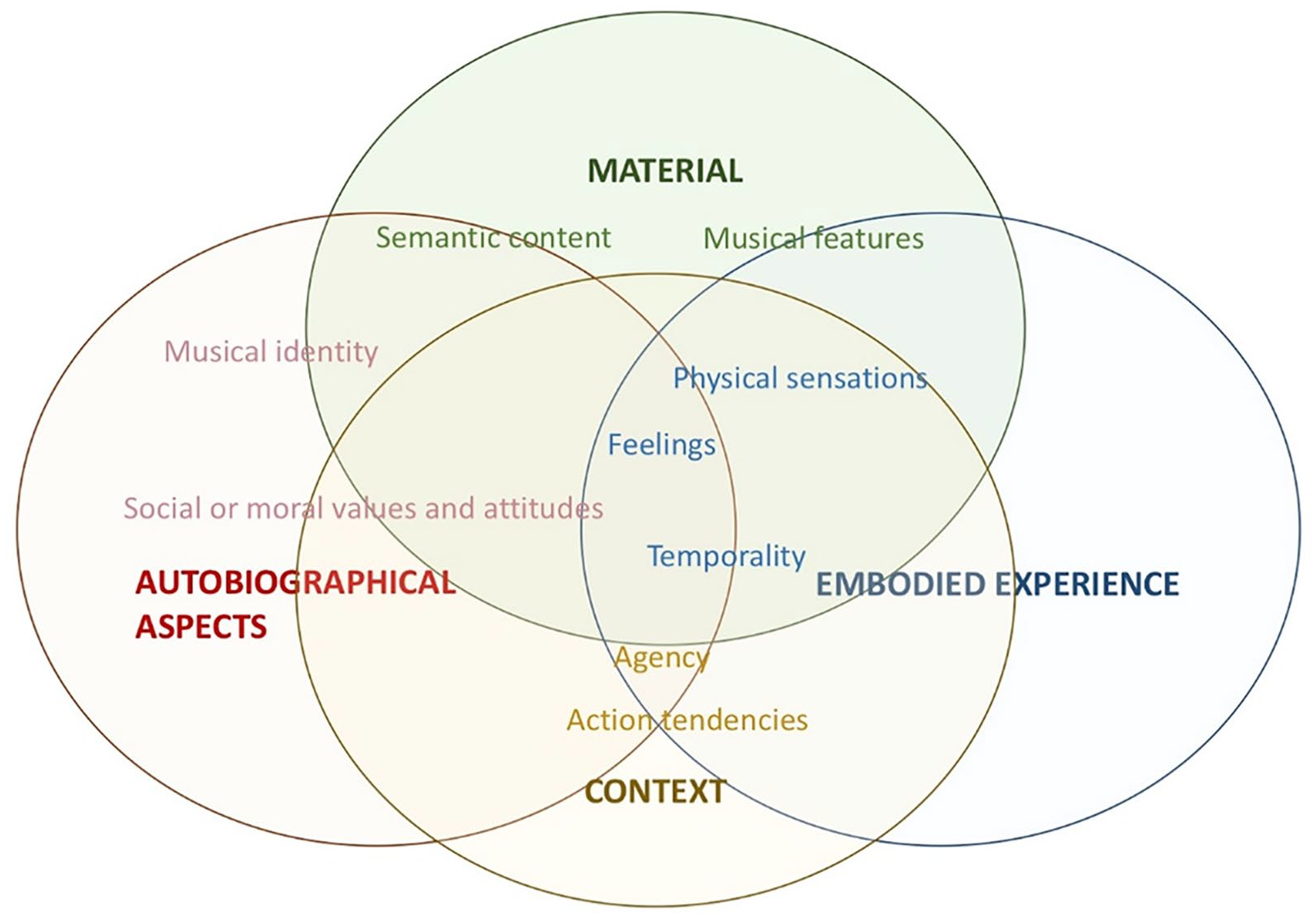
The Relationships Between the Main Thematic Categories and Subcategories.
Furthermore, we also identified two “experiencer types” among the participants: One reflecting a strong negative attitude toward unpleasant music, and the other reflecting a more neutral attitude. The characterizing features of these two types, with respect to the main themes (with the exception of Material, since there were no clear differences between the two types with regard to musical features or semantic content), are summarized in Table 1.
A summary of the characteristic features associated with the two listener types exhibiting either a strong negative attitude or a neutral attitude toward aversive music.
There are also visible similarities between our results and Firth’s (2004) notions of how people’s musical judgments are also ethical judgments, and part of the ongoing construction of their musical identities. This is especially evident in the third theme discussing the musical, social and moral attitudes and values of the respondents, which are also in line with the social legitimation strategies proposed by Ackermann (2019). Identity construction and reconstruction is achieved by comparing the self with other people (MacDonald et al., 2002), and thus musical preference, personal values, and tacit knowledge of the rules for social interaction provide dynamic material for the ongoing development of self-identity. However, the themes Embodied experience and Context draw our focus on the embodied, experiential level of these experiences, in which the interaction between the sonic, musical material and the experiencing body is taking place in a social and material environment. The immediate experience of the materiality of music and the experiencer’s ways of making sense of it are there at the core of the phenomenon which, in this paper, we call as “musical aversion”
Restricted agency occurred repeatedly in our data as one of the aversive aspects of disliked music. Physical or psychological restraints have been proposed to be an inborn elicitor of frustration-aggression responses in both animals and humans, and such negative affect is likely to generate reactions such as “fight or flight” tendencies (see Berkowitz, 1993). Examining aversive music as a form of affective mind invasion (Krueger, 2019), where involuntary music listening is actually diminishing the listener’s agency and ways of being in the world, could help us to understand not only the materiality and embodied nature of musical aversion, but also how music is able to evoke highly negative emotions in the first place. Music, as a material phenomenon, has the power to take over and create a “shared musical world,” as Krueger (2019) has argued. Yet, if this musical world is a hostile one and not of the listener’s making, music can remove individual agency and consent (Krueger, 2019, p. 65). Thus, music can be experienced not only as a tool for connecting people, but also as a weapon for violating personal and physical space. Moreover, if we consider emotions to be the result of psychological construction processes (e.g., Barrett, 2017; for a review of emotion theories used in music research, see Warrenburg, 2020), in which subjective feelings, physiological reactions, involuntary and voluntary motor responses, and thoughts, memories and personal associations are all interconnected, we might be able to explain why a seemingly harmless stimulus, such as music, is capable of triggering such strong aversive responses in some listeners.
It has been debated whether or not moral aversion could be considered as disgust, which is an emotion term often used when referring to bodily rejection of an object (e.g., rotten food) with specific physiological states, such as nausea. However, according to Rozin, Haidt, and McCauley (2008), morally offensive material can induce similar physical responses as those that are known to be markers of deep-level core disgust. An interesting notion concerning the data of our study is that many people described physical reactions typical for disgust, such as nausea or lump in the throat (see Rozin et al., 2008), as well as fight-flight responses (see Kemeny & Shestyuk, 2008). Curiously, some of these reactions, such as lump in the throat, shivers and chills, or increased pulse, are often reported as highly pleasurable in the musical context (e.g., Sloboda, 1991). How can similar reactions be associated with drastically different experiences?
In his analysis on anger and emotional aggression, Berkowitz (1993) proposed that many animals, humans included, have a “built-in” association between negative affect and anger/aggression response. Aversive events generate negative affect and a rudimentary anger experience, which can further be interpreted in different ways depending on the individual, thus resulting in different negative emotions. This view has a strong resemblance with Barrett’s (2006, 2017); conceptual act model, emphasizing the constructionist relationship between physiological, motor, and cognitive reactions (the core affect and its conceptualization) occurring in emotional experiences. We propose that the affect evoked by aversive musical sounds might be rudimentarily a quick, physical response to an unpleasant or potentially dangerous material stimulus, and may in some cases involve unpleasant, involuntary emotional contagion. However, because of the social and moral values, and subjective “layers” of associations and previous experiences, music can, at least in some cases, be more annoying, disgusting, or personally threatening than non-musical sounds.
Furthermore, musical engagement can be seen to be based, at least partly, on the interaction between the listener and the virtual agent existing in the music, or musical persona, as Levinson (2006) conceptualizes it. In the case of aversive music, this imaginary persona is not an empathetic friend providing support to your emotional experiences and temporarily satisfying the need for social connection or intimacy (cf., Schäfer & Eerola, 2018), but an enemy insulting you and diminishing or threatening your experiences. For many of our respondents, reacting with aggression to this kind of “interpersonal threat” was a common action tendency, which also could lead to hostile thoughts toward not only the musical persona, but other people as well. This kind of behavior is in line with Berkowitz’s (1993, p. 10) notions of the anger/aggression response, which, according to him, has the potential to generate hostile action tendencies toward “suitable available targets.” Thus, the aggressive behavior caused by “only music” may look or feel irrational, but it is a result of a complex, genuine emotion experience.
This study has some limitations that need to be acknowledged and discussed. First, since the participants were recruited on a voluntary basis, it is possible that those with a heightened interest toward music were over-represented in our sample. This possibility is supported by the fact that 50% of our participants reported playing a musical instrument, and 89% reported listening to music at least daily. Furthermore, the gender distribution of our sample was skewed, with women accounting for 72.6% of the sample. Both of these factors may have contributed to an over-representation of those listeners with a strong negative attitude toward aversive music (relative to those with a more neutral attitude): Listeners with a heightened interest toward music have been shown to react more intensely to pleasurable music (e.g., Grewe et al., 2007), and the same may hold true for aversive music as well. Moreover, the gender distribution within the two attitude types discovered in our study suggests that men were somewhat more likely than women to display a neutral attitude toward aversive music, but because of the skewed sample and the explorative qualitative research approach, we cannot make generalizations or conclusions about the prevalence of these two attitude types in the wider population. Future studies should investigate the intensity and range of responses to aversive music in a larger and more representative sample, and explore factors (such as personality traits) contributing to individual differences in such responses. It may be that traits contributing to the intensity of emotional reactions to music—such as trait empathy and openness to experience (e.g., Eerola, Vuoskoski, & Kautiainen, 2016; Nusbaum & Silvia, 2011)—also contribute to the intensity of responses to aversive music.
In conclusion, this study has demonstrated that unpleasant responses to aversive music are characterized by embodied experiences, perceived loss of agency, and violation of social or moral attitudes and values. Furthermore, two “experiencer types” were identified: One reflecting a strong negative attitude toward unpleasant music, and the other reflecting a more neutral attitude. These two types differed from each other in terms of the intensity, valence, and temporality of the experience. Overall, these findings demonstrate that—in addition to evoking strong pleasure—music is also capable of eliciting strong dislike and aversion.
