




Abstract
This study explored 19 themes embedded in the lyrics of 1,040 U.S. top-40 songs from 1960 through 2010, using R strucchange software to identify trends and breaks in trends. Findings reveal both continuity and change. As in 1960, the predominant topic of pop music remains romantic and sexual relationships. However, whereas the proportion of lyrics referring to relationships in romantic terms remained stable, the proportion including reference to sex-related aspects of relationships increased sharply. References to lifestyle issues such as dancing, alcohol and drugs, and status/wealth increased substantially, particularly in the 2000s. Other themes were far less frequent: Social/political issues, religion/God, race/ethnicity, personal identity, family, friends showed a modest occurrence in top-40 music throughout the studied period and showed no dramatic changes. Violence and death occurred in a small number of songs, and both increased, particularly since the 1990s. References to hate/hostility, suicide, and occult matters were very rare. Results are examined in the context of cultural changes in the social position of adolescents, and more specifically in light of the increased popularity of rap/hip-hop music, which may explain the increases in references to sex, partying, dancing, drug use, and wealth.
In view of the centrality of popular music in the lives of adolescents, it is important to understand the messages inherent in it. Indeed, popular music both reflects and constructs the adolescent agenda. This study tracks historical trends in the themes embedded in the lyrics of modern popular music – the U.S. top-40 songs from 1960 through 2010.
Music in adolescence
Popular music has long been a crucial interest of youth. Music’s importance has not waned in the era of new media, new music listening platforms and media-multitasking (North & Hargreaves, 2003). Surveys of U.S. adolescents conducted by the Kaiser Family Foundation (Rideout, Foehr, & Roberts, 2010; Roberts, Foehr, & Rideout, 2005; Roberts, Foehr, Rideout, & Brodie, 1999) found that average daily music listening time for 8- to 18-years olds jumped from 1.75 hours in 2004 to 2.5 hours in 2009. Among 15- to 18-year-olds the average time rose from roughly 2.5 hours in 2004 to 3.33 hours in 2009. This last number is corroborated in a recent study (Edison Research, 2015). Young people have been shown to listen to music to improve their moods and to cope with problems (Christenson & Roberts, 1998; Saarikallio, 2011; Schäfer, Sedlmeier, Städtler, & Huron, 2013). They also use the images and messages in lyrics to acquire knowledge of the social world and to develop and refine the image that they want to project. In that sense, music helps to define teens’ personal identity (Ter Bogt, Mulder, Raaijmakers, & Gabhainn, 2010).
Why does the content of music lyrics matter?
The themes and references in popular music lyrics matter for at least two reasons. First, assuming that popular music says something about what is on the minds of the youth who produce and consume it, lyrics reflect what young people are interested in, worrying about, aspiring to, and so on. To be sure, lyric content should not be viewed as a faithful picture of youth culture and values, but as a sort of funhouse mirror, producing a somewhat distorted image of such aspects of teen “reality” as sex, alcohol, drugs, conflict with authority, and so on. Nonetheless, it seems reasonable to view patterns of content in popular music as a reflection, however distorted, of trends in youth culture and of individual concerns of adolescents.
Second, music preferences are linked with important indices of adolescent welfare. The extent to which adolescents are affected by the media they consume is addressed by a large and growing body of theoretical perspectives. We briefly refer to two recent ones relevant for the study of music’s effects. Valkenburg and Peter’s (2013) Differential Susceptibility to Media Effects Model (DSMEM) integrates aspects of earlier media effects theories into a framework in which media effects are linked to individual, developmental and social factors. Ter Bogt et al.’s (2013) Music Marker Theory (MMT) builds on the observation that music and music preferences have been shown to direct individuals in either more or less risky social contexts. For example, youth gravitating towards groups with “non-mainstream” music preferences in combination with elevated deviance will be more likely to adopt norm-breaking behaviors and minor delinquency than those who lean toward “mainstream” forms.
In empirical studies, music taste—especially a taste for electronic dance music, hip-hop, and the more aggressive forms of rock—has been linked to substance use, problem behavior, and norm-breaking (for example: Arnett, 1996; Coyne & Padilla-Walker, 2015; Lozon & Bensimon, 2014, 2015; Miranda & Claes, 2004; Mulder, Ter Bogt, Raaijmakers, & Vollebergh, 2007; Tanner, Asbridge, & Wortley, 2008; Ter Bogt, Keijsers, & Meeus, 2013; Vuolo, Uggen, & Lageson, 2014). Experimental research indicates that listening to popular music not only correlates with but may directly influence listeners’ attitudes, values, mood, and behavior, positively or negatively (for example: Carpentier, 2014; Carpentier, Knobloch-Westerwick, & Blumhoff, 2007; Engels, Slettenhaar, Ter Bogt, & Scholte, 2011; Greitemeyer, 2009; Johnson, Jackson, & Gatto, 1995; Lennings &Warburton, 2011; Mast & McAndrew, 2011).
Previous content analyses
Most content analyses of music lyrics have focused either on specific genres—in particular heavy metal, country, rap/hip-hop—or on a specific content domain, such as sexuality, substance use, violence, or suicide (for example: Aday & Austin, 2000; Armstrong, 2001; Baxendale, 2008; Flynn, Craig, Anderson, & Holody, 2016; Freudiger & Almquist, 1978; Lena, 2006; Lowell et al., 2014; Rogers, 1989; Stickle & Tewsksbury, 2015; Weitzer, 2009). The following discussion focuses on studies that do one or more of three things: (a) examine samples of top-ranked songs (as opposed to collections of songs that happen to contain a reference to a narrow issue); (b) deal with thematic categories that have played a central part in popular music and in the research literature on it (for instance, romance, sex, substance use, politics, violence); and/or (c) provide evidence related to trends over time.
Themes surrounding what one might call the “boy–girl issue”—courting, romance, breakup, sex, and so on—have long predominated in American popular music. For example, Christenson and Roberts (1998) analyzed the top-40 Billboard hits from 1980 to 1990 and found that, of 240 songs examined, 73% had a “love relationship” as the major theme. Even a casual glance at the current charts confirms the importance of boy–girl relationships on the popular music agenda.
The extent to which music has referred to sex in relationships has increased with each decade since the 1950s (Carey, 1969; Christenson & Roberts, 1998; Cole, 1971; Fedler, Hall, & Tanzi, 1982; Hall, West, & Hill, 2012; Primack, Gold, Schwartz, & Dalton, 2008). References to sex have also become more explicit over time. Primack, Gold and colleagues (2008) examined a sample of 279 top songs from 2005 pulled from several different charts (Pop, Hot-100, Country, R&B/Hip-hop, Rap, Mainstream Rock, and Modern Rock) for the frequency and tone of sexual references. Some 37% of songs made some sort of reference to sexual intercourse. A similar pattern emerged in a recent study by Madanikia and Bartholomew (2014). Hall et al. (2012) analyzed 600 Billboard year-end top songs, comparing lyrics from 1959 with those from 1969, 1979, 1989, 1999, and 2009 and found that sexualization was more present in male artists’ lyrics and in those of non-White artists. Sexualization increased markedly from 1959 to 2009.
Attention has also been paid to substance use portrayals in popular music. Roberts, Henriksen, and Christenson (1999) examined 1,000 popular songs from the years 1996 to 1997. Of this sample, 18% of songs contained references to illicit drugs, 17% to alcohol, and 27% referred to either or both. Primack, Dalton, Carroll, Agarwal, and Fine (2008) tallied alcohol and drug references in top Billboard songs from 2005 and found that 24% of the songs portrayed alcohol, 14% portrayed marijuana, and 11% portrayed other or “unspecified” substance use. Overall, 33% contained a substance reference of some kind. Other researchers have charted historical trends in references to substance use and found overwhelming evidence for a strong increase in those references (Christenson, Roberts and Bjork, 2012; Herd, 2005). Hall, West, and Neeley (2013) documented a similar trend. This pattern also holds in the U.K. charts (Hardcastle, Hughes, Sharples, & Bellis 2015).
Concerning political content (see Christenson & Roberts, 1998, for a review), early research tended to center around 1960s “protest rock” (Denisoff & Levine; 1970). More recently, the focus has been largely on rap and hip-hop. Generally, the few published content analyses of political content tend to show that although political messages have certainly occurred, they have never been common (Christenson & Roberts, 1998). We located a single quantitative study of the frequency of political/social themes in the Billboard year-end charts. That study found that only 5% of top hits from 1980–1990 conveyed themes related to political or social issues (Roberts, Kinsey, & Gosh, 1993, cited in Christenson & Roberts, 1998). Articles dealing with the political and social content of rap and hip-hop (Krims, 2000; Ogbar, 2007; Reddick & Beresin, 2002; Rose, 2008) establish that rap—especially in the 1990s—has incorporated such commentary, but we found no systematic quantitative analyses of the frequency of political themes in rap or hip-hop.
Data on the frequency of violent content in overall top hits comes from the earlier cited (unpublished) analysis of top-40 songs from 1980–1990 (Roberts et al., 1993, cited in Christenson & Roberts, 1998), which found that 8% of top-40 songs during the 1980s contained references to violence and that violence formed the primary theme in fewer than 1%. Other studies of violent content have tended to center on heavy metal and rap. We found no systematic quantitative analyses of trends in the frequency of violence in heavy metal, but rap/hip-hop songs have been examined. Herd (2009) found that the percentage of songs with references to violence in top rap songs increased from 27% during 1979–1984 to 60% in the 1994–1997 period. In addition, these references became less condemning over the roughly two-decade time span of the study. Hunnicutt and Andrews (2009) studied Billboard chart rap songs across a somewhat shorter timeframe (1989–2000) and found a modest increase in the representation of homicide across this time period. Between 1989 and 1991, 29% of the most popular rap songs contained homicide-related lyrics, compared to 42% in the period from 1998 to 2000.
In sum, most previous content analyses of popular music lyrics have examined either specific genres and/or specific content domains, with the topics of romance/sex, substance use, political/social commentary, and violence/aggression receiving the most attention. Some studies have taken a trend approach, but none has examined a broad range of content in top songs across multiple decades. Note also that studies addressing a longer time span employ adequate but rather basic statistics such as χ2-tests, ANOVAs, or logistic regression to locate time trends. In this study we use a more sophisticated analytical tool, the R package strucchange (Zeileis, Leisch, Hornik, & Kleiber, 2002) to identify time trends and change points where sudden increases or decreases in the prevalence of themes occurs, or where acceleration, deceleration or reversal of trends become visible.
With the preceding discussion in mind, then, we advance these research questions:
RQ1: What lyrical themes prevailed in top chart hits during the period 1960–2010?
RQ2: How did the relative frequency of these themes evolve over the time period?
Method
Sample
We examined the lyrics of the year-end U.S. Billboard top-40 singles for every even-numbered year from 1960 through 2010. Instrumental recordings, present in 1960, 1962, 1968, and 1982, were replaced by songs from the 41st position and up. The sample consisted of 1,040 song lyrics representing 26 years. In early decades, top-40 charts were based solely on record sales and radio airplay data. Various online sources provided Billboard charts for these earlier years (1960s through 1980s). More recently, Billboard has incorporated data from downloads and Internet exposure as well, and has published a year-end “Hot-100,” readily available from Billboard.com. In spite of the change in methodology, we are confident that the sample of 1,040 songs constitutes a valid reflection of the lyrics of the most popular songs across five decades. Lyrics were compiled from Internet lyric sites such as www.azlyrics.com, www.lyricsmania.com, www.romanticlyrics.com, and www.lyricsmode.com. Because of the many instances of slang involved in music lyrics, websites such as www.urbandictionary.com, www.rapgenius.com, and www.lyricinterpretations.com were consulted.
Content categories
A search of the research literature on lyric content, as well as examination of popular press accounts of controversies surrounding the (perceived) threats posed by “offensive” content (see Christenson & Roberts, 1998, for a summary) led to a list of content categories. In addition to content areas already prominent in the literature such as Relationship/Love, Sex/Sexual Desire, Alcohol/Drugs, Social/Political, Violence and Death, we added themes further reflecting adolescent leisure (Music/Musicians, Dance/Dancing, Good Times/Partying) and their social context (Family, Friends); identity and mood issues (Personal Identity, Alienation/Unhappiness/Depression, Suicide); religious affiliation and feelings (Religion/God, the Occult); as well as concepts in the Violence spectrum (Interpersonal Hate/Hostility); and Race/Ethnicity. These additions were based on an extensive but non-quantitative examination of approximately 200 popular songs. The following list of our final 19 concepts briefly explains our content categories.
Relationships/Love
Content implicating a “romantic” or “love” relationship in which the “other” is important, as opposed to being merely a sex object. Bad relationships and relationships gone wrong were included as well as good ones.
Sex/Sexual Desire
Content related to sex or sexuality (“I want to have sex with you”), as well as specific acts, including oral sex. Kissing and hugging were not included.
Music/Musicians
Content addressing music or artists, bands or composers
Dance/Dancing
Content describing types of dances or the (fun or difficulty of) dancing.
Good Times/Partying
Content addressing social gatherings having a good time
Alcohol/Drugs
Generic (“Let’s go get drunk”) as well as specific (“Let’s go chug some Scotch”) content related to either alcohol or drugs.
Wealth/Status
Content related to money or the trappings of wealth as avenues to social status—e.g., reference to expensive champagne, Cuban cigars, luxury cars.
Social/Political Issues
Content that seemed consciously to involve social, political, and/or controversial “issues.” The classic example would be the protest song.
Race/Ethnicity
References to race and race issues, belonging to a distinct ethnic group, relations between ethnic groups.
Religion/God
Content related to institutionalized religion, religious feelings, or a personal relation to God or another Supreme being.
The Occult
Content referring to other supernatural phenomena not part of conventional religion, sometimes with a dark twist.
Personal Identity
Content related to the search for “who one is” and where one fits in.
Alienation/Unhappiness/Depression
Content addressing periods of bad, unhappy moods, and feelings of not belonging in this word.
Suicide
Content addressing suicide ideation or suicide.
Family
References to family life, relations with family members,
Friends/Friendship
Content describing friendship and the quality of friends.
Interpersonal Hatred/Hostility
Negative ideas or hostility directed at individuals or groups, but falling short of violence.
Violence
Content involving (the threat) of violent actions with or without weapons. Interpersonal violence, street violence, and military violence were included. Lyrics are not necessarily promoting violence, but can include disapproval of violent acts (e.g., a song protesting violence or war).
Death
Content addressing dying, death itself, and the death of people or other creatures.
Coding procedures and reliability
The coding task was randomly divided among four different coders, all undergraduate seniors at a liberal arts college in the Pacific Northwest of the United States. Coders were trained extensively over the course of several weeks in the application of a detailed set of decision rules and definitions. Daily meetings were conducted to maximize agreement and consistency in the application of these rules. In areas where consensus proved difficult to achieve, definitions and decision rules were sharpened and elaborated.
Intercoder agreement was assessed through a system in which each of the four coders was paired with all others. For each of the six pairings, 30 songs, randomly distributed across the years, were double-coded. Inter-coder reliability for these 180 songs was high, with kappas ranging from .86 to 1.00, and the majority above .90.
Strategy for analysis
First, descriptive statistics were derived to produce an overview of the prevalence of different content categories across the five decades from 1960 to 2010. Second, we examined trends by means of regression and change point analyses, using R (version 3.1.1; R Core Team, 2014) with the package strucchange (version 1.5-0; Zeileis et al., 2002). We used regression analysis with time as a predictor to assess whether there was a linear trend over time, and the strucchange package to identify change points. If a slope (trend) was constant but its level changed, this reflected an abrupt shift in the average proportion of songs with certain content. A change in the slope at a certain point indicated acceleration or decrease, or even a reversal in the trend over time. Thus, we were able to uncover diverse patterns of temporal change.
To identify change points, we used a significance test based on F statistics (Andrews, 1993; Chow, 1960; Zeileis et al., 2002) with the limitation that the change point should not lie within the first or last five measurement occasions. The function Fstats provided a Chow F statistic (Chow, 1960) for each potential change point and the supremum of these F values was used as a test statistic (Andrews, 1993). With the sctest function the corresponding p-values were computed (Hansen, 1997).
Results
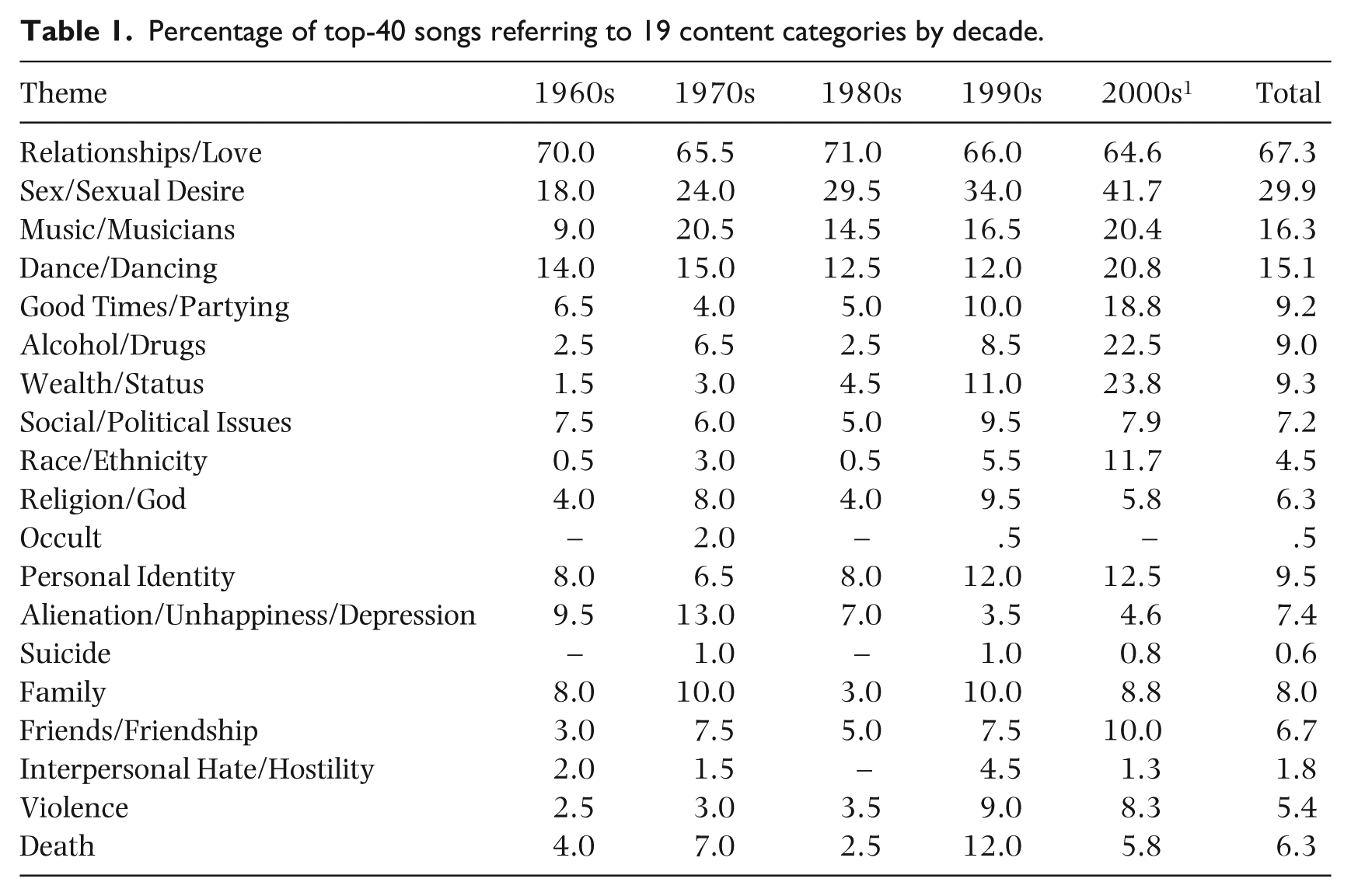
The lion’s share of lyrics in every decade contained references to relationships and love (67.3%) and/or sex and sexual desire (29.9%; Table 1). While differences in the prevalence for the 1960s and 2000s were not substantial for relationships and love, the number of references to sex and sexual desire more than doubled across the same period. Music or musicians were mentioned in 16.3% of the songs, and dance or dancing in 15.1%. No other topic was referenced by more than 10% of top-40 songs, and in some decades, some of the reference categories received hardly any mention at all. Leisure (having a good time and partying [9.2%]; alcohol and drugs [9.0%]) and the means to fill that leisure in a luxurious way, status and wealth (9.3%), were present relatively often, particularly in the 1990s and 2000s. Social context mattered as indicated by the percentages for family (8.0%) and friends (6.7%). Social/political issues (7.2%) and references to religion/God (6.3%) showed a modest presence across time; references to race/ethnicity (4.5%) were particularly mentioned in the 1990s and 2000s. The search for an identity (personal identity [9.5]) and teenage angst (alienation, unhappiness, depression [7.4%]) occurred in somewhat less than in one in ten songs, but references to suicide (0.6%) were rare. Occult phenomena (0.5%), and hate and hostility (1.8%) were also virtually absent, but references to violence (5.4%) and death (6.3%) were present more often.
Percentage of top-40 songs referring to 19 content categories by decade.
Year trends are presented in Figure 1. The time series are graphically illustrated with dashed lines representing the fitted regression equations.
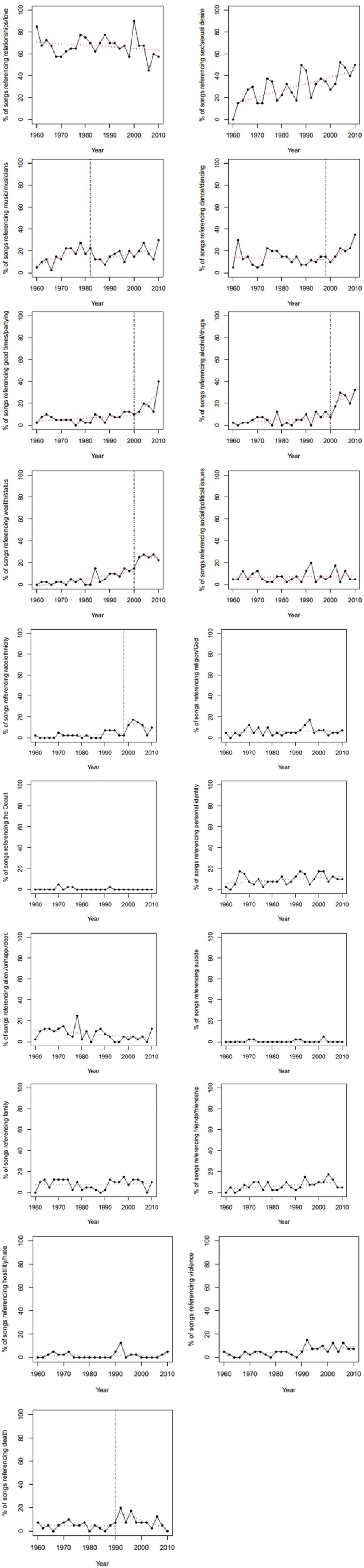
Trends in themes in popular music 1960–2010.
Relationships/Love
No changes in the prevalence of representations of romantic relations and love were found, β1 = -0.15, p = 0.23. Further, no sudden drops or increases in prevalence could be identified either, i.e., we found no evidence for a change point, supF = 8.5, p = .15.
Sex/Sexual Desire
A significant linear growth, β1 = 0.61, p < .001, in references to sex was observed, implying that, on average, between 1960 and 2010 the percentage of songs containing a reference to sex increased by 0.61% biennially. There was no statistically significant change point, supF = 4.5, p = .59.
Music/Musicians
Across the whole time period, the linear trend model for musical references indicated an increase of .19% per two-year period, β1 = 0.19, p = .03, implying a modest increase in the mentioning of music and musicians. A change point was found in 1982, supF = 14.8, p = .01. As can be seen in Figure 1, there was a strong growth, β1 = 0.83, p = .002, before this 1982 change point, then a sudden but slight drop, after which the prevalence of music and musicians increased again, but more slowly, β1 = 0.45, p =.02. The mean percentages of songs addressing music before and after 1982 were 15.6% and 17.0%, respectively. Overall, the occurrence of references to music seems to have increased slightly between 1960 and 2010, but not consistently.
Dance/Dancing
Dancing peaked shortly in the early 1960s. A steep increase in references to dancing occurred after 1998, a significant change point, supF = 11.7, p = .04. Until 1998, there was no significant trend, β1 = -0.06, p = .65, in the number of references, but starting in 2000 a positive trend was significant, β1 = 2.07, p = .01. The mean percentage of songs before and after the change point was 13.3% and 20.8%, respectively.
Good Times/Partying
References to good times and partying increased slowly but steadily over the time period of the study, β1 = 0.33, p < .001. The trend changed after 2000, supF = 18.6, p = .002, with an estimated increase of 2.38% biennially, β1 = 2.38, p = .23. However, it is clear from Figure 1 that the year 2010 is an outlier that can explain these results and, except for this year, the references to partying increased only slowly.
Alcohol/Drugs
Alcohol and drugs references increased across the whole period, β1= 0.45, p < .001, with a significant change point in the year 2000 where the number of references leaped upwards, supF = 30.5, p < .001. The increase in addressing alcohol and drugs before 2000 was smaller, β1 = 0.15, p = .045, than after, β1 =1, p = .40, suggesting a substantial acceleration of alcohol and drugs after 2000. However, the estimated trend after 2000 was not statistically significant, although it was relatively steep. This may be due to the fact that there were only a few more years in the study after 2000, giving us little statistical power. The average percentage for the period up to 2000 and afterwards was 5.1% and 25.5%, respectively.
Wealth/Status
A similar change point in 2000, supF = 26.8, p < .001, was found for status or wealth. There was a slow but steady increase until the year 2000, β1 = 0.33, p < .001, after which the frequency stabilized, as indicated by a non-significant slope coefficient, β1 = -0.25, p = .53, though references were noticeably higher afterwards. The average percentage of song lyrics mentioning wealth or status was 5.5% before 2000, and 25.5% afterwards.
Social/Political Issues
The percentage of songs referencing political or social topics was quite stable over time. No significant change point emerged, supF = 4.6, p = 0.56, nor any significant trend, β1 = 0.03, p < .64. The average percentage of songs with references to social and political issues was 7.2%.
Race/Ethnicity
Over the entire time period there was a significant increase in lyrics referencing race or ethnicity, β1 = 0.22, p < .001, but, as can be seen in Figure 1, it appears that a linear increase does not capture the development well. The F-test indicated a significant change point in the year 1998, supF = 21.1, p < .001. Until 1998, the number of references was quite stable, β1 =0.10, p = .054, but there was a sharp temporary increase during the early 2000s, which had all but disappeared again by the end of the decade, β1 = -0.86, p = .19.
Religion/God
The number of references to religion did not significantly change across time, β1 = 0.05, p = .36, and we found no significant change point, supF = 7.0, p = .26. Overall, 6.3% of the songs had lyrics referencing religion or God. The year 1996 was somewhat of an outlier with seven songs, i.e., 17.5% of the top songs, addressing this theme.
The Occult
Top-40 songs including references to occult matters were rare; there was neither a trend over time, β1 = -0.02, p = .26, nor a significant change point, supF = 11.0, p = .053. From 1960 to 2010 about one in 200 songs (0.5%) referred to anything occult.
Personal Identity
Over the entire period there was a slight increase of 0.13% biennially in the number of songs that referred to identity, β1 = 0.13, p = .04; there was no significant change point, supF = 10.5, p = .07. On average, 9.5% of the songs over the whole study period had lyrics addressing personal identity.
Alienation/Unhappiness/Depression
Lyrical references to alienation, unhappiness, and depression slowly and gradually decreased since 1960 with a biennial rate of 0.16%, β1 = -0.16, p = .04; there was no change point, supF = 6.77, p = .28.
Suicide
In most of the years studied, there were no top-40 songs containing references to suicide, and the average over the whole time period was only 0.6%. No time trend, β1 =0.008, p = .66, or change point was observed, supF = 7.9, p = .19.
Family
Little systematic change over time was observed, β1 =0.02, p = .78, except a potential temporary dip in family references during the 1980s. However, the F-test provided no evidence for a change point, supF = 9.1, p = .12. On average, 8.0% of the songs contained references to family.
Friends/Friendship
A small and gradual increase in references to friends or friendship occurred between 1960 and 2010, β1 = 0.14, p = .01. Figure 1 suggests a decline in the last years of the study, but this may be due to random fluctuation or sampling error. No significant change point was detected for references to friends or friendship, supF = 4.7, p = .56.
Interpersonal Hostility/Hate
Lyrics referring to hostility or hate were rare, on average 1.8% from 1960 through 2010, and in most of the years studied, none of the songs in the top-40 contained any such references. No linear increase or decrease over the entire time period, β1 = 0.01, p = .78. Figure 1 shows a short spike in the beginning of the 1990s, but the change point analysis yielded no significant result, supF = 6.0, p = .37.
Violence
A small but significant linear increase of references to violence across the whole time period occurred, β1 = 0.16, p < .001. On average, 5.4% of the songs referred to violence in some way. Figure 1 suggests that references to violence were increasing somewhat since the 1990s, but the change point analysis revealed no significant break, supF = 10.1, p = .08.
Death
We found a change point in the year 1990, supF = 17.5, p = .003. Until 1990, no trend in death references was found, β1 = -0.03, p = .70, but after this year an initial increase was observed, which first leveled off and finally decreased in later years of the study, β1 = -0.72, p = .03. On average, until 1990, 4.7% of songs had lyrics referencing death, while after 1990 this was true for 8.8% of songs.
Discussion
This study set out to explore which lyrical themes prevailed in U.S. top-40 hits during the period 1960–2010. Seven important trends emerged. First, American popular music has been and continues to be primarily focused on relationships, love, and sexuality. Second, pop songs have become far more often sexually explicit over the years. Third, “lifestyle” issues—dancing, partying, substance use and conspicuous consumption—have also become more prevalent, particularly during the last two decades. Fourth, content related to social and political issues, and religion showed a steady presence across the last five decades but was never particularly salient. Fifth, content related to family and friends, and sixth, to the search for an identity also showed a modest presence throughout this period. Seventh, references to the “darker” side of adolescent life in the form of hatred, violence, alienation/unhappiness/depression, suicide and death were relatively rare in pop music, with significant but modest decreases for alienation and slight increases for violence and death.
To elaborate, although the proportion of (heterosexual) “love songs” was somewhat lower in our sample (67%) than the 85–90% reported by Peatman (1944) and Horton (1957), romantic longing, courtship, or love continue to reign as popular music’s most common theme. Madanika and Bartholomew’s (2014) results also showed a preponderance of relationships, but they found a decrease in references to love or the combination of love and lust, particularly from the mid-1990s onwards, not matched in our data. This may be due to the fact that we operationalized romance and love in the broadest sense, whereas they focused on love or the specific combination of love and sexual desire. Combining these outcomes, it may be concluded that relationships were the most prevalent theme in pop music across the whole time range, but that love may have dwindled somewhat.
A clear increase in references to sex and sexual desire in top-40 lyrics was observed, in tandem with more directness and explicitness. To be sure, sex was often implied in the love songs of the 1960s, as when Roy Orbison sings in “Pretty Woman” (1964) “… I need you, I’ll treat you right/ Come with me baby, be mine tonight,” but by the late 1990s and early 2000s, sexual references tended to be far more explicit and graphic, cf. “Lollipop” by Lil’ Wayne (2008): “That pussy in my mouth had me lost for words (yeah)/ So I told her to back it up like berp berp (yeah)/ And I made that ass jump like jerp, jerp (jueeerp).” Our results corroborate those of Carey (1969) who noted that 1960s pop songs involved a more “active” courtship than those from the 1950s and that sexual attraction was a more explicit motive for pursuing a relationship. Similarly, Fedler et al. (1982) found that during the 1960s, sexual desire became a more dominant theme and by the 1970s love songs often described casual affairs, with lyrics becoming ever more sexually explicit, a trend that has also consistently been found in other studies (Hall et al., 2012; Fedler et al., 1982; Primack, et al., 2008). Our data imply that this trend may have intensified from the 1990s onward. Madanikia and Bartholomew (2014) suggest that the increased presence of sex in pop music reflects a broader cultural shift in valuing and evaluating sex. Adolescents still overwhelmingly link sex to love, but have become more accepting of casual sex, i.e., sexual relations outside exclusive and enduring love relations (Giordano, Manning, & Longmore, 2006); Meier, Hull, & Ortyl, 2009). Moreover, we note that the increasing focus on sex is paralleled in other teen-oriented media content (cf. Strasburger, Wilson, & Jordan, 2012).
The proportion of songs referencing lifestyle components (music, dance, partying, alcohol/drugs, wealth/status) increased radically. By the 2000s, references to music had roughly doubled when compared to the 1960s; references to dancing had increased by a third; and to good times and partying by a half. Even more conspicuously, the number of references to alcohol and drugs increased ninefold and that to wealth and status sixteenfold over the five decades we covered. We further found evidence for increasing references to violence and death. It is reasonable to relate these changes to the ascent of rap and hip-hop into the popular music mainstream, as most of the increase occurred during the last two decades. By 2000, black American music such as rap/hip and R&B dominated the charts, with “gangsta rap” as an important subgenre, sporting a cocktail of action, luxury, sex, alcohol, drugs, and partying (Chang, 2007). Indeed, such a hypothesis is supported by previous studies in which genres have been compared (Primack et al., 2008; Roberts et al., 1999), or in which hip-hop’s most popular songs have been analyzed (Hunter, 2011). Generally, such studies conclude that references to sex, substance use and other lifestyle issues are particularly frequent in rap/hip-hop music and videos (Armstrong, 2001; Hall et al., 2012, 2013).
Rap/hip-hop does have a strong undercurrent of critical social and political commentary, offering messages of resistance and empowerment (Krims, 2000; Ogbar, 2007; Rose, 2008), but the ascent of this type of music in the charts has not lead to a salient growth of politics in pop music. This implies that the most popular forms of rap/hip-hop may be characterized by a relative absence of these themes and focus on sex, violence, and other lifestyle issues (Salaam, 1995). A similar argument can be developed with regard to religion/God. While overall the American black music tradition has a strong undercurrent of religiosity (Southern, 1997), this theme did not increase during the last two decades, implying that nowadays popular forms of black American music seem to focus on secular aspects of life.
We further plotted the social context of adolescents: family and friends. Neither theme was present in a majority of songs, that is, family and friends were less salient than romantic relations. In the 2000s only about one in ten songs referred to family or friends. While family showed a constant presence in popular music, references to friends increased. This may reflect a long-term historical trend in which the social context of peers has become more important. Already in the 1950s and early 1960s social scientists such as Coleman (1961) and Matza (1964) described the birth and development of “adolescent society,” a youth cultural domain with values, attitudes, and behaviors specific to youth. Within this adolescent society friends are crucially important. Pop lyrics seem to reflect both this historical trend and the importance of peers.
References to negative or depressed mood appeared in about one in twenty songs, and hatred and hostility, and suicide were rare. Thus, feelings of alienation, unhappiness and depression and desperate acts were far less present than happy-go-lucky consumerism. While these cognitions and feelings appear with some frequency in music subgenres such as heavy metal, gothic and emo (Van Zalk, Van Zalk, & Kerr, 2011) the downward trend in our sample seems to indicate that there is less room for the expression of adolescent insecurity and angst in popular music. It can be hypothesized that this shift may be related to a development in which young people are not only consumers of media any more, but also producers. With the advent of social media and social networking cites the pressure to present oneself in a favorable, happy, or even glamourized light has increased (e.g., Walther, 2007) and pop music lyrics may reflect and sustain this tendency.
Music vs. the real word
Artists and their music present vivid models, but there is no one-to-one relationship between the messages in popular music and adolescent behavior and attitudes. For example, even as music has become increasingly sexualized, the U.S. rate of teen pregnancy is now at a historic low, having dropped steadily in recent decades (Hamilton & Ventura, 2012). Similarly, while references to substance use have accelerated in the last two decades, actual substance use has trended somewhat downward in recent years and adolescent alcohol use has reached historic lows in the U.S. (Johnston, O’Malley, Bachman, & Schulenberg, 2011). With regard to violence, Hunnicutt and Andrews (2009) observed a significant positive trend in their sample of pop songs in an era where the actual homicide rate was on the decline. Hence, despite clear evidence that popular music may directly or indirectly influence young people, exposure to music is just one of many factors influencing adolescents. Potential trends in substance use, delinquency, and sexual behavior as a result of media influences may be countervailed by other factors.
Limitations and future study
This study allows for conclusions on the prevalence of various themes in the U.S. top-40 but did not analyze precisely how the themes were treated. For example, although we were able to conclude that references to violence rose over time, an important next step would be study the description and valence of violence references. Similarly, future studies should go more deeply into the treatment of romantic and sexual relationships, mirroring analyses that already have been presented with regard to love and lust, violence, and substance use. It would also be interesting to examine differences in content across genres, and explore whether the complexity of lyrical content might have increased, both overall and within specific genres, thus reflecting a more general development in which media content has become more differentiated and intricate across the last decades (Johnson, 2005).
Conclusion
The results of this study reveal both continuity and change in the agenda of America’s top songs. The continuity lies largely in its continuing heavy focus on the “boy–girl issue” and on “lifestyle” components. As we noted earlier, it seems natural that the music to which adolescents are most attracted would emphasize male–female relationships and the hedonistic lifestyle-related aspects of the adolescent social scene rather than on the more serious “tasks” of adolescence. Listening to popular music is leisure, not work, and it makes sense that the music of adolescents is about love, sex, and the fun of being young. As to lyrics’ potential effects, when comparing trends in songs to real-life trends we find no evidence that higher sexual explicitness or frequent references to substance use is reflected in adolescent behavior.
Footnotes
Acknowledgements
The authors wish to thank Joe Braman, Nichole Carnell, Nic Costa and Stephanie Locke for their hard work and careful coding.
Funding
The authors received no financial support for the research, authorship, and/or publication of this article.