




Abstract
A prevalent aspect of contemporary digital campaigning is the use of humor to attract attention, elicit amusement, and mark group boundaries. This study investigates the humor in digital campaigns during two recent Finnish parliamentary elections, focusing on how different styles of humor are used to (de)legitimize political ideas and actors. Our original dataset consists of 125,604 posts by 1262 candidates on Facebook six months before the 2019 and 2023 election days. Using Facebook’s haha reactions and manual coding to annotate humor style, we focused on 729 posts with seemingly intentional humor by candidates. We show how different parties and individual candidates used humor to varying degrees and in different styles. Overall, the proportion of humorous posts was not high, but the populist radical right Finns Party candidates used humor by far the most, and their style was primarily aggressive, aimed at delegitimizing the incumbent government, political opponents, and their reference groups. Candidates from other major parties also used some humor, but overall the tone was more positive. Some of these candidates were profiled as “humor specialists” who produced similar combinations of ridicule and anti-elitism as the Finns Party candidates or, alternatively, focused on disseminating self-deprecating and affiliative humor. Affiliative and self-deprecating humor was used to foster closeness, ordinariness, and spontaneity, thus legitimizing oneself as a relatable candidate. The paper discusses how candidates use humor strategically to stand out in a competition for attention between candidates, and elaborates on the implications of using different humor styles in strategic political communication.
Introduction
Humor is a common feature of modern political communication (Kuipers & Zijp, 2024). It is used by elites and grassroots movements alike to attract attention, elicit amusement, and mark group boundaries through criticism and ridicule (Chattoo & Feldman, 2020; Gal, 2019). At the same time, it might introduce an element of unpredictability and ambivalence into strategic political communication, as there is no guarantee that audiences will understand the humor in the same way (e.g., Boxman-Shabtai & Shifman, 2014; Laaksonen et al., 2021). Nevertheless, it seems that humor has become a feature of contemporary political campaigning, particularly in social media environments.
From blogs and discussion boards to X (Twitter) and TikTok, politicians have adapted to using the latest trending online platforms, and a strand of research has tracked how politicians use the internet and social media platforms in general (e.g., Jackson & Lilleker, 2011), and in election campaigning more specifically (e.g., Stier et al., 2018; Strandberg, 2013). As politicians adopt new platforms for their communication, they also tend to adopt the communication styles characteristic of those platforms. This also encourages them to play along with the oddities, antagonisms, and emotions typical of online spaces (e.g., Phillips & Milner, 2017).
This study investigates the use of humor on Facebook by candidates six months prior to the Finnish Parliamentary Elections of 2019 and 2023. Previous studies have focused on investigating the salience of humor in candidates’ publications (Borah, 2016), especially on Twitter (Gonawela et al., 2018; Lopez-Meri et al., 2017; Marchal et al., 2021). Yet few studies have investigated how politicians use humor in particular contexts (cf. Mendiburo-Seguel et al., 2022 for Chilean Twitter). This is important as the style of humor can vary from aggressive to affiliative (e.g., Martin et al., 2003; Meyer, 2000), and different platform affordances can reward and cultivate different types of humor styles.
In recent years, international relations (IR) and political communication researchers have begun to investigate how humor is used to legitimize and delegitimize political ideas and people in various contexts (e.g., Crilley & Chatterje-Doody, 2021; Laaksonen et al., 2021; Ross & Rivers, 2017). We extend this strand by integrating the study of humor styles into the literature and exploring how both legitimization and delegitimization through humor occur during a campaign period. Studies on discursive legitimation have suggested that humor is a strong vehicle in political power struggles, as it can be used to justify and legitimize arguments and views, but also to delegitimize them (e.g., Koivukoski, 2022; Reyes, 2011; Ross & Rivers, 2017; Van Leeuwen, 2007). Populist radical right actors seem to be particularly keen on employing humor on social media to ridicule their opponents (Gonawela et al., 2018; Nikunen, 2015) and to strategically mainstream their arguments (e.g., Hakoköngäs et al., 2020; McSwiney & Sengul, 2024). Hence, humor is not only employed for fun, but also for political purposes, as well as strategically to promote oneself and undermine others.
Our extensive research design includes Facebook posts by more than 1200 candidates over a period of six months prior to two elections, allowing us to explore changes over time and in different political competition settings. We scrutinize how candidates employ aggressive styles of humor to delegitimize political opponents and ideas, as well as affiliative and self-deprecating styles of humor to present themselves as spontaneous and identifiable. We also investigate whether the populist radical right Finns Party is more inclined to use aggressive humor, as previous research implies (Herkman & Koivukoski, 2024; Nikunen, 2015; Sakki & Martikainen, 2021). Our overall aim is therefore to enhance our understanding of how politicians make use of humor in online contexts.
To this end, we formulated our research questions as follows: (RQ1) Which styles of humor did Finnish parliamentary candidates use on Facebook in the six months prior to the elections in 2019 and 2023, and to what extent? (RQ2) How were different styles of humor used to legitimize or delegitimize political views or actors during these periods? (RQ3) How did the degree and style of humor used by populist radical right candidates differ, if at all, from that used by other candidates on Facebook during the elections?
The article proceeds as follows. First, we review existing literature that explores the extent and nature of the humor used by politicians on social media. Second, we focus on how humor can be used to legitimize and delegitimize political ideas and people. We then present our research design. Our findings show that humor is not widely adopted in campaign communication. Both the use and styles of humor differ between parties and individual candidates, with the candidates of the Finns Party applying humor the most alongside with “humor specialists”—politicians who use a lot of humor—from other parties. We argue that for those who apply humor, it has developed into a strategically used style in the attention competition. We conclude by discussing the implications and avenues for future research.
Salience and Styles of Humor on Social Media during Elections
Social media platforms provide a channel for politicians to connect with citizens and influence the public agenda and opinion formation. The significance of social media as a means of campaigning and following politics has steadily increased (Chadwick, 2017; Stier et al., 2018). For instance, during the 2019 Finnish parliamentary election, 87% of candidates used Facebook for campaigning (Strandberg & Borg, 2020). Politicians use social media to present themselves in a positive light, communicate their actions and opinions, mobilize supporters, and connect with people on an emotional level (e.g., Jackson & Lilleker, 2011). Humor is used by politicians on social media to advance these aims. Humor is understood here as the communication of incongruities to amuse an audience (Martin & Ford, 2018) through verbal and audiovisual humor techniques such as hyperbole, irony, metaphors, funny faces, and anthropomorphisms (e.g., Buijzen & Valkenburg, 2004).
Politicians use humor on social media to varying degrees. For example, a study on Chilean politicians' use of humor on Twitter found that 7% of all tweets contained self-produced humor, with male politicians using more humor (7.8%) than female politicians (3.8%) (Mendiburo-Seguel et al., 2022). Another study indicates that 11.5% of all messages on Barack Obama’s Facebook campaign page during the 2008 US presidential election included humorous emotional content, whereas John McCain included humor in 3.6% of his messages. Obama’s share rose to 21.2% in the 2012 election (Borah, 2016). In turn, a study on populist leaders’ Twitter activity indicates that Geert Wilders, Narendra Modi, Nigel Farage, and Donald Trump included humor (i.e., wordplay or sarcasm) in around 11%–15% of all their tweets during elections in the mid-2010s (Gonawela et al., 2018).
The ways in which politicians use humor on social media also vary. Building on a theory of humor styles (Martin et al., 2003), Mendiburo-Seguel and colleagues (2022) show that politicians use humor on social media in at least three ways: a) aggressively to ridicule others, b) to make fun of themselves (self-deprecating humor), and c) in an affiliative, positive manner without a target. Affiliative humor is friendly and funny communication with no real target that facilitates positive relations, whereas self-deprecating humor makes fun of oneself and one’s flaws (Martin et al., 2003). Martin and colleagues’ (2003) original proposal for humor styles also includes a fourth category, self-enhancing humor, which means “a generally humorous outlook on life,” including using humor as an intrapsychic emotional regulation or coping mechanism (p. 53–54), which was not found in Mendiburo-Seguel and colleagues’ (2022) study.
In turn, the most common style of humor for politicians on social media appears to be aggressive ridicule of competitors (Marchal et al., 2021; Mendiburo-Seguel et al., 2022). For instance, almost three-fourths (74.4%) of humorous tweets by Chilean politicians were aggressive, meaning that they “sought to ridicule or attack a person, idea, or group, whether through irony, sarcasm, satire, or cynicism” (Mendiburo-Seguel et al., 2022). Further, a cross-national study on visual content shared on Twitter during the 2019 EU parliamentary election found that political humor was used most extensively to express criticism toward the elites and the European project (Machal et al., 2021). The study on Chilean politicians' use of humor on Twitter showed that opposition politicians use aggressive humor more than politicians in the government (Mendiburo-Seguel et al., 2022). Despite these studies, few actually analyze the distinctive content features of these humor styles—let alone across the party spectrum. We therefore scrutinize recurrent patterns within the categories of aggressive, affiliative, and self-deprecating humor, focusing on how candidates use these styles to legitimize themselves and their ideas, and to delegitimize political opponents and their behavior.
(De)Legitimizing Humor: Why Humor Pays Off on Social Media
Amusement aside, politicians have various reasons for using humor on social media. Humor is generally perceived as a positive characteristic (Billig, 2005; Martin & Ford, 2018), and some citizens, especially young people, expect politicians to be funny online (Parmelee & Roman, 2019). Furthermore, like other emotional content (e.g., Bene, 2017), humor potentially captures users’ attention and encourages reactions (likes, shares, and comments) that further boost the visibility of a post through algorithmic calculations (Borah, 2016; Shifman, 2013). Moreover, experimental research suggests that humor can enhance people’s content recall and intention to share political messages compared to non-humorous political messages (Coronel et al., 2021). Despite this potential, audiences can sometimes dismiss politicians’ humor as improper or dull, making them seem “uncool” (Gray, 2009), and sometimes even causing scandals if the humor is perceived as too transgressive (Herkman & Koivukoski, 2024).
Humor is therefore an effective frame in communication. In addition to capturing attention, it can be strategically applied to construct political realities. Humor can be used to (de)legitimize actions, ideas, institutions, and individual representatives of institutions, such as politicians (Davis et al., 2016; Ross & Rivers, 2017). Legitimization is understood here as the justification of actions, ideas, and people through discourse (Reyes, 2011; Van Leeuwen, 2007). This can be achieved by creating and disseminating “a sense of positive, beneficial, ethical, understandable, necessary, or otherwise acceptable action in a specific setting” (Vaara, 2014, p. 503). Conversely, delegitimization means challenging and criticizing behavior and people by constructing them as amoral and irrational. Humor duly serves as an effective option for politicians to promote themselves and criticize others in a context of heightened inter- and intra-party competition, such as campaigns in (party-list) proportional representation electoral systems like Finland’s.
Recently, political communication and IR researchers have begun to study how humor is used in different contexts to (de)legitimize political ideas and people (Crilley & Chatterje-Doody, 2021; Ross & Rivers, 2017). While the connection between criticism and humor has been well-known for centuries (see e.g., Waisanen, 2015), Ross and Rivers (2017) were one of the first to combine theories of discursive legitimation (e.g., Van Leeuwen, 2007) to humor in their investigation of citizens’ use of memes to delegitimize the actions of US presidential candidates. Since then, others have studied how progressive activists employ irony to delegitimize anti-immigration groups (Hatakka, 2020; Laaksonen et al., 2021), or how Russian state-funded broadcaster RT harnesses humor to legitimize Russian foreign policy (Crilley & Chatterje-Doody, 2021). Building on this literature, we scrutinize how candidates use aggressive humor to delegitimize political opponents’ actions and, in turn, how affiliative and self-deprecating humor is employed to legitimize oneself and one’s behavior.
Aggressive humor can be used to delegitimize political opponents and their behavior in various ways. Candidates may use different humor techniques in their criticism, such as irony, hyperbole, wordplay, and metaphors (Laaksonen et al., 2021), and the aggressive tone can alternate between mild teasing and dehumanizing humor (Tuters & Hagen, 2020). Additionally, the main message delivered along with humor can be more or less ambiguous (Boxman-Shabtai & Shifman, 2014), and the criticism within humorous communication can lean on different (de)legitimization strategies, such as authorization, moral evaluation, rationalization, and moral tales (Ross & Rivers, 2017).
Right-wing populist politicians in particular seem to use aggressive humor on social media to delegitimize their opponents, such as “the elites” or other outgroups such as immigrants (Gonawela et al., 2018; Nikunen, 2015). The populist style of communication, which can be understood as a combination of negativity, emotionality, simplifications, and sociability, fits well with the social media logic (Engesser et al., 2017; Ernst et al., 2019; Schwartz et al., 2022). Antagonistic targeting of opposing actors duly appears to be a fruitful social media strategy for conservative actors (Strum Wilkinson et al., 2021). The ridicule of outgroups amplifies this antagonistic communication, which is essential to the appeal of populist communication (Nikunen, 2015; Sakki & Martikainen, 2021). Simultaneously, the emotive posts evoke negative reactions from those who disagree, garnering more attention (Postill, 2018). Importantly, however, this combination of criticism and antagonistic humor can, of course, be delivered by politicians and candidates from parties that are not considered “populist” by public commentators.
In addition to aggressive humor targeting others, affiliative and self-deprecating humor can enhance politicians' legitimacy in various ways. Affiliative humor means positive humor without a target, such as witty banter and wordplay, while self-deprecating humor refers to humor that pokes fun at oneself (Martin et al., 2003). Politicians employ these styles of humor in political speeches and debates (Meyer, 2000; Stewart, 2012), and in appearances on entertaining talk shows and satire programs (Coleman et al., 2009; Gray, 2009) to identify with the audience. Politicians themselves believe that this kind of humor can promote their political messages, show a human side of themselves, and connect with broader audiences (Coleman et al., 2009; Frame & Brachotte, 2015). We expect that these styles of humor, communicated on social media sites, can promote politicians’ legitimacy by performing ordinariness and spontaneity, which are considered to be important building blocks of politicians’ legitimacy in today’s mediated politics (e.g., Enli, 2024; Frame & Brachotte, 2015).
Context: Online Campaigning before the 2019 and 2023 Finnish Parliamentary Elections
Finnish parliamentary elections for 200 seats are held every four years, with Members of Parliament (MPs) elected through an open-list proportional electoral system across multi-member districts. The country is divided into 13 regional districts, determined by population size. Candidates therefore compete between parties and within their own party. Such competition tends to personalize campaigning more than closed list systems, where candidates are primarily competing between parties (Mattila, 2024; Van Aelst, Sheafer & Stayner, 2012). Consequently, some candidates may be more inclined to use humor to attract attention and differentiate themselves from other candidates, including those within their own party.
In 2019, the incumbent government was a right-centrist government formed by the Center Party, the National Coalition Party, and Blue Reform (a faction that had split from the Finns Party in the summer of 2017, in the middle of the election period). During the campaign, key policy issues focused on the economy, reform of the healthcare sector, and immigration policy (Borg & Paloheimo, 2020). The Social Democratic Party won the election and formed a coalition with the Greens and the Left Alliance, which also gained seats, as well as the Swedish People’s Party. The race, however, was fairly even as no party received more than 20% of the votes. The Finns Party won the second largest number of seats, while the Blue Reform Party failed to win any seats in parliament. The leader of the Finns Party, Jussi Halla-aho, received the most votes (30,596) of all candidates. Small parties' share of seats remained unchanged.
In 2023, the situation was reversed: the government led by the Social Democratic Party was heavily challenged in election campaigning by the right-wing parties. The government’s term had been characterized by the global crises of the COVID-19 pandemic and Russia’s war on Ukraine, both of which contributed to rising national debt and a deteriorating economic outlook. As a result, the pre-election political debate focused heavily on the economy, the budget deficit, and the prospects for economic growth. The final race was very close between the National Coalition Party, the Social Democratic Party, and the Finns Party, with the National Coalition Party ultimately emerging as the winner with 20.8% of the votes. The party then formed a right-wing coalition with three other parties: the Finns Party, the Swedish People’s Party, and the Christian Democrats.
The use of social media in Finnish election-related communication has increased since the 1990s, and by the 2019 election, almost 90% of candidates were already using a social media platform of some sort in their campaigns (Strandberg & Borg, 2020). According to the same study, 87% of all candidates used Facebook, which was a higher share than campaign websites. At the same time, the adoption of social media in politics has been accompanied by an increasing discussion regarding its negative effects, such as the possibility of negative campaigning, cyberbullying, or even electoral interference. Survey findings from the 2019 election show that the majority of voters perceive a high risk of digital forms of harassment in particular, such as smearing and the breeding of conflict online (Wass et al., 2020).
Since the 2008 US presidential election, Facebook has been an influential platform for political campaigning (Stier et al., 2018; Strandberg & Borg, 2020). During the 2019 Finnish parliamentary election, Facebook was the most used social media platform for campaigning by candidates, with 87% of use (Strandberg & Borg, 2020). In early 2023, Facebook was one of the most used social media services in Finland (DNA, 2023), and the most used social media platform for news in the country (Newman et al., 2023). In spring 2023, 59% of Finnish internet users visited Facebook daily, and it remains among the top three social media services for users aged between 25 and 74 (DNA, 2023).
Data and Methods
For our research data, we collected posts from the public Facebook pages of candidates from two parliamentary elections in 2019 and 2023. We chose to study two election cycles, as this enabled us to detect consistencies and differences in candidates' use of humor. The first step in the data collection entailed finding the Facebook pages of politicians. A primary source for links to pages was the voting advice application run by the national newspaper Helsingin Sanomat. The website is a relatively comprehensive source of information about candidates in Finland: 85%–89% of all candidates, and practically every candidate with a realistic chance of being elected, fill out their profiles in voting advice applications (Borg & Koljonen, 2020, pp. 61–62). We created a list of Facebook pages by programmatically going through every profile on the site and recording links to the Facebook pages of candidates placed on their profiles.
Some corrections had to be made to this list. Some candidates omitted links on their profiles, and others linked to their personal Facebook accounts even when they also had a public Facebook page. The list for 2019 was corrected through crowdsourcing: the advocacy group Open Knowledge Finland asked their followers to add missing candidate Facebook pages to the list. For 2023, the authors of this paper manually added the missing pages.
The amount of data collected was slightly different for each year. For 2023, we went through the list manually and added missing pages for all candidates who had received a minimum of 2500 votes in the election (336 candidates, with 265 Facebook pages). We nonetheless downloaded Facebook posts for all candidates that had listed their page, even if they received fewer than 2500 votes. For 2019, the crowdsourcing of pages was more open-ended, focusing on identifying any pages for candidates, resulting in a list of 958 pages. In practice, many of the pages created for the 2019 election were inactive. Since the analysis focused on posts that gathered at least 15 “haha” reactions, most candidates with little visibility were excluded from the sample of posts for 2019.
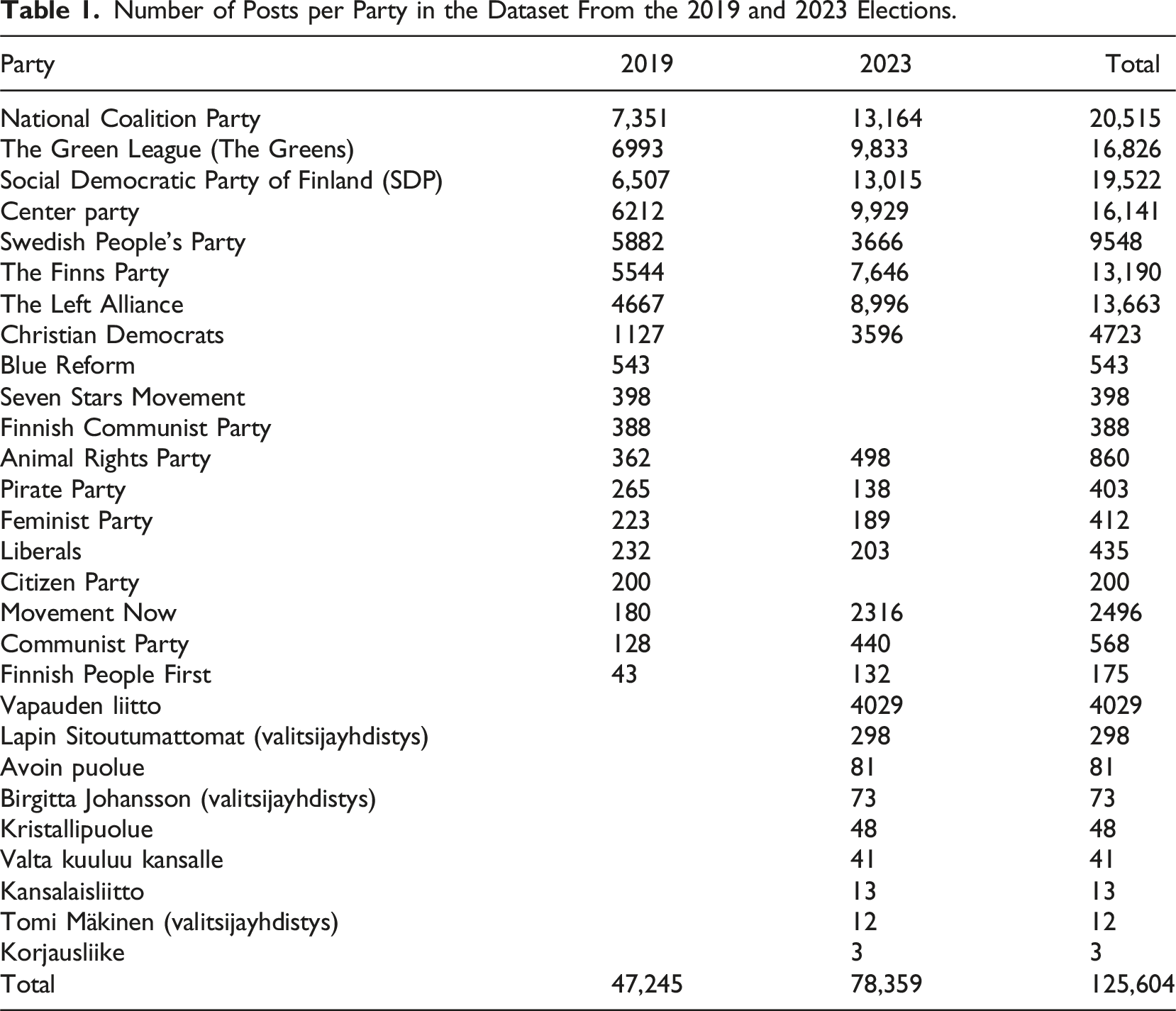
Number of Posts per Party in the Dataset From the 2019 and 2023 Elections.
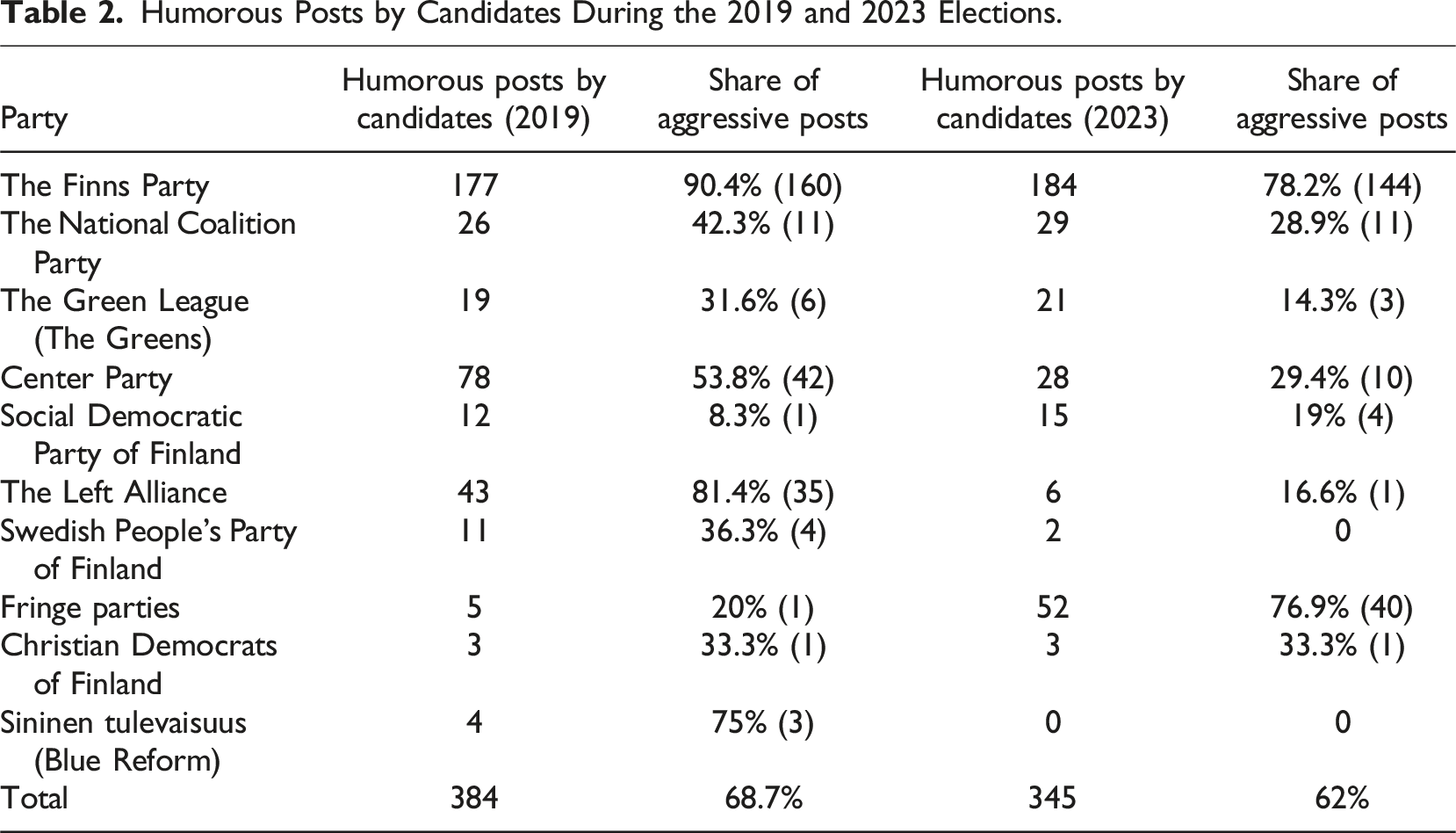
Humorous Posts by Candidates During the 2019 and 2023 Elections.
Such data is inevitably partial, as collecting material from Facebook sites other than public pages is forbidden by the platform’s policies and is also somewhat questionable from the perspective of research ethics. Not all politicians have a public political page, using their private profiles for campaign communication instead. Such messages and politicians are unfortunately missing from our data. This includes the former leader (2017–2021) of the populist radical right Finns Party, Jussi Halla-aho.
For each message, the material includes the update ID number, a link to the original update, the page name and ID, the party name or information about the candidate’s party, the message content, any URLs shared in the message, and interaction metrics. The variables include likes, shares, comments, and frequencies for the five emotional reactions. Facebook provides emotional reactions through emoji icons (e.g., a laughing face) as an alternative to the classic like. The translations defined by the platform for these are love (iconic heart), haha, wow, sad, and angry. In March 2020, Facebook added a “care” emoji to the range of available reactions. Previous studies have shown how party differences are reflected in the distribution of emotional reactions (Muraoka et al., 2021; Sturm Wilkerson et al., 2021).
Our analysis focuses on posts that received 15 or more “haha” reactions, yielding 1123 posts from the 2019 corpus and 1214 from the 2023 corpus. This criterion allowed us to capture posts featuring intentional and relatively successful humor. However, this approach may have overlooked instances of intentional humor lacking sufficient reactions from the Facebook audience.
In addition to expressing laughter at posts with intentional humor, the laughter reaction is used rather extensively to express scornful laughter at sincere posts by politicians without intentional humor 1 (see Knuutila & Laaksonen, 2020). Thus, we first coded posts with 15 or more laughter reactions by marking those that included intentional humor. We coded the post as intentionally humorous if we detected humor a) in the posted text, b) in the shared image, c) in the opening screen of a shared video, or d) in the name of the shared link. We did not watch the videos in full or follow the links to see if they included humor. After this procedure, we settled on a dataset of 384 posts from the 2019 corpus and 345 posts from the 2023 corpus.
Second, we coded the posts with intentional humor into two categories: posts containing aggressive humor targeting a person, group, or idea, and posts containing non-aggressive humor. Non-aggressive humorous posts included positive humor that pokes fun at the sender or is generally affiliative (such as wordplay, puns, or funny pictures). Accordingly, we coded a post as aggressive humor if it was clearly mocking or criticizing somebody or something (person, group, or idea). We coded a post as non-aggressive if the overall tone of the message was positive, and with no clear target other than the sender himself or herself, or a group they represent. Thus, posts including non-aggressive humor entailed both the affiliative and self-deprecating humor styles, whereas aggressive humorous posts included only the aggressive humor style (Martin et al., 2003, pp. 53–54).
After this phase, we analyzed how aggressive and non-aggressive humor styles can function as (de)legitimizing strategies (Crilley & Chatterje-Doody, 2021; Ross & Rivers, 2017). We did not create different codes for self-deprecating and affiliative humor styles, because we found that they function similarly as positive and seemingly benign, yet potentially influential, strategies for enhancing candidates’ legitimacy through performing closeness, wit, and authenticity (cf. Coleman et al., 2009; Enli, 2024; Frame & Brachotte, 2015). We did not systematically code the themes in the humorous posts as we were mainly interested in how humorous de/legitimizing strategies work in general. Yet, in the analysis we discuss the most prominent themes and targets in humorous aggressive posts (e.g., government’s policies and prevention of climate change), and in humorous non-aggressive posts (e.g., witty slogans, pets, funny situations or faces).
Findings
Finns Party candidates were by far the most frequent users of humor in the 2019 and 2023 elections. Of all humorous posts by candidates before the 2019 election, 46% were by Finns Party candidates, while in 2023, the share was 53.3%. During the 2019 election, the five largest parties combined used about the same amount of humor as the Finns Party. The Center Party was the only other party whose candidates produced more than one-fifth of all humorous posts (20.3% in the 2019 elections). The total amount of humor used by all candidates of the same party remained fairly consistent. Only the amount of humor used by the candidates of the Centre Party and the Left Alliance decreased notably in the 2023 election compared to the 2019 election: from 78 to 28 and from 43 to 6 humorous posts, respectively. In turn, the number of humorous posts by fringe parties rose from 5 to 52, of which the share of Vapauden liitto (Alliance of Freedom) was notable (36).
The volume of humorous posts in the dataset decreased slightly between the two elections, from 384 in 2019 to 345 in 2023. At the same time, however, the overall volume of posts in the dataset increased considerably, from 47,245 in 2019 to 78,359 in 2023. Thus, the share of humorous posts plummeted even though the absolute number of humorous posts decreased only slightly. The share of humorous posts even decreased for posts by the Finns Party, which had by far the highest number of humorous posts in both elections and even increased its share between 2019 and 2023. However, they also significantly increased the overall volume of Facebook posts in the dataset from 5544 to 7,646, reducing the share of humorous posts. This seems to be the big picture regarding the use of humor in Finnish Facebook campaigning between 2019 and 2023. The absolute amount of humor remained rather stable, notably because of the Finns Party. However, the share of humor did not follow the overall increase in the volume of posts.
In addition to being the most active disseminators of humor, the humor of the Finns Party candidates was distinctively aggressive. They produced 60% of all aggressive humor in the 2019 election, while in the 2023 election, the figure was 78.2%. The share of aggressive posts by Finns Party candidates varied from 90.4% in the 2019 election to 78.2% in the 2023 election, while the share of aggressive humor within all humorous posts in the 2019 election was 68.7% (264) and 62% (214) in the 2023 election. In general, the share of aggressive posts varied between 0 and 54% for candidates from other parties, with the exception of the Left Alliance in the 2019 election, during which their share was 81.4%, and with the fringe parties during the 2023 election, where the share of aggressive posts was 76.9%.
As the number of humorous posts per party during the elections was not that high, the practices of individual candidates heavily impacted the total number of humorous posts per party—and in some cases, also the share of aggressive posts per party. A few candidates in particular stand out due to their extensive use of humor. For instance, Mikko Kärnä (48 humorous posts) and Antti Kaikkonen (20 humorous posts) together produced 87.2% of all humorous posts by Center Party candidates in the 2019 election. Moreover, candidate Kärnä single-handedly delivered all 42 humorous aggressive posts by Center Party candidates. Similarly, 39.5% of all humorous posts by Left Alliance candidates came from Paavo Arhinmäki. Further, almost all of Arhinmäki’s humorous posts were also aggressive, affecting the overall tone of the Left Alliance’s humor.
In addition to identifying the distribution of humor styles between the political parties during the two elections, we analyzed distinctive content features within each style category. Our analysis proceeds accordingly. We first focus on delegitimizing through aggressive humor by the Finns Party candidates. We then analyze the aggressive humor of other parties, and finally scrutinize the affiliative humor and self-deprecating humor of all candidates.
Delegitimizing Strategies: Aggressive Humor by the Finns Party Candidates
During the 2019 and 2023 campaigns, the Finns Party candidates ridiculed the incumbent government and its representatives the most. During the 2019 campaign, the Center Party, the National Coalition Party, and Blue Reform and their leading politicians—especially Prime Minister Juha Sipilä—were repeatedly mocked. Finns candidate Sebastian Tynkkynen, for example, released a selfie format video (March 22, 2019) comparing Sipilä’s refugee policy and discourse to a flight with compromised security measures: “Imagine if the pilot controlled the plane like Sipilä in this country.” This humorous comparison questioned PM Sipilä’s competence as a political leader and duly aimed to delegitimize his authority.
Politicians representing the Greens and the SDP were ridiculed repeatedly; in the polls, the SDP was competing with the Finns Party for the largest share of votes, and the Greens were (and still are) the ideological opposite of the Finns Party. Again, during the 2023 campaign period, the Finns Party candidates attacked the government and its representatives, the SDP, including its leader, PM Sanna Marin, the Greens, and the Center Party.
During the 2019 campaign, two of the most active candidates posting aggressive humor were Sanna Antikainen and Veikko Valin. Together, Antikainen and Valin disseminated more than half of all the humorous posts by Finns Party candidates. During the 2023 campaign, the distribution of humorous posts was more even between the candidates. Candidate Antikainen posted only 22 humorous posts compared to 60 in the 2019 election, and Valin was no longer a candidate. In turn, several other Finns Party candidates posted a relatively high amount of humor.
The themes of aggressive humor changed only slightly between the two elections. During the 2019 campaign period, Finns Party candidates ridiculed the prevention of both climate change and racist speech, whereas during the 2023 campaign, prominent topics were the new law on transgender rights and, again, the prevention of climate change, but this time also targeting activists such as the Finnish branch of Extinction Rebellion (Elokapina) or Greta Thunberg. These posts were designed to undermine the rationality of progressive activists, and the candidates who support them, thus questioning their legitimacy.
For example, candidate Sami Kymäläinen (Finns Party) published a post 2 in which he shares a TikTok video from his account commenting about a demonstration where activists were demanding to cut the price of soy milk but became involved in an accident due to pouring cement into their boots (December 19, 2022). Kylmänen ridicules these activists; his caption, for instance, includes the comment “Evolution no longer excludes the simplest individuals from the circle of life.”
Kymäläinen’s post also exemplifies the use of political humor in the hybrid media environment (Davis et al., 2018; Koivukoski, 2022): people comment on news media content on social media, and funny content is shared from platform to platform verbatim or with some recontextualization. In addition to TikTok, candidates shared scornful content from their YouTube channels, Instagram, and Twitter. Interestingly, some of the Finns Party candidates specialized in different platforms in 2023: candidate Sebastian Tynkkynen shared his sarcastic posts from YouTube, Veikko Vallin from Twitter, and two younger candidates, Miko Bergbom and Joakim Vigelius, shared some of their posts from TikTok, where their main campaign took place.
Throughout the data, one of the most common types of aggressive humorous posts was one in which the candidate shared a ridiculing meme, picture, or video with short or no commentary. This shared humorous content was used to delegitimize and ridicule political opponents. For example, candidate Sanna Antikainen (the Finns Party) published a post 3 in which she shared a photo of Minister Sampo Terho (leader of Blue Reform) holding a book authored by PM Juha Sipilä entitled “How to screw the public” (October 28, 2018). Antikainen’s caption includes only a laughing emoji. The post questions Sipilä and Terho’s morality, thereby aiming to undermine their legitimacy by portraying them as deceptive and self-interested leaders. The post was typical of Antikainen, who was the most active disseminator of humor throughout the whole corpus.
Another popular type of post involving aggressive humor was one in which the candidate shared a news story—either as a link or a screenshot—and commented on it sarcastically. These kinds of posts link the candidate’s campaign to current affairs, arguably enhancing the feeling of authenticity in comparison to predesigned campaign material. Previous research has shown that topical news events spark political humor online (Davis et al., 2018; Shifman, 2013). Hence, if politicians can tap into memetic moments, they may be able to present themselves as witty and spontaneous, at least to their supporters. This could enhance their legitimacy as competent and responsive politicians.
Similar to reacting sarcastically to news events, the Finns Party candidates also used aggressive humor to criticize the statements and actions of other politicians. This was done by sharing screenshots, quotes, or news items. Ahead of the 2019 election, candidate Veikko Vallin was particularly active in spreading ridiculing comments about other politicians' sayings. In his Facebook posts, Vallin often shared screenshots of his exchanges on Twitter, in which he ridiculed others. For instance, in one post, Vallin sarcastically, and very aggressively, commented on a Tweet by MEP Liisa Jaakonsaari (SDP), in which she was stuck in Strasbourg due to a shooting incident (12 December, 2018). Valin wrote in his Twitter response: “Enjoy the vibrancy of multiculturalism now, Liisa. The same sh*t you have been ordering for us in Finland.” The caption on his Facebook post simply says: “Veikko gave feedback to social democrat Liisa Jaakonsaari in Strasbourg.”
Vallin’s post was one of the most aggressive in our corpus. Very aggressive humorous posts usually originated from the fringe parties, but the Finns Party candidates also published some posts that tested the limits of decency.
Delegitimizing Strategies: Aggressive Humor by Other Candidates
Other parties used much less humor than the Finns Party in both elections. The humor used by candidates from the Social Democratic Party and the Greens was distinctly positive. However, during the 2019 election, candidates from the Left Alliance and the Center Party were quite active in disseminating aggressive humor. As pointed out above, this was mainly due to a few very active candidates.
During the 2023 election, the National Coalition Party and the fringe party Freedom Alliance were the most active in producing aggressive humor, in addition to the Finns Party and the Center Party. The Left Alliance, however, disseminated little humor compared to the 2019 election, during which candidate Paavo Arhinmäki (Left Alliance) was an active critic of the right-wing government. Prior to the 2019 election, Arhinmäki repeatedly ridiculed sitting Prime Minister Sipilä for his cuts to education and social benefits. Arhinmäki’s comments were largely substantive, but he employed irony and sarcasm to underline his critical points. For instance, in one post (March 31, 2019), he shared a news item about a private nursing home that had decided to hire school children. In the text, Arhinmäki ironically describes how inventive the capitalists have been in exploiting cheap labor instead of educated staff.
Structurally, posts with aggressive humor by other candidates were similar to posts including aggressive humor by the Finns Party candidates: candidates commented sarcastically on news stories and other politicians’ statements and actions, shared memes supporting their viewpoints, and colored their text-based posts with verbal humor. Yet, unlike the Finns Party, the majority of candidates from other parties did not ridicule measures to prevent climate change or limit hate speech. Instead, the focus of aggressive humor was on right-wing policies. However, a few politicians from the National Coalition Party, and candidate Mikko Kärnä from the Center Party, mocked green activism and measures to tackle climate change.
During the 2019 election, candidate Mikko Kärnä was one of the most prominent producers of humor and aggressive humor on Facebook. In fact, he was responsible for all the aggressive humor conveyed by the Center Party. Kärnä ridiculed the greens, vegetarians, and those politicians and citizens who live in the city and have no “healthy relationship with nature.” Like some of the Finns Party candidates, he mocked the perceived contradictions and double standards of Green politicians and activists, such as flying on vacation or promoting the electric car policies of Norway, a major oil producer.
While ridiculing the Greens, Kärnä often promoted alternatives: instead of vegan food, he suggested “eating vegans,” namely, quarry (November 1, 2018); or instead of Green policies that would lead to rural decline, Kärnä proposed keeping the countryside vibrant. For example, in one post 4 (April 3, 2019), Kärnä sarcastically recontextualized the Greens’ election advertisement: “I have to thank the Greens for painting an honest picture of their policy on preventing climate change. There’s an empty barn, an untamed farm, an untended forest. In the background, a windmill that won’t rotate because there’s no wind in winter. This is not the future that I want to build …” As noted, this type of ironic recontextualization was a popular aggressive humor strategy used by all parties across our dataset.
Legitimizing Strategies through Affiliative Humor
Candidates’ affiliative humor often manifested itself in posts with funny pictures from the campaign trail or private life. These pictures showed funny faces, poses, or coincidences, often featuring the candidate in the picture with a short comment explaining the situation. For example, in a post 5 by candidate Petteri Orpo (who later became prime minister), Orpo and MP Ben Zyskowicz are standing side by side in a market square, smiling at the camera (March 15, 2023). Orpo’s caption reads: “I sometimes help candidates with little experience of campaign work.” The joke is that Zyskowicz has—in fact—been an MP since 1979. These affiliative posts underline positive emotions and bring out the personal side of the candidates, making them more relatable (Coleman et al., 2009; Meyer, 2000). At the same time, they act as forms of legitimation by highlighting both their personality and their closeness to citizens. In the example described above, Orpo builds legitimacy through witty, ironic framing and by borrowing authority from long-term politician Zyskowicz.
A few candidates also posted funny pictures of their pets. During the 2019 campaign, Orpo, for instance, published several photos with his dog, Pessi, in which Pessi acted as part of the campaign team. The most active candidate who published affiliative pictures with a pet was a Finns Party candidate, however. During the 2023 campaign, the candidate posted many pictures of her dog, where the humor in the pictures relied on textual anthropomorphism in which the candidate “revealed” in quotes what the dog was thinking or trying to say. Employing pets in social media posts to convey a personalized and “normal” image is a common practice among politicians (Laineste et al., 2023).
Another popular type of affiliative humor in candidates' posts was wordplay and puns. This was prevalent in longer text-based posts and election slogans. A few candidates, for example, had fun with the randomly assigned election number that each candidate received. Candidate Ville Tulkki (the Greens), for instance, compared his number 230 to the voltage of Finnish sockets, claiming that he would “go through like 230 V” (March 2, 2023).
Perhaps the most notable slogan in our corpus was the traffic sign campaign by the National Coalition Party in the 2019 election. The traffic sign read: “autot kuuluvat teille,” which can mean either “cars belong to you” or “cars belong to the roads.” The sign caused a fuss in the media as some did not understand the message, or called out the National Coalition for their apparent promotion of cars, which conflicted with the party’s goal of zero emissions. A few competing candidates also made fun of the campaign by photoshopping the words on the traffic sign. Similarly, the slogan used by the SDP—“Meillä taitaa olla sama suunta” (“Apparently we’re heading in the same direction”) was ridiculed by competing candidates. For instance, a post 6 by candidate Olli Immonen (February 10, 2019) ironically employs SDP’s slogan in the caption “Life on the road. Same direction )”. The post includes Finns Party candidates in similar posing positions in two different cars smiling—including their then party leader Jussi Halla-aho who is wearing sunglasses.
Immonen’s post also highlights the ambiguity in some humorous posts by candidates. It can be understood either as an affiliative feel-good post or as an ironic reference to the SDP’s campaign slogan, or both. The Finns Party in particular has cultivated an ironic style of humor—similar to that of alt-right humor (cf. Phillips & Milner, 2017), which can be understood differently by different audiences, depending on whether they are familiar with the ironic markers that accompany the humor.
Legitimizing Strategies through Self-Deprecating Humor
Overall, self-deprecating humor was not used that often by candidates. However, some candidates used self-deprecation to build their profile. Antti Kaikkonen (Center Party) was one of the most active disseminators of humor targeting himself. During both campaigns, Kaikkonen joked about his inability to do math and made fun of his appearance on several occasions. For example, in one post, 7 Kaikkonen shared a meme including a photograph of himself in the parliament with hair standing up on his head with a caption “No time to do my hair, they need me now” (April 13, 2019).
While some studies suggest that self-deprecation has no effect on public opinion of a politician who uses it (Becker, 2012), others contend that laughing at oneself could be associated with favorability and the intention to vote for a candidate (Baumgartner et al., 2018). As with affiliative humor, self-mockery could allow citizens to more easily identify with politicians (Meyer, 2000), thereby confirming legitimacy by enhancing the representational bond between politician and voter. At the same time, self-deprecating posts can signal candidates’ ability and courage to laugh at their shortcomings publicly (cf. Coleman et al., 2009; Gray, 2009). In self-deprecating humor, the politician presents himself or herself in an unflattering light, but can self-select the weakness and how it is ridiculed, duly increasing the ambiguity of the message (Boxman-Shabtai & Shifman, 2014).
In the 2019 election, candidate Paula Risikko’s (National Coalition) campaign was partly based on cheerful self-deprecation. Risikko published several professionally crafted images of herself with quotes from “Ostrobothnian pearls of wisdom!”. For example, one of these posts showed Risikko smiling at the camera with a quote in Ostrobothnian dialect: “You can stand this by learning to sleep on your stomach as the knives are always in your back” (March 22, 2019). This is a reference both to the regional lore related to knife fighting in the Ostrobothnia region where she comes from, as well as to the intrigues and backstabbing that are part and parcel of politics.
While the humor of the Finns Party candidates was mostly aggressive toward others, they also used some self-deprecating humor. For instance, candidates shared canned jokes about the Finns Party—a type of humor that was otherwise rare in our dataset. Often, the self-directed humor was about the underdog or outsider position that the Finns Party has cultivated in the Finnish context. For example, in one post, 8 candidate Ari Koponen jokingly implied that he and two other Finns were students with special needs that the leader of the Finns Party, Riikka Purra, could lead (February 4, 2023). At the same time, Koponen highlighted how the Finns Party had advocated the return of classes for special needs children.
Discussion and Conclusion
Our study of candidates' use of humor on Facebook during the last two Finnish parliamentary elections (2019 and 2023) shows how different parties and candidates apply humor to varying degrees and in different styles. The results indicate that candidates from the populist radical right Finns Party used humor by far the most, and that their humor was predominantly aggressive toward other candidates, parties, and their networks or ideologies. Such antagonistic communication seems to be a strategy that elicits reactions, particularly among Facebook audiences (Sturm Wilkinson et al., 2021).
We contend that aggressive humor by candidates on Facebook epitomizes the convergence between the populist style and the logic of social media (cf. Engesser et al., 2017; Ernst et al., 2019; Schwartz et al., 2022): negative, colloquial, simple, and emotional posts are delivered directly to predominantly like-minded people to elicit reactions and create a sense of community. Previous studies have discussed the different proportions of emotional reactions to parties on Facebook, typically showing how right-wing and nationalist parties receive proportionally more angry responses (Muraoka et al., 2021; Sturm Wilkerson et al., 2021), perhaps in response to their populist style of negativity and emotionalization (Schwartz et al., 2022). Our results contrast with these existing studies by suggesting that emotionalization through humor also plays a major role in the communication strategies of right-wing politicians.
Our research is the first to show the vast extent to which a populist radical right party applied humor on Facebook during two parliamentary elections, in comparison to other parties. Previous studies have investigated how radical right activists (e.g., Hakoköngäs et al., 2020; Phillips & Milner, 2017) and individual populist political leaders (e.g., Gonawela et al., 2018; Nikunen, 2015) have used humor in their communication. While our research focuses on one platform, it may hint at a broader tendency, as studies have shown how two former leaders of the Finns Party have keenly employed humor in blogs and on Twitter (Koivukoski, 2022; Nikunen, 2015), and the party has disseminated aggressive humorous campaign advertisements on YouTube (Sakki & Martikainen, 2021), sparking scandals related to their use of humor more than any other party in Finland in recent decades (Herkman & Koivukoski, 2024). Researchers have identified the use of humor by far-right actors as a type of mainstreaming strategy of radical ideas (e.g., Hakoköngäs et al., 2020; McSwiney & Sengul, 2024). Future studies should investigate whether the extensive use of humor is a broader trend or an anomaly among radical right parties.
The Finns Party aside, the overall amount of humor used by all candidates was quite low. The number of humorous posts by candidates remained rather stable between the elections studied, whereas the overall volume of Facebook posts increased. This implies that humor is not a widely adopted means of campaign communication by candidates on social media, at least on Facebook. This may be because using humor requires too much effort and expertise, or simply because most politicians do not see humor as a reasonable means of conveying political messages. Also, broader contextual issues, such as the ongoing war in Ukraine or salient issues before elections, could hinder candidates' tendency to use humor. Alternatively, politicians could be posting humorous content on other platforms, such as Instagram or TikTok, of which popularity among citizens and candidates has increased (DNA, 2023; Strandberg & Borg, 2020). Nevertheless, studies have shown that entertainment is one of the motivations for following politicians on social media, especially for young citizens (Parmelee & Bichard, 2012; Parmelee & Roman, 2019). Therefore, politicians could benefit from including some humorous elements to their social media communications.
Indeed, in addition to the Finns Party, some candidates from other parties were profiled as “humor specialists.” As the overall amount of humor by all candidates was quite low, these few active individual candidates from the Center Party and the Left Alliance shaped the total number of humorous posts per party and the overall tone of the humor by a party. Our analysis shows how these humor entrepreneurs from non-populist parties either produced similar combinations of ridicule and anti-elitism as the Finns Party candidates or focused on disseminating self-deprecating and affiliative humor. We argue that this extensive use of humor could be a good strategy for a candidate to differentiate himself or herself from other candidates. Indeed, many of the active users of humor were elected as MPs. Of course, based on content analyses, we cannot know what kind of role humor plays in the actual voting decisions—besides attention in the form of shares, reactions, and comments. Nevertheless, future studies could analyze how these humor specialists employ humor on different platforms as candidates might change their style according to the affordances, user base, and platform conventions.
In addition to demonstrating the salience of humor, our study integrated research strands on humor styles (Martin et al., 2003; Meyer, 2000) and humorous (de)legitimation strategies (Crilley & Chatterje-Doody, 2021; Ross & Rivers, 2017) to investigate how candidates employed different styles of humor to legitimize or delegitimize political views or people during the two elections. Our analysis showed how aggressive humor was used to delegitimize political ideas and people based on amorality, irrationality, and incompetence. In turn, affiliative humor was employed to perform closeness and spontaneity, thus potentially enhancing the legitimacy of the communicating candidate as an identifiable, “ordinary,” and responsive actor. This was often done using wordplay and puns, or funny pictures from the campaign trail or private life, which effectively brings out candidates' personal sides and relatable authenticity (Coleman et al., 2009; Enli, 2024; Meyer, 2000). Future studies could construct research designs investigating the actual effects, or reception, of politicians' discursive de(legitimizing) efforts, as our study focuses on the content.
Our study identified candidates’ recurring strategies of employing the different styles of humor. Aggressive humor was often delivered through memes, funny videos, or pictures that supported their cause. Candidates also shared their own ridiculing content produced on different platforms, as well as material produced by their party colleagues or the party organization. Alternatively, they shared memes and funny pictures found online, as well as professionally produced humor by satirists. Aggressive humor was also disseminated repeatedly by sharing a news story or an utterance by another politician and commenting on it sarcastically. This kind of posting exemplifies the circulative nature of political humor in the current hybrid media environment (Davis et al., 2018; Laaksonen et al., 2021; Tuters & Hagen, 2020). Such posts indicate candidates’ ability to tap into current affairs spontaneously, arguably enhancing the feeling of authenticity in comparison to predesigned, clinical campaign material (cf. Enli, 2024). Potential voters could therefore identify with the candidate more easily, thereby enhancing their legitimacy. At the same time, these posts aim to delegitimize the sayings and doings of the competitors.
Overall, our results expand existing research by demonstrating the more detailed discursive patterns of mobilizing humor in political legitimation. Future studies could further expand the analysis of interlinks between legitimacy and humor in specific contexts. For example, based on our analysis, humor is used to delegitimize ideas and actors who advocate for climate change mitigation. Furthermore, future studies could investigate politicians who specialize in affiliative and self-deprecating humor, or investigate whether humor entrepreneurship is a successful campaigning strategy and in which conditions.
Supplemental Material
Supplemental Material - Challenging and Enhancing Legitimacy Through Humor: A Comparative Study of Candidates’ Use of Humor on Facebook before the 2019 and 2023 Finnish Parliamentary Elections
Supplemental Material for Challenging and Enhancing Legitimacy Through Humor: A Comparative Study of Candidates’ Use of Humor on Facebook before the 2019 and 2023 Finnish Parliamentary Elections by Joonas Koivukoski, Salla-Maaria Laaksonen, Janne Zareff, and Aleksi Knuutila in Alternatives
Footnotes
Declaration of Conflicting Interests
The author(s) declared no potential conflicts of interest with respect to the research, authorship, and/or publication of this article.
Funding
The author(s) disclosed receipt of the following financial support for the research, authorship, and/or publication of this article: This work was supported by the Kone Foundation under Grants 202102670 and 202009043 and the Research Council of Finland under grant 340650.

Supplemental Material
Supplemental material for this article is available online.
Notes
Author Biographies
References
Supplementary Material
Please find the following supplemental material available below.
For Open Access articles published under a Creative Commons License, all supplemental material carries the same license as the article it is associated with.
For non-Open Access articles published, all supplemental material carries a non-exclusive license, and permission requests for re-use of supplemental material or any part of supplemental material shall be sent directly to the copyright owner as specified in the copyright notice associated with the article.
