




Abstract
This review examines Votes, Drugs, and Violence, Authoritarian Police in Democracy, Resisting Extortion, as well as Democracy and Security in Latin America to outline the latest scholarly developments on how the region has dealt with the challenges posed by violent, militarized state and non-state actors. Leveraging distinct cases and methods, these four recently published books discuss the political rationale behind the military and institutional responses that have shaped public security in Latin America over the last three decades. Beyond unpacking their contributions, common themes, tensions, and shortcomings, we argue that by focusing on the political dynamics behind state interventions, these volumes highlight the persistence of a democratic paradox: rather than curtailing militarism and violence, or facilitating their containment via reforms, electoral dynamics and partisan incentives—part and parcel of democratic politics—have enabled the endurance of state and non-state militarization and violence. Relatedly, as Eduardo Moncada’s new title underscores, ordinary Latin American citizens have had to adopt civilian militarization as a bottom-up resistance strategy to navigate the uncertainty this worrying paradox presents. By examining work by scholars including Guillermo Trejo, Sandra Ley, Brian Fonseca, and Yanilda María González this review helps to delineate future research as well as policy interventions.
Over a decade ago, Arias and Goldstein (2010) suggested that in the aftermath of the Third Wave (Huntington, 1991), transnational and structural processes shaped violent democracies across Latin America. They concluded their seminal volume by asserting that an effective response to the regional challenges of violence and militarization would demand re-thinking politics. Yet, in a more recent paper Flores-Macias and Zarkin (2021) concluded that even after 11 years of research, the politics of militarization in Latin American democracies remain relatively unexplored, let alone fully rethought. Here we review Votes, Drugs, and Violence, Authoritarian Police in Democracy, Resisting Extortion, as well as Democracy and Security in Latin America; books which, to our view, begin to fill this long-standing gap in the literature at the same time that they set the agenda for new scholarship on security, militarism, violence, and civil resistance.
In order to highlight their core arguments and contributions to the growing debate on militarization, we identify a common trope across these four volumes. In line with classic (Arias & Goldstein, 2010) and more recent accounts (Chouhy et al., 2022), we contend that the reviewed volumes highlight the persistence of a democratic paradox. Across Latin America, rather than curtailing militarism, reducing violence, or fostering their containment through successful reforms, electoral and partisan dynamics—part and parcel of democratic politics—have allowed and indeed fostered the endurance of state and non-state militarization and violence. While previous research has underscored tensions and contradictions regarding state-violence and pro-punitive citizens’ preferences, to provocatively paraphrase González (2021, p. 77), the four works reviewed emphasize that strictly democratic political logics underlie the persistence and expansion of militarization across Latin American democracies.
To offer a cogent and systematic assessment of these four titles, in the first two sections, we summarize and critique each of the books under review, paying particular attention to their core theoretical argument, their methods, as well as to their strengths and weaknesses. We then contend that while current discussions on militarization are state-centered, these volumes expand our understanding to include social or bottom-up militarization. Indeed, the evidence increasingly suggests that otherwise, ordinary civil society is adopting the use of force and threat of violence as a means to solve problems. Afterward, we highlight how the reviewed works locate politics at the core of the democratic paradox. In so doing, we conclude our review by highlighting some of the questions and lines of inquiry Moncada (2021), Trejo and Ley (2020), and Marcella et al. (2022) leave open for future scholars to explore.
The Arguments (and Strengths) in Brief
Marcella et al.’s (2022) volume provides a comprehensive and wide-ranging exploration of security and violence across the region. The first section of the book discusses institutions, with essays by Phil Williams on governance, Lucía Dammert on policing, and a chapter by Gabriel Marcella on Defense Ministries and the Armed Forces. These discussions lay the groundwork for the book’s subsequent section focused on country cases, which include analyses by Raúl Benítez Manaut and Luis Bitencourt on both Mexico and Brazil, respectively. Refreshingly, the chapters by Brian Latell, and John Polga-Hecimovich also explore security in Cuba and Venezuela, cases that are normally overlooked given their status as non-democratic polities.
While the authors do not present elaborate theoretical arguments, their chapters do offer rich empirical insights. Cumulatively, they amount to a well-documented diagnosis of the region. While Democracy and Security in Latin America does not include a chapter that directly tackles either militarism or militarization, these topics are indirectly present in each and every one of the contributors’ reflections. To this purpose, Gabriel Marcella’s analysis of defense ministries and armed forces presents perhaps the most provocative conclusion of the book by suggesting that across the region “[d]ealing with conflict in the twenty-first century will require a new civil-military coalition” (Marcella, 2022, p. 76). We believe Democracy and Security will be useful to anyone looking for a thorough diagnosis of the distinct security-related challenges faced by Latin American states.
The remaining three books stand out for their theoretical and empirical depth. In Authoritarian Police in Democracy, González (2021) claims that police forces are institutional authoritarian enclaves, shaped after the military and marked by the political use of coercion. After highlighting the legal, normative and theoretical contradictions between a militarized police and democratic governance, she investigates the drivers of successful police reform in contemporary Latin America. Through process-tracing, interviews, and archival research, she compares the cases of Sao Paulo (Brazil), Buenos Aires (Argentina), and Colombia. She argues that successful police reform will occur only when converging social interests provide enough electoral incentives for national and subnational executives to pursue change. In the absence of aligned social interests and a catalyzing opposition, the infrastructural power of police forces ensures the continuation of the status quo. To put it bluntly, the politics of democracy only rarely lend themselves to wide-reaching police reforms: democratically elected leaders will present viable challenges to persistent enclaves of authoritarianism and militarism only where they perceive this as electorally advantageous.
Weaving together interviews from several years of field work, González’s book thus highlights how democratic politics gives way to either abortive or successful reform initiatives. Importantly, rather than considering the police as a passive institution, in her work González innovates by recognizing that the police have infrastructural power, which is, more often than not, leveraged to safeguard its interests. This insight is crucial to understand the seemingly exponential militarization of many Latin American countries, as well as the challenges current (and future) politicians (will) face to change or revert this trend. In sum, Authoritarian Police in Democracy offers important lessons for scholars interested in understanding why efforts to reform and “demilitarize” the police succeed or fail in democratic settings.
In Votes, Drugs and Violence (2020), Trejo and Ley offer an account of the primary drivers of organized criminal violence in Mexico during recent decades. Their analysis can be divided into three sequential stages: They contend that 1) the outbreak of cartel-related violence was caused by political alternation at different governmental tiers, which ruptured the network of State-crime collusion—an integral part of what the authors call the “gray zone of illegality”—that was originally forged under the hegemony of the Institutional Revolutionary Party (PRI). They then suggest that 2) the intensification of violence was triggered by Felipe Calderon’s politicization of the federal response to cartel violence, which became especially salient after the War on Drugs was launched in 2006. Lastly, Trejo and Ley contend that 3) the drug cartels’ strategy mutated, showing that criminal groups turned to capturing municipal governments across Mexico in order to finance their increasingly militarized confrontations with state agents and other criminal organizations. Under this light, the initial militarization of Mexico’s cartels was therefore the consequence of the country’s (incomplete) democratization process, and at each stage of their explanation for escalating violence, we find that the authors underscore an intimate interrelation between democratic politics and militarized cartel-related bloodshed.
To back their convincing three-step argument and heighten the internal validity of their analysis, in Votes, Drugs and Violence Trejo and Ley rely on robust quantitative methods. These include the use of the synthetic control method, a natural experiment, and novel data. To elaborate, they introduce two original datasets: the Criminal Violence in Mexico (CVM) and the Criminal Attacks against Public Authorities in Mexico (CAPAM). Through a systematic review of national and local newspapers, the former provides a tally of homicides that can be directly attributed to organized criminal groups in the country between 1995 and 2012. For its part, CAPAM records attacks on public authorities and politicians in Mexico for the same time period. While the book does not sufficiently delve into the cross-border traffic of drugs and arms, or other international drivers of violence in Mexico (Dube et al., 2013), it offers an insightful exploration of the spiraling violence and militarization in one of Latin America’s largest democracies.
Last but not least, Moncada’s (2021) book, Resisting Extortion, contends with a simple question: what explains variation in victims’ responses to criminal extortion? In Moncada’s argument, three primary variables interact to produce different types of civilian resistance. First, criminal actors with short (long) time horizons will be more (less) violent in their interactions with their civilian victims. Second, citizens in a more (less) cohesive local political economy will be more (less) capable to coordinate and adopt a response to pressures from organized criminal groups (OCGs). Third, Moncada suggests that the criminal capture of the police will condition the willingness of civilians to cooperate with local state authorities. Through in-depth case studies of Colombia (Medellín), El Salvador (two anonymized municipalities), and Mexico (Michoacán), exploring the different configurations of these factors allows Moncada to identify four main subtypes of victim response, ranging from acts of everyday resistance—involving rhetorical appeals to renegotiate extortion fees– to the coproduction of order, whereby well-organized citizen vigilante groups work with local authorities to limit criminal encroachment.
Although Moncada omits explicit references to militarization in his theory, we contend that the intersection of the three central factors outlined above produces resistance strategies with varying degrees of civilian militarization. At one end of the spectrum, where criminal time horizons are long, or local political economies are fragmented and the police are captured, civilians adopt non-militarized responses. Nonetheless, as we move across the spectrum, Moncada traces how victims exhibit ever more militarized resistance strategies, responding to the opportunities and constraints of their circumstances. That is, civilian responses move from seeking to renegotiate the terms of their victimization, toward trying to end this victimization through increasingly more organized acts of violence, and then to ultimately trying to prevent victimization altogether, while similarly relying on militarized coercion as their deterrent. As such, it is important to note that although coproducing order may augment the ability of both state and society to resist criminal predation, this phenomenon might nonetheless have alarming implications for democratic governance, especially at the subnational level. Resisting Extortion is a pathbreaking study which opens the door to further theoretical and empirical investigation into victim responses to criminal predation.
Overviewing the Shortcomings
Each one of these books therefore makes important contributions to the scholarship on security, violence, and indeed militarization in Latin America. Nonetheless, below we briefly present individual and general shortcomings that if addressed, would have certainly strengthened the volumes reviewed. For simplicity, we group our critiques around volume cohesion, the level of analysis, issues of theoretical sequencing, and the conceptualization of the dependent variable.
Volume Cohesion
While Marcella, Pérez and Fonseca’s volume offers a useful diagnosis of the region’s challenges and advancements vis-à-vis security and militarization, the book would benefit from greater dialog between the individual chapters. Contrasts, commonalities, and any overarching theoretical conclusion are not sufficiently discussed, largely leaving the reader to draw their own inferences. For example, Mark Ungar’s chapter on Judicial Systems could have more strongly engaged in dialog with Jonathan Rosen’s discussion of Latin American prisons. The country-case chapters would have also benefitted from a more robust exchange between themselves and between the contributions focused on institutions.
Level of Analysis
Additionally, one weakness that cuts across Moncada’s (2021) and Gonzalez’s (2021) work pertains to the level of analysis. More specifically, Resisting Extorsion and Authoritarian Police in Democracy would benefit from more thoroughly discussing how the level or territorial scale of analysis conditions or impacts theory building and the conclusions drawn from the evidence.
To consider Moncada’s argument in this light, what is to be made of the fact that an informal market in a major city (Medellín) is contrasted to a set of rural municipalities (in Michoacan)? On the one hand, the author’s relies on “cross-system equivalence” (Giraudy et al., 2019), which allows him to show how the independent variables probabilistically produce variation in different spatial and temporal contexts. On the other hand, we are left questioning whether if we were to examine different territorial scales in these same locales, we would observe different victim responses. Might we see different responses to extortion, say, in the case of Medellín were we to adopt a city-wide focus, meaning that our political economy of choice was constituted of actors beyond the single informal market? Might the time horizons of criminal actors in Medellín be considered as “longer” if the city as a whole were studied? This is not to deny the strength of Moncada’s approach, but rather to suggest that—as physicists know—space and time are intertwined, and his argument would be strengthened by addressing such concerns as they relate to the build-up and implications of his theory.
Related questions are also raised about González’s (2021) argument given her decision to compare two loci of subnational reforms (São Paulo and Buenos Aires) with one national case study (Colombia). In the case of Authoritarian Police in Democracy, this point is particularly pertinent not only because the comparison occurs between two subnational units from federal countries and one unitary polity, but critically because one of the successful (positive) cases of reform is indeed Colombia, the evidently contrasting unitary and national case study. Just as in the case of Moncada’s work, we are left wondering if there might be any institutional constraints faced by subnational executives that might explicitly or implicitly be hindering their ability to introduce reform. Conversely, we are inclined to question if international pressures (absent or less salient in other, lower territorial scales) nudged or incentivized national executives and politicians to more forcefully push for police demilitarization.
Sequencing
The issues around the scale of analysis and case selection also tie into aspects of theoretical sequencing. For example, in Resisting Extortion, Moncada argues that the time horizons of criminal actors are the initial factor conditioning civilian response. However, when thinking about the relationship between this and the other two factors (local political economies and police capture), we cannot help but wonder, what of cases where the police forces are not captured and the time horizons of criminals are long? Could it be that the criminal capture of the police is more likely in instances where OCGs have long time horizons? If so, this would suggest that the factors in Moncada’s theory are endogenous to each other and that paying attention to the sequence through which they unfold is fundamental to understand the patterns of civilian resistance observed.
While Trejo and Ley’s (2020) three-step argument has high levels of internal validity, their theory’s sequential proposition could be strengthened by looking at evidence outside Mexico. For example, the authors make a probabilistic argument about the “gray zone” of organized criminality emerging amid authoritarian contexts. Consequently, we should observe varying levels of gray zone disruption following from either full or elite-biased democratization processes (Albertus & Menaldo, 2018). Additionally, we cannot help but wonder: would democratic politics equally disrupt the network of state-crime linkages if these gray zones emerge not in authoritarian contexts, but rather in democratic ones? While this evidently is a question for future research, it is one that naturally stems from the theoretical steps taken by the authors in this study, and which remains unexplored due to their focus on a single case. As Varese (2017) has sought to emphasize, organized crime is more likely to thrive—and will continue to emerge—in democratic settings rather than authoritarian ones.
Dependent Variable
Relatedly, when examining González’s (2021) cases, we cannot help but remain curious about what has been left out. Positive cases of reform within this study must reach a very exacting standard: they must amount to comprehensive police reforms enshrined into law within democratic systems. And yet, this necessarily excludes a host of potentially theoretically relevant cases, such as reform processes which take place at the point of democratic transition (the first point at which “authoritarian coercion” might plausibly be transformed into “democratic coercion”), as well as less wide-reaching reforms under democratic systems. So while Dammert (2022) and González (2021) would agree that police autonomy has been a deterrent of police demilitarization, they would disagree as to the number of reforms the region has seen over the past few decades.
Additionally, in Authoritarian Police in Democracy, González chooses not to examine the consequences of these reforms: successful cases of reform stop at the point at which they become law, and although the author admits that studying the impact of reform processes is beyond the scope of the analysis, we are hard pressed to believe that investigating reform success does not necessitate some discussion of its consequences. As it stands, a sceptic reader might still ask, in cases of successful reform, could it not be that coercion becomes “democratic” solely de jure rather than de facto?
The Review in Overview.
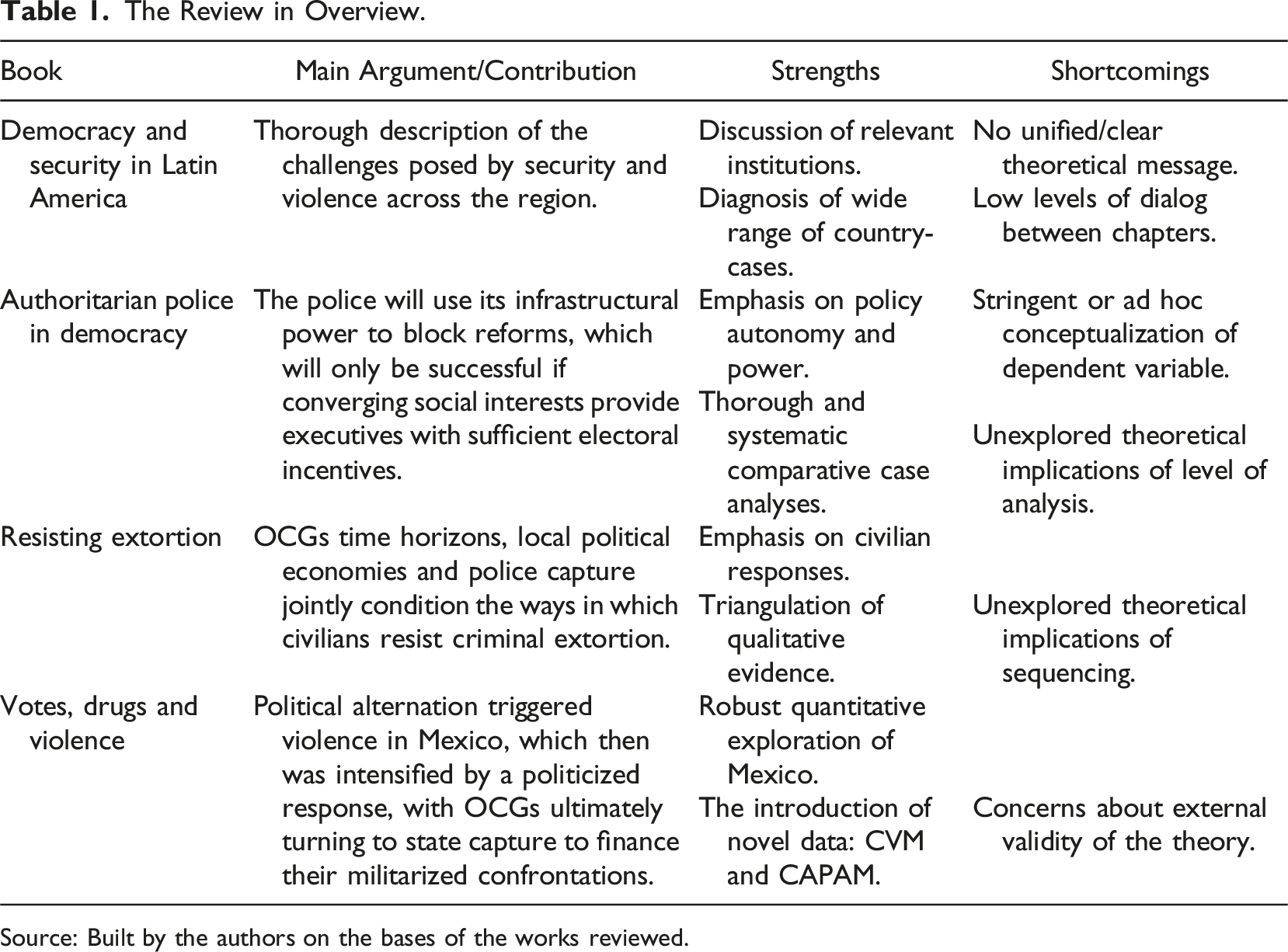
Source: Built by the authors on the bases of the works reviewed.
Looking Ahead
We close our discussion by highlighting two elements raised by the volumes reviewed, elements we contend should be at the front and center of future discussions on policing, militarization, and security across Latin America. Specifically, we briefly discuss issues pertaining to bottom-up militarization and conclude by underscoring the primacy of politics.
Bottom-Up Militarization
From Kraska’s classic definition, 1 we know that at least conceptually, militarism and militarization can unfold at the state and the societal level. However, in their theoretical and empirical work scholars frequently prioritize either governmental or state institutions as the loci of these two concepts. This is evident in discussions that highlight issues such as the increasing involvement of the armed forces in non-military missions (“mission creep”), which include but is not limited to military “constabularization.” These are by no means inaccurate characterizations of the phenomena in question. However, here we would like to highlight that what the books reviewed here reveal—and what Moncada’s volume particularly exposes—is a broader spectrum of militarism and militarization. The cases in these volumes either implicitly or explicitly show that these processes not only influence state actors, but also, they show how they increasingly shape the actions of non-state actors. When thinking about OCGs and their recourse to violence this assertion might already be familiar. What is novel though, is that the evidence increasingly points to the militarization of otherwise civil society.
To paraphrase Bermeo (2003), that ordinary citizens militarize in extraordinarily violent times poses new challenges for scholarship and political practice. On the one hand, it asks that we re-orient the conventionally state-centric definitions and explorations of militarism and militarization. On the other hand, theorizing and assessing how society and ordinary citizens have embraced this militaristic logic will be relevant to better tackle the political challenges these processes imply. 2 That is, it will prove crucial to effectively strengthen the rule of law, and sustain civil rights, and make electoral dynamics viable in a region that has been recently dubbed the “land of militarized democracies” Corrales (2019).
The Primacy of Politics
Arias and Goldstein (2010) characterized Latin America’s violent democracies as political systems in which endemic violence was not “simply a failure of democratic governance and institutions [but rather] an element integral to the configuration of those [democratic] institutions, [a] necessary component to their maintenance, and […] an instrument for popular challenges to their legitimacy” (our emphasis, p. 4). Although other variables are undeniably relevant to understanding regional militarism, the works reviewed here all strongly suggest that (democratic) politics have (un)intendedly trapped the region in a militaristic spiral.
Politics both encourages and sustains militarization, but the former is in turn also shaped by the very phenomenon it fuels. Whether because of top-down, elite-level dynamics, or because of bottom-up, social resistance, the works examined in this review show that the incentive structures of democratic politics permit the persistence of militarized, authoritarian institutions within Latin America. Intuitively, we might be inclined to think of these challenges only at the national scale. However, it is the second and third tier governments who face seemingly insurmountable odds. In this regard, exploring the implications of militarization for subnational democracy and for local state capacity or institutional strength, are necessary avenues not only for future inquires, but also for effective, police reform, demilitarization, and governance.
As scholars continue to break new theoretical and empirical ground on the subjects of militarism and militarization in Latin America, they should be mindful of the (perverse) synergies between these phenomena and politics across the region. To put it provocatively, in a similar fashion to the rationale of punitive populism (Bonner, 2019), to the extent that what the region has experienced involves shifts at the institutional, the elite, and the societal level, it seems that Latin American polities are not only violent but also increasingly militarized democracies. Unfortunately, we believe that this is hardly what Marcella (2022) meant when talking about new civil-military coalitions, and is clearly not the type of political re-thinking Arias and Goldstein encouraged more than a decade ago. The risk, as Chouhy et al. (2022) have recently underscored, is not only that the dynamics of democratic politics lead to harsh, violent, and increasingly militarized regimes, but that in doing so, they might be sowing the very conditions for democratic demise.
Following on the steps of the work reviewed here, the contributions to this special issue also underscore the primacy of politics (see, for example, Aguilar and Olvera this volume). Critically, they move the agenda forward by looking at the social dimension of militarization (Diamint this volume, Coutiño and Madrazo also this volume), by tracing changes along subnational police forces (Pérez Ricart and Padilla this volume), and by identifying environmentalism and foreign policy as new contested arenas of militarization (Corredor-García and Vega this volume, Oelsner, Solmirano, and Tasselkraut also this volume). To paraphrase Goethe’s (in)famous adage, the way out of the Latin America paradox necessitates that we keep thinking and re-thinking politics, until ultimately, we re-invent it.
Footnotes
Declaration of Conflicting Interests
The author(s) declared no potential conflicts of interest with respect to the research, authorship, and/or publication of this article.
Funding
The author(s) received no financial support for the research, authorship, and/or publication of this article.
