




Abstract
Background
Obstructive sleep apnea (OSA) is a condition in which the upper airway narrows or closes repeatedly during sleep, interrupting normal breathing. To evaluate its trends and advancements, a bibliometric study examining the 50 most frequently referenced articles in dentistry published between 2002 and 2022 was conducted.
Methods
The Scopus online database was searched for relevant literature on OSA published in the last two decades. VOSviewer software was used for data analyzes, science mapping, and network analysis. A country-based correlation analysis and keywords based on bibliographic data were used to create a co-occurrence network.
Results
The top 50 most highly cited articles appeared across 17 separate journals, comprising 39 original research articles (78%) and 11 reviews (22%). The top three cited journals were the European Journal of Orthodontics (EJO), Journal of Oral and Maxillofacial Surgery (JOMS), and American Journal of Orthodontics and Dentofacial Orthopedics (AJODO). The bibliometric analysis revealed that the top 50 articles were authored by individuals from 20 different countries, with the USA contributing the greatest number of publications and receiving the highest citation count.
Conclusions
The 50 most-cited articles primarily focused on the diagnosis and management of OSA, with the highest citations from the EJO, JOMS, and AJODO.
Practical Implications
This research emphasizes the importance of diagnostic techniques, such as 3D airway imaging and sleep studies (polysomnography), for detecting associated morphological and physiological variations. Orthodontics, oral and maxillofacial surgery, and dental sleep medicine are all addressed in the most-referenced studies, highlighting the impact of craniofacial structures on airway patency and the need for individualized diagnostic and interdisciplinary treatment approaches.
Introduction
Obstructive sleep apnea (OSA) is a sleep-related breathing disorder characterized by recurrent partial or complete upper airway collapse during sleep. It is associated with intermittent hypoxia, hypercapnia, fragmented nocturnal sleep, excessive daytime somnolence, heightened sympathetic activity, multiple systemic complications, neurocognitive impairment, depression, and an increased risk of mortality. 1 Craniofacial features linked to OSA involve a variety of skeletal and soft tissue abnormalities, involving structures like the mandible, maxilla, cranial base, and hyoid bone, as well as the size and configuration of the soft palate and tongue. Upper airway narrowing and collapsibility result from various factors, such as aberrant craniofacial morphology, altered tongue neuromuscular control, hyoid positional variations, cervical and pharyngeal fat deposition, and reduced airway volume. 2
Sleep medicine and dental sleep practitioners collaborate in evaluating and managing patients with OSA. Dental professionals support patients across multiple levels, beginning with recognizing sleep-related disorders, referring patients, and providing therapeutic support. In the absence of effective pharmacologic therapy, treatment options are broadly categorized as invasive and noninvasive. 3 While continuous positive airway pressure is the standard for mild to moderate OSA, mandibular advancement devices (MADs) are increasingly important, especially for patients with primary snoring and mild OSA. 4
Bibliometrics is an interdisciplinary field that applies mathematical and statistical techniques to quantitatively assess scientific research using journal metrics, including the Journal Impact Factor, 5-year Journal Impact Factor, Eigenfactor score, and normalized Eigenfactor.5, 6 It helps identify emerging trends, ongoing research, and new technologies in various fields, as well as core research or authors, and their relationships. 7 Scopus, a source-neutral abstract and citation database, provides tools for bibliometric evaluation, including the “Analyze Search Results” function, which aids in identifying trends and citation metrics across authors, institutions, publications, and funding sponsors. 8
Several bibliometric analyzes on OSA have been published in related disciplines, including studies by Öner et al. OSA in anesthesiology, 9 Zhao et al. focusing on OSA biomarkers, 10 An et al. on artificial intelligence in OSA, 11 Dong et al. on cognitive impairment with OSA, 12 Huamaní et al. (1991-2012), 6 and Huang (1991-2006). 13 Despite these substantial contributions, no bibliometric analysis of OSA has been reported within the dental literature. In view of this gap, the present study aims to conduct a bibliometric analysis of the 50 most-cited articles on OSA in dentistry published between 2002 and 2022, using the Scopus database. The analysis seeks to trace the evolution of research in this domain, highlight influential authors, institutions, and themes, and identify emerging trends and potential directions for future research.
Materials and Methods
Search Strategy
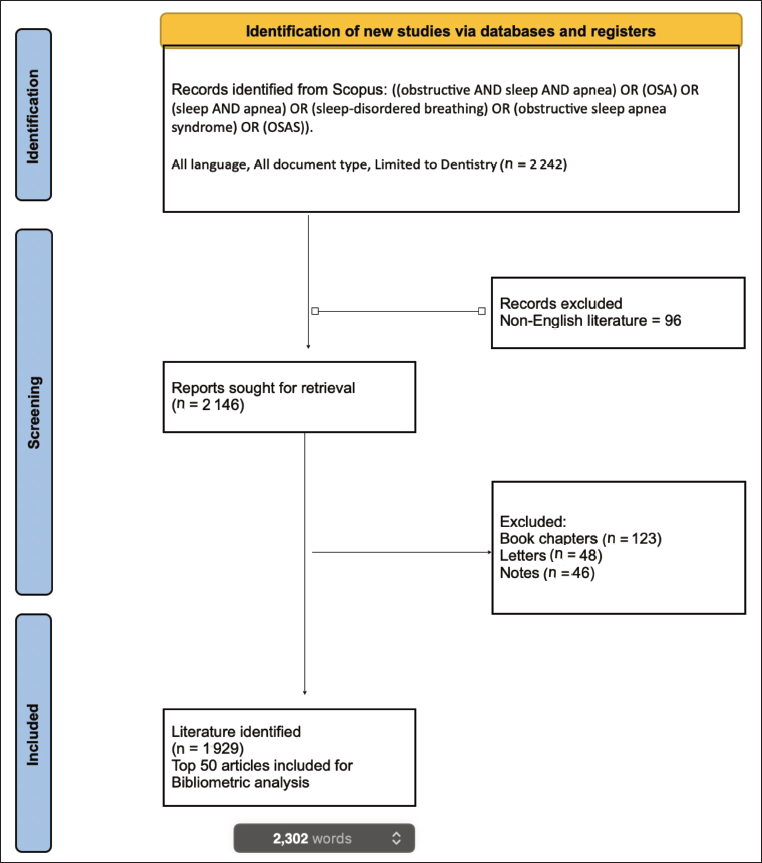
This study did not require ethical approval. The Scopus database, provided by Elsevier and headquartered in Amsterdam, the Netherlands, was searched on October 1, 2023, to identify publications related to OSA. The following search equation was applied: TITLE-ABS-KEY ((“obstructive sleep apnea” OR “obstructive sleep apnoea” OR OSA OR “sleep apnea” OR “sleep apnoea” OR “sleep-disordered breathing”)). The search resulted in a total of 5,824 articles; the application of the “Dentistry” filter resulted in 2,242 articles. The application of the “Dentistry” filter was done to ensure the retrieval of articles only about the field of dentistry, since OSA belongs to a multidisciplinary domain. The exclusion of non-English articles (n = 96) was done due to feasibility constraints, including the unavailability of reliable translations and the potential for misinterpretation. The exclusion of book chapters (n = 123), letters (n = 48), and notes (n = 56) resulted in 1,929 publications, as depicted in the Preferred Reporting Items for Systematic Reviews and Meta-Analyzes flow diagram (Figure 1). The articles were arranged in descending order according to citation counts. Duplicate articles retrieved from Scopus were identified and removed manually before the screening process based on digital object identifiers, titles, and author details. In cases where multiple records of the same study appeared, only the version with the highest citation count was retained for analysis (Figure 1).
Flowchart Diagram of Search Strategy.
Data Collection
For each article that satisfied the inclusion criteria, data were collected on the title, authors’ name(s), institutional affiliation(s), country of origin, journal name, publication year, publication type, and citation count. All the data, including citation counts, were calculated on October 10, 2023. The 2022 impact factor for each journal was obtained using data from the Clarivate Journal Citation Reports database.
Data Analysis
The articles, along with the information, were downloaded in comma-separated values format and then exported to VOSviewer (the Netherlands version 1.6.17) for data analysis, mapping, and grouping. Keywords based on bibliographic data were utilized for the creation of a co-occurrence network. Keywords were counted in full in the VOSviewer software, which signified that each co-occurrence link received the same weight. The nodes represented the keywords, the edges represented the keyword associations, and the distance between nodes specifically echoes like relationships among the nodes. A country-level correlation analysis was also performed to assess the relationships among the countries represented by the co-authors.
Results
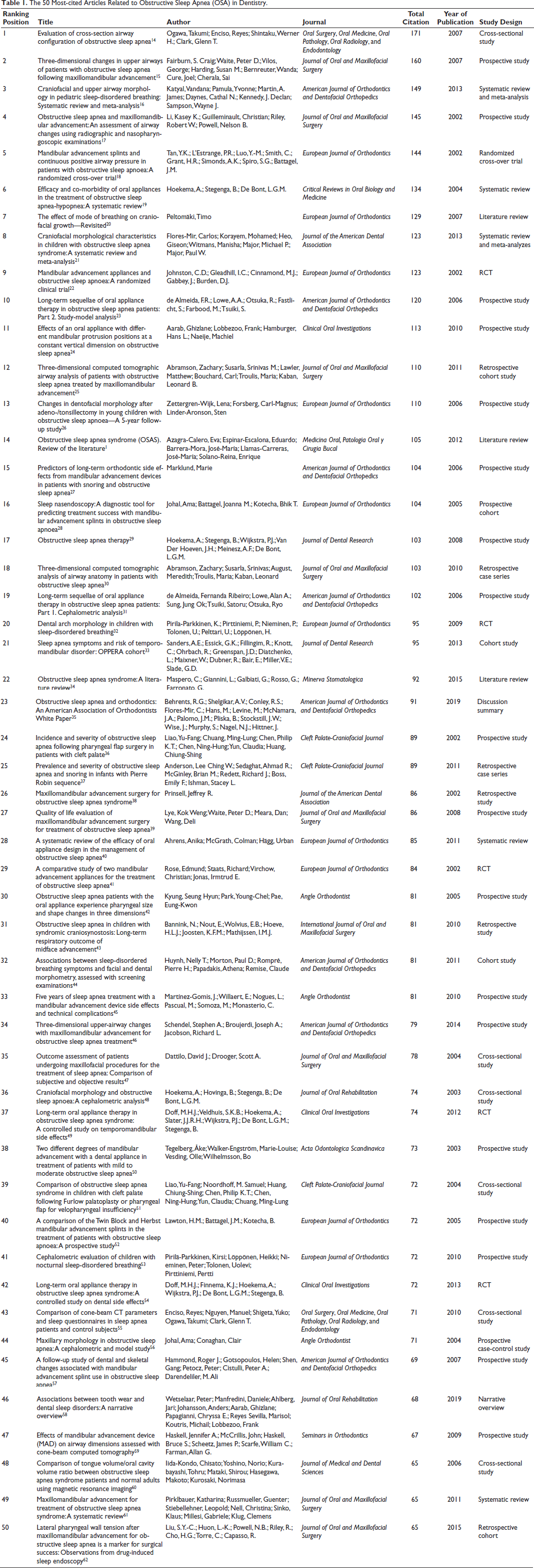
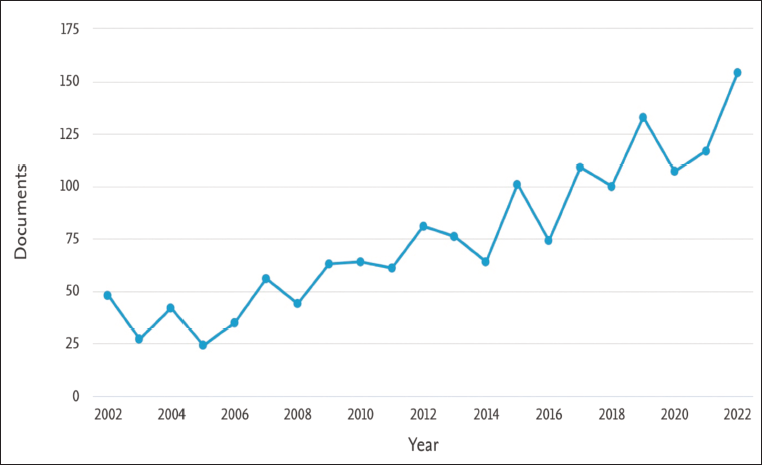
The search equation yielded 2,242 articles under the “Dentistry” filter. Applying a time filter to include publications from 2002 to 2022 resulted in the identification of 1,842 documents (Figure 2). The articles were assessed for eligibility, and the top 50 most highly referenced articles were listed in descending order from the most referenced to the least referenced articles (Table 1). Thirty-nine were original research studies (78%), and 11 were reviews (22%). A total of five systematic reviews (10%) and two meta-analyzes (4%) were identified. Other reviews included literature review (6%), retrospective review (2%), narrative overview (2%), and discussion summary (2%). Among the original articles, 20 prospective studies (40%), six cross-sectional studies (12%), five randomized controlled trials (RCTs) (10%), one randomized cross-over study (2%), two cohort studies (4%), and five retrospective (10%) studies were identified. The bibliometric analysis showed that the 50 most highly cited articles appeared across 17 different journals (Table 2) and had authors from 20 different countries (Table 3).
The 50 Most-cited Articles Related to Obstructive Sleep Apnea (OSA) in Dentistry.
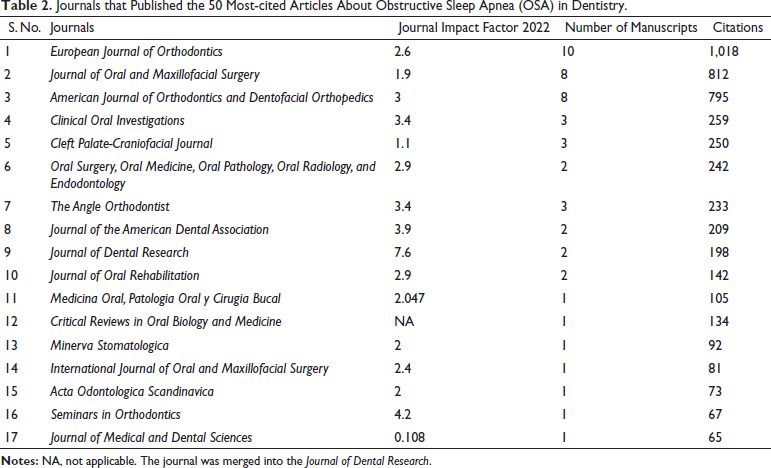
Journals that Published the 50 Most-cited Articles About Obstructive Sleep Apnea (OSA) in Dentistry.
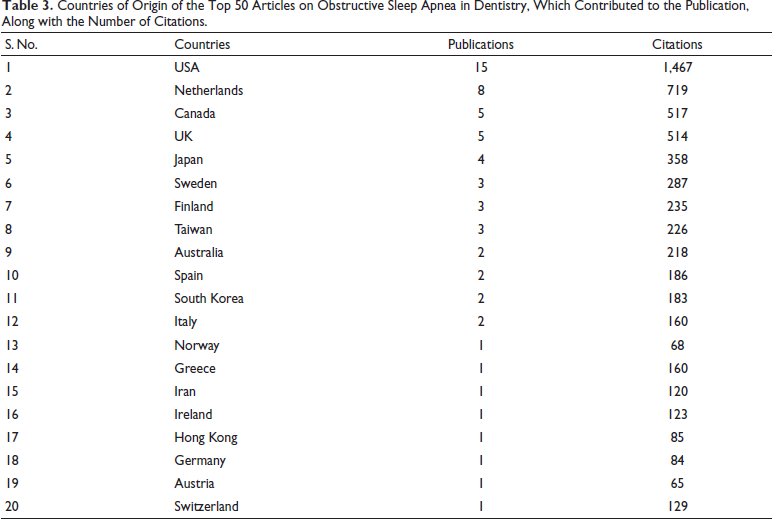
Countries of Origin of the Top 50 Articles on Obstructive Sleep Apnea in Dentistry, Which Contributed to the Publication, Along with the Number of Citations.
Year-wise Trend in the Number of Research Documents Related to Obstructive Sleep Apnea (OSA) in Dentistry from 2002 to 2022.
Journals
The 50 most highly referenced studies appeared across 17 different journals. The three highest cited journals, with the European Journal of Orthodontics (EJO) having the greatest number of citations (1,018 citations, 10 articles), preceded by the Journal of Oral and Maxillofacial Surgery (JOMS) (812 citations, 8 articles) and the American Journal of Orthodontics and Dentofacial Orthopaedics (AJODO) (795 citations, 8 articles) (Table 2). The journals found in the study were not restricted to Orthodontics but extended to other specialties, such as oral and maxillofacial surgery, due to the multidisciplinary approach towards the management of OSA.
Keyword Analysis
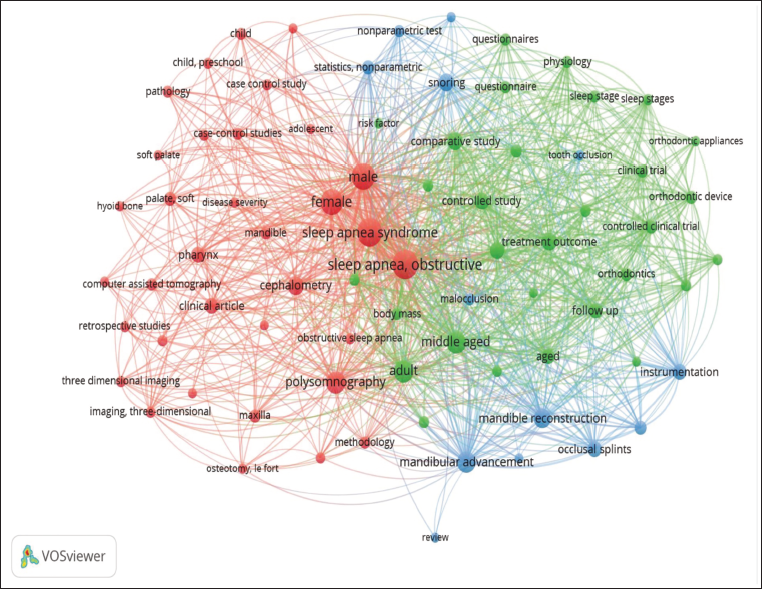
Bibliometric analysis of the keywords found by VOSviewer revealed a total of 444 keywords. A keyword map was created with keywords that had occurred more than five times in the Scopus online database, of which 80 met the threshold. The keywords that appeared most were “sleep apnea, obstructive” (42 occurrences and total link strength 845), followed by “male” (36 occurrences and total link strength 780) (Figure 3). Men, especially middle-aged, are at a higher risk of OSA as compared to women. 63 Other recurrent keywords were “polysomnography” (25 occurrences and link strength 502) and “mandibular advancement” (22 occurrences and 475 link strength). Based on guidelines from the American Sleep Disorders Association, mandibular advancement oral appliance therapy is recommended for individuals with primary snoring or mild OSA who fail to improve with conservative treatments.64, 65
Keyword Network Analysis of the 50 Most-cited Articles on Obstructive Sleep Apnea (OSA) in Dentistry.
Country-wise Analysis
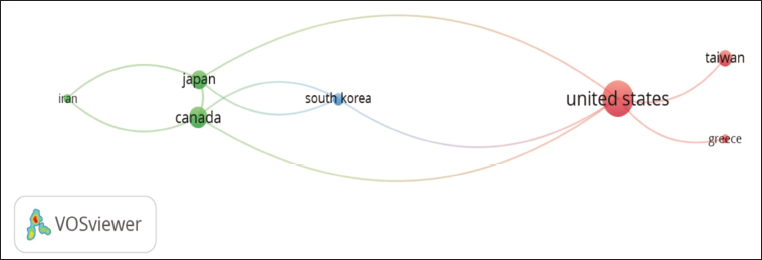
The top 50 articles related to OSA had authors from 20 different countries, having the most publications (15) and the greatest number of citations (1,467) from authors based in the USA (Table 3). The bibliometric analysis revealed that the highest link strength existed between the USA, Canada, and Japan, with a link strength of five (Figure 4).
Country-wise Analysis of the 50 Most-cited Articles on Obstructive Sleep Apnea (OSA) in Dentistry.
Discussion
Summary
Bibliometrics quantitatively analyzes a researcher’s work and the contributions of a country or an institution using quantitative analysis of the overall number of publications and their total citation counts within a specific field. The bibliometric analysis of the 50 most-cited articles related to OSA was selected to have a sample size large enough for data extraction. The last 20-year period (2002-2022) was chosen to assess recent developments in this area, as well as the trend of an increasing number of publications related to OSA over the last two decades (Figure 2).
The Scopus database was selected for article retrieval to ensure consistency, as citation counts can vary across bibliographic databases. Compared with other databases such as the Web of Science or PubMed, Scopus has been shown to index a larger number of journals and conference proceedings and to provide more comprehensive citation data for recent publications, making it well-suited for bibliometric analyzes. Moreover, Scopus is a comprehensive abstract and citation database comprising peer-reviewed scholarly literature. It indexes multiple components of scientific publications obtained from external publishers, including publication titles, abstracts, keywords, author names with affiliated institutions, and reference lists. A notable enhancement of the Scopus database is its curated institutional profiles, which account for variations in institutional names and hierarchical structures in a manner analogous to author profiling. Additionally, Scopus applies natural language processing techniques to the full text of indexed articles to identify potential references to funding.
The top 50 articles could be grouped into different categories, with the studies mainly focusing on craniofacial morphology and upper airway structure in OSA, highlighting the key influence of craniofacial structures in the pathophysiology and diagnosis. High citation count may be a result of several factors, such as topic popularity, historical precedence, journal impact, and relevance to a particular research community. In bibliometric analysis, high citation frequency should not be considered as a direct measure of methodological excellence, evidence quality, or clinical significance.
A substantial proportion of studies focused on MADs and maxillomandibular advancement surgery, underscoring the importance of dental and surgical approaches in treating OSA. Oral appliance therapy was especially investigated with respect to efficacy, design optimization, and long-term dental and temporomandibular side effects, indicating an interest in treatment effectiveness with functional stability. OSA research on pediatric patients focused on craniofacial growth patterns, syndromes, and the outcome of varied surgical procedures in managing OSA. Additionally, diagnostic and predictive tools, including cone-beam computed tomography and sleep nasoendoscopy, have emerged as important areas of investigation aimed at improving diagnosis and treatment planning. Nonetheless, despite their significant citation impact, considerable deficiencies persist, including a lack of interdisciplinary research, a lack of long-term and patient-centered outcome data, and insufficient representation of diverse populations.
The most-cited study was published in 2007 by Ogawa et al. 14 (171 citations), which aimed to evaluate the airway configuration in individuals diagnosed with OSA (Table 1). Among patients suffering from OSA, were found to have a concave, elliptical-shaped airway, whereas non-OSA patients had a concave, circular, or square in shape airway. The second-highest-cited study was published in 2007 by Fairburn et al. 15 (160 citations), which evaluated changes in the three-dimensional structure of the upper airway in patients with OSA following maxillomandibular advancement. The third most influential study was findings from a systematic review and meta-analysis reported in 2013 by Katyal et al. 16 (149 citations), which evaluated the correlation between craniofacial discrepancies and sleep-related breathing disorders. The fourth most influential study was published in 2002 by Li et al. 17 (145 citations), which evaluated the airway adaptations after undergoing maxillomandibular advancement. The study revealed an expansion in the size of the upper airway with decreased collapsibility in patients after maxillomandibular advancement. This was followed by research by Tan et al. (144 citations) published in 2002. 18 The study was a randomized, cross-over trial that compared the efficacy of MADs and nasal continuous positive airway pressure.
The article placed sixth in citation count was a systematic review and meta-analysis authored by Hoekema et al. (134 citations) published in 2004, which assessed the efficacy and comorbidity related to MADs. 19 The seventh most highly cited article was published by Peltomäki (129 citations) in 2007, which discussed the effects of modes of breathing on craniofacial growth. 20 The craniofacial characteristics in children with OSA include a mandibular retrusion, an increased mandibular plane angle, a vertical growth pattern, and a tendency toward Class II malocclusion. These features were analyzed in the eight most-cited publications, a systematic review and meta-analysis by Flores-Mir et al. 21 in 2013 (123 citations). This was followed by an RCT by Johnston et al. (123 citations) in 2002, which evaluated the effectiveness of MADs in the management of OSA. 22 The tenth most influential article was published by de Almeida et al. 23 (120 citations) in 2006, which evaluated cephalometric changes in the dentition caused by MADs in subjects who wore the appliances for more than 5 years.
Generalizability
Citing articles involves subjective judgments by authors, which means bibliometric analysis can be shaped by various factors and has inherent limitations. MAD therapy and craniofacial risk factors for OSA are domains where dentists play a significant therapeutic role, thus resulting in preferential citation in dental literature compared to other OSA treatments that are more commonly addressed in medical journals, thereby falling outside the dentistry-centric research scope. Besides, older foundational studies on orthodontic interventions and airway morphology had more time to accumulate citations, potentially inflating their position relative to newer diagnostic or interdisciplinary research. Therefore, the ranking of orthodontic and MAD-related articles in this analysis should be interpreted as reflecting citation dynamics within dental research rather than the overall clinical importance of all OSA treatment modalities.
Existing biases in the system, such as gender and language discrimination, can lead to disparities in citation practices. Factors such as self-citations, the number of co-authors, similarities or differences in author names, and the accessibility of cited works can create gaps in citation analysis. Additionally, the Matthew effect suggests that established scholars are more frequently cited than lesser-known researchers, regardless of the quality of their work. This phenomenon can introduce disparities in academic visibility and influence. 66
This bibliometric analysis adhered to protocols in the field. Previous bibliometric studies have utilized similar frameworks, focusing on broader domains, including medical and dental literature. 1 Zhang et al. 67 assessed the top 100 articles related to OSA, revealing that the highest-cited manuscripts were published in respiratory and critical care, followed by sleep and chest. Both studies identified that the highest number of publications affiliated with OSA came from authors from the USA. The latter focused more on interdisciplinary care, as opposed to the current publication, which focused on the dental literature.
Interpretation and Implications for Research
Future research could focus on evaluating the long-term influence of MADs on patient quality of life, which may yield important insights into their durability and effectiveness. Collaborative exploration between the dental and medical fields can assist in the development of evidence-based guidelines.
Comparison with Other Studies
Pan et al. 68 undertook a bibliometric evaluation of OSA research in medicine from 2011 to 2020, in which the USA and China emerged as leading contributors, similar to the current study. The most common keywords were “Biomarkers,” “Endoscopy,” “Bariatric surgery,” “Oral appliance,” and “Oropharyngeal exercises,” which focused on the management aspect of OSA, similar to our study. In another bibliometric analysis by Yang et al., 69 which analyzed publications from 1999 to 2022, had similar keywords, for instance, “positive airway pressure,” “oral appliance,” and “surgery,” and the authors concluded that a multidisciplinary combination of targeted therapy was required for the management of OSA. Since their inception in the 1980s, MADs have garnered significant traction as a therapeutic alternative for OSA, largely due to their relative simplicity. 70 Although MADs may yield beneficial outcomes in managing OSA, rigorous comparative investigations evaluating their efficacy and associated comorbidities are required.
Limitations
This study analyzed only the Scopus database, but other databases could also be explored. Studies in languages other than English were excluded, which could have resulted in the exclusion of other impactful studies. Furthermore, the accumulation of citations requires time, and the number of citations is not the only indicator of the quality of research. Highly cited articles and authors may be cited more, regardless of the research quality, a phenomenon known as the Matthew effect. Overall, focusing solely on citation numbers may underestimate the quality of a research publication. In the future, an analysis including other databases, as well as the inclusion of other languages, can be conducted for further exploration. This study analyzed only the Scopus database, which may not capture all relevant publications indexed in other databases. In addition, emerging areas such as artificial intelligence-based OSA research, machine learning-driven diagnostics, and digital orthodontic workflows are relatively recent and may not yet have accumulated sufficient citations to appear among the top-ranked articles. These rapidly evolving fields are likely underrepresented in citation-based analyzes and should be interpreted as important gaps rather than a lack of impact.
Conclusion
The 50 most frequently cited publications were published in 17 different journals, with the greatest number of citations attributed to the EJO, followed by the JOMS and the AJODO.
Contributing authors were drawn from 20 countries, with the US accounting for the highest number of publications.
The most influential articles predominantly focused on craniofacial morphology and upper airway anatomy.
A significant proportion of highly cited studies also focused on MADs and maxillomandibular advancement surgery, highlighting the importance of both MADs and the surgical management of OSA.
Oral appliance therapy was extensively studied regarding its efficacy, appliance design, mandibular advancement optimization, and long-term dental and temporomandibular side effects, emphasizing functional stability.
Footnotes
Authors Contribution
KF and PS conceptualized the study, PS and GC designed the study and wrote the protocol, GC and PS collected the data, and the data analysis was performed by KF. PS and KF interpreted the data. KF and PS wrote the first draft. All authors edited the manuscript and approved the final version of the manuscript.
Data Availability
All data generated or analyzed in this study are included in the published article.
Declaration of Conflicting Interests
The authors declared no potential conflicts of interest with respect to the research, authorship, and/or publication of this article.
Ethical Approval and Informed Consent
This study was not conducted on humans/patients; therefore, ethical statements and patient consent documents are not applicable.
Funding
The authors received no financial support for the research, authorship, and/or publication of this article.
