



Abstract
This article introduces a novel instrument designed to enhance patient and clinician safety during orthodontic procedures. By modifying a standard ligature cutter, this new device effectively collects and retains the cut ends of ligature wires, significantly reducing the risk of aspiration.
Introduction
Swallowing or aspiration of orthodontic appliances or their components is a common concern reported in orthodontic clinics. The associated risks can range from minimal to fatal, depending on the nature of the aspirated object. Notably, one clinical procedure that carries the risk of aspiration is the cutting of orthodontic wires. Various types of cutters are employed for this task, including ligature cutters, side cutters, and distal end cutters. 1 Ligature cutter is specifically designed to cut stainless steel ligature wires and has conical heads with sharp cutting edges. 2
To minimize the risk of aspiration and prevent damage to the cheek mucosa from the cut wire ends in orthodontics, it is essential to use tools that facilitate the safe cutting of the remaining wire length within the oral environment. 3 The introduced cutter in the current article is able to minimize the risk of throwing the cut wire end and causing damage to the orthodontist’s eye or the patient’s cheek. This article describes the design and function of this innovative device.
Method
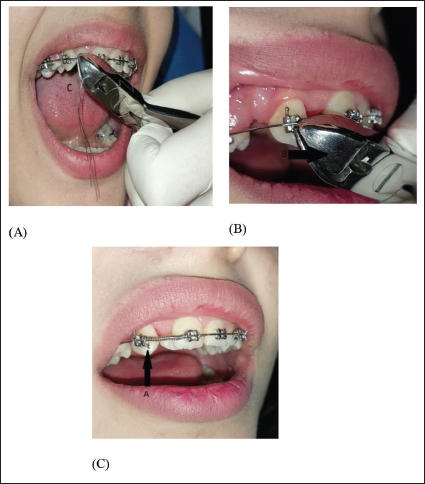
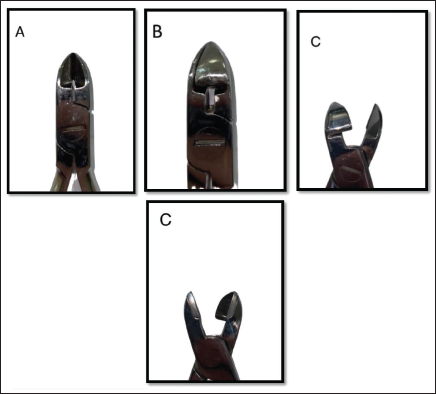
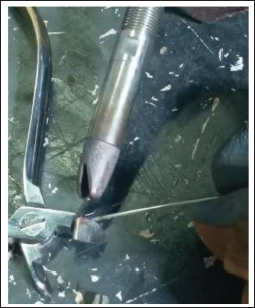
The introduced tool is designed by making changes in the ligature cutters. The ligature cutter has two tapered, opposite ends that end in sharp cutting edges and is used to cut stainless-steel ligature wires. 2 The necessary products for preparing this tool include a ligature cutter and metal sheets that can be added to the tip of the ligature cutter as a wing. The metal sheet is cut according to the shape of the designed wing and is connected to the ligature cutter with the laser-welding process to make a reservoir for collecting the end of the cut wire (Figures 1–3). Adding protective wings to the beak series of ligature cutter enables safe separation with the additional holding of the ligature wire. It prevents the separated end of the ligature wire from being thrown and the possibility of damage to the orthodontist’s eye and the patient’s cheek. The designed cutter is also able to keep the long free end of the ligature wire so that the clinician will not need to hold the free end of the wire with his finger. This prevents the risk of needle stick and makes infection control easier.
(A) Cut-end of Ligature Wire. (B) The Added Protective Wing. (C) The Long Free End of the Ligature Wire is Secured by Two Support Points: The Surface of the Instrument and the Protective Wing. This Design Eliminates the Need for the Clinician to Hold the Free End of the Wire with Their Fingers, Thereby Enhancing Infection Control and Protecting the Mucosa from Damage.
(A) A Common Ligature Cutter. (B) A Modified Ligature Cutter; the Picture Displays the Metal Wings and Reservoir. (C) A Modified Ligature Cutter is Shown in an Open Position; Clearly, the Metal Wing Serves as the Reservoir.
The Cut Steel Sheets were Attached to the Ligature Cutter Using the Laser Welding Process.
Discussion
The risk of swallowing or aspiration of dental appliances is a significant concern in dentistry, especially in orthodontics. One of the processes that carries the risk of aspirating a foreign body is cutting the ends of the ligature wires. To prevent aspiration, various tools are used. These tools are not always capable of holding the excess wire, and there is a strong danger of aspirating or swallowing the cut piece of ligature wire, which can damage the patient.4, 5
Due to the risks associated with not holding the excess wire, it is essential to modify cutters before using them intraorally. The innovative tool introduced in this article is a simple solution to this problem. By keeping the cut wire end, it can prevent damage to both the patient and the orthodontist. This tool is designed by modifying a ligature cutter, which is available in the market. The advantages of the instrument are as follows:
The ability to modify existing cutters, thus eliminating the need to prepare new ones Can be sterilized Economical Comfort for a clinician Can be fabricated easily.
Conclusion
Thus, the invented orthodontic cutter might be an efficient tool to effectively cut the ligature wire, hold the cut piece, and is safe and cost-effective.
Footnotes
Acknowledgments
The present study was extracted from a research project approved by the Health Technology Development Center of Zanjan University of Medical Sciences (Ethics Code: IR.ZUMS.REC.1402.049).
The authors would like to express their gratitude to all staff members who cooperated in this research.
Declaration of Conflicting Interest
The authors declared no potential conflicts of interest with respect to the research, authorship, and/or publication of this article.
Ethical Approval or Informed Consent
This study was conducted in accordance with all ethical principles.
Funding
The authors disclosed receipt of the following financial support for the research, authorship, and/or publication of this article: Zanjan University of Medical Sciences has financially supported current study.
