




Abstract
In orthodontics, molar tubes are discarded once utilized, and in the general dental armamentarium, many double-ended angled instruments are used and subsequently discarded. Here, the authors have described a technique to fabricate a modified distal end bender from discarded instruments, which is cost-effective and easy to fabricate. With a rectangular slot, the double-ended instrument can be used for rectangular wire used early in a self-ligating system.
Introduction
Orthodontists have utilized cinching instruments for many years, which are expensive and bulky to use. The concept of making a modified distal end bender from a discarded instrument is to make a plier with an easy and cost-effective method. With the advances in passive self-ligating bracket systems, the use of rectangular wire early in the treatment is also increasing. 1 The modified distal end bender with a rectangular slot can be used for cinching the rectangular wire distal to molar tubes. The round slot can be used to cinch the round aligning wires used in the early stages of treatment.
Here, the authors have used a discarded spoon excavator as an example. Any other curved instruments like hand scalers (e.g., sickle scaler, curettes) or probes (e.g., shepherd hook probe), which have been discarded or are not in use, can also be used in this technique. In orthodontics, bondable or weldable molar tubes are commonly used and these discarded tubes can be used with this instrument. For a round slot, a 15-gauge needle was used.
Fabrication
Modified distal end bending instrument is fabricated by using:
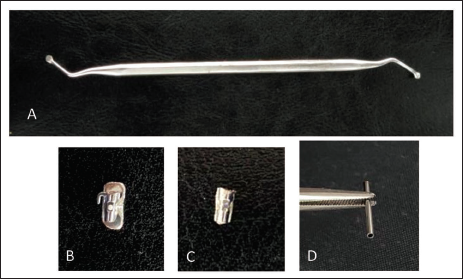
Discarded spoon excavator (Figure 1A) Discarded molar tube (Figure 1B and C) 15-gauge needle (Figure 1D) Solder and flux
(A) Spoon Excavator, (B) Molar Tube, (C) Trimmed Molar Tube, and (D) 15-gauge Needle.
Steps
Take a discarded spoon excavator.
Take a molar tube (bondable or weldable), remove the hook and excess portion from tube, that is, for bondable molar tube remove base, and for weldable molar tube remove the wings.
Molar tube is soldered to the tip of spoon excavator as shown in Figure 2A.
The 15-gauge needle is trimmed to 5 mm length and then soldered to the other end of the spoon excavator as seen in Figure 2B.
(A) Rectangular Slot, (B) Round Slot, and (C) Modified Double-ended Distal End Bender.
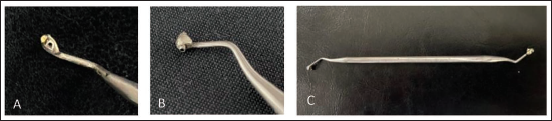
After soldering, both the ends should be trimmed and polished to avoid injury to the soft tissue (Figure 2C).
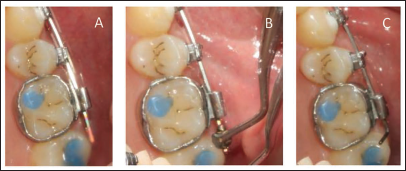
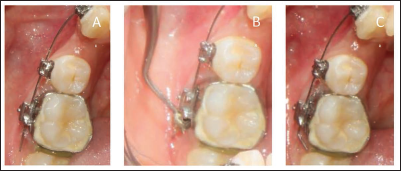
The instrument is used to bend the excess wire extending from the molar tubes. The bender is inserted distally from the wire, and the wire is bent lingually or gingivally as shown in Figures 3 and 4.
(A) Rectangular NiTi Wire, (B) Distal End Bender Inserted Distally, and (C) Bent NiTi Wire.
(A) Round NiTi Wire, (B) Distal End Bender Inserted Distally, and (C) Bent NiTi Wire.
Advantages
Can be used in all four quadrants.
Can be used for both rectangular and round wires.
Easy to fabricate with less chairside time.
Cost-effective as discarded instruments are used.
The instrument can be a valuable tool to the armamentarium because of its versatility, easy fabrication, and low cost.
Footnotes
Declaration Competing Interests
The authors declared no potential conflicts of interest with respect to the research, authorship, and/or publication of this article.
Ethical Approval
Not applicable.
Funding
The authors received no financial support for the research, authorship, and/or publication of this article.
Informed Consent
Not applicable.
