



Abstract
Aim
The aim of this study was to compare and evaluate the perception of patient’s soft tissue profiles treated with Damon and traditional braces (MBT) in non-extraction cases.
Methods
The record of 14 patients (five Damon, five MBT, and four Duplicated) non extraction cases was included in the study. A total of 28 resulting profile silhouettes (pre- and post-treatment profile photographs) were evaluated by 90 examiners (orthodontists, general dentists, laypersons) using a Likert scale to rate the profiles randomly. Statistical analysis (Student t-test, ANOVA) revealed significant differences both between and within groups.
Results
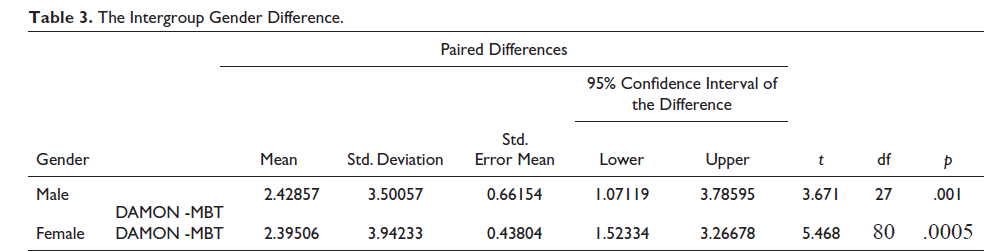
The Laypersons, General dentist, and Orthodontist significantly gave high scores for Damon system compared to (MBT system). It is seen that both male and female examiners gave high scores for Damon compared to MBT system.
Conclusion
Damon system was found to have a perceptible difference in the profile improvement when compared to MBT with all three groups of examiners.
Introduction
Orthodontics, a branch of dentistry, addresses malocclusions to enhance both function and aesthetics for patients. Recent trends have sparked growing interest in facial aesthetics associated with orthodontic treatment. 1 The perception of beauty is closely tied to facial aesthetics, and studies indicate strong connections between malocclusion, self-perceived facial concerns, and negative impacts on self-esteem and overall quality of life.2, 3
Contemporary orthodontics places significant importance on evaluating the facial appearance of patients post-treatment, considering it a key factor in assessing success. 4 Patients, prioritizing dental and facial aesthetics over functional improvements, express heightened concern for the aesthetic outcomes of orthodontic procedures. 5 Understanding how orthodontic treatment impacts the soft tissue profile is crucial for accurate aesthetic assessment, as numerous studies focus on this aspect. While orthodontic treatment can influence soft tissues, the extent of these changes remains a subject of ongoing debate. 6
In orthodontic treatment, tooth extraction is frequently required to address malocclusions by creating necessary space. Aniruddh et al. (2016) highlighted the ongoing and contentious debate between extraction and non-extraction approaches as one of the most debated aspects in orthodontics. The fluctuating opinions on treatment protocols, including a steadfast commitment to non-extraction methods, prompted the study, emphasizing the need to investigate and clarify perspectives in this area. 7
The Damon system, a contemporary orthodontic technique, is promoted as capable of treating almost all cases without the need for extractions. Utilizing self-ligating bracket technology in a twin configuration that mimics a tube, the Damon system employs broad Copper Nickel Titanium arch wires to expand dental arches sufficiently, eliminating the need for extractions. 8 On the other hand, the MBT system, drawing from over 70 years of combined clinical experience, is specifically designed for sliding mechanics. This system emphasizes light continuous forces, incorporating lacebacks and bendbacks into its approach. 9
Thus, the aim of this study is to assess the changes in soft tissue profile induced by treatment with Damon system and MBT system without extraction, by comparing the facial profile silhouettes before and after treatment. This study aimed to compare the facial attractiveness in non-extraction cases between Damon and MBT treatment philosophy by the orthodontist, general dentist, and lay person.
Aim
The aim of this study is to determine the perception of Orthodontists, General Dentists, and Lay people about changes in profile of the non-extraction cases treated by Damon and MBT philosophy.
Method
This retrospective study was based on archival records of patients treated with Damon and MBT for class I non-extraction cases. The photos were converted into silhouettes and were tabulated into google forms for survey. The ethical committee approval was procured before the start of the study.
Inclusion Criteria
This study includes subjects in which growth changes were insignificant (age- 17–30 years) with non-extraction treatment pattern on a Class I skeletal base (ANB of 20) with Class I molar relationship, with no history of previous orthodontic treatment/orthognathic surgery, and with post-treatment Class I molar and canine relationship and 1–2 mm overjet.
Exclusion Criteria
Subjects with anterior open bite, extreme vertical growth pattern, skeletal malocclusion, and developmental abnormalities
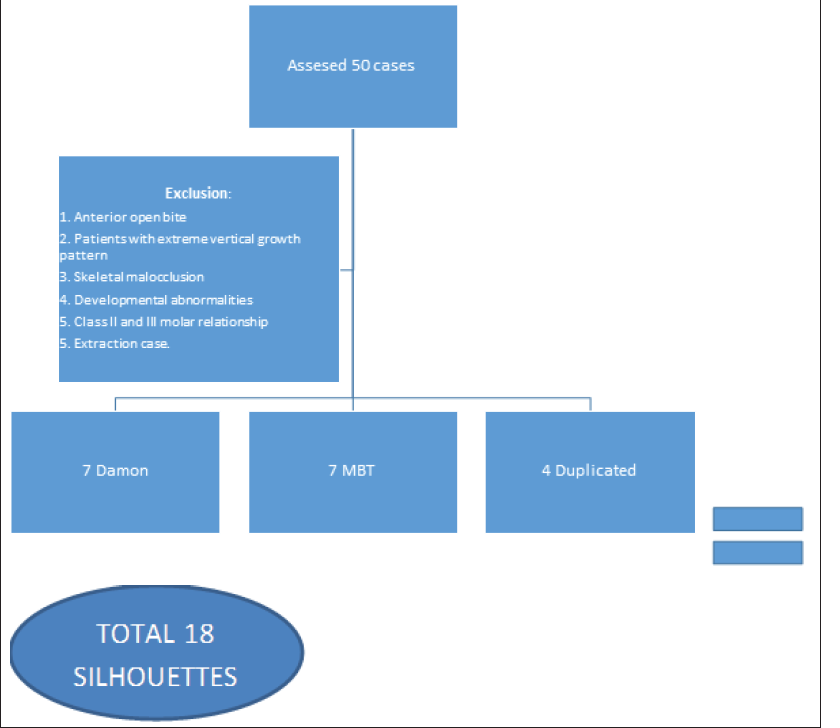
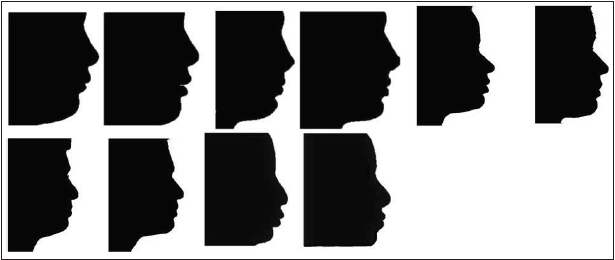
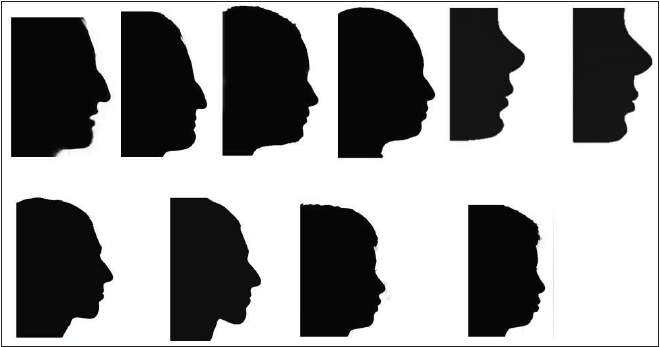
Five Damon and five MBT treated for class I non-extraction cases were taken (Figure 1). Pre-treatment and post-treatment profile photographs of patients taken in the natural head position with standardized camera settings were selected. From the profile pictures, profile silhouettes were generated with Adobe Photoshop Version 7 (Figures 2, 3). The Frankfurt’s plane was oriented horizontally for standardization of the silhouettes.
Total no. of silhouettes.
Damon Silhouettes.
MBT Silhouettes.
Randomization
To ensure randomization, a computer-generated program (
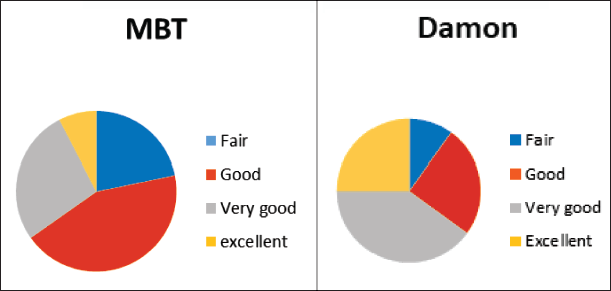
Pie Diagram for MBT and Damon Responses.
Statistical Analysis
The statistical software SPSS (version 22, SPSS IBM) was used in computing the statistical differences. Means and standard deviations (SD) for data distributed normally, medians with first and third interquartile for data not distributed normally, and frequencies for categorical data were computed. The Shapiro- Wilk test was used to evaluate the distribution of the data. Chi-square tests were used to identify the distribution of responses. ANOVA was performed to identify the differences between the evaluators’ comprehension. Student t-test was used to identify the inter-group (DAMON-MBT) difference.
Results
Separate quantitative values were assigned to the silhouettes for the pre and post-treatment changes, and the difference was computed. The difference between the pre-post treatment scores was added up and mean value of it was derived for both the groups. The sum of the Damon and MBT test scores was used to calculate the statistically determined mean intergroup difference. The mean change in the score between pre and post-treatment is more in Damon group (Mean = 2.98) when compared to the MBT group (Mean = 2.08). All three groups of examiners reported preference for the Damon silhouette profiles, which was statistically significant (Table 1).
The Analysis of Three Groups of Examiners for DAMON-MBT.
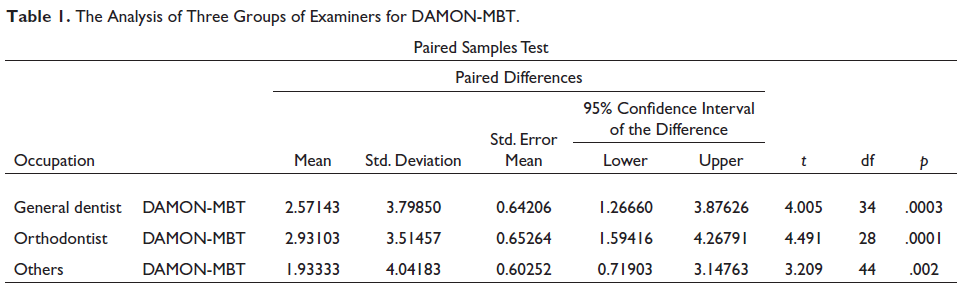
A total of 90 evaluators performed their analysis on 28 (14 pre-treatment and 14 post treatment)*90 = 1,260 silhouettes.
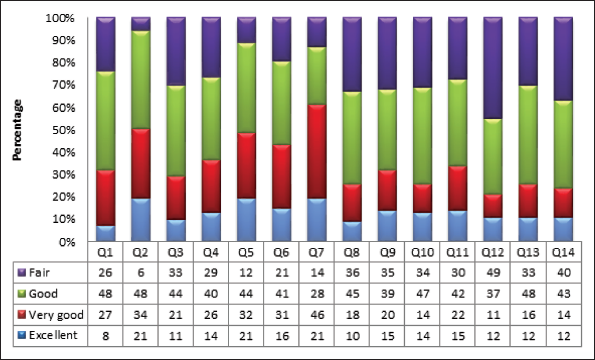
The data were analyzed by ANOVA to ascertain the intragroup difference to see if there were any discrepancies between laypeople’s and professionals’ assessments. In each treatment group, there was evidence that the lay raters’ initial scores were higher than those of the orthodontist. Yet, when final profile ratings were taken into account, the result did not alter significantly (Table 2). Thus, the results showed no significant difference between orthodontists, general dentists, and layperson in their assessments of Damon and MBT profile silhouettes. Similarly, both male and female examiners gave significantly higher scores for post-treatment Damon than that of MBT (Table 3). Among the three groups, there was no statistically significant difference in terms of age, professional experience, or gender. The Likert scale data for distribution of responses is represented in Figure 5. The resultant mean of each treatment group did not statistically differ from the original means when the viewers’ responses for the duplicated pairs of silhouette profiles were used in place of the original pair.
The Preference between the Observers within the Same Group.

The Intergroup Gender Difference.
Likert Scale for Response Distribution.
Discussion
The enhancement of facial appearance is inextricably connected to the outcome of orthodontic treatment. During orthodontic treatment, it is crucial to achieve a balanced soft tissue profile. 10 Malocclusion is commonly described as the irregularity that changes the symmetry, balance, and proportions of the face. Patients’ long-term psychological well-being will be impacted by facial profile improvement. 11 The location, length, and relationship between the skeletal and dentoalveolar structures is altered by orthodontic treatment, which in turn improves the facial expressions and aesthetics. The facial profile is influenced by the morphological relationships and proportions of three key structures: the chin, lips, and nose. Additionally, the facial profile consists of five facial prominences, namely, the forehead, nose, lips, chin, and submental-cervical region, all contributing to overall facial harmony. 12 A significant improvement in the facial profile is the optimal soft tissue response predicted for orthodontic treatment.
The Damon system, considered a prominent self-ligating bracket system, has gained widespread adoption among orthodontists. Its emphasis on light force and low friction mechanics is believed to facilitate clinically stable arch expansion, potentially reducing the perceived need for extractions. 13 Despite extensive studies on the efficacy and treatment response of both the Damon and MBT systems, there is a gap in the literature concerning the comparative perception of treatment outcomes between these two approaches.
Consequently, the perception of treatment changes was taken into consideration when conducting this study. There was a unanimous response from the observers, which included both professionals and lay people, for the Damon group. This might be attributed to the arch expansion brought on by the Damon philosophy, which gave the Damon system more room than the MBT system for inclination correction.
This study used facial silhouettes of patient’s profile owing to their unbiased nature and three different examiner groups were chosen to identify the perspective disparities. 14 Many authors have suggested using silhouettes to evaluate the aesthetics of the face profile since they do away with the impacts of other elements, such as skin complexion, makeup, hair, and eyes. 15
Furthermore, profile silhouettes enable accurate assessment of the sagittal jaw relationship. 16 This can also resolve the ethical issues raised by the facial photographs.
Likert scales were chosen for their simplicity, convenience, and efficiency in the study. The use of Likert scales allows for a quick and straightforward assessment. It is worth noting that as more information becomes available, examiners tend to approach their assessments with greater caution, potentially reflecting a nuanced consideration of the data. 17
As most people cannot discern the difference between how the lips and chin are positioned, it was projected that the profile changes would go unnoticed by the general public. Yet, because laypeople in this study were more sensitive to the profile change, they gave similar ratings to other raters. Given the influence of facial attractiveness on social activities, it is appropriate to give laypeople’s judgment the maximum weightage.
The perception of face beauty differs depending on the ethnicity. 18 The fact that this study is single-centered is one of its limitations. It is necessary to conduct multicentered research with standardized methodologies in order to compare the findings of the current study to those from various settings and locations. Moreover, eye-tracking technology can be utilized to offer quantifiable data on the areas of the profile that each group of examiners finds visually appealing. This study is a retrospective study in which proper matching of cases with respect to facial pattern and arch forms were not done. Further, prospective study is needed to draw better conclusion and future research is necessary to evaluate how patients perceive the changes brought about by the Damon and MBT systems because there is limited information available on how patients perceive various treatment modalities from their perspective.
Conclusion
It is clear that the general dentists, orthodontists, and laypeople notably expressed clear preference for the Damon-treated group. Some clinical implications that can be drawn from our study are between Damon and MBT system; Damon can be considered superior over MBT in the profile changes. There were no differences in the preference based on age, gender, and profession, which implied that lay raters also had the equal capacity to analyze the silhouettes- based profile changes.
While comparing the profiles of patients treated with different orthodontic mechanics, the silhouette is a useful tool for aesthetic assessment. It can be viewed as a supplement, not a replacement though, to the existing techniques for evaluating facial aesthetics because it simplifies the representation of a profile.
Footnotes
Declaration of Conflicting Interests
The authors declared no potential conflicts of interest with respect to the research, authorship, and/or publication of this article.
Ethical Approval
Ethical approval was obtained from IRB, SRM Dental College, Ramapuram.
Funding
The authors received no financial support for the research, authorship, and/or publication of this article.
Informed Consent
Not applicable.
