




Abstract
Background
With orthodontic patient demographics expanding to involve more adults, the demand for esthetic appliances is greater and orthodontists are keen on offering their patients more discreet and even invisible options. Clear aligners are a very viable option which offers all this, and it is noteworthy that more and more orthodontists in India are practicing the craft. Keeping this vision in mind, and the fact that aligners are revolutionary and here to stay, this study was conducted to assess the efficiency of various tooth movements carried out with clear aligner therapy as compared to traditional orthodontic treatment.
Aim
This questionnaire-based survey aimed to analyze and assess the orthodontists’ perception and experience of various tooth movements carried out with clear aligner in their routine clinical practice in India.
Methodology
A cross-sectional study was conducted by sending out a questionnaire on a virtual platform. It was approved by the Ethical Committee of the Dental Institute it was carried out in (Ref no: SDCH/IEC/OUT 2021/13). A sample size of 205 participants within the age group of 27–59 years was taken. The participants comprised of orthodontists practicing in various parts of India. A questionnaire, comprising of 22 closed-ended questions, was created on Google forms and circulated to participants using various social media platforms. The data of responses of participants were analyzed and evaluated with the help of chi-square test and p values were interpreted for the significance of responses.
Results
This survey analyzed the experience of orthodontists with respect to the various tooth movements carried out with clear aligners. There were mixed responses, but most of them suggested the aligners to be either same in effectiveness or poorer than the fixed appliances in carrying out various tooth movements.
Conclusion
This questionnaire-based survey helped in analyzing the orthodontists’ perception on the use of clear aligners in their routine clinical practice in India. It most importantly helped in assessing various kinds of tooth movements achievable with clear aligners. It also helped in getting an opinion on the movements presently not possible with aligners alone. This study clearly suggests that the general perception amongst the orthodontists is that more advancement is needed as far as aligners are concerned before they become competent enough to deal with various tooth movements easily achievable with fixed appliances.
Introduction
Orthodontic treatment is primarily sought for functional and visual satisfaction in cases of dentofacial malocclusions. With people becoming more aware of their dental problems and conscious of their looks, we see orthodontic treatment gaining tremendous popularity and acceptance. This is proven by the fact that the number of patients who received orthodontic treatment rose linearly in the late 20th century. 1
In the past, comprehensive orthodontic treatment was viewed as a treatment for children and young adults only. Then later, with the coming in of aesthetic brackets and lingual appliances, it was believed to have gained popularity amongst the adults too. But the fact is, despite the trend and despite the necessity of orthodontics, adults still tend to be skeptical about taking treatment mainly because they detest wearing a visible appliance comprising of bands, brackets, and wires.
In recent years, removable clear aligner therapy has shown promising results as a unique appliance of choice among orthodontists and patients alike, especially in minor orthodontic corrections. The distinctiveness of this therapy is marked by the use of removable clear plastic sequential appliances that are effective in treating milder cases, although complex mechanics cannot be fully expressed using these systems on their own. 2
Compared to conventional fixed appliances, it has been reported that the clear aligners are more comfortable to wear and are less visible.3, 4 With clear aligners, aesthetically suitable solutions could be provided using computer-assisted technology.5–7 Hence, with the coming in of clear aligners, the upsurge in the demand by orthodontic patients to correct their malocclusions and maligned teeth with more aesthetic alternatives could be met.
Orthodontic treatment not only improves function, structure, and aesthetics but also boosts the psychology of the patient and hence enhances their quality of life. 8 Keeping this vision in mind, and the fact that aligners are revolutionary and here to stay, it is only pertinent to devise ways and means to improve the effectiveness of the tooth movements achieved with the aligners. The first step toward this would be to understand what kind of movements can be easily achieved with the aligners and what tends to get difficult. Hence, this study was conducted to assess the perception of orthodontists on the efficacy of aligners in carrying out various tooth movements as compared to traditional orthodontic appliances.
Methodology
A cross-sectional study was conducted by sending out a questionnaire on a virtual platform. After approval from the institutional ethical committee, the questionnaire in the form of Google Forms was open for responses for a period of three months from April 2021 to June 2021. The sample size estimation was based on a previous study done by d’Apuzzo et al. As per the calculations, a sample size of 205 (minimum 201) participants (orthodontists) within the age group of 27–59 years (Table 1) was taken. The sample size was calculated using OpenEPi software version 3. The power of the study was kept at 80% and α = 5%. Orthodontists practicing in various parts of the country gave their informed consent for the survey.
Mean Age of Study Participants.

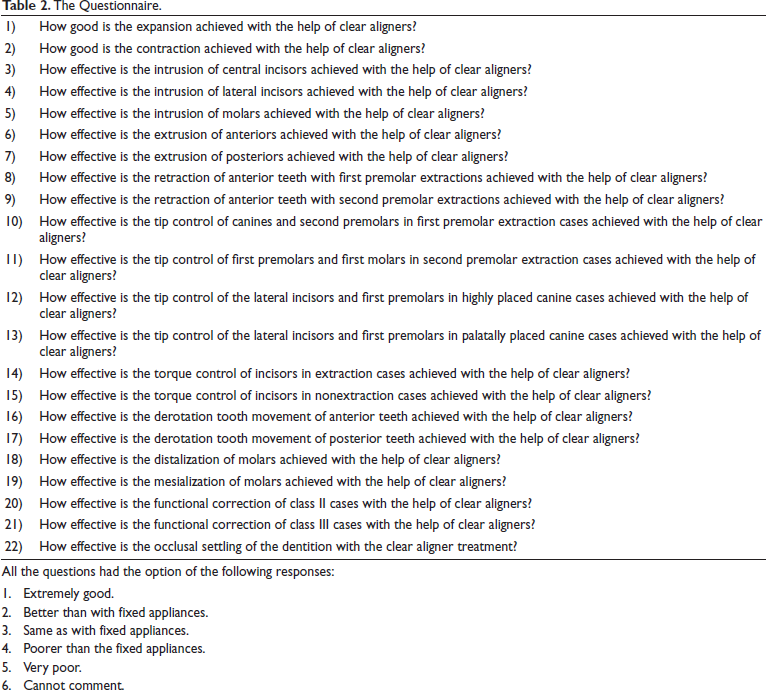
The questionnaire used for the study consisted of 22 multiple choice questions (Table 2). The questions were closed-ended and were designed to have singular responses and all questions were to be answered. The questionnaire which was in English language was subjected to validity and reliability by a team of four experts (Table 3). The percentage of agreement ranged from 75% to 100% between the experts. The questionnaire was then tested on 10 participants and the kappa values were good (κ = 0.88). These 10 participants were excluded from the main study. The Lawshe’s Content Validity Ratio Index was calculated and it ranged from 0.5 to 1.0 (Table 4). Then the questionnaire was finalized with Cronbach’s alpha of 0.897 and intraclass correlation of 0.913.
The Questionnaire.
Reliability to Assess the Percentage Agreement Between the Experts.
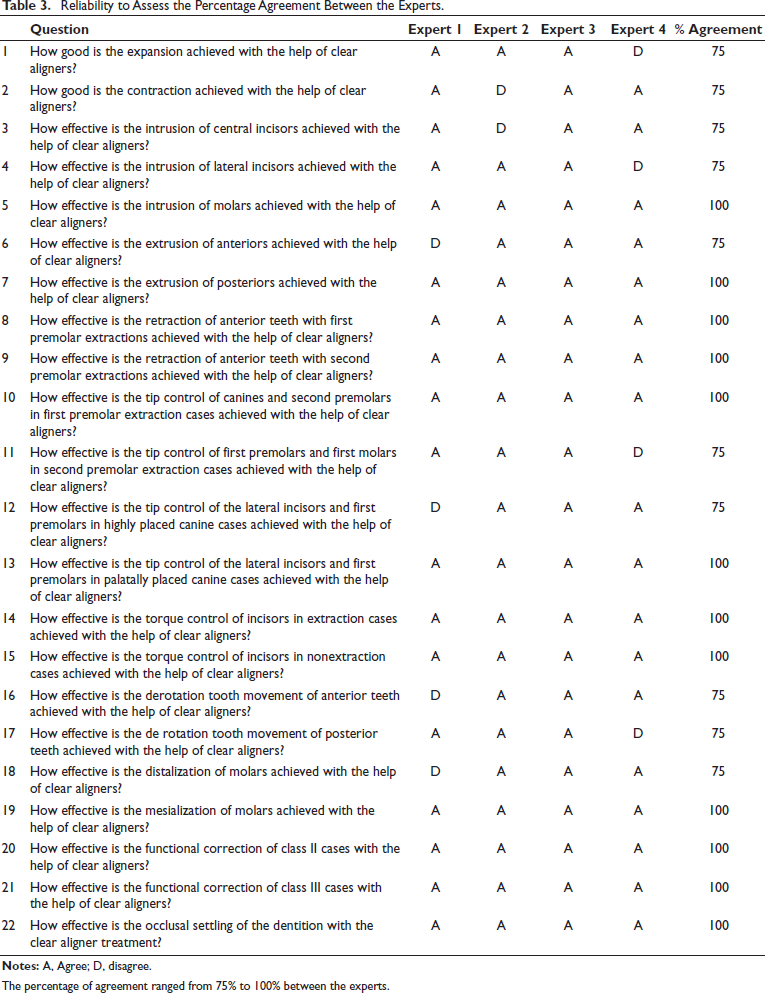
The percentage of agreement ranged from 75% to 100% between the experts.
Lawshe’s Content Validity Ratio Index.
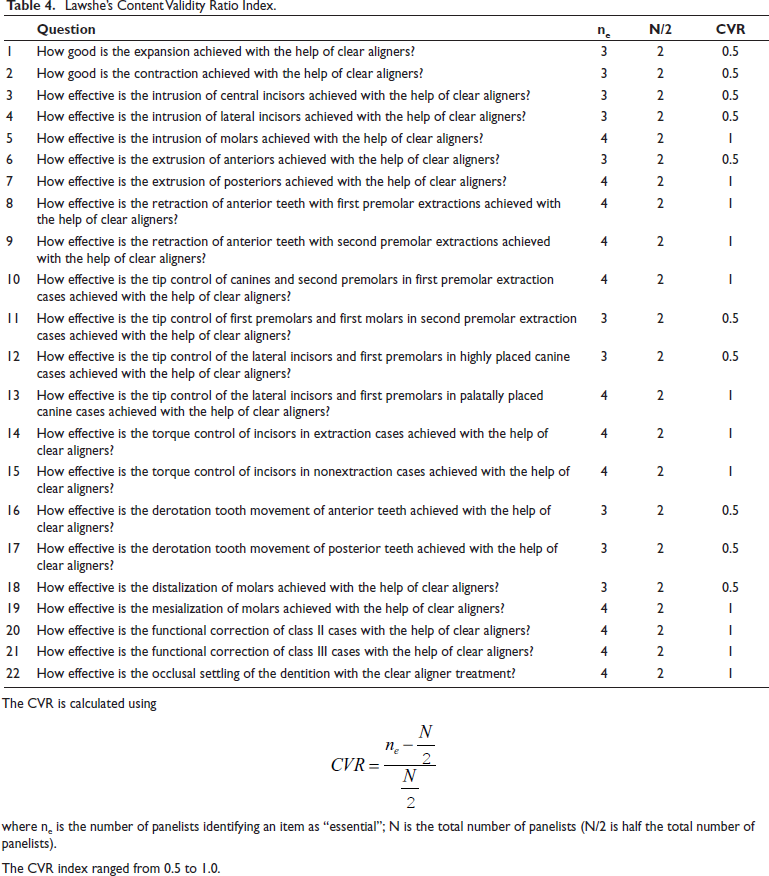
The CVR is calculated using
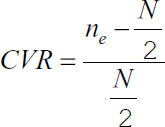
where ne is the number of panelists identifying an item as “essential”; N is the total number of panelists (N/2 is half the total number of panelists).
The CVR index ranged from 0.5 to 1.0.
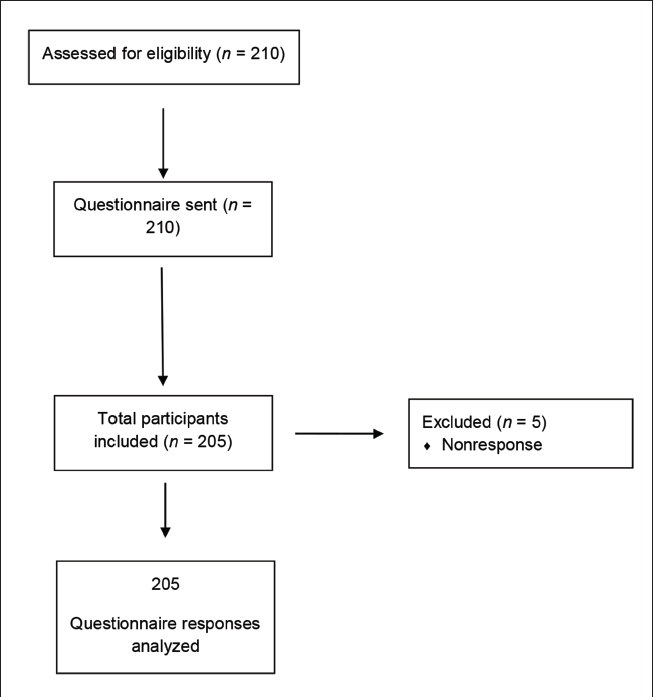
A Google Forms of the questionnaire was created to analyze and assess the orthodontists’ perception of various tooth movements carried out with clear aligners. The questionnaire in the Google link along with a brief synopsis explaining the aims and objectives of the study was sent to participants by means of various messaging platforms. Informed consent was taken from all the participants before solving the questionnaire and timely reminders were sent accordingly. Participation was completely voluntary and all the participants had the option of opting out of the study by not filling out the questionnaire. The questionnaire was sent to 210 consenting and eligible participants. Out of these, five participants were excluded as they failed to provide responses to the questionnaire. Hence, 205 questionnaire responses were analyzed (Figure 1).
The Study Flow Chart.
Statistical Analysis
Statistical analysis was performed using Statistical Package for the Social Sciences (SPSS) (v.21). Descriptive statistics were performed for demographic details along with responses to 22 items of the tool. The responses for the items were rated from extremely good to extremely poor and an option of cannot comment was also provided. Chi-square test was used and data tested for association and p values were interpreted for the significance of the responses. The results were interpreted and depicted appropriately in tables with 95% confidence interval and p < .05, considered to be significant.
Results
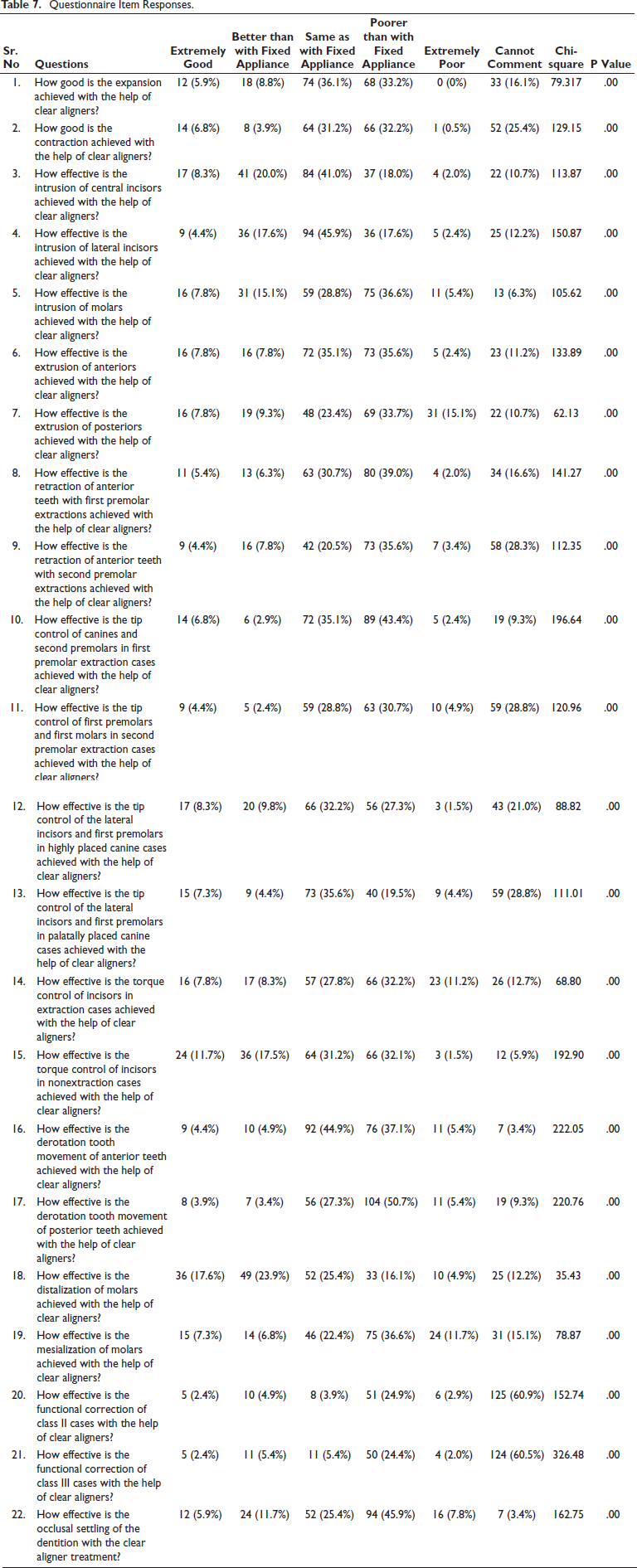
The mean age of the participants was 38.6 years with 59.5% males and 40.5% females (Table 5). Out of 205 study participants, 41%, 29.8%, 24.9%, and 4.4% were practicing orthodontists for more than 10 years, 6–10 years, 2–5 years, and 0–1 years, respectively (Table 6). The majority of the participants (36.1%) believed that the expansion achieved with clear aligners was same as with fixed appliances. When asked if contraction achieved with the help of clear aligners was similar to fixed orthodontic treatment, 32.2% felt it was poorer and 41.0% and 45.9% of the participants respectively thought that the intrusion of central and lateral incisors achieved with the help of clear aligners were similar to fixed orthodontic treatment. However, it was poorer for molars with 36.6% participants believing so. The extrusion of anteriors and posteriors was also believed to be poorer by majority of orthodontists, 35.6% and 33.7% respectively. Also, 39.0% and 35.6% of the participants opined that the retraction of anterior teeth with first and second premolar extractions respectively achieved with the help of clear aligners was poorer than fixed appliance treatment. A total of 43.4% and 30.7% of the participants experienced that the tip control of canines and second premolars in first premolar extraction cases and tip control of first premolars and first molars in second premolar extraction cases respectively achieved with the help of clear aligners was poorer than fixed orthodontic treatment. Derotation tooth movement of posterior teeth was poorer as felt by 50.7% of the participants. Similarly, occlusal settling of the dentition achieved with the help of clear aligners was also voted as being poorer than the fixed appliance, therapy as opined by 45.9% of orthodontists. Mesialization of molars (36.6%), torque control of incisors in extraction and nonextraction cases (32.2% and 32.1%, respectively), is perceived to be worse than fixed appliance therapy.
Distribution of Study Participants According to Gender.

Distribution of Participants According to Years of Practice.

Alternatively, tip controls in lateral incisors and first premolars in highly placed canine cases (32.2%) and palatally placed canines (35.6%), rotation of anterior teeth (44.9%), distalization of molars (25.4%), were at least voted as being similar to fixed appliances.
On asking about the effectiveness of class II correction with mandibular advancement and class III cases with the help of clear aligners, the majority of participants, more than 60%, polled that they could not comment (Table 7).
Questionnaire Item Responses.
Discussion
The present cross-sectional survey illustrates the perception of orthodontists regarding the efficacy of clear aligner therapy over fixed orthodontic appliances. The study was done on 250 participants out of which 40 participants did not use aligners and 5 were nonpracticing dentists. Hence, the final statistical analysis was performed on 205 participants.
The inclusive results of the study indicate that most tooth movements carried out by clear aligner treatment are either the same or poorer, but not superior to the fixed appliance therapy. This verdict is in agreement with a few systematic reviews1, 3 that reported the efficiency of clear aligners as “low to moderate” in comparison to fixed appliance therapy. It has also epitomized fairly good outcomes in treating buccolingual inclination of the anterior teeth while treating moderate-to-mild malocclusion cases. This decree is similar to this study which stated that torque control of incisors with clear aligners is rated better in nonextraction cases as compared to extraction cases though both were poorer to fixed appliances.
In the existing study, vertical movements such as intrusion of central incisors and laterals, using clear aligners, were similar as equated to fixed appliance therapy. In contrast, extrusion of anterior teeth and molar intrusion and extrusion were voted worse than fixed appliance therapy. This outcome is to some extent analogous to results from a systematic review 4 that specifies that clear aligners are not as good as fixed appliance therapy in treating vertical or anterior/posterior discrepancies.
Some studies5, 6 have elucidated that the use of clear aligner therapy has an abundance of important features like being more comfortable, aesthetic, reduced tissue irritation, and good for periodontal health but on the downside, it cannot be used as an individual mode of treatment for complex tooth movements like interarch deviations, anchorage issues, extrusions, rotations, controlling mesiodistal root tip, and so on.7, 10–13 However, the quick and easy image of clear aligners as a better treatment option in contrast to the distressing bracket and wire treatment has recently been receiving mixed reviews as it has now emerged that it has compliance issues and depends upon the patient using it consistently. 14 Moreover, it has a predicted accuracy rate of only 41% to the actual tooth movement.15, 16
This outcome resonates with our results which found that in the opinion of practicing orthodontists, clear aligner therapy is not better than fixed appliances as an isolated treatment option in many aspects.
A study done in Dianiskova 17 has established that clear aligner therapy in permutation with fixed appliances has better outcomes in treating mild class II malocclusion cases. Likewise, our study shows perception of poor results with clear aligners as a standalone treatment option when compared to fixed appliances in the correction of class III and class II malocclusions. Though a lot of orthodontists believed that the aligners were poorer, maximum could not comment. One of the reasons could be their lack of experience in treating skeletal class II or class III with aligners.
Nevertheless, our study has displayed a perception of comparable outcomes with clear aligners for treating nonextraction and simple malocclusion cases. Albeit the results of our survey agree with other studies done around the globe, the outcomes have to be extrapolated with caution as better study designs like systematic reviews and longitudinal study designs will help to validate these conclusions.
Limitations of the Study
This study only obtained an opinion of a small number of orthodontists in India and may not be applicable worldwide. Also, the perception and experience is directly related to the orthodontists’ skill which cannot be overlooked. Post orthodontic relapse was not looked into and it being an important marker for successful orthodontic treatment, should also be analyzed in future research.
Conclusion
This questionnaire-based survey helped in analyzing the orthodontists’ perception on the use of clear aligners in their routine clinical practice in India. It most importantly helped in assessing the various kinds of tooth movements achievable with clear aligners. It also helped in getting an opinion on the movements presently not possible with aligners alone. By highlighting this major drawback, it will surely encourage and pave way for the researchers to devise methods for making this appliance better in terms of achieving desirable tooth movements.
Footnotes
Acknowledgments
We thank all the participant orthodontists practicing all over India, for their contribution toward this survey, by helping us with their valuable inputs and insights while filling up and submitting the questionnaire.
Declaration of Conflicting Interests
The authors declared no potential conflicts of interest with respect to the research, authorship and/or publication of this article.
Ethical Approval
A cross-sectional study was conducted by sending out a questionnaire on a virtual platform. The study was approved by the Ethical Committee of Sinhgad Dental College and Hospital, Pune (Ref no: SDCH/IEC/OUT 2021/13).
Funding
The authors received no financial support for the research, authorship and/or publication of this article.
Informed Consent
Practicing orthodontists from various parts of India gave their informed consent for participating in the survey.
