




Abstract
Documentation of patient records helps to evaluate, plan, and monitor the treatment progress. It should be recorded timely and legibly. Recently, TADs are being used commonly in our orthodontic practice, but the precise description of the site requires lengthy cumbersome statements. Here, we describe an easy method to describe the TAD site, thus improving the efficiency of documentation.
Introduction
Documentation is a critical component to the delivery of quality healthcare. It allows caregivers to analyze the patient’s condition and provides a method of communication with other team members. It also helps in legal and ethical obligations.1, 2 Busy practice schedules may make the clinician skip documentation to save time. However, an easy method may improve the efficiency in documentation.
The use of TADs is becoming popular and has become a major armamentarium in orthodontic practice.3–6 But there is no established method to document the position of TAD site with ease.
Concept
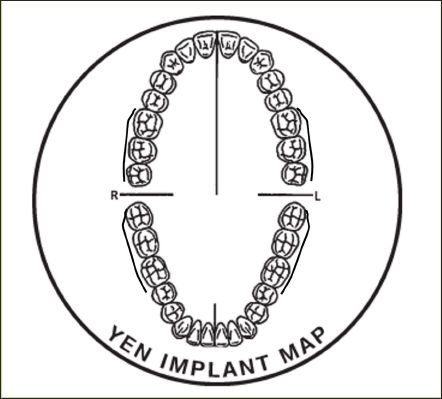
We have developed a pictogram to denote the site of an orthodontic implant site (Figure 1). The pictogram can be integrated with the software or imprinted in a rubber stamp and be sealed in the case file. The pictogram includes upper and lower arch with marking of ridges. The site of the implant can be marked in the pictogram. The microimplants placed in the inter radicular region can be marked above the ridge line and bone screws such as buccal shelf and IZC can be marked outside the ridge line. For example, when “Two IZC bone screws are placed on the upper right and left infra zygomatic region along the first molars with micro implants placed between the two upper lateral incisors and canines” rather than writing such a long statement, it is easy to mark the position in the required fields of the implant map (Figures 2 and 3).
Novel Pictorial Representation to Denote Orthodontic Implant Sites.
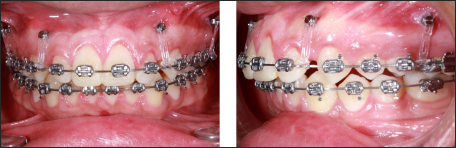
Pictorial Representation of the Above Mentioned Example (Figure 2).
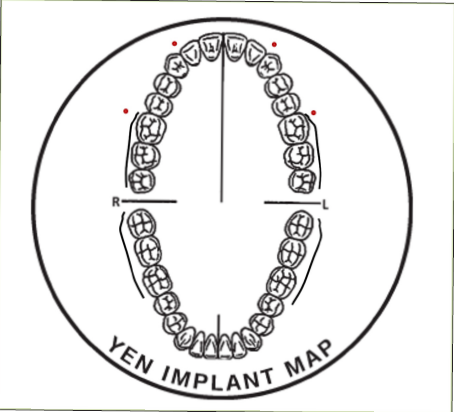
The pictogram is named “Yen implant map” incorporating the name of our university. One of the disadvantages of the concept is that the map only denotes the area of placement, but not the precise height or position.
Conclusion
As the idiom says “A picture is worth a thousand words,” we developed an implant site pictogram to explain the micro implant site thus reducing the words and time. We found this improvised documentation technique to be easy and helpful. The link QR code to portable document format (pdf) of the pictogram is
Footnotes
Declaration of Conflicting Interests
The authors declared no potential conflicts of interest with respect to the research, authorship and/or publication of this article.
Statement of Informed Consent and Ethical Approval
Not applicable.
Funding
The authors received no financial support for the research, authorship and/or publication of this article.