



Abstract
Abstract
Advances in the field of mini-implants lead to their availability in various head forms, materials, and in different sizes, which widened their scope in orthodontics. With the increased usage of mini-implants, a common nomenclature coding system providing the details of mini-implants for better communication and data storage is essential. Hence, in this article, an easy and clear-cut nomenclature coding system “T A D S” has been described.
Introduction
The introduction of mini-implants aids in achieving absolute anchorage because of the implants’ wide range of sizes, compliance, ease of insertion and removal, and an excellent biomechanical advantage in different clinical scenarios. 1 A proper standardized coding system is required for their communication and data storage regarding their site, size, position, and sort of mini-implant head. Hence, a coding system, T A D S, has been contributed, which assists in communicating unambiguous data and in better comprehension about mini-implants.
Procedure for Coding
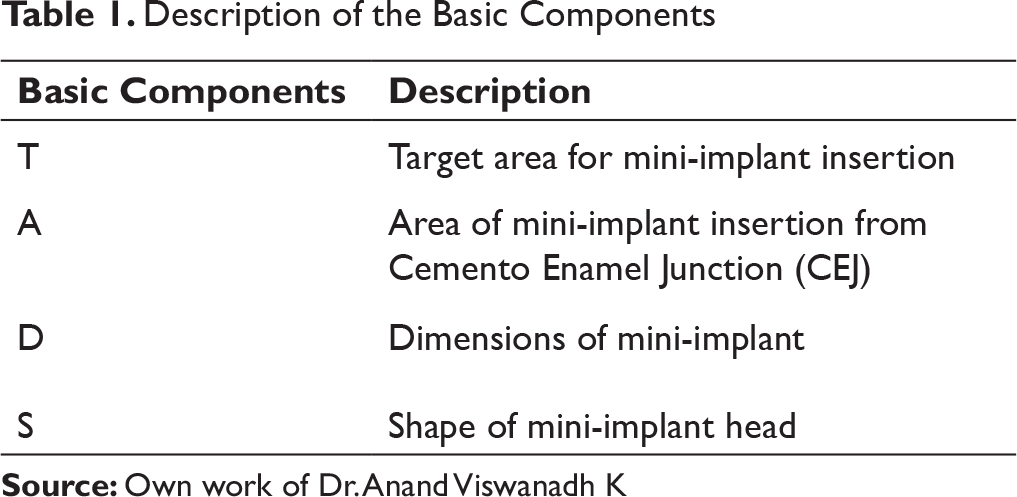
Description of the Basic Components
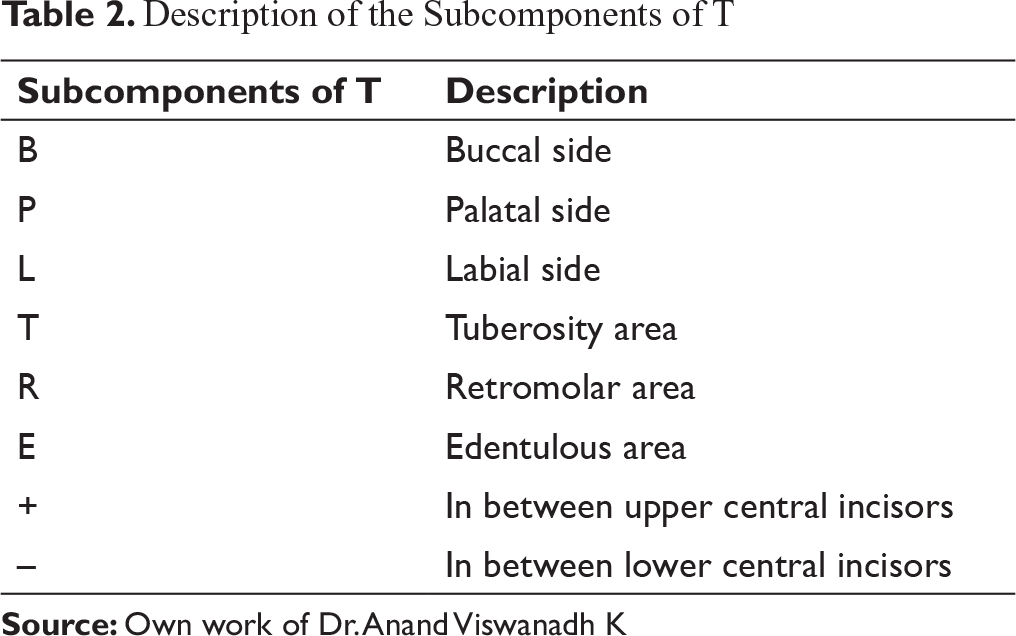
Description of the Subcomponents of T
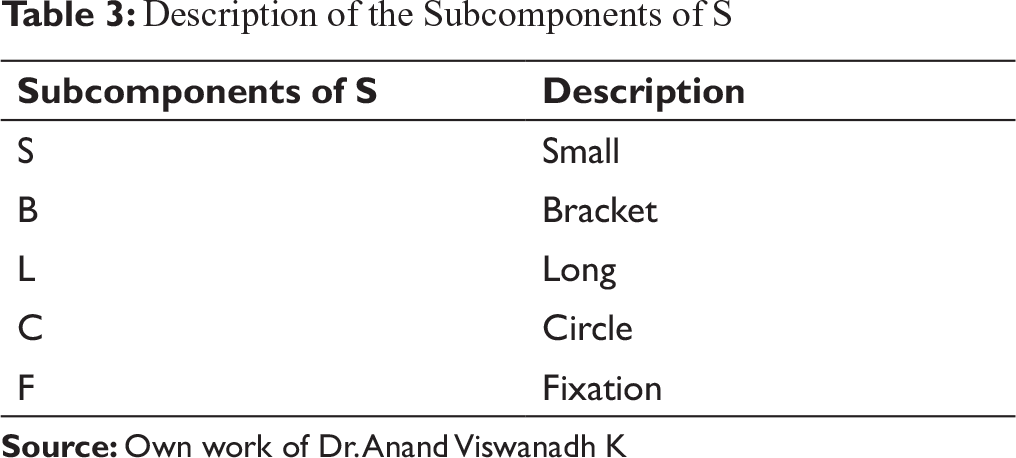
Description of the Subcomponents of S
This component tells us about the area of mini-implant insertion from the cemento enamel junction (CEJ). The distance is measured in millimeter (mm) and denoted in numbers as a superscript.
This component tells us about the dimensions of the screw, i.e., the length and diameter of the screw. Both these dimensions are denoted in numbers as a superscript to component “D” and measured in mm.
This component tells us about the shape of the head, and its subcomponent denoted in lowercase letters as a superscript (Table 3).
Description of the Code
A mini-implant is placed buccally between 15 and 16 at a distance of 6 mm from CEJ, with screw dimensions of 7 mm length and 1.5 mm diameter, with a fixation head.
Discussion
Over the last decade, there are several advances in the design and material aspects of mini-implants. The usage of mini-implants and their descriptions are commonly explained in a much-elaborated form. Communication and data transfer with other orthodontists and researchers is becoming difficult due to the lack of a standard nomenclature system. Clinical photographs and radiographs will only provide the location of mini-implants and are unable to provide any information regarding the dimensions of the mini-implants used and their distance from the CEJ. So, a simple and instantly recognizable nomenclature coding system is required. This problem is effortlessly resolved with nomenclature coding system TADS for mini-implant usage. With this nomenclature coding system, data regarding mini-implants are elaborated concisely as superscripts over these four main components.
Conclusion
The present nomenclature coding system for mini-implants is in a comfortable and clear-cut way to understand, for better communication, appropriate data storage, and in retrospective studies.
Footnotes
Declaration of Conflicting Interests
The authors declared no potential conflicts of interest with respect to the research, authorship, and/or publication of this article.
Funding
The authors received no financial support for the research, authorship, and/or publication of this article.
