




Abstract
Retrognathic mandible is the most common feature in growing children with skeletal Class II malocclusion. This does not self-correct with growth. Functional appliances are known to exert beneficial effects to improve this skeletal pattern. Among several removable functional appliances, Twin Block is the most preferred. Twin Blocks are designed for full-time wear such that maximum benefit from functional forces can be obtained. The maxillary and mandibular bite blocks occlude at a 70° angle on complete closure. It is important to angulate the inclines at exactly 70°, as an increase in this angulation will require a conscious effort from the patient. Incline Correct is designed to accurately measure and construct inclines at 70° to the occlusal plane.
Keywords
Introduction
The cuspal inclined planes of natural dentition have a significant role in determining occlusal relationship of the teeth as they erupt. A constant proprioceptive stimulus is provided by the occlusal forces that are transmitted through the dentition. This stimulus has an influence on the growth of the supporting bone. 1 Construction bite for the Twin Block appliance is made to a protrusive bite which modifies the existing cuspal inclined planes. This is done by means of acrylic blocks with inclined planes. They induce favorably directed occlusal forces by promoting forward mandibular position for skeletal Class II correction. 2 The accurate angulation of inclined planes is vital in correcting the sagittal skeletal relationship. Maxillary and mandibular bite blocks must approximate at an angle of 70° for greater horizontal component of force. 2 Hence, maintaining a 70° angulation is important during the fabrication of the Twin Block appliance.
There are various methods to ensure 70° angulation of inclined planes. The Roger Harman tool and preformed bite blocks are among the methods used for obtaining accurate inclined plane angulation. 2 However, the preformed bite blocks must be purchased for every patient. Both the abovementioned methods require additional inventory and are not economical. Hence, we introduce a new tool that can be constructed by clinicians themselves.
Incline Correct is a novel clinical innovation that ensures the accuracy of inclined plane angulation in Twin Block therapy.
Steps in the Fabrication of Incline Correct
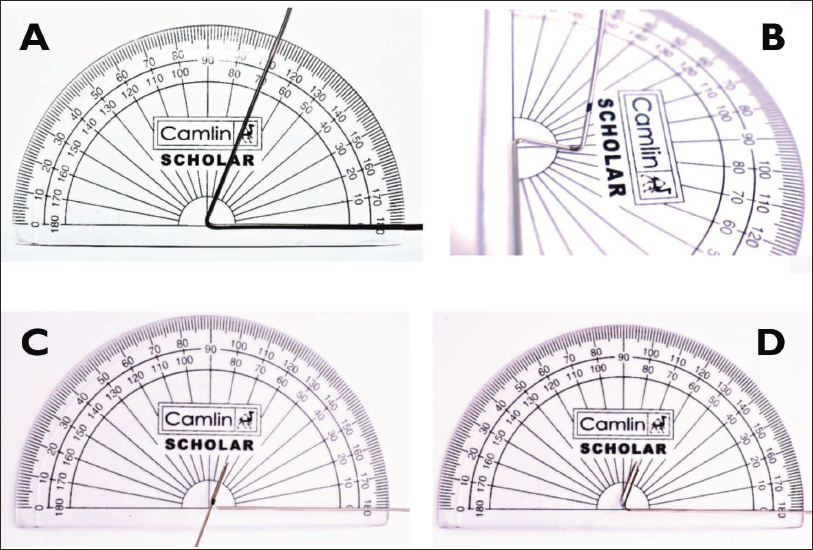
Make a 70° bend on a 0.9 mm stainless steel base wire (Figure 1A).
At about 5 mm from the 70° bend on the vertical arm, make a horizontal bend (Figure 1B).
At about 5 mm on the horizontal arm, make a bend such that both the vertical arms are parallel to each other (Figure 1C).
This gives us a rectangular framework with 70° angulation to the horizontal base wire (Figure 1D).
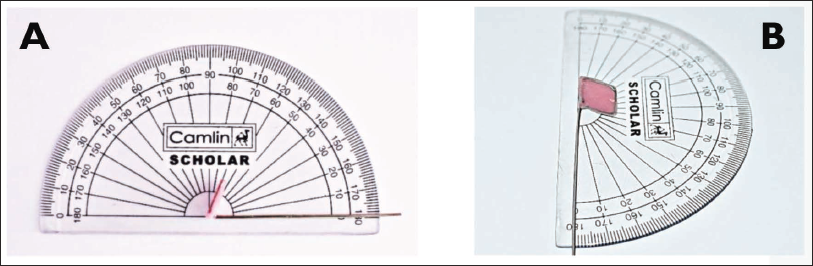
Acrylize the wire framework and recheck the 70° angulation (Figure 2A, 2B).
1A, 1B, 1C, 1D. Fabrication of Incline Correct.
2A, 2B Acrylizing the Wire Framework.
Procedure for the Construction of Inclined Planes
Stabilize the Delta clasp and ball-end clasp on the maxillary cast with a thin layer of self-cure acrylic.
Cut about 1–2 cm long piece from a ballpoint pen refill.
Orient the refill along the maxillary occlusal plane and stabilize it with self-cure acrylic closer to the first molar.
Insert the distal end wire of Incline Correct into the refill fixed along the maxillary occlusal plane.
Apply Vaseline or petroleum jelly on the Incline Correct.
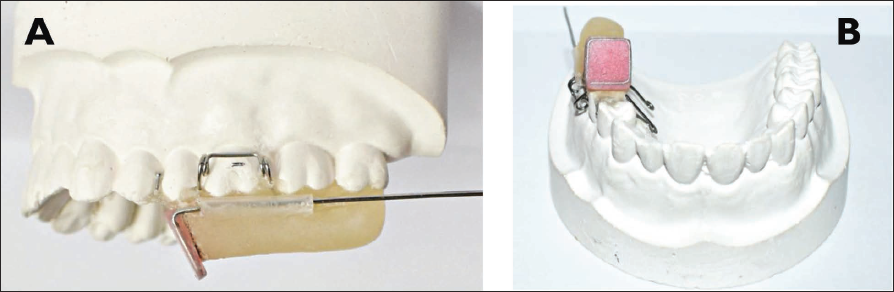
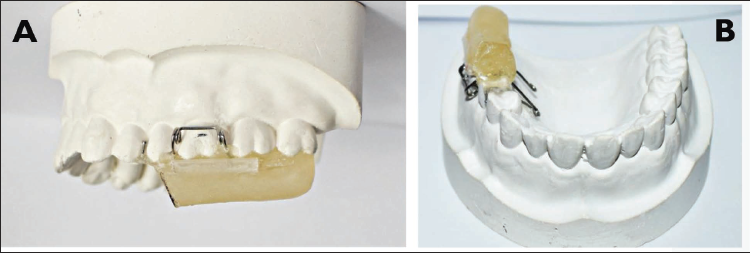
Angulate the inclined planes by pressing the acrylic blocks against the Incline Correct (Figure 3A, 3B, 4A, 4B).
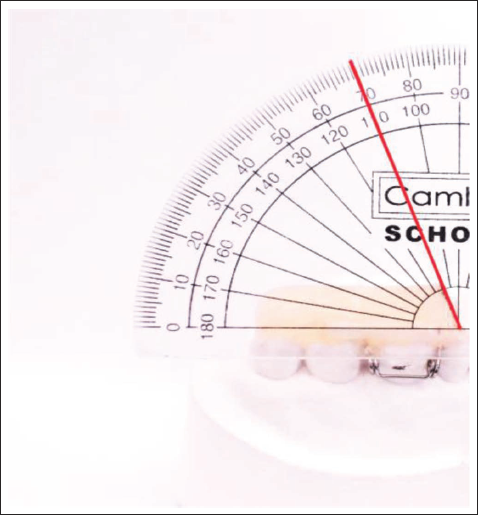
Ensure 70° angulation using a protractor (Figure 5).
Remove the plastic refill after the acrylic sets.
3A, 3B Angulating the Inclined Planes by Pressing the Acrylic Blocks Against the Incline Correct.
4A, 4B Post-acrylization.
Ensuring 70° Angulation Using a Protractor.
Advantages
Simple and efficient technique.
Can accurately angulate the inclined planes of Twin Block at 70°.
The Incline Correct and plastic refill can be reused.
Short duration of fabrication.
Conclusion
Incline Correct would serve as a useful tool to ensure the accuracy of inclined plane angulation.
Footnotes
Declaration of Conflicting Interests
The authors declared no potential conflicts of interest with respect to the research, authorship and/or publication of this article.
Funding
The authors received no financial support for the research, authorship and/or publication of this article.
Statement of Informed Consent and Ethical Approval
Not available
