




Abstract
The adult patients requiring orthodontic treatment usually need adjunctive dental care for complete rehabilitation. There are so many orthodontic appliances that are used as retainer after comprehensive treatment to retain the orthodontic tooth movement achieved. The purpose of this clinical pearl is to showcase a modified acrylic retainer to prevent the supra-eruption of terminal molar whose antagonist tooth was to be replaced using dental implant after the completion of orthodontic treatment.
Background
In adult patients, fixed orthodontic treatment is often followed by the replacement of missing teeth with either implant-supported or conventional prosthesis. The appliances need to be retained to prevent extrusion of the tooth in the opposite arch, which causes difficulty in prosthodontic replacement. 1 Adult patients sometimes desire the removal of orthodontic appliances due to aesthetic concerns. The modified removable retainer was designed to hold the maxillary molar in position until the opposite mandibular molar was replaced.
Fabrication
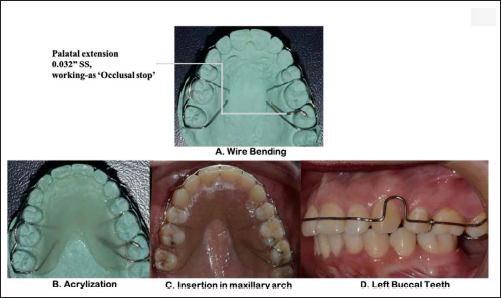
The Begg’s retainer 2 was modified using a wire extension of 0.032-inch stainless steel from the palatal aspect of the mesial side of maxillary left second molar. The occlusal stop was made from a silver solder on the terminal end of 0.032-inch stainless steel archwire and adapted to the occlusal surface of the terminal maxillary molar to prevent the supra-eruption. Figure 1(a–d) shows the step-by-step procedure of wire bending in the study cast, acrylization and adaptation in the patient’s maxillary arch.
This appliance is easy to design, fabricate and inexpensive. The appliance has the advantage of holding the molar effectively without any loss of vertical control of the intruded molars. Therefore, it is of significant clinical importance in contemporary orthodontic practice and should be indicated when the antagonist tooth required significantly more time to be replaced in the oral cavity.
Step-by-step Procedure for the Fabrication. (a) Wire bending. (b) Acrylization. (c) Insertion in maxillary arch. (d) Left buccal teeth.
Footnotes
Declaration of Conflicting Interests
The authors declared no potential conflicts of interest with respect to the research, authorship and/or publication of this article.
Funding
The authors received no financial support for the research, authorship and/or publication of this article.
Statement of Informed Consent and Ethical Approval
Not available.
