



Abstract
Traditionally occlusal cant angle is measured using a posteroanterior cephalogram. They can also be measured using photographic and 3-dimensional imaging methods. This clinical tip describes an easy method to measure occlusal cant clinically.
Introduction
Occlusal plane canting affects smile esthetics which could be skeletal or dental in origin and may present with or without facial asymmetry. Occlusal cants in the range of 0° to 3° are usually found in normal, healthy patients. Cants greater than 4° are detected clinically with a frequency greater than 90% by both professionals and laypersons. It is more prevalent in a patient with class-3 malocclusions.1, 2
The level of the occlusal plane is a prerequisite for the success of all orthognathic surgeries, and failure to level the canting of occlusal plane during surgery may have detrimental effects on masticatory functions. Recording of the occlusal cant at the initial stages is very important as the development of occlusal cant at a later stage in treatment usually points to faulty treatment biomechanics. It is often overlooked due to the soft tissue compensation in most of the patients. 3
The occlusal cant can be evaluated by clinical assessment, frontal photographs, posteroanterior cephalogram, and 3-dimensional imaging methods. 1 There are various chairside methods described in the past in which authors either used metal scales 4 or fox guide plane mounted with spirit level 3 to quantify transverse occlusal cant. However, these devices could not measure the degree of the occlusal canting present.
Natural head position (NHP) is a most reproducible relaxed head position in an upright posture, and the eyes are focused on a distant point at eye level, which suggests that the visual axis is horizontal. 5 There are many clinical methods described in the literature to determine NHP for the patient clinically. The commonly used method is to ask the patient to look at a distant point at eye level or to look into his or her own eyes in a mirror. 6
This clinical tip describes an easy method to measure occlusal cant clinically using a metal scale and a smartphone with a patient held in NHP.
Material and Method
To measure occlusal cant clinically, a 30-centimeter metal scale and a smart mobile phone are required.
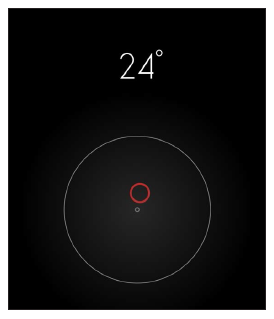
There are pre-installed inbuilt digital levels in iPhones (Apple, Cupertino, Ca) and android phones (Figure 1). It can be found in the compass toolkit. These digital levels function using an inbuilt gyroscope sensor in mobile phones.
To measure occlusal cant, first orient the patient’s head in NHP. To obtain NHP, any of the 2 techniques described above can be used. Both the technique are equally reliable and reproducible. 7
An assembly is made by holding the metal scale and mobile phone together with the flat surface of the phone adapted to the surface of the metal scale at its one end.
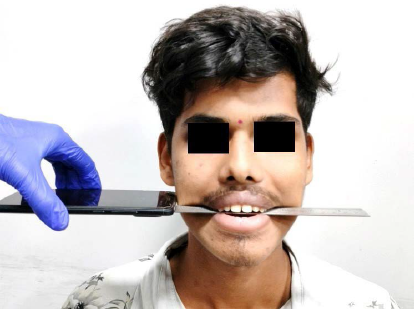
To measure occlusal cant, first, the patient’s head is oriented in NHP. Then the patient is asked to keep the metal scale inter-occlusally as posterior as possible and bite on it. The flat posterior surface of the mobile phone is adapted to the one end of the metal scale, and the horizontal transverse angulation is recorded on the mobile phone screen (Figure 2).
Care should be taken that the operator should not apply any external force by lifting or pressing on the scale and should hold the phone passive on the surface of the scale such that the surfaces of the phone and scale just touch each other.
Since some mobile phones could be heavier to bear the load on the metal scale, it would be advised to not load the phone weight on the scale end and hold it such that it passively touches it. The use of a thick and rigid metal scale or a plastic ruler and mobile phone lighter in weight without a phone case/cover on it is always preferable.
As the digital level is very sensitive, to overcome the device error and also to eliminate the methodological error, a mean of 3 subsequent readings should be calculated and considered as a degree of the occlusal cant present.
A Screenshot of Digital Level in an Android Phone Showing Angulation of the Mobile Phone.
The Method to Measure Occlusal Cant Angle Clinically.
Limitations
Metal scale can be autoclaved; however, it can flex with time and can cause an error in the measurement. A plastic ruler can be used of the same length to prevent the same.
The straightness of the scale needs to be checked on a flat surface before using it on a patient.
Conclusion
This novel clinical method can be used as an adjunct to other methods used to measure the degree of occlusal cant.
Footnotes
Declaration of Conflicting Interests
The authors declared no potential conflicts of interest with respect to the research, authorship, and/or publication of this article.
Funding
The authors received no financial support for the research, authorship, and/or publication of this article.
Statement of Informed Consent and Ethical Approval
Necessary ethical clearances and informed consent was received and obtained respectively before initiating the study from all participants.
