




Abstract
In Orthodontics, initial classification of malocclusions was based on planar malocclusions in the anteroposterior, transverse and vertical planes that were based only on translation of the jaws in space. In 2007, Ackermann and Proffit introduced rotational components—roll, pitch, and yaw—analogous to the position of the airplane in space. These rotations can result in canting of the occlusal plane.
There are no quantitative methods available in the literature for a precise estimation of the occlusal cant.
Qualitative evaluation of occlusal cant is subjective and is associated with inter-individual variations. This article describes an indigenously devised simple chairside device that can quantify cant of the occlusal plane in terms of the roll and pitch in degrees. There is accurate quantification of cant, which can be used effectively in many clinical scenarios.
Background
In Orthodontics, the classification of malocclusion given by Angle was based only on imbalances caused by displacement of teeth in the sagittal plane. 1 In 1969, Ackermann and Proffit proposed that Angle’s classification could be systematically strengthened by evaluating the dental and skeletal relationships in all three planes of space, not just in the anteroposterior or sagittal dimension. 2 In 2007, the classification was further enhanced by including three aeronautical rotational descriptors (ie, pitch, roll, and yaw), which supplemented the planar terms (ie, anteroposterior, transverse, and vertical) in describing the orientation of jaw rotation with the aesthetic line of the dentition. 3
Subjects with an abnormal orientation of jaw bases frequently have an angulated occlusal plane, which is referred to as canting of the occlusal plane. Rotation of the aesthetic line of dentition around the horizontal axis, up, or down on the right or left side can be described as roll. Downward or upward rotation of the jaws, which is reflected in the dentition along the aesthetic line, is termed pitch. Transverse canting of the smile line is evaluated as part of mini-aesthetics in orthodontic diagnosis and treatment planning and is termed “yaw.”
The qualitative evaluation of occlusal cant is subjective and associated with inter-individual variations. 4 This article describes the use of an ingeniously designed device “Cant-O-Meter” for measuring the roll and pitch and a study comparing the same in patients with vertical and horizontal skeletal patterns.
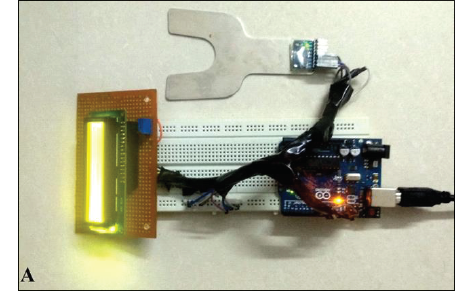
Cant-O-Meter is a simple chairside device (Ref: EP/SJ/BS/patent application: 202041022426/vl/Patent-267), which includes a bite plane that is compatible with the patient’s arch form. The bite fork is affixed with a gyroscopic sensor, and the sensor is connected to an Arduino board and alphanumeric display unit, which shows the value of roll and pitch in degrees once the patient bites on the bite plane (Figure 1). This study was conducted with the aim of quantitative evaluation and comparison of roll and pitch among patients with vertical and horizontal skeletal patterns using the Cant-O-meter device.
Cant-O-Meter Device.
Materials and Methods
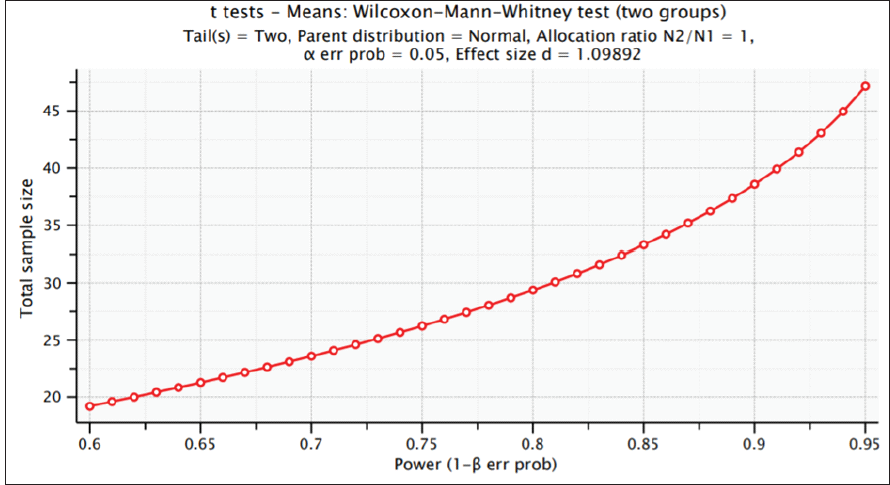
This study was performed at the Department of Orthodontics, SRM Dental College, Ramapuram, Chennai. Sample size determination was performed using the G power software version 3.1 for 90% power and 0.05 alpha error, arriving at 20 per group (Figure 2). A total of 20 subjects, each with horizontal and vertical skeletal patterns, were considered for measuring roll and pitch using Cant-O-meter.
Sample Size Determination.
The categorization of groups was based on vertical and horizontal skeletal patterns. Subjects with FMA > 25° were considered under vertical skeletal pattern, and those with FMA < 25° were considered under horizontal skeletal pattern.
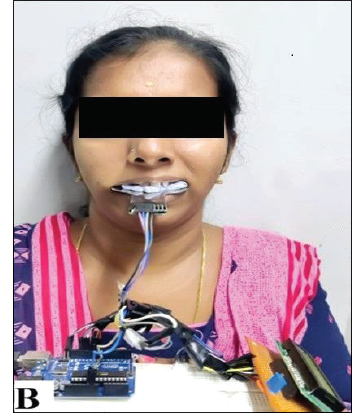
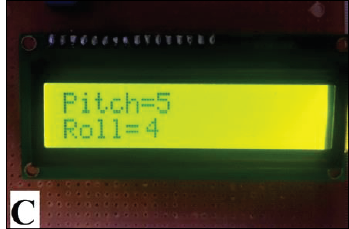
Before measuring the roll and pitch of the occlusal plane, the subjects were asked to be in a relaxed state with their eyes focused on a distant object, and a fox plane was used to standardize the head position. The stainless-steel bite fork was cold sterilized by using a 95% alcohol solution after cleaning. Polyvinyl siloxane impression material (putty) was placed on the bite plane of the device to record the bite. The gyroscopic sensor with liquid-crystal display (LCD) was fixed on the handle of the bite plane. The values of roll and pitch were read from an LCD, which was a part of the unit (Figures 3 and 4). These values were evaluated and compared between the subjects with vertical and horizontal skeletal patterns.
Standardization of Head Posture with a Fox Plane Before Measuring the Degree of Occlusal Cant with the Cant-O-Meter.
LCD Display Showing the Degree of Roll and Pitch.
Results
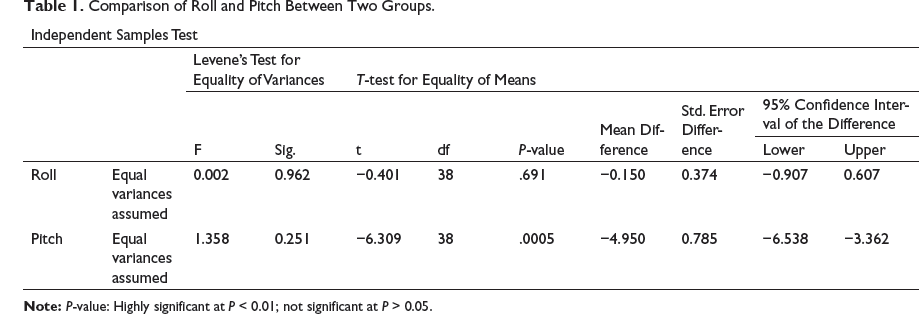
Comparison of Roll and Pitch Between Two Groups.
Discussion
This study was performed to evaluate and compare the roll and pitch of the occlusal plane in subjects with vertical and horizontal skeletal patterns. The pitch of the occlusal plane was determined to be higher in people with the vertical skeletal pattern. This result was statistically significant with the P-value of .005.
Orthodontic treatment planning is greatly affected by the analysis of mandibular growth rotation and also the orientation of dentition with the occlusal plane and respective jaw bases. 5 Thus, comparison of rotational parameters between different growth patterns will significantly affect orthodontic treatment planning. Researchers, like Ricketts and Thompson, have compared children with vertical and horizontal growth trends and identified variations in the morphology of the lower jaw, facial height ratios, and muscle attachment areas between different growth trends. 6 Karka et al performed a cephalometric study to evaluate the relationship between dental parameters (eg, overbite, overjet, anterior and posterior freeway space, and occlusal plane angle) and the curve of Spee with certain anatomic structures (eg, soft palate tongue and hyoid bone in mandibular centric and rest positions) in subjects with vertical and horizontal growth trends; the abovementioned researchers determined that the occlusal plane angle was larger in people with the vertical growth trend. 7
Shilpa et al compared and correlated antegonial notch depth, symphysis morphology, and ramus morphology among different growth patterns in Angle’s class II division 1 cases and concluded that these parameters showed a highly significant correlation in horizontal growth pattern. 8 Comparison of dental, anatomical, and mandibular parameters among different growth patterns helps with accurate treatment planning and allows proper anchorage preparation.
Despite the abovementioned evidence, the comparison of precise degree of roll and pitch of the occlusal plane among the subjects with vertical and horizontal skeletal patterns has not yet been performed. This may be attributed to the lack of availability of a simple chairside device that could quantify these parameters in degrees.
Measurement of degree of pitch and roll using “Cant-O-Meter” helped to evaluate and compare the degree of roll and pitch among the people with vertical and horizontal skeletal patterns. It was determined that the value of pitch was statistically significantly higher in subjects with the vertical skeletal pattern. The developed device can be used chairside in dental clinics to sequentially measure the correction of cant by orthodontic treatment and also during orthognathic surgeries performed to correct the occlusal cant.
Conclusion
In this study, pitch was determined to be significantly higher in patients with the vertical skeletal pattern. The correlation between increased pitch in the occlusal plane and vertical skeletal pattern must be considered during treatment planning.
Footnotes
Declaration of Conflicting Interests
The authors declared no potential conflicts of interest with respect to the research, authorship, and/or publication of this article.
Funding
The author(s) disclosed receipt of the following financial support for the research, authorship, and/or publication of this article: The device was patented with the help of funds received from SRM Institute of Science and Technology for funding the patency of the device Cant-O-meter.
Statement of Informed Consent
Written informed consent was obtained from the subject for the use of photographs for publication.