




Abstract
Objective
To evaluate the geometrical effects of double keyhole loop (DKHL) and T-loop and its forces and moments during en mass space closure using finite element method.
Materials and Methods
A 3-dimensional finite element model of maxillary arch was created and stimulated for first premolar extraction case with 0.022 slot Roth prescription bracket. DKHL and T-loop arch wire were created using 19×25 stainless steel and was opened 1 mm for activation using 2 different methods. The study was divided into 2 groups based on the loop design, method of activation, and degree of Gable bend. The stress distribution, tooth displacement, and moment-force ratio were calculated.
Result
The overall stress distribution was more or less uniform in all the groups. However, maximum von Mises stress was observed in the second premolar region for both the groups. There was greater torque and vertical control in the anterior segment and better anchorage control in posterior segment with increase in degree of Gable bend for both the loops activated using ligature tie. Moment-force ratio of 8-10 was achieved for both the loops.
Conclusion
Therefore, DKHL was as efficient as T-loop in producing the desirable biomechanical properties during en mass space closure.
Introduction
Space closure poses a great challenge to an orthodontist and is accomplished using either friction or frictionless/loop mechanics. However, some of the significant drawbacks of friction mechanics are high-force levels needed to produce tooth movement, arch wire binding, high anchorage demands, and therefore unwanted tooth movement. 1 Loop mechanics may be more beneficial in this regard because a known force system is delivered to the teeth and spaces are closed with the help of loops with forces and couples built into it.2–4
T-loop developed by Burstone 3 is one of the most common loops for predictable space closure. The geometry of T-loop incorporates greater length of wire for its construction and therefore yields a significant decrease in load/deflection rate.5, 6
Double keyhole loop (DKHL), introduced by John Parker, is considered to be advantageous for the following reasons 7 : (a) allows the use of one set of arch wire for entire space closure; (b) allows the operator to select how the extraction space will be closed depending on anchorage considerations; (c) control of canine position; and (d) incorporation of 2 loops makes the arch wire more flexible for optimal force delivery.
To satisfy the principles of gnathology, the in-built canine tip in Roth prescription is 13º and Roth suggested that if the force levels are not at an optimum, it could alter the moment-force ratio, causing the canine root to be displaced into the cortical plate thereby taxing the anchorage. Therefore, DKHL with the presence of 2 loops particularly works well with Roth prescription, acting like a stress breaker in the canine region aiding in excellent control of canine position. 7 Although there are several advantages of DKHL, literature is scant with regard to its biomechanical efficiency during space closure.
Several methods have been used to assess the biomechanical response of loops in relation to tooth movement and periodontium. Finite element method (FEM) is a noninvasive technique that aids in understanding of the physiologic reactions subsequent to forces and interaction of individual tissues. Thus, the actual stress experienced can be measured and moment-force ratio can be calculated. 8
Retraction loops are conventionally activated by cinching the arch wire distal to the terminal molars. 5 With stainless steel loops in continuous mechanics, cinching the arch wire makes it difficult to remove and reinsert the wire for subsequent adjustments. Therefore, loops activated using ligature-tie may be more beneficial in this regard. From the biomechanical aspect, the point of force application varies with cinch back and ligature tie and its effect on resultant moments have not been reported. To the best of our knowledge, there has been no study done till date to assess the load systems and biomechanical response of DKHL.
Thus, the present study aimed to evaluate the stress distribution and moment-force ratio of DKHL and compare it with the T-loop with 2 different methods of activation (cinching and ligature tie) at different degrees of Gable bend using FEM.
Materials and Methods
Three Dimensional Modeling of Maxillary Dentition
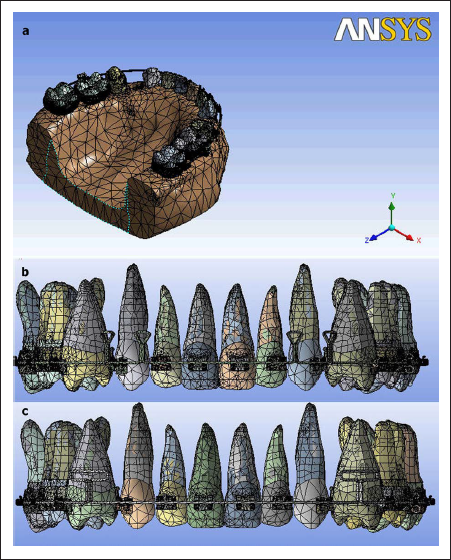
The research was reviewed and approved by Institutional Ethics Committee of Ragas Dental College and Hospital, Uthandi, Chennai, Tamil Nadu, India. A 3-dimensional finite element model of a maxillary arch with tooth and supporting structures (periodontal ligament and alveolar bone) was created and simulated for first premolar extraction case with brackets and arch wires. Computerized tomography (CT) image acquisitions in the digital imaging communications in medicine (DICOM) format of maxillary arch with anterior and posterior teeth and first premolars extracted was obtained from an adult dry skull using 120 kV, 150 mA, 512 × 512 matrix, field of view 14 × 14 cm, and slice thickness of 0.5 mm. These CT images consisted of 165 sections in axial axis and 123 sections in the coronal axis, which was then imported into 3-dimensional (3D) imaging system (Pro-Engineer Wildfire Version 4.0). A geometric model was then generated that could be manually adjusted to get the exact shape and curves in different sketch planes and the model discretized into several small elements connected with nodes. The joining of these elements at the nodes was termed a “mesh.” Once meshing was done, lateral curves were created to ensure lateral connectivity of the geometric model, the surfaces were formed/built using a command called boundaries which was used to study the deformation of the generated model during activation by restricting the degree of freedom (movement of the node in each direction x, y, and z) for some of the nodes (Figure 1). Such constraints were termed boundary conditions.
FEM Mesh Models: (A) Maxilla; (B) DKHL; (C) T-loop.
Construction of Appliance
The following components were constructed using 3D imaging system (Pro-Engineer Wildfire Version 4.0)
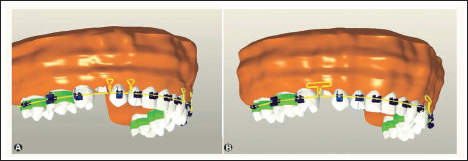
3D model of preadjusted edgewise brackets with 0.022×0.028 inch slot and Roth prescription. All brackets were sited on the facial axis points. DKHL measuring 7 mm in height (loop head 3 mm in height and vertical arm length of 4 mm) and 3 mm wide configured in shape of a keyhole was constructed using 0.019×0.025 inch stainless steel arch wire with 2 loops placed on each side of the arch, 1 being distal of lateral incisor and the other distal of canine. A symmetrical T-loop measuring 7 mm in height (loop head 2 mm in height and vertical arm length of 5 mm) and 10 mm wide was constructed using 19×25 inch stainless steel arch wire. Curve of Spee was incorporated in both the loops.
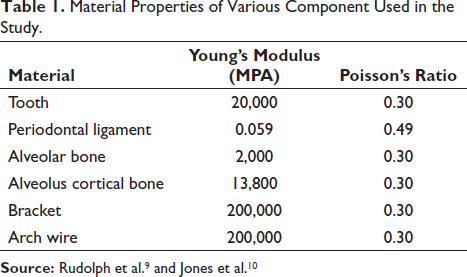
The constructed model of maxillary arch with dentition, brackets, and arch wire (Figure 2) was finally imported to work bench ANSYS software (ANSYS workbench version 11.0) which transferred data with 0% data loss. The relevant material properties (Poisson’s ratio and Young’s modulus) were assigned as per the norms given in the literature9, 10 (Table 1). The models were then converted into elements and nodes. The type of element used in our study was mid-noded Tetrahedron and the total number of elements and nodes established were 1,15,3876 and 1,57,233, respectively. After the model was completed, the boundary conditions were defined at all the peripheral nodes of the alveolar region in all 3 planes of space.
3D Models: (A) Double Keyhole Loop; (B) T-loop.
Material Properties of Various Component Used in the Study.
All these components were individually modeled and then assembled to create 3D finite element models of the maxilla depicting en masse retraction of 6 anterior teeth with DKHL and T-loop. The stress distribution and moment-force ratio were calculated for different methods of activation at different degrees of Gable bend. The Gable bend was given mesial of the second loop in DKHL and mesial of T-loop.
Activation was done by opening the loop 1 mm and bending the arch wire distal to terminal molar (cinching) or by using a ligature tie.
The study was divided into 2 groups based on the loop design, methods of activation, and position and degree of Gable bend. The outline is given in Figure 3.
Flowchart Representation of Designed Groups.
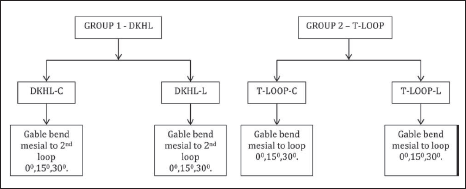
Group 1: DKHL—Cinching (C) and DKHL—Ligature tie (L)
Group 2: T-Loop—Cinching (C) and T-Loop—Ligature tie (L)
Results
The study was conducted to compare the biomechanical efficiency of DKHL and compared with T-loop during en masse space closure. The resultant stress, displacement of the dentition, and moment-force ratio was calculated using FEM for 0, 15, and 30° of Gable bend with 1 mm of activation using both Cinching and Ligature tie.
Stress Distribution
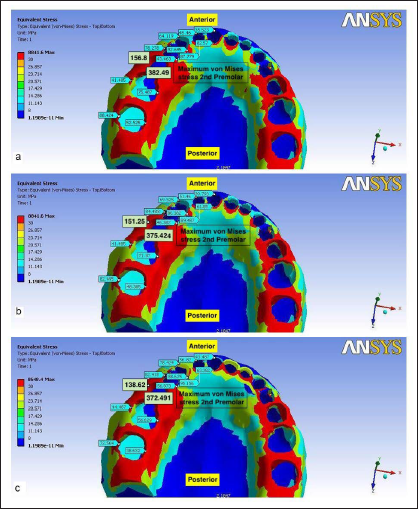
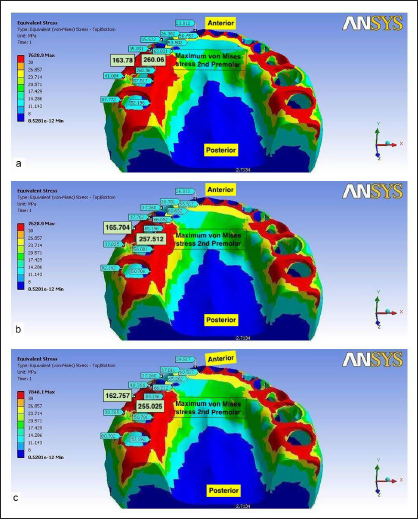
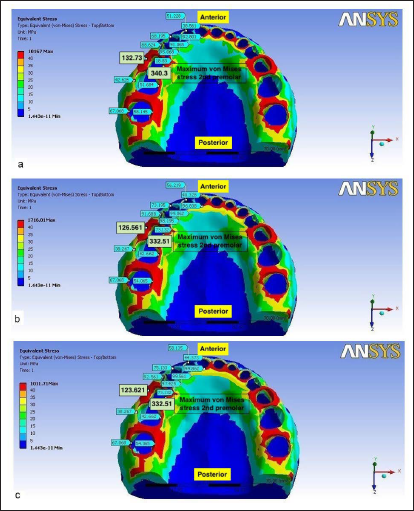
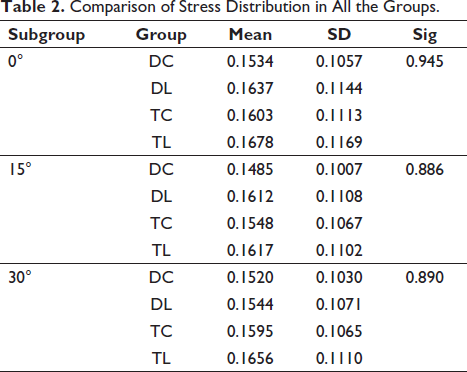
The stress distribution (von Mises stress) was measured on the buccal and palatal sides surrounding the teeth in both the groups, and the values plotted at different degrees of Gable bend are shown in the spectrum of colors ranging from red (very high) to blue (lowest) in the obtained analysis image (Figures 4–7). The finite element analysis showed no statistically significant difference in overall stress distribution for all the groups (Table 2). Nevertheless, maximum von Mises stress was seen in the second premolar region both on buccal and palatal sides with greater values for cinching compared to ligature tie in both the loops.
Stress Values of DKHL-C at (A) 0°, (B) 15°, and (C) 30°.
Stress Values of DKHL-L at (A) 0°, (B) 15°, and (C) 30°.
Stress Values of T-Loop-C at (A) 0°, (B) 15°, and (C) 30°.
Stress Values of T-Loop-L at (A) 0°, (B) 15°, and (C) 30°.
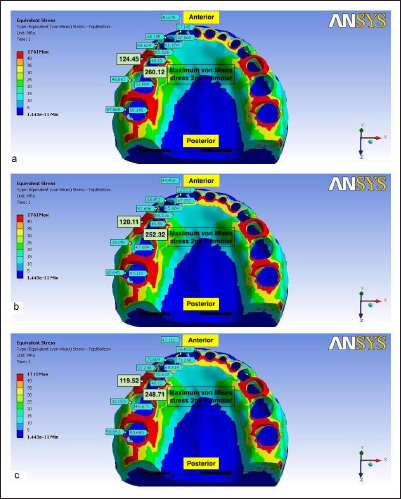
Comparison of Stress Distribution in All the Groups.
Tooth Displacement
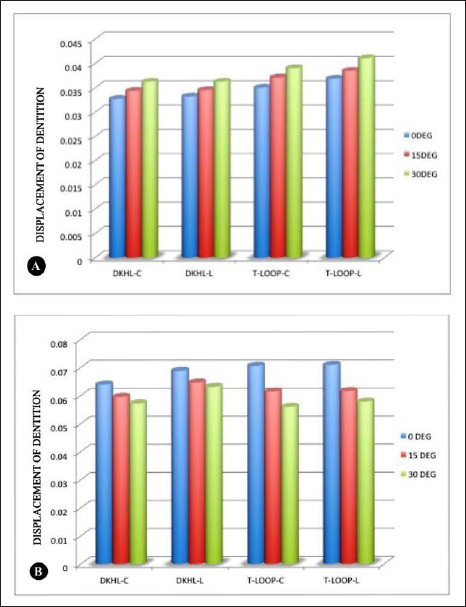
The displacement of dentition was individually measured for all the teeth in anteroposterior (Z), vertical (Y), and transverse (X) planes of space and grouped as anterior and posterior segments. The anterior segment of teeth showed more bodily controlled retraction with intrusion while the posterior segment exhibited greater anchorage control when the Gable bend was increased to 30° in both the groups. Loops activated using ligature tie showed more controlled retraction of teeth compared to loops activated by cinching (Figures 8–10).
Displacement of Dentition in mm for All the Groups: (A) Anterior Segment in Anteroposterior Plane of Space; (B) Posterior Segment in Anteroposterior Plane of Space.
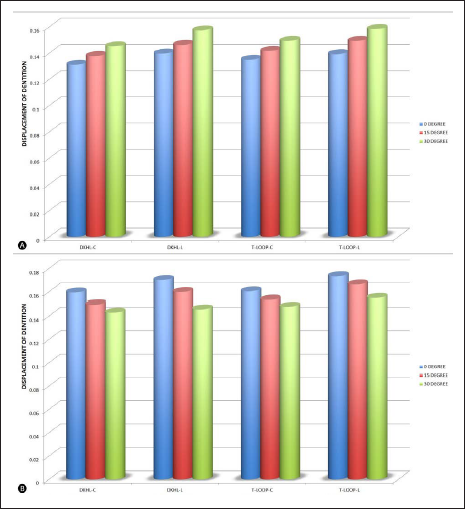
Displacement of Dentition in mm for All the Groups: (A) for Anterior Segment in Vertical Plane of Space; (B) Posterior Segment in Vertical Plane of Space.
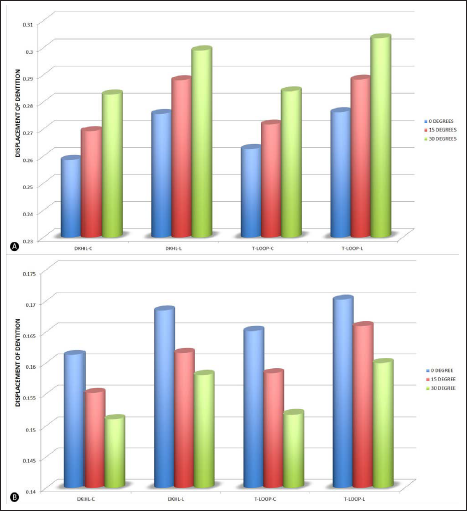
Displacement of Dentition in mm for All the Groups: (A) for Anterior Segment in Transverse Plane of Space; (B) Posterior Segment in Transverse Plane of Space.
Center of Resistance
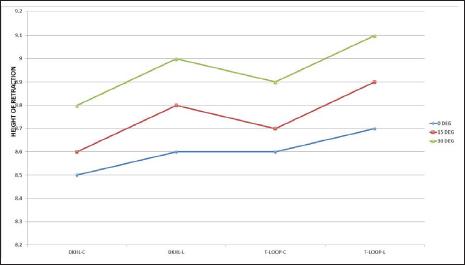
The center of resistance of 6 anterior teeth was determined in both sagittal and vertical directions and tabulated (Tables 3 and 4). During en masse retraction, both the loops were efficient in terms of height of retraction force that progressively shifted more apical for loops activated using ligature tie and with increase in the degree of Gable bend (Figure 11).
Centre of Resistance and Moment Force Ratio With DKHL.

Centre of Resistance and Moment-Force Ratio With T-Loop.

Height of Retraction Force in All the Groups.
Moment-Force Ratio
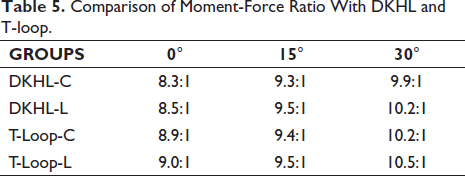
There was a progressive increase in moment-force ratio with increase in the degree of Gable bend in both the groups (Table 5). Moment-force ratio was maximum with a ratio of 10.5:1 for T-loops activated with ligature tie.
Comparison of Moment-Force Ratio With DKHL and T-loop.
Discussion
Roth suggested the use of DKHL for en masse space closure in 0.022×0.028 inch bracket system and also recommended different cross-sections of the loop for producing differential anchorage. 5 However, Ayala suggested the use of 0.019×0.025 inch stainless steel for both group A and group B anchorage cases. 11
Gable bends are frequently incorporated into the loop configuration to generate sufficient moments and prevent uncontrolled tipping. In the present study, Gable bends and curve of Spee were incorporated to provide a more controlled bodily retraction of the teeth during space closure. 12 Gable bends were given mesial to the loop to control the position of canine (mesial tip) prior to activating the loop and during subsequent activations.
The moment-force ratio was then calculated with respect to the center of resistance of 6 anterior teeth as suggested by Gwang-Mo Jeong, 13 for both the loops with different methods of activation (cinching and ligature-tie) and different degrees of Gable bend (0, 15, and 30).
The present study was done to evaluate the biomechanical response of DKHL and compared with T-loop.
The following comparisons were made:
Stress distribution, tooth displacement, and moment-force ratio within the groups. Stress distribution, tooth displacement, and moment-force ratio between group 1 (DKHL) and group 2 (T-loop).
Stress Distribution, Tooth Displacement, and Moment-Force Ratio Within the Groups
The stress patterns were studied using FEM for 1 mm of activation and different degrees of Gable bend. Results showed that the overall stress distribution was uniform for all degrees of Gable bend. However, the maximum von Mises stress was seen in the second premolar region on both buccal and palatal sides. This could be due to the effect of the Gable bend and curve of Spee incorporated in the arch wire.
The net displacement of dentition measured and calculated showed greater intrusion and controlled bodily retraction of anterior teeth with ligature tie compared to cinching and at 30° of Gable bend. Likewise, the posterior anchorage increased with increase in the Gable bend.
Therefore, Gable bends incorporated in the posterior segment of the arch wire may be beneficial for high anchorage cases where increased forces in the second premolar region could lead to undermining resorption and prevent tooth movement, thereby increasing the anchorage in the posterior segment and producing controlled bodily retraction of anterior teeth.
The moment-force ratio was found to be higher in loops activated using ligature tie reaching a maximum of 10.5 at 30° of Gable bend. It is well documented in literature that when the point of activation is at the head of the loop, the retraction force shifts apical to the center of resistance, thereby increasing the moment-force ratio producing a more controlled bodily translation of teeth.14, 15 Therefore, loops activated using ligature tie may be more beneficial both biomechanically as well as for subsequent arch wire adjustments.
Stress Distribution, Tooth Displacement, and Moment-Force Ratio Between Group 1 (DKHL) and Group 2 (T-loop)
The biomechanical efficiency of both the loops was compared using FEM at 1 mm of activation and different degrees of Gable bend. Results showed that the overall stress distribution was uniform with both the loops (Figures 3–6). This could be attributed to the morphology/design of the loops, producing an optimal force thereby leading to similar stress distribution in both the groups.2, 3, 16 However, the maximum amount of von Mises stress was observed in the second premolar region in both groups due to the effect of the Gable bend and curve of Spee incorporated in the arch wire.
The displacement of dentition assessed anteroposteriorly showed anticlockwise movement of anterior segment and clockwise movement of posterior segment which gradually increased with increase in degree of Gable bend. In the vertical plane, intrusion of anterior segment of teeth increased with increase in degree of Gable bend, while a mild extrusion was observed in the posterior segment. Perhaps, it is interesting to note that in both the groups, loops activated using ligature tie had better anterior torque, anchorage, and vertical control compared to loops activated by cinching the arch wire.
The moment-force ratio increased progressively with increase in the degree of Gable bend in both the groups. Burstone quantified the moment-force ratio with T-loop and stated that increasing the length of the wire in the apical region increases the moment-force ratio. 2 Likewise, DKHL with the presence of 2 loops configured like a keyhole effectively increased the quantum of arch wire and hence the moment-force ratio. Raymond E Satkowski suggested that a continuous loop can produce a constant moment-force ratio of 8.0-9.1 during en masse space closure, thereby providing an uniform stress distribution in the periodontal ligament which is in concurrence with our present study. 17 Thus, a moment-force ratio of 8-10 obtained in the present study is therefore desirable for bodily retraction of teeth.
Limitations
The present study was based on activating the loops by a mm and the biomechanical response during deactivation was beyond the scope of the study. This being an in vitro study cannot be directly extrapolated to clinical conditions. Therefore, further clinical studies are needed to confirm the efficiency of DKHL and its biomechanical advantages.
Conclusion
This FEM study suggests that the DKHL was found to be equally efficient as T-loop in producing the desirable biomechanical properties during en mass space closure. However, loops activated using ligature tie had more biomechanical and clinical advantages compared to loops activated by cinching the arch wire.
Footnotes
Declaration of Conflicting Interests
The authors declared no potential conflicts of interest with respect to the research, authorship, and/or publication of this article.
Funding
The authors received no financial support for the research, authorship, and/or publication of this article.
Ethical Approval
Ethical approval has been obtained from Institutional Ethics Committee of Ragas Dental College and Hospital, Uthandi, Chennai, Tamil Nadu, India.
