



Abstract
Abstract
One of the most suitable procedures in orthodontics for the management of impacted teeth is the orthodontic traction. Using a bonded accessory and an orthodontic force to pull the canine to its correct position requires multiple activations, which has often shown to be one of the main reasons for failure. A simple chair-side fabrication technique using nickel-titanium closed-coil spring-assisted attachment for precisely orthodontic traction of impacted teeth is presented.
Context
Impacted teeth are a routine clinical problem, and their traction is a major challenge for orthodontists. The most common orthodontic-surgical technique is the one-button or orthodontic bracket bonded on the surgically exposed impacted teeth aimed to tract and position them into the dental arch.1, 2 The orthodontic traction of impacted teeth may be done by attaching a gold chain, a ligature wire, an elastomeric chain or a nickel-titanium (Ni-Ti) closed-coil spring. 3
We have developed a simple chair-side fabrication technique using Ni-Ti closed-coil spring-assisted single attachment system for a precisely orthodontic traction of impacted teeth. This attachment consists of a Ni-Ti closed-coil spring with an eyelet-side attached with a bondable button (being preferable over bracket by reducing the tissue irritation during the orthodontic traction and eliminating the risk of bracket debonding), and the other eyelet-side attached with a ligature wire. This attachment can be used for effective traction of impacted teeth without the need for multiple times activation.
The Clinical Steps Are as Follows
On a Ni-Ti closed-coil spring of 6.0 mm length with eyelets attach a bondable button using a ligature wire to one eyelet-side, and a double end of a 3.0 cm length of 0.01” ligature wire attaches to the other eyelet-side (Figure 1 E). After the surgical exposure, the button is bonded to the impacted tooth (Figure 1 [F–G]) and the other end of Ni-Ti closed-coil spring is ligated with a rigid archwire (Figure 1 [H–I]).
Here, a clinical case report using the proposed procedure has been presented (Figure 1 [A–K]). The pretreatment records (Figure 1 [A–D]) show four impacted canines. After the surgical exposure, Ni-Ti closed-coil spring assisted attachments were bonded (Figure 1 [F–G]) and attached to the corresponding side of upper and lower rigid archwires (Figure 1 [H–I]). The final alignments of the impacted canines in both dental arches are shown in Figure 1 (J–K).
Procedure to Fabricate Single Activation Ni-Ti Closed Coil Spring Assisted Attachment for the Traction of Impacted Tooth
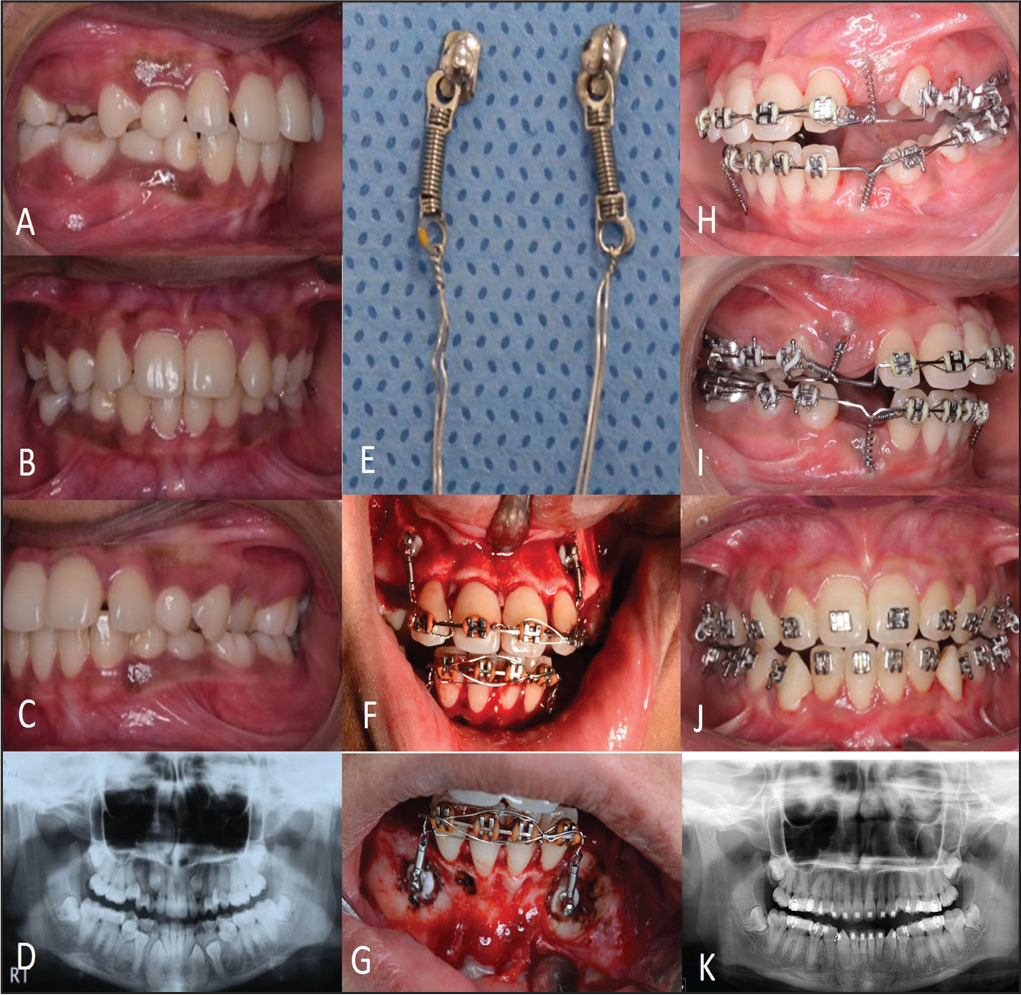
The advantage of this design is that there is no need of multiple activations in most of the cases; thus, allowing the orthodontist to use predictable and effective mechanics with constant and continuous forces, with respect to orthodontic tooth movement. In special clinical situations, such as highly placed impacted canines, this proposed design allows multiple time activations without the risk of ligature wire breakage.
The most important precaution is needed to be taken while securing one of the eyelets of the Ni-Ti closed-coil spring with the bondable button by tightly ligating with ligature wire on the neck of the bondable button between the button and the bondable base. Another precaution to be taken during the bonding is placing this attachment on the impacted teeth crown so that the Ni-Ti closed-coil spring faces toward the occlusal surface. To avoid the breakage of the attachment, only light forces should be applied during the activation of the attachment for orthodontic traction of impacted teeth. This attachment for orthodontic traction of impacted teeth should only be used on 0.019 by 0.025” or 0.021 by 0.025” stainless steel base archwire to avoid tipping of the adjacent teeth to take place.
Footnotes
Declaration of Conflicting Interests
The authors declared no potential conflicts of interest with respect to the research, authorship, and/or publication of this article.
Funding
The authors received no financial support for the research, authorship, and/or publication of this article.
