



Abstract
Abstract
Iatrogenic discomfort becomes a part of practice with limitation of armamentarium and technology. With the usage of temporary anchorage devices. It became a bliss to the orthodontist and patients in terms of ease and less anchorage loss but the continuous lingering irritation caused by the attaching ligature used to engage the spring to the implant head is harmful to patient. In this clinical pearl we have devised a small modification to the way the spring gets attached to implant head which eases the process and eliminates the iatrogenic problems.
Introduction
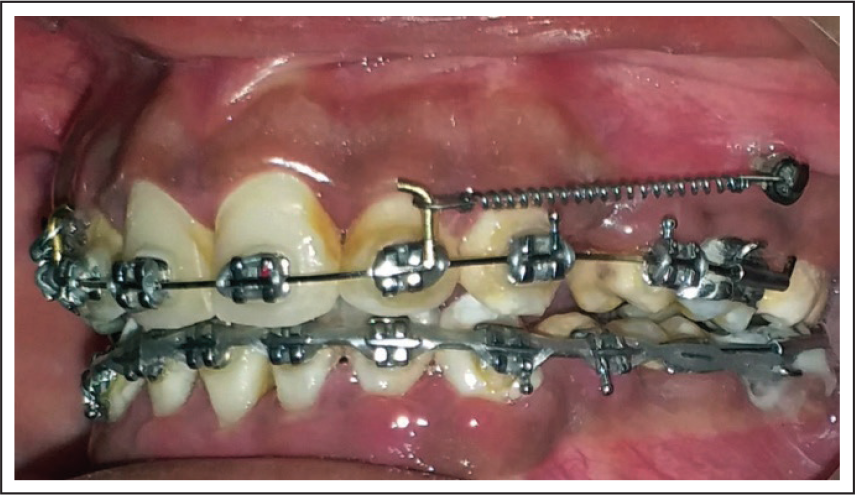
The placement of springs /elastics to temporary anchorage devices using ligature wires,cause iatrogenic discomfort to patients. This results in impingement and ulceration, which can be easily avoided by using an attachment that will be seated on to the head of the TADS (temporary anchorage devices) with minimal discomfort and easy chairside management while loading TADS with specified forces. The keychain attachment provides an easy-type, lasso-like anchorage to the mini-implant, which can secure the placement of nickel titanium spring for improving clinical efficiency.
Technique
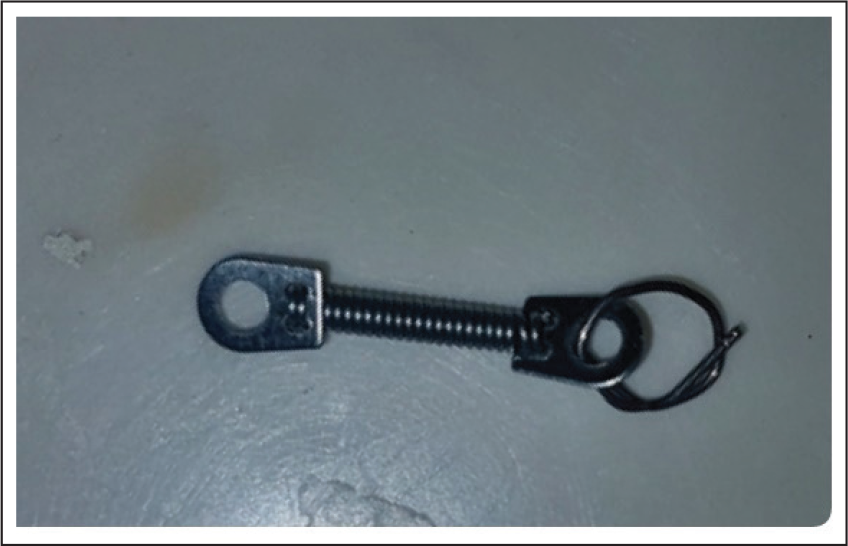
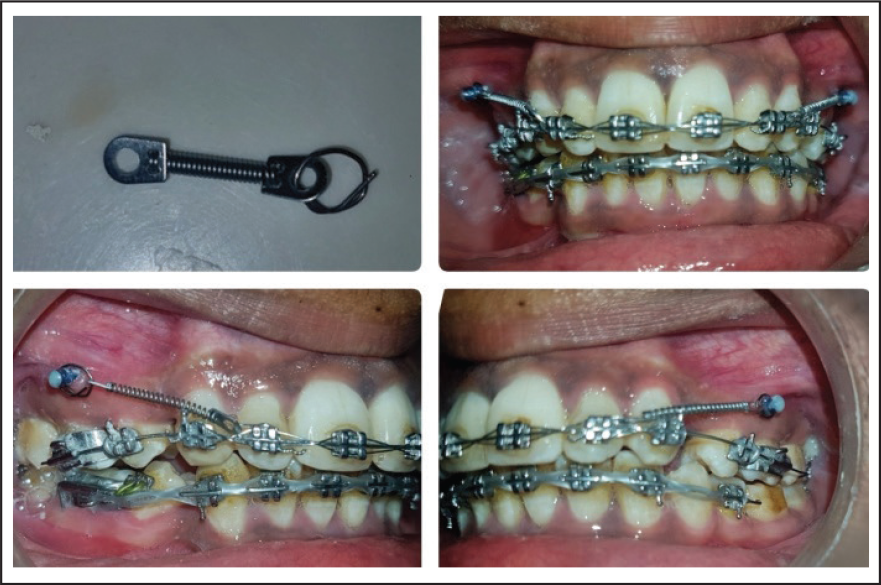
The implant angultions sometimes make it tricky to place the ligature wire and cause discomfort to the patient. To overcome this, we have made a keychain attachment (Figure 1), which can be easily made using a 0.018” A.J. Wilcock® Australian Wire in conjunction with the third serration of a bird-beak plier. This keychain attachment is given a circular dimension and can engage the implant like a lasso, thus preventing the discomfort and providing a snug fit to the implant. This will be an easy chairside management while loading TADS with specific forces as required.
Discussion
No breakage or disengagement of the keychain attachment has been observed to date. It should be noted that the placement of the ligature into TADS is tricky at times and may cause unwanted tissue growth to cover the ligature wire or ulcer formation, resulting in discomfort to the patient, which can be avoided by using a simple keychain attachment. An added advantage is that in case of any slippage of the loaded spring or solder failure, patients can remove the lasso kind of attachment easily without any discomfort till they come for the next appointment.
Keychain Attachment With Closed Coil Spring
Keychain on the Mini-Implant Head
Keychain Attachment on Both Sides for Retraction
Conclusion
Keychain attachment is easy to fabricate, more predictable, causes less discomfort to the patient, and is easy to manage while engaging the forces as required, which makes it clinically useful.
Footnotes
Declaration of Conflicting Interests
The authors declared no potential conflicts of interest with respect to the research, authorship, and/or publication of this article.
Funding
The authors received no financial support for the research, authorship, and/or publication of this article.