




Abstract
Abstract
We do retraction of anterior teeth as routine part of our orthodontic practice, and for this retraction to happen, we apply some form of retraction element. This retraction element runs straight on a curved arch from molars or temporary anchorage device (TAD) anteriorly, which contacts the soft tissues on most prominent part and causes trauma. This article gives a simple remedy to this problem by applying “guide hook” to the main archwire, which prevents the soft tissue trauma.
Introduction
This article describes the placement of a hook that guides and keeps away the retraction force element to prevent the soft tissue injury as retraction element touches the prominent soft tissue surfaces. This auxiliary hook is called “guide hook.”
Guide Hook Placement
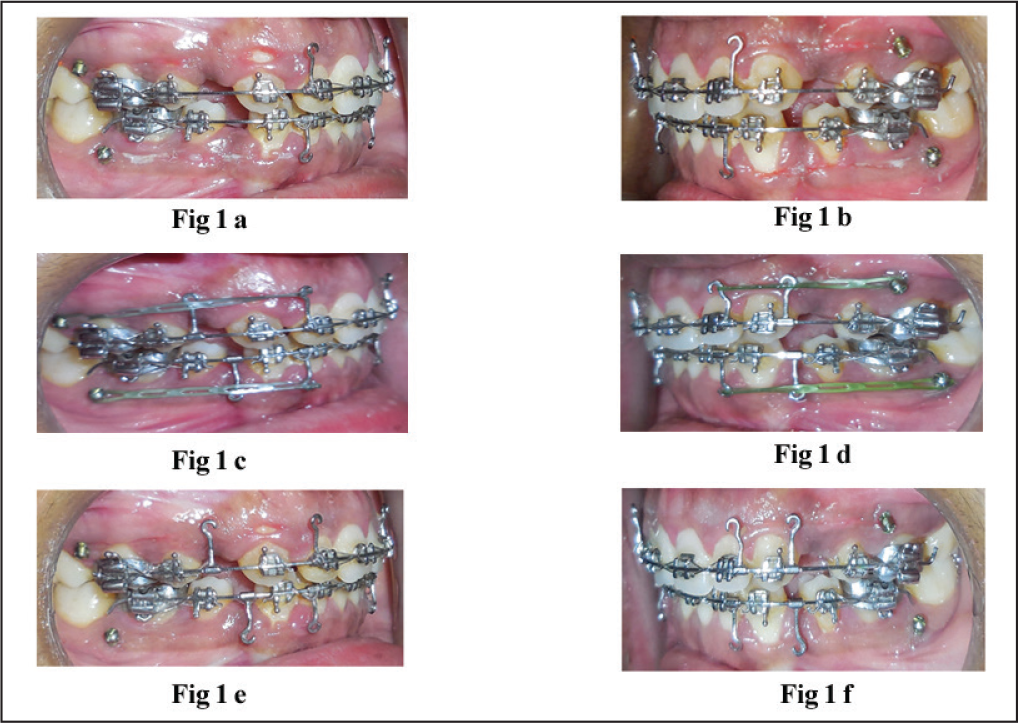
Soft tissues that are closer to retraction units are subjected to trauma and irritation (Figures 1[a] and [b]) and may be prevented with the use of guide hook. This hook can be placed in the stainless steel 0.19 × 0.25 archwire while retraction, if the soft tissue is pressed against the retraction unit. Place the hook at the most prominent soft tissue (Figures 1[c] and [d]). The healing soft tissue at the end of one week is shown in Figures 1(e) and (f). In some particular cases, this hook can also be placed anywhere in vicinity of the prominent tissue surface. This guide hook can be used in cases where molars are anchor units but in cases of micro implant anchorage, this hook seems to be mandatory as the implants are placed in soft tissue in the posterior region and there is a significant height difference between buccal tubes and implants. Generally, the micro implants are placed in interradicular area between second premolar and first molar in the upper arch and between the first and second molar in the lower arch. In the latter case, the curvature becomes significant and the guide hook is the remedy to keep away the retraction unit.
(a and b) Trauma due to retraction elastic chain running from TAD to retraction hook; (c and d) Guide hook placed in archwire and elastic chain placed; (d and e) Healing at the end of one week.
Discussion
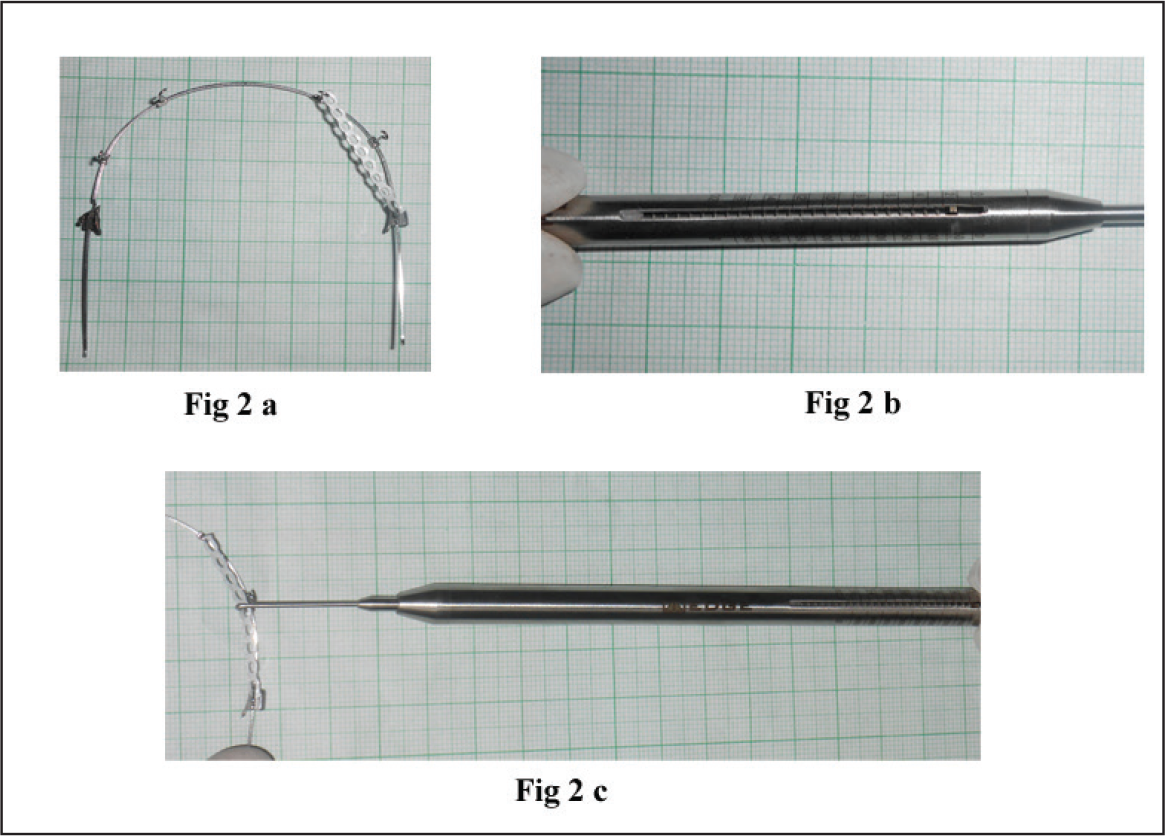
Canine eminence is the area where the soft tissue is most prominent and during retraction, this area is traumatized due to the application of e-chain, active tie back or coil spring. To solve this problem, we apply one extra hook (guide hook) to the archwire at the extraction site or most prominent tissue surface so that it can prevent the contact to the soft tissue surface. If we go through the publications, the above problem is probable complication with the micro implant retraction, especially in the lower arch. 1 To solve this problem, some type of guide bar or auxiliary wire is indicated to be placed in auxiliary buccal tube made with rectangular wire.1, 2 This bar has an inherent problem as there is some degree of play between the archwire and auxiliary tube and it may be deflected to contact the soft tissue. This guide hook also saves time and avoids extra wire bending. The author considers the biomechanical effect of force to be delivered on the guide hook in three dimensions and if sufficiently rigid wire (stainless steel 0.19 × 0.25) is used, the effects are insignificant. The force measured with the Dontrix gauge is below 50 grams, which is not sufficient to cause distortion of arch form (Figure 2). The force that is delivered on to the guide hook may further be overcome by transpalatal arch as it prevents the flaring of arch wire in the posterior section. In consideration with the above finding, the guide hook must be placed bilaterally whenever it is used.
(a) The way the elastic chain is placed and it hurts the soft tissues; (b) Elastic chain is pulled near guide hook with the dontrix gauge; (c) Dontrix gauge reading showing less than 50 grams of force.
Declaration of Conflicting Interests
The authors declared no potential conflicts of interest with respect to the research, authorship, and/or publication of this article.
Funding
The authors received no financial support for the research, authorship, and/or publication of this article.