




Abstract
Abstract
The aim of this article was to introduce a new simplified method to control the vertical level and avoid canting of arches during molar protraction using skeletal anchorage.
Introduction
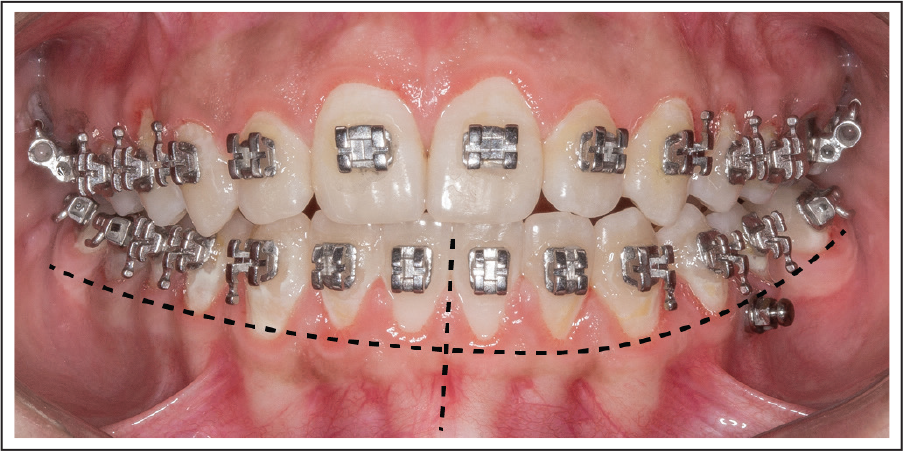
In orthodontic treatment, protraction of the second molars using miniscrews is a commonly used modality when a missing or extracted first molar exists.1,2 However, a common side effect of molar protraction is canting of the occlusal plane (Figure 1). The molar tips toward the extraction site during protraction as the long span of wire anterior to the second molar adds more flexibility.
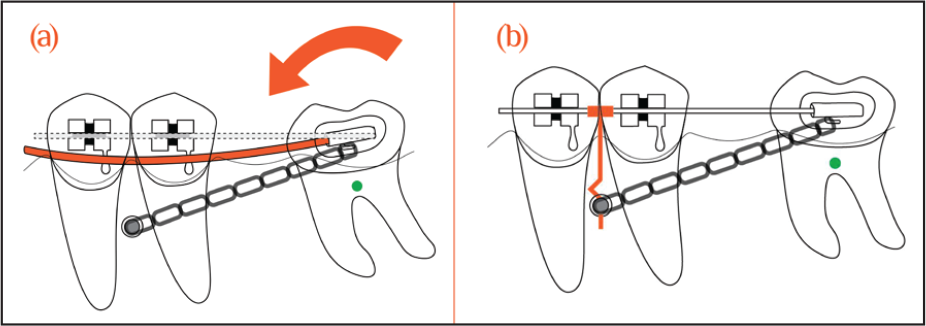
Bowing of the archwire takes place even with heavy wires 3 due to the force applied being occlusal to the molar’s center of resistance (Figure 2[a]). One method to control this phenomenon is by indirect anchorage through bonding a heavy wire to adjacent teeth. This method has four advantages. First, in moderate anchorage cases, the miniscrew, the 19/25 stainless steel (SS) vertical wire, and composite can be placed mid-way in the extraction space to control the vertical intrusive component. However, an elastic chain or a retracting coil will run from the premolar to the molar directly.
Intraoral photograph showing a canted lower arch after two month of second molar protraction. Notice the resultant bowing of the lower arch and the lower incisors tipping
(a) Illustration showing a protracted molar receiving retracting force above the center of resistance of the molar. The molar tips and the arch wire bends gingivally. (b) – Illustration showing the completed appliance Green dot (center of resistance). Orange wire (deflected archwire)
Second, no tooth stabilization with heavy wire to screw is necessary, thus allowing free movement in this particular tooth, for example, wire bending or sliding mechanics. Third, if the screw failed, it would be easier to detect an ailing implant and disassemble and reassemble the system. Fourth, it reduces enamel damage due to etching and removal of composite as well as decalcification from plaque around margins and periodontal insult.
Procedure
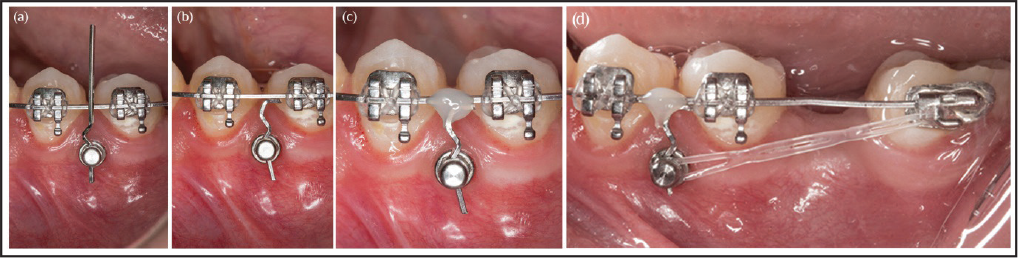
The miniscrew head is aligned so that the miniscrews hole points toward the archwire. A stopper is made occlusal to the screw head in a 0.019″ × 0.025″ SS wire (Figure 3[a]). The wire is marked immediately under the main archwire and bent with a tweed plier to rest intimately underneath the main archwire (Figure 3[b]). Flowable composite is placed around the two wires to secure them together, and the excess wire underneath the screw is cut off (Figure 3[c]).
A retraction coil or power chain is stretched over the screw head to the hook of the molar tube (Figures 3[d] and 2[b]).
(a-c) Photograph showing clinical steps of fabricating the appliance. (d) Photograph showing the completed appliance
Conclusion
This simplified technique was proposed to avoid the canting of arches during the second molar protraction without the need to indirectly bond to miniscrews and to allow the freedom of movement of neighboring teeth, especially in moderate anchorage cases.
Declaration of Conflicting Interests
The author declared no potential conflicts of interest with respect to the research, authorship, and/or publication of this article.
Funding
The author received no financial support for the research, authorship, and/or publication of this article.