




Abstract
The judgment of female body appearance has been reported to be affected by a range of internal (e.g., viewers’ sexual cognition) and external factors (e.g., viewed clothing type and colour). This eye-tracking study aimed to complement previous research by examining the effect of facial expression on female body perception and associated body-viewing gaze behaviour. We presented female body images of Caucasian avatars in a continuum of common dress sizes posing seven basic facial expressions (neutral, happiness, sadness, anger, fear, surprise, and disgust), and asked both male and female participants to rate the perceived body attractiveness and body size. The analysis revealed an evident modulatory role of avatar facial expressions on body attractiveness and body size ratings, but not on the amount of viewing time directed at individual body features. Specifically, happy and angry avatars attracted the highest and lowest body attractiveness ratings, respectively, and fearful and surprised avatars tended to be rated slimmer. Interestingly, the impact of facial expression on female body assessment was not further influenced by viewers’ gender, suggesting a ‘universal’ role of common facial expressions in modifying the perception of female body appearance.
In our daily life, we often judge other people's body appearance, such as body attractiveness and body size, either consciously or unconsciously (Peelen & Downing, 2007). As such evaluation of female bodies could determine our social behaviour (e.g., approach or avoidance tendency) and affect our physical and mental health (e.g., eating disorders; Adolphs, 2003; Slade, 1994), female body perception has increasingly attracted researchers’ attention in relevant disciplines.
Recent psychological studies have observed a stereotypical gaze distribution in viewing and assessing female body appearance. In comparison with other non-face body regions, the chest and waist-hip regions typically attract more fixations and longer viewing because they contain diagnostic cues for assessing sexuality, body attractiveness and size (e.g., Cornelissen et al., 2009; Cundall & Guo, 2017; Dixson, Grimshaw, et al., 2010, 2011; Hall et al., 2011, 2014, 2015). This body-viewing gaze behaviour and subsequent body evaluation could be further influenced by a range of internal and external factors. The internal factors include the viewers’ ethnicity, gender, sexual orientation and cognition, mental state, body composition and satisfaction (e.g., Cundall & Guo, 2017; Hall et al., 2011, 2014, 2015; Rodway et al., 2019; Tovée et al., 2006). For instance, Caucasian women were more likely to judge female Caucasian avatars as more attractive and slimmer than Asian and African avatars (in-group favouritism; Rodway et al., 2019). When viewing other women, those participants who were unhappy with their body composition tended to look less at body features with high self-rated satisfaction scores but more at features rated with low scores (Cundall & Guo, 2017). The external factors are cues contained in the viewed bodies, such as body mass index (BMI), waist-to-hip ratio (WHR), body fat distribution, skin colour and clothing style and colour (e.g., Cundall & Guo, 2017; Fan et al., 2003; Rodway et al., 2019; Sidhu et al., 2021; Singh & Young, 1995). For instance, in comparison with other clothing colours, the same avatar wearing red or black tended to be rated slimmer and more attractive (Sidhu et al., 2021). In addition to the above-mentioned factors, facial cues are also able to modify the perceived body appearance (body shape, weight, etc.; Coetzee et al., 2010; Holzleitner et al., 2014; Schneider et al., 2013). In particular, face attractiveness ratings could predict women's body attractiveness ratings (Bleske-Rechek et al., 2014; Currie & Little, 2009). In comparison with sad facial expression, women posing happy or neutral expressions were rated higher in physical attractiveness (Mueser et al., 1984). Interestingly when the perceived facial expression became ambiguous by wearing a face mask (Noyes et al., 2021), the viewers increased their body attractiveness ratings for women with angry faces but decreased ratings for women with happy faces (Mills & Guo, 2022), suggesting a direct causal effect of facial expression on body attractiveness evaluation.
The generalisation of these findings, however, could be affected by the limitations in previous studies. For instance, only a limited number of facial expressions (e.g., happiness, sadness, anger) were tested, and only Caucasian male (Mueser et al., 1984) or female participants (Mills & Guo, 2022) were recruited for data collection. It is unclear to what extent other common prototypical facial expressions, such as fear, surprise, and disgust, affect body attractiveness judgment, and whether such facial expression influence is universal to the viewers of varying gender and ethnic background. Given different expressions represent different emotional valence with different levels of arousal, and are typically associated with different human social behaviour (e.g., happiness/anger is high-arousal positive/negative-valenced emotion that is associated with approach/avoidance tendency, whereas surprise is ambiguous and often rated with either slightly positive or slightly negative valence; Calder et al., 2011; Ekman & Cordaro, 2011; Mehu et al., 2008), they may show different direction and/or degree of influence on body attractiveness judgment. Furthermore, as both expression perception and idealized female body shape are subject to gender and culture influence (e.g., Bruce & Young, 2013; Tovée et al., 2006, 2012), the interaction between facial expression and body attractiveness assessment may be further modified by participants’ gender and ethnic background. Additionally, it is unclear whether body size judgment, another important aspect of body perception closely related to body attractiveness judgment, and body-viewing gaze behaviour are affected by model facial expressions.
In this eye-tracking study, we presented female body images of Caucasian avatars in a continuum of common clothing posing seven basic facial expressions (neutral, happiness, sadness, anger, fear, surprise, and disgust), and asked male and female participants to rate the perceived body attractiveness and body size. Considering that the Western, African and Arab cultures tend to prefer different female body shape and size (e.g., Musaiger et al., 2004; Sugiyama, 2004; Tovée et al., 2006, 2012), we recruited participants in ethnic groups of white Caucasian, black African, and Arab. Guided by previous findings, we hypothesised that (1) different avatar facial expressions would impact differently on body attractiveness and size ratings, such as higher arousal positive-valenced expression is associated with higher body attractiveness rating (Mills & Guo, 2022; Mueser et al., 1984); (2) participants’ gender and ethnicity would influence their ratings of avatar body appearance because general body perception is affected by individual's sexual cognition (Hall et al., 2015) and culture (in-group favouritism; Rodway et al., 2019), and such influence may not be further modified by avatar facial expressions if the perception of the chosen seven expressions is universal (i.e., with comparable recognition performance across cultures) as suggested by Ekman and Cordaro (2011) or may be further interacted with avatar expressions if the perception of these expressions is influenced by participant ethnicity (Jack et al., 2009; Masuda et al., 2008); (3) avatar facial expression may affect body-viewing gaze behaviour because expression recognition time varies with expression category (Guo, 2012, 2013), but such influence is unlikely to be further modified by participant gender and ethnicity because gaze behaviour in assessing female body attractiveness and body size (or body fat and WHR) is comparable between participant gender or when viewing avatars of different ethnicities (e.g., Cornelissen et al., 2009; Rodway et al., 2019).
Materials and Methods
Participants
Seventy participants, aged between 18 and 28 years old (21.05 ± 0.19, mean ± SEM), participated in this study voluntarily. They included 37 Caucasian (23 women), 18 Black African (9 women) and 15 Arab (6 women). The suitability of this sample size was confirmed by power analysis using G∗power software. With a conservative effect size of 0.3 often reported in previous studies on body attractiveness judgment and body-viewing gaze distribution (e.g., Cundall & Guo, 2017; Rodway et al., 2019; Sidhu et al., 2021), a sample of 21 and 28 participants in this study would have been large enough for the facial expression effect to be detected with a power of 0.95 at alpha level 0.05 and 1 nonsphericity correction in a 7 (facial expression) × 7 (body size) and 7 (facial expression) × 5 (body region) repeated measures design, respectively. All participants were either born in the UK or had spent considerable amount of time (> 1 year) studying in the UK, reported heterosexual orientation and no history of eating disorders, and had normal or corrected-to-normal visual acuity. Before the study, the research purpose and experimental procedure had been explained to the participants and written informed consent was obtained from each of them. The Ethical Committee in the School of Psychology, University of Lincoln, approved this study (PSY1819123), and all procedures complied with the British Psychological Society Code of Ethics and Conduct.
Body Images
High-resolution grey-scale female body images of computer-generated avatars in full frontal view were created in our previous study (Cundall & Guo, 2017). Wearing a tight dress, these bodies represented two Caucasian avatars in seven common UK dress sizes (size 6, 8, 10, 12, 14, 16 and 18; standardised 165 cm height and 74 cm inner leg measurements). The faces of two female Caucasian models were selected from the Karolinska Directed Emotional Faces CD ROM (Lundqvist et al., 1998). Each of these models posed one neutral and six high-intensity facial expressions (happiness, sadness, fear, anger, disgust and surprise) in full frontal view. For each avatar identity at each dress size, the same face identity with one of seven facial expressions was placed onto the body via Adobe® Photoshop 2017 CC. In total, 98 images (2 face identities × 7 facial expressions × 7 dress sizes) were created for the testing (see Figure 1 for example). The background of the body image was set as white [100, 0.01, 296.81], and the size of the images was set to 200 × 663 pixels (7.69° × 25.5°).
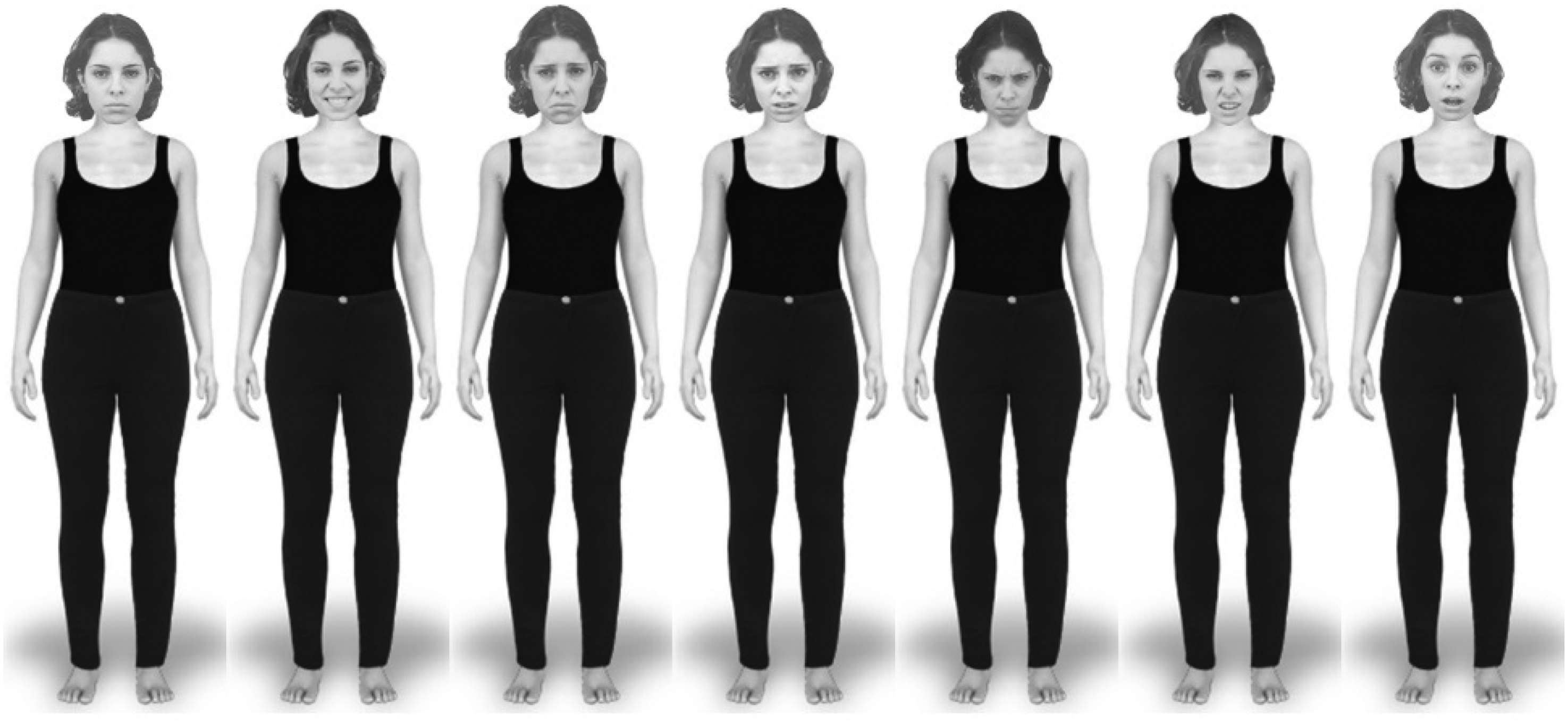
Examples of a Caucasian female avatar in UK dress size 10 displaying neutral, happy, sad, fearful, angry, disgusted, and surprised facial expressions.
Procedure
The general experimental setup and procedure for data collection and analysis are similar to Rodway et al. (2019), from which the following details are reproduced. The digitized body images were presented through a ViSaGe graphics system (Cambridge Research Systems, UK) and displayed on a non-interlaced gamma-corrected colour monitor (30 cd/m2 background luminance, 100 Hz frame rate, Mitsubishi Diamond Pro2070SB) with the resolution of 1024 × 768 pixels. At a viewing distance of 57 cm, the monitor subtended a visual angle of 40 × 30°.
During the eye-tracking experiment, the participants sat in a chair with their head restrained by a chin-rest, and viewed the display binocularly. Horizontal and vertical eye positions from the dominant eye (determined through the Hole-in-Card test) were measured using a pupil-centre/cornea-reflection Video Eyetracker Toolbox with 250 Hz sampling frequency and up to 0.25° accuracy (Cambridge Research Systems, UK). Eye movement signals were first calibrated by instructing the participant to follow a fixation point (FP, 0.3° diameter, 15 cd/m2 luminance) displayed randomly at one of 9 positions (3 × 3 matrix) across the monitor (distance between adjacent FP positions was 10°). After the calibration procedure, the participant pressed the response box to initiate a trial. The trial was started with an FP randomly displayed 10° left or right to the screen centre to minimize central fixation bias. If the participant maintained fixation for 1 s, the FP disappeared and a testing image was presented at the centre of the screen for 3 s. The participants were instructed to ‘rate body attractiveness and body size as carefully as possible’, and verbally report the perceived body attractiveness rating on a 9-point scale (1 represents ‘not attractive at all’ and 9 represents ‘extremely attractive’) and body size rating on a scale ranging from UK size 6 to 18. During the testing, no feedback was given, and each body image was displayed once in random order.
Data Analysis
All the collected data were analysed offline. For eye movement data, the software developed in Matlab computed horizontal and vertical eye displacement signals as a function of time to determine eye velocity and position. Fixation locations were then extracted from raw eye-tracking data using velocity (less than 0.2° eye displacement at a velocity of less than 20°/s) and duration (greater than 50 ms) criteria (Guo, 2007). To determine gaze allocation within key body regions (Hall et al., 2011), each body was divided into five regions of interest: face (including hair), upper body (from the base of the neck to the end of the rib cage), waist-hip region (including stomach, hips, and pubic region), arms (including hands) and legs (including feet). The viewing time allocated to each region was normalised in proportion to the total viewing time sampled in that trial.
A series of repeated-measures analyses of variance (ANOVAs) were conducted to examine the effect of facial expression and dress size on participants’ body attractiveness and body size judgments, and their body-viewing gaze allocation. For each ANOVA, Greenhouse–Geisser correction was applied where sphericity was violated, and a Bonferroni adjustment was made for post-hoc multiple comparisons.
Results
Effect of Avatar Facial Expression and Dress Size on Body Attractiveness and Body Size Judgements
Body attractiveness judgement: to explore to what extent body attractiveness judgements were affected by avatar facial expression and dress size, a 7 (facial expression) × 7 (dress size) ANOVA was conducted with attractiveness rating as the dependent variable. The analysis revealed significant main effect of facial expression (F(1.94, 134.17) = 93.24, p < .001, ŋp2 = 0.58; Figure 2) with happy faces attracting the highest body attractiveness ratings (5.91 ± 0.17; all ps < .001), followed by surprised and neutral faces (4.71 ± 0.15 vs. 4.52 ± 0.16, p = .06), and then by fearful, disgusted and sad faces (4.23 ± 0.16 vs. 4.08 ± 0.15 vs. 4.07 ± 0.16, all ps > .05), and finally by angry faces (3.86 ± 0.16; all ps < 0.01). The main effect of dress size was also significant (F(2.12, 146.11) = 31.35, p < .001, ŋp2 = 0.31) with sizes 6, 8, 10 and 12 attracting similarly high attractiveness ratings (4.78 ± 0.15 vs. 4.79 ± 0.15 vs. 4.69 ± 0.15 vs. 4.55 ± 0.15, all ps > .05), followed by size 14 (4.39 ± 0.15, all ps < .01), and then by size 16 and 18 (4.14 ± 0.16 vs. 4.04 ± 0.16, p = .7). The facial expression × dress size interaction was not significant (F(19.5, 1345.43) = 1.52, p = .06, ŋp2 = 0.02).
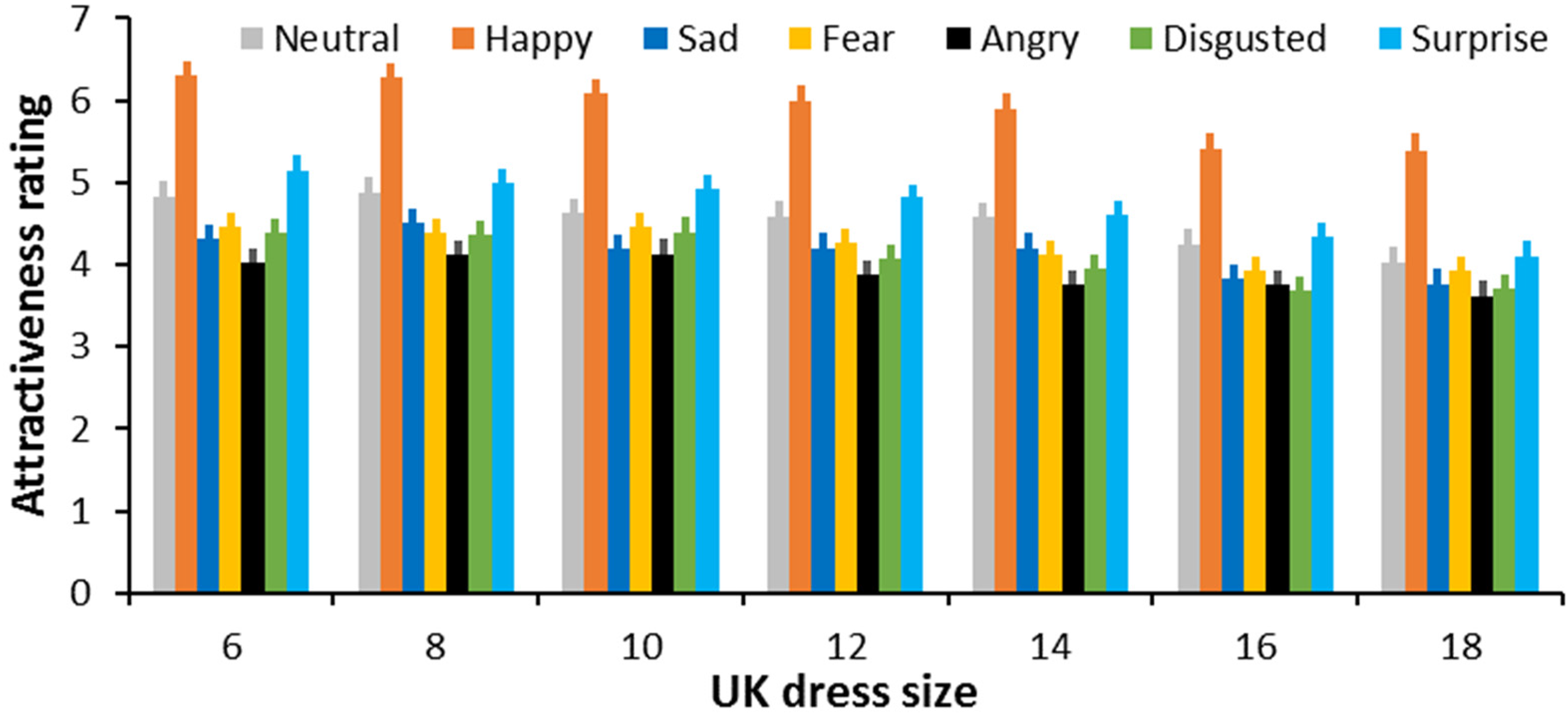
Attractiveness ratings for avatar in each dress size displaying neutral, happy, sad, fearful, angry, disgusted, and surprised facial expressions. Error bars represent SEM.
Body size judgement: to explore to what extent body size judgements were affected by avatar facial expression and dress size, a 7 (facial expression) × 7 (dress size) ANOVA was conducted with body size estimation error for each dress size (reported size−actual dress size) as the dependent variable. The positive or negative estimation error indicated an overestimation or underestimation of the presented body size, respectively. The analysis revealed significant main effect of facial expression (F(6, 414) = 7.51, p < .001, ŋp2 = 0.1; Figure 3) with fearful (−0.94 ± 0.13) and surprised faces (−0.85 ± 0.13) inducing higher body size underestimation than sad (−0.7 ± 0.15), happy (−0.69 ± 0.13), disgusted (−0.67 ± 0.14), neutral (−0.65 ± 0.13) and angry faces (−0.62 ± 0.15; all ps < .05). The main effect of dress size was also significant (F(2.32, 160.02) = 432.4, p .001, ŋp2 = 0.86) with the highest body size overestimation for dress size 6 (1.91 ± 0.13), similar overestimation for dress size 8 and 10 (0.51 ± 0.14 vs. 0.22 ± 0.13, p = .06), and increased underestimation for dress size 12 (−0.81 ± 0.15), 14 (−1.56 ± 0.18), 16 (−2.19 ± 0.17) and 18 (−3.2 ± 0.16) (size 6 vs. 8/10 vs. 12 vs. 14 vs. 16 vs. 18, all ps < .01). The significant facial expression × dress size interaction (F(36, 2484) = 3.57, p < .001, ŋp2 = 0.05) further indicated the effect of fear and surprise expressions on the body size underestimation was dependent upon the presented dress size. Specifically, fearful and surprised avatars in size 10, 14, 16 and 18 tended to be judged as slimmer than angry avatars (all ps < .05). Facial expressions, on the other hand, showed little impact on body size judgement of avatars in dress size 6 and 8 (all ps > .05).
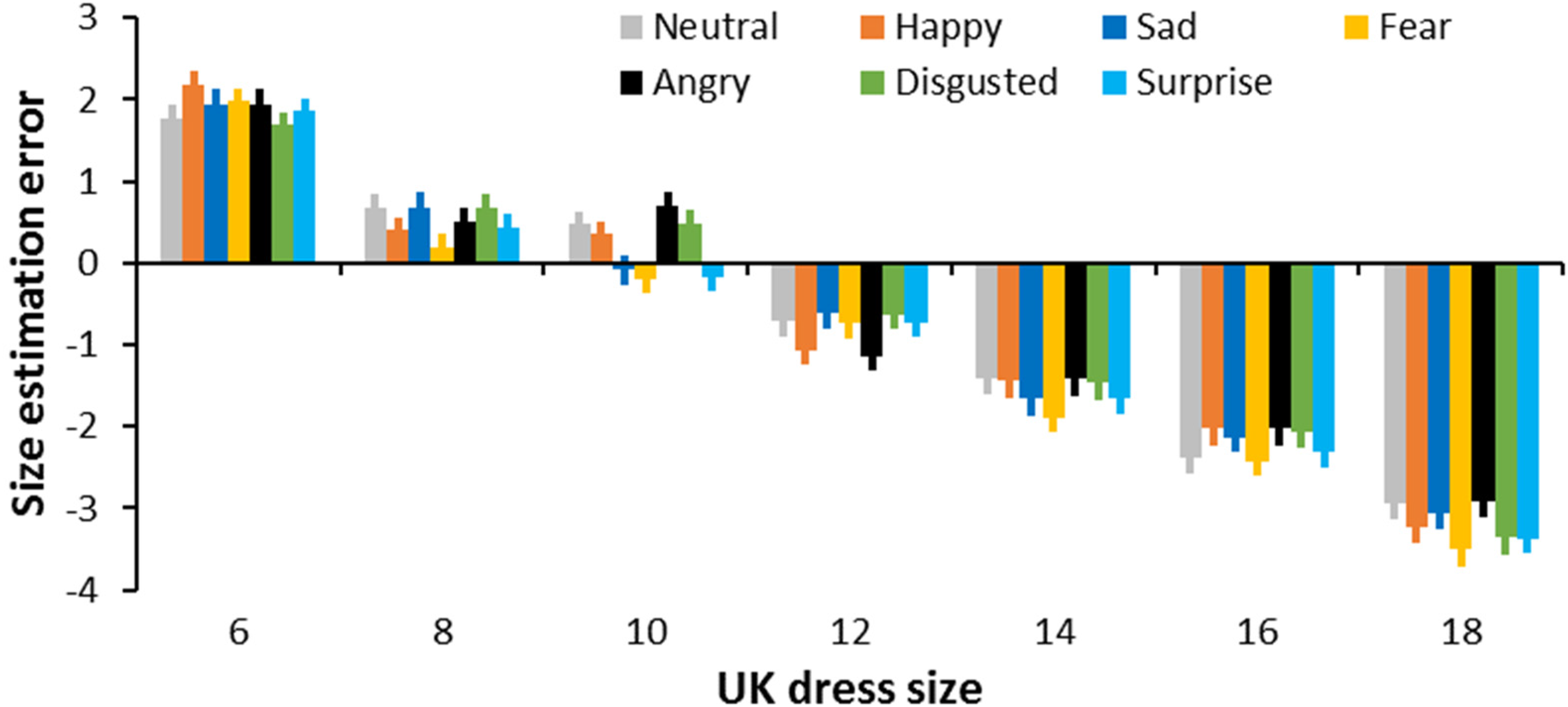
Mean body size estimation error between reported and actual size for avatar in each dress size displaying neutral, happy, sad, fearful, angry, disgusted, and surprised facial expressions. Error bars represent SEM.
Effect of Avatar Facial Expression on Body-Viewing Gaze Allocation
To further examine to what extent body-viewing gaze behaviour was altered by avatar facial expression, a 7 (facial expression) × 5 (body region) ANOVA was conducted with the proportion of viewing time directed at each body region as the dependent variable. The analysis revealed significant main effect of facial expression (F(6, 414) = 9.61, p < .001, ŋp2 = 0.12; Figure 4) with sad avatars attracting shorter viewing than angry, neutral, fearful and happy avatars (all ps < .05), and digsuted avatars receiving less viewing than angry avatars (p < .001). The main effect of body region was also significant (F(2.28, 157.18) = 84.46, p < .001, ŋp2 = 0.55) with waist-hip and face regions attracting similarly high proportion of viewing time (29.79% ± 1.55 vs. 26.76% ± 1.97, p = 1), followed by upper-body (18.79% ± 1.15), and then by legs and arms (2.51% ± 0.49 vs. 2.39% ± 0.69, p = 1) (face/waist-hip vs. upper-body vs. legs/arms, all ps < .05). The facial expression × body region interaction was not significant (F(12.65, 872.6) = 1.7, p = .06, ŋp2 = 0.02).
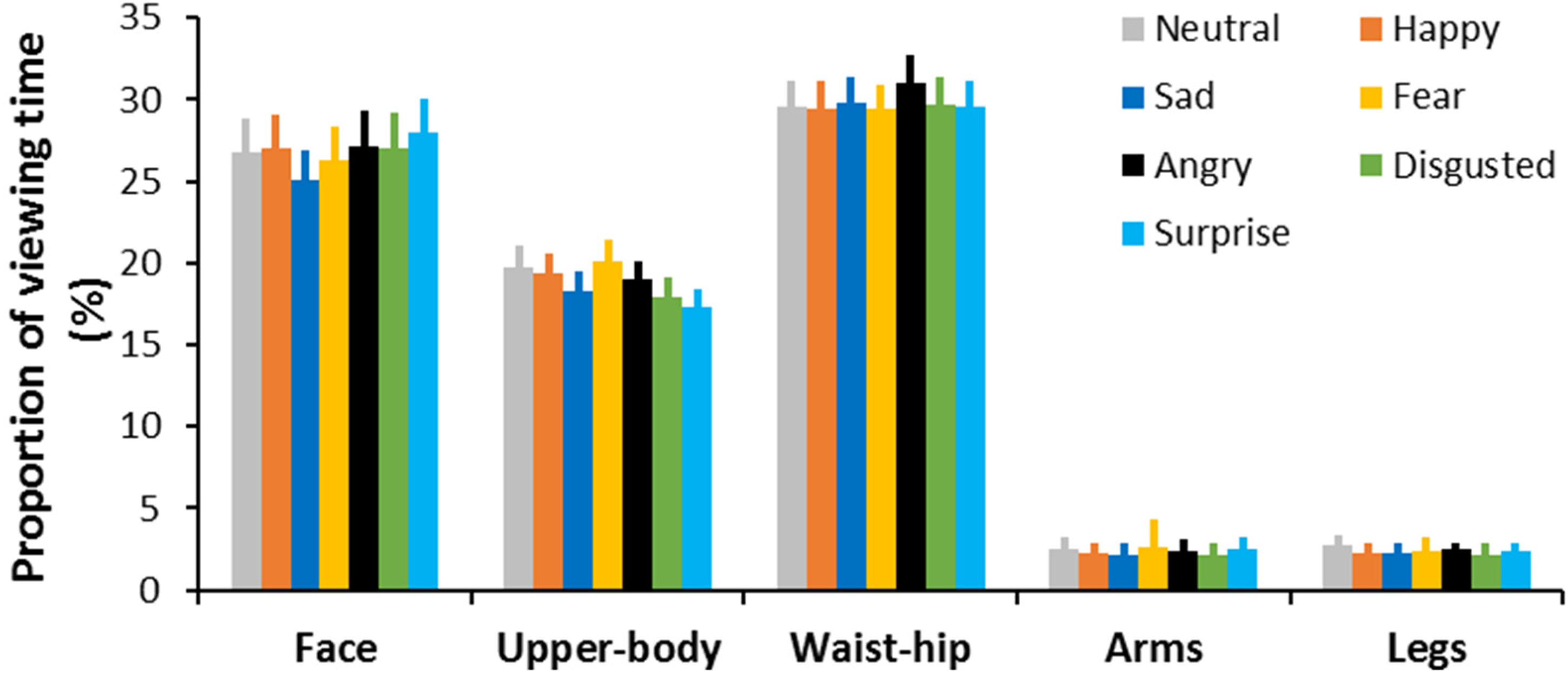
Mean proportion of viewing time directed at individual body regions in avatar displaying neutral, happy, sad, fearful, angry, disgusted, and surprised facial expressions. Error bars represent SEM.
Gender and Culture Differences in Body Perception
In this study, both male and female Caucasian, African and Arab participants were tested. To examine whether the above reported effects of avatar facial expression on female body perception were varied across different participant groups, two GLMMs were conducted with participant gender and ethnicity, avatar facial expression and dress size as predictor variables, and body attractiveness rating and body size estimation error as response variable, respectively. The analysis revealed that avatar body attractive ratings were dependent on both participant gender (F(1, 3414) = 182.82, p < .001) with higher ratings from female than male participants (4.57 ± 0.03 vs. 3.93 ± 0.04), and participant ethnicity (F(2, 3414) = 234.19, p < .001) with the highest ratings from Caucasian followed by African and then by Arab participants (4.87 ± 0.03 vs. 4.27 ± 0.04 vs. 3.61 ± 0.05). The body size estimation errors were also dependent on participant gender (F(1, 3414) = 27.47, p < .001) with lower underestimation from female than male participants (−0.7 ± 0.04 vs. −0.98 ± 0.04), and participant ethnicity (F(2, 3414) = 44.38, p < .001) with the lowest underestimation from Caucasian followed by African and then by Arab participants (−0.53 ± 0.04 vs. −0.85 ± 0.05 vs. −1.14 ± 0.06). However, there were no significant participant gender × participant ethnicity × avatar facial expression × avatar dress size interactions on body attractiveness (F(72, 3414) = 0.19, p = 1) and body size judgements (F(72, 3414) = 0.31, p = 1), suggesting avatar facial expression and dress size had qualitatively similar impact on female body perception across different participant groups.
For the body-viewing gaze distribution, another GLMM was conducted with participant gender and ethnicity, avatar facial expression and body region as predictor variables, and the proportion of viewing time directed at each body region as response variable. The analysis revealed that the viewing time was dependent on participant gender (F(1, 2436) = 4.34, p = .04) with slightly longer viewing from female than male participants, but was not dependent on participant ethnicity (F(2, 2436) = 0.69, p = .5). Furthermore, there was no significant participant gender × participant ethnicity × avatar facial expression × avatar body region interactions on viewing time allocation (F(48, 2436) = 0.18, p = 1). It should be noted that our recruited participant group was skewed toward female Caucasian, hence these findings on gender and ethnicity differences in body perception should be treated cautiously.
Discussion
The purpose of this study was to complement previous research on a range of internal and external factors modifying female body perception (e.g., Cundall & Guo, 2017; Hall et al., 2011, 2014, 2015; Mills & Guo, 2022; Rodway et al., 2019; Sidhu et al., 2021; Tovée et al., 2006), focusing mainly on how common facial expressions could affect the judgments of female body attractiveness and size, and associated body-viewing gaze behaviour. The overall findings revealed an evident modulatory role of avatar facial expressions on body attractiveness and body size ratings, but not on gaze allocation at individual body features. Specifically, happy and angry avatars attracted the highest and lowest body attractiveness ratings, respectively, and fearful and surprised avatars tended to be rated slimmer. Interestingly, such impact of facial expression on female body assessment was not further modified by viewers’ gender and (possibly) ethnicity, suggesting a universal role of common facial expressions in influencing female body perception.
One novel finding in this study is that the examined seven common facial expressions showed systematic influences on body attractiveness ratings irrespective of body sizes (ratings for a given body size: happiness > surprise = neutral > fear = disgust = sadness > anger), probably according to the perceived expression valence, arousal level, and its associated human traits and role in social interactions. For instance, happiness is a typical high-arousal and positive-valenced emotion that is associated with attractive human traits (e.g., friendliness, warmth, sociability, likability, generosity, trustworthiness) and approach tendency (Li et al., 2021; Mehu et al., 2008; Reis et al., 1990). Surprise is an ambiguous emotion often rated with either slightly positive or slightly negative valence (Ekman & Cordaro, 2011), hence demonstrated a similar influence on attractiveness judgment as neutral expression. Fear, disgust and sadness are negative-valenced emotions that could further trigger more aroused angry emotion (Ekman & Cordaro, 2011). Anger is a typical high-arousal and negative-valenced emotion that is associated with unattractive human traits (e.g., threat, harm, unpleasantness) and avoidance tendencies (Calder et al., 2011). Previous studies have observed these positive and negative facial expressions could increase and decrease face attractiveness ratings accordingly, with happy and angry faces often perceived with the highest and lowest attractiveness scores, respectively (Calder et al., 2011; Golle et al., 2014; Mueser et al., 1984). Considering that face attractiveness can directly impact body attractiveness judgment (a person's face and body are often processed as a single unit; Hu et al., 2020) and even serve as a predictor of body attractiveness (Bleske-Rechek et al., 2014; Currie & Little, 2009), it is plausible these different positive and negative facial expressions with different levels of arousal can modify body attractiveness ratings systematically.
Another novel finding in this study is that avatar facial expression impacted differently on body attractiveness and size judgments. While happiness induced higher body attractiveness ratings, fear and surprise tended to elicit slimmer body size judgment (especially for larger size 14–18 avatars) than other expressions. Previous research has reported an interdependent relationship between body attractiveness and size assessments in the manipulation of avatar dresses (e.g., clothing type and colour). For instance, a higher attractiveness rating is often correlated with a slimmer body size estimation (Cundall & Guo, 2017; Sidhu et al., 2021). However, body size assessment mainly relies on bodily cues, such as BMI, WHR, and body fat distribution (e.g., Cundall & Guo, 2017; Mo et al., 2014), but body attractiveness assessment relies on the integration of facial and bodily information (Hu et al., 2020). Hence, manipulating avatar facial cues alone could have an unequal influence on body attractiveness and body size ratings (Mills & Guo, 2022), and different facial expressions on the same avatar could induce different body attractiveness ratings but similar body size ratings as reported in this study (at least for avatars in sizes 6, 8, and 12). Interestingly, anger showed a similar impact on body attractiveness and body size assessment for larger avatars, that is, angry larger avatars were rated as the least attractive and less slim. It is unclear why our participants rated fearful and surprised avatars slimmer than the same avatars displaying other expressions. Given that our expressions of fear and surprise are often associated with withdraw or avoidance body action and posture (Dael et al., 2012a, 2012b) that typically make our body look smaller, it is plausible such visual experiences enabled our participants to associate fearful and surprised facial expressions with slimmer body perception.
In agreement with previous research (Cundall & Guo, 2017; Rodway et al., 2019; Sidhu et al., 2021), female body size also affects body attractiveness judgment with slimmer avatars (size 6–12) attracting higher attractiveness ratings than larger ones (size 14–18), and body size estimation error with overestimation for smaller avatars (size 6–10) and underestimation for larger avatars (size 12–18). Unlike earlier studies in which only female Caucasian participants were tested, this study recruited both male and female Caucasian, African and Arab participants currently living in the UK. We did not observe significant interactions between participants’ gender, ethnicity and body attractiveness or body size assessments. They all demonstrated a preference for female body with a low but healthy BMI (Mo et al., 2014), probably due to their exposure to the same mass media and culture influence (e.g., Toselli et al., 2016). Additionally, they have probably adopted similar strategy of social etiquette conformation (tendency to avoid skinny and fat labels) and/or judgment bias (tendency to use mid-scale when uncertain in magnitude judgments) in estimating female body size (Rodway et al., 2019). However, it should be noted all our Caucasian, African and Arab participants were either born in the UK or had spent considerable amount of time studying in the UK, and the distribution of our relatively small sample size on ethnicity was skewed. Previous cross-culture studies have reported the idealized female body shape and WHR are subject to culture influence. While slimmer women (∼20–22 BMI and ∼0.7 WHR) are rated as the most attractive in Western culture (Tovée et al., 2012), larger women are preferred in African (∼0.8 WHR) and native south American (∼0.9WHR) cultures (Reeve et al., 2016; Sugiyama, 2004; Tovée et al., 2006), and more curvaceous female physiques (i.e., low WHR and healthy BMIs) are perceived as more attractive in Asia and Oceania regions (e.g., Cameroon, China, Indonesia, Samoa, Papua New Guinea, New Zealand; Dixson, Li, et al., 2010; Dixson, Sagata, et al., 2010; Singh et al., 2010). Future studies with a large sample size could systematically examine how the interaction between ethnicity and culture affects participants’ female body perception.
Interestingly, the impact of avatar facial expressions on body attractiveness and size judgments was not further influenced by participants’ gender and ethnicity. This could be attributed to the tested basic facial expressions. As these ‘universal’ expressions are associated with a common understanding of their emotional communicative value and comparable recognition performance across cultures (Ekman & Cordaro, 2011), it is unlikely that our participants will perceive differently about their valence and associated human traits. Finally, it is worth mentioning our participant group was skewed toward female Caucasians, hence these findings on gender and ethnicity differences in female body perception should be treated cautiously.
Although sad and disgusted avatars tended to be inspected slightly less than other avatars, such as angry ones, the viewing time directed at a given body feature was not affected by avatar facial expressions. Overall, participants allocated concentrated gaze at the face, waist-hip, and upper body area, three body features providing diagnostic cues for evaluating attractiveness, sexual maturity, and body size (Cornelissen et al., 2009; Dixson et al., 2011; Garza et al., 2016; Hall et al., 2011; Lykins et al., 2014). Similarly, the amount of body-viewing gaze allocation at these body regions was not manipulated by other external factors in the viewed bodies, such as previously reported body size or WHR (Dixson et al., 2011), clothing type (Cundall & Guo, 2017) and colour (Sidhu et al., 2021), or avatar race (Rodway et al., 2019). On the other hand, the viewers’ internal mental state, such as sexual cognition and own body satisfaction, could modify viewing time directed at individual body features (Cundall & Guo, 2017; Hall et al., 2014; Lykins et al., 2014). For instance, young women with low body satisfaction tended to look more at body regions with low self-rated satisfaction scores, but less at regions with high ‘scores’ (Cundall & Guo, 2017). Taken together, it appears we show a stereotypical gaze pattern in viewing and assessing others’ body appearance, which is mainly driven by one's internal state or individualised body comparison process.
In conclusion, the present study was the first to examine the impact of a full range of basic/common facial expressions on the judgment of female body appearance. It appears different expressions could systematically modify body attractiveness ratings, probably according to the perceived emotional valence and level of arousal. The same facial expression could impact differently on body attractiveness and body size ratings, indicating these two aspects of body appearance assessments are not necessarily interdependent. Participants’ gaze allocation at a given body feature, however, was not affected by avatar expression, further confirming a stereotypical gaze pattern in assessing female body appearance. Interestingly, the observed effect of facial expression on female body perception was not further modified by participants’ gender and (possibly) ethnicity, suggesting a universal role of common facial expressions in guiding female body perception.
Footnotes
Author Contributions
Declaration of Conflicting Interests
The authors declared no potential conflicts of interest with respect to the research, authorship, and/or publication of this article.
Funding
The authors received no financial support for the research, authorship, and/or publication of this article.
