




Abstract

Recently, Meyerholz and Flaherty 2 discussed the possible importance of the impact factor (IF) and citation index data (Web of Science) for Veterinary Pathology. Their discussion is well-timed as the question of the value of IF is under open debate in the research community. 1,2
Clarivate Analytics produces The Web of Science (https://clarivate.com/products/web-of-science/) and Journal Citation Reports. In research, the various fields/disciplines of research are ranked, compared with their peers, according to Journal Citation Reports. Veterinary Pathology does well in the categories for pathology journals and veterinary sciences journals, being ranked 13th of 136 journals in veterinary science and 49th of 212 pathology journals.
There are many differences between medical and veterinary research (and other specialized disciplines) that contribute to modest IF rankings of specialized journals such as Veterinary Pathology. The size of the research community in each discipline affects their “footprint” in translational research. For instance, articles published in so-called high-impact journals (SCHU) are of importance to a much larger community of medical researchers than are the relatively small fields such as our own. Individual physicians involved in human medicine (900 000+), researchers in medical pathology (18 000+), and PhDs in various fields (more than 2 million) greatly outnumber those in veterinary medicine (90 000+) and veterinary pathology (2000+) (data from various sources). Journals that specialize in basic medical research usually are a source of publications often by scientists with PhD or MD degrees but often not with a DVM degree. In contrast, veterinary journals are leaders in publishing research that concerns veterinary medicine including domestic animals, wildlife, and laboratory animals. The veterinary community is often interested in natural diseases of animals, but the funding resources for this research are limited, and most funding is heavily skewed toward studies modeling human disease.
Studies involving animal models of human disease often aim for publication in SCHIJ (ie, journals with the most highly cited research publications) and can be the basis of highly cited papers. In contrast, veterinary research publications in SCHIJ journals often have much lower citation levels than those for publications involving basic and translational biomedical research—even for diseases of comparative “One Health” interest (Tables 1 –4). Table 1 shows the journal IFs and numbers of citations for top-cited articles published in SCHIJ and in leading pathology journals. These differences in citations might, in part, be due to the numbers of scientists in a field of research who publish and read those publications. Comparisons between veterinary (Table 2) and medical (Table 3) infectious disease discoveries show that initial publications of new human infectious agents often have a much higher number of citations than do those initial reports of comparable veterinary diseases. The leading articles published in Veterinary Pathology have much lower numbers of citations (Table 4) than other journals (compare to ranges in Table 1) but are of high interest for the field of veterinary medicine. It is interesting to note that 6 of the top 10 articles feature pig diseases. A likely contributing factor for the lower numbers of citations may be the smaller field of veterinary research.
Impact Factor and Top-Cited Articles From Selected High-Impact Research and Leading Pathology Journals in 2016.a
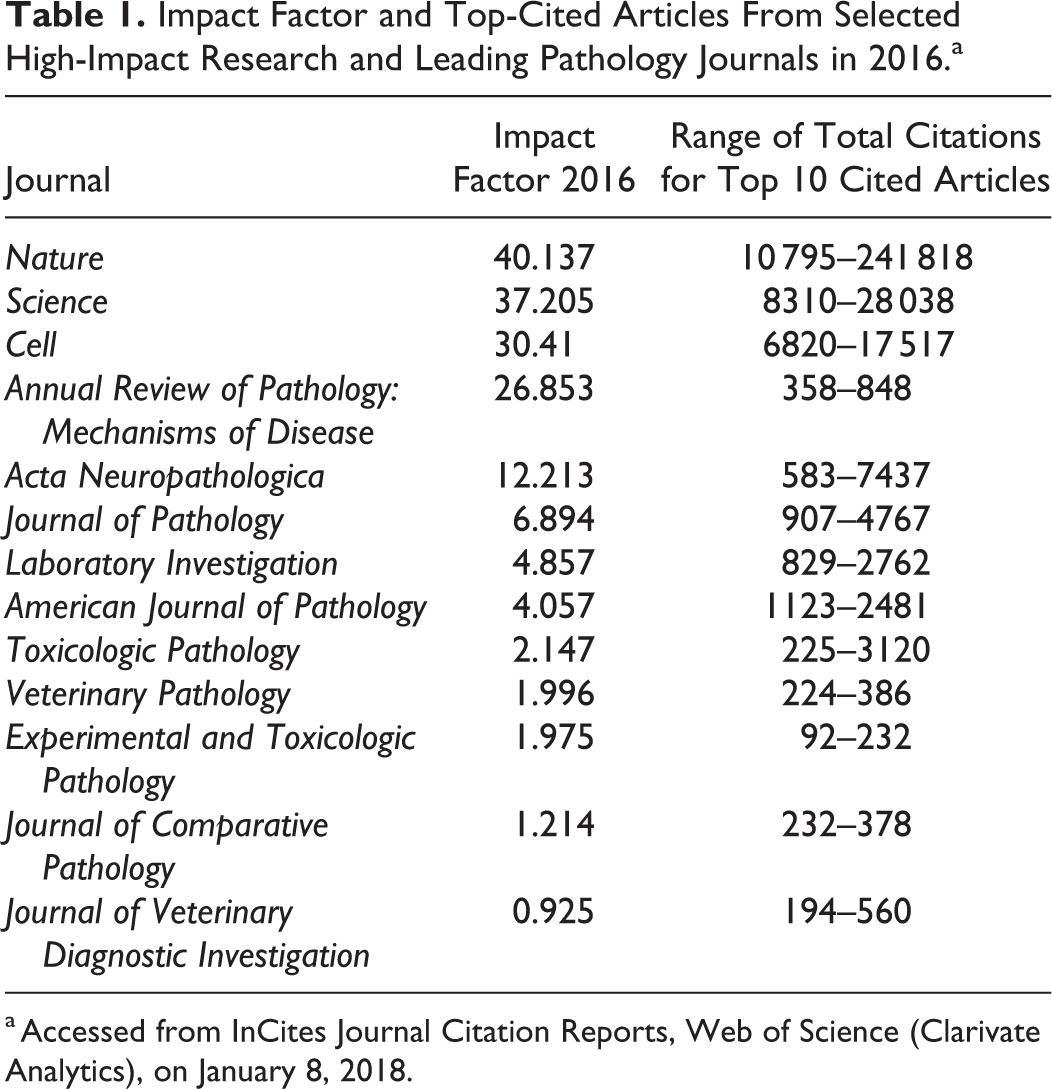
a Accessed from InCites Journal Citation Reports, Web of Science (Clarivate Analytics), on January 8, 2018.
Selected Top-Cited Articles Published on Veterinary Infectious Disease With Veterinary Pathologists as Coauthors.a
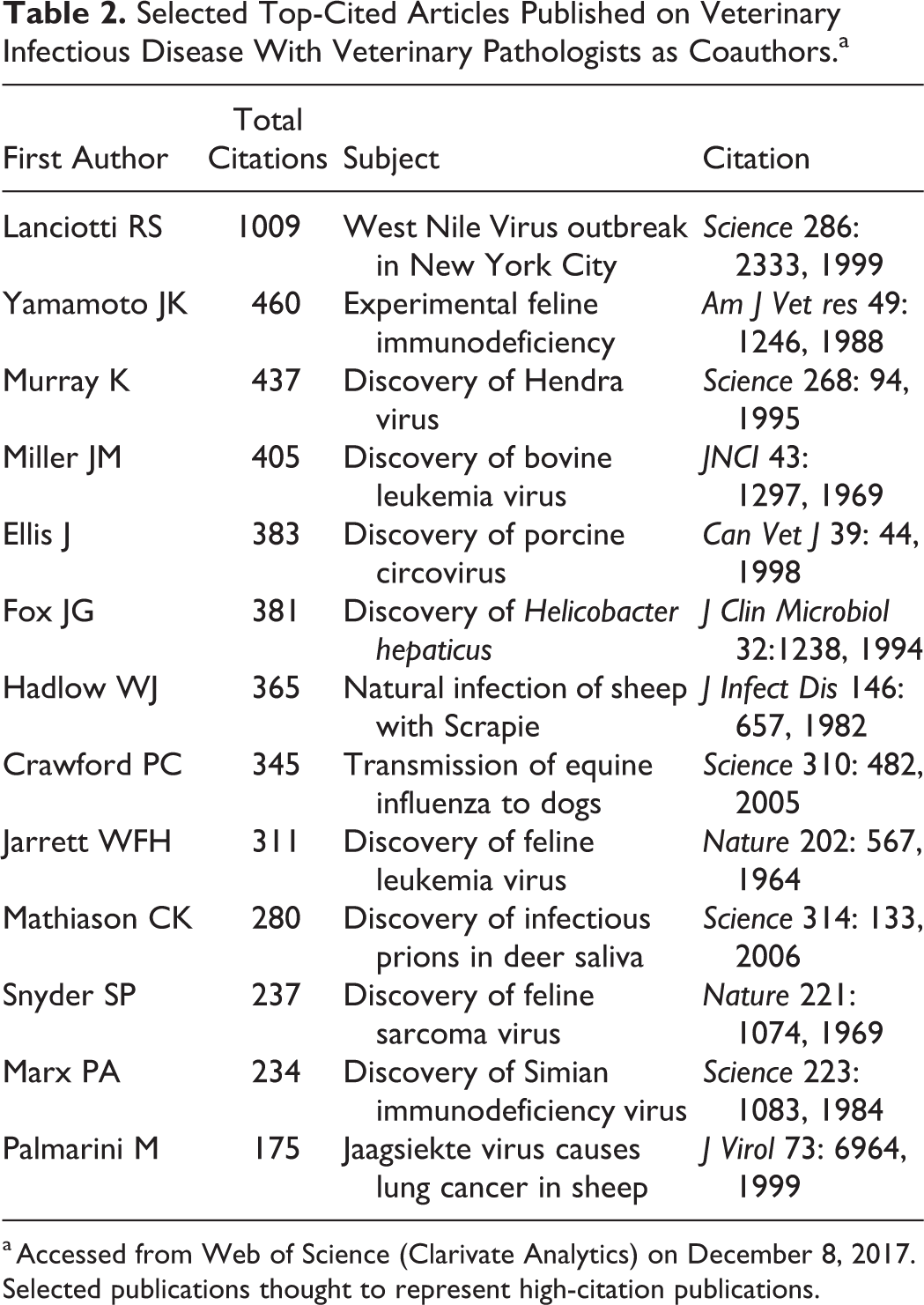
a Accessed from Web of Science (Clarivate Analytics) on December 8, 2017. Selected publications thought to represent high-citation publications.
Selected High-Impact Articles on Human Infectious Diseases.a
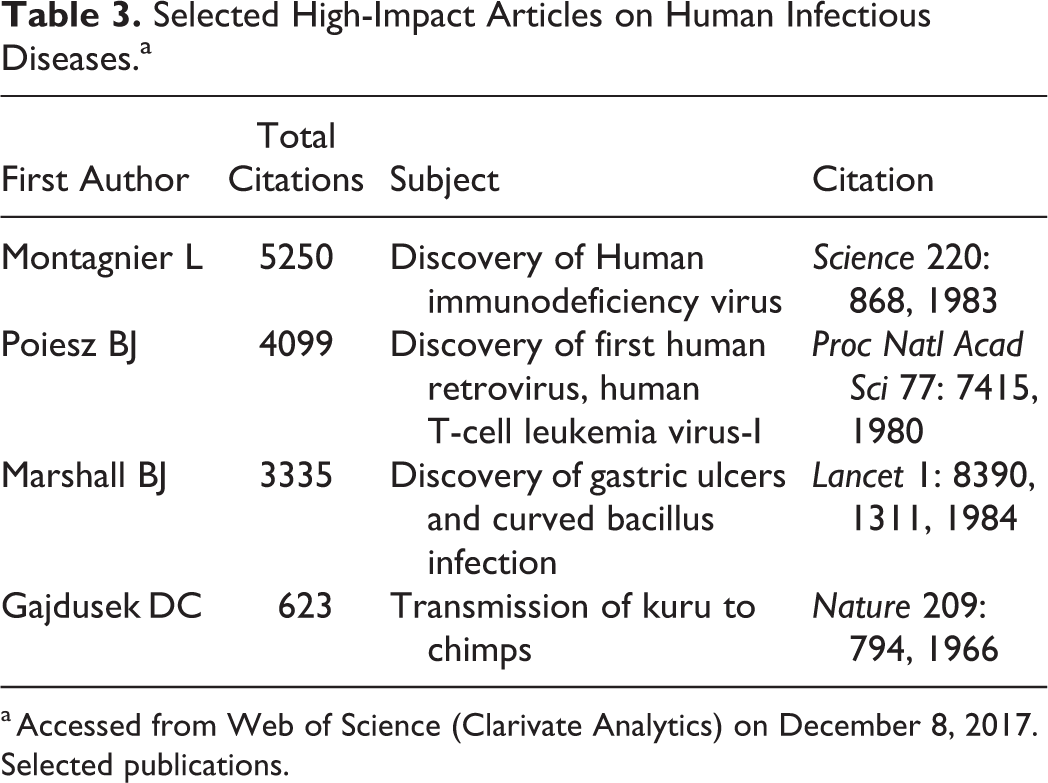
a Accessed from Web of Science (Clarivate Analytics) on December 8, 2017. Selected publications.
Top 10 Cited Veterinary Pathology Journal Articles.a
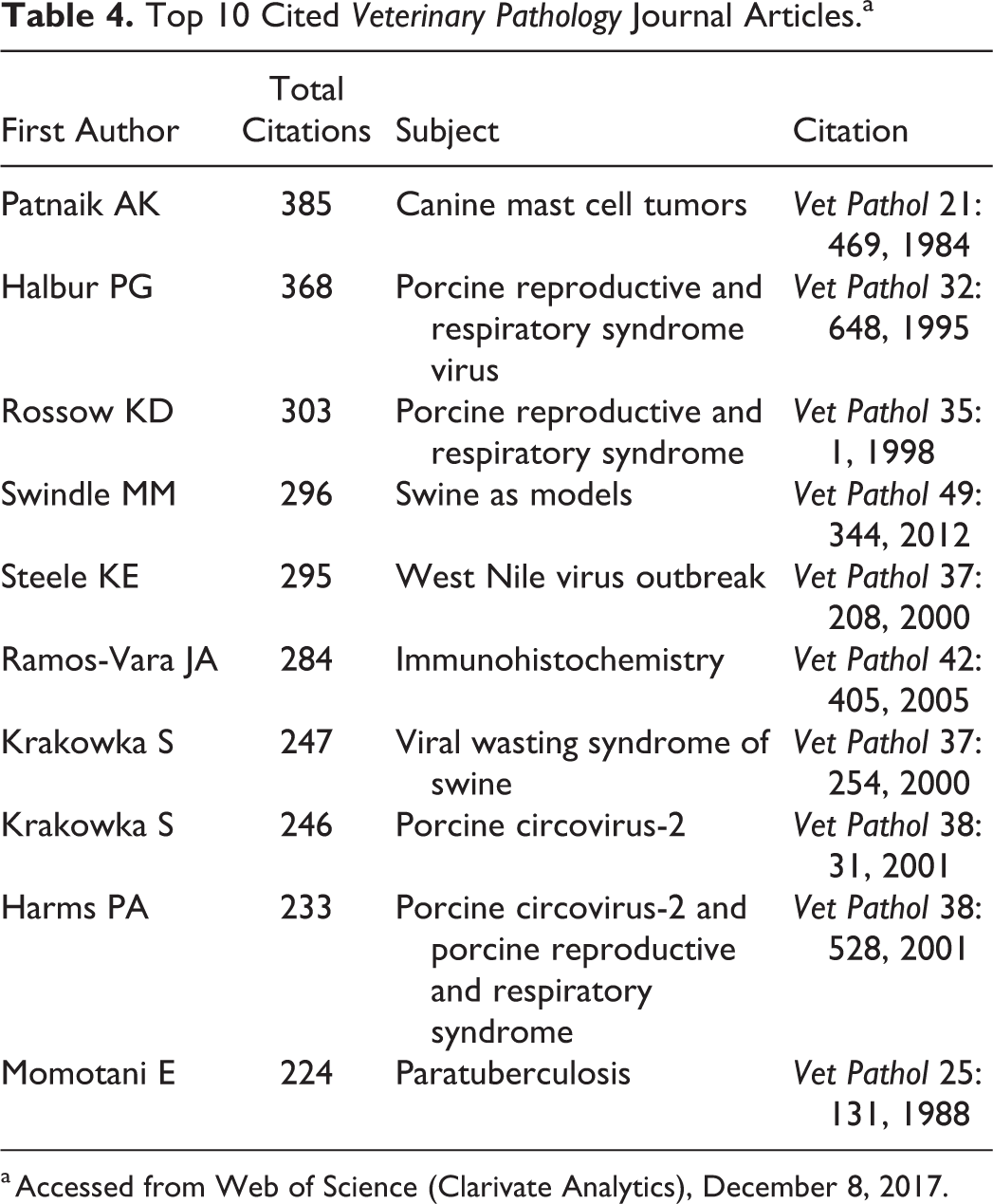
a Accessed from Web of Science (Clarivate Analytics), December 8, 2017.
Thus, we must recognize that the IF for veterinary pathology journals will never reach those of SCHIJ medical research journals. Even so, the IF for veterinary pathology journals does not have to even approach those levels. Veterinary Pathology is highly successful in our chosen fields of work and research as evidenced by its popularity in veterinary pathology throughout the world and its rankings in the list of journals for veterinary science and pathology. Unfortunately, even some of our veterinary pathologist colleagues are often confronted by situations that require publication in a high-impact journal for promotion, tenure, and/or prestige. Despite this lack of a high IF, Veterinary Pathology will remain one of the most important veterinary pathology journals in the world and will continue to its mission of high-relevance papers to veterinary medicine, pathology, and “One Health” interests.
Footnotes
Declaration of Conflicting Interests
The authors declared the following potential conflicts of interest with respect to the research, authorship, and/or publication of this article: The authors are associate editors for Veterinary Pathology, but the publication of the letter was not solicited by the journal.
Funding
The authors received no financial support for the research, authorship, and/or publication of this article.